Tag Archives: age

Michael R. Burch, ‘How It Goes, or Doesn’t’

My face is getting craggier.
My pants are getting saggier.
My ear-hair’s getting shaggier.
My wife is getting naggier.
I’m getting old!

My memory’s plumb awful.
My eyesight is unlawful.
I eschew a tofu waffle.
My wife’s an Eiffel eyeful.
I’m getting old!

My temperature is colder.
My molars need more solder.
Soon I’ll need a boulder-holder.
My wife seized up. Unfold her!
I’m getting old!

*****

Michael R. Burch adds the disclaimer “that the poem is pure comedy and my wife Beth is an absolute jewel. I’m lucky to have her. (Rodney Dangerfield put me up to it!)”

Michael R. Burch’s poems have been published by hundreds of literary journals, taught in high schools and colleges, translated into 23 languages, incorporated into three plays and four operas, and set to music, from swamp blues to classical, 75 times by 34 composers. He is also the founder and editor-in-chief of The HyperTexts.

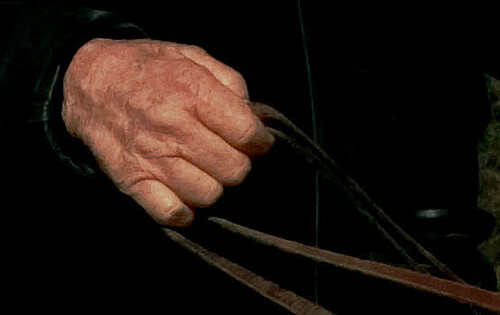
OLD old Man” by bixentro is licensed under CC BY 2.0.

Using form: Villanelle: Rachel Hadas, ‘However Cool’

However cool X may have thought he was
made very little difference in the end.
We are transformed as we approach the close.

Everyone is subject to these laws.
Ozymandias collapsed in sand,
however cool he may have thought he was.

We live in structures—marriage, job, or house—
steered steadily toward an unknown land,
slyly transfigured as we near the close,

additions and subtractions dealt by whose
enormous unseen hand?
However cool Y may have thought Z was,

her freshness faded like a poet’s rose,
malady no medicine can mend
disguising her before she reached the close.

Think of it as time; a veiled command;
a principle: I do not give. I lend.
However cool we might have thought A was,
we all are changed as we approach the close.

Rachel Hadas writes: “The villanelle ‘However Cool’ was occasioned by a conversation with a friend; she and I were talking about a mutual acquaintance who was ill, and my friend uttered a perfect iambic pentameter line which became the first line of the poem, as well as, with variation, one of the repeated lines.  It was fun to keep switching initials – the “however cool…” downward arc applies in different ways to so many people.

“A.E. Stallings has commented that villanelles are more fun to write than to read, and she may have a point.  At this point in life, I certainly find them easier to write than sonnets. But I hope there’s a bit of rueful fun to be had in ‘However Cool’.”

Rachel Hadas’s recent books include Love and Dread, Pandemic Almanac, and Ghost Guest. Her translations include Euripides’s Iphigenia plays and a portion of Nonnus’s Tales of Dionysus. Professor Emerita at Rutgers-Newark, where she taught for many years, she now teaches at 92Y in New York City and serves as poetry editor of Classical Outlook. Her honors include a Guggenheim fellowship and an award from the American Academy-Institute of Arts and Letters.

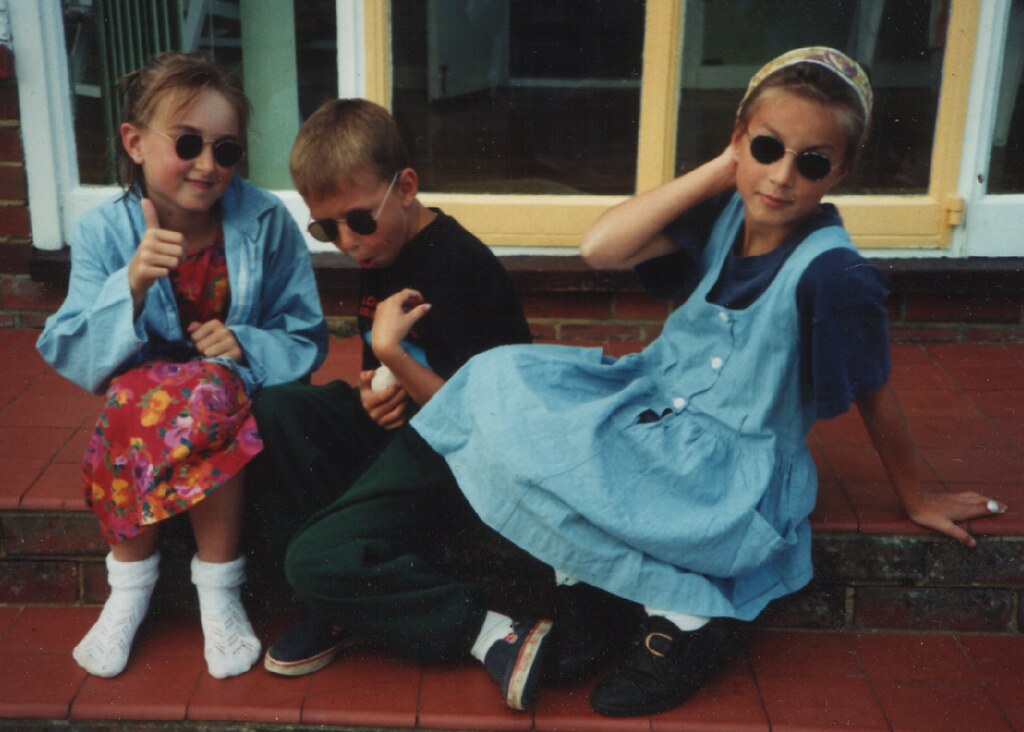
Photo: “cool for kids – summer holidays” by oddsock is licensed under CC BY 2.0.

RHL, ‘In the Spring’

In the spring, an old man’s fancy
ruefully reviews his youth;
thinks of girls both past and present,
wonders can he hide time’s truth.

His always googly gardening eyes
all ever which ways scan and glower
at the bud-bursting blossoming girls
exploding in their flower of power.

What is this green and noisy growth
that’s flourishing, fresh and unkempt?
Old’s good, so’s young… could one be both?
O Fates! from fate make me exempt!

*****

‘In the Spring’ was published in Bewildering Stories, an online weekly of Speculative Fiction, Poetry, Art, etc. Thanks, Don Webb!

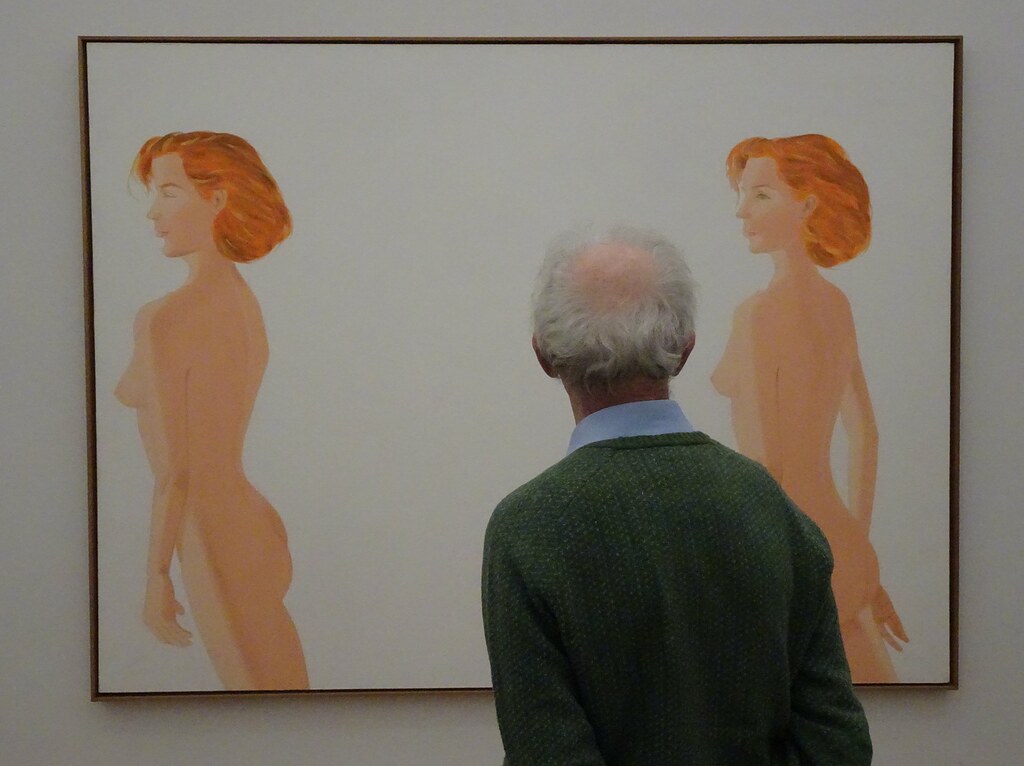
at the museum” by derpunk is licensed under CC BY-NC-SA 2.0.

Using form: Quatrains with refrain: Jerome Betts, ‘Plus ça change. . .’

If, as a child, he had a spreading rash,
The squitters, then, far worse, was constipated,
Or boasted big blue bruise and graze and gash,
A doctor murmured, “Yes, it’s age-related.”

When, in mid-life, and seeking novel thrills,
He got a dose of something best not stated
So had to suffer jabs and bitter pills,
A doctor murmured, “Yes, it’s age-related.”

Come his declining years, which tax most brains,
His wits would wander, now grown antiquated,
And while he rambled down his memory’s lanes
A doctor murmured, “Yes, it’s age-related.”

Until, one day of flowers and muffled peals,
Cause of demise at last certificated,
As up the aisle he rolled, worm-food on wheels,
A doctor murmured, “Yes, it’s age-related.”

*****

Jerome Betts writes: “Hearing a phrase new to you can start some process in the brain leading toa piece of verse. Here it was my GP saying of some minor ailment It’s age-related. It stuck in my mind, and I think triggered a recollection of a Thomas Hood poem, The Doctor, its seven stanzas all ending with the refrain Yes, yes, said the Doctor, / I meant it for that!, the dodgy physician’s unvarying response to reports of the disastrous effects, even death, of his prescriptions. Not long after, the sight of a hearse on wheels rather than on bearers’ shoulders entering a Devon church provided the idea for the last stanza of this essay in black humour which appeared in Snakeskin.

Jerome Betts lives in Devon, England, where he edits the quarterly Lighten Up Online. Pushcart-nominated twice, his verse has appeared in a wide variety of UK publications and in anthologies such as Love Affairs At The Villa NelleLimerick Nation, The Potcake Chapbooks 1, 2 and 12, and Beth Houston’s three Extreme collections. British, European, and North American web venues include Amsterdam QuarterlyBetter Than StarbucksLightThe Asses of ParnassusThe HypertextsThe New Verse News, and  Snakeskin.

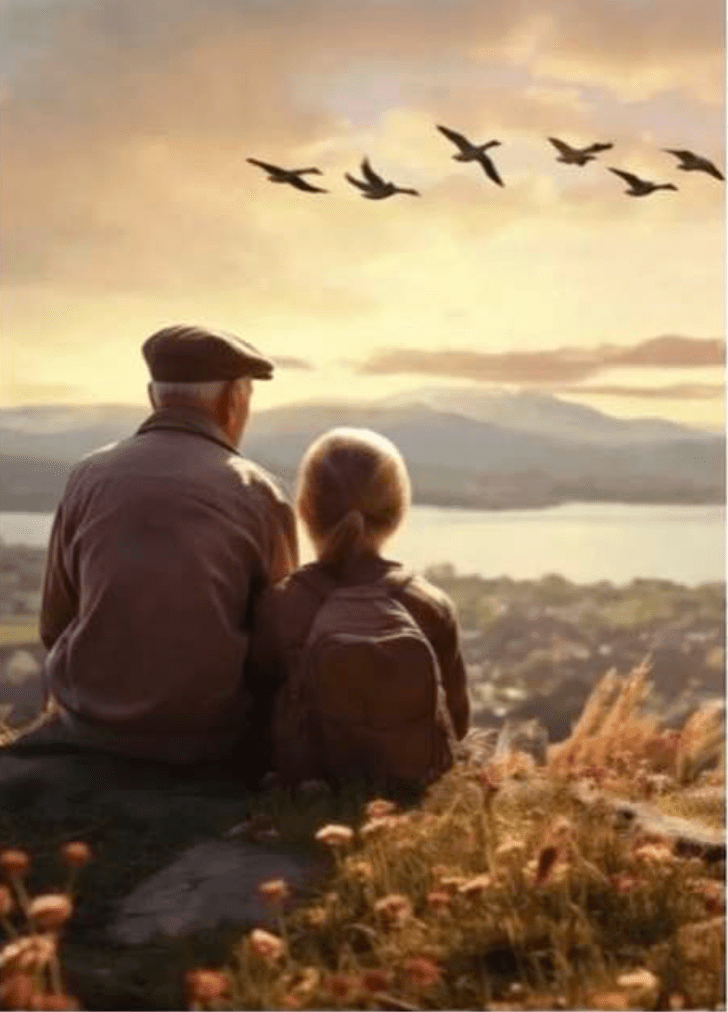
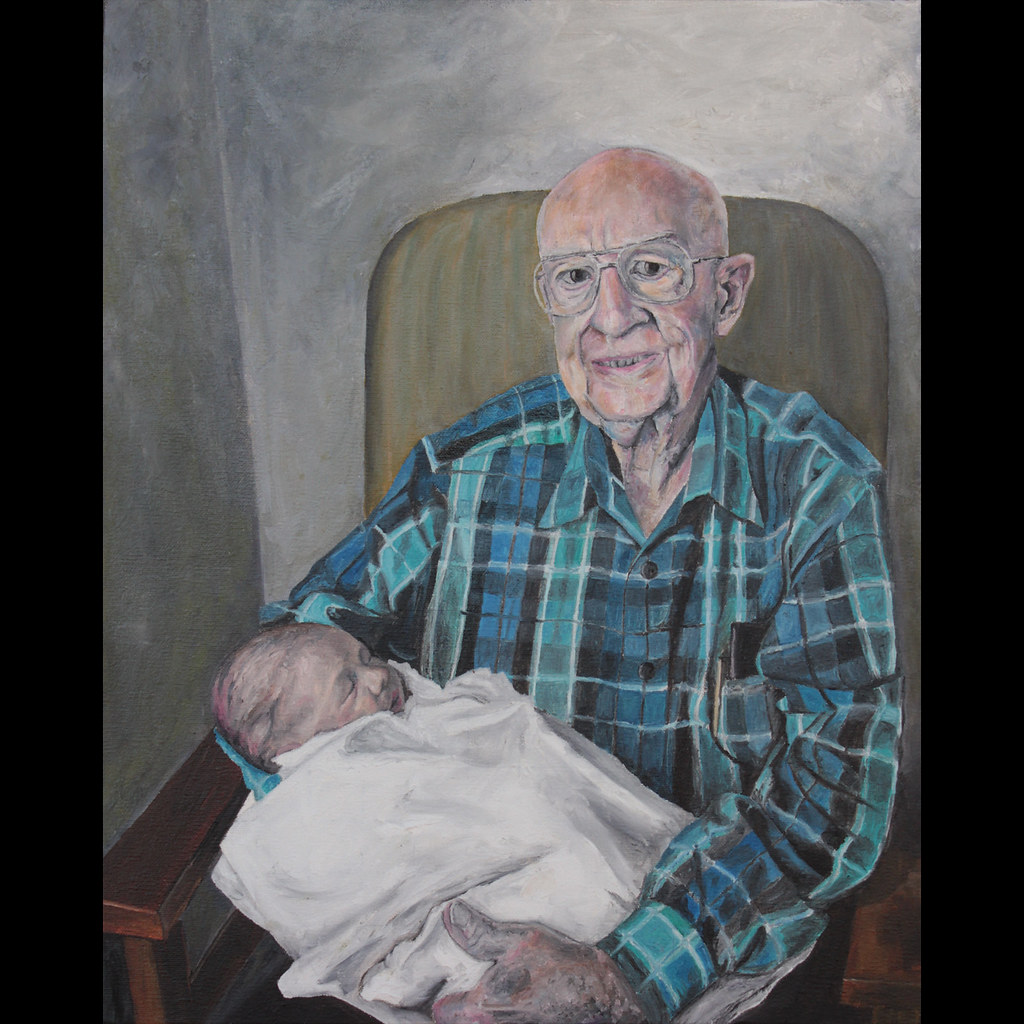
Illustration: “Great Grandfather and Child” by Melissa Flores is licensed under CC BY-NC-ND 2.0.

Richard Fleming, ‘In Grace’

The present is arcane and strange
and any recollection left
of what has happened in the past
is vague and liable to change.
Of future plans, he is bereft,
for nothing now is hard and fast.

They give him multicoloured pens
and paper, as one might a child.
Familiar voices interweave.
He sees, through a distorting lens,
people who wept, people who smiled,
that, one by one, stood up to leave.

He is content. He lives in grace.
What matter if the moments blur,
if his nocturnal thoughts are grim?
He has escaped himself: his face,
a kind of absence in the mirror,
comforts and somehow pleases him.

*****

Richard Fleming writes: “Getting old is like exploring new territory without a map: nothing prepares you for the subtle changes in body and mind. Is a moment of forgetfulness just that, or an early indication of approching dementia? We cannot know what strange highways a decaying brain takes us down but I like to think that they might lead to a place of contentment, where the burdens of age are laid down and replaced by some measure of contentment. That’s what I’ve tried to capture in this poem.”

Richard Fleming is an Irish-born poet (and humorist) currently living in Guernsey, a small island midway between Britain and France. His work has appeared in various magazines, most recently Snakeskin, Bewildering Stories, Lighten Up Online, the Taj Mahal Review and the Potcake Chapbook ‘Lost Love’, and has been broadcast on BBC radio. He has performed at several literary festivals and his latest collection of verse, Stone Witness, features the titular poem commissioned by the BBC for National Poetry Day. He writes in various genres and can be found at www.redhandwriter.blogspot.com or Facebook https://www.facebook.com/richard.fleming.92102564/

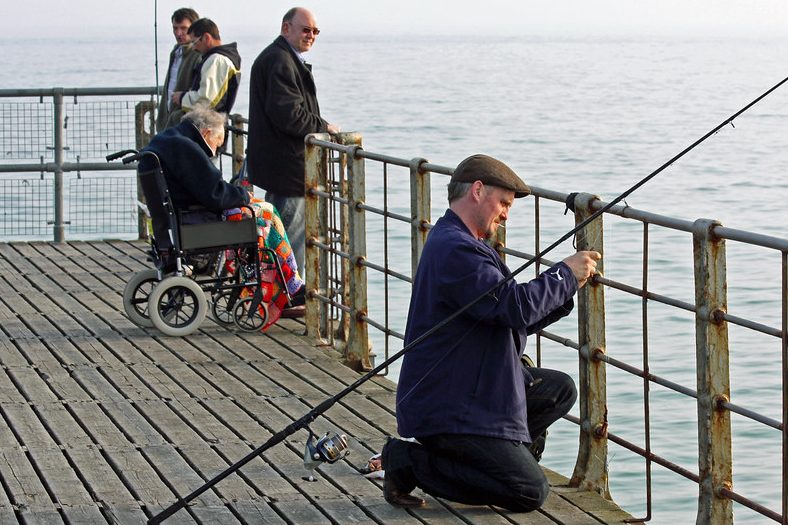
Photo: Richard Fleming post

Sonnet: Richard Fleming, ‘Sunny Afternoon’

Book discarded, like excess baggage shed
by someone who has rapidly pushed on
into uncharted regions far ahead,
he sleeps in an old deck chair on the lawn.
Gulls circle, skaters on an ice-blue lake,
while he dreams on, oblivious, his face
unshaded by a hat which, when awake,
he wears with equanimity and grace.
What does he dream? Is the unreal more real
than those pale gulls that spiral high above?
In sleep, has youth returned? No longer frail,
does he relive time when impatient love
was everything and all his heart desired,
before life tricked him, left him old and tired?

*****

Richard Fleming writes: “I suppose Sunny Afternoon reflects my own station in life, that is, drifting steadily towards the end, with the usual collection of regrets that most of us have.”

Richard Fleming is an Irish-born poet (and humorist) currently living in Guernsey, a small island midway between Britain and France. His work has appeared in various magazines, most recently Snakeskin, Bewildering Stories, Lighten Up Online, the Taj Mahal Review and the Potcake Chapbook ‘Lost Love’, and has been broadcast on BBC radio. He has performed at several literary festivals and his latest collection of verse, Stone Witness, features the titular poem commissioned by the BBC for National Poetry Day. He writes in various genres and can be found at www.redhandwriter.blogspot.com or Facebook https://www.facebook.com/richard.fleming.92102564/

Photo: posted by Richard Fleming

Weekend read: Marcus Bales, ‘Ambush’

You’re smiling, nodding, entering some room
Where what weight you once swung you swung for years,
Acknowledging this or that one, most of whom
Are people you politely call your peers.

And like the step you miss that wasn’t there
Kaboom: the rush returns. Awareness bursts
Enormously inside and out, the where
And when, the who and why, the lasts, the firsts.

Then no one listens as you start to speak,
And there’s another, higher, step you miss.
You squint, and almost hear the leather creak,
But readiness is all there is of this.

Your saddlebags and holsters do not rate.
There’s nothing to fight out of if you can.
The ambush turns, indifferently, to wait
For something more than you. Move on, old man.

*****

Editor: I like this poem as it is. However there appears to be more backstory, and Marcus Bales assembles the following: an excerpt from ‘Lonesome Dove’, and Daniel Keys Moran’s comments, and Marcus Bales’ own comments:

After a few minutes the empty feeling passed, but Call didn’t get to his feet. The sense that he needed to hurry, which had been with him most of his life, had disappeared for a space.
“We might as well go on to Montana,” he said. “The fun’s over around here.”

Augustus snorted, amused by the way his friend’s mind worked.

“Call, there never was no fun around here,” he said. “And besides, you never had no fun in your life. You wasn’t made for fun. That’s my department.”

“I used the wrong word, I guess,” Call said.

“Yes, but why did you?” Augustus said. “That’s the interesting part.”

Call didn’t feel like getting drawn into an argument, so he kept quiet.

“First you run out of Indians, now you’ve run out of bandits, that’s the pint,” Augustus said. “You’ve got to have somebody to outwit, don’t you?”

“I don’t know why I’d need anybody when I’ve got you,” Call said.

Even though he still came to the river every night, it was obvious to Call that Lonesome Dove had long since ceased to need guarding. The talk about Bolivar calling up bandits was just another of Augustus’s overworked jokes. He came to the river because he liked to be alone for an hour, and not always be crowded. It seemed to him he was pressed from dawn till dark, but for no good reason. As a Ranger captain he was naturally pressed to make decisions—and decisions that might mean life or death to the men under him. That had been a natural pressure—one that went with the job. Men looked to him, and kept looking, wanting to know he was still there, able to bring them through whatever scrape they might be in. Augustus was just as capable, beneath all his rant, and would have got them through the same scrapes if it had been necessary, but Augustus wouldn’t bother rising to an occasion until it became absolutely necessary. He left the worrying to Call—so the men looked to Call for orders, and got drunk with Augustus. It never ceased to gripe him that Augustus could not be made to act like a Ranger except in emergencies. His refusal was so consistent that at times both Call and the men would almost hope for an emergency so that Gus would let up talking and arguing and treat the situation with a little respect.

But somehow, despite the dangers, Call had never felt pressed in quite the way he had lately, bound in by the small but constant needs of others. The physical work didn’t matter: Call was not one to sit on a porch all day, playing cards or gossiping. He intended to work; he had just grown tired of always providing the example. He was still the captain, but no one had seemed to notice that there was no troop and no war. He had been in charge so long that everyone assumed all thoughts, questions, needs and wants had to be referred to him, however simple these might be. The men couldn’t stop expecting him to captain, and he couldn’t stop thinking he had to. It was ingrained in him, he had done it so long, but he was aware that it wasn’t appropriate anymore. They weren’t even peace officers: they just ran a livery stable, trading horses and cattle when they could find a buyer. The work they did was mostly work he could do in his sleep, and yet, though his day-to-day responsibilities had constantly shrunk over the last ten years, life did not seem easier. It just seemed smaller and a good deal more dull.
Call was not a man to daydream—that was Gus’s department—but then it wasn’t really daydreaming he did, alone on the little bluff at night. It was just thinking back to the years when a man who presumed to stake out a Comanche trail would do well to keep his rifle cocked. Yet the fact that he had taken to thinking back annoyed him, too: he didn’t want to start working over his memories, like an old man. Sometimes he would force himself to get up and walk two or three more miles up the river and back, just to get the memories out of his head. Not until he felt alert again—felt that he could still captain if the need arose—would he return to Lonesome Dove.

“Ambush” developed out of following Daniel Keys Moran on F*c*book. For some time now he has been posting about coming changes in his life, one of which is retirement from the work-force. My poem actually has no connection to his situation at all, apart from my also having retired. He was a much bigger deal, in charge of a lot more than I ever was, in any of my endeavors, but within my limits I was usually in charge of whatever small enterprises I participated in. I imagine the experience of going from being in charge to being supernumary   is about the same, internally, for everyone.

Moran posted the excerpt from McMurtry’s “Lonesome Dove” just recently, as, I inferred, a comment and possibly a reflection on his situation. It certainly resonated with me. Of course Call, the Captain in “Lonesome Dove”, and Moran, and the narrator of “Ambush” all have different situations and different reactions. But there is, I think a family resemblance.

*****

Not much is known about Marcus Bales except that he lives and works in Cleveland, Ohio, and that his work has not been published in Poetry or The New Yorker. However his ‘51 Poems‘ is available from Amazon. He has been published in several of the Potcake Chapbooks (‘Form in Formless Times’).

Photo: “Real Photo Hard Drinking Handsome Cowboys at the Deadwood Dick Saloon Studio Photograph RPPC AZO Stamp Box Hennesy Canadian Club Holland Gin Old Crow 2” by UpNorth Memories – Don Harrison is licensed under CC BY-NC-ND 2.0.

Short poem: RHL, ‘I Started Out Alone’

I started out alone,
No numbers and no words.
The people gave me food and clothes.
I loved the sun and birds.

And when I reach the end
Numbers and words all done,
Have to be fed and dressed again,
I’ll love the birds and sun.

*****

This is one of my favourite poems, for several reasons:
First, it extols the combination of curiosity, enjoyment and acceptance that I believe is appropriate for this thing called life.
Second, it is simple in expression: simple words, simple rhythm, in iambics with simple full and slant rhymes.
And third (and perhaps most importantly) it is easy to memorise: it has lodged itself in my brain without any effort or even intent on my part and, as this blog frequently claims, that is the essence of poetry.

‘I Started Out Alone’ was originally published in Bewildering Stories in 2019. More recently it was included in a batch of my poems that Michael R. Burch spotlighted in The Hypertexts for August 2024.

Photo: “Baby face” by matsuyuki is licensed under CC BY-SA 2.0.

Sonnet: Gail White, ‘The Way It Ended’

So time went by and they were middle-aged,
which seemed a cruel joke that time had played
on two young lovers. They were newly caged
canary birds – amused, not yet afraid.
A golden anniversary came around
where jokes were made and laughing stories told.
The lovers joined the laugh, although they found
the joke – though not themselves – was growing old.
She started losing and forgetting things.
Where had she left her keys, put down her comb?
Her thoughts were like balloons with broken strings.
Daily he visited the nursing home
to make her smile and keep her in their game.
Death came at last. But old age never came.

*****

Gail White writes: “Time is the strangest of the conditions we live in.  Scientists, essayists, and poets can ring endless changes on this theme.  Time has devastated the lives of the couple in this sonnet, but as Solomon told us long ago, love is as strong as death.”

Gail White is the resident poet and cat lady of Breaux Bridge, Louisiana. Her books ASPERITY STREET and CATECHISM are available on Amazon. She is a contributing editor to Light Poetry Magazine. “Tourist in India” won the Howard Nemerov Sonnet Award for 2013. Her poems have appeared in the Potcake Chapbooks ‘Tourists and Cannibals’, ‘Rogues and Roses’, ‘Families and Other Fiascoes’, ‘Strip Down’ and ‘Lost Love’. ‘The Way It Ended’ was first published in 14 by 14 (which has also ended…) and is collected in her chapbook, ‘Sonnets in a Hostile World‘, also available on Amazon.

Photo: “young couple being photographed at the beach” by phlubdr is licensed under CC BY 2.0.

Sonnet: RHL, ‘The Days Have Come Unhooked’

The days have come unhooked from passing time,
its little Brio trucks are off their tracks;
the past and future mix to make their rhyme,
with pieces placed at random in fresh stacks.
Clear memories blend their present, future, past.
The days stretch out, and yet the months fly by –
you turn in circles, facing first, not last.
As childhood deepens, old age pools go dry.
Behind its smoke and mirrors, whores and pimps,
its harshly lovely playful attitude,
reality is thinning – you now glimpse
an indescribable infinitude.
The game is won – your enemies are no more,
yet you don’t end it while you max your score.

*****

Published in the Spring 2024 issue of The Road Not Taken.

Photo: “Brio freight train set” by Ben Sutherland is licensed under CC BY 2.0.