Tag Archives: change

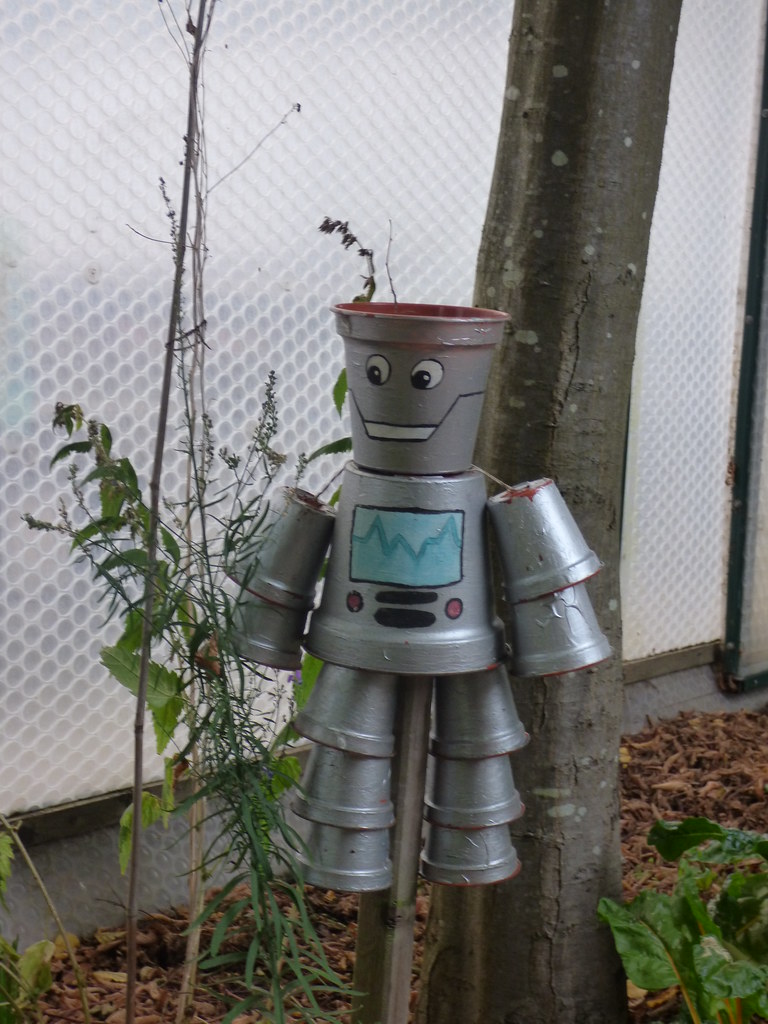
Sonnet: Felicity Teague, ‘Robot Dawn’

I sensed your rising in the paper years,
when I was sitting on the garden wall
to copy edit, through my teens. My fears
were few, back then, because the threat seemed small
and I still held the tools. My pencil case
contained my biros, red and royal blue,
my trusty ruler. And at quite a pace,
the work to trim and tidy would ensue,
just as required. But slowly, over time,
the paper-scape was lost to you, your screens,
your checks, your macros. Now, you’re in your prime,
you’re winning worlds of words with your machines,
while I am, we are, shrinking, dwindling, done,
deleted. Humans, zero; robots, one.

*****

Felicity Teague writes: “Due to the advance of the robots in my profession, I’m currently exploring other employment options. These are limited as I have severe and worsening autoimmune arthritis, but I really want to keep working for as long as I can.”

‘Robot Dawn’ was first published in Snakeskin.

Felicity Teague (Fliss) has featured in a number of poetry journals and has published two collections, From Pittville to Paradise (2022) and Interruptus: A Poetry Year (2025). Since April, she has put together the monthly metrical poetry showcase Well Met, and the November issue is here.

Photo: “Greenhouses – Castle Bromwich Hall Gardens – Silver robot potted man” by ell brown is licensed under CC BY-NC-SA 2.0.

Maryann Corbett, ‘To the Anti-Librarian’

Small vandal, parked on your padded bum
on a cheerful rug in the Children’s Section
next to a bottom shelf,
yanking the volumes one by one
till they strew the aisle in every direction,
loudly pleased with yourself
at the way your brightly patterned havoc
obstructs the traffic,

keep to your task. Disrupting order
is evolution’s eternal purpose.
Surely it’s been your goal
from the hour two gametes burst their border
and two tame selves went wild as a circus.
Systems that once felt whole
eyeballed each other, laughed, and gambled,
and lives got scrambled.

Do your worst, then, with giggles, rage,
and all the smackdown-loud rebellion
grown-ups are now too tired for.
These sleepless two, in a golden age,
were a black-clad goth and a hard-rock hellion.
Change is the charge we’re wired for.
small changer, blessings. Though elders frown,
pull the world down.

*****

Maryann Corbett writes: “Like many poems, this one (first published in LIGHT) is part memory and part pure fiction. “Anti-librarian” was our joke term for our daughter as an infant when (long years ago) she sat on her tush next to the bookshelves and pulled the books off just because she could. The image of young parents as reformed characters is imaginary. The hope that the young will change the world seems to be eternal.”

Maryann Corbett earned a doctorate in English from the University of Minnesota in 1981 and expected to be teaching Beowulf and Chaucer and the history of the English language. Instead, she spent almost thirty-five years working for the Office of the Revisor of Statutes of the Minnesota Legislature, helping attorneys to write in plain English and coordinating the creation of finding aids for the law. She returned to writing poetry after thirty years away from the craft in 2005 and is now the author of two chapbooks and six full-length collections, most recently The O in the Air (Franciscan U. Press, 2023). Her work has won the Willis Barnstone Translation Prize and the Richard Wilbur Award, has appeared in many journals on both sides of the Atlantic, and is included in anthologies like Measure for Measure: An Anthology of Poetic Meters and The Best American Poetry.

Picture: ‘Anti-Librarian’ by RHL and ChatGPT.

Richard Fleming, ‘In Grace’

The present is arcane and strange
and any recollection left
of what has happened in the past
is vague and liable to change.
Of future plans, he is bereft,
for nothing now is hard and fast.

They give him multicoloured pens
and paper, as one might a child.
Familiar voices interweave.
He sees, through a distorting lens,
people who wept, people who smiled,
that, one by one, stood up to leave.

He is content. He lives in grace.
What matter if the moments blur,
if his nocturnal thoughts are grim?
He has escaped himself: his face,
a kind of absence in the mirror,
comforts and somehow pleases him.

*****

Richard Fleming writes: “Getting old is like exploring new territory without a map: nothing prepares you for the subtle changes in body and mind. Is a moment of forgetfulness just that, or an early indication of approching dementia? We cannot know what strange highways a decaying brain takes us down but I like to think that they might lead to a place of contentment, where the burdens of age are laid down and replaced by some measure of contentment. That’s what I’ve tried to capture in this poem.”

Richard Fleming is an Irish-born poet (and humorist) currently living in Guernsey, a small island midway between Britain and France. His work has appeared in various magazines, most recently Snakeskin, Bewildering Stories, Lighten Up Online, the Taj Mahal Review and the Potcake Chapbook ‘Lost Love’, and has been broadcast on BBC radio. He has performed at several literary festivals and his latest collection of verse, Stone Witness, features the titular poem commissioned by the BBC for National Poetry Day. He writes in various genres and can be found at www.redhandwriter.blogspot.com or Facebook https://www.facebook.com/richard.fleming.92102564/

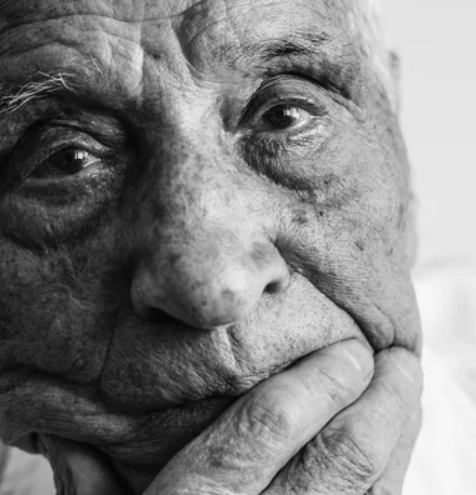
Photo: Richard Fleming post

Unrhymed sonnet: Peggy Landsman, ‘Shortly Before Another Winter Solstice in South Florida’

The seasons flow from much too hot to warm;
the moon balloons from farther south to north.
I struggle with myself to catch sunrise;
I shiver at sunset as darkness dawns.
Two clouds drift by in stillness as in dream.
My mind makes small confessions in the dark.
I wander through this ordinary night
discovering new doubts about myself.
The weather of my moods, not too extreme;
the climate of my life in crisis blooms.
The winter days grow short; my life, too long.
My understanding pales beneath the moon.
We creatures who’ve evolved to change the world
have not evolved enough to change ourselves.

*****

Peggy Landsman writes: “It did take me quite a while to make the transition from Berkeley, California, but now, after twenty-one years in South Florida, I’m finally over my culture shock.
I love walking on the beach and swimming in the ocean when the water temperature is at least 80°. I love the birds I see more of here than in other places: ibises, egrets, herons, ospreys, pelicans, etc. And I get all the culture I need for free from my local public county library. If they don’t have a movie, cd, or book on their shelves, they order it through ILL (inter-library loan).
I spend most of my time writing and hanging out with my favorite other person. What more could any septuagenarian poet want?
Also: The poem was first published under the slightly shorter title “Before Another Winter Solstice in South Florida” in the Winter 2024 issue of The Orchards Poetry Journal. And, by the way, that’s a very friendly journal for formal poetry. Thanks, Karen and Jenna!”

Peggy Landsman is the author of the full-length poetry collection, Too Much World, Not Enough Chocolate (Nightingale & Sparrow Press, 2024), and three other books, including the poetry chapbook Our Words, Our Worlds (Kelsay Books, 2021). She lives in South Florida where she spends as much time as possible at the beach. To learn more about her and her work, visit: https://peggylandsman.wordpress.com/

Photo: “Walk on a Warm Beach” by justenoughfocus is licensed under CC BY-NC 2.0.

RHL, ‘The Sun is Always Setting’

The sun is always setting, always setting on your day;
you sense the dark approaching, wish that it would stay away.
Do you want a life unchanging? Wish to still be a newborn?
Don’t you know life’s not a rosebud, but has root and leaf and thorn?

The sun is always setting and the black drapes are unfurled;
but notice that the sun sets on your world, not on the world:
it’s rolling into brightness in another’s happy land,
and the dark is evanescent and the brightening is grand.

The sun is always setting on the dinosaurs, but birds
are flocking into being, as are Serengeti herds;
and the sun that lights humanity? Of course it’s going to set,
and elsewhere light new tales of which we’ll just be a vignette.

The sun is always setting, but that view is just your choice;
I say the world is turning and evolving; I rejoice.

*****

Sometimes I’m told that my poetry is too bleak. But I think that’s only so if you want everything to stay as it is now. If, on the other hand, you expect change, and that change will ultimately provide more benefit than loss to the universe as a whole, then <shrug>… so it goes.

This poem has 14 lines but is hardly a sonnet. It was recently published in Pulsebeat Poetry Journal. Thanks, David Stephenson!

Photo: “Sunset Sadness” by BaboMike is licensed under CC BY-NC 2.0.

Non-traditional sonnet: RHL, ‘The Range of Change’

In times of no change, the advantage lies
with those who are receptive to being taught.
Parents and teachers may seem truly wise,
avoiding dangers with which life is fraught;
the stories of the old none would despise
when they hold all the answers that are sought.

In times of constant change, advantage shifts
to those who, hating school, go and explore.
Old answers fail. Fresh questions cause great rifts
with parents who are seen as wise no more;
questions now turn up unexpected gifts
in crossing unknown seas to virgin shores.

Remain alert that there’s a range of change
from none, to gradual, to fast, to strange.

*****

A sonnet, or not? 14 lines of iambic pentameter, rhyming regularly and with a final couplet. Though not in either of the standard English forms, it has the organised, compressed, reflective sense of the sonnet. Recently published in Shot Glass Journal, Online Journal of Short Poetry. Thanks, Mary-Jane Grandinetti!

Climate change icon” by Tommaso.sansone91 is marked with CC0 1.0.

Potcake Poet’s Choice: Vadim Kagan, ‘You Are Changing’

You are changing from day to day
And from night to night
You are changing before I say
Let there be light
You are changing your smile, your hair
And even your eyes
You are changing what isn’t there
Making truth of lies

You are changing the coins you bet
And the games you win
You are changing what has been set
Outside and in
You are changing from old to new
And again to old
You are changing all that we knew
But were never told

You are changing along the way
And across the sea
You are changing the things that may
Be the last we see
You are changing your blood to sweat
And yourself to me
So keep changing but don’t forget
How it used to be

Vadim Kagan writes: “Life is all about changes. People change, countries change, the world changes. Are we walking in circles or are we ascending (or descending) some universal helix? Opinions differ but as I got older I realized that to me it matters less where we are going than where we came from. This poem was written during a tumultuous time in my life, when I realized that, no matter how well I try to plan,  tomorrow will be different from what I imagined. The poem was, in a way, a kind of therapy – and is probably even more relevant than several years ago. It is also more musical than many of my poems, and made a great (if little known) song.”

Vadim Kagan writes poetry and prose in English, Russian and, occasionally, a combination of both languages. He runs an AI company in Bethesda, MD and is a member of the DC Poetry Collective. His poems have been published in The Lyric, The Road Not Taken, Founder’s Favorites, DC Poetry Collective Inkblots anthologies and the latest Potcake Chapbook, ‘Lost Love’. He often posts on Facebook (@vadimkagan) and Instagram (@wines_and_rhymes.)

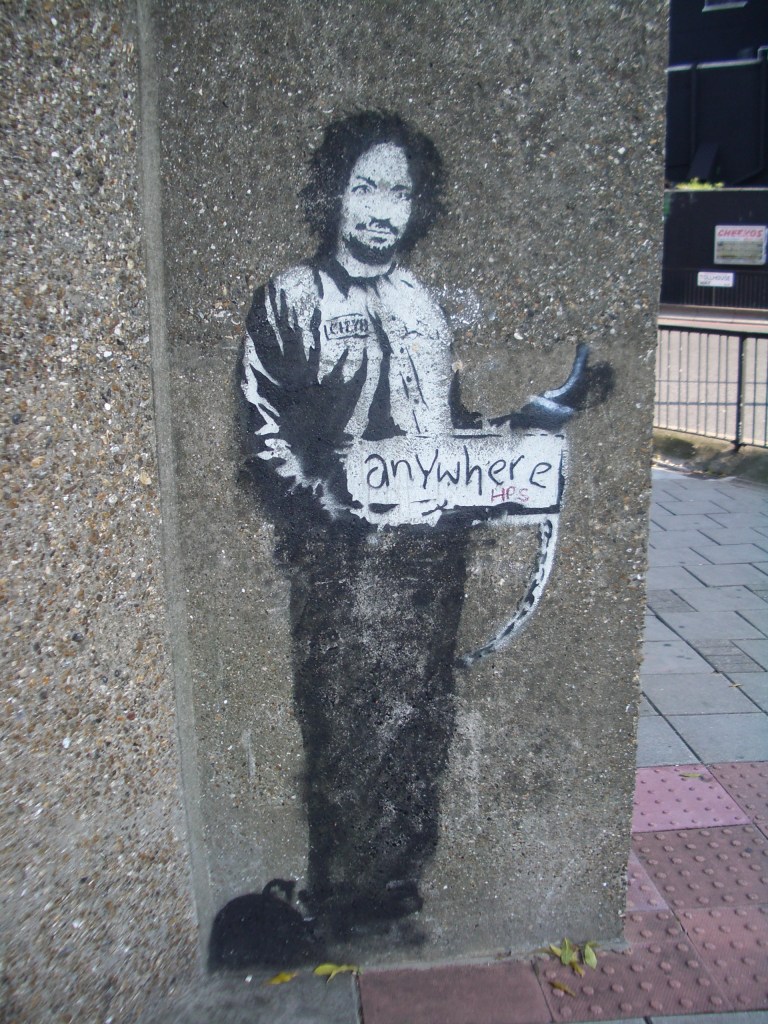
Short poem: ‘Remember’

Remember the whole world’s in your range,
When all your strength is gone.
If you can’t accept, then rearrange;
Can’t rearrange, move on.

I wrote this little poem when I was a very unsettled and directionless 20-year-old, and I lived by its tenets for several years, constantly changing jobs, countries and relationships. Eventually I slowed down, only changing jobs, countries and relationships once every few decades. But I still hold to the principle that you have no obligation to stay in an unsatisfactory situation, that you should actively try to identify what makes you happiest at the deepest level and then change your life in that direction. And sometimes random change is an appropriate if temporary solution.

This poem was finally published, decades later, in The Asses of Parnassus.

Photo: “File:Banksy Hitchhiker to Anywhere Archway 2005.jpg” by User:Justinc is marked with CC BY-SA 2.0.

Poem: ‘Advances in Personal Care’

1700 BCE
A length of fibre to extract a tooth –
a flint to decorate yourself with scars –
a large, strong thorn to make holes for tattoos –
an oyster shell to scrape off excess hair…
so health’s improved and beauty is accented.

1700 CE
High heels and wig show stature, vigour, youth;
a monocle improves both look and looking.
How we’ve advanced, compared to ancient times!
Some say there’ll be advances still to come,
but how, when all’s already been invented?

This poem is a riff on a 19th century joke. Charles H. Duell, the Commissioner of US Patent Office in the late 1890s, is widely quoted as having stated that the patent office would soon shrink in size, and eventually close, because “Everything that can be invented has been invented.” (In fact Duell said in 1902: “In my opinion, all previous advances in the various lines of invention will appear totally insignificant when compared with those which the present century will witness. I almost wish that I might live my life over again to see the wonders which are at the threshold.”) But the joke appears to have had earlier incarnations in the 19th century in Punch magazine and elsewhere, presumably as the world was adapting to the reality of life changing more and more rapidly.

The poem is in iambic pentameter, but the only rhymes are between the two verses: the first lines of each and the last lines of each. But I feel that produces enough echo to make it sound adequate. My thanks to Bill Thompson for including it in the Alabama Literary Review – ALR 2021.

Photo: “France-001560 – Louis XIV” by archer10 (Dennis) is licensed under CC BY-NC 2.0

Poem: ‘Dreams’

In the back alleys of our nightly dreams-–
Where cartoon murders repay debts of grudge,
And all’s not graspable nor as it seems,
And logic leers, then sneers and disappears,
And our warped lusts of power, sex and pain
Live stray cat lives, are killed, and live again
To yowl and fight, to scavenge, hunt, give birth-–
We overlay fresh civilized veneers
On age-old dynamos of massive girth.
So the thin skin of life upon the Earth
Cannot restrain the molten mass beneath
(Driving relentless change despite crust’s sheath),
Till, trampled and forgotten in the sludge,
Our empires are mere broken plastic toys.
Dreams run from us like cats from evil boys.

Dreams, the unconscious, one’s Muse… cats, ravens, the Earth… time and timelessness, change and continuty… so many of these ideas return again and again, always the same, always differently organised, a true kaleidoscope. And this isn’t a sonnet–too many lines, no pattern to the rhymes–even if it sort of feels like one; it’s more of a kaleidoscope itself.

This poem was first published in The Lyric. As far as I remember, its editor wanted the removal of the word “on” from the ninth line; they thought this improved the scansion, and the editor is always right so I allowed it. But I’ve put it back now, anyway.

“My cat running away from the camera #cat #iphone #cats” by gargudojr is licensed under CC BY-SA 2.0