Tag Archives: childhood

Rondeau: Political Poem: J.D. Smith, ‘Citizen Vain’

Who burned his sled? That would explain
The wisps of hair coiffed like a mane,
The name writ large on thrusting towers,
His rating of his works and powers.
Who wouldn’t take up his refrain?

A loser, say, without a brain
And envious he can’t obtain
Fresh wives imported like cut flowers.
(Who burned his sled?)

A nation may endure a reign
Of fire once tended with some pain
Outlasting its appointed hours
Yet starved, for all that it devours.
The question holds fast like a stain–
Who burned his sled?

*****

J.D. Smith writes: “I try not to say or write the name of the moral homunculus who is currently the 47th President of my country, lest my words get entangled in his omnipresent branding. That said, in verse I have occasionally renounced him and all his works. This poem was first published during the 2016 primary season, when speculating on how that troubled and troubling man became that way was still an interesting parlor game with low stakes. While others with credentials in psychology have discussed his origin story, perhaps most notably in this book, as a poet I gravitated toward metaphor. As some will ask a badly behaved person “Who broke you?” or “Who hurt you?”, I began to wonder ” Who burned his sled?” in the sense of some analog to the loss of Charles Foster Kane’s sled Rosebud in Citizen Kane. What early personal trauma made the current collective trauma possible?”

J.D. Smith’s seventh collection of poetry, The Place That Is Coming to Us, was published in September by Broadstone Books. His first fiction collection, Transit, is available from Unsolicited Press. Further information and occasional updates are available at www.jdsmithwriter.com.

Photo: screenshot from that unbelievably offensive AI-generated video that Trump posted of himself as King Trump in a King Trump fighter-jet, bombing American protesters with his diarrhoea.

Sonnet: Rick Mullin, ‘Shrine to Satan’

The neighbor’s child has built a muddy shrine
to Satan in our yard. And I’m supposed
to cut the lawn? OK, but look at those
croquet clubs that she used (good God, they’re mine)
to pound her pentagrams of chicken bone
into the ground. The handles are unscrewed
from all the hammer heads. It’s kind of shrewd
the way she placed that PlayskoolTM telephone.

Still, little girls should not touch garden tools
or take the plastic rake out of the shed–
she’s tied it with those jump ropes to the tree.
A shattered flower pot. The Barbie head.
Horrific how this child has learned the rules
of Belial for sculpting in debris.

*****

Rick Mullin writes: “The little girl, A., is a friend of our family and was one of three girls that spent most days playing in our yard. One day they split up, each doing their own thing in their own corner of the yard. The Shrine to Satan, as I called it, was crafted by A. The architect of the horror described in this poem is getting married today.”

Rick Mullin’s poetry has appeared in various journals and anthologies, including American Arts Quarterly, Measure, The New Criterion, The Dark Horse, The Raintown Review, Epiphany, and Rabbit Ears: TV Poems. ‘Shrine to Satan’ is from his chapbook “Aquinas Flinched”, Exot books, 2008. His books include Soutine and Sonnets from the Voyage of the Beagle (Dos Madres Press, 2012 and 2014), Lullaby and Wheel (Kelsay Books, 2019), and Huncke (second edition, Exot Books, 2021). He is a painter and retired journalist living in northern New Jersey. His website is rickmullin.com and his art blog is onlyofobjects.wordpress.com

Photo: “Little girl playing with a kitten and dolls.” by simpleinsomnia is licensed under CC BY 2.0.

Weekend read: Semi-formal: Darlene Young, ‘Sisters’

for Marilyn

Litter mates. Glitter mates. Mirror
of what you hate, what you adore
about yourself. Sleep together on the floor.
Giggles and snorts, kicks, forts
of chairs and furry blankets. Fury. Tangle.
Tussle and brush. Braid and wrangle, pulling hair;
it’s just not fair. One of you is picked.
Not it! On your mark, get set and go! Kicked
gameboards; slam and pout. Crossing the street
when the mean dog is out. I dare you.
A secret meeting place under the willows
against the fence. Sheets and pillows.
Toothbrushes, blood, things buried in mud.
All-ee, All-ee in free! Quit looking at me.
Canned peaches, cold beaches. You
and not-you;
anyone but you.

So sick of that piano song! Scented
markers. Shotgun! Wishing she was anyone.
Wanting to be anyone. Else. Lure the cat
to your lap from hers, pointing out
how loud he purrs. Making cookies.
Making up. Stealing make-up. Just shut up.
Together, bang the pots on New Year’s.
Pretend that you don’t hear her tears. Her
bad boyfriend that you hate. And yours.
Get home late. Will you, won’t you? Tattle-tell.
Pounding on the bathroom door, shirt that’s wadded
on the floor. You,
not you.

Share a mattress in the tent,
trees and stars and what you meant.
The thrilling doorbell. That weird noise
she makes in her throat. You both finish
the movie quote. Belting songs in underwear,
saying that you love her hair. Midnight soda run,
car windows down—U2 blasting to the edge of town.
Knowing look, shared favorite book,
all the things
you’ll always keep.
Someday, you’ll rock her child to sleep.

*****

‘Sisters’ was published in New Verse Review, and nominated for a Pushcart Prize. Darlene Young writes: “I’ve been blessed with two radiant, hilarious, gifted sisters. The one closest to my age has been battling cancer this year, something that took our mother when we were in our early twenties. I wrote this poem in honor of her, her courage, and all she has meant in my life.”

Darlene Young is the author of three poetry collections (most recently, Count Me In from Signature Press, 2024). She teaches writing at Brigham Young University and has served as poetry editor for Dialogue and Segullah journals. Her work has been noted in Best American Essays and nominated for Pushcart Prizes. She lives in South Jordan, Utah. Find more about her at darlene-young.com and @darlylar.

Photo: Darlene Young and her sister.

RHL, ‘Boy With Scab’

The boy he’s always been still takes delight
In testing scabs on elbows, knees,
To see if fingernails can assert their right
To lift with satisfying ease
The lid from off the mystery healing box
And see the flesh beneath the skin
Where the wise body-mind slowly unlocks
Corpuscles and white pus within.
The hint of pain, like some itch that you scratch,
Is fun alongside look-and-see.
What does the boy do with that useless patch,
The scab? Easy: autophagy.

*****

Curiosity is a useful aspect of intelligence. This poem first published in Lighten Up Online (aka LUPO). Thanks, Jerome Betts!

Photo: “War Stories” by Noël Zia Lee is licensed under CC BY 2.0.

Terza Rima: Louise Walker, ‘The Swing’

I hold you on my lap; I think you’re dead.
Next to us hangs a rusty, creaking swing.
I look down as my white dress blooms with red.

Such fun to pull the seat right back, then fling
it free. You’re two, I’m four, so I’m to blame;
now I’m screaming bloody murder to bring

someone to the garden to witness my shame
where swaying grimly like a tolling bell
the swing is the proof of the deadly game.

It’s a story my mother liked to tell
while tracing the faint white mark on your brow:
how she found me soothing you after you fell.

The truth is, I can’t remember why or how
I hurled that dead weight directly at you.
Did she wonder at all, as I do now

if I pushed it so hard because I knew
the swing’s unpredictable to and fro
showed love and jealousy can both be true?

You never reproached me, but even so
I still bear the scar of that reckless throw.

*****

Louise Walker writes: “The Swing was my second effort at writing a poem in terza rima; my first was a complete disaster, written in response to an assignment set by Cahal Dallat during a course I did with Coffee-House Poetry earlier this year. That novice attempt followed the rules of the form perfectly, with 3-line stanzas rhyming aba  bcb  cdc   ded  efe fgf gg. However, my poem was pompous, stilted and vacuous. It also took me an entire day. The next morning, a memory from early childhood came to me and I thought I would try terza rima one more time. To my surprise (and joy!) the poem called ‘The Swing’ came very quickly, was a pleasure to write and didn’t require my usual endless revisions and tweakings. What’s more, I found that the terza rima form became a little engine for generating my poem – for example, searching for a rhyme for ‘you’ threw up the word ‘fro’ which made think of the swing as a metaphor for the oscillating feelings of a child when a younger sibling arrives. I also found that the chain-like effect of the form, swinging back for rhymes, and then forward, suited the subject matter perfectly. Deep in my subconscious, the terza rima form had been working its magic overnight!

I was not at all delighted to get the terza rima assignment at first, but I learnt such a valuable lesson: sometimes one has to write a really bad poem to be able to write a decent one. ‘The Swing’ became an important poem in my recent debut collection ‘From Here to There’ published by Dithering Chaps, which has at its core my journey from childhood, through the death of my brother in our twenties, then onwards.”

Louise Walker was born in Southport and now lives in London. After reading English at Magdalen College, Oxford, where she was a member of the Florio Society, she taught English for 35 years at girls’ schools. Her work has been published in journals such as Acumen, Oxford Poetry, South, Prole and Pennine Platform. Highly Commended in the Frosted Fire Firsts Award and longlisted in in The Alchemy Spoon Pamphlet Competition, in 2023 she was shortlisted in the Bedford Competition and won 3rd prize in the Ironbridge Poetry Competition. Commissions include Bampton Classical Opera and Gill Wing Jewellery for their showcase ‘Poetry in Ocean’. She has recently published her debut collection with Dithering Chaps:
https://www.ditheringchaps.com/from-there-to-here
Instagram @louise_walker_poetry

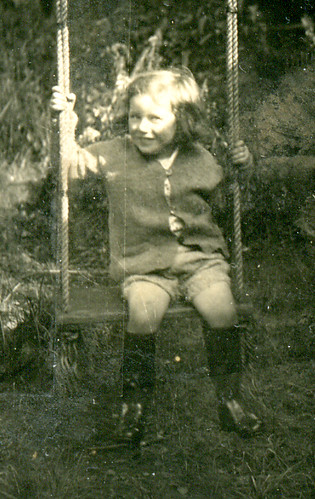
Photo: “The Garden Swing” by theirhistory is licensed under CC BY-NC-SA 2.0.

Isabel Chenot, ‘Echoes of Love’

The house is creaking like a rocking chair.
I’m small again,
comforted by the sway of matter in a shift of air,
cosseted by wind.

Undulate earth, how do you slip your hum
around our roar
of concrete, needles, neon, wadded gum,
demented hungers, war,

discarded children? Your lap is full of us
and of our wrong.
How can you simplify the noise
to cradle our first song?

*****

First published in Shot Glass Journal.

Isabel Chenot has loved and practiced poetry for as long as she can remember. Her poems have been published in Shotglass and other places, and some of them are collected in The Joseph Tree, available from Wiseblood books.

Man, woman and child on verandah of weatherboard house” by State Library Victoria Collections is licensed under CC BY-NC 2.0.

Joshua C. Frank, ‘The Adventures of Verb’

At six, I had a dictionary
Where I would meet a man named Verb,
Superb and quite extraordinary,
In every definition’s blurb,
Right at the finish, did while doing,
For example: “Verb chewed, chewing.”

In my mind, I saw Verb clearly,
With brown hair, mustache, thin, and tall.
“Verb smiled, smiling” sincerely
And “Verb told, telling” me of all
That “Verb did, doing” through his days
Within a sentence or a phrase.

“Verb ran, running,” “Verb swam, swimming,”
“Verb vaulted, vaulting,” “Verb gave, giving,”
“Verb bought, buying,” “Verb trimmed, trimming,”
“Verb flew, flying,” “Verb lived, living,”
One day I came real close to crying:
The day I read that “Verb died, dying.”

I looked up “verb,” and then I knew,
It’s not a man who lived and died;
It’s just a word that means to do.
Relieved, I put the book aside
And ran outside, where I “played, playing”
The things Verb did that still “stayed, staying.”

*****

Joshua C. Frank writes: “The poem was based on a children’s dictionary I remember from childhood.” It was first published in The Society of Classical Poets.

Joshua C. Frank works in the field of statistics and lives in the American Heartland.  His poetry has been published in The Society of Classical PoetsSnakeskinThe LyricSparks of CalliopeWestward QuarterlyNew English ReviewAtop the CliffsOur Day’s EncounterThe Creativity WebzineVerse VirtualMedusa’s KitchenThe Asahi Haikuist Network, and LEAF Journal, and his short fiction has been published in Nanoism and The Creativity Webzine.

https://www.newenglishreview.org/authors/joshua-c-frank/

Graphic: “moustache man” by A_of_DooM is licensed under CC BY 2.0.

Using form: ghazal: Barbara Lydecker Crane, ‘Love Refrains’

Mom banged her hairbrush down in a reprimand of love.
“What an awful question! You don’t understand love.

“Of course Dad loves you. How can you question that?
He doesn’t have to blare it out, like a brass band of love.

“You aren’t a princess to be coddled on a lap or praised
without good reason. That’s a never-never land of love.

“Your father works hard, with a great deal on his mind.
Now don’t go causing trouble, making a demand of love.

“Yes, I know he yells and sends you to your room a lot.
But be glad he never hits you with the backhand of love.

“Once, banished to your room, you drew a picture poem
for him. I watched him beam at you with unplanned love.

“He said he’s proud of you. I’ve heard him tell you twice.”
She brushed my hair, hard. “Barbara, that’s a brand of love.”


Barbara Lydecker Crane writes: “Based on a real interaction with my mother when I was about five, I think this poem reflects a different style of parenting back then (this was in the 50’s), perhaps a British approach: “don’t spoil your children with a lot of praise or affection.” I like modern ways better! As for the form, I love ghazals because you always know where you are headed–the fun is choosing your route to get there.”

Barbara Lydecker Crane was a finalist for two recent Rattle Poetry Prizes, including with this poem.  She has received two Pushcart nominations and various awards from the Maria W. Faust and the Helen Schaible Sonnet Contests. Her poems have appeared in Atlanta Review, Ekphrastic Review, First Things, Light, THINKValparaiso Literary ReviewWriter’s Almanac, many others, and in several anthologies. Her fourth collection, You Will Remember Me (ekphrastic, persona sonnets) was recently published by Able Muse Press, and is available from Amazon: https://www.amazon.com/You-Will-Remember-Me-Ekphrastic/dp/1773491261. Barb lives with her husband near Boston.

Photo: “She’s On The Naughty List” by Cayusa is licensed under CC BY-NC 2.0.

Short poem: ‘Raven’

Every raven started as a naked nestling,
every fox was a blind nursing pup,
helpless… then looking, reaching, wrestling
into the wilderness of growing up.

*****

Written for my grandson Raven (born in October last year, and dressed by his parents in a fox outfit for Halloween). The poem was published recently in The Asses of Parnassus – thanks, Brooke Clark!

Photo: “HBT Raven Chicks” by vastateparksstaff is licensed under CC BY 2.0.

Potcake Poet’s Choice: Mindy Watson, ‘On Johnson’s Creek’

Mid 80’s, late Wisconsin summer day.
You’re male; just one of many crayfish lured
Innately to this shallow, turbid creek.
July’s sweet warmth assures you that you’ll not
Find only sanctuary, but a mate.
And at a human hand-span’s length from tail

To telson, you’re a splendid prospect: tail
Aloft and eyestalks staunch, you greet the day.
With fierce claws brandished, you await your mate
In burrow’s dark. And nothing could have lured
You from your would-be breeding quarters – not
Until a stealthy stick from o’er the creek

Despoils your warren’s sanctity. The creek,
In tacit bounty, spurs your nerve. Your tail
Aflutter, claws outstretched, you’re not
Alarmed – you clamp the twig and seize the day.
But then the surreptitious branch that lured
You wrests you from the stream, reveals its mate

Above – a boy who thwarts your quest for mate.
His form obstructs the sun and dwarfs the creek
Below the wooden pier. It seems he’s lured
You here for idle sport; he grips your tail
And flings you hard against the planks. While day
Retreats, light’s sudden ebb arises not

From cosmic cause. The sneering boy (who’s not
Alone – a girl shrinks near her preening mate)
Uplifts his foot and renders blissful day
Brutality. Impassively, the creek
Laps on. Your once resplendent olive tail
Is tattered, shattered by the boy who lured

You, crushed your stately carapace. Though lured
From neural ruination’s throes, you’re not
Yet blind; you see his female friend turn tail.
And I, the girl that boy deems doting mate,
For whom you’re executed by the creek –
I know what cruel conceit is that day.

From where once lured, you sink, potential mate
Undone. Not waiting, brethren flee the creek,
Tails undulating. Silence veils the day.

*****

Mindy Watson writes: “‘On Johnson’s Creek’ represents not only one of my earliest published poems, but also my first-ever sestina attempt. Even three decades later, the poem’s instigating tragedy—an ill-starred crustacean’s senseless slaughter—so profoundly disturbed me, that I chose the most convoluted, challenging form I’d known (at that point) to narrate from the dwindling victim’s (second person) point of view. Although my own human projections—predicated upon the Northern Wisconsin climate, incident’s time of year, and region’s most statistically plentiful crayfish species—dictated the crayfish’s depicted age, gender, and objectives; the poem’s auxiliary characters’ (the boy=my older step-cousin; the girl=10-year-old me) motivations and ensuing impressions were pointedly accurate. While I’ve since drafted/published two subsequent sestinas, I still believe the form’s almost fanatical repetition, intricate transpositions, and final unifying envoi best suit this tale-in-verse; which aimed to equate a single creature’s unwitting suffering with humanity’s often capricious cruelty. Two end notes: 1) this sestina preceded/inspired ‘The Maligned Majority,’ a pro-arthropod, non-fiction essay that appeared in Willows Wept Review’s Summer 2020 issue; and 2) while I’m told my childhood step-cousin later married (twice) and still resides/works near Johnson Creek…I haven’t directly spoken to him since that fateful day.”

Mindy Watson is a Washington DC-based formal verse poet who holds an MA in Nonfiction Writing from the John Hopkins University. Her poems have appeared in venues including Autumn Sky Poetry, Eastern Structures, the Poetry Porch, the Potcake Chapbooks, the Quarterday Review, Snakeskin, Star*Line, Think Journal, and many others. Read her work at: https://mindywatson.wixsite.com/poetryprosesite

‘On Johnson’s Creek’ originally appeared in Autumn Sky Poetry Daily, Jan. 30, 2017