Tag Archives: feminism

Blank verse: Gail White, ‘Eve Discusses Adam’s First Wife’

You tell me Lilith has become a fiend,
a vampire, a screech-owl, one who preys
on children (I‘ve had three and she has none),
sentenced for disobedience to run wild,
hideous now, howling for all she lost.
You tell me I was taken from your side
that I might always find a refuge there,
a warm and nestling creature like the cat,
safe from the free but haunted world of dark.
And I’ve adjusted splendidly, I think.
My apple fritters are the best you’ll eat,
go where you will.  I keep domestic life
tidy and clean.  I never stir abroad
for fear of Lilith’s shriek and bat-like wings.
Yet when our first son killed our second son,
I – the good mother and obedient wife –
had one quick moment’s envy of her life.

*****

Gail White writes: “You won’t find the story of Lilith in Genesis, but in later Jewish commentary.  She was created simultaneously with Adam – God made them out of mud – and she used this joint creation to claim equality with him.  The world was not ready for Lilith as First Feminist.  She was banished, and Eve was created within Eden and presumed to be more docile.  I tried to give her a little flash of independent thought.”

First published in Blue Unicorn.  

Gail White lives in the Louisiana bayou country with her husband and cats.  Her latest chapbook, Paper Cuts, is available on Amazon, along with her books Asperity Street and Catechism.  She appears in a number of anthologies, including two Pocket Poetry chapbooks and Nasty Women Poets.  She enjoys being a contributing editor to Light Poetry Magazine.  Her dream is to live in Oxfordshire, but failing that, almost any place in Western Europe would do.

Photo: “Adam and Eve (and Lilith, the serpent) (Notre Dame, Paris, France)” by runintherain is licensed under CC BY-NC-SA 2.0.
Using form: Ballade variant: Barbara K. Loots, ‘Opera: a Ballade’

Sometimes the heroine is just a girl,
an innocent set up to be betrayed.
Whether she loves a hero or a churl,
she’ll face a three- or four-hour escapade
in which her feelings and her fate are swayed
by charm, by force, deception, or disguise
she’s helpless to resist or to evade.
And then she dies.

Sometimes around the heroine unfurl
fate’s sinister entrapments. Undismayed,
she feels the storm of accusation swirl
and knows the price of honor must be paid.
Beset by Powers That Must Be Obeyed,
she suffers while the chorus vilifies.
Her hopes of justice and redemption fade.
And then she dies.

Sometimes the heroine, a perfect pearl,
whether a princess or a village maid,
regardless of her protest or demurral,
becomes the object of an evil trade,
a bloody game, a sinister charade,
with hidden motives and transparent lies,
with clash of insult and with flashing blade.
And then she dies.

Through every lamentation and tirade,
each heroine embraces her demise
despite how fervently she might have prayed.
And then…

*****

First published in Light with the note “After watching 33 free streamed operas from the MET during quarantine.” Barbara Loots writes: “Watching those gorgeous productions from the MET day after day during COVID confinement was a saving grace. I have a journal with a complete list, where I starred the ones I liked best for future reference. Kansas City’s excellent Lyric Opera recording of the brand new opera “The Shining” (yes, based on the horror story by Stephen King) recently won a Grammy.”

Barbara Loots resides with her husband, Bill Dickinson, and their boss Bob the Cat in the historic Hyde Park neighborhood of Kansas City, Missouri. Her poems have appeared in literary magazines, anthologies, and textbooks since the 1970s. She is a frequent contributor to Light. Her three collections are Road Trip (2014), Windshift (2018), and The Beekeeper and other love poems (2020), at Kelsay Books or Amazon. More bio and blog at barbaraloots.com

Photo: “This picture makes me happy” by James Jordan is licensed under CC BY-ND 2.0.

Susan McLean, ‘The Only Feminist in High School’

Two roads diverged in high school when a student
chose to study women’s liberation
to write her senior paper. Though imprudent,
that choice provided her an education

in bias, inequality, derision,
The Second Sex, The Feminine Mystique,
historical erasure, long division,
and talent gagged and shackled by physique.

She swore off make-up, wanted a career
but maybe not a family. She read
Kate Millett, Gloria Steinem, Germaine Greer,
and gave a speech on beauty, which, she said,

turned women into objects and betrayed
their goals. She didn’t want to be a mom
or movie star. When she went out, she paid.
Though never asked, she boycotted the prom.

The boys were baffled and the girls disdainful,
for who would want to talk to, much less date her?
And what she lost was obvious and painful,
while what she gained was only clear years later.

*****

Susan McLean writes: “This poem starts with the opening phrase from Robert Frost’s ‘The Road Not Taken‘ and it records a turning point in my own life of the sort that his poem describes. Though I hope that feminists are not such a rarity among high school students anymore, the term “feminist” is still so loaded that I tend to think of it as “the new F-word.” At one level, it still mystifies me that looking for equal opportunity and equitable treatment remains so controversial, but at another level, every society has been built on unequal opportunity and inequitable treatment since recorded history began, so it is not surprising that each step away from that system has made some people feel that the world was ending.

“I learned long ago that what a poem doesn’t say is as important as what it does say, so the ending of this one does not specify what was lost or what was gained. I want the readers to think about those things, so I don’t want to tell them what to think. As for why I wrote this in the third person, these events happened so long ago that it almost feels as though they happened to someone else. I am and am not that girl.

“The poem first appeared in my second poetry book, The Whetstone Misses the Knife.”

Susan McLean has two books of poetry, The Best Disguise and The Whetstone Misses the Knife, and one book of translations of Martial, Selected Epigrams. Her poems have appeared in Light, Lighten Up Online, Measure, Able Muse, and elsewhere. She lives in Iowa City, Iowa.
https://www.pw.org/content/susan_mclean

Photo: “Two Road Diverged…” by wackybadger is licensed under CC BY-SA 2.0.

Using form: Rondeau: Gail White, ‘Opera Rondeau’

And then she dies—since men are no damn good—
Mimi, consumptive and misunderstood,
or Desdemona, most defamed of brides—
the woman is abandoned on all sides—
she so believes in love (as women should)
and in the end she burns like firewood.

Here Tosca on the tower a moment stands,
first throwing back her hood and then her hands
and then one step—invisibly she flies—
and then she dies.

Poor Butterfly, who meant to be so good.
Tough Carmen, using all the wiles she could
to get her man. So many suicides,
so many murders. Violetta hides
but can’t escape—she’s found, she’s understood—
and then she dies.

*****

Gail White writes: “One of my favorites in my new book Paper Cuts is ‘Opera Rondeau’.  It was written after a friend pointed out to me that most summaries of opera plots could end with the words “then she dies.” Although the poem doesn’t conform perfectly to the rondeau rhyme scheme, it does provide the perfect refrain. And gives me a chance to mention a few of the many opera heroines who win, lose, or miss love altogether – and die.”

Gail White is the resident poet and cat lady of Breaux Bridge, Louisiana. Her books ASPERITY STREET and CATECHISM are available on Amazon. She is a contributing editor to Light Poetry Magazine. “Tourist in India” won the Howard Nemerov Sonnet Award for 2013. Her poems have appeared in the Potcake Chapbooks ‘Tourists and Cannibals’, ‘Rogues and Roses’, ‘Families and Other Fiascoes’, ‘Strip Down’ and ‘Lost Love’. ‘Opera Rondeau’ was first published in Mezzo Cammin and is collected in her new light verse chapbook, ‘Paper Cuts‘, also available on Amazon.

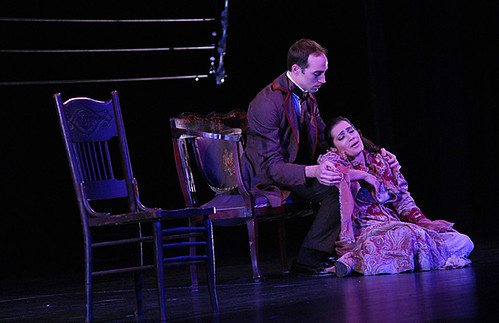
Photo: “Heroine – a female lament” by Yo! Opera is licensed under CC BY-NC-SA 2.0.
Using form: Roundel: Susan McLean, ‘No Thanks’

No one wants to be the damsel in
distress, the one in need of chivalry,
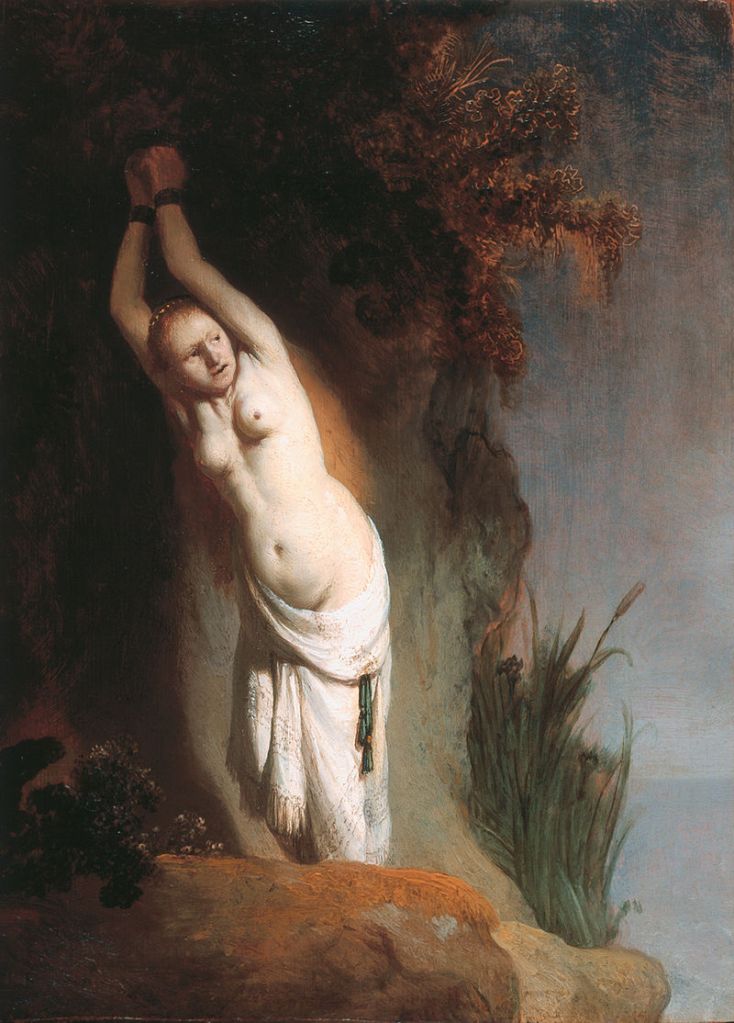
chained to a rock in nothing but her skin.
No!  One wants to be

the one who skirts the trap and steals the key,
testing the rope bridge with a shaky grin.
Whoever longs for victims he can free

is not a hero, but the villain’s twin.
So save yourself.  Don’t go expecting me
to play the clingy wimp, the might-have-been
no one wants to be.

*****

Susan McLean writes: “This poem got its start when I heard that Kirsten Dunst said, about playing Mary Jane in Spider-Man (2002), “I just don’t want to be the damsel in distress. I’ll scream on the balcony, but you’ve got to let me do a little action here.” It struck a chord with me. I was so tired of watching action movies in which the male hero does all of the derring-do and the female lead exists only to be saved, over and over again. Men still write, direct, and produce most films, so I guess it is not surprising that most movies reflect male fantasies. But women have fantasies, too, and screaming while I wait to be saved is not one of mine.
“The poem is a roundel, a poetic form invented by Algernon Swinburne. As in a rondeau, the poem has only two rhymes, and the first part of the first line appears twice more. Part of the fun of writing it lies in finding ways to vary the repeating line, and part lies in the challenge of finding five rhyme words for each rhyme. English averages fewer rhymes per word than French, the language in which the rondeau originally appeared. Swinburne chose to make the roundel shorter than the rondeau (which is fifteen lines long) in order to make it easier to write in English.
” ‘No Thanks‘ originally appeared in Mezzo Cammin, an online journal that features female formalist poets. It was also included in my second poetry book, The Whetstone Misses the Knife.”

Susan McLean has two books of poetry, The Best Disguise and The Whetstone Misses the Knife, and one book of translations of Martial, Selected Epigrams. Her poems have appeared in Light, Lighten Up Online, Measure, Able Muse, and elsewhere. She lives in Iowa City, Iowa.
https://www.pw.org/content/susan_mclean

Painting: ‘Andromeda Chained to the Rocks‘ by Rembrandt Harmensz. van Rijn, ca. 1630

Potcake Poet’s Choice: Dervla Ramaswamy, “Woman vs The Virus”

Dervla Ramaswamy

Dervla Ramaswamy

Dervla Ramaswamy writes:

The poem of mine that you will print is my most recent, which contains my thoughts on the Coronavirus epidemic:

WOMAN vs THE VIRUS

the virus is the virus

the old and the debilitated
sadly become victims to its power

the doctors quake
the politicians tremble
but
I am woman

the power of woman confronts
the virus
for males are fifty
percent more likely to expire
due to the virus

such is the fortitude of women
I am the strength of women

yes, for my hips are monstrous
my belly is glorious
my appetites are profound
my cunt terrifies clergymen
power must bend before me

I am woman
I am the strength of all women
I am Marie Curie
I am Marilyn Monroe
I am Viginia McKenna
I am Jiang Qing
I am Winnie Mandela
I am Meghan Markle
I am our NHS
I am woman

Undefeated

Dervla Ramaswamy’s Potcake Poet bio simply states: “Poet. Thinker. Woman.”

She is hard to track down. Through our mutual friend George Simmers, Editor of Snakeskin, I heard she had entered a two-year writing retreat somewhere in the Balkans, with the project of creating a thirteen-line sonnet. “Luckily,” he continued, “the Mother Superior of the convent where she is currently on retreat is an ex-girlfriend of mine.”

This led to Dervla Ramaswamy herself suggesting that Potcake Chapbooks should publish what she describes as “my major work. It is a 4,000 line epic in free verse, describing the grim struggles of a family of Bulgarian potato farmers through seven depressing decades. I think you will enjoy it.”

Perhaps. But there are shorter, more traditional poems of hers which I look forward to including in future Potcake Chapbooks.