Tag Archives: formal verse

Sonnet: ‘The Arrogance of Youth’

How fortunate the arrogance of youth—
the optimism and innumeracy,
lack of experience, perspective, truth—
giving hopes, visions that they’d never see
if they but knew the small chance of success
in major league politics, business, sports.
Most fail, adopt some wage-slave form of dress
that not dreams, but a family, supports.

Without those early dreams, with a clear view
of stats on making it in the Big Time,
they’d all give up, seeing how very few
truly succeed. Then we’d miss those sublime
insane few dreamers who can win their race,
make the discoveries, blast into space.

*****

This Shakespearean sonnet has just been published in Shot Glass Journal – thanks, Mary-Jane Grandinetti!

Photo: “Arrogance” by De kleine rode kater is licensed under CC BY-NC-ND 2.0.

Nina Parmenter: ‘The Quantum Fox’

Have you seen the quantum fox,
the fox in flux, the paradox?
His whereabouts is rare, because
he’s in his den, and in this box.

This hokum locus tends to vex
the best of us; the mind rejects
the concept of his flightiness
as fiction or as foxy hex.

But fiction’s just refocused facts –
a lens that bends, a parallax.
The fact remains that Foxy lacks
a fix, til someone interacts.

See, should you pry inside the box,
you’ll find a fox, or not a fox,
and then this quantum nonsense stops
and everything is orthodox.

*****

Nina Parmenter writes: “I love reading ‘Quantum Fox’ out loud because it’s one of the few poems of mine I reliably know by heart and if performing it, I read it with props (er, a fox and a box funnily enough). Sometimes I  also recite it to myself to distract my brain if it’s overheating! It’s one of the older poems in my book ‘Split, Twist, Apocalypse‘ (relatively – written around 2019 I think) and I can’t remember where the inspiration came from – I think it was just the nice feel of the words ‘Quantum Fox’!”

Nina Parmenter has no time to write poetry, but does it anyway. Her work has appeared in Lighten Up Online, Snakeskin, Light, The New Verse News, Ink, Sweat & Tears, and the Potcake Chapbook ‘Houses and Homes Forever’. Her home, work and family are in Wiltshire.
https://ninaparmenter.com/

Fennec fox in box” by Joel Abroad is licensed under CC BY-NC-SA 2.0.

Launch: Potcake Chapbook 12, ‘City! Oh City!’

City! Oh City! – poems on the light and dark of urban life. Thirteen of the best contemporary English-language poets present their wildly differing takes on the glamour and squalor, the joy and heartbreak, the varied people and the hidden wildlife of our modern cities.

Five of the poets are new to the Potcake Chapbook series, and I’m delighted to be adding Kate Bingham of England, Francis O’Hare of Northern Ireland, Pino Coluccio of Canada, and Quincy R. Lehr and J.D. Smith of the US. They join eight returning poets. Amit Majmudar and Maryann Corbett deserve special mention for their brilliant use of form to capture contradictory situations: Majmudar’s static street scene which suddenly changes pace to a hectic chase, Corbett’s interwoven Baroque chamber ensemble and homeless encampment with their separate realities in a shared evening in Saint Paul, Minnesota. In addition: Michael R. Burch, Jerome Betts, Terese Coe, Marcus Bales, Martin Elster and myself; everyone contributes to this memorable capture of the complexity of the modern city.

Bios, photos and links to read more of their work can all be found on the Sampson Low site’s Potcake Poets page, while all the chapbooks in the series, showing which poets are in which, are here. Each of the 12 chapbooks is profusely illustrated (of course) by Alban Low, and can be yours (or sent as an intriguing gift) for the price of a coffee.

Value the city – citification is civilisation!

Poem: ‘Some Fling Away’

Some fling away
Some stay and cling—
Each their own Way
To do their own thing.

Sacrifice meaning
For love of the rhyme;
Know that in dreaming
You make up the time.

Sacrifice meaning—
When thought becomes sight
Your soul from its mole-hole
Blinks into life-light.

*****

An early poem, from when I was searching for meaning and questioning the various Meanings that were presented. Decades later, I feel the answer to the meaning of everything is best expressed by Leonard Cohen at the end of Tower of Song. That, and by John Cleese in the photo’s poster, and Douglas Adams’ “42”. Do your own thing, indeed; and keep dreaming and rhyming.

‘Some Fling Away’ was first published in ‘Metverse Muse‘ in India.

Do Your Own Thing” by mikecogh is licensed under CC BY-SA 2.0.
Sonnet: ‘Ultimate Control’ (from the series ‘Voices from the Future’)

If you’ve the aptitude and love the role,
the Army’s always been the place to be.
Rise in the ranks, absorbing strategy:
coordinate, consolidate, control.
And what a blessing when those new implants
gave mind-to-mind awareness… and command.
Like the unthinking fingers on your hand
you can maneuver thousands with a glance.
The battle then’s to see what you can wrest
from other leaders, fighting mind-to-mind;
you have to grow, or you get left behind:
can you control ten million, like the best?
Of would-be kings there’s never been a dearth…
will it be only one who rules all Earth?

*****

This sonnet has just been published in Pulsebeat Poetry Journal’s 3rd issue (thanks, David Stephenson!) It is one of a series written in response to a comment from Maryann Corbett (a brilliant formalist poet) about the bleakness of my vision of the future. Well, she’s a Christian, so she has a totally different take on humanity’s future from my irreligious SF-infused speculations. Another sonnet in the series, ‘Exiled Leader‘, was published by Star*Line.

I don’t find it bleak to think that there will be unprecedented individual and planetary disruptions. I’m not distressed at the thought of humans being supplanted some posthuman higher intelligence. Should the earliest rat-like mammals of 145 million years ago be upset to learn that their human descendants build cities and kill any rats they find in them? Should they identify only with the familiar rats and wish that evolution had stopped there, or instead be proud that they have also developed into humans (and dogs, and whales, etc)?

For myself, life is a wild ride, and I long to see where it will take humans in a hundred or in a thousand years. Because of the current revolutions in genomics, robotics, AI and nanotechnology, I doubt we can reasonably forecast even a hundred years into the future. We can speculate all we like but once we merge a human with AI, create a cyborg, all bets are off.

20120401 – Hand – IMG_2898” by Nicola since 1972 is licensed under CC BY-NC-ND 2.0.

Michael R. Burch: ‘For All That I Remembered’

For all that I remembered, I forgot
her name, her face, the reason that we loved …
and yet I hold her close within my thought:
I feel the burnished weight of auburn hair
that fell across her face, the apricot
clean scent of her shampoo, the way she glowed
so palely in the moonlight, angel-wan.

The memory of her gathers like a flood
and bears me to that night, that only night,
when she and I were one, and if I could …
I’d reach to her this time and, smiling, brush
the hair out of her eyes, and hold intact
each feature, each impression. Love is such
a threadbare sort of magic, it is gone
before we recognize it. I would crush

my lips to hers to hold their memory,
if not more tightly, less elusively.

*****

Michael R. Burch writes: “For All That I Remembered” is one of my personal favorites and one of a number of poems I have written about the transience of memory, along with “The Effects of Memory,” “Violets,” “Moments,” “Distances,” “Redolence,” “Vacuum,” “Afterglow” “Memento Mori” and “Remembrance.” “For All That I Remembered” has been published by The Raintown Review, Boston Poetry Magazine, la luce che non muore (Italy), The Eclectic Muse (Canada), Kritya (India), Jewish Letter (Russia), Gostinaya (in a Russian translation by Yelena Dubrovin), Freshet, Orchards Poetry, Poetry Life & Times, Sonnetto Poesia (Canada), Trinacria, The New Formalist and Pennsylvania Review.”

Michael R. Burch is an American poet who lives in Nashville, Tennessee with his wife Beth and two outrageously spoiled puppies. Burch’s poems, translations, essays, articles, reviews, short stories, epigrams, quotes, puns, jokes and letters have appeared more than 7,000 times in publications which include TIME, USA Today, The Hindu, BBC Radio 3, CNN.com, Daily Kos, The Washington Post and hundreds of literary journals, websites and blogs. Burch is also the founder and editor-in-chief of The HyperTexts, a former columnist for the Nashville City Paper, and, according to Google’s rankings, a relevant online publisher of poems about the Holocaust, Hiroshima, the Trail of Tears, Darfur, Gaza and the Palestinian Nakba. Burch’s poetry has been taught in high schools and universities, translated into fifteen languages, incorporated into three plays and two operas, set to music by twenty composers, recited or otherwise employed in more than forty YouTube videos, and used to provide book titles to two other authors. To read the best poems of Mike Burch in his own opinion, with his comments, please click here: Michael R. Burch Best Poems.

Memory” by Kris Krug is licensed under CC BY-NC-ND 2.0.

Short poem: ‘Disappearance’

I’ve always been around, since before I can remember,
so it just would be so strange, if one day I should dismember,
and my body disappear, like a swallow in September…
Will there be no glowing coal? Of my life survive no ember?

*****

This short poem was published on a page of ‘Senior Moments’ in the current Lighten-Up Online. I like the rhythm (there’s a pause in the patter in the middle of each line) but the simile is bogus: unlike with swallow migration, dead people are unlikely to show up again the next spring…

Photo: “Swallows” by Marie Hale is licensed under CC BY 2.0.

Clerihew: ‘Robert Bridges’

Robert Bridges
was way too religious.
He rhymed like mad for his God,
but his knowledge of Science was flawed.

*****

This clerihew was recently published in The Asses of Parnassus. Regarding the form, Wikipedia says it best: “A clerihew is a whimsical, four-line biographical poem of a type invented by Edmund Clerihew Bentley. The first line is the name of the poem’s subject, usually a famous person, and the remainder puts the subject in an absurd light or reveals something unknown or spurious about the subject. The rhyme scheme is AABB, and the rhymes are often forced. The line length and metre are irregular. Bentley invented the clerihew in school and then popularized it in books.”

As for the subject, Bridges had a lifelong drive for nature, religion and poetry; he produced hymns like “When morning fills the skies”, launched Gerard Manley Hopkins by bringing out a posthumous collection of his poems, and became Poet Laureate. But his poetic style was, like the phonetic alphabet he developed, idiosyncratic and anachronistic; definitely interesting, but not that successful.

It’s not surprising that he is little known. He’s an acquired taste, and even then you have to be in the right mood.

Short poem: ‘Loss’

Which is the worst –
Is it the loss, or memory of loss,
Or loss of memory? Who gives a toss
When the brain’s banks have burst
And all we valued yesterday
Is washed away?

*****

The above is a short poem, semi-formal (i.e. it’s in iambics, it rhymes, but it lacks formal structure) published in this month’s Snakeskin No. 298. I like semi-formal because it allows natural expression in a way that formal structure often prevents. Contrast these examples from Matthew Arnold of the formal (from The Scholar-Gipsy) and semi-formal (from A Summer Night):

Thee at the ferry Oxford riders blithe,
Returning home on summer-nights, have met
Crossing the stripling Thames at Bab-lock-hithe,
Trailing in the cool stream thy fingers wet…

The inversions of adjectives and phrases were used to fit rhyme and metre to line length. Drop the line length requirements and, even retaining the “thee”s and “thou”s, the expression is more naturally conversational:

And the rest, a few,
Escape their prison and depart
On the wide ocean of life anew.
There the freed prisoner, where’er his heart
Listeth will sail…

Poor Matthew Arnold! With his father a famous Headmaster and himself an Inspector of Schools, there is a sad irony in so much of his poetry being about escaping the tedium of regimented Victorian life.

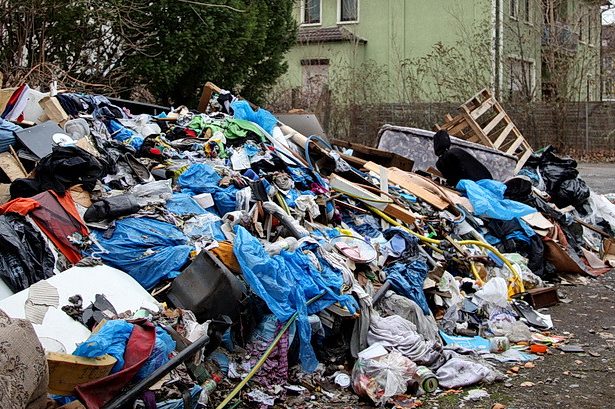
Photo: “Müllhaufen Villa V R s 1000 s” by rosalux-stiftung is licensed under CC BY 2.0.

Calling the Poem: 13. ‘Crafting the Verse’

We stand on two banks of the river that’s flowing between us.
I’ll bridge my new thoughts out to you with a verse.
First I form key ideas – they need clarity, cleanness –
The bridge forms an outline, takes shape in my head.
Now that bridge must be built,
Built regardless of canyons, or mud flats and silt.

The pillars are images placed first for more of the bridge to traverse,
With my strongest words buttressing them so they’re not washed away.
Their positions are set by the distance and shores,
While the force of the water, the shape of the bed,
And the landscape and soil on my side and yours,
The allowance for possible earthquake or storm,
The demands of the load that the bridge will convey…
These determine the structure, materials, form:
For the best bridge will meet site demands
With both strength and matched style.
So the poet needs meter and rhyme, every trick he commands,
Or the verses won’t carry their burden, will fail to beguile.

Though you see stone or steel in the bridge, for the most part it’s air,
Rhythmic arches of unspoken airy allusion, illusion,
Outlined in hard words and designed to be elegant, spare.
So this poem’s a book, that’s reduced to an essay, reduced more compactly
To two hundred lines, sacrificing precision
To memory’s need for concision, elision.
Two hundred exactly?
No, not exactly. (Exactly!)

From the sweep, pattern, length,
To its delicate strength,
Whether old Roman aqueduct, young Golden Gate,
Whether flowing with water or people and freight,
Its clean shape was constrained by the structural needs and efficiencies,
Driving its strength and position and duty.
All unstructured words in the river are wasted deficiencies.
Poems will last quite as long as an old Roman aqueduct,
Bridging the banks, bearing brightly in rhythms of beauty,
If all ostentation and ornamentation
Support the key functions in what you construct.
Raise your sights to the Space Elevator, that cable,
That modern-day Tower of Babel,
To not just bridge over
A strait or the Severn
But up! to bridge up! at the same time, to heaven.

Cloaked gods were invoked,
And the tiger broke cover,
Your poem connects river banks.
Now give thanks.

*****

When I moved to Denmark in my early 20s I was intrigued to hear that engineering students at a local university began their studies, not with lectures on a variety of key subjects, but by being placed in teams and told to design a bridge that would meet the demands for specific use at a specified site. Materials, geology, weather, load, cost, elegance and everything else that goes into bridge design all had to be researched and included in the project. When students had completed a whole series of projects, they had earned their degree. It was a very different approach from the lecture-based university courses that I had dropped out of in the UK.

How does this relate to writing poetry? Well, it brings to mind Heinlein’s ‘first law of writing’: “You must write.” Also the old story of the would-be concert-goer lost in New York City, asking a man with a violin case how to get to Carnegie Hall and being told “Practice, practice, practice.” There are a lot of factors involved in writing verse – some are common across all cultures and languages while others are language-specific. They all involve ideas (and their mysterious origin), images and their expression in words; but making those words so effective that they evoke an appropriate response in the reader or listener, so effective that they can be remembered and recited, requires the use of a whole range of language-specific factors that are mastered by doing.

By the way, the “two hundred lines” mentioned above refers to the length of the entire ‘Calling the Poem’ e-chapbook that this is part of. This chapbook is a single work, though constructed of various formal and semi-formal pieces.

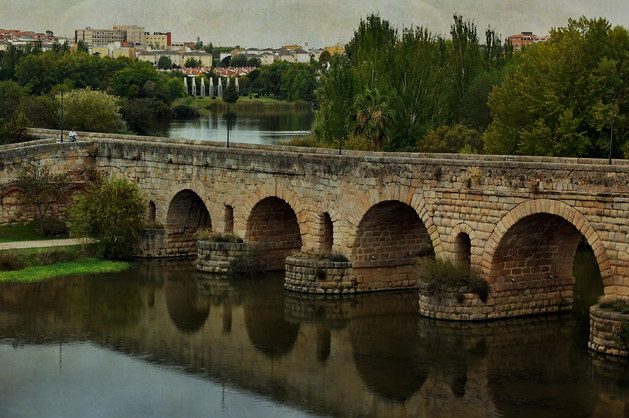
Photo: “Roman Bridge, Merida” by Jocelyn777 Love Europe is licensed under CC BY-SA 2.0.