Tag Archives: light verse

Odd poem: ‘The Naughty Preposition’ by Morris Bishop

I lately lost a preposition:
It hid, I thought, beneath my chair.
And angrily I cried: “Perdition!
Up from out of in under there!”

Correctness is my vade mecum,
And straggling phrases I abhor;
And yet I wondered: “What should he come
Up from out of in under for?”

*****

Morris Bishop had a high regard for light verse: “The aim of poetry, or Heavy Verse, is to seek understanding in forms of beauty. The aim of light verse is to promote misunderstanding in beauty’s cast-off clothes. But even misunderstanding is a kind of understanding; it is an analysis, an observation of truth, which sneaks around truth from the rear, which uncovers the lath and plaster of beauty’s hinder parts.”

Bishop was an acknowledged master of rhyme and meter, but that doesn’t imply that he would be limited by the grammatical restrictions of the apparently well-educated. He employed and enjoyed common speech.

Now this may sound strange coming from me, someone who writes a blog dedicated to the expansion of formal verse, but many “rules of grammar” are garbage. To me, correct speech is whatever unambiguously communicates what the speaker intended. This is naturally aided by the use of predictable patterns of word usage, because we are a pattern-recognition species, and this in turn leads to “rules”; but these rules are really only “commonly used patterns”.

Similarly the forms of traditional verse are there because they are useful: rhythm guides and builds emotion; rhyme, rhythm and wordplay all create engagement and help memorisation. The forms are neither arbitrary nor sacrosanct. The formality is purely useful (and part of its use is creating fun). Grammatical rules and formal verse have that in common.

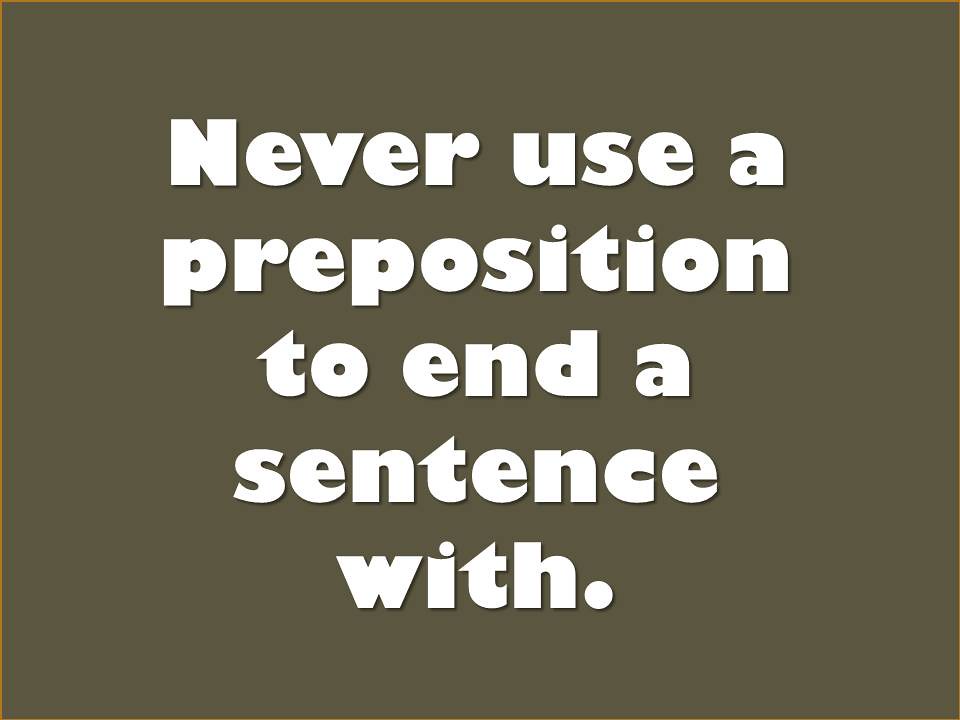
Winston Churchill is often cited as the author of a scribbled comment on someone “correcting” his grammar: “This is the sort of nonsense up with which I will not put.” But that joke appears to predate his involvement with the issue: there is a lengthy discussion of it here in the Quote Investigator.

English has particularly confusing and contradictory rules because of the blending of several waves of Germanic speakers (Anglo-Saxons, followed by Danish invaders and later Dutch merchants) overrunning the British (i.e. Celtic speakers with their complicated auxiliary verbs: “How did you do that?”), in turn being overrun by French-speaking conquerors supported by Latin-speaking priests. (I recommend John McWhorter’s ‘Our Magnificent Bastard Tongue‘.) It was this latest ruling class that was averse to (among other things) ending a sentence with a preposition. But that’s a natural and correct part of speech for a Dane to end with.

And I’m an Anglo-Dane.

T-shirt Slogan: ‘Never use a preposition to end a sentence with.’” by Ken Whytock is licensed under CC BY-NC 2.0.

Nina Parmenter: ‘The Quantum Fox’

Have you seen the quantum fox,
the fox in flux, the paradox?
His whereabouts is rare, because
he’s in his den, and in this box.

This hokum locus tends to vex
the best of us; the mind rejects
the concept of his flightiness
as fiction or as foxy hex.

But fiction’s just refocused facts –
a lens that bends, a parallax.
The fact remains that Foxy lacks
a fix, til someone interacts.

See, should you pry inside the box,
you’ll find a fox, or not a fox,
and then this quantum nonsense stops
and everything is orthodox.

*****

Nina Parmenter writes: “I love reading ‘Quantum Fox’ out loud because it’s one of the few poems of mine I reliably know by heart and if performing it, I read it with props (er, a fox and a box funnily enough). Sometimes I  also recite it to myself to distract my brain if it’s overheating! It’s one of the older poems in my book ‘Split, Twist, Apocalypse‘ (relatively – written around 2019 I think) and I can’t remember where the inspiration came from – I think it was just the nice feel of the words ‘Quantum Fox’!”

Nina Parmenter has no time to write poetry, but does it anyway. Her work has appeared in Lighten Up Online, Snakeskin, Light, The New Verse News, Ink, Sweat & Tears, and the Potcake Chapbook ‘Houses and Homes Forever’. Her home, work and family are in Wiltshire.
https://ninaparmenter.com/

Fennec fox in box” by Joel Abroad is licensed under CC BY-NC-SA 2.0.

Short poem: ‘When Your Flesh Freshly’

When your flesh freshly and your face flushly
Face the imperatives of flesh,
I find your mind now unleashed lusty-lushly…
Must we not then enmesh?

*****

This little poem was triggered by pondering the nearness to each other of the words fresh, flesh and flush, and jamming them all together. The result was coherent enough for publication in (naturally) ‘Rat’s Ass Review‘ – thanks, Rick Bates!

Photo: “The Redhead Piano Bar” by Thomas Hawk is licensed under CC BY-NC 2.0.

Poem: ‘Some Fling Away’

Some fling away
Some stay and cling—
Each their own Way
To do their own thing.

Sacrifice meaning
For love of the rhyme;
Know that in dreaming
You make up the time.

Sacrifice meaning—
When thought becomes sight
Your soul from its mole-hole
Blinks into life-light.

*****

An early poem, from when I was searching for meaning and questioning the various Meanings that were presented. Decades later, I feel the answer to the meaning of everything is best expressed by Leonard Cohen at the end of Tower of Song. That, and by John Cleese in the photo’s poster, and Douglas Adams’ “42”. Do your own thing, indeed; and keep dreaming and rhyming.

‘Some Fling Away’ was first published in ‘Metverse Muse‘ in India.

Do Your Own Thing” by mikecogh is licensed under CC BY-SA 2.0.
Poem: ‘Village Fetes’

Come learn your fates at the village fêtes,
hosted by kindly vicars;
there’s lots to eat, don’t be discreet –
but your attention flickers…

the boys want toys with lots of noise,
the girls want glittery stickers,
while a gypsy tent, being devil-sent,
offers both lust and snickers.

The fêtes are fine for beer and wine,
less so for fancy liquors;
if you want to cruise for a bit of booze,
they’re not for city slickers;

but the real thrust builds on the trust
of godly, sinful vicars –
it’s being caressed by a gypsy breast
that puts a twist in their knickers.

*****

The latest edition of Rat’s Ass Review (for Fall/Winter 2022) has just been published, and I’m delighted to have this irreverent (pun intended) piece included. (As the journal’s title suggests, the editor doesn’t care if you don’t agree with his selections and opinions.) Thanks, Rick Bates!

Romany Rose” by timnutt is licensed under CC BY-NC-SA 2.0.

Short poem: ‘Bantering’

Bantering needs many, not one voice:
you need ‘response’ as well as ‘call’.
Or else it’s only masturbantering –
with no real intercourse at all.

*****

You make up a word, and then you have to use it… a short poem is one way to do it. This poem was first published in Rat’s Ass Review (as you might have guessed, if you know that no-holds-barred magazine). Thanks, Rick Bates!

Photo: “banter” by Andrew G Thomas is licensed under CC BY 2.0.

Resources: Light poetry magazine

Light‘ has just published its winter/spring 2022 issue… perhaps a little late, but it still has snow on the cover. Originally founded in 1992 by John Mella as the print magazine Light Quarterly with the mission to “restore humor, clarity, and pleasure to the reading of poems”, it is now biannual. It moved online in 2013, and all issues since then can be read for free on its website, along with excerpts from print issues dating back to 1999. Under current editor Melissa Balmain and her staff of fellow volunteers, it remains the oldest and best-known journal of light verse in the U.S.

I used to think of magazines as purely ephemeral, things to be skimmed and discarded unless a page or photo was worth retaining by tearing out physically or saving online. Light, however, has made me pay attention to how many resources are made available through a well-managed publication. In this case you get the following:
1. The magazine – some 50 poets with one or several pieces each – a great way to be exposed to, and kept up to date on, the range of light formal verse being produced in the English-speaking world today;
2. and more extensive work by, and coverage of, a featured poet – someone with a strong track record, worth learning about their work and career;
3. and (sometimes) an additional light-verse-related feature or essay;
4. and (always) reviews of light-verse books, and/or books that at least have a large helping of comic poetry – and I’m happy to say that the Potcake Chapbooks are again mentioned this issue!
5. and general news: the News page carries info on: 1- events of interest to Light poets (i.e., readings, workshops, and so forth involving light verse and/or Light poets); 2- contests and submission calls friendly to comic poets; 3- awards and honors received by Light contributors and volunteers; 4- books and, occasionally, music by Light poets. **NOTE: Poets and editors are encouraged to email editor Melissa Balmain with info appropriate for the News page: lightpoetrymagazine@gmail.com
6. and the magazine even runs light-verse events! Recordings of its “Light Verse in Dark Times” Zoom series are on Youtube: https://www.youtube.com/channel/UC-tR4v4H23BUg5ZDUJlU7fA. In pre-Covid days, Light hosted live readings in Washington, DC, and at the AWP conference in San Antonio, TX. Its first live event in two years will be a reading in honor of Light’s 30th anniversary, May 26 (next week!) at the Poetry by the Sea conference in Madison, CT;
7. and the current-events Poems of the Week (POTW), a mailing list you can join (or find on the Light website’s Home Page) for a weekly blast of 10-12 snappy, snippy comments on the absurdities and iniquities of the world.

So, more than just being a skimmable and disposable magazine, Light provides a doorway to an extensive community, with each issue providing the work of dozens of current poets, and opportunities to go deeper into the world of formal light verse either online or in person, and to be engaged with it actively or passively, weekly, twice-yearly, or as you feel like.

Of course Light also provides an opportunity for a poet to submit their own work: just read an issue or two, and go to https://lightpoetrymagazine.submittable.com/submit to get the details on how (and what) to submit to either the magazine or the POTW.

And for those who think this is the most worthy (free) enterprise they have run across in a long while, their donation page is here: https://lightpoetrymagazine.com/donate/)

Potcake Poet’s Choice: Cody Walker, ‘Mad System Down’

He thought he saw a Herd of Cattle
Grazing on his lawn:
He looked again, and found it was
A Phaser set to “On.”
“We’re seeing more and more of this,
With Sarah Brady gone.”

He thought he saw a One-Eyed Jack
Go grizzling through the night:
He looked again, and found it was
His Dream of Being Right.
“It turns out not to mean a thing,”
He texted Barry White.

He thought he saw a High-school Hoodlum
Trash his Neighbor’s Yard:
He looked again, and found it was—
Just say it, man. “It’s hard.
I saw my life, reviewed by God.
He had it single-starred.”

He thought he saw Roberta Vinci
Execute a volley:
He looked again, and found it was
A randy Shepherd (prolly).
“I’d live with him, and be his love—
But no, I’ve read my Raleigh.”

He thought he saw his Country’s Fortunes
Crumble—wait a minute:
He looked again, and found there was
Another way to spin it.
“In eighty years we’ll be cadavers.
Kinda funny, innit?”

He thought he saw a Panicked Face
Upon a Panicked Neck:
He looked again, and found it was
Umm . . . nothing. Wait a sec.
He thought he saw a Panicked Face
Upon a Panicked Neck.

Cody Walker writes: “I’ve been writing in Lewis Carroll’s ‘Mad Gardener’s Song’ stanza form for a couple of decades. The form ferries me to some of my favorite destinations: the Land of Rhyme, the Land of Associative Logic. Though I don’t think I’ll ever outdo Carroll in terms of quality (the start of his final stanza—’He thought he saw an Argument / That proved he was the Pope: / He looked again, and found it was / A Bar of Mottled Soap’—strikes me as unimprovable), I have outdone him in terms of quantity (he wrote nine stanzas; I’ve written about 375). I’ve also, more and more, tried to shake the form free from its light-verse origins. Can a form as seemingly weightless as the ‘Mad Gardener’s Song’ stanza take on cancer, Alzheimer’s, school shootings, and (see above) debilitating anxiety? I think it can. But I may need another couple of decades to fully test the hypothesis.

“I’ve read ‘Mad System Down’ for the University of Michigan’s Poetry Blast series, and I’ve written about the form for Poetry Northwest and the Kenyon Review’s blog. Four of the six stanzas in ‘Mad System Down’ originally appeared on the KR blog. The poem’s penultimate stanza first appeared in Light.”

Cody Walker is the author of three poetry collections, including ‘The Self-Styled No-Child’ (Waywiser, 2016). His work appears in The New York Times Magazine, Light, Parnassus, The Best American Poetry and the latest Potcake Chapbook, ‘Lost Love’. He directs the Bear River Writers’ Conference in Northern Michigan. Website: codywalker.net

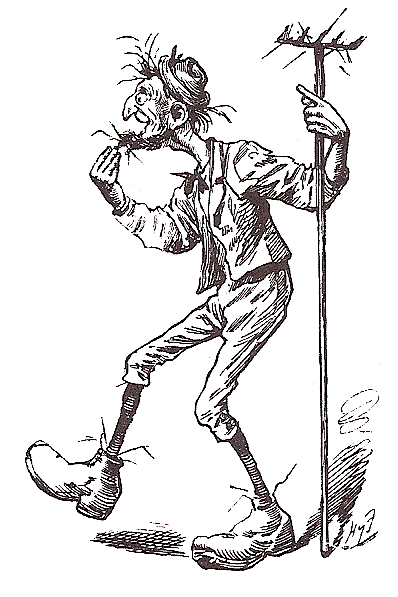
Illustration: A Harry Furniss illustration for ‘The Mad Gardener’s Song’ from the Lewis Carroll novel Sylvie and Bruno.

Potcake Poet’s Choice: Max Gutmann, ‘Raindroppings’

Can anyone make out
The quality inherent
In being with an umbrella, that makes people without
Completely transparent?

On the rainiest days,
In the hardest of showers,
People with umbrellas courteously step out of other umbrella’d people’s ways
Right into ours.

Or, if as it starts
To really pour, ya
Dash for the shelter of a little awning, sure as rain’s wet someone with an umbrella darts
Under it before ya.

And you look at the fella
As you stand in the steady
Downpour, but he ain’t gonna budge, ’cause, as any one-eyed idiot could plainly see, his umbrella
Is wet enough already.

Beyond disputation,
We already hear a lot
About the many forms of indiscriminate discrimination
Our world has got.

Still, I wish some teller’d
Deign to tell us
The reasons for the way the umbrellered
Treat the umbrell’less.

Max Gutmann writes: “In ‘Raindroppings,’ a line of OgdenNashian length is part of each otherwise regularly metered quatrain. These lines get longer and longer, and then shorter and shorter. I hope this helps the poem feel both sillily loose, and formally structured: the topic, though it may sound invented, is an actual aspect of human nature, trivial in itself but reflective of more serious attitudes.”

Max Gutmann has worked as, among other things, a stage manager, a journalist, a teacher, an editor, a clerk, a factory worker, a community service officer, the business manager of an improv troupe, and a performer in a Daffy Duck costume. Occasionally, he has even earned money writing plays and poems.

linkmaxgutmann.com

‘Raindroppings’ was first published in Light Quarterly

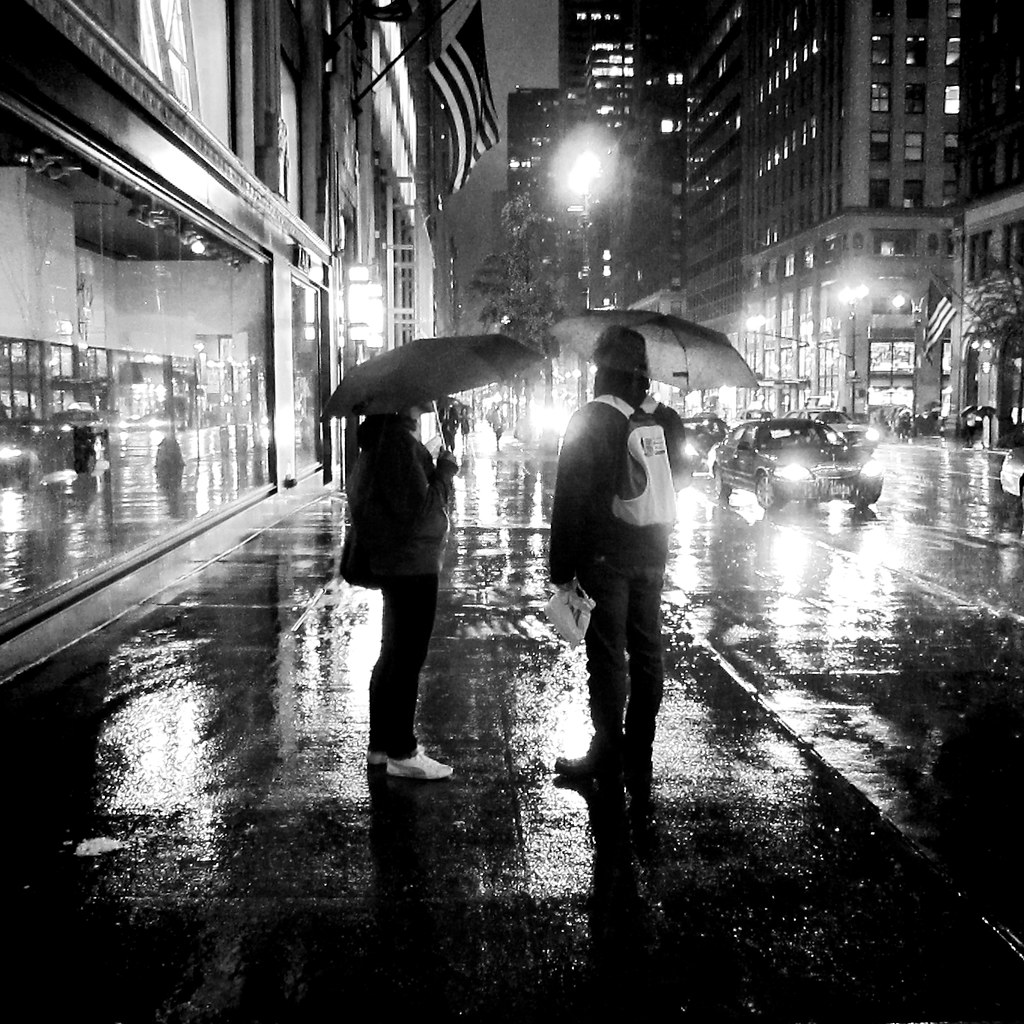
Photo: “Downpour” by roeyahram is marked with CC BY-NC-ND 2.0.

Potcake Poet’s Choice: Gail White, ‘Snails’

This morning, at my garbage can,
just underneath the lid,
two snails in the embrace of love
connubially hid.

Who knows what dangers they had passed,
how high they had to climb,
in order to achieve at last
this interchange of slime?

I left you unmolested, snails,
beneath your plastic shelf,
because on Friday nights I look
ridiculous myself.

Gail White writes: “This is a favorite light verse of mine, first published in Light. Our sexual nature gives us something in common with even the lowliest life forms, a fact which caused me to spare the snails from eviction.”

Gail White is the resident poet and cat lady of Breaux Bridge, Louisiana. Her books ASPERITY STREET and CATECHISM are available on Amazon. She is a contributing editor to Light Poetry Magazine (lightpoetrymagazine.com). “Tourist in India” won the Howard Nemerov Sonnet Award for 2013. Her poems have appeared in the Potcake Chapbooks ‘Tourists and Cannibals’, ‘Rogues and Roses’, ‘Families and Other Fiascoes’ and ‘Strip Down’.
https://www.amazon.com/Asperity-Street-Gail-White/dp/1927409543

“snails mating” by tonrulkens is licensed under Openverse from WordPress.org