Tag Archives: Maryann Corbett

Maryann Corbett, ‘October’

I fail at them, these scenes
where beauty is married to fear.
I have failed before with this one.
How can I make it clear

when the moment itself was a blur?
My son and I, that night,
stepped through the warm, wet air
that had magicked every light

to a wide, all-hallowing halo.
He said–I think he was ten,
still with his clear soprano–
It’s lovely out here.
And then

the edge of every nimbus,
pale gold through a fog scrim,
shivered, knowing that beauty soon
would be bullied out of him.

*****

Maryann Corbett writes: “This poem (first published in Mezzo Cammin) is indeed based on one of those indelible memories, the sort that lodge in a parent’s brain for decades. And I have in fact tried to write about it before without succeeding. I’ve never asked my very adult son whether he remembers this moment at all.”

Maryann Corbett earned a doctorate in English from the University of Minnesota in 1981 and expected to be teaching Beowulf and Chaucer and the history of the English language. Instead, she spent almost thirty-five years working for the Office of the Revisor of Statutes of the Minnesota Legislature, helping attorneys to write in plain English and coordinating the creation of finding aids for the law. She returned to writing poetry after thirty years away from the craft in 2005 and is now the author of two chapbooks and six full-length collections, most recently The O in the Air (Franciscan U. Press, 2023). Her work has won the Willis Barnstone Translation Prize and the Richard Wilbur Award, has appeared in many journals on both sides of the Atlantic, and is included in anthologies like Measure for Measure: An Anthology of Poetic Meters and The Best American Poetry.

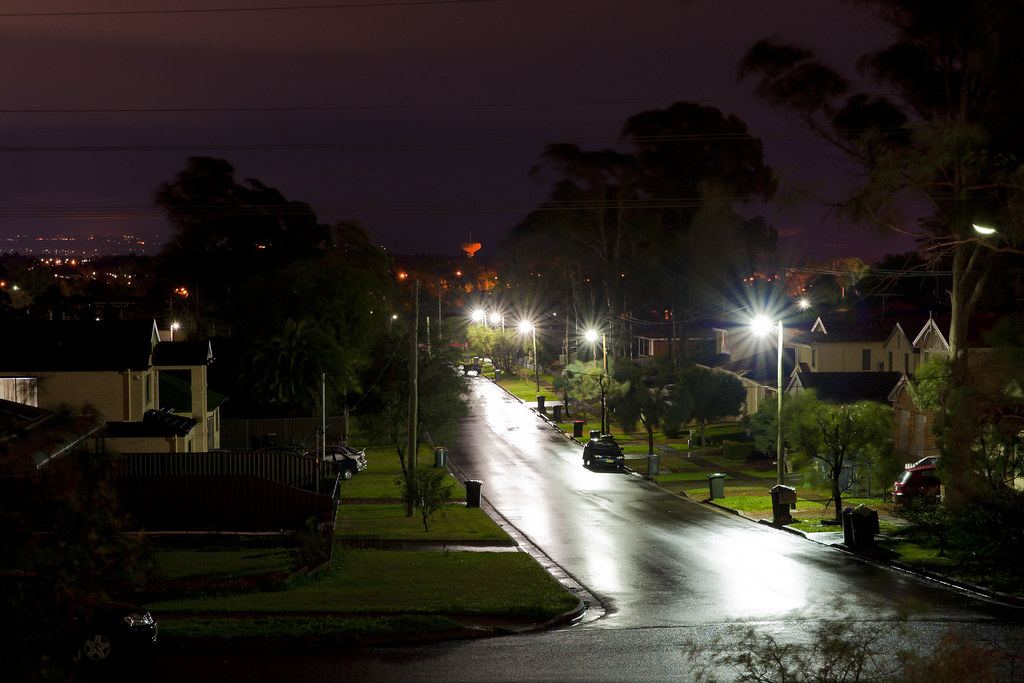
Photo: “Bright Lights of Quakers on a Wet Night” by Frank.Li is licensed under CC BY-NC-SA 2.0.

Maryann Corbett, ‘To the Anti-Librarian’

Small vandal, parked on your padded bum
on a cheerful rug in the Children’s Section
next to a bottom shelf,
yanking the volumes one by one
till they strew the aisle in every direction,
loudly pleased with yourself
at the way your brightly patterned havoc
obstructs the traffic,

keep to your task. Disrupting order
is evolution’s eternal purpose.
Surely it’s been your goal
from the hour two gametes burst their border
and two tame selves went wild as a circus.
Systems that once felt whole
eyeballed each other, laughed, and gambled,
and lives got scrambled.

Do your worst, then, with giggles, rage,
and all the smackdown-loud rebellion
grown-ups are now too tired for.
These sleepless two, in a golden age,
were a black-clad goth and a hard-rock hellion.
Change is the charge we’re wired for.
small changer, blessings. Though elders frown,
pull the world down.

*****

Maryann Corbett writes: “Like many poems, this one (first published in LIGHT) is part memory and part pure fiction. “Anti-librarian” was our joke term for our daughter as an infant when (long years ago) she sat on her tush next to the bookshelves and pulled the books off just because she could. The image of young parents as reformed characters is imaginary. The hope that the young will change the world seems to be eternal.”

Maryann Corbett earned a doctorate in English from the University of Minnesota in 1981 and expected to be teaching Beowulf and Chaucer and the history of the English language. Instead, she spent almost thirty-five years working for the Office of the Revisor of Statutes of the Minnesota Legislature, helping attorneys to write in plain English and coordinating the creation of finding aids for the law. She returned to writing poetry after thirty years away from the craft in 2005 and is now the author of two chapbooks and six full-length collections, most recently The O in the Air (Franciscan U. Press, 2023). Her work has won the Willis Barnstone Translation Prize and the Richard Wilbur Award, has appeared in many journals on both sides of the Atlantic, and is included in anthologies like Measure for Measure: An Anthology of Poetic Meters and The Best American Poetry.

Picture: ‘Anti-Librarian’ by RHL and ChatGPT.

Sonnet: Maryann Corbett, ‘Saturday Edition’

Page one, above the fold: the world in flames.
A luxury hotel gapes like a sore.
In mammoth type, the headlines yell the names
of prophets stoking hells of holy war.

In Business, meanwhile, there is calm discussion
of sales rates for the sexy underclothes
pitched by Victoria’s Secret, and a fashion
for surgical revision of the nose.

It isn’t news to those who sell the paper:
their readers can take only so much hell.
They proffer me the surgeon and the draper
as pastures where my bovine brain may dwell,

ignoring, while it chews on this confection,
the screams of children from the other section.

*****

Maryann Corbett writes: “My records tell me that ‘Saturday Edition’ is one of my very earliest sonnets and very earliest acceptances, appearing in The Barefoot Muse in 2007 and included in Mary Meriam’s Irresistible Sonnets in 2014. It was among the poems that gave me the lightbulb realization that I tend to write sonnets when I’m angry.”

Maryann Corbett earned a doctorate in English from the University of Minnesota in 1981 and expected to be teaching Beowulf and Chaucer and the history of the English language. Instead, she spent almost thirty-five years working for the Office of the Revisor of Statutes of the Minnesota Legislature, helping attorneys to write in plain English and coordinating the creation of finding aids for the law. She returned to writing poetry after thirty years away from the craft in 2005 and is now the author of two chapbooks and six full-length collections, most recently The O in the Air (Franciscan U. Press, 2023). Her work has won the Willis Barnstone Translation Prize and the Richard Wilbur Award, has appeared in many journals on both sides of the Atlantic, and is included in anthologies like Measure for Measure: An Anthology of Poetic Meters and The Best American Poetry.

Photo: “UN School in Gaza Attacked” by United Nations Photo is licensed under CC BY-NC-ND 2.0.

Weekend read: Maryann Corbett, ‘A Valediction: of Maintenance Work’

Time was, we spent our muscle and our nous
propping an aging house
against the pummeling of its hundred years.
Clean paint, neat gardens, upkeep rarely in arrears,
sober as Donne. Yet now each year afresh
burdens us with new failings of the flesh:

Legs that once mounted ladders without qualm
tremble. Nor are we calm
confronting pipework; torsos will not shrink,
backs bend, or shoulders fold to grope below a sink.
Hands shake; eyeballs glaze over. What appalls
is that our bodies buckle like our walls:

plaque in arteries, soot in chimney stacks,
stubborn and troublous cracks
in teeth, in plaster. House! Ought we to call
ourselves—and you—new poster children for the Fall,
for that hard doctrine grumbling down the ages
that Sin’s to blame, with Death and Rot its wages?

Entropy as theology—would Donne
jape at it? Wink and pun
as in his randy youth? Or solemnly
robed in his winding sheet, sing Mutability,
spinning into the praise of God in Art
the fact that all things earthly fall apart?

Or pull from air some bit of modern science,
yoking (even by violence)
thermodynamics, shortened telomeres,
transplants, genetics, sex, the music of the spheres?
Strange physics and wild metaphors—all grand,
but Rot and Death, plain woes we understand,

are better fought with checkbooks than with verse.
We’ll sit, these days. We’ll nurse
our beers, while able bodies stir their dust.
A distant siren whines—we sigh; it whines for us.
Let plumbers, painters, carpenters begin
this season’s round of battling Death and Sin.

*****

Maryann Corbett writes: “Last summer, Clarence Caddell was just beginning work on a new magazine, The Boroughand was planning a second issue while the first came together. He had in mind an issue centered on Donne, and he commissioned me to contribute a poem. I’d read the wonderful biography Super-Infinite: The Transformations of John Donne by Katherine Rundell not many months before, so a lot of the life was fresh in my mind–but it was also the season of endless repair that is the eternal truth of owning a house that’s 113 years old.  It wasn’t hard to pull together a poem about the woes of home ownership with tidbits that “everyone knows” about Donne–his worldly-to-holy conversion, the familiar line about his yoked-by-violence metaphors–under an allusive title, and in a stanza form a bit like one of his. (Alas, this blog can’t show you the indents that would best imitate Donne’s way of laying out a poem. You’ll have to imagine all the trimeter second lines indented and the hexameter fourth lines hanging out farther left.) In the end, Clarence had to use the poem to fill out his first issue, so it sat alone, unassisted by an issue theme.”

Maryann Corbett earned a doctorate in English from the University of Minnesota in 1981 and expected to be teaching Beowulf and Chaucer and the history of the English language. Instead, she spent almost thirty-five years working for the Office of the Revisor of Statutes of the Minnesota Legislature, helping attorneys to write in plain English and coordinating the creation of finding aids for the law. She returned to writing poetry after thirty years away from the craft in 2005 and is now the author of two chapbooks and six full-length collections, most recently The O in the Air (Franciscan U. Press, 2023). Her work has won the Willis Barnstone Translation Prize and the Richard Wilbur Award, has appeared in many journals on both sides of the Atlantic, and is included in anthologies like Measure for Measure: An Anthology of Poetic Meters and The Best American Poetry.


Photo: “House Repairs” by JessNityaJess is licensed under CC BY-NC-SA 2.0.

Weekend read: Maryann Corbett, ‘An Orientation’

If, in the midst of this elated day,
someone took him aside with the stern warning,
Most of your life will not be like this morning,
he’d never hear it. How–while fountains play
beside clipped lawns and walkways arched with green
maples that move to stipple white and gold
on paths he and his harried parents have strolled
laden for move-in–how could he hear? He’s seen
Arcadia now, where classical facades
put a straight face on tanglements of thought,
and edgy spears of light and color, wrought
in steel and glass, look daggers at the gods.

The whole week’s strewn with glittering temptations
and parti-colored parties for the eyes:
gown-sleeves aflap like tropical butterflies,
professors float along in convocations.
Some one of them, someday, and over a drink,
will show him grittier visions: Rumor. Snark.
Administrative bloat. Nowhere to park.
How only summers bless you with time to think.
How even the mind’s beauties fester, vexed
by deadlines, balky software, budget hassle.
How research builds its turreted air-castle,
gorgeous for one day, rubble on the next.

But here, today, does anybody give
a bleep for realness? Let us cleave to form,
leaving him to his roommate and his dorm
and whispering, Here’s the poison. Drink and live.

*****

Maryann Corbett writes: “A few years ago, I happened to be on the campus of a nearby university on move-in day during freshman orientation week. It was an experience that gave me poem-provoking nostalgia.
“Orientation week is an institution I know well; I’ve lived my own college orientation and each of my children’s, and I’ve worked as a university staffer conducting such events. Freshman orientations usually take place in the week before classes begin in the fall and before other students return to campus. They’re meant to give new students everything they need to settle in and become part of the university community.
“But in addition to practicalities like moving young people into their dormitories — and dealing with parents’ emotional goodbyes — orientations will always involve hype and hoopla. Beautiful campuses are part of that hoopla, part of the seduction of academe. There will also be welcoming events that overpraise what students have achieved just by being admitted, tours that overpraise the campus’s buildings and amenities, and academic convocations with professors in full regalia delivering speeches that overpraise everything about the academic world.
“How true is all this as a picture of the scholarly life? I’ve been close enough to the facts of that life to know that the picture needs some correcting pessimism. The poem offers that but says it can wait. Let’s let the students fall in love with the vision before we tell them the truth.”

Maryann Corbett earned a doctorate in English from the University of Minnesota in 1981 and expected to be teaching Beowulf and Chaucer and the history of the English language. Instead, she spent almost thirty-five years working for the Office of the Revisor of Statutes of the Minnesota Legislature, helping attorneys to write in plain English and coordinating the creation of finding aids for the law. She returned to writing poetry after thirty years away from the craft in 2005 and is now the author of two chapbooks and six full-length collections, most recently The O in the Air (Franciscan U. Press, 2023). Her work has won the Willis Barnstone Translation Prize and the Richard Wilbur Award, has appeared in many journals on both sides of the Atlantic, and is included in anthologies like Measure for Measure: An Anthology of Poetic Meters and The Best American Poetry. ‘An Orientation’ is from her collection In Code.

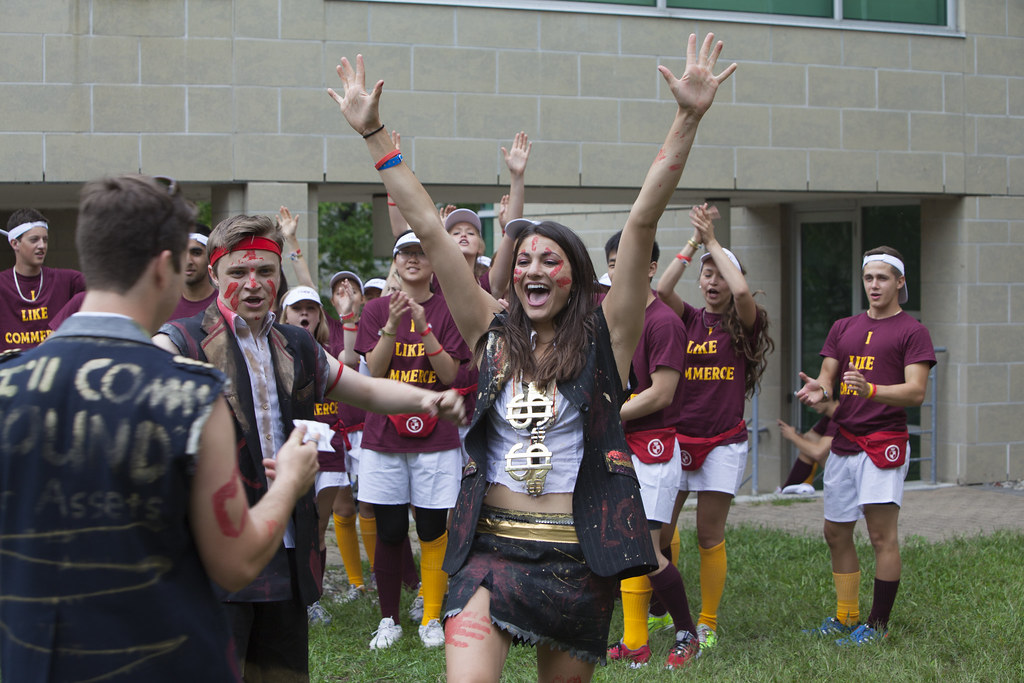
Photo: “Orientation week” by queensu is licensed under CC BY-NC-ND 2.0.

Using form: Stretch Villanelle: Maryann Corbett, ‘Pictures of Ourselves at 21’

a meditation on the current Facebook meme

Those were the days we had amazing hair.
And bodies. And ambitions. Chutzpah, too.
“Look on our manes, ye mighty, and despair!”

we cry, smirking disdain like Baudelaire
from yearbook-picture ranks and files. We grew
it lush, that long-ago amazing hair,

while choruses wailed Gimme down to there
hair! Though in our hippie hearts we knew
we’d have to tame it someday soon, despair

spared us. In shoulder pads, Dynasty flair,
the Farrah Fawcett shag, the Rachel do,
we offered up our still-abundant hair

to workdays. To quotidian wear and tear,
crimpers and curling irons, styling goo.
And then one day the mirror sighed: Despair.

Are these our offspring, whose inventions blare
from TikTok posts in floof and curlicue,
strange new explosions of amazing hair

half-shaved, half rainbow striped? (Try not to stare,
though they return your gawk, peering straight through
your brow lines, fashion failures, gray despair …)

Who were we? Do we remember? Do we care,
you with your naked pate, I with my two-
toned thatch? Is time the low road to despair?
Look at us, though: we had amazing hair.

*****

Maryann Corbett writes: “Every week, the magazine Rattle publishes a ‘Poets Respond’ feature, a poem that reacts to one of the previous week’s news items. For several days at the start of February, I’d been seeing posts by Facebook friends of photos of themselves at the age of 21; it was clearly “something happening” even though it didn’t seem to be a news item. I decided I’d try a poem rather than a picture and I’d aim it at Poets Respond. Over and over, I’d see replies to the posts that exclaimed about the hair, its style or its sheer abundance, so a refrain suggested itself. I went for a villanelle (on the model of Bishop’s ‘One Art’) but found I needed extra space to fit in all the allusions I wanted to the pop culture of the past several decades. We can call it a stretch villanelle, a term Susan McLean gave me. I found out after the fact that there had been a news story about the meme, but the poem prevailed at Poets Respond even without one.”

Maryann Corbett earned a doctorate in English from the University of Minnesota in 1981 and expected to be teaching Beowulf and Chaucer and the history of the English language. Instead, she spent almost thirty-five years working for the Office of the Revisor of Statutes of the Minnesota Legislature, helping attorneys to write in plain English and coordinating the creation of finding aids for the law. She returned to writing poetry after thirty years away from the craft in 2005 and is now the author of two chapbooks and six full-length collections, most recently The O in the Air (Franciscan U. Press, 2023). Her work has won the Willis Barnstone Translation Prize and the Richard Wilbur Award, has appeared in many journals on both sides of the Atlantic, and is included in anthologies like Measure for Measure: An Anthology of Poetic Meters and The Best American Poetry.

Maryann Corbett, ‘Dissonance’

We dress ourselves
from the Goodwill store
since Art has kept us
genteelly poor
and we laugh together
at how we’ve slummed
amid vocalises
and arias hummed
and the mirth for both of us
seemed sincere
so I joked, where others
would overhear,
about our finds
in the plaids and prints

and saw you wince.

*****

Maryann Corbett writes: “Perhaps every poem that seems to portray one small moment is really a goulash of hundreds of moments. That’s certainly true of ‘Dissonance‘. There really was a friend who was a fellow singer, fellow poet, and fellow fan of the bargains to be found in charity shops. And there really was an awkward moment when I misjudged her feelings about artistic penury, a penury I’d escaped in a very un-artistic job. But folded into the writing of the poem were all my student years, years when I was much younger, much poorer, and much more in solidarity with friends still following their dreams.”

Dissonance‘ was first published in Mezzo Cammin, and gave its name to a 2009 chapbook collection published by Scienter Press.

Maryann Corbett earned a doctorate in English from the University of Minnesota in 1981 and expected to be teaching Beowulf and Chaucer and the history of the English language. Instead, she spent almost thirty-five years working for the Office of the Revisor of Statutes of the Minnesota Legislature, helping attorneys to write in plain English and coordinating the creation of finding aids for the law. She returned to writing poetry after thirty years away from the craft in 2005 and is now the author of two chapbooks and five full-length collections. Her work has won the Willis Barnstone Translation Prize and the Richard Wilbur Award, has appeared in many journals on both sides of the Atlantic, and is included in anthologies like Measure for Measure: An Anthology of Poetic Meters and The Best American Poetry. Her sixth book, The O in the Air, is forthcoming from Franciscan University Press.

Photo: “Goodwill outlet store” by sparr0 is licensed under CC BY-SA 2.0.

Poem: ‘City! Oh City!’

Cities–once all smeared with grime,
rich but dirty, full of crime–
clear the excess cars and dust
if their governments are just,
house the homeless, and among
their cares: clean water, healthy young.
Gorgeous buildings grow and twist
through a river’s gentle mist;
trees in leaf for urban hikes:
sculptures, cafes, books and bikes…
children run wild in the park
till theatre signs light up the dark;
music spills from bars at night–
the well-run city’s a delight.

*****

This poem was published (in 2021 or 2022, the Bahamas Post Office seems to have lost my copy so I’m not sure yet) in The Lyric Magazine, Jean Mellichamp calling it “a breath of fresh air”. I wrote it to be an upbeat view of the modern world in contrast to a lot of the more worrying future issues that I’m often concerned with; and when I put together the ‘City! Oh City!’ Potcake Chapbook, I included the poem to balance some of the less rosy views of urban life–though my poem is nowhere near as skilled as the pieces in the chapbook by Maryann Corbett, Amit Majmudar and others.

Photo: “le quai river cafe on seine” by grahamdale74 is licensed under CC BY-NC-SA 2.0.

Using form: Couplets: Maryann Corbett, ‘Fugue in October’

Baroque chamber ensemble and homeless encampment, Saint Paul

Perfect: the singers, strings, and keyboards. Perfect
Bruised sky above the tents of the squatters’ district
the little jewel-box church, its bright acoustic
calm in the year’s last mildness, the only music
softened a little in the candles’ lighting,
the mumbling underpass. The wind. No fighting
for this is God’s mind, woven of harmonies
for once. Tonight, for once, no one ODs—
and our souls thread through the flame of the vigil lamp
someone got lucky at the entrance ramp
as we hold, hold to Monteverdi’s line
(panhandling, on this warm day, with a sign)
and stop our breath until the last string dies
and parcels out his manna of salty fries
in the last great chord of his Beatus vir
while sirens wail some sorrow, far from here.

*****

Editor’s comments: “In case it isn’t clear from whatever device you are reading this on, each couplet here is comprised of a line about a musical ensemble in a church followed by a line about a homeless encampment under a highway. You can read it straight through as a soft-voiced line followed by a harsher one; or you can read every other line in one voice and the remaining lines in a different voice; either way, you are blending two very different aspects of city life into a larger, richer picture of community sharing, whether in glamour or squalor. This is an unusual and remarkably effective use of rhymed couplets of iambic pentameter.
The contrast built into the poem, and the skill with which it was done, made it a natural poem for inclusion in the ‘City! Oh City!‘ Potcake chapbook. It first appeared in Measure Review; and is included in the collection In Code.

Maryann Corbett writes: “Events that trigger a poem need not be as simultaneous as the poem makes them seem. The choral concert in this poem took place on a subzero night during the Christmas season; the rise of homeless encampments occurred at a warmer time of year–but both could be happening in my city at any time, and they probably still are.”

Maryann Corbett earned a doctorate in English from the University of Minnesota in 1981 and expected to be teaching Beowulf and Chaucer and the history of the English language. Instead, she spent almost thirty-five years working for the Office of the Revisor of Statutes of the Minnesota Legislature, helping attorneys to write in plain English and coordinating the creating of finding aids for the law. She returned to writing poetry after thirty years away from the craft in 2005 and is now the author of two chapbooks, five full-length collections already published, and a forthcoming book. Her fifth book, In Code, contains the poems about her years with the Revisor’s Office. Her work has won the Willis Barnstone Translation Prize, has appeared in many journals on both sides of the Atlantic, and is included in anthologies like Measure for Measure: An Anthology of Poetic Meters and The Best American Poetry 2018.

Her web page: http://maryanncorbett.com

Photo: “sleeping on the rock of ages” by waferboard is licensed under CC BY 2.0.

Maryann Corbett: ‘The Nutshell Studies of Unexplained Death’

Crime scene dioramas created as teaching tools by Frances Glessner Lee
Renwick Gallery, Washington, D.C.

Well-behaved voyeurs
bend above these exquisite
dollhouse miniatures

where the small-scale poor
die in ’40s dailiness.
Blood speckles a floor

tiled in one-to-twelve
scale. Ditto bath fixtures, beds,
plates shocked from a shelf—

Here’s a girl’s sliced neck.
Here’s another, legs jutting
from a tub, freaklike.

Is this Dresden head
brush-tipped with the purpling
livor of the dead?

To appreciate
such intently crafted pain,
one must contemplate

finger-cramping care:
quarter-inch-high postcards, penned
with a single hair.

A close eye for sin’s
rigor vitae: tiny socks
hand-knitted with pins.

Strict detail is key.
Look there for the rage of God.
Search for that and see,

sisters. As will I,
taken with the pains by which
quiet women die.

*****

Maryann Corbett writes: “In the autumn of 2018, I visited Washington, D.C. to speak at Catholic University, and while I was there, my sister-in-law took me to visit the Renwick Gallery. Its permanent displays are all lovely, but what stayed with me was a visiting exhibition: the Nutshell Studies. The quaintness of the doll-sized views and the perfection of craft in the recreated period interiors contrasted eerily with the bloody crimes laid out in them. They all stayed with me for a long time, and I did more digging about their creator and her work. The resulting poem—in haiku stanzas, because a small form seemed appropriate—was first published in Pangyrus. It’s included in the book In Code, which centers on my years in the Revisor’s Office but talks about all sorts of social evils.”

Maryann Corbett earned a doctorate in English from the University of Minnesota in 1981 and expected to be teaching Beowulf and Chaucer and the history of the English language. Instead, she spent almost thirty-five years working for the Office of the Revisor of Statutes of the Minnesota Legislature, helping attorneys to write in plain English and coordinating the creating of finding aids for the law. She returned to writing poetry after thirty years away from the craft in 2005 and is now the author of two chapbooks, five full-length collections already published, and a forthcoming book. Her fifth book, In Code, contains the poems about her years with the Revisor’s Office. Her work has won the Willis Barnstone Translation Prize, has appeared in many journals on both sides of the Atlantic, and is included in anthologies like Measure for Measure: An Anthology of Poetic Meters and The Best American Poetry 2018.

Her web page: maryanncorbett.com

Photo: “Murder is Her Hobby Exhibition” by massmatt is licensed under CC BY 2.0.