Tag Archives: rhyme

RHL, ‘The Sun is Always Setting’

The sun is always setting, always setting on your day;
you sense the dark approaching, wish that it would stay away.
Do you want a life unchanging? Wish to still be a newborn?
Don’t you know life’s not a rosebud, but has root and leaf and thorn?

The sun is always setting and the black drapes are unfurled;
but notice that the sun sets on your world, not on the world:
it’s rolling into brightness in another’s happy land,
and the dark is evanescent and the brightening is grand.

The sun is always setting on the dinosaurs, but birds
are flocking into being, as are Serengeti herds;
and the sun that lights humanity? Of course it’s going to set,
and elsewhere light new tales of which we’ll just be a vignette.

The sun is always setting, but that view is just your choice;
I say the world is turning and evolving; I rejoice.

*****

Sometimes I’m told that my poetry is too bleak. But I think that’s only so if you want everything to stay as it is now. If, on the other hand, you expect change, and that change will ultimately provide more benefit than loss to the universe as a whole, then <shrug>… so it goes.

This poem has 14 lines but is hardly a sonnet. It was recently published in Pulsebeat Poetry Journal. Thanks, David Stephenson!

Photo: “Sunset Sadness” by BaboMike is licensed under CC BY-NC 2.0.

Casual form: Lisa Marshall, ‘Lust’

Under the moonlight’s magical hold
Lust prowls like a wolf, hungry and bold

Slinking by with a wink of the eye
Slowly drawing me in on the sly

Into temptation’s cunning allure
Tainting even the purest of pure

Whispered confessions into the wind
Forgive me, Father, for I have sinned

*****

Editor’s comments: I’m classifying these lines as ‘casual form’: the meter is undisciplined by classical standards, but the beat is clear and the rhymes are straightforward. The verse is as natural to English as nursery rhymes, noted for their ease of memorisation without being classically regular. Look at the varying numbers of syllable per foot in the four lines of ‘Baa Baa Black Sheep’, for example. English speech is very forgiving regarding unstressed syllables, while still maintaining a rhythmic flow – as we know from rap. By that standard, adherence to beat and structured rhyme is adherence to form.

Lisa Marshall is a poet and author who resides in beautiful Dartmouth, Nova Scotia – also known as the City of Lakes.  She is the author of Black Olive: A Novel and Poetry for the Feminist’s Soul, both of which are available on Amazon Kindle. 
Read more at Not Another Nice Girl Blog.

Photo: from Lisa Marshall’s blog.

J.D.Smith, ‘Proposal’

Resign yourself, my heart’s delight,
To me before a better offer
Comes along with hair and height,
A sea-deep chest, a bulging coffer.

Don’t wait for him: if love’s a song,
I am the toad’s primeval croak.
If love’s a wheel, then I belong
Among its rusty, broken spokes.

If I mean nothing in the world
To you, that nothing could be all,
A version of transcendence, curled
And primed to blossom from your soul.

Who else is equal to this test,
This cup of gall? You’ve had a sip–
In our shared life you’ll taste the rest.
Come join me on this sinking ship.

*****

J.D. Smith writes: “This poem explains, if nothing else, why I didn’t go into sales. It was not written for a specific person, but it does capture a time earlier in my adulthood when I was frustrated on all fronts. The poem also partakes of self-parody. If Philip Larkin had proposed in writing, it might have gone something like what I did.”

J.D. Smith has published six books of poetry, most recently the light verse collection Catalogs for Food Lovers, and he has received a Fellowship in Poetry from the United States National Endowment for the Arts. This poem is from The Killing Tree (Finishing Line Press, 2016). Smith’s first fiction collection, Transit, was published in December 2022. His other books include the essay collection Dowsing and Science. Smith works in Washington, DC, where he lives with his wife Paula Van Lare and their rescue animals.
X: @Smitroverse

Illustration: by Edward Lear for his poem ‘The Courtship of the Yonghy-Bonghy-Bo’.

RHL, ‘Everyone’

Everyone’s naked under their clothes,
everyone’s bald under their hair;
hide if you like, everyone knows!
Everyone sees what you’re like under there.

Everyone’s meat under their skin,
everyone’s bones under their meat;
we know what your outside is hiding within:
hiding will always end in defeat.

So banish the words and censor the book,
draw little clothes on the cartoons for kids;
everyone knows where your dirty eyes look,
everyone sees that your life’s on the skids.

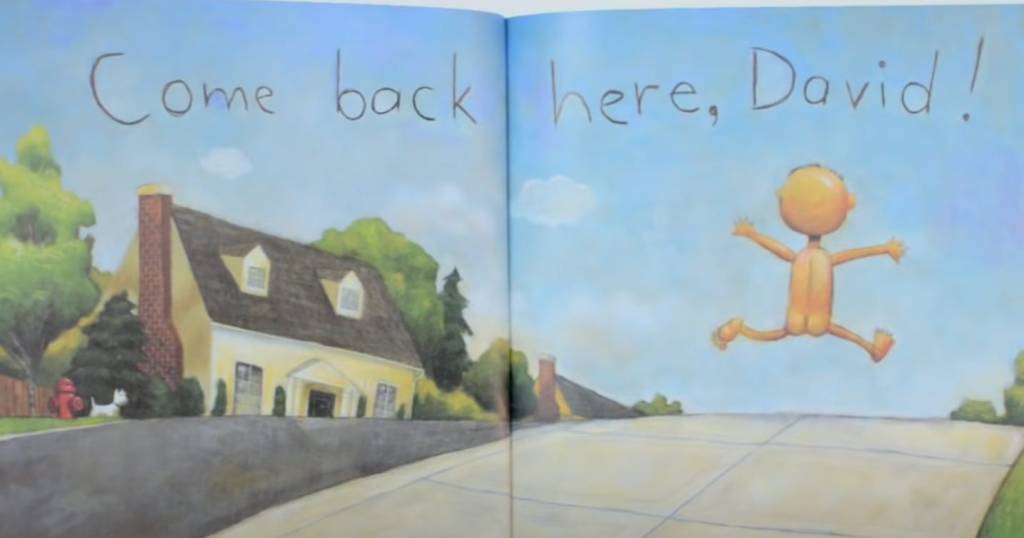
This poem was a response to the news out of Florida that elementary schools are being forced to draw clothing on cartoon characters in children’s books if the printed images show nakedness of either front or back. The right-wing nutcase group ‘Moms For Liberty’ is causing the trouble.
This link https://popular.info/p/pressed-by-moms-for-liberty-florida gives details and shows some of the results.
Incidentally, one co-founder of the Moms for Liberty group is Bridget Ziegler. Apparently she and her husband Christian Ziegler had sexual threesomes with another woman; and when Bridget backed out of a planned threesome event in October 2023, Christian went along anyway; the third party declined sex, saying she was in it more for Bridget; so Christian raped her. The woman then filed a complaint with the police.
Why is it that the hysterically over-moral types seem to be the ones causing most of the problems?

This poem was published in the March 2024 issue of Lighten Up Online (aka LUPO); thanks, Jerome Betts!

Photo: illustration from ‘No, David!‘, written and illustrated by David Shannon.

Parody: Brian Allgar, ‘If you can …’

If you can make her laugh, that’s half the battle,
Especially if she’s married to a bore;
If you can make her glad to be your chattel,
Yet treat her like a lady, not a whore;
If you can undo bra-straps single-handed
While murmuring enticements in her ear;
If you can make her think you’re being candid
When telling her just what she wants to hear;
If you, my friend, can easily persuade her
To sample things she’s never tried before,
Or if she sighs with pleasure when you’ve laid her,
And smiles as you sneak out by the back door;
If you can tolerate her endless prattle,
(And never tell her “Darling, get a life”),
Her gossip and her foolish tittle-tattle—
Then you’re the bastard who seduced my wife!

*****

Brian Allgar writes: “Written with a particularly amoral friend of mine in mind, although I am glad to say that the narrator is not me.”

Brian Allgar was born a mere 22 months before Adolf Hitler committed suicide, although no causal connection between the two events has ever been firmly established. Despite having lived in Paris since 1982, he remains immutably English. He started entering humorous competitions in 1967, but took a 35-year break, finally re-emerging in 2011 as a kind of Rip Van Winkle of the literary competition world. He also drinks malt whisky and writes music, which may explain his fondness for Mendelssohn’s Scottish Symphony.
He is the author of “The Ayterzedd: A Bestiary of (mostly) Alien Beings” and “An Answer from the Past, being the story of Rasselas and Figaro”, both available from Kelsay Books and Amazon.

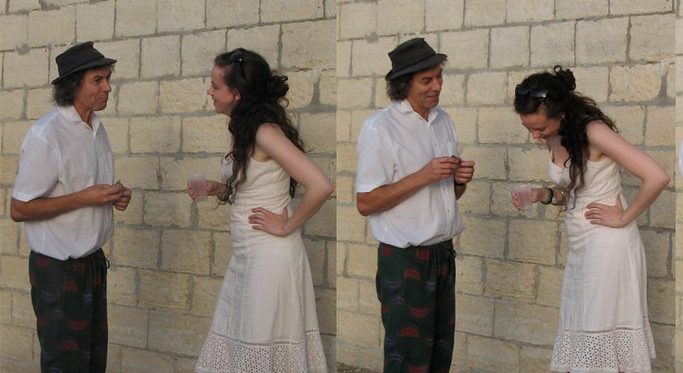
Photo: “Making Her Laugh II” by kahala is licensed under CC BY-NC-ND 2.0.

Richard Fleming, ‘Invisible’

It’s footwear that I recognise
not faces but that’s no surprise:
I don’t look up, they don’t look down
except occasionally to frown
then look away and hurry on
and moments later they are gone.
There’s city Oxfords, polished, black,
worn by the older, banking pack,
and Converse sneakers for the lads,
whose work is fabricating ads.
The women, they too, dress that way:
I rarely see high heels today.
A constant stream of passing feet
flows by me on this busy street
while I sprawl here, small in my shawl,
and ask, do I exist at all?

*****

Richard Fleming writes: “During my early life I wrote non-rhyming verse, having been conditioned to believe that rhyme and metre were old-fashioned and therefore to be avoided: the last thing a young person wants is to be thought of as old-fashioned.
I was also prejudiced against humorous verse: my enjoyment of it was something of a guilty secret as my contemporaries all wrote dark, navel-gazing, stream-of-consciousness nonsense.
During Covid lockdown I found myself with time to reevaluate these blinkered views and finally embraced my love of nonsense verse. I set myself a goal of writing a light-hearted rhyme a day for the duration of lockdown, to assuage boredom, but once I had established a routine, I just kept on writing a bit of rhyming verse each day.
That was more than a thousand days ago and the rhymes just keep rolling out, one per day on Facebook, often inspired by the quirky images I find online but frequently the verse bubbles up of its own accord and I have to seek a suitable accompanying image.
As you might image, I now have an embarrassment of poems that, like the mayfly, live for, at most, one day and are gone. There’s no obvious long-term home for them.”

Richard Fleming is an Irish-born poet (and humorist) currently living in Guernsey, a small island midway between Britain and France. His work has appeared in various magazines, most recently Snakeskin, Bewildering Stories, Lighten Up Online, the Taj Mahal Review and the Potcake Chapbook ‘Lost Love’, and has been broadcast on BBC radio. He has performed at several literary festivals and his latest collection of verse, Stone Witness, features the titular poem commissioned by the BBC for National Poetry Day. He writes in various genres and can be found at www.redhandwriter.blogspot.com or Facebook https://www.facebook.com/richard.fleming.92102564/

Photo: “2016 – Mexico – Puebla – Street Person” by Ted’s photos – For Me & You is licensed under CC BY-NC-SA 2.0.

Using form: Quatrains: Stephen Gold, ‘So Pseud Me’

My verse is of the humorous variety,
And does its best to brighten up society.
To spread a little joy’s a noble calling,
A life without a laugh would be appalling.

Yet still, of late, I’ve had a thought that niggles;
What worth is work that just produces giggles?
Should it be judged as slight and ineffectual,
Compared to art we label intellectual?

And so I did what “proper” poets do,
And signed up to The Scrivener’s Review,
“The connoisseur of poesy’s magazine”,
Where scribes will scratch your eyes out to be seen.

I found it was a terrifying place,
Where people were obsessed with lower case,
Allusions veered from cryptic to absurd,
And “meaning” seemed to be a dirty word.

Their poetry was like the peace of God,
That passeth understanding – truly odd.
Some claimed to write for womxn and for mxn,
Though none had come across the verb, “to scxn”.

With open mind, I asked, “Is it my fault
That there is nothing here I can exalt?”
But days of dredging through this awful rot
Confirmed beyond all doubt that it was not.

Each new excrescence served to reinforce
That I had veered disastrously off course.
I wheeled around and fled back to the light
Which shines upon the droll and erudite,

Bring on a world where rhyme and meter matters,
And isn’t full of folk as mad as hatters.
Adieu to “Scrivener’s Review”, I quit.
Do I need what you’re full of? Not one bit.

*****

Stephen Gold writes: “The idea for So Pseud Me came from wading through an august poetry periodical which had better remain nameless, and coming to the following conclusion: WTF?
There was some good, thoughtful work, but much of it was pretentious drivel, written by the deservedly obscure with their heads rammed firmly up that place where the Lord causeth not the sun to shine.
If you were to ask them, I guess most would place high verse on a pedestal, way above light. But on this, I am with Kingsley Amis, who wrote in the New Oxford Book of Light Verse:
“Light verse makes more stringent demands on the writer’s technique. A fault of scansion or rhyme, an awkwardness or obscurity that would damage only the immediate context of a piece of high verse endangers the whole structure of a light-verse poem. The expectations of the audience are different in the two cases, corresponding to the difference in the kind of performance offered. A concert pianist is allowed a wrong note here and there; a juggler is not allowed to drop a plate.”
‘So Pseud Me’ is a light-hearted attempt to speak up for jugglers.”

Stephen Gold was born in Glasgow, Scotland, and practiced law there for almost forty years, robustly challenging the notion that practice makes perfect. He and his wife, Ruth, now live in London, close by their disbelieving children and grandchildren. His special loves (at least, the ones he’s prepared to reveal) are the limerick and the parody. He has over 700 limericks published in OEDILF.com, the project to define by limerick every word in the Oxford English Dictionary, and is a regular contributor to Light and Lighten Up Online (where this poem was first published).

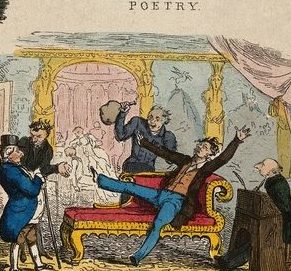
Illustration: “A group of poets carousing and composing verse under the influence of laughing gas. Coloured etching by R. Seymour after himself, 1829.” is licensed under CC BY 4.0.

Short poem: Richard Fleming, ‘The Clock Collector’

He didn’t hurry, took his time
to gradually collect the clocks:
large clocks, small clocks, clocks with a chime,
he gathered stocks of ticks’n tocks
time-pieces, chronographs, all gold,
he harvested them like a crop.
He hoped to put his life on hold
but time, unmeasured, did not stop.

*****

Richard Fleming writes: “I think I was just playing with rhyme on this one. That it says something serious was an unexpected bonus.”

Richard Fleming is an Irish-born poet (and humorist) currently living in Guernsey, a small island midway between Britain and France. His work has appeared in various magazines, most recently Snakeskin, Bewildering Stories, Lighten Up Online, the Taj Mahal Review and the Potcake Chapbook ‘Lost Love’, and has been broadcast on BBC radio. He has performed at several literary festivals and his latest collection of verse, Stone Witness, features the titular poem commissioned by the BBC for National Poetry Day. He writes in various genres and can be found at www.redhandwriter.blogspot.com or Facebook https://www.facebook.com/richard.fleming.92102564/

Edmund Conti, ‘My Son the Critic’

Read me a bedtime poem, said my son.
So I read him this:

We say hippopotami
But not rhinoceri
A strange dichotomy
In nature’s glossary.

But we do say rhinoceri, he said. Look it up.
So I read him this:

Life is unfair
For most of us, therefore
Let’s have a fanfare
For those that it’s fair for.

I smell a slant rhyme, he said, sniffing.
So I read him this:

While trying to grapple
With gravity, Newton
Was helped by an apple
He didn’t compute on.

My teacher says that’s not poetry, he said.
So I read him this:

René Descartes, he thought
And therefore knew he was.
And since he was, he sought
To make us think. He does.

That made me think, he said. But not feel.
So I read him this:

My hair has a wonderful sheen.
My toenails, clipped, have regality.
It’s just all those things in between
That give me a sense of mortality.

Did the earth move? I asked. Anything?
Nothing moved. He was asleep.

*****

Edmund Conti writes: “This is one of my favorites today. Tomorrow I might have different ones. I like it because it makes me nostalgic for an event that never happened. (My persona has a better life than me.) It came about after I sent the following quatrain to John Mella of Light Magazine (with appropriate punning title, of course).

We say hippopotami
But not rhinoceri
A strange dichotomy
In nature’s glossary.

John liked it and accepted it. I few weeks later he wrote and said he couldn’t use. Talking to a fellow editor, he learned there is such a plural as ‘rhinoceri.’ But now I was in love with my little piece and wanted to salvage it. But how? All I could think of was to take advantage of the poem’s failing. I came up with the idea of showing several possibly flawed quatrains to my son and having him disparage each one. And lo, the poem! I have 2 sons and when either one questions the reality, I just say it was the other one.”

Edmund Conti has many reasons for wanting his poems published—Power! Fame! Money!—but not (as you can see) as a venue for his bio notes.

Edmund Conti has recent poems published in Light, Lighten-Up Online, The Lyric, The Asses of Parnassus, newversenews, Verse-Virtual and Open Arts Forum. His book of poems, Just So You Know, is published by Kelsay Books,
https://www.amazon.com/Just-You-Know-Edmund-Conti/dp/1947465899/
and was followed by That Shakespeherian Rag, also from Kelsay
https://kelsaybooks.com/products/that-shakespeherian-rag

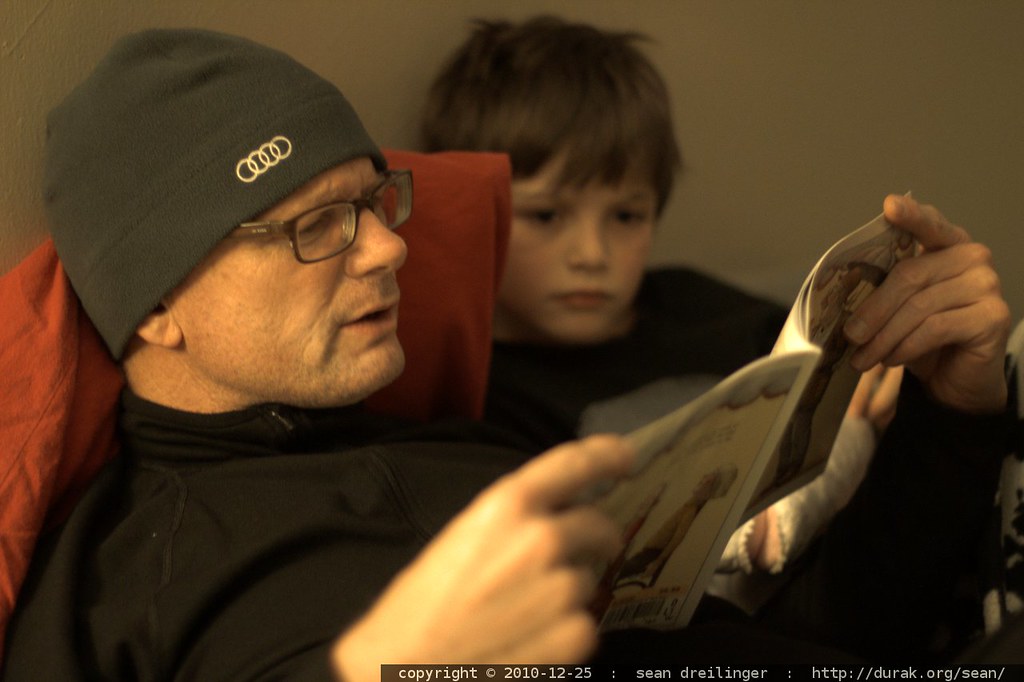
Photo: “grandpa reading nick a bedtime story – MG 6291.JPG” by sean dreilinger is licensed under CC BY-NC-SA 2.0.

Ann Drysdale, ‘Winter Song’

When blizzards blow under the tiles
and the dishcloth crisps on the draining board
and the snowscape stretches for miles and miles
and only the idiot ventures abroad.
When it’s early to bed, and thank heavens for that,
then coldly keens the cast-out cat:
Miaow! Miaow! – a doleful din –
and who will rise and let him in?

When slippery stones by the pond
make filling a bucket an effort of will
and you’re walled-up for weeks in the back of beyond
in a farm at the foot of a hell of a hill
then it’s early to bed, and thank heavens for that,
till coldly keens the cast-out cat:
Miaow! Miaow! – a doleful din –
and who will rise and let him in?

*****

Ann Drysdale writes: “It was published in my very first collection, The Turn of the Cucumber (Peterloo Poets 1995) and dates from a time when I was bringing up three children as a single mum on a hand-to-mouth smallholding on the North York Moors.”

Editor’s note: Ann Drysdale takes the structure, but not the precise metre, of Shakespeare’s ‘Winter Song’ from Love’s Labours Lost. Her rollicking metre allows her “and the snowscape stretches for miles and miles” and the wonderful “in a farm at the foot of a hell of a hill”, for a bigger wintry landscape than Shakespeare shows.

Ann Drysdale now lives in South Wales and has been a hill farmer, water-gypsy, newspaper columnist and single parent – not necessarily in that order. Her eighth volume of poetry, Feeling Unusual, has recently joined a mixed list of published writing, including memoir, essays and a gonzo guidebook to the City of Newport.
http://www.poetrypf.co.uk/anndrysdalepage.html
http://www.shoestring-press.com

Photo: “Hole of Horkum, North York Moors” by reinholdbehringer is licensed under CC BY-NC-SA 2.0.