O it is a wide winter, windy with gales, Hard, harsh and horizonless, cold, And I can do nothing more this year But sharpen the swords, mend the gear, Mend cloth, patch sails, Listen to tales told by the old, Listen to horses stamp in stalls. Feel the blood in my veins going nowhere, Feel the river halt, the bay iced in, The sun brief and thin The food dried, smoked, salt And no fresh fruit, fresh meat, No fresh lands, fresh goods, No fresh deeds, fresh girls, No seas running and blood running And people running and tales running… For what is the good of inaction Save to prepare for fresh action; And what is the good of fresh action Save for fresh tales; And what is the good of fresh tales Save for the glory and the name And the fame that lives past the death rattle For the sword singer, Word winger, The Bard of Battle?
*****
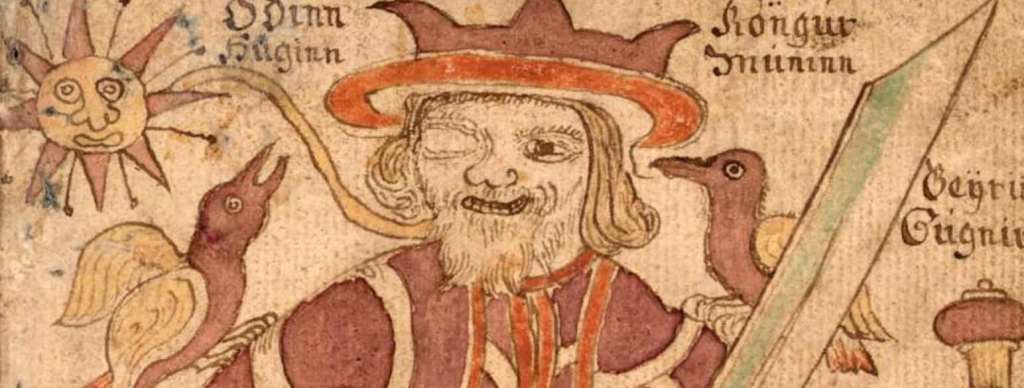
I feel the same fascinated connection to my Viking ancestors that I feel to my even earlier chimp-like forbears and modern chimp and bonobo cousins. All have social networks, hierarchies, politics, violence and ways of overcoming violence, cherished families, a sense of fairness and ways of cheating. I suspect the Viking gods would be far easier for chimps and bonobos to accept than modern scientific understanding could ever be. I greatly enjoy Vikings, chimps and bonobos, recognise that a lot in me comes from them, and am thankful to have outgrown much of their limitations. (And to neo-Nazis who think they are Vikings, I say this: “You’re not; don’t be so stupid.”)
This rambling semi-formal poem was first published in Snakeskin; thanks, George Simmers!
It is only appropriate to end this chapbook on summoning poems with gratitude that anything at all is achieved. We generate thoughts and ideas so constantly and easily that we don’t even wonder how we do it – just as we don’t think how it is that our legs are able to carry us forward when we decide to walk, let alone how our stomachs know whether to digest or reject the things we swallow. Thoughts and ideas come from somewhere and something, an internal process that is being constantly fed from the outside… but quite what that process involves we rarely consider.
This work is an attempt at describing the various stages of writing a poem: being aware of a creative mood, telling your subconscious that you want more ideas by making an effort to record and use the ideas you get, focusing your creativity by reading within the genre you want to write, developing your technical skills in the craft that that genre offers, and building your piece from author to audience with all necessary components and as much elegance as possible… and then recognising that it won’t always be successful, but that it is all a miracle that anything is achieved at all, and you can (and should) be grateful for that.
The opinions and their expression are of course personal and idiosyncratic. YMMV.
This series of poems was written and strung together over a few months in late 2016. I sent it to George Simmers, hoping for comments on such matters as whether the pieces were too disparate in style, whether the rudest of them was too offensive and so on – but his only response was that he would publish it as an e-chapbook, and so it appeared in Snakeskin 236 in January 2017. I’ve toned down the first four lines of Poem 10: ‘Inspiration 1’ for these posts, and I’ve continued to tinker with issues such as English vs American spelling, and whether or not every line should begin with a capital letter. Hopefully the Snakeskin Archive will be restored, and the original chapbook will be available again.
Thank you for reading this far. I hope you found some value in it? I welcome any comments you have.
Of the various publication opportunities specifically for formal/traditional poets, three are taking submissions until July 15, and four other formal-friendly publications have submission deadlines of July 31. There is no submission fee for any of them. Here they are – the links are to the submission requirements:
Able Muse (magazine) Deadline, July 15. Submit one to five metrical poems (or one long poem), rhymed or unrhymed. (A poem of more than 40 lines is considered a “long” poem.) All types of formal poetry are welcome, from traditional to boundary-pushing. We want well-crafted poems that use meter skillfully and imaginatively (with rhyme or not), in a contemporary idiom that reads as naturally as free verse.
Able Muse Press (book-length manuscript) Deadline, July 15. At least 50 pages of poems – same preferences as for the magazine. There’s NO reading fee. “We respond within 9 months or so.”
Helen Schaible International Sonnet Contest Deadline, July 15. Categories: 1 Traditional Sonnet – Shakespearean or Petrarchan 2 Modern Sonnet Open to All. Free. Enter only one poem in either Category #1 or #2, or one poem in each. Prizes for both categories: First Prize: $50. Second Prize: $30. Third Prize: $20.
Formal-friendly magazines, themed and with July 31 cut-offs:
Snakeskin (short poem issue, nothing over 10 lines). At the link, read the tabs on the left side for submission details. Submit earlier than the very end of July, as publication is scheduled for August 1st. Editor: George Simmers.
Allegro (theme: Freedom) Four poems max. Editor: Sally Long.
Amsterdam Quarterly (theme: City and/or Country) Two poems max. Editor: Bryan R. Monte.
Rat’s Ass Review (unthemed – the editor publishes whatever he damn well feels like publishing, as you might have guessed.) Five poems max. Editor: Roderick Bates.
In addition:
Rhizome Press (not to be confused with Rhizome Books) publishes anthologies of formal verse. Editor Beth Houston is taking submissions of up to 10 sonnets for Extreme Sonnets III, and up to 10 “extreme formal poems of at least twelve lines” for Extreme Formal Poems II. The submission deadlines are not given on the website, but will presumably follow on the publication of Extreme Sonnets II which is currently in the works.
UPDATE from Beth Houston, 11 July 2022: “At long last Extreme Sonnets II is published and available on Amazon! Will there be an Extreme Sonnets III? Likely, but not for awhile. In the meantime I’ll be putting together an anthology of love sonnets—extreme sonnets, of course. I’ll post submission details on the Rhizome Press website soon. All sonnets included in Extreme Sonnets, Extreme Sonnets II, and Extreme Formal Poems will automatically be considered. Stay tuned for more details.”
The men in suits, the men in African robes, The men in jeans and sports shirts, The local men in headdresses and thobes, None look out of place. The women in abayas, saris, or long skirts, The women in slacks and blouses (Some with, some without headscarves, depends on race) None look out of place. But the anonymous silent women faceless in veils, And the noisy drunk in-your-face blatant females In shorts that barely cover their barelys, They look alien even in a Gulf airport. The extremes have to be more extreme here to stand out– Either private as houses, Or provocative past any “careless”– But it can be done, with thought.
*****
I wish I had been able to find a photo showing the wonderful range of clothing styles that you encounter in the truly global airports of the Middle East, where travellers on the long-haul carriers change planes en route to Sydney, Tokyo, Mumbai, Johannesburg, Paris, Houston… Your clothing and behaviour has to be extremely extreme if it is to stand out.
This poem was written in Bahrain’s Manama Airport in 2015, published in Snakeskin a year later. It’s not really “formal” verse, is it? 😦
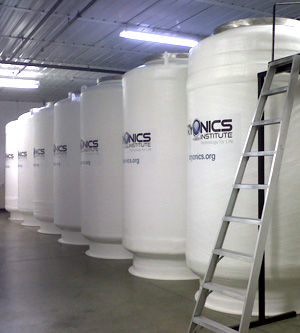
We had no destination ever, from birth, save into the ultimate ocean, or ultimate fire, or ultimate earth. Now we have not quite so ultimate ice. For now, it will have to suffice.
The chance of reanimation from cryonic suspension may be small, but still greater than the chance of reanimation after cremation or burial in land or at sea. And I guess we now have a fifth option – ending up off-planet, adrift in space. But in effect that will be a variant on “not-quite-so-ultimate ice”. In space you’d end up near Absolute Zero, as with cryonics – but whereas with cryonics there is the miniscule hope of eventual reanimation, in space your ultimate fate would be that of all space debris: drifting for millions of years until burning up into a star or planet, or getting sucked into a black hole.
Life, death, quite fascinating. Not many options for changing the outcome, though various billionaires are throwing some of their money at the search for immortality, as people have done since at least the time of the pharaohs and early Chinese emperors. And why not? think it’s “just science fiction”? For thousands of years we used to dream we could fly to the moon, and that happened eventually…
This poem was originally published in Snakeskin #274, July 2020. Thanks, George Simmers!
Religion starts as trying to explain, Progresses to high priests’ financial gain. I’ve tried religions, and seen through them all; Desire is the last domino to fall.
Explore the world – well, fifty lands’ enough; Novelty fades; folks are just folks; stuff’s stuff. I’ve seen both rich and poor round this blue ball; Desire is the last domino to fall.
And I’ve gone barefoot, and I’ve gone first class: The trinkets pall beside bare feet on grass. Markets go up and down and they too pall; Desire is the last domino to fall.
The fearful right, the overtrusting left: Politics, history, both of sense bereft. Reagan’s road leads to Trump and hits a wall; Desire is the last domino to fall.
My arts expression’s been in writing verse– The arse end, clearly, of the universe. There’s rarely silver in the nets I haul; Desire is the last domino to fall.
I’ve had my fill of sex – but when I see A vibrant youth, my thoughts are freshly free. I want, though why I want I mayn’t recall… Desire is the last domino to fall.
This poem, published by George Simmers in April’s Snakeskin, flowed straight out of a comment by Jackson Browne in a Guardian article on his latest album, ‘Downhill From Everywhere’. My thanks go to Mindy Watson, creator of poems in every form she hears of, for identifying this one as a kyrielle. I hadn’t set out to write within a specific form, I merely wrote a poem that used a repeating last line of the stanza. And this highlights one of the things about form: form follows function, in poetry as in architecture. Metre, rhyme scheme, line length, all these are chosen for their appropriateness for the mood and content of the poem. Ballads, sonnets, couplets, villanelles, each type finds its best use in a different situation, each evolved to provide a good expression of a different mood, each became popular as its expressive strength was demonstrated.
A kyrielle seems to me a natural poetic construct for an expression of prayer or despair or wherever all avenues of thought lead back obsessively to the same essential fact or wish. It was formalised in the time of the troubadours, and its name derives from the Late Latin phrase “kyrie eleison“, “Lord, have mercy”. Very appropriate.
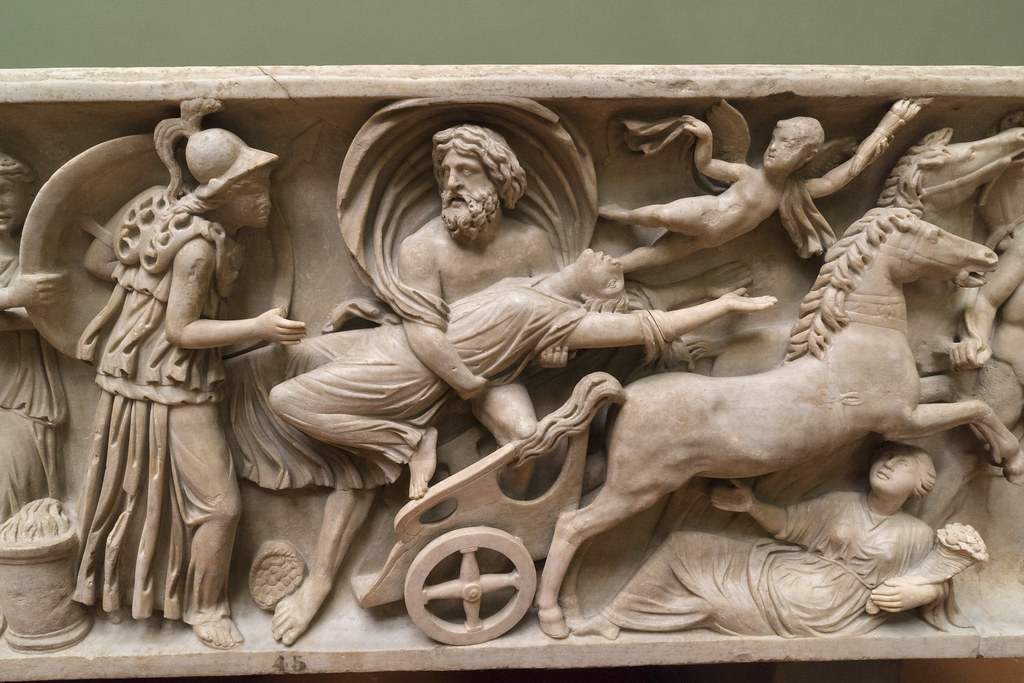
Makaría, my girl, though you’ve heard Every word Of this myth I’ve recounted before, I implore You—indulge me again. For at last You’ve surpassed Fragile childhood’s constraints. Now hold fast And let fantasy shift into creed. You’re Persephone’s daughter; please heed Every word, I implore. You’ve surpassed
Expectations I set at your birth. From my dearth You drew bountiful joy; from disgrace You forged grace. And it’s clear that your eyes could induce Mighty Zeus To devise an elaborate ruse That would send you careening unseen Down to Hades, where I was once queen. From my dearth, you forged grace mighty Zeus—
Who, three decades ago sent me bound Underground As a chthonian bride—would aspire To acquire. Once, Demeter’s stray heart, all aglow For the beau She’d just met, allowed Zeus to sow woe. He pared back the earth’s crust, laying waste To her harvest and left me displaced Underground to acquire. For the beau
Who then claimed me, I burned seven years. Through her tears, Fair Demeter cursed Earth and repealed Springtime’s yield, Vowing Winter would linger ‘til I Bid goodbye To the underworld. Hades complied, For the innocent girl he’d once craved Was no more. As I rose, Mother waved Through her tears. Springtime’s yield bid goodbye
To its seven-year drought. But although Status quo Seemed to flourish again, when detained I’d retained Hades’ seed. It entrenched its black song For so long In my belly, no matter how wrong, The abyss still enthralled me. When eight More years passed, I spit out the innate Status quo I’d retained for so long,
And descended at twenty to reign Hell’s domain. Disavowing my schooling to seek Dark’s mystique, In the city, I stripped on a stage To assuage What convention had trapped in a cage. And I deemed each male patron a thrall On whose worship I’d draw to recall Hell’s domain—dark’s mystique. To assuage
The lacuna lost innocence spread In its stead, I sought lust, ‘til a man who’d paid much Dared to touch Me as Zeus had once touched. But his ploy To destroy My esteem served instead to deploy Comprehension. Mercurial youth Had to forfeit illusion that truth, In its stead, dared to touch—to destroy.
While these decades I’ve learned to delight In the light, I acknowledge I’ll always endure Dark’s allure. For the Hades against which I strain Lives to reign. Makaría, I’ll need not explain When, from underworld’s embers you rise And return to me, blinking your eyes In the light—dark’s allure lives to reign.
Originally appeared in Star*Line, Fall 2018
Mindy Watson writes: “‘(Under)worlds Collide,’ which originally appeared in Star*Line’s Fall 2018 issue, constitutes my most ambitious attempt at restructuring a prior creative nonfiction/memoir essay (the initial ‘Underworlds Apart: A Story for Ailie’ piece appeared in Adelaide Magazine’s online March 2017 edition) into poetic form—in this case, an 8-stanza string of linked ovillejos. While the poem follows the original memoir’s metaphorical trajectory and overarching narrative—that is, a mother leverages a well-known Greek myth’s parallels to her own coming of age story to relay a “moral” (of sorts) to her burgeoning young daughter—I wanted the compressed, verse form to read less like a dark bedtime story and more like a literary song… but without losing the original’s intensity. While in hindsight I concede that my chosen form’s line/length constraints hampered my ability to clearly align my real-world characters to their mythological counterparts (a far easier feat via prose), I believe the form’s stipulation that each terminal ovillejo line contain a convergence of previously distinct phrases conferred a sense of interconnectedness between one elapsed past and another possible future that no mere prose ever could. I applaud George Simmers for penning ‘Strip,’ which made me remember my prior manifesto, and Robin for posting it.”
Mindy Watson is a formal verse poet and federal writer who holds an MA in Nonfiction Writing from Johns Hopkins University. Her poetry has appeared in venues including Snakeskin, Think Journal, the Poetry Porch, Orchards Poetry Journal, Better Than Starbucks, Eastern Structures, the Quarterday Review, and Star*Line. She’s also appeared in Sampson Low’s Potcake Poets: Form in Formless Times chapbook series and the Science Fiction and Fantasy Association’s 2019 Dwarf Stars Anthology. You may read her work at: https://mindywatson.wixsite.com/poetryprosesite.
Remember waking, starting, stupidly young the promises, the lies, the world’s forked tongue
Remember how you longed for love, and how you long for love the same way, even now
you know that there’s no cure for loneliness not even love, let alone happiness
Remember marriage, children, summer holidays Remember work, remember all the ways
you chose to be defined which were not you – if there’s a self definable as ‘true’
Then remember prayer, answered or unanswered (either way, how to tell?). Remember whispered
doubts. Remember the words and images which led/misled you on your pilgrimage
Remember how you crossed the desert, cursing Remember how you crossed the desert, hoping
Remember age and illness, letting go of everything you’d told yourself you know
Remember forgetting the Lord your God decreed you must remember him, and teach your seed
the stories storing their identity. And if you read this, please remember me.
Tom Vaughan writes: “I like it because it came in a rush, like something hammering in my head, and because it reflects not just what seems to me the crucial nature of the link between memory (however selective and indeed creative) and identity, a link I saw brutally put to the test during my mother’s long decline with Alzheimer’s, but what has always fascinated me about Judaism and the wonderful emphasis in the Jewish scriptures and festivals on the need to remember, in order to retain/create a sense not just of individual but also of collective identify.
The rush also meant that substantial trimming was called for: it was originally about twice the length. But I hope the final compressed result pins down more precisely the push and tumble of the writing process.”
Tom Vaughan is not the real name of a poet whose previous publications include a novel and two poetry pamphlets (A Sampler, 2010, and Envoy, 2013, both published by HappenStance). His poems have been published in a range of poetry magazines, including several of the Potcake Chapbooks: Careers and Other Catastrophes Familes and Other Fiascoes Strip Down Houses and Homes Forever Travels and Travails. He currently lives and works in London. https://tomvaughan.website
‘To Whom It May Concern’ was first published in Snakeskin 277, October 2020
My looming silhouette, obese and bald, As well as my distinctive semi-slur Still resonate, and even now I’m called The cinema’s preeminent auteur, Epitomising what François Truffaut Revered: a moviemaker in control Of everything on screen. I ran the show: Finessing scripts and casting every role, Selecting music and the mise-en-scène. Unwilling as I was to look beyond Simplistic plots that featured guiltless men Plus pretty women (preferably blonde) Entangled in intrigues, they all had doubt, Not payoffs, situated at their heart: Set bombs a-ticking, tension builds throughout, Explode them and you blow it all apart.
Rob Stuart writes: “This poem was previously published in ‘Snakeskin’ although I have revised it since.
“Is this my best poem? Probably not, but it’s certainly the fiddliest I’ve ever written and consequently the most satisfying to have (perhaps) finished. A rhymed acrostic gives one very limited room for manoeuvre as it imposes constraints at both the beginning and end of each line, and this led to all manner of contrived rhymes and clunky word choices in my early drafts, including the version that was originally published a few years ago, and I have literally spent hours poring over lists of verbs beginning with a ‘u’ and synonyms for ‘suspense’ in the search for suitable replacements. I may yet go on to revise the poem further (I’m still not sure that the second to last line quite works), but I think it reads pretty damned well now. It’s a dinky little lesson in film history, too.”
Rob Stuart’s poems and short stories have been published in numerous magazines, newspapers and webzines including Ink Sweat and Tears, Light, Lighten Up Online, M58, Magma, New Statesman, The Oldie, Otoliths, Popshot, The Projectionist’s Playground, Snakeskin, The Spectator and The Washington Post. His work appears in the Potcake Chapbooks ‘Careers and Other Catastrophes‘ and ‘Wordplayful‘. He lives in Surrey, England with his family.
Sleep is like heading to the locker room at halftime Sleep is like stepping into the wings between acts Sleep is like going outside for a cigarette.
And then you go back to work Back to the performance Back to the game.
The game that may go thirty thousand rounds; But who you really are is when you’re on break; The rest is just your job, performance, game, not you.
And when at last it ends, and you go home, Back to where you came from, Who are you? and where do you go?
Perhaps you know this while you’re deep Asleep…
This poem–if it is a poem–on (one of) the mysteries of the universe was just published in Snakeskin. I suppose you could call it a sonnet if you want… it has 14 lines. With four thoughts in four sets of three lines and a concluding sort of rhymed couplet, it has an organised form. Sonnetish. But it’s not elegant, it’s coarse–like life and death, consciousness and sleep.
It has no regular beat, let alone formal metre. And it’s not reasonable to claim that ABC DEF GHI JKL MM is a rhyme scheme. The piece simply doesn’t have the carefully balanced exposition of a sonnet, the flow of rhythm, the inevitability of rhyme.
If I put together a collection of my sonnets, I wouldn’t include it.




 Form in Formless Times