Tag Archives: sonnet

Potcake Poet’s Choice: Ann Drysdale, ‘Sleeping in Tongues’

Three of us breathing; me and dog and cat.
Awoken by a faint and plaintive mew,
I hold my own breath, ascertaining that
the sound comes from one of the other two.
I act upon an educated guess
and lay a hand on cat, who quickly twists
into a different pose of idleness
and settles, silent. But the sound persists.
So dog it is, who wheezes in a dream
that has bestowed on him the gift of tongues
and things both are, and are not, what they seem.
I let the captive air out of my lungs.
Three of us breathing, dog and cat and me;
companionable synchronicity.

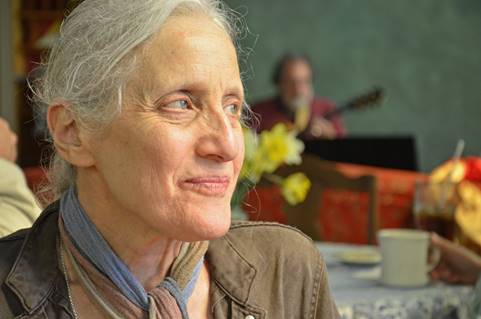
Ann Drysdale writes: “This poem emerged from a situation that took a minute to happen and evolved into a sonnet that takes a minute to read. I can almost believe that it sprang fully-formed from my fingertips, now that the pile of sawdust, chippings and paintflakes generated by the making of one into the other has been swept under the carpet and forgotten.”

Ann Drysdale now lives in South Wales and has been a hill farmer, water-gypsy, newspaper columnist and single parent – not necessarily in that order. Her most recent volume of poetry, Vanitas, joined a mixed list of published writing, including memoir, essays and a gonzo guidebook to the City of Newport. Another collection is accreting nicely and is due to be published next year.

Her poems have been published in several of the Potcake Chapbooks:
Tourists and Cannibals
Rogues and Roses
Careers and Other Catastrophes
Families and Other Fiascoes
Houses and Homes Forever
… all available from Sampson Low for the price of a coffee.

Potcake Poet’s Choice: Jean L. Kreiling, ‘The Waves’

Sprawled on a pew of sand, you meditate
on miracles of tide and time. Without
a prayer but apparently devout,
and humbled by the water’s shifting weight,
you watch with wonder, even venerate
this higher power rolling in and out:
omnipotence too obvious to doubt,
authority too awful to debate.
Like salty spray, some blue-green grace may cling
and seep unsanctified into your soul,
without a psalm or sermon—for the sea
makes its own joyful noise: the breakers ring
uncounted changes, and no church bells toll
more faithfully or irresistibly.

Previously published in 14 by 14. 

Jean L. Kreiling writes: “Growing up on the beach, and living on another coast in adulthood, I have never lost the sense of awe and humility that the sea inspires.  And of course I have never succeeded in capturing its magic in words, but I hope I’ve made a start in this poem.  Its form, my favorite, imposes the sonnet’s graceful structure onto what might otherwise have been an amorphous rhapsody; in addition, its meter and rhyme might suggest a bit of the ocean’s own rhythms and harmonies.”

Jean L. Kreiling is the author of two collections of poetry: Arts & Letters & Love (2018) and The Truth in Dissonance (2014). Her work appears widely in print and online journals, and has been awarded the Able Muse Write Prize, three New England Poetry Club prizes, the Plymouth Poetry Contest prize, and several other honors.  She is Professor Emeritus of Music at Bridgewater State University, and an Associate Poetry Editor for Able Muse: A Review of Poetry, Prose & Art.   

Her poem ‘The Salisbury Crags’ which first appeared in the Orchards Poetry Journal, is included in the ‘Travels and Travails’ Potcake Chapbook.

Sonnet: ‘Fat-shaming’

Gorging on food, an atavistic trait
useful, essential, in the paleolithic–
like a man’s lust for teenage girl as mate–
is one not needed now, shamed as horrific.
It’s healthy, though, to recognise such drives,
note where they came from, why they once were good:
these traits in which the primitive survives,
inbuilt components of our personhood.

It’s acting on them, though, that we deplore:
those who fuck teens and those who overfeed,
like those who steal, or lie, or start a war,
aren’t shamed for primitive desire, but deed–
like those who pray to gods, follow religions,
or skry the future from entrails of pigeons.

It’s not PC these days to even mention various issues, and I seem to have covered a lot of them in this sonnet. But it’s a decent enough Shakespearean sonnet (iambic pentameter, ABAB CDCD EFEF GG, volta between the octave and sestet) and also a good enough expression of an opinion, so what is there to complain about? Originally published in that not-always-comfortable but always formal ‘The Road Not Taken – A Journal of Formal Poetry’. Thanks, Dr. Kathryn Jacobs!

“Young and Fat” by Tobyotter is licensed under CC BY 2.0

Sonnet: ‘The Fall of Rome’

Jesus, a preacher with fake miracles,
his “Sea” of Galilee just eight miles wide–
rebelling against Rome and crucified–
his failure clear (though words were lyrical)…
you’d think “Messiah” was satirical!
But epileptic Paul a chance descried
to shut out other gods and thoughts worldwide,
thus sealing up Rome’s vital spiracles.
So, building on apocalyptic fears,
the Jewish Jesus ends where Paul begins.
Scientists, artists, poets, engineers,
are suffocated as the new faith wins.
All progress is set back a thousand years.
The Roman Empire died for Jesus’ sins.

Belief is strange. Take Covid vaccination: two thirds of us believe it’s an effective way to save lives, one third of us believe it’s a dangerous and unscrupulous way to make money and control people. Virtually no one has actually done any research and analysis of the issue, we just listen to our preferred sources of information and the community we’re a part of.

Or take religion: for the most part, children raised in Christian families remain Christian believers all their lives, Muslims remain Muslim, Buddhists remain Buddhist, and so on. Which makes it all the more impressive when someone can radically change the belief structure that surrounds them. Kudos then to the epileptic Paul of Tarsus, who created a Jewish-Mithraist-polytheist mishmash that has lasted almost 2,000 years. Pity about the Roman Empire, though.

This happily Petrarchan sonnet (iambic pentameter, and rhyming ABBAABBA CDCDCD) was originally published in Rat’s Ass Review, where respectfulness and respectability are not required. Thanks, Roderick Bates!

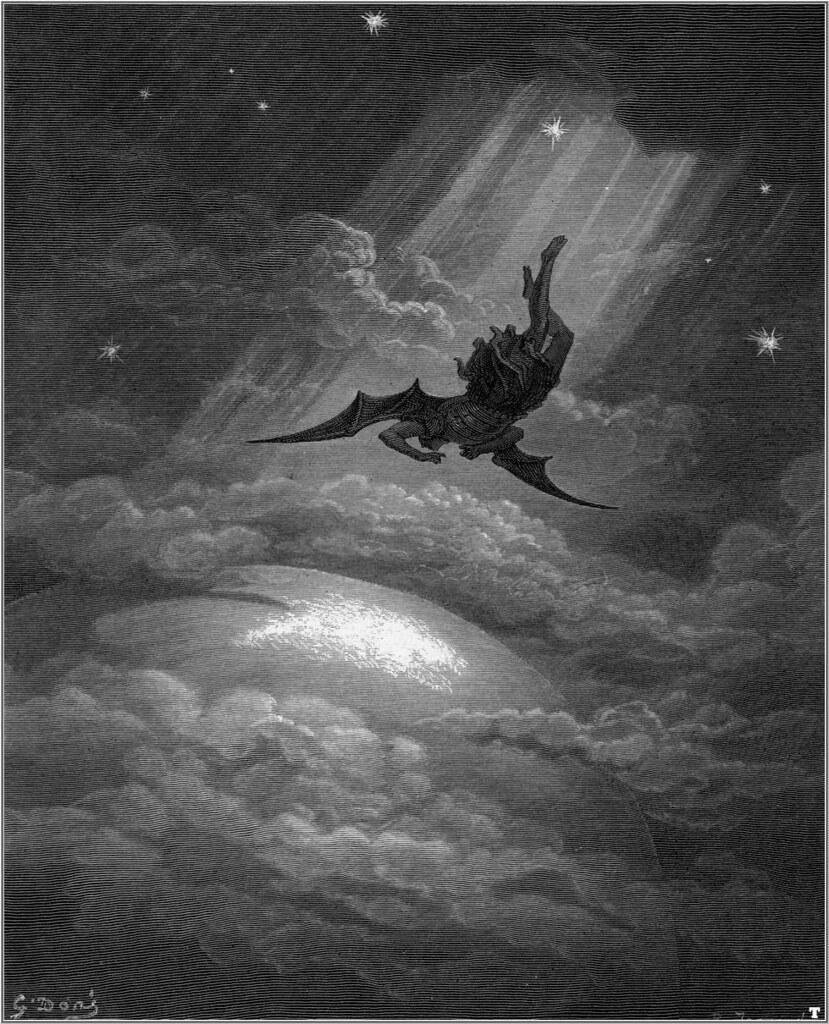
“Darkness Falls in Rome” by Storm Crypt is licensed under CC BY-NC-ND 2.0

Sonnet: ‘The Thief’

More than the actual loss, it’s helplessness
That we most loathe when suffering a theft:
The arbitrary way one daring, deft,
Brass act leaves careful order in a mess;
The knowledge the thief’s wilder and cares less;
The easy way he tears the warp and weft
Of dull security; the insight left
The cosmos can as quickly curse as bless.

Therefore the fears are mostly overblown-–
The thief himself causes no loss or strife
More than insurance or day’s work redeems.
But there’s a greater thief, and more unknown,
Who comes each night and steals one third your life,
Leaving no more than fingerprints, your dreams.

Sleep and dreams are so large a part of our existence that they seem to merit more attention than most people pay them. Sure, we need some rest, but we can get physical rest while awake during the day. So do we really need seven or eight hours every night to defrag our minds and delete unnecessary memories?

I like to think (this is close to “I believe”, but it isn’t belief) that there is something crucial going on that we are missing. The occasional “big dream” that resonates life-changingly. The dream of a distant loved one saying goodbye, before you get the news the next day of their death. The awareness that your unconscious is actually running your show, and that you better pay attention and assist where you can. All these reduce the apparent dominance of the waking mind, and open cans of existential worms. There are no certain answers. We are nowhere near understanding how our bodies, our minds or the universe works.

It’s all wonderful; but I still resent the amount of time I have to sleep. (And to those who say “It’s possible to sleep a lot less” I say “Yes, but at what cost? We have no idea.”)

I’m proud of this sonnet on a technical level. It is a true Petrarchan sonnet (iambic pentameter, and rhyming ABBAABBA CDECDE); the flow of words finds natural tiny pauses at the line breaks; only the volta, the twist to the exposition, is arguably in the wrong place, being strongest after the 11th line rather than after the eighth. But I feel it is all redeemed by a strong last line.

‘The Thief’ was originally published in ‘Candelabrum‘ – a magazine stolen by time.

Photo: “Thief Of Dreams” by Monica Blatton is licensed under CC BY-NC-ND 2.0

Sonnet: ‘Maya’

When God took Time to spin a length of Matter,
And, nothing at each end, tied the ends together,
He held between his fingers and surveyed
The first cat’s-cradle, and since then has played.

Flames flicker, flare, re-form as a friend’s face;
Dogs mime all features of the human race;
The willow weaves a walker from the air;
All Nature helps us see things that aren’t there.

To read Life’s Meanings, we must write the text:
What’s Right one day is often Wrong the next –
I’m rich or poor only as I profess,
Must ask your love or hate, for you can’t guess.

If love’s illusion, so are hate and fear…
Why not choose love?, when it’s so great, and near?!

Reareading this poem after a number of years, I have my doubts about it. It seems to start strong, and ends weak. What to do about a poem like that? The stuff about Maya, the illusory nature of the universe, is OK; but maybe cut it off after eight lines, before it starts preaching. But then maybe it would be lacking an ending, and I’d have to come up with something better than what’s there now.

As it is, it was first published in the defunct ‘Rubies in the Darkness’, and republished in India’s ‘Metverse Muse’. But I’m not happy with the poem…

“Cat’s Cradle by N.O. Bonzo” by wiredforlego is licensed under CC BY-NC 2.0

Sonnet: ‘Marion Campbell of Kilberry, 1919-2000’

In winter’s broken skies, in spring’s thin drizzle,
The gardens wall in sun to warm the ground,
Can still be worked: vegetables grow year-round.
Fingers are cold – but hearths will crackle, sizzle.
It’s drear – but through a week’s rain, and two fair
Days’ sun, daffodils flood the world with light.
Otters slide down rocks, lambs jump in delight,
Rooks tumble, jump and slide, in empty air…
You love their flight; but, grounded, here you stand.
The summer dry and hot, sea almost warm,
Unpeopled heather hills, long days, no storm.
And you, embodying castle and land:
Stone walls and floors, trophies and weaponed walls,
Books read, books written, haunting ancestral halls.

Marion Campbell was a truly remarkable archaeologist, author and cultural activist. Her enormous store of memory of history and lore blended with personal experience, together with her desire to share her knowledge through writing books and creating local museums, is summed up in a charming anecdote at the start of her obituary in The Herald:

Two days before her death, as she lay apparently unconscious in the hospital at Oban, I was telling someone in the same ward about a lost standing-stone at Ballymeanach and remarking that nobody knew when it had fallen. Suddenly a muffled voice from behind the oxygen mask said: ”Well, I know! It was in 1943, when a Shetland pony was sheltering against it from the storm. The poor beast was nearly scared to death.”

She was a cousin of my mother’s, and I was fortunate enough to spend weeks and months with her at Kilberry in my teens and 20s. This sonnet, written in fond tribute, was published in The Orchards Poetry Journal a couple of years ago.

Poem: ‘Nymph’

A mayfly nymph, in water for a year,
transforms into a beauty of the air
for just one day – one day to mate, breed, die.
The essence then’s the nymph, and not the fly
which we see only thronging in death throes,
death throes of riotous sex. Everyone knows,
though, that the fly’s the cycle’s pinnacle
to artists, if not to the clinical.
Though humans for long eons lived on land,
at Science’s Nietzschean precipice we stand,
transform to things that freely live in space,
or formless Cloud-based online lives embrace…
and may survive but briefly in that state,
but, dying, will seed new worlds as we mate.

Nature poem? Piece of science fiction? The observation of how nature works and a hypothetical extrapolation of human nature into the future are not really two different things – it’s all part of life, the universe and everything… though that future will be is anyone’s guess. The only thing for sure is that tomorrow is not going to be like today.

Is a 14-line poem in iambic pentameter a sonnet, if it just rhymes as couplets? I think not. This poem has a volta after the eighth line, but it still doesn’t feel like a sonnet to me. The feel comes from a couplet closing the poem out after a series of three quatrains, or from the shift from ABBAABBA to CDCDCD. That finalising shift, that sense of completion, is integral to the feel of the sonnet. This poem fails to meet that criterion.

‘Nymph’ was first published in the Orchards Poetry Journal, whose latest issue has just come out – free online, or available in print.

Photo: “mayfly” by ian boyd is licensed under CC BY-NC 2.0

Sonnet: ‘Drifting’

Drifting and drifting in an eddying stream
The leaf cannot recall the maple tree;
Pieces fall off; it has nor plan nor scheme;
How could a leaf have sense of destiny?
Its work is done; tree-feeding fades like dream,
Tree-making’s not a possibility.
It drifts and rots, nibbled by perch and bream
Or reaches finally the endless sea.

The sea itself moves, rhythmical and blind:
Is calm, or sprays salt as the waves make foam.
Seas have no will, no parliament of mind,
To make directives like hives make bees roam
To pollinate the world, defend their kind,
And with their mind create their honeycomb.

This sonnet drifts in several ways. The rhythm of iambic pentameter is meditative, rambling. The rhyme scheme is slow, repetitive, changing between the octave and sestet: ABABABABCDCDCD. And the ideas drift: the leaf is left behind when it reaches the sea, and the sea is abandoned for bees. The form seems suitable for the content.

‘Drifting’ has just been published in this month’s Snakeskin, whose editor commented “I like the way it moves from one idea to another that you don’t expect.” Thanks, George Simmers!

Photo: “Like a Leaf in a Stream” by Referenceace – Working! is licensed under CC BY-NC-SA 2.0

Odd poem: William Faulkner, ‘After Fifty Years’

Her house is empty and her heart is old,
And filled with shades and echoes that deceive
No one save her, for still she tries to weave
With blind bent fingers, nets that cannot hold.
Once all men’s arms rose up to her, ‘tis told,
And hovered like white birds for her caress:
A crown she could have had to bind each tress
Of hair, and her sweet arms the Witches’ Gold.

Her mirrors know her witnesses, for there
She rose in dreams from other dreams that lent
Her softness as she stood, crowned with soft hair.
And with his bound heart and his young eyes bent
And blind, he feels her presence like shed scent,
Holding him body and life within its snare.

William Faulkner began writing poetry at an early age; and in his late 20s he published his first book, a collection of poems titled ‘The Marble Faun’. Though much of the fiction for which he won the 1949 Nobel Prize carries a heavy southern accent or is written in stream of consciousness, it is engaging to see that he could be meditative in the iambic pentameter of a regular sonnet if he chose.

Photo: “William Faulkner’s Typewriter 2” by visitmississippi is licensed under CC BY-ND 2.0