Tag Archives: time

Sonnet: Amit Majmudar, “The Only Holy War”

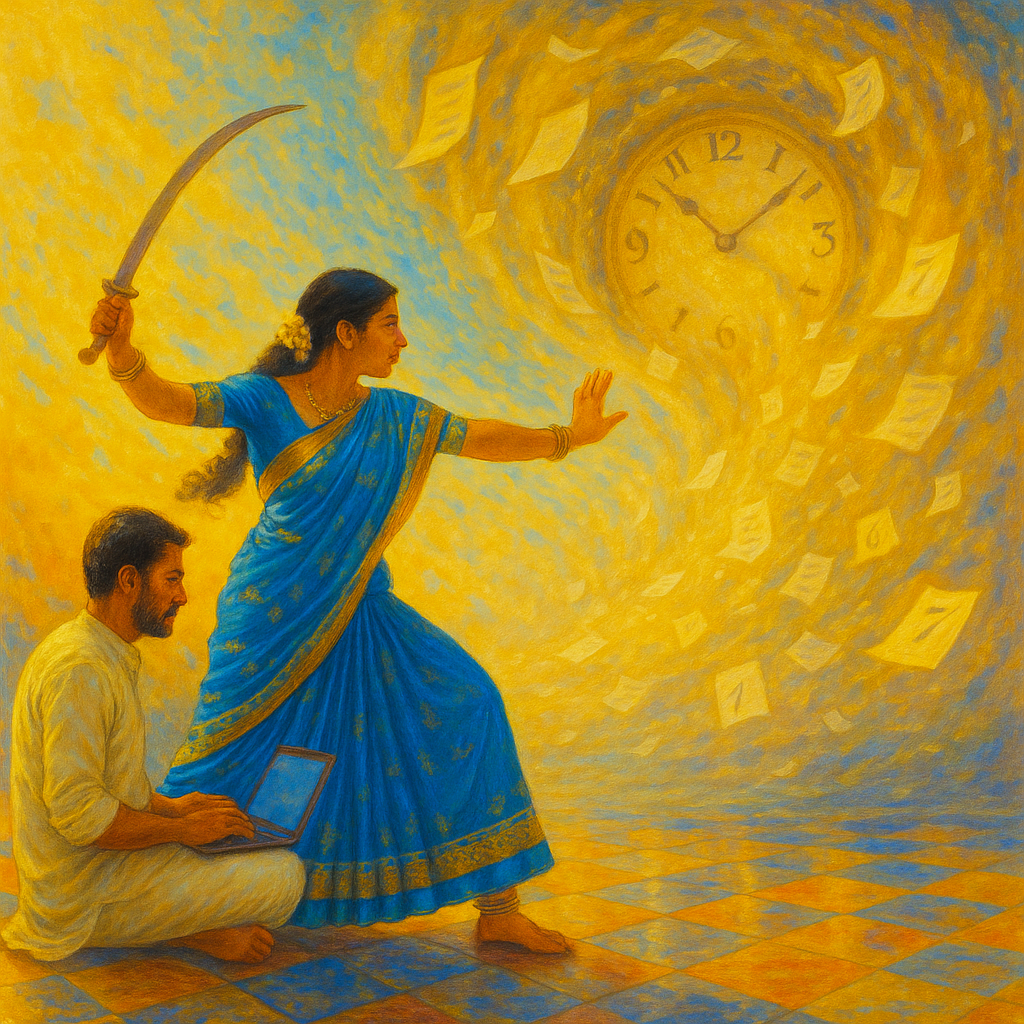
Oh what a glorious war we waged on time,
you in your peacock pleats and jasmine braid
and ankle bells portraying a warrior goddess,
me at my laptop redeploying rhyme
like roving arrows on a map of fate.
We fought our Passchendaele, entrenched in bodies,
my dugout deep in yours. We woke up, ate,
went on our morning walks, we made love, played
old board games, ditched our iPhones, stormed the beachhead,
kamikazed straight into the sun
while knowing we would likely never reach it,
while knowing no Great War was ever won,
each night, each decade together one more mission
prolonging this timeline, this lifegiving war of attrition.

*****

Amit Majmudar writes: “My twin sons, so recently in diapers, just submitted their college applications. My beard has now more white hairs than black. How did this happen? At the cellular level, at the level of fast-twitch muscular contractions and verbal elan, time causes depletion, the radioactive decay of the youthfully glowing complexion, the degradation of collagen, the degradation of memory…. Sophocles, Goethe, and Yeats wrote beautifully into their later lives. Shakespeare stopped writing, voluntarily, when he was less than a decade older than my current age. Two things take me out of time: love, and the creative flow state. This poem represents (both in its subject matter, and as an example of my creativity) the intersection of the two. Yet time really doesn’t stop during that interval. I just cease to register it. The aging goes on, unchecked: the piecemeal conquest of the body, follicle by follicle, neuron by neuron; the tick-tock wastage of love’s remaining years together…. It demands a war effort, and total war at that, all one’s resources of spirit and body utilized to fight it: a Crusade to retake one’s youth, the war against time a Manhattan Project, a veritable Mahabharata: “the only holy war.”

‘The Only Holy War’ was originally published in the New Verse Review.

Amit Majmudar’s recent books include Twin A: A Memoir (Slant Books, 2023), The Great Game: Essays on Poetics (Acre Books, 2024), and the hybrid work Three Metamorphoses (Orison Books, 2025). More information about his novels and poetry collections can be found at www.amitmajmudar.com.

Illustration: RHL and ChatGPT

Sonnet Crown: Amit Majmudar, ‘Recourse’

1.

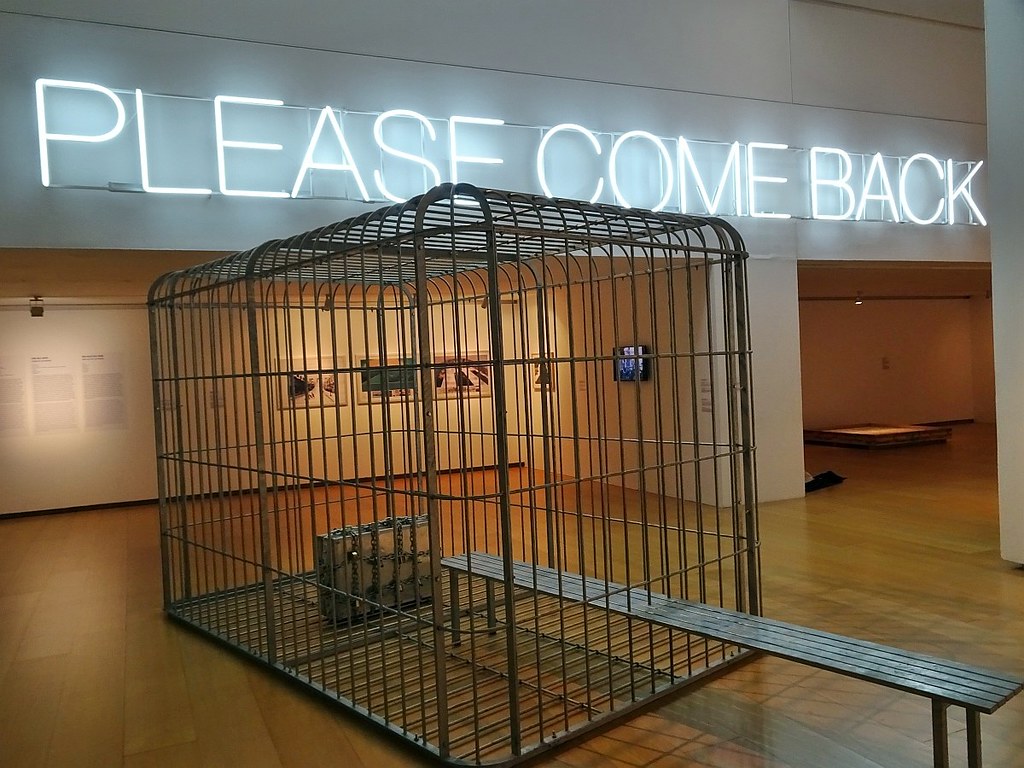
Time, like love, is cyclic. Please come back
to me. I’ll stand here waiting, wanting while
the mare without her rider rounds the track.
I want to weave a crown for you, design
a daisy chain whose threaded stems become
a bracelet that handcuffs your wrist to mine.
My shadow’s gnomon tilts like a sun dial’s.
I know you’re somewhere close. I feel a thrum,
a thrill beneath the stillness of the earth,
the way a woman, days before the birth,
places her husband’s hand on the sea swell
that rises out of her and passes through her,
and, touching so much vastness, he can tell
for all their time as one, he never knew her.

2.

For all our time as one, I never knew you—
but doesn’t learning come from repetition?
I’ll do this better if I do it over.
I’ll know your every need by heart, pursue you
like truth. I’ll learn to be a truthful lover.
I’ll circle back to freshman year and woo you.
No song’s recorded in a single session.
No sinner’s shriven after one confession.
It’s time that grows the pearl. Nacre layers
the sand grain, like a secret in the mouth.
Repentance grows, too—grows by daily prayers
into a faith whose trigger seed was doubt.
I am a pearl diver in your depth.
I never left. I just came up for breath.

3.

I never left, I just came up for breath,
but now I am ready to follow you all the way down.
I’ve read we get euphoric as we drown.
Samsara swirls us under. When we break
the whitecaps for an instant, that is death.
Don’t make us wait to be reborn before
we love again. You know me—I’ll just make
the same mistakes. Or make things even worse.
So what if time’s a circle? Doesn’t mean
we have enough of it. The now we’re in
will never come again. So come again
into my life, and love me sight unseen.
We’re both at sea, and no good at dead reckoning.
A burning town’s the only lighthouse beckoning

4.

Our house of light is burning down. It beckons in
the gloaming. The road I’m roaming is a ring.
All time is circular. We’re only seconds in.
All reasoning is circular. I sing
the seasons all the way around the year.
There was a chemist once whose dream disclosed
benzene’s atomic structure. What appeared
before him was a serpent swallowing
its tail—aroma’s O, ouroboros.
I’m wise at last to what the image knows.
I see my answer now, my big mistake.
A ring! Why couldn’t it have been this clear
back then? I see it best when I’m awake.
I’ve circled back. But there is no one here.

5.

I’ve circled back, but there is no one where
the ring road ends. It ends in newfound ruins,
a shell-flecked nest, a rain-worn blade that bears
a message for us. Who can read the runes?
Nietzsche proclaimed the eternal return
and threw his arms around a bleeding horse
to feel the centuries reversing course.
His gooseflesh rose like spores that pock a fern.
Let vultures circle, only widdershins
above the ring road where I wait alone,
knifing in bark a promise of my own.
I know the ring road ends where it begins.
Time is a circle I can put to use:
a wheel to roll things back, a crown, a noose.

6.

A wheel to roll things back, a crown, a noose:
My own Venn diagram of rings to choose
from. Fill its center up with hourglass sand,
and that’s where Archimedes, kneeling, draws.
This is the Roman siege of Syracuse;
he’s hard at work on time, its shape and laws.
He looks up from a boot. A soldier stands
above him, dripping gladius in hand.
Do not disturb my circles, says the Greek.
The soldier studies them, then runs him through—
and so reveals what Archimedes seeks,
the circle, like a circuit, broken, weeks
and months and centuries and aeons spilling
in slow, concentric circles from the killing.

7.

In slow, concentric circles from the still-pink
narcotic kiss print of the cupping glass,
let your memories ripple outward, killing
the pain I’ve caused you. We are not our past,
though time is cyclic. Cycles can be broken,
souls reborn in this life, sleepers woken.
Not that I can sleep beneath this star.
Horizon, magic circle, boxing ring—
time is the space, the spell, the place we spar,
the dome in which your name is echoing.
It’s where I pray the theory into fact
that love, like time, is cyclic. Please come back.

*****

Amit Majmudar writes: “The sonnet crown is a naturally recursive form of forms. The beginning of each sonnet is also an ending, and vice versa. A candle tilts to light a candle that tilts to light a candle, until the occult circle of flame is complete, and the poet sits inside it, meditating the next line, which may well be the line just written.

“This sonnet crown took, as its subject, the tendency of lovers, or at least their memories, to relapse. “Relapse” means to fall back, etymologically. To fall back in love; to fall back out of love. The sonnets enact through form and content alike the recrudescence of the past. The last line of the overall crown matches the first line of the overall crown. The reappearance of the old pain makes it a crown of thorns.

“I wrote this sonnet crown first line to last. I had never even attempted one before, but I relinquished myself to the music-making. I could do that because I circled around a theme–recursion in love–rather than trying to tell a story or present a philosophical argument or any such prosaic thing. Just pure pursuit of the right sounds. This crown came at the end of a sonnet-writing tear so my hand was in practice, as it were.

“Close readers will notice that the crown is imperfect, however. In the final, truncated sonnet, the speaker makes haste to return to the beginning, to break the process of endless recursion. Accordingly, the rhyme word of the line where the deviation begins is “broken”–and it’s there that the formal pattern–the “cycle”–itself is broken. Broken/woken collapses the separated rhyme sounds into a couplet, with a second couplet to conclude the 12-line ending–a couplet of couplets, the original pair formation and the hoped-for repeat pair formation, embodied in the music of the ending that is, at last, a new beginning. “

*****

Amit Majmudar is a poet, novelist, essayist, and translator. He works as a diagnostic nuclear radiologist in Westerville, Ohio, where he lives with his wife and three children. Recent books include Twin A: A Memoir (Slant Books, 2023), The Great Game: Essays on Poetics (Acre Books, 2024), and the hybrid work Three Metamorphoses (Orison Books, 2025). “Recourse” was first published in Plume Poetry, and will be appearing in Majmudar’s forthcoming collection, Things My Grandmother Said, in early 2026. 
More information at www.amitmajmudar.com

Photo: “0103-IVAM – Please Come Back 05” by gibbix1 is licensed under CC BY-NC 2.0.
RHL, ‘In the Spring’

In the spring, an old man’s fancy
ruefully reviews his youth;
thinks of girls both past and present,
wonders can he hide time’s truth.

His always googly gardening eyes
all ever which ways scan and glower
at the bud-bursting blossoming girls
exploding in their flower of power.

What is this green and noisy growth
that’s flourishing, fresh and unkempt?
Old’s good, so’s young… could one be both?
O Fates! from fate make me exempt!

*****

‘In the Spring’ was published in Bewildering Stories, an online weekly of Speculative Fiction, Poetry, Art, etc. Thanks, Don Webb!

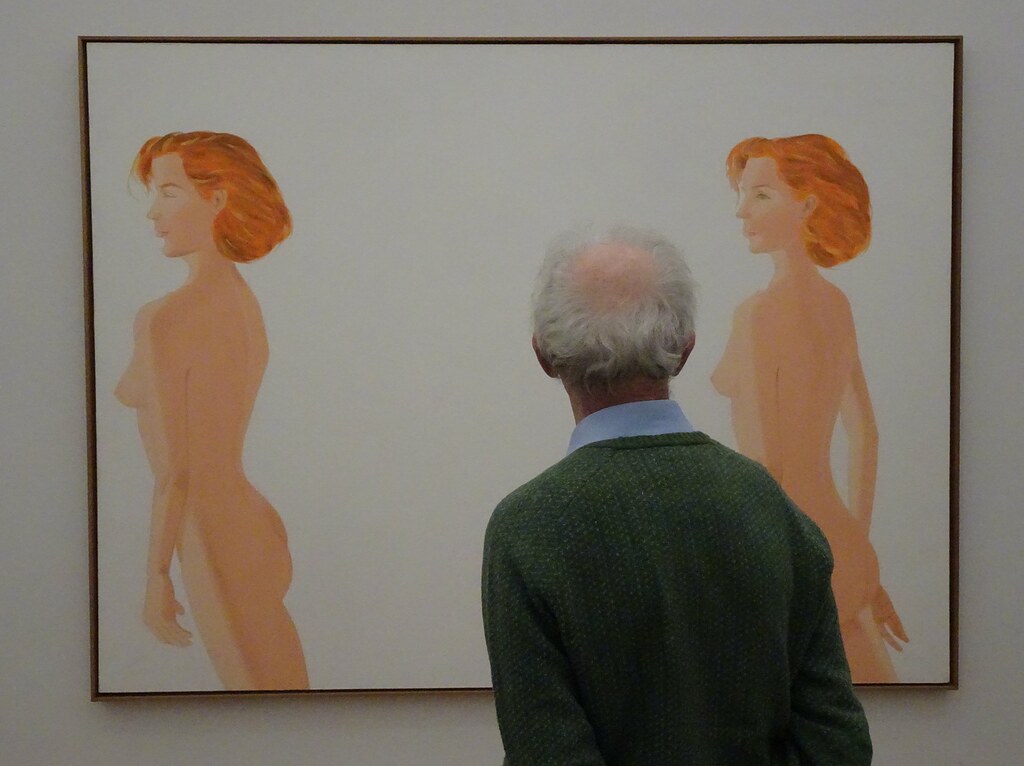
at the museum” by derpunk is licensed under CC BY-NC-SA 2.0.

Tom Vaughan: ‘Is This It?’

Well if it is, and this is it
then what will be will be
and time will toil and time will tell
if there’s a guarantee

that at the least and at the last
the daily here and now
which now and here are thick as thieves
will be transformed, somehow

and either way, here’s my advice –
lie back and think of all
the ups which came between the downs
before your curtain call.

*****

Tom Vaughan writes: “There was no particular trigger for this poem, apart from my fitful attempts to be Stoical about the state – and weirdness – of the world. But just at the moment the anger occasioned by the former keeps breaking through.”

‘Is This It?’ was published in the current Lighten Up Online.

Tom Vaughan is not the real name of a poet whose previous publications include a novel and three poetry pamphlets (A Sampler, 2010, and Envoy, 2013, both published by HappenStance; and Just a Minute, 2024, from Cyberwit). His poems have been published in a range of poetry magazines, including several of the Potcake Chapbooks and frequently in Snakeskin and Lighten Up Online. He currently lives in Brittany.
https://tomvaughan.website

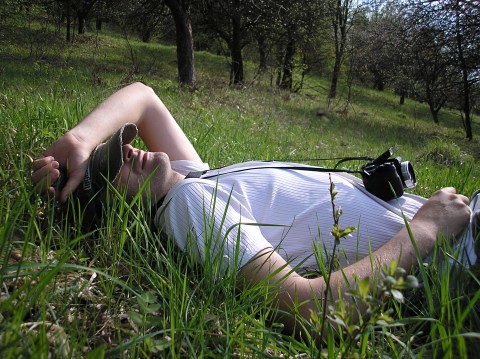
Photo: “man-relaxing-in-the-grass_8954-480×359” by Public Domain Photos is licensed under CC BY 2.0.

Short poem: Richard Fleming, ‘Now’

The future’s inconceivable.
The past is irretrievable.
So all we have is now: that’s it,
yet half the time we miss that bit.

*****

Richard Fleming writes: “Four short lines, two rhyming couplets, succinct, hopefully not preachy, just something that we need to take to heart and not forget.”

Richard Fleming is an Irish-born poet (and humorist) currently living in Guernsey, a small island midway between Britain and France. His work has appeared in various magazines, most recently Snakeskin, Bewildering Stories, Lighten Up Online, the Taj Mahal Review and the Potcake Chapbook ‘Lost Love’, and has been broadcast on BBC radio. He has performed at several literary festivals and his latest collection of verse, Stone Witness, features the titular poem commissioned by the BBC for National Poetry Day. He writes in various genres and can be found at www.redhandwriter.blogspot.com or Facebook https://www.facebook.com/richard.fleming.92102564/

Photo from Richard Fleming

Morri Creech, ‘Mileage’

The car mechanic’s counting out his bills
behind the E-Z Mart at one a.m.;
he’ll toss rocks at beer bottles just for thrills
until his dealer comes, it’s fine with him.

He draws in a deep breath and sees the light
swerve from the highway, puzzling the back wall
he leans against just to keep out of sight.
A quarter bag and some fentanyl, that’s all.

His phone vibrates again though nothing’s wrong.
For two years he’s been living in a trailer
with a girl who works at Publix. They get along
even if sometimes she says he’s a failure—

what can he say to that? Sure. He lives cheap.
They’ll fight until she forces a decision,
then roll around on the couch. Once she’s asleep
he’ll take a dose and watch some television.

At night he dreams of cylinders and sprockets,
the trucks and cars too busted up to fix;
startled awake, eyes aching in their sockets,
he’ll watch the clock hands grope their way to six.

A car pulls up but he can see it’s not
his hookup. Just kids with nothing else to do
but drink a six-pack in the parking lot
before they head out to the lake to screw.

He had his share of mischief, too, Lord knows.
The girls don’t eye him in the check-out aisle
much anymore, the ones with painted toes.
A few years back, at least, they used to smile.

The boys can see the grease that stains his hands;
they all think, damn, who wants to work that hard?
He spends the day beneath their dads’ sedans
while they play tackle football in the yard.

Chasing a football blew out both his knees
and broke his wrist. That was three years ago.
Customers say, “go Stags,” and toss their keys,
then look at him real close as if they know.

A text says no one’s coming. The BP sign
flickers over the pumps, and though it’s half-
past two now, and he’s tired, he’s feeling fine
enough to think it’s all a bust, and laugh.

And, anyway, it’s good to be alone
with the gas fumes and blinking traffic light
and fifteen missed calls lighting up his phone.
Later, he thinks, once he and his girl fight,

and once she falls asleep on his left arm,
he’ll stare at the divots on the ceiling tile
and wait to hear the clock sound its alarm
while the night’s odometer counts one more mile.

*****

Morri Creech comments: “As Mark Strand once said, I write to find out what I have to say. I don’t start a poem with an idea; I start with a line, an image, a rhetorical stance. Then I write in search of context: how can I situate this in a situation, a narrative moment, an argument, a meditation? The language takes me wherever I end up. This poem was constructed like that. I started with a first line and then wrote toward trying to figure out the context of the line. In this case, it led me to a character sketch. It was fine to discover what this character was about; the decisions I made about his character and circumstances were largely directed by rhymes. They steered me in what I hope was the right direction.”

Morri Creech is the author of five collections of poetry, including the Sleep of Reason, a finalist for the Pulitzer Prize, Blue Rooms, and The Sentence (published by LSU Press, and which includes this poem). A recipient of NEA and Ruth Lilly Fellowships, as well as North Carolina and Louisiana Artists Grants, he teaches at Queens University of Charlotte.
www.morricreech.com

Photo: “Let’s Talk Tires” by gfpeck is licensed under CC BY-ND 2.0.

Weekend read: Tom Vaughan, ‘Rhyme-Crime’

Does rhyme matter –
    however occasional?

It used to be
    considered vocational

a must for verse’s
    inspirational

impact, even
    educational –

but these days, it’s a
    generational

sign your stuff’s just
    recreational.

*****

Tom Vaughan writes: “For me, rhyme is not just a technical trick to help make poetry memorable. I think the world rhymes in odd ways. I also believe time rhymes, across the centuries but also in our short individual lives, sometimes in irony, but more often – if we listen hard enough to hear it – to point the way to a deeper level of challenge and reflection.”

Editor: I had been planning a rant on the essence of poetry being all the tricks that make it memorisable word-for-word: rhyme, rhythm, alliteration, assonance, etc; and on the fact that the bits of poems an adult remembers are invariably rhymed; and on poetry’s links to dance and song and the prenatal heartbeat. But Tom Vaughan introduces a whole new layer of value of rhyme, obliquely in his poem, incompletely in his comment. There are things to meditate on here.

Tom Vaughan is not the real name of a poet whose previous publications include a novel and three poetry pamphlets (A Sampler, 2010, and Envoy, 2013, both published by HappenStance; and Just a Minute, 2024, from Cyberwit). His poems have been published in a range of poetry magazines, including several of the Potcake Chapbooks and frequently in Snakeskin.
He currently lives in Brittany.
https://tomvaughan.website

Photo: “Sometimes, I like going back into #poetry and pretending like I am still in college. #johnkeats #bookstagram #annotations #reading #books” by alis.smith is licensed under CC BY-NC 2.0.
Sonnet: RHL, ‘The Days Have Come Unhooked’

The days have come unhooked from passing time,
its little Brio trucks are off their tracks;
the past and future mix to make their rhyme,
with pieces placed at random in fresh stacks.
Clear memories blend their present, future, past.
The days stretch out, and yet the months fly by –
you turn in circles, facing first, not last.
As childhood deepens, old age pools go dry.
Behind its smoke and mirrors, whores and pimps,
its harshly lovely playful attitude,
reality is thinning – you now glimpse
an indescribable infinitude.
The game is won – your enemies are no more,
yet you don’t end it while you max your score.

*****

Published in the Spring 2024 issue of The Road Not Taken.

Photo: “Brio freight train set” by Ben Sutherland is licensed under CC BY 2.0.

Short poem: Richard Fleming, ‘The Clock Collector’

He didn’t hurry, took his time
to gradually collect the clocks:
large clocks, small clocks, clocks with a chime,
he gathered stocks of ticks’n tocks
time-pieces, chronographs, all gold,
he harvested them like a crop.
He hoped to put his life on hold
but time, unmeasured, did not stop.

*****

Richard Fleming writes: “I think I was just playing with rhyme on this one. That it says something serious was an unexpected bonus.”

Richard Fleming is an Irish-born poet (and humorist) currently living in Guernsey, a small island midway between Britain and France. His work has appeared in various magazines, most recently Snakeskin, Bewildering Stories, Lighten Up Online, the Taj Mahal Review and the Potcake Chapbook ‘Lost Love’, and has been broadcast on BBC radio. He has performed at several literary festivals and his latest collection of verse, Stone Witness, features the titular poem commissioned by the BBC for National Poetry Day. He writes in various genres and can be found at www.redhandwriter.blogspot.com or Facebook https://www.facebook.com/richard.fleming.92102564/

Richard Fleming, ‘Time 2’

A hamster racing on a wheel,
a movie spinning on a reel,
the clock-hands march inexorably.
What they record, we cannot see
or touch, or hear, or smell, or taste,
yet it diminishes. Make haste.

*****

Richard Fleming writes: “When young, I thought about time in terms of how quickly I could run 200 metres and, later, whether I could dip under 35 minutes in a 10k road race. Yes, I was shallow then but youth and shallowness often go hand in hand: they did in my case. Grown older (let’s be honest, old) , Time has acquired a capital T and seems to have morphed into a rather unnerving companion who demands more and more of my attention every day.”

Richard Fleming is an Irish-born poet (and humorist) currently living in Guernsey, a small island midway between Britain and France. His work has appeared in various magazines, most recently Snakeskin, Bewildering Stories, Lighten Up Online, the Taj Mahal Review and the Potcake Chapbook ‘Lost Love’, and has been broadcast on BBC radio. He has performed at several literary festivals and his latest collection of verse, Stone Witness, features the titular poem commissioned by the BBC for National Poetry Day. He writes in various genres and can be found at www.redhandwriter.blogspot.com or Facebook https://www.facebook.com/richard.fleming.92102564/