Tag Archives: Yeats

Joe Biden’s favourite poem: Seamus Heaney, ‘The Cure of Troy’

Human beings suffer
They torture one another,
They get hurt and get hard.
No poem or play or song
Can fully right a wrong
Inflicted and endured.

The innocent in gaols
Beat on their bars together.
A hunger-striker’s father
Stands in the graveyard dumb.
The police widow in veils
Faints at the funeral home.

History says, Don’t hope
On this side of the grave…
But then, once in a lifetime
The longed-for tidal wave
Of justice can rise up,
And hope and history rhyme.

So hope for a great sea-change
On the far side of revenge.
Believe that a further shore
Is reachable from here.
Believe in miracles
And cures and healing wells.

Call miracle self-healing:
The utter, self-revealing
Double-take of feeling.
If there’s fire on the mountain
Or lightning and storm
And a god speaks from the sky

That means someone is hearing
The outcry and the birth-cry
Of new life at its term.
It means once in a lifetime
That justice can rise up
And hope and history rhyme.

*****

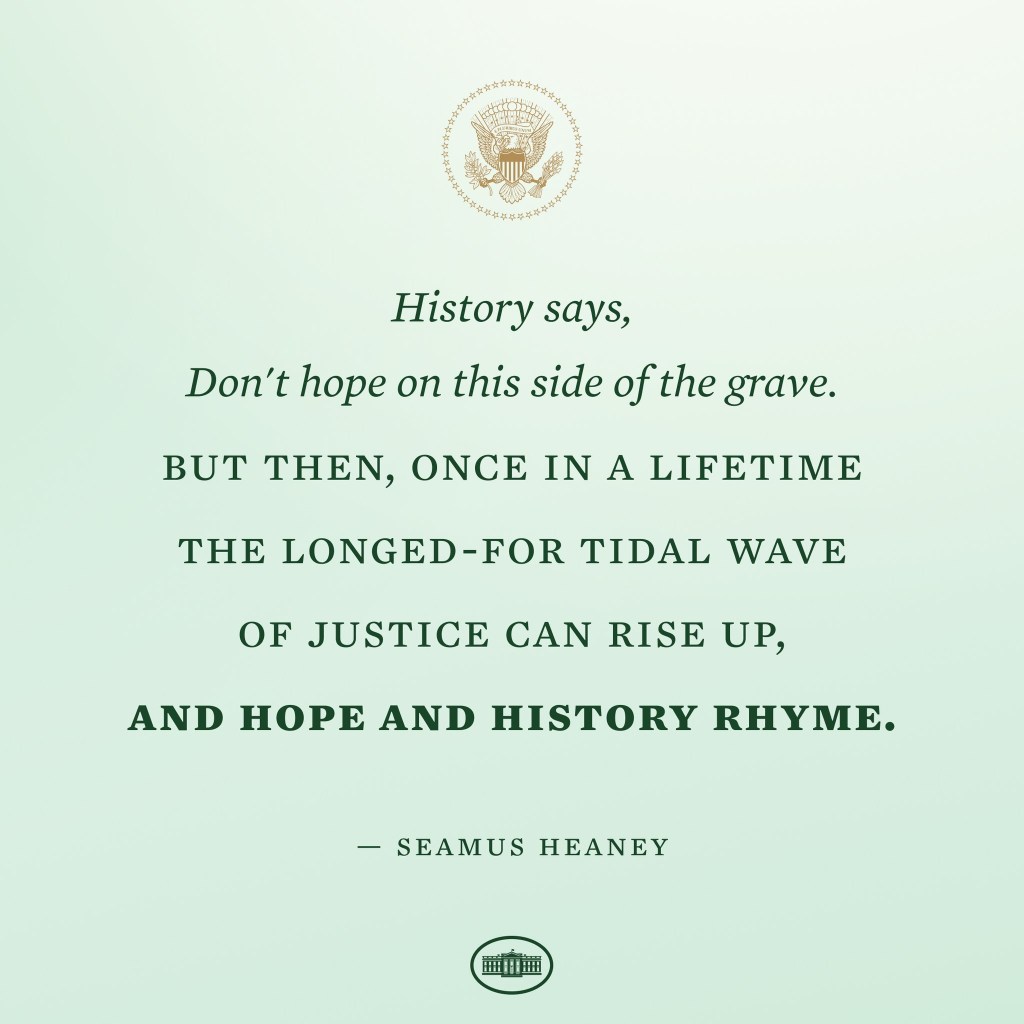
US President Joe Biden frequently quotes poets: Yeats and, especially, Heaney; often with the disclaimer that he doesn’t quote Irish poets because of his Irish heritage, but because Ireland has the best poets. And from the poem above, the verse that particularly resonates with him is:
History says, Don’t hope
On this side of the grave…
But then, once in a lifetime
The longed-for tidal wave
Of justice can rise up,
And hope and history rhyme.

Joe Biden may not be perfect, but it is reassuring to have an American President with at least some commitment to Justice… and the sensibility of reinforcing it through the memorisation of poetry.

Photo: Joe Biden’s White House Facebook post for St. Patrick’s Day 2022.
Weekend read: David Galef, ‘A Question of Emphasis’ or ‘Wanna Make Something of It?’

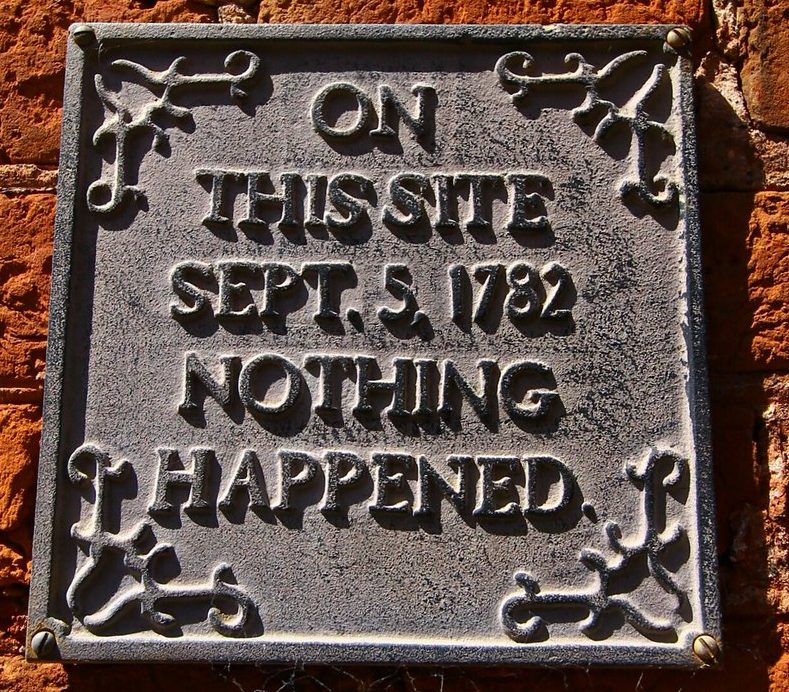
“poetry makes nothing happen . . . .”
—W. H. Auden, “In Memory of W. B. Yeats”

Poetry makes nothing happen.
Song lyrics, on the other hand,
Wedge into people’s hearts
When sung by a heartthrob band.

Poetry makes nothing happen.
It doesn’t enforce a cause.
That’s the way of propaganda,
With all its fixed applause.

Poetry makes nothing happen.
But I’ve seen something sublime
In the eyes of a student reading
Eliot’s Prufrock the first time.

Poetry makes nothing happen.
But must events take place
For poems to be eventful—
To make a normal pulse race?

*****

David Galef writes: “This poem was inspired by the memory of a graduate seminar taught by Edward Mendelson, a professor at Columbia University and the executor of the Auden estate. What Mendelson doesn’t know about Auden probably isn’t worth knowing, and what he brought to the study of Auden’s poetry was a deep knowledge of technique, context, and Auden’s modus cogitandi. Tired of those who quoted Auden’s famous line from “In Memory of W. B. Yeats” to indicate the inutility of poetry, Mendelson pointed out that the significance of “For poetry makes nothing happen” is more a point about art versus propaganda. The emphasis shouldn’t be on “nothing” but on “makes.” The aim of agitprop is to make all minds bend in one direction. True art, on the other hand, doesn’t force one meaning on the audience, though it may be powerfully suggestive. As Auden continues (and people who quote often omit surrounding words),
“it survives
In the valley of its making where executives
Would never want to tamper, flows on south
From ranches of isolation and the busy griefs,
Raw towns that we believe and die in; it survives,
A way of happening, a mouth.

Poetry does indeed enjoy a special, immortal status, but those who want it to be a crowd-controlling megaphone will probably be disappointed.
What I wanted to accomplish in ‘A Question of Emphasis’ is just what stressing the right
word can do, and how poetry can change lives, in its own way.”

David Galef has published over two hundred poems in magazines ranging from Light and Measure to The Yale Review. He’s also published two poetry volumes, Flaws and Kanji Poems, as well as two chapbooks, Lists and Apocalypses. In real life, he directs the creative writing program at Montclair State University.
www.davidgalef.com

Editor: I can’t help adding this 6-minute exposition of emphasis from Hamlet: https://vk.com/video17165_456239062 with its star-studded cast… Enjoy!

Photo: “Nothing happened” by Graham Ó Síodhacháin is licensed under CC BY-SA 2.0.

Jawaharlal Nehru’s favourite poem: Robert Frost’s ‘Stopping by Woods on a Snowy Evening’

Whose woods these are I think I know.
His house is in the village though;
He will not see me stopping here
To watch his woods fill up with snow.

My little horse must think it queer
To stop without a farmhouse near
Between the woods and frozen lake
The darkest evening of the year.

He gives his harness bells a shake
To ask if there is some mistake.
The only other sound’s the sweep
Of easy wind and downy flake.

The woods are lovely, dark and deep,
But I have promises to keep,
And miles to go before I sleep,
And miles to go before I sleep.

*****

In June 2023 Indian Prime Minister Narendra Modi visited the United States, and President Joe Biden gave him an autographed first edition copy of the ‘Collected Poems of Robert Frost’. (Modi gave Biden a copy of the ‘Ten Principal Upanishads’ by Purohit Swami and William Butler Yeats – the latter being a poet that Biden frequently quotes.)

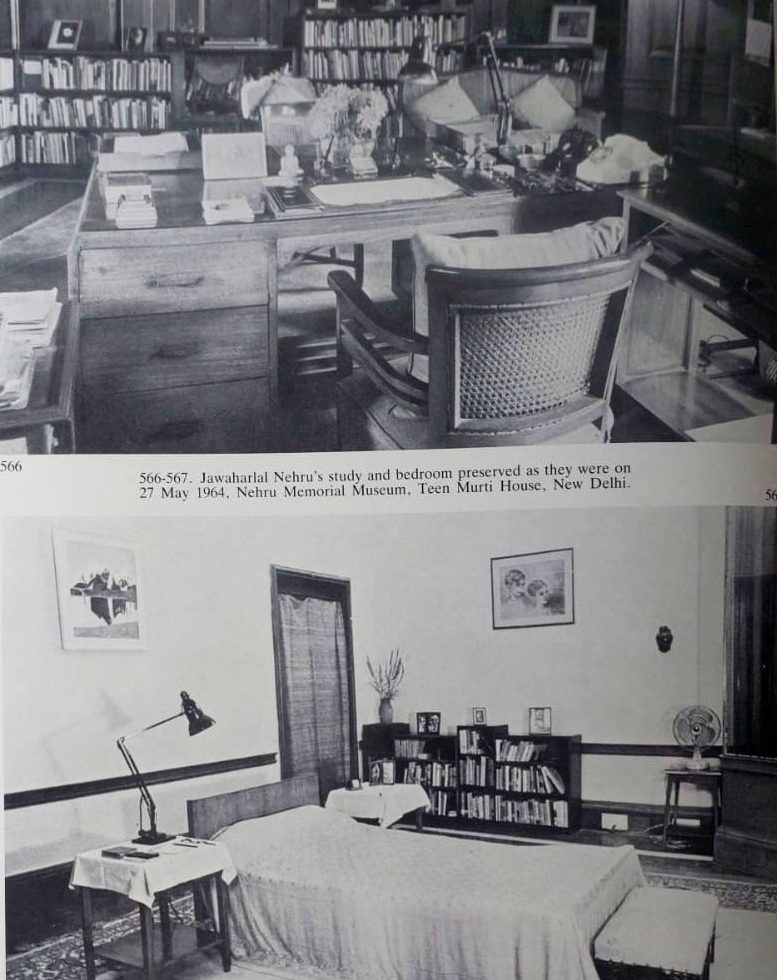
In India the gift of Frost’s work was recognised as a tribute to Jawaharlal Nehru, India’s first Prime Minister. Nehru, apart from being a founding father of Indian democracy, was a prodigious writer with a love of history, poetry and nature; in Himalayan vacations he went horseback riding and exploring woods. Frost’s poetry was a natural for him. Nehru had a particular fondness for ‘Stopping by Woods on a Snowy Evening’. Towards the end of his life he kept a copy of Frost’s poems by his bedside, with the last stanza of “Stopping by Woods” underlined:

The woods are lovely, dark and deep,
But I have promises to keep,
And miles to go before I sleep,
And miles to go before I sleep.

Photos: Jawaharlal Nehru’s study and bedroom, preserved as they were at the time of his death.

Marcus Bales, ‘Down-sizing’

I will retire and go to buy a ranch-house home,
And a fenced yard build there, for the dogs to roam around,
And raised beds, full of easier-weeding loam,
And cultivate my garden’s ground.

And I shall have my wife there, who knows the signs of stroke.
Morning and night, we’ll take the pills our doctors gave us,
And cook our meals of beans and rice because we’re broke —
And hope the kids vote blue, and save us.

I will retire, and maybe write and, when I’ve napped,
Cruise the internet, perhaps, and lament the loss
Of civility, and watch the fascists arrive, wrapped
In the flag, and holding a Bible and cross.

*****

Marcus Bales writes: “Yeats‘s ‘The Lake Isle of Innisfree‘ irritates me. Its narrator, left to live on an isle, would be dead in a week. Yeats’s mode of life was a series of retreats from country-home to country-home, sponging off the wealthy. Retreat is his vade mecum, and ‘The Lake Isle’ is only his most famous one. So I thought, well what the hell am I doing differently? And the answer is, not much. I made a career out of selling expensive things to rich people, too. And my retirement will be a retreat as well. Where’s my Lake Isle? In the suburbs, funded by Social Security instead of Lady Gregory, perhaps, but no less a throwing up of the hands and leaving it to the next generation to try to straighten out what mine has done.

“So Yeats’s narrator retreats to the high-fantasy farming of an isle in a lake, as if farming weren’t hard enough but it needed the difficulties of getting supplies across water. My narrator retreats to the suburbs without enough money to sustain his prior lifestyle. Two silly poets writing silly stuff.”

Not much is known about Marcus Bales except that he lives and works in Cleveland, Ohio, and that his work has not been published in Poetry or The New Yorker. However his ‘51 Poems‘ is available from Amazon. He has been published in several of the Potcake Chapbooks (‘Form in Formless Times’).

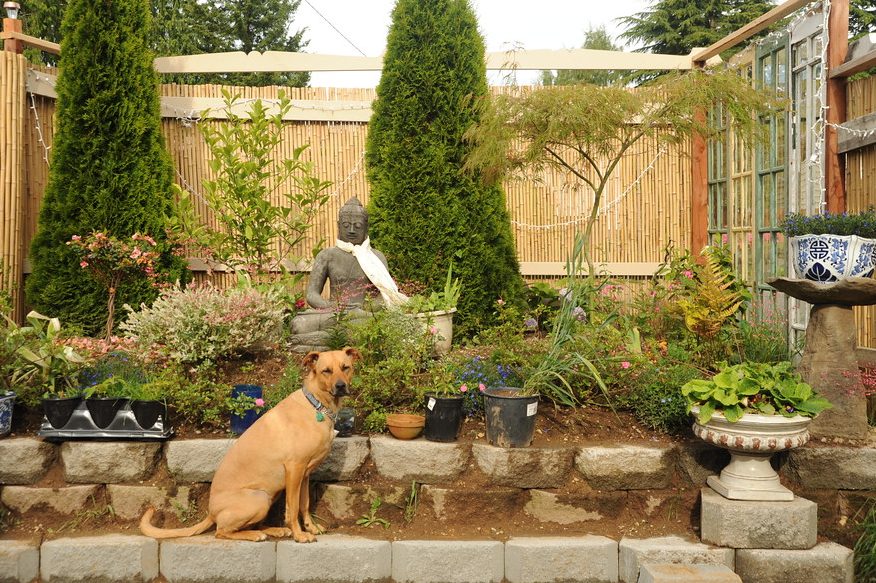
Photo: “Rosie poising with the garden Buddha, plants, raised bed, bamboo fence, Garden for the Buddha in progress, front yard, Seattle, Washington, USA” by Wonderlane is marked with CC0 1.0.

Marcus Bales, ‘Sailing to Margaritaville’

That is the country we go to, all of us
Made young again by music, smooth with oil
And lust, all generations generous
With youth and laughter. Couples coil
And uncoil, casually amorous,
With booze in the blender and shrimp beginning to boil.
Everybody dreams they have the chance
To chase the charms and challenge of romance.

A laughing bard is the essential thing.
A patterned shirt, an old six-string guitar,
Who urges us to sing and louder sing
And clap and dance and order from the bar,
And thank hard-working servers as they bring
The stuff that lubricates this whole bazaar.
And though the bard is covering the bill,
Tip well when you’re in Margaritaville.

Oh, parrotheads — imagination’s fire
Illuminates the marvel of it all,
And conjures every sorcery we require,
The call to the response, response to call,
A consummation fevered with desire,
Beatified by the local alcohol.
The song creates the dream. The dream creates
Another song the dreamer celebrates.

And once reality is far away,
Our youth returned, our stamina restored,
We eat and drink and sing and dance and play
And manifest ourselves within each chord
As if we might entrance ourselves to stay
Within this reverie we’ve found aboard
The magic vessel Margaritaville,
Distilling what distillers can’t distill.

*****

Marcus Bales writes: “Someone immediately floated a raft of shit my way over this poem, claiming, in a local Cleveland group generally given to local music, that I’m normalizing alcoholism. I know — it’s an astonishing misinterpretation, but there it is. And in spite of my protestations, he insisted on shouting that I was a lush, a drunk, and an idiot for promoting and approving a disease. Well, it’s not as if poets aren’t used to being misunderstood.

The odd thing to me about this is that I work hard to trigger people through poetry. That’s what art does, in my view, confront us with our frauds and foibles, and makes us look at them in detail. If, of course, we read poetry at all. There must be some corollary to Murphy’s Law that states that when a poem can be misinterpreted it will be misinterpreted. Normally I’m delighted by responses to my poems that are outraged and offended, because normally those responses are from the people I’m trying to outrage and offend. But this blindsided me. The entire Jimmy Buffett phenomenon was built on the fantasy of sun and sand and sea, which is only tangentially alcohol-fueled. No doubt alcohol plays a role in lubricating the enchantment, but it’s the enchantment people go for, not alcoholism.

And that enchantment is powerful. It makes people wear loud clothes and play loud music. But the central lure is that we can think of ourselves as all multi-talented and tanned, slim and young and horny. It’s not the lure of tales of drunkenness and cruelty on a summer afternoon, but rather the opposite: tales of slightly disreputable fun, but tales of the lure of the freedoms from regimentation for the freedoms of a more relaxed like-minded culture where everyone is youthfully attractive and eagerly lascivious.

And what a lure! Even those of us whose only encounter with youthfully attractive and eagerly lascivious were our own dreams had those dreams. And with Jimmy Buffett the price of admission was a seducing tune and a clever lyric. You didn’t need a white sportcoat, much less a pink crustacean. All you needed was a sense of lockstepness of the modern bourgeoisie and a desire to escape it. The whole thing is all in your mind. You create your own sensitive young poet self in a lubricious setting among the young and eager to love you. It’s thrilling, it’s fulfilling, it’s art.”

*****

(Editor’s note: From the title, to the ottava rima form, to the themes, ‘Sailing to Margaritaville’ pays homage to Jimmy Buffett by riffing on W.B. Yeats’ ‘Sailing to Byzantium‘. Beginning with Yeats’ opening words, “That is no country for old men” and all the way through, Bales echoes and plays with Yeats’ words, bringing everything to Buffett’s Margaritaville.)

Not much is known about Marcus Bales except that he lives and works in Cleveland, Ohio, and that his work has not been published in Poetry or The New Yorker. However his ‘51 Poems‘ is available from Amazon. He has been published in several of the Potcake Chapbooks (‘Form in Formless Times’).

Photo: “Wasting away again in Margaritaville……..” by efleming is licensed under CC BY 2.0.

Marcus Bales, ‘Lighthouse’

She needed constant, searching light
And some firm continent
From which to dive into the night
To find what darkness meant.

She fought the horses of the tides
And they her urgency.
She caught their lunar reins and rides
Triumphant out to sea.

And now she knows the powers of
The dark sea’s character,
And scorns the note her former love
Moans out, moans out to her.

*****

Marcus Bales writes: “Probably poets ought not tell this sort of story about their work. I found a stash of very old poems, carefully typed out on now-yellowed paper in a metal file box amid 5” Tandy floppy discs, and printed on a dot-matrix printer, a little faded, some months ago, and have started the often painful task of retyping them into my little electronic library of my work. Many of them are obviously student stuff, but this one seemed a little less studious than the rest. It brought back its context in my mind pretty clearly.
This is a very early poem, maybe sophomore year. I’d read someone’s comment that Yeats wrote about his friends as if they were characters in a Greek myth, and it had struck me as a sudden truth — to me, anyway. Nothing would do, of course, except to try the thing on my friends. Then a woman I knew gave me a copy of Adrienne Rich’s ‘Transformations’, which tells the stories of ancient myths about women, mostly, as if they had much more contemporary attitudes, and that seemed like a much better model than the Yeats tone and manner — and besides, Yeats had already done that tone and manner. So though the idea originated in Yeats, it is really Rich’s idea that I tried to follow, trying for the tone of metaphor in a contemporary voice. And Larkin was in there somewhere too, as I recall, having discovered him when asked to write a paper contrasting and comparing one of his poems to one of Wilbur’s. The Larkin was the one starting:
Sometimes you hear, fifth-hand,
As epitaph:
He chucked up everything
And just cleared off,

And that led me to many others, notably ‘The Trees’, with its amazingly unlarkinish  repetition at the end.
Steal from the best has long been my motto.”

Not much is known about Marcus Bales except that he lives and works in Cleveland, Ohio, and that his work has not been published in Poetry or The New Yorker. However his ’51 Poems’ is available from Amazon. He has been published in several of the Potcake Chapbooks (‘Form in Formless Times’).

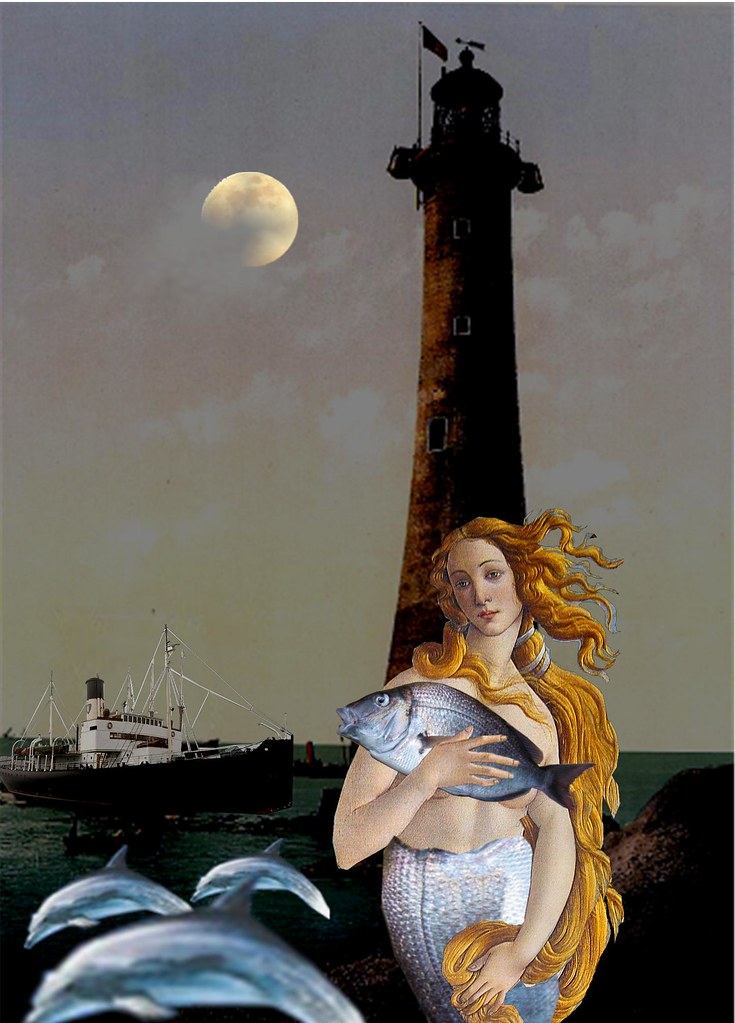
Photo: “my father was the keeper of the eddystone light” by sammydavisdog is licensed under CC BY 2.0.

Julia Griffin: ‘A Remembered Swan’

Former Ballerina with Alzheimer’s is able to remember her old dance routine when she hears “Swan Lake” – Yahoo! News 16th November 2020

A sudden glow: the hollowed arms upswept
Above the wandering head, the starry burst
Streaking the dark. The cobwebbed feet have kept
Their knowledge, not their power: she has been cursed,

Long since, this maimed princess. A crueller stroke
Than Rothbart’s holds her caged, blots out her sky;
How can frail forelimbs beat away his smoke?
How can a grounded spirit hope to fly

Back to its Lake? – except that something strange
Still beats in her, beneath her parchy skin:
A memory.
Among art’s kindlier things,
This timelessness, created out of change:
A ballerina, spotlit from within,
Trailing her lovely, half-extended wings.

*****

Julia Griffin writes: “I feel the form works with the subject-matter. This was inspired, of course, by the news story – and the way it seemed to reverse Yeats’ great poem by making the swan a deliverer from helplessness.”

Julia Griffin lives in south-east Georgia/ south-east England. She has published in Light, LUPO, Mezzo Cammin, and some other places, though Poetry and The New Yorker indicate that they would rather publish Marcus Bales than her.
Her poem ‘Wasp Waste’ was reprinted in the Potcake Chapbook ‘Robots and Rockets‘, and much more of her poetry can be found in Light, at https://lightpoetrymagazine.com/?s=julia+g&submit=Search

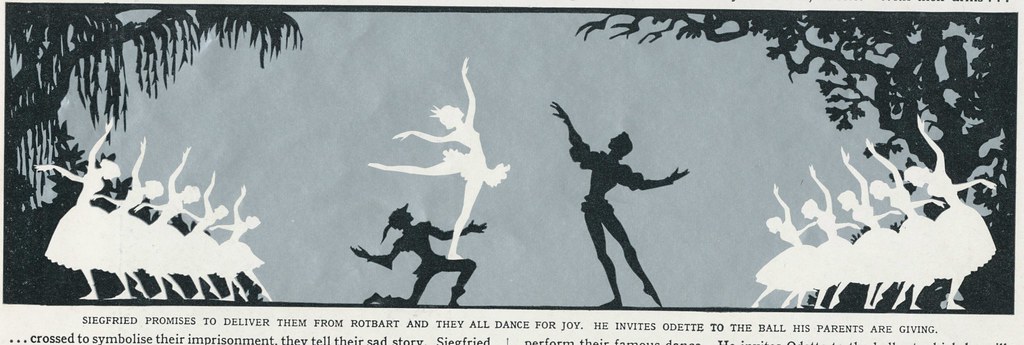
Photo: “swanlake c Lotte Reiniger” by janwillemsen is licensed under CC BY-NC-SA 2.0.

The Nobel Prize for Literature: Louise Glück

Archaic Fragment

I was trying to love matter.
I taped a sign over the mirror:
You cannot hate matter and love form.

It was a beautiful day, though cold.
This was, for me, an extravagantly emotional gesture.

…….your poem:
tried, but could not.

I taped a sign over the first sign:
Cry, weep, thrash yourself, rend your garments—

List of things to love:
dirt, food, shells, human hair.

……. said
tasteless excess. Then I

rent the signs.

AIAIAIAI cried
the naked mirror.

Source: Poetry (January 2006)

So Louise Glück has won the 2020 Nobel Prize for Literature, “for her unmistakable poetic voice that with austere beauty makes individual existence universal.” This is all very well–she has powerful insights, strong images, and these translate well into other languages. But as an advocate of the use of poetic tools inherent in language–rhyme and rhythm in particular, for English–I can’t classify the expressions of her poetic voice as poetry.

The simplest touchstone is this: How easy is it learn the passage by heart, to recite it word for word from memory? Because that is why we developed the tricks of poetry, the different rhythms for different moods, the different forms for different levels of complexity. Poetry is song with the emphasis shifted from the melody to the words; but the music is still there in shadow form.

It is very hard to keep the actual poetry when a poem is translated from one language to another. It is easy enough to translate the insights and imagery, but what of the music of the language? It can be done by a skilful translator, but the fidelity is often compromised to remake the poetry. Yeats was very free with the French of Pierre de Ronsard when he wrote

When you are old and grey and full of sleep,
And nodding by the fire, take down this book,
And slowly read, and dream of the soft look
Your eyes had once, and of their shadows deep;

but he captured the poetry and made it into one of his own best-loved pieces. James Joyce translated the German of Gottfried Keller as

Now I have fed and eaten up the rose
Which then she laid within my stiffcold hand.
That I should ever feed upon a rose
I never had believed in liveman’s land.

It’s Keller, but it’s also poetry, and with Joyce’s own voice. Glück indeed has a voice, but how simple is it to learn her work and recite it word for word, compared with the Yeats or Joyce work above? And if you learn it by heart, will you still be able to recite it verbatim years later? I think not. So I submit that her work is not poetry.

That doesn’t mean that it isn’t literature. It just means that we need a word for such work, writing that is too poetic to be called prose, but too prosaic to be called poetry. Poetry needs its undercurrent of song. When the Nobel Prize was being awarded for poetry, Bob Dylan was a far wiser choice than Louise Glück.

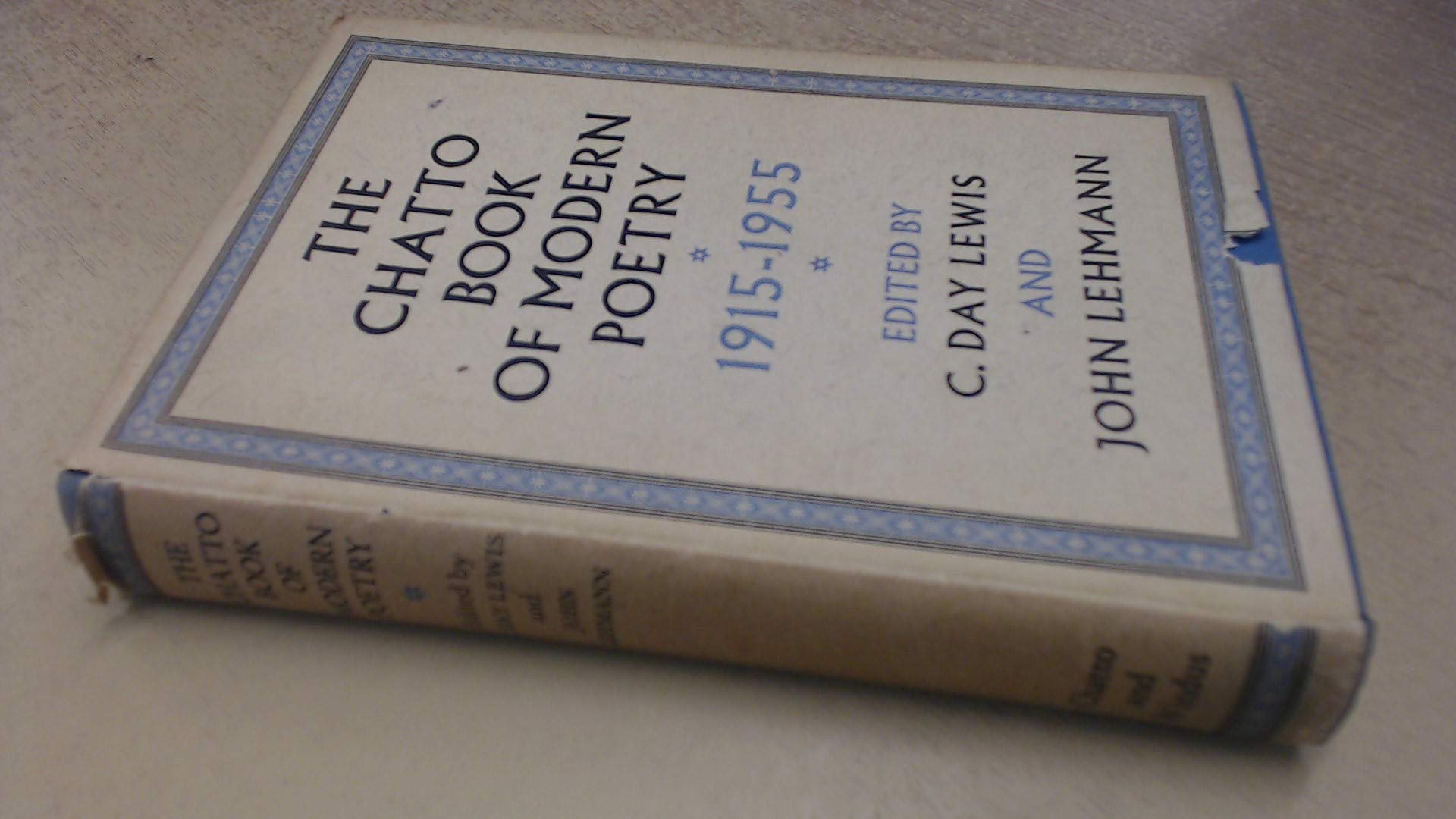
Review: “The Chatto Book of Modern Poetry, 1915-1955”

Chatto Modern Poetry

1915 to 1955 provides quite a range of poetry! From Hardy, Housman, Kipling, Yeats, through two world wars, to Dylan Thomas and twenty poets younger than him. Editors C. Day Lewis and John Lehmann confined themselves to (loosely defined) British poets, and to those aged at least 30 by their final selection. Among the 260 poems are many standards–Hardy’s ‘Afterwards’, Yeats’ ‘Sailing to Byzantium’, Eliot’s ‘East Coker’, Auden’s ‘Lay Your Sleeping Head’, Dylan Thomas’ ‘Fern Hill’–but the real joy is in discovering good work by less well known poets. I give a few excerpts as examples: pastoral, autobiographical, of mortality, a war poem, wistfulness:

Andrew Young, ‘Wiltshire Downs’

The cuckoo’s double note
Loosened like bubbles from a drowning throat
Floats through the air
In mockery of pipit, land and stare.

And one tree-crowned long barrow
Stretched like a sow that has brought forth her farrow
Hides a king’s bones
Lying like broken sticks among the stones.

Laurie Lee, ‘First Love’

Then it was she put up her hair,
inscribed her eyes with a look of grief,
while her limbs grew as curious as coral branches,
her breast full of secrets.

But the boy, confused in his day’s desire,
was searching for herons, his fingers bathed
in the green of walnuts, or watching at night
the Great Bear spin from the maypole star.

Alun Lewis, ‘Water Music’

Cold is the lake water
And dark as history.
Hurry not and fear not
This oldest mystery.

This strange voice singing,
This slow deep drag of the lake,
The yearning, yearning, this ending
Of the heart and its ache.

Keith Douglas, ‘How to Kill’

Now in my dial of glass appears
the soldier who is going to die.
He smiles, and moves about in ways
his mother knows, habits of his.
The wires touch his face: I cry
NOW. Death, like a familiar, hears

and look, has made a man of dust
of a man of flesh. This sorcery
I do. Being damned, I am amused
to see the centre of love diffused
and the waves of love travel into vacancy.
How easy it is to make a ghost.

Sidney Keyes, ‘The Gardener’

Do you resemble the silent pale-eyed angels
That follow children? Is your face a flower?
The lovers and the beggars leave the park–
And still you will not come. The gates are closing.
O it is terrible to dream of angels.

As a collection the poetry is overwhelmingly formal, rural and male. It is titled ‘The Chatto Book of Modern Poetry’, but it predates the formless chaos of what we now call “modern poetry”, the unstructured confessional outpourings of the past half century. The anthology isn’t perfect, but very rewarding for lovers of traditional poetry. (Not hard to find. Used hardcovers are available from $0.99 on Amazon.)