Monthly Archives: December 2024

Unrhymed sonnet: Peggy Landsman, ‘Shortly Before Another Winter Solstice in South Florida’

The seasons flow from much too hot to warm;
the moon balloons from farther south to north.
I struggle with myself to catch sunrise;
I shiver at sunset as darkness dawns.
Two clouds drift by in stillness as in dream.
My mind makes small confessions in the dark.
I wander through this ordinary night
discovering new doubts about myself.
The weather of my moods, not too extreme;
the climate of my life in crisis blooms.
The winter days grow short; my life, too long.
My understanding pales beneath the moon.
We creatures who’ve evolved to change the world
have not evolved enough to change ourselves.

*****

Peggy Landsman writes: “It did take me quite a while to make the transition from Berkeley, California, but now, after twenty-one years in South Florida, I’m finally over my culture shock.
I love walking on the beach and swimming in the ocean when the water temperature is at least 80°. I love the birds I see more of here than in other places: ibises, egrets, herons, ospreys, pelicans, etc. And I get all the culture I need for free from my local public county library. If they don’t have a movie, cd, or book on their shelves, they order it through ILL (inter-library loan).
I spend most of my time writing and hanging out with my favorite other person. What more could any septuagenarian poet want?
Also: The poem was first published under the slightly shorter title “Before Another Winter Solstice in South Florida” in the Winter 2024 issue of The Orchards Poetry Journal. And, by the way, that’s a very friendly journal for formal poetry. Thanks, Karen and Jenna!”

Peggy Landsman is the author of the full-length poetry collection, Too Much World, Not Enough Chocolate (Nightingale & Sparrow Press, 2024), and three other books, including the poetry chapbook Our Words, Our Worlds (Kelsay Books, 2021). She lives in South Florida where she spends as much time as possible at the beach. To learn more about her and her work, visit: https://peggylandsman.wordpress.com/

Photo: “Walk on a Warm Beach” by justenoughfocus is licensed under CC BY-NC 2.0.
Weekend read: Odd poem: Winston Churchill, ‘Our Modern Watchwords’

I
The shadow falls along the shore
The search lights twinkle on the sea
The silence of a mighty fleet
Portends the tumult yet to be.
The tables of the evening meal
Are spread amid the great machines
And thus with pride the question runs
Among the sailors and marines
Breathes there the man who fears to die
For England, Home, & Wai-hai-wai.

II
The Admiral slowly paced the bridge
His mind intent on famous deed
Yet ere the battle joined he thought
Of words that help mankind in need
Words that might make sailors think
Of Hopes beyond all earthly laws
And add to hard and heavy toil
The glamour of a victorious cause.

*****

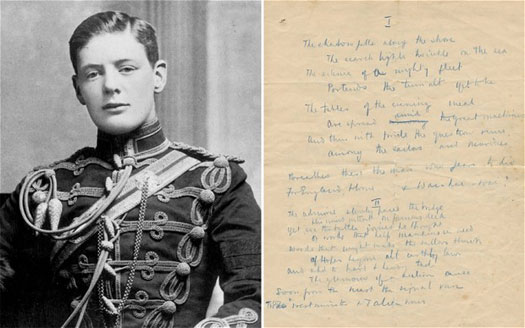
Around 115 years after it was written, the only known poem written by Winston Churchill as an adult was discovered by Roy Davids, a retired manuscript dealer from Great Haseley in Oxfordshire: ‘Our Modern Watchwords’, which was apparently inspired by Tennyson and Kipling.
Written between 1898 and 1900 when Churchill was a cornet (equivalent to today’s second lieutenant) in the 4th Hussars, the 10-verse poem is a tribute to the Empire. The author peppers the poem with the names of remote outposts defending Britain’s interests around the world, many of which he would have visited as a young officer and even fought at, including Weihaiwei in China, Karochaw in Japan and Sokoto in north-west Nigeria. Written in regular iambic tetrameter but with irregular rhymes, the poem exists in a tradition that stretches back to Homer’s Iliad: the soldier waiting impatiently for the battle to begin. As Churchill writes: ‘The silence of a mighty fleet / Portends the tumult yet to be.’
Davids, who says the poem “is by far the most exciting Churchill discovery I have seen”, admits it is merely “passable”.
Andrew Motion, the former Poet Laureate, goes further, calling it “heavy-footed”. “I didn’t know he wrote poems, though somehow I’m not surprised: oils, walls, why not poems as well?” said Motion. “This is pretty much what one would expect: reliable, heavy-footed rhythm; stirring, old-fashioned sentiments. Except for the lines ‘The tables of the evening meal/Are spread amid the great machines’, where the shadow of Auden passes over the page, and makes everything briefly more surprising.”
Despite its lack of literary virtues, however, the poem written in blue crayon on two sheets of 4th Hussars-headed notepaper was expected to raise between £12,000 to £15,000 when it went on sale in 2013. Its price reflected its rarity: the only other poem known to be penned by Churchill is the 12-verse ‘The Influenza’, which won a House Prize in a competition at Harrow school in 1890 when he was 15. However ‘Our Modern Watchwords’ failed to sell at the auction as bidding never reached the reserve price.
Churchill was well-known for his love of poetry. He won the Headmaster’s Prize at Harrow for reciting from memory Macaulay’s 589-line poem ‘Horatius at the Bridge‘.
Allan Packwood, director of the Churchill Archive Centre at Churchill College, Cambridge, said the wartime prime minister’s interest in poetry spanned the sophisticated to the more earthy: “In his speech accepting freedom of the city of Edinburgh in 1942, he quoted Robert Burns and ended by quoting the music hall entertainer Sir Harry Lauder, who was in the audience. This was no cheap politician’s trick, Churchill was an admirer of Lauder’s.”
By the way, Churchill was well-known for his oratory and repartee, but he wasn’t always the victor. My favourite story involves Richard Haldane in the 1920s. Churchill prodded Haldane’s ample belly and asked “What’s in there?” Haldane answered: “If it is a boy, I shall call him John. If it is a girl, I shall call her Mary. But if it is only wind, I shall call it Winston.”

Photos: https://winstonchurchill.org/publications/churchill-bulletin/bulletin-056-feb-2013/appreciation-the-young-churchill-poem-hints-at-the-rhetorical-greatness-to-come/

Lindsay McLeod, ‘Last Call’

If this isn’t what you’ve yearned for
or indeed what you are craving
then cup your hands, drink deeply
of a sweeter misbehaving.

If you cannot find your wine inside
the glass that you were given,
taste the new with eyes and thighs
and dye your lips a deep vermillion

with a juice that has been pressed
from vines let grow out of control
that taste of summertime and
sex and drugs and rock and roll

because if you…

find distaste in your final breath
dressed in another’s ill fit clothes
remember, this did not just happen
sweetheart, this is what you chose.

*****

Lindsay McLeod is an Australian poet that has won a few things and is widely published. He just had to start messing about with words again lately. You’d think he’d know better by now, but oh no. Some of his most recent work can be found in DILLYDOUN REVIEW, GRAND LIL THINGS, DRAWN TO THE LIGHT, POETiCA and MORTAL MAGAZINE.

RHL: In addition to Mr McLeod’s self-description, let me add that I have been trying and failing to contact him. I don’t even have permission to post this poem. If anyone can put me in touch with him, I would be grateful.

Photo: “98/365: ♫ Red, Red Wine…” by rogersmj is licensed under CC BY-NC 2.0.
Short poem: RHL, ‘Home Thoughts from the North’

Dog-skinny, winter’s mangy sun
Slinks between clouds.
A West Indian dog – there are none such here in the UK ….
Nor, there, such mangy suns.

*****

Some people equate a good Christmas with a family walk in the snow, others with family time on a beach. It all depends on what you grow up with, doesn’t it? With my first twelve years being on islands with palm trees, it has remained difficult for me in my decades of climate exile to appreciate more than a month or two of bleaker weather at a time. ‘Home Thoughts from the North’ was originally published in Snakeskin – thanks, George Simmers!

Best wishes for an appropriately weathered Merry Christmas to all… and apologies to Eliza for subjecting her to non-Canadian winters for so many years!

Photo: “Skinny puppy in Udaipur” by Dey is licensed under CC BY-NC-SA 2.0.

Helena Nelson, ‘Invitation’

a homage to Donne’s ‘Nocturnal on St Lucies day’

The shortest day is soon. Time for a pact.
I don’t mean with Saint Lucy (Lucy’s day
falls earlier in the month). But hey
let’s meet and talk and counteract
such darkness of the heart
as coincides with winter’s formal start.
We can read Donne’s ‘Nocturnal’, view its art,
its provenance and what on earth it means.
Location doesn’t matter. We have screens.

Nobody writes a poem now like that —
not something so precise and well controlled.
Of course, we hear what we are told:
the world is round, a rhyme is flat,
‘poetics’ have moved on
and these days no-one wants to write like Donne
who was amazing, right? But dead and gone.
Or not that dead. I’d say he’s still alive
in stanza three and certainly in five.

They call Donne ‘metaphysical’, you know,
a word still popular in jacket blurbs
for living, writing bards where verbs
(or verbiage) propel the flow
but hard now to be sure
whether they mean what Johnson meant. The more
‘meta’ you get with blurbs, the more obscure.
When ‘metaphysical’ foretells a treat
it might be true; it might be mere conceit.

But in ‘Nocturnal’, metaphor leans out
and mystifies. It’s not the usual thing
like glass or compasses or string.
It’s nothing. No thing. Less than nowt.
He says what he is not
in several different ways. In fact, the knot
of nothingness becomes his central plot.
The poet in him can’t forget that ‘none’,
his rhyme for ‘run’, echoes both ‘sun’ and ‘Donne’.

So he’s the sum of everything he feels:
annihilated by the loss of one
without whom he is not a man,
just numb. And yet he still appeals
to logic to make clear
how dark existence is. Yes, she was dear.
Each syllable recounts her loss, his fear,
and this is now and then and now, since this
both the year’s and the day’s deep midnight is.

*****

Helena Nelson writes: “In 1617 when, after the death of his wife, John Donne wrote ‘A nocturnall upon S. Lucies day, Being the shortest day’, St Lucy’s Day coincided with the winter solstice in the author’s hemisphere. Then they changed the calendar, and these days, Saint Lucy’s Day is 13 December. But the winter solstice falls over a week later (this year 21 December).

“Every year on the solstice, I think about John Donne’s solstice poem, every year it gets more apposite, since it is essentially about death. Last year, I did a formal online discussion about it, and I wrote an invitation using the form that is Donne’s, though obviously for a less serious purpose. It allowed me to think it through. I’m thinking about the poem again today, so here’s the invitation.”

Helena Nelson runs HappenStance Press (now winding down) and also writes poems. Her most recent collection is Pearls (The Complete Mr and Mrs Philpott Poems). She reviews widely and is Consulting Editor for The Friday Poem.

Photo: “John Donne, Poet” by lisby1 is marked with Public Domain Mark 1.0.

Sonnet: Rick Mullin, ‘Shrine to Satan’

The neighbor’s child has built a muddy shrine
to Satan in our yard. And I’m supposed
to cut the lawn? OK, but look at those
croquet clubs that she used (good God, they’re mine)
to pound her pentagrams of chicken bone
into the ground. The handles are unscrewed
from all the hammer heads. It’s kind of shrewd
the way she placed that PlayskoolTM telephone.

Still, little girls should not touch garden tools
or take the plastic rake out of the shed–
she’s tied it with those jump ropes to the tree.
A shattered flower pot. The Barbie head.
Horrific how this child has learned the rules
of Belial for sculpting in debris.

*****

Rick Mullin writes: “The little girl, A., is a friend of our family and was one of three girls that spent most days playing in our yard. One day they split up, each doing their own thing in their own corner of the yard. The Shrine to Satan, as I called it, was crafted by A. The architect of the horror described in this poem is getting married today.”

Rick Mullin’s poetry has appeared in various journals and anthologies, including American Arts Quarterly, Measure, The New Criterion, The Dark Horse, The Raintown Review, Epiphany, and Rabbit Ears: TV Poems. ‘Shrine to Satan’ is from his chapbook “Aquinas Flinched”, Exot books, 2008. His books include Soutine and Sonnets from the Voyage of the Beagle (Dos Madres Press, 2012 and 2014), Lullaby and Wheel (Kelsay Books, 2019), and Huncke (second edition, Exot Books, 2021). He is a painter and retired journalist living in northern New Jersey. His website is rickmullin.com and his art blog is onlyofobjects.wordpress.com

Photo: “Little girl playing with a kitten and dolls.” by simpleinsomnia is licensed under CC BY 2.0.

Semi-formal: ‘My Doctir’s Excus’ by Michael R. Burch, age 8

I can eggsplain why Im sick.
Sick as a brick
and my stule is thick.
I came to school
and I caught it from Rick.
Now I’m sick as a brick
and my stule is thick.
I cant do my homework
becus Im sick.
I cant take tests
becus Im a mess.
Blame Rick, the prick!
—signed, my doctir

PS, Thurd grade is hard enuff on kids nervs and bad graids make my simptoms worse! Liten up, doctirs orders!

*****

Michael R. Burch confesses: “I must admit that the whole thing is entirely fictional, and I lied about my age. Poet license! I came up with the poem this morning (December 17, 2024) as soon as I awoke. That happens to me quite bit: having a line in my head as soon as I wake up. I have even composed poems in my sleep a few times. The original poem had normal spelling, but then it occurred to me to turn it into a not-so-artful ‘doctir’s excuse.’
There was no Rick.”

Michael R. Burch’s poems have been published by hundreds of literary journals, taught in high schools and colleges, translated into 22 languages, incorporated into three plays and four operas, and set to music, from swamp blues to classical, 61 times by 32 composers. He is also the founder and editor-in-chief of The HyperTexts.

Illustration: WikiHow: https://www.wikihow.com/Make-Up-a-Good-Excuse-for-Your-Homework-Not-Being-Finished#/Image:Make-Up-a-Good-Excuse-for-Your-Homework-Not-Being-Finished-Step-18.jpg

Semi-formal at best, RHL, ‘Remembering Winter’

I remember winter when it was only
Mostly too cold to swim –
The churning suck and drag of waves under the rock.
Yes, there are flowers – there are always flowers –
But, with the poinciana stripped of leaves,
Its pods like forearms thinned and bent with age,
The rattling of sticks, the hiss of wind,
The broken sea stuck futilely on Wash
With endless turning, churning, foaming pulse –
How long can waves beat on a rock before
The tired rock gives up?

Yes, I remember later northern winters –
The bitter satisfaction of a too-thin sun,
Beauty without the joy, light without heat.
Feet always cold, clothes never quite enough;
Skin drying back from fingernails, lips chapped, throat raw,
The smell of damp coats, never fully dry.

I dream of alternating south and north
And never having to be cold again,
Turning, returning, always in the sun –
Or settling in an equatorial land
And swimming year-round, mellowing on the sand
Flattening my temperature, my will,
Soaking up sun, and dreaming I’m asleep.

Bitter it is, the winter argument,
Betrayed by world that slices off the years,
I have no love of winter, and I feel
Trapped, and betrayer of true kids of mine –
But look – they love it, so I’m further trapped,
Bound to the year that crushes as it turns,
And has become their home – are they then kids of mine?
Ice – snow – the winding down of life and year.

And I’ve known other winters all too well –
Where years of spring gave way to years of warmth,
Blossoms to children sparkling in the light,
The wonders of the world’s sharp sense delight;
Then years of fruit, as independent seeds
Form their own thoughts and follow darkening paths
Falling away, on purpose shrivel up,
And days grow shorter, moods swing soft and harsh
Drizzle sets in for weeks, cold in the bones,
Cold in the head, and colder in the heart –
That’s how the years of endless winter start.

Bleakness to bleakness, blackness into black;
Lives dry and crack,
Sap gone from tree and house and bone.
Who knew that emptiness could weigh so much?
Give me the strength to last to Spring, or start my own.

*****

This poem is from decades ago, in one of those periods where life felt bleak. (But such seasons pass!) For a long time I was unsure of the poem because it always feels like sloppiness and cheating when my rants are low on rhythm and rhyme; but George Simmers liked it enough for inclusion in Snakeskin, and that’s more than good enough for me.

Photo: “Shack-Shacks” by Chris Hunkeler is licensed under CC BY-SA 2.0.

Unforgettable nonsense: Christopher Isherwood, ‘The Common Cormorant or Shag’

The common cormorant (or shag)
Lays eggs inside a paper bag,
The reason you will see no doubt,
Is to keep the lightning out.
But what these unobservant birds
Have never noticed is that herds
Of wandering bears may come with buns
And steal the bags to hold the crumbs.

*****

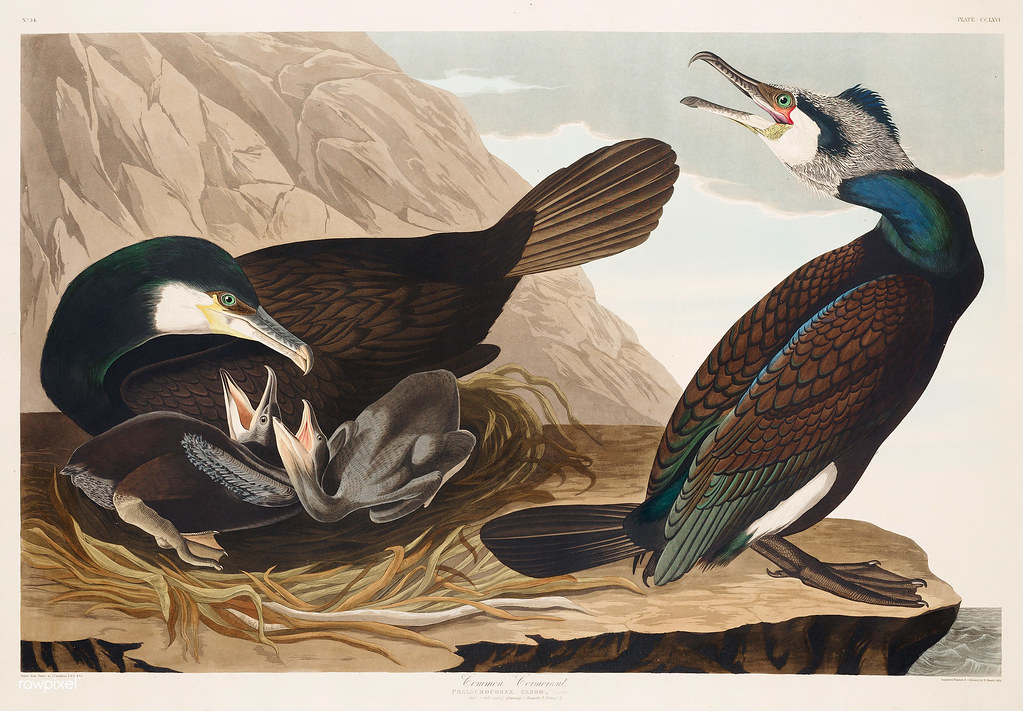
There are a couple of anomalies about this poem. First, some people doubt that it is by Christopher Isherwood, because the poem had been circulating anonymously since 1938 but didn’t appear under his name until 1982 in his nonsense-animals collection ‘People One Ought To Know’. But he had actually written the collection as early as 1928, as I gather here. Secondly, cormorants and shags are similar but different birds of the same family, at least in current terminology; however as Wikipedia says, ‘No consistent distinction exists between cormorants and shags. The names “cormorant” and “shag” were originally the common names of the two species of the family found in Great Britain.’ And anyway, it’s a nonsense poem, so who really cares? It is amusing, and easy to memorise because it is in verse.

Illustration: “Common Cormorant from Birds of America (1827) by John James Audubon (1785 – 1851), etched by Robert Havell (1793 – 1878). The original Birds of America is the most expensive printed book in the world and a truly awe-inspiring classic.” by Free Public Domain Illustrations by rawpixel is licensed under CC BY 2.0.

Sonnet: Gail White, ‘A Visit on All Saints Day’

Hello. I’ve brought your favorite flowers again.
How is going under there, my dead?
On this side, we’re no better off than when
you walked beside us. (Yes, I know I said
the same last year.) The human race is not
improvable. Ask any saint you meet.
We’ve gone to war again without a thought.
Our leaders shuffle bribes, our heroes cheat.
Your children haven’t turned out awfully well,
but who expected it? You’re not to blame.
They’ll manage, and nobody burns in hell.
Goodbye for now. I’m always glad I came.
I make no promises about next year,
but one way or another, I’ll be here.

*****

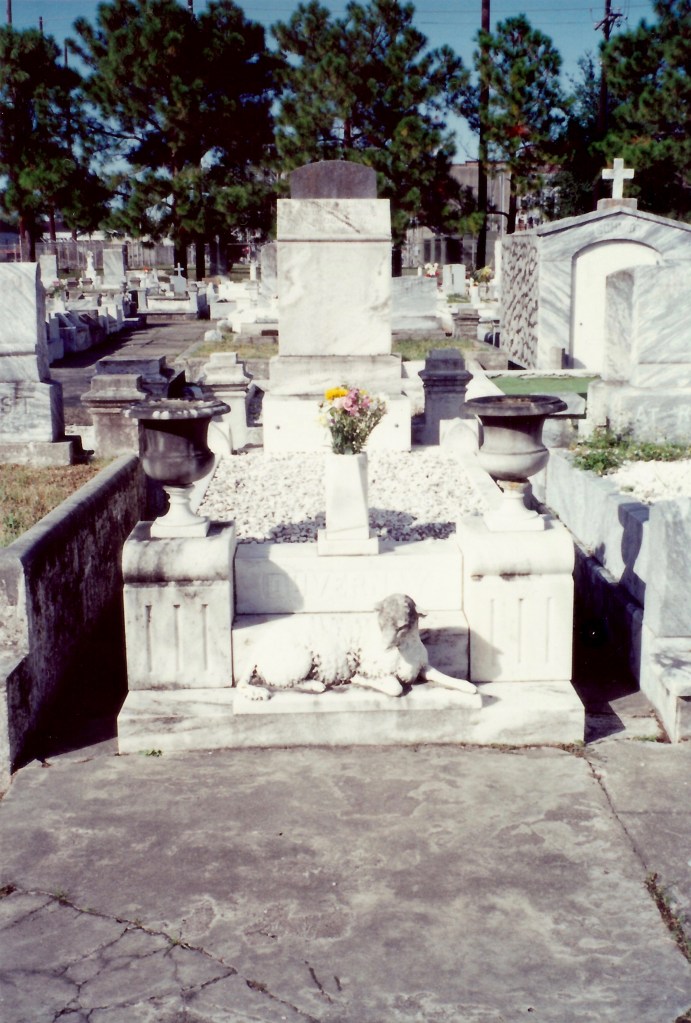
Gail White writes: “I wrote this while living in New Orleans, where the dead are buried above ground (mostly) because the city is below sea level.  All Saints Day is still a big deal, when the family tomb gets a new coat of whitewash and flowers are placed on every grave.  It’s time to reflect on family and faith and our all ending up in the same place, as I’ve tried to do here.”

Gail White is the resident poet and cat lady of Breaux Bridge, Louisiana. Her books ASPERITY STREET and CATECHISM are available on Amazon. She is a contributing editor to Light Poetry Magazine. “Tourist in India” won the Howard Nemerov Sonnet Award for 2013. Her poems have appeared in the Potcake Chapbooks ‘Tourists and Cannibals’, ‘Rogues and Roses’, ‘Families and Other Fiascoes’, ‘Strip Down’ and ‘Lost Love’. ‘A Visit on All Saints Day’ was originally published in Mezzo Cammin, and collected in her chapbook, ‘Sonnets in a Hostile World‘, also available on Amazon.

Photo: “New Orleans Cemetery DUVERHAY tomb” by Infrogmation of New Orleans is licensed under CC BY-SA 4.0.