Author Archives: Robin Helweg-Larsen

Unknown's avatar

About Robin Helweg-Larsen

Director, Andromeda Simulations International, Bahamas: a global education company providing online and in-person workshops in business finance. Series Editor, Sampson Low's 'Potcake Chapbooks'. Formal verse about traveling, family, love, etc...

Poem: ‘Hail Deth’

Hail Deth, that from alle Natur’s birth
Hast kept each living thing thy thrall!
Teech me to love thy quiet call,
To rest
Among the blest,
To be at peace with every thing on earth.

Come soft, without impediment;
Let mee slide sleeping to thy armes,
Discover alle thy soothing charmes;
And kill
My every ill,
Leave mee uninterrupted sediment.

This is one of my very earliest poems, with the form, theme and erratic spelling all obviously influenced by studying the Metaphysical Poets in school. I’ve always been fascinated by death–at least since the time I gave up Christianity, thanks to my excellent Church of England schooling. The poem was written tongue-in-cheek, of course: I’m in no hurry to die.

‘Hail Deth’ has just been published in the Shot Glass Journal which, in accordance with Shakespeare’s “brevity is the soul of wit”, publishes both formal and free verse so long as a poem doesn’t exceed 16 lines. It also divides contributions into American and International groups and lists them separately, which is interesting if not necessarily useful in any functional sense.

Photo: “NS-01023 – Death Head” by archer10 (Dennis) is licensed under CC BY-SA 2.0

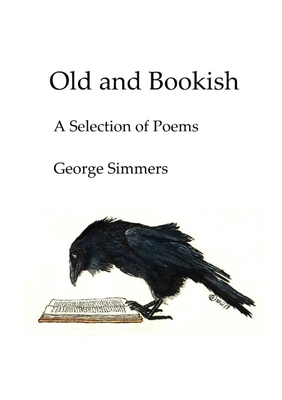
Review: ‘Old and Bookish’ by George Simmers

George Simmers has chosen a title for his latest collection of poems that describes it very well: “Old and Bookish”; and also–if being merely in our 70s isn’t premature–self-deprecatingly describes himself. But though he writes with understanding about oldness and bookishness, he makes it clear that he is not being autobiographical: The first section is called “from The songs of the Old Man”, the title immediately followed by: “Note: The Old Man is not me, but I know how he feels.”

The Old Man Walks his Dog; The Old Man Visits a Very Old Woman; even The Old Man’s Song About the Crematorium… poems about the kind of thoughts the Old Man has:
Both the slutty and the proper,
Both the crooked and the copper,
Those who decorate interiors,
And the very very serious,
Both the fervent Corbynista
And her fashionista sister
Who’s obsessed by the length of a hem –
They’ll all end up at the crem crem crem
They’ll all end up at the crem.

That gives a sense of Simmers’ work–smooth and amused in rhythm and rhyme, in tone and in message. Or take The Old Man’s Heaven–how would a music lover imagine eternity in the afterlife? Discounting the “hoity-toity… operatic… Bayreuth-y” and the alternative punk “one long mosh pit”, the Old Man with gentle amusement envisages an older blonde in a piano bar:
With a voice of smoky yearning,
A lady who has seen too much,
But she keeps the old torch burning.

She sings that life is made for love,
And time will kill the pain.
She sings that though your love’s gone bad
You still should love again.
She sings that there is always hope
And those who love are wise.
Yes, I could spend eternity
Hearing those lovely lies.

The second section of the book moves away from the internal view of the Old Man to the external view of Some Oldies. It begins with Rachel, the most energised:
Old Rachel’s fierce and heavy-browed
Her views are strong; her voice is loud.
She says the councillors are crooks;
She says the mayor cooks the books.
She says the government’s a mess –
Don’t start her on the NHS –
While London, which survived the Blitz,
Is being bought by foreign shits,
By criminals and sheiks and sharks,
And kleptocrats and oligarchs…

and ends with Christopher, aware of his life winding down, dozing off with a smile
For he is entering a dream –
A joyous dream where he’s pursued
By several plump and laughing women
In the pink bumgorgeous nude.

The third, final, and largest section of the book is where we get to Bookish. Here are poems on poetry, on poets, on words, on English. There is a 26-line Elsinore Alphabet that starts at the beginning of Hamlet:
A is for armour, which kingly ghosts wear.
B is for battlements, where the guards stare.

and works its way through to the very end:
Y, they’re all dead as Yorick, once such a great hoot.
Z’s for zero plot left. Bid the soldier-chaps shoot.

There is two-page book review in limericks of a book of limericks. And there is my favourite poem of the book, ‘Poets in Residence’. Simmers having been a schoolteacher, he takes obvious delight in his tale of a headmaster who invites all the best English poets to the school. Here are eight of the 33 couplets:
Geoffrey Chaucer came first, on an equable horse,
And Spenser, and Marlowe, and Shakespeare, of course…
Keats arrived coughing, Kipling marched vigorously;
Matthew Arnold began to inspect the school rigorously…
Vaughan was ecstatic, though Clough was more sceptical.
Ernest Dowson puked up in a litter receptacle.
Coleridge sneaked off to discover the rates
Of an unshaven person outside the school gates…

Unfortunately for the Headmaster, there is a Romantic Revolt:
Shelley’d gathered the students out in the main quad,
And roused them to rise against school, Head, and God…
The bards of the thirties were equally Red,
And Milton explained how to chop off a head…
Soon the School was destroyed. Eliot paced through the waste,
And reflected with sorrow and learning and taste,
Which he fused in a poem, an excellent thing,
Though rather obscure and a little right-wing…

And the Head is left amidst the rubble, cursing all poets and poetry.

It all makes for a thoroughly enjoyable romp through the many aspects of ageing, viewed both internally and externally; and the consolations and disconsolations of poetry itself. It is an easy read, the ease belying the breadth and depth of Simmers’ thought, his lifetime of experience including the 25 years he has spent editing and publishing that excellent monthly online poetry magazine, Snakeskin.

Old and Bookish is an excellent and memorable collection of verse.

Even the cover illustration gets a little write-up at the end of the book, including a last poem by Simmers:

“I am very grateful to Bruce Bentzman for permission to use again his ‘Raven’ drawing, which made an earlier appearance in our Animals Like Reading collaboration. I approve of this bird, both for his obvious appetite for reading, and for his air of scepticism, which once inspired this rhyme:
‘Human nature? Bloody chronic!’ Raven caws in tones sardonic,
And adds: ‘I’ve read some rubbish as I’ve studied human lore,
But I’ve read no book that’s dopier than Sir Thomas More’s Utopia,
Which imagines human harmony and man (that carnivore!)
Being so nice to his neighbour he abjures all thoughts of war.’
Quoth the raven: ‘Never, More.’

And as for that Raven’s comment about warfare: it should be noted finally that George Simmers also authors a blog called Great War Fiction plus which focuses on fiction of the First World War, but also goes off on whatever tangents seem interesting.

Odd poem: French Verse on painting, by Winston Churchill

La peinture á l’huile
Est bien difficile,
Mais c’est beaucoup plus beau
Que la peinture á l’eau.

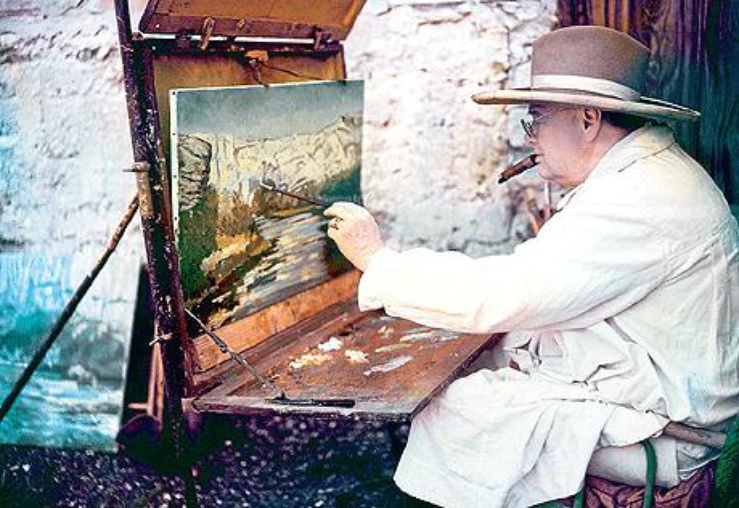
The translation: “Oil painting / Is certainly hard, / But it’s much lovelier / Than watercolour.” For reasons unknown, Winston Churchill came up with what is almost a Clerihew in style, but in French, as a comment in his little 1948 book ‘Painting as a Pastime‘.

Churchill first took up painting in 1915 at age 40 when he was removed as First Lord of the Admiralty. His fall was a result of the disastrous Dardanelles and Gallipoli attacks on Turkey that he had organised.

He took up painting for distraction, but it became increasingly a part of his life. He didn’t have hopes of making money from his “daubs”, and didn’t consider he had mastered the art. As he wrote in that slim book, “When I get to heaven I mean to spend a considerable portion of my first million years in painting, and so to get to the bottom of the subject.” Early on he submitted and exhibited under pseudonyms as a way of assessing his abilities without the influence of his name. In 1921 he exhibited at Galerie Druet in Paris under the pseudonym Charles Morin and sold six paintings for £30 each. In 1947 he submitted paintings to the Royal Academy Summer Exhibition under the name David Winter, and was successful with two of them.

He continued to paint for over 40 years, landscapes when the weather was obliging, still lifes when stuck indoors. Wherever he travelled–Morocco and Egypt, France and Italy, Jamaica, Canada and the US–his easel, brushes and paints went with him and were put to use. He produced at least 500 paintings, giving many away and not keeping records of them. You can see several of his paintings here if you scroll to the bottom.

‘Photo: Churchill painting a view of the Sorgue river in 1948, photographer unknown

(Loosely) Anapestic Sonnet: ‘A Run’

Over the island from beaches this side where it’s blowing,
it’s only a mile to the side where today it’s flat calm;
so over the hill’s potholed tarmac, to tracks of sand going
along under southern pine, seagrape, gum elemi, palm;
and then between sea-oats and cocoplums over the dunes
and down to the beach where the sand is as dusty as powder,
then lower across the high tide mark that seaweed festoons,
to harder packed sand under sun hot as bird-pepper chowder —
the sand at the ocean low tide, flat and hard as a ledge,
so flat you don’t feel that you’re running the side of a slope
where the ocean runs up inches deep and you splash through its edge,
one more mile to the end, where the sand is as pink as fresh hope,
is as pink as a conch shell, as pink as the still morning skies —
and you rest on the rocks in the shade while the southern pine sighs.

Eleuthera, the island where I was raised and where I live, is long and skinny like many of the Bahama Islands. A hundred and ten miles long, mostly a mile or two wide. I live on the south side (local name), the west side (tourist name), the sea side, the Sound side, the Caribbean side. It’s a great run of a mile over a 60 foot hill to the north side (or east side, ocean side, Atlantic side). On the south side the sand is white, and all the way out to the horizon the water is only 20 feet deep or so. On the north side the sand varies from powdery white to coarse pink, and long before you got to the horizon you would be in 8,000 feet of water. You can tell immediately from a photo which side you’re looking at: vegetation, beach, colour of the water, they’re all different.

This poem was published this month in Snakeskin, edited for 25 years by George Simmers. He is receptive to both traditional and free verse, everything depending on what appeals to him at the time. This is good for me, because I am inconsistent with what I produce. With this one, I went for the rhythm, the da-da-dum, da-da-dum which may not be the sound one person makes when running, but for me captures the mood of running. I can’t define it more than that. And so long as that rhythm is in the heart of each line, I don’t have a problem with being a syllable short at the beginning, or having an extra one at the end, so long as it all flows from one line to the next without a big hiccup.

Poem: ‘For Peter, Drugged in a Mental Hospital’

In the winter the Interior stops
The shops close
Clocks unwind
Clothes hang frozen on the line.

With the summer tourists gone
Birdsong is ended
The water is locked away in the hills
And the waterfall hangs suspended.

No one takes down the signs that read
“Entering tunnel, remove sunglasses”.
Stopped by the wind at the top of the passes
We look down
On some tiny, frozen, unmoving town,
Down on a land without seed.

The city, car-filled, cascading, bickering,
Seems so long, long ago.
Look down on the river trickling
Through the desert dusty with snow –
The tracks of coyote and deer
Echo the unseen in our own austerity.
Will Spring ever come, here?
In this desolate clarity?
With blossoming fruit trees and softening lakes?

It will, and the snow will be brushed from the sage
But until then the only life that we see
Is:
Giant snowflakes
Lily pads of ice
Flowing down the Fraser to the sea.

In 1975 I had started living in British Columbia (where every landscape is monumental and dramatic), and I was friends with a young man who was in and out of mental hospitals. Under the stresses of university finals and high parental expectations, he had flipped out: as best I remember, he had boarded an airplane that was being cleaned and tried to hijack it from the cleaning lady with a pocketknife. At the time of writing the poem I believed he would work through his mental breakdown and return to a quiet, charming, intelligent existence. Unfortunately that was happening too slowly, and he died a couple of years later in a fire at a halfway house.

The poem was published in Candelabrum Poetry Magazine, a British publication that appeared twice yearly from April 1970 to October 2010, dedicated to keeping traditionalist poetry alive through those darkest of poetry decades.

Photo: “ice-pancakes” by JeremyOK is licensed under CC BY-NC-SA 2.0

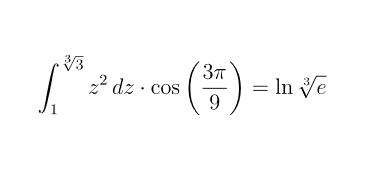
Odd poem: Integral limerick by Betsy Devine and/or Joel E. Cohen, perhaps

Which should be read as:

Integral z-squared dz
from 1 to the cube root of 3
times the cosine
of three pi over 9
equals log of the cube root of ‘e’.

Note that this limerick relies for its rhyme on the American pronunciation of “z” as “zee”. For the “z = zed” half of the world, you can substitute in another letter such as “t”. What it all means is beyond me… however much I had of this in school is long forgotten. I’m much happier with the Mathematical limerick in an earlier blog post.

This limerick appears in a book by Devine and Cohen, ‘Absolute Zero Gravity‘, but it is not clear that any of the poems, jokes and puzzles collected in it actually originate with the authors, as they are all “collected” but unattributed.

Sonnets: ‘Confronting Churches and the Void’

A man-like god creates the universe?
Two hundred billion galaxies? Each holding
a hundred billion stars? And each star moulding
its planets into life, teeming, diverse!
All this from some bearded old angry face
who says “Build me a temple, pray, and pay
the priests who’ll guide you onto Heaven’s way,
erase your sins . . . or you’ll go in disgrace
to torment underground — eternally.”
No way your life gains from such small belief,
passed on by some royal or holy thief
who says “God wants your money, send it me —
my palace honours Him . . .” The human lurches
fearful, confused, through wastes of wasteful churches.

As social animals, we find our place
by walling others out, putting them down:
these walls, my family; those walls, my town.
Even more walls: tribe, country, faith or race.
This atavism’s bad for mental health,
supports no sense of personal strengths or meaning,
allows no purpose, individual leaning,
denies achievement to your inner self.
Identity’s reduced to football fan,
or something uniformed, or some group prayer;
without those — alcohol, drugs or despair,
not knowing how to move past Nowhere Man.
Know yourself, human, to confront the Void:
your proper study’s all that’s anthropoid.

You can think of these two sonnets as the result of ten years of Church of England boarding school–five years in Jamaica, five in England–where Scripture lessons and daily church services were complemented by solid science and rigourous literature. And of course the Church of England recognises no Pope except the man who wrote “Know then thyself, presume not God to scan; the proper study of Mankind is Man.” So here you see the fruits of a well-rounded education.

This poem has just been published in Better Than Starbucks, a remarkably extensive poetry journal (and with some fiction too). The bulk of my BTS-published poems are in the Formal Poetry section, but there are many other sections–it’s a 100-page magazine. The online version is free, and well worth exploring.

“stepping across the bridge” by Max Nathan is licensed under CC BY-NC-ND 2.0

Odd poem: Mathematical limerick by Leigh Mercer

That may not look like a limerick to you, but if you read correctly it can be!

A dozen, a gross, and a score
Plus three times the square root of four
Divided by seven
Plus five times eleven
Is nine squared and not a bit more.

Leigh Mercer was a very odd character. Born the son of a Church of England pastor in 1893, he said “I have been taught to regard myself as the fool of the family, a professional ne’er-do-well.” From 1910 to 1959 he held between 60 and 85 different jobs: in the engineering shops of 30 motor car companies including Rolls-Royce and Ford, as a nurse to a wealthy invalid, as a Post Office Savings Bank clerk, a pavement artist, a carnival sideshow assistant, an English tutor in Paris…

He loved puzzles and wordplay, especially palindromes. He is best known for creating “A man, a plan, a canal – Panama.” There is an 8-page biography of him here, including 100 palindromes. Leigh Mercer died in 1977.

Odd poem: King Canute’s spontaneous song

Merie sungen the Muneches binnen Ely,
Tha Cnut ching reu ther by.
Roweth, cnites, noer the land,
and here we thes Muneches saeng.

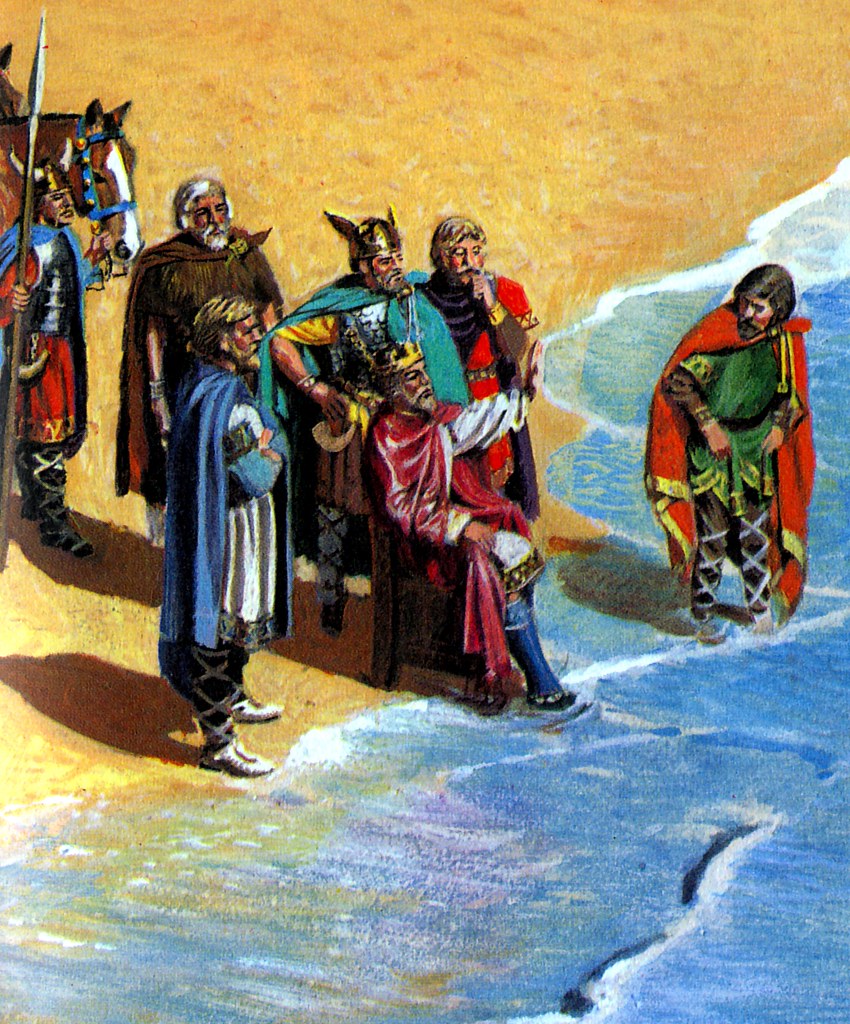
King Canute, on a journey by water to Ely, heard the chanting of monks and at once–according to the 12th century Liber Eliensis, but translated out of the original Latin and Old English–“With his own mouth expressing the joy he felt in his heart, he composed a song in English, in these words, which begins thus:

Merrily sang the monks of Ely
As Canute the king rowed there by.
Row, knights, nearer the land,
And hear we these monks’ song,

and the rest that follows, which to this day is sung at dances among the people and remembered in popular sayings.”

After a rocky beginning, the Danish-born Canute (or Cnut) became a well-loved King of England. Canute’s father Sweyn Forkbeard, King of Denmark, had invaded England twice. The first time was in 1003 to avenge the death of his sister Gunhilde in the St. Brice’s Day general massacre of Danes ordered by the Wessex King Æthelred the Unready (the massacre itself being in response to years of slaughter and pillage by raiding Danes). The second time was in 1013, when he overthrew Æthelred. Sweyn died in 1014, and Æthelred resumed his rule. Sweyn’s son Canute invaded in 1015, Æthelred died in 1016, and Canute the Great ruled England (and Denmark, and latterly Norway) until 1035.

First misconception: Æthelred the Unready doesn’t mean he was ill-prepared. The “red” or “rede” in both his name and his nickname means “advice”, and his pun of a nickname makes him “King Well-Advised the Ill-Advised”.

Second misconception: King Canute wasn’t being foolish in the story of his ordering the incoming tide to stop. He did it to shut up the flattering courtiers who told him he was all-powerful and could do anything. He had his chair set up on the beach and ordered the tide to go back; when the sea soaked him and his courtiers, he made it clear that he wanted truth and not flattery from his advisers.

Canute married King Æthelred the Unready’s widow Emma, perhaps for political reasons and as a way for Emma to protect her sons; it seems that the marriage grew to be very affectionate. Canute was very happy in England, and increasingly relied on the Anglo-Saxon nobility rather than on imported Danes for his control, taxation and administration of the country. Two of his sons followed him as kings of England, and for a while it looked like England might become a permanent part of Scandinavia. And personally, as an Anglo-Dane, I regret this didn’t happen.

Picture: “The Wisdom of Knut” by spratmackrel is licensed under CC BY-SA 2.0

Sonnet: “The Word”

“In the beginning was the Word.” What word?
Said by what tongue? Indeed, said in what tongue?
And by what consciousness was the Word flung
Out into Nothing, as from Ark a bird?
Nothing will come of nothing, we’ve concurred.
A billion galaxies, from Nothing sprung?
How “the beginning,” if a lowest rung
Requires both ground and ladder? It’s absurd.
Religions, sects, philosophies and schools,
Simple or complex, always come to grief
Because our grasp of Nothingness is flawed.
The atheist rightly shows all gods are fools;
The agnostic claims that any held belief —
Including one in Nothing — is a fraud.

I’ve written poems for and against various religions, depending on my mood and on whatever idea I was exploring. But in the end I come back to disbelief. I’m a militant agnostic: “I don’t know, and neither do you!” And this acknowledgement of ignorance of where the Universe comes from is emphatically NOT an endorsement of any religion. It is an endorsement of the (probably hopeless) search by science for all the answers.

This sonnet, with Petrarchan rhyme scheme ABBA ABBA CDE CDE, was originally published in Bewildering Stories, issue 789. I’ve tinkered with the penultimate line since then, trying to improve the metre.

Photo: “WORDS” by Pierre Metivier is licensed under CC BY-NC 2.0