Author Archives: Robin Helweg-Larsen

Unknown's avatar

About Robin Helweg-Larsen

Director, Andromeda Simulations International, Bahamas: a global education company providing online and in-person workshops in business finance. Series Editor, Sampson Low's 'Potcake Chapbooks'. Formal verse about traveling, family, love, etc...

Short poem: ‘Nothing’s Yours Always’

Nothing’s yours always, anyhow,
And Time shall lift from off your brow
Your troubles, wrinkles, hat and wig,
Leave you the basis for “long pig”.

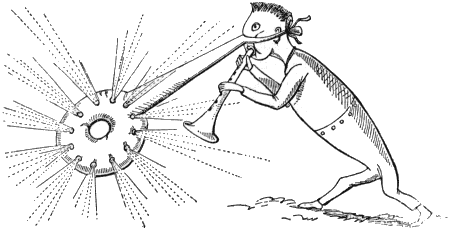
So many unusual foods are described as “tastes like chicken”; it’s worth remembering that there is one that apparently tastes like pork. And really, when you’re dead, does it matter who benefits from the recycling of your atoms? The picture is of a figure from Ethiopian legend, Belai the Cannibal.

This poem was published in Metverse Muse, a long-established Indian journal that champions traditional verse, edited by Dr. Tulsi Hanamanthu.

Photo: “Belai the Cannibal” by A.Davey is licensed under CC BY 2.0

Short Poem: ‘The Hitchhiker’

Sometimes you’d sell your soul just to get warm! –
Your clothes are rags in the wind, your skin goes blue,
You doubt your mouth can ever smile again;
The lonely world grows dark before the storm
Whose icy rain’s a mile away… and then,
The sun breaks through!

I used to do a lot of hitchhiking – 25,000 miles is my best estimate, on five continents. It can be miserable, it can be ecstatic, but as a way of exploring the world without plans and preconceptions, it’s hard to beat. It used to be safe, then it became unsafe, but now it’s probably safe again – if you send a picture of the vehicle from your cell phone before you get in. Or if you live on an island with no public transportation, where everyone seems to know everyone and it’s just common courtesy to give people a ride.

The poem was published in the now-defunct Candelabrum, a twice-yearly British publication that championed traditional verse through the darkest days of “free verse” from 1970 to 2010. The magazine has ceased publication, but thank goodness the sun has broken through again!

“Winter Road” by ryanmcgilchrist is licensed under CC BY-SA 2.0

Political poems: Byron on Castlereagh

Posterity will ne’er survey
a Nobler grave than this:
Here lie the bones of Castlereagh:
Stop, traveller, and p*** !

Robert Stewart, Viscount Castlereagh (which rhymes with “pray”, if you choose to have that, rather than “piss”, as the last word of Byron’s little poem) was an Anglo-Irish politician who managed to make himself throughly hated.

Though generally in favour of concessions to the Irish he did not support Catholic Emancipation from the discrimination and civil disabilities they suffered under as disenfranchised second-class citizens. He took the lead in suppressing the Irish Rebellion of 1798; he advocated leniency to the common people but had leaders executed – including a Presbyterian minister who had canvassed for him in an election. From 1812 to 1822 he was the British Foreign Secretary, instrumental in managing the alliance that defeated Napoleon; and then at the Congress of Vienna, with the conservative Bourbons back on the throne of France, he advocated leniency for France and non-intervention by the UK in European affairs – which was seen as siding with the repressive Eastern European powers. This is from the ‘Dedication’ to Byron’s ‘Don Juan’:

Cold-blooded, smooth-faced, placid miscreant
Dabbling its sleek young hands in Erin’s gore,
And thus for wider carnage taught to pant,
Transferred to gorge upon a sister shore
The vulgarest tool that Tyranny could want,
With just enough of talent, and no more,
To lengthen fetters by another fixed,
And offer poison long already mixed.

Castlereagh’s suicide in 1822 further occasioned this from Byron:

Oh, Castlereagh! thou art a patriot now;
Cato died for his country, so didst thou:
He perish’d rather than see Rome en­slaved,
Thou cutt’ st thy throat that Britain may be saved!
So Castlereagh has cut his throat!–The worst
Of this is, – that his own was not the first.
So He has cut his throat at last!–He! Who?
The man who cut his country’s long ago.

Poem: ‘Spring Sprang’

Spring sprang full force with sudden storms then stopped.
Of which vertu engendred were the floods. We mopped.
Summer so wet dried into humid dank.
Sweat dripped, dried, dripped, and as we worked we stank.

This little poem was published in The Asses of Parnassus, where poems range from the short to the very short. Epigrams translated from the Greek or Latin alternate with modern insults and with odd little observations such as this post’s verse. It is a site for people who enjoy the occasional small random thought.

Why I wrote the poem, I don’t know. It probably started with the evocative sounds of “spring sprang”. Spring rains always bring Chaucer’s Prologue to my mind, whence the “of which vertu engendred” phrase. The whole thing is inconsequential, except that in one very important sense no creative act, not even the most trivial, is inconsequential: your creativity speaks to you, and your decision of whether or not to act on it determines many aspects of your life: not just your creative output, but your sense of satsfaction, your happiness, your mental balance, even your physical health. When the muse speaks, listen and act – the output doesn’t have to be significant, but keeping the lines of communication open to the inner and unconscious (but in several ways wiser and more knowledgeable) parts of yourself is supremely important. Call it the soul, if you want. Call it God, for all I care. There is something essential there: honour it. Your happiness, maybe even your life, depends on it.

OK, rant over. Back to other inconsequentialities.

Photo: “025457:Floods Central Library New Bridge Street Newcastle upon Tyne Unknown 1966” by Newcastle Libraries is marked with CC PDM 1.0

Short poem: ‘Subduction’

All human nature, conflicts, nations, and all races
will be washed as by tides on beaches, all loves and lusts
will with Time disappear, all human traces
washed under as all plates are washed
by the subduction of Earth’s crusts.

This poem was published this month in Lighten Up Online – an excellent place to read light verse on subjects both light and heavy. Every issue has a mixture of longer and shorter poems, and a competition. This March 2021 edition concludes with the results of the eco-crisis competition, headed ‘The Airing of the Green’; ‘Subduction’ was one of the winners. Other sections of the magazine were also focused on the environment. Pollution and climate change are twin disasters, and you can express outrage, despair, or (more usefully) proposals for action. The million-year view of my poem isn’t useful but it’s low-hanging fruit, there to be taken.

I’m delighted to be in a magazine along with poems by fellow Potcake Poets Martin Elster, Michael R. Burch, D.A. Prince, George Simmers, Nina Parmenter, Gail White, Chris O’Carroll, Tom Vaughan, Jane Blanchard, Jerome Betts, Martin Parker and Melissa Balmain, as well as two poets who will be appearing in the next Potcake Chapbook, Bruce McGuffin and Julia Griffin, and the ever-anomalous Max Gutmann. Several of us have more than one poem in this issue.

“File:Tectonic-plates-subduction-zone-17280738.jpg” by Benjilrm is licensed under CC BY-SA 4.0

Odd poem: ‘The Siege of Belgrade’, alliterative abecedarian poem by Alaric Alexander Watts

An Austrian army, awfully arrayed,
Boldly by battery besieged Belgrade.
Cossack commanders cannonading come,
Dealing destruction’s devastating doom.
Every endeavour engineers essay,
For fame, for fortune fighting – furious fray!
Generals ‘gainst generals grapple – gracious God!
How honours Heaven heroic hardihood!
Infuriate, indiscriminate in ill,
Just Jesus, instant innocence instill!
Kindred kill kinsmen, kinsmen kindred kill.
Labour low levels longest, loftiest lines;
Men march ‘mid mounds, ‘mid moles, ‘mid murderous mines;
Now noxious, noisy numbers nothing, naught
Of outward obstacles, opposing ought;
Poor patriots, partly purchased, partly pressed,
Quite quaking, quickly “Quarter! Quarter!” quest.
Reason returns, religious right redounds,
Suwarrow stops such sanguinary sounds.
Truce to thee, Turkey! Triumph to thy train,
Unwise, unjust, unmerciful Ukraine!
Vanish vain victory! vanish, victory vain!
Why wish we warfare? Wherefore welcome were
Xerxes, Ximenes, Xanthus, Xavier?
Yield, yield, ye youths! ye yeomen, yield your yell!
Zeus’, Zarpater’s, Zoroaster’s zeal,
Attracting all, arms against acts appeal!

Belgrade was besieged nine times between 1440 and 1806. It is right on the edge of the area the Ottoman Turks were able to wrest from the Christians, and control went back and forth. This poem is about the 1789 Siege of Belgrade, when the Austrians showed up in mid September with 120,000 troops and 200 siege guns to try to take control of the Belgrade fortress that was held by 9,000 Ottoman troops with 456 cannon. On 6th October the Austrians began a devastating bombardment. Two days later, in exchange for the surrender of Belgrade, the Ottoman garrison was given a free passage with their personal and private possessions to Orșova; a prisoner exchange was also arranged between the combatants.

The poem was written by British journalist and poet Alaric Alexander Watts (1797-1864) and published in 1828. There are a couple of versions floating about on the internet, with various spellings and typos, and with and without the ‘Just Jesus’ line which deteriorates from J’s to I’s. The rhyme pairing isn’t perfect, the metre is imperfect, the syntax is stretched in places, and meanings and references are sometimes obscure. (‘Suwarrow’ for instance is the brilliant Russian general Alexander Suvorov who, though instrumental in winning battles with Turkey and others in the late 18th century, was not present at the 1789 Siege of Belgrade. He was defeating the Turks elsewhere at the time, but how can you ignore a general credited with winning 63 major battles, and never losing one?)

My initial impression is that the metre is an easy-to-read, easy-to-recite ‘four beats to the bar’, but the number of syllables varies with the needs of the alliteration:

An AUStrian ARmy, AWfully arRAYED, × / × × / × / × × × /
BOLDly by BATTery beSIEGED BelGRADE / × × / × × × / × /

But then it dawns on me that the poem is actually in iambic pentameter, with five beats… but the first line is so technically weak that it’s misleading: it has eleven syllables instead of ten unless you pronounce the second word ‘Austrin’, and also requires the ‘-ly’ of ‘awfully’ to be a stressed syllable. But once you reinterpret the rhythm of that line, the poem settles down properly. (There is a good lesson in poetics here: the technical purity of your opening line is super important!)

Anyway, I think we can cut Watts some slack: I don’t know of any other alliterative abecedarian poem at all, though surely there must be some. Wikipedia quotes this fragment from the Harper Handbook to Literature:

An abecedarius always alliterates
Blindly blunders, but blooms:
Comes crawling craftily, cantering crazily,
Daring, doubtless, dark dooms.

but I’m still looking for something more…

Photo: “Cossack Mannequin” by sarmoung is licensed under CC BY-NC-SA 2.0

Sonnet: ‘Irritated Muse’

My muse is angered by my Covid cares –
“You worry if the shops have food and beer,
and what a Zoom attendee rightly wears!
You’re just as mortal as you were last year,
and wrote of life and death, sickness and health.
Well, now’s an actual existential crisis!
Think family and friends, the world, your self…
forget the shopping and the product prices!
You’ll die; the question’s When. The only tool
for immortality is me, that clear?
You should be writing poetry, you fool!
This is your chance. Focus on me.” (Yes, dear.)
“Respect me as your muse: I’m not your shill.
If you can’t write a poem, write your will.”

This sonnet has just been published in Allegro in the UK, edited by Sally Long. The magazine comes out twice a year, one issue themed and the other open. It focuses on formal verse, but on a long continuum between fully formal and free.

Photo: “Thalia, Muse of comedy.” by Egisto Sani is licensed under CC BY-NC-SA 2.0

Fantasy Analysis: Auden’s ‘Jumbled in the common box’

Jumbled in the common box
Of their dark stupidity,
Orchid, swan, and Caesar lie;
Time that tires of everyone
Has corroded all the locks,
Thrown away the key for fun.

In its cleft the torrent mocks
Prophets who in days gone by
Made a profit on each cry,
Persona grata now with none;
And a jackass language shocks
Poets who can only pun.

Silence settles on the clocks;
Nursing mothers point a sly
Index finger at the sky,
Crimson with the setting sun;
In the valley of the fox
Gleams the barrel of a gun.

Once we could have made the docks,
Now it is too late to fly;
Once too often you and I
Did what we should not have done;
Round the rampant rugged rocks
Rude and ragged rascals run.

In January 1941, W.H. Auden had been living in New York for nearly two years. The Second World War had started, but not yet in the US. Auden had fallen in love with Chester Kallman who was now turning 20 and was too young to want to be sexually faithful; Auden had also returned from atheism to the existential Christianity that is common in the Anglican/Episcopalian church. It was a period of change, backgrounded by the widening war.

Regarding the poem from this time, I choose to imagine Auden rambling, reminiscing, muttering to himself: “Around the rugged rocks the ragged rascal ran… Nice metre as well as alliteration and, for people with difficulty pronouncing their Rs, a twuly tewwible tongue-twister. Rhythmic, memorable. Nonsense; not meaningful, but not meaningless; nonsense and nursery rhymes are right on the border. And it splits in two, you could easily rhyme it: rocks, box, blocks, brocks, cocks, cox, clocks, crocks… ran, Ann, ban, bran, can, clan, cran… or easy to change to run, or runs. A lot of rhymes, anyway. Run them out, see what transpires.

Once we could have made the docks, / Now it is too late to fly; that adds another rhyme, not a problem, maybe a 6-line stanza. Once too often you and I / Did what we should not have done; and into the last two lines, have to fill them out a bit to maintain the metre, keep the alliteration of course: Round the rampant rugged rocks / Rude and ragged rascals run… So that’s all right, that would make an ending.

“Then of course we can have more stanzas leading up to it. Flick a bit of paint at the canvas, see what sort of patterns we can find to elaborate on. Time, decay, trepidation, warnings… out come the words and images around the rhymes, and suddenly it’s all as evocative and semi-coherent as a reading of tarot or yarrow or horoscope. Hm, tarot or yarrow, I hadn’t noticed that before, wonder if I can use that somewhere else…”

(Remember, this is a fantasy analysis, presupposing the poem to have been written with full skill to capture both rhymes and a mood, but without any serious intent beyond that. For a completely different intellectual analysis, you can always try this…)

Photo: “Jumble Box” by .daydreamer. is licensed under CC BY-NC-ND 2.0
Review: ‘Short and Sweet – 101 very short poems’

One of a series of short poetry collections that Faber produced in the 1990s, this one features a good introduction by the anthologist (and poet well-known in the UK) Simon Armitage, discussing and justifying the short poem:
“The short poem, at its best, brings about an almost instantaneous surge of both understanding and sensation unavailable elsewhere; its effect should not be underestimated and its design not confused with convenience.”

Of course I love them, they are my children.
This is my daughter and this my son.
And this is my life I give them to please them.
It has never been used. Keep it safe. Pass it on.

– The Mother, by Anne Stevenson

Armitage defines the short poem as no more than 13 lines, thereby ruling out the sonnet as something more than short. Other people define it in other ways: the Shot Glass Journal publishes anything up to 16 lines under its “Brevity is the soul of wit” motto, while another of my favourite collections of verse defines the short poem as ‘Eight Lines or Less’. There is no agreed definition of “short poem”. And as Armitage shows, in 13 lines you can still cover a lot of ground.

She lay a long time as he found her,
Half on her side, askew, her cheek pressed to the floor.
He sat at the table there and watched,
His mind sometimes all over the place,
And then asking over and over
If she were dead: ‘Are you dead, Poll, are you dead?’

For these hours, each one dressed in its figure
On the mantelpiece, love sits with him.
Habit, mutuality, sweetheartedness,
Drop through his body,
And he is not able now to touch her–
A bar of daylight, no more than
Across a table, flows between them.

– As He Found Her, by Jeffrey Wainwright

Some of the poems in the collection were new to me, including both the above. Some of the poems are extremely well-known but always a joy to read: Yeats’ ‘The Lake Isle of Innisfree’, William Carlos Williams’ ‘This is Just to Say’. And others hover half-known:

Where is the grave of Sir Arthur O’Kellyn?
Where may the grave of that good man be?
By the side of a spring, on the breast of Helvellyn,
Under the twigs of a young birch tree!
The oak that in summer was sweet to hear,
And rustled its leaves in the fall of the year,
And whistled and roared in the winter alone,
Is gone, — and the birch in its stead is grown. —
The Knight’s bones are dust,
And his good sword is rust; —
His soul is with the saints, I trust.

– The Knight’s Tomb, by Coleridge

Starting off with the 13-liners, the poems get shorter and shorter as you read on, but without losing their punch–perhaps, as the introduction suggests, condensing their power.
Shakespearean fish swam the sea, far away from land;
Romantic fish swam in nets, coming to the hand;
What are all those fish that lie gasping on the strand?

– Three Movements, by Yeats

… all the way down to the final poem with no text at all, but only its title:
– On Going to Meet a Zen Master in the Kyushu Mountains and Not Finding Him, by Don Paterson.

Most but not all of the 101 poems are formal; most are originally in English, though there are a few translations: Paz, Sappho, Apollinaire, Salamun and – most surprising in its elegant translation from the Polish – this one, ‘Bodybuilders’ Contest’:
From scalp to sole, all muscles in slow motion,
The ocean of his torso drips with lotion.
The king of all is he who preens and wrestles
with sinews twisted into monstrous pretzels.

Onstage, he grapples with a grizzly bear
the deadlier for not really being there.
Three unseen panthers are in turn laid low,
each with one smoothly choreographed blow.

He grunts while showing his poses and paces.
His back alone has twenty different faces.
The mammoth fist he raises as he wins
is tribute to the force of vitamins.

– Bodybuilders’ Contest, by Wislawa Szymborska.

Altogether an excellent and well-rounded collection.

Odd poem: ‘Changsha’ by Mao Zedong

Alone I stand in the autumn cold
On the tip of Orange Island,
The Xiang flowing northward;
I see a thousand hills crimsoned through
By their serried woods deep-dyed,
And a hundred barges vying
Over crystal blue waters.
Eagles cleave the air,
Fish glide under the shallow water;
Under freezing skies a million creatures contend in freedom.
Brooding over this immensity,
I ask, on this bondless land
Who rules over man’s destiny?
I was here with a throng of companions,
Vivid yet those crowded months and years.
Young we were, schoolmates,
At life’s full flowering;
Filled with student enthusiasm
Boldly we cast all restraints aside.
Pointing to our mountains and rivers,
Setting people afire with our words,
We counted the mighty no more than muck.
Remember still
How, venturing midstream, we struck the waters
And the waves stayed the speeding boats?

Mao Zedong wrote this poem in 1925, when he was 31. He had previously spent five years in Changsha at university, young, bold and enthusiastic. Now he returned, reflected, remembering his student days, pondering the land’s immensity and the nature of destiny, and he wrote his poem. And today the young Mao gazes again at the river from Orange Island… or would, if it wasn’t just a stone statue of his head.

Despite his revolutionary tendencies in other areas, Mao wrote in Classical Chinese verse. ‘Changsha’ is annotated “to the tune of Chin Yuan Chun”, marking it as belonging to the type of verse called tzu. The tzu originated in the Tang Dynasty (618-907 CE) as lines sung to certain tunes. Each tune prescribes a strict tonal pattern and rhyme scheme, with a fixed number of lines of a standardised varying length. Obviously, a translation into a European language is going to lose the structural form inherent in the original. Mao may not be one of the best Chinese poets, but his poems are generally considered to have literary quality. Arthur Waley, the eminent British translator of Chinese literature, however, described Mao’s poetry as “not as bad as Hitler’s paintings, but not as good as Churchill’s.”

Photo: “A young Chairman Mao” by timzachernuk is licensed under CC BY-NC 2.0