Category Archives: collection

Sonnet: Jane Blanchard, ‘Between Rounds’

Year after year the very best in golf
head to Augusta. Fans come, too, and those
who live and work here either take time off
to travel or adopt a Masters’ pose.
One local woman hosts a party for
alumni of our alma mater. I
attended with my husband once. The hors
d’oeuvres were delicious, drinks well worth a try.
Invitees wandered through the house into
the garden, where the talk had lots of fizz.
One liquored man when asked “What do you do?”
replied: “I fly for Delta—soon to Rome.”
My husband looked my way as I looked his;
we both were more than glad to stay at home.

*****

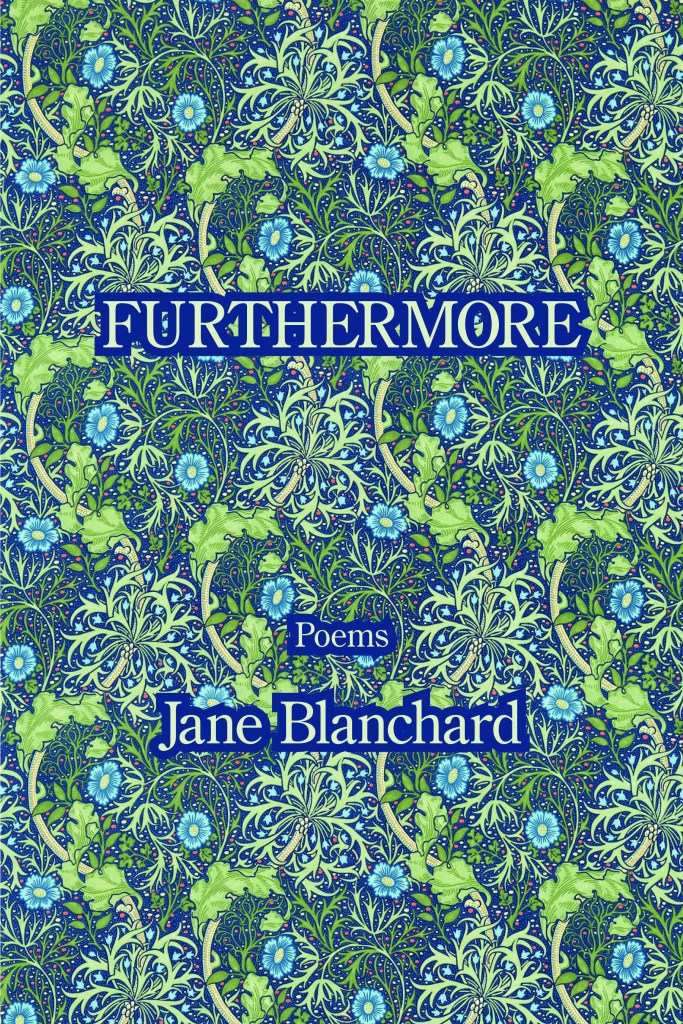
Congratulations to Jane Blanchard, who has just had her collection ‘Furthermore’ published by Kelsay Books. (Blurbs by Steve Knepper among others can be found at her Amazon listing.) I asked her for a favourite poem to represent the book, and she sent me ‘Between Rounds’, originally published in Valley Voices: A Literary Review.

A native Virginian, Jane Blanchard lives and writes in Georgia. Her collections with Kelsay Books include Metes and Bounds (2023) and Furthermore (2025).

The Two-State Dissolution (3): Smith, Burch, Foster, McCarthy, Helweg-Larsen, Bales

J.D. Smith, ‘Apology in Siege’

I hope you will forgive me
for having given you hope—
Too late for youthful indiscretion, though
I believed my story and felt young in it
until the metal facts fell.

I’d still like to imagine some god
would help, but that line looks broken
like the water, the gas and electricity.

What we have is hours, and in them
you should have the bread and fruit
before they feed the rats.
I am keeping the wine for myself.
It is piss-poor, anyway, and I have
far more to forget.

J.D. Smith, ‘Slant Psalm’

My right hand has never known cunning,
yet I remember thee, O Jerusalem,
not as others’ sacred city
but capital and emblem of loss,
origin of far wandering
without prophecy of return.

My right hand has never known cunning.
May I have, as recompense, forgetting.

Michael R. Burch, ‘Starting from Scratch with Ol’ Scratch’
for the Religious Right

Love, with a small, fatalistic sigh
went to the ovens. Please don’t bother to cry.
You could have saved her, but you were all tied up
complaining about the Jews to Reichmeister Grupp.

Scratch that. You were born after World War II.
You had something more important to do:
while the children of the Nakba were perishing in Gaza
with the complicity of your government, you had a noble cause (a
religious tract against homosexual marriage
and various things gods and evangelists disparage.)

Jesus will grok you? Ah, yes, I’m quite sure!
Your intentions were noble and ineluctably pure.
And what the hell does THE LORD care about Palestinians?
Certainly, Christians were right about serfs, slaves and Indians.
Scratch that. You’re one of the Devil’s minions.

Gail Foster, ‘On The Heights Above Jezreel’

War’s harvest then is of these bitter fruits
Hot shards of shrapnel buried in the flesh
Of children, olives ripped up from the roots
The horrid cries that fly from the nephesh
And blinded eyes. Who benefits from this?
Warmongers, metal forgers, men who plan
Whole cities while still smoking ruins hiss
Black marketeers and strategists. Who can
Sleep peacefully while others have to hide
Their families beneath their mothers’ skirts
And bury them before their tears have dried?
When will this harvest of these bitter hurts
Be over? On the heights above Jezreel
The storm clouds gather. Over soon I feel

Martin McCarthy, ‘The Unkillables’

There’s no great reason here to sing,
but still they sing and play once more …
the filthy, ragged children of the poor,
who shall, as always, inherit nothing.

There’s no beckoning paradise
beyond these war-torn streets of dirt,
where chalked slogans outline their hurt,
and yet, the unkillables rejoice!

Robin Helweg-Larsen, ‘Photo of a Dead Palestinian’

Hard to describe blown-off-ness of a head:
no head, neck, shoulder – only flopping flesh,
unfinished ending of a smooth-limbed, fresh,
strong, naked body on white-sheeted bed;
a tangled, mangled churning; then, instead
of the anticipated face (serene
as marble statue, Christmas figurine)
instead, disorganised meat, spilling red.

No face or brains or hair. We’re sick, confused.
The torn-off torso seems to have the calm
proportions of an adult – look again:
the genitalia of a boy of ten.
“Collateral damage” is the term that’s used.
Beside the body, on the sheet, an arm.

Marcus Bales: Right-Wing Semite-Murderer’s Song

Netanyahu:
I am the very model of a right-wing Semite-murderer,
Since I’m a Semite, too, the thing cannot get much absurderer.
My people were abused by every tribe and nationality,
So I, instead of empathy, embraced provinciality.
Because we were oppressed I’m now oppressing weaker other folks,
It gives me cover that we’re killing our Semitic brother-folks.
It isn’t ethnic cleansing if I swear that in my piety
I’m killing and I’m maiming only folks of my variety.

Nazi Chorus:
It isn’t ethnic cleansing if we swear that in our piety
We’re killing and we’re maiming only folks of our variety.
We’re killing and we’re maiming only folks of our varie- riety.

Netanyahu:
The same way each religion has its zealots kill for true-ishness
Islamic zealots have declared that they’ll erase all Jewishness,
And we have trained our own to act with criminal lethality
To counterbalance enemies of lethal criminality.

Nazi Chorus:
And we have trained our own to act with criminal lethality
To counterbalance enemies of lethal criminality.
To counterbalance enemies of lethal criminali- nality.

Netanyahu:
I play the left against the right. My politics are strenuous.
I say “If you hate one Jew …” Well, the rest is disingenuous.
That propaganda works so well is not much of a mystery
By pointing out how badly Jews were treated throughout history.
We’ve rarely had an easy time, with ghettos, rape, and slavery,
Our holidays still celebrate the mass of unmarked gravery.
But we survived because we had our own ulteriority —
And now we’re in a place at last where I am the authority.

Nazi Chorus:
But we survived because we had our own ulteriority,
And now we’re in a place at last where we are the authority.
And now we’re in a place at last where we are the authori- thority.

Netanyahu:
The Stern Gang and the Irgun were the Hamas of their day and time
They killed and maimed the British, and they justified dismaying crime,
And now my brave Israeli right-wing zealots take that bow for theirs,
And use exactly those excuses Hamas uses now for theirs.

Nazi Chorus:
And now our brave Israeli right-wing zealots take that bow for theirs,
Exactly with the same excuses Hamas uses now for theirs.
Exactly with the same excuses Hamas uses now for now for theirs.

Netanyahu:
When everyone is furious that everyone is furious,
And injury is contemplating things yet more injurious;
When money spent on arms and planning how to break the breakerage
Could buy opponents whole, including buildings, stock, and acreage;
When every group is cheering zealots’ grim religiosity
And everyone is trembling with the fear of new atrocity,
I stay in office by appealing to the prejudicial dumb —
While filling my Swiss bank accounts just like Hamas officialdom.

Nazi Chorus:
I stay in office by appealing to the prejudicial dumb —
While filling my Swiss bank accounts just like Hamas officialdom.
While filling my Swiss bank accounts just like Hamas official- licialdom.

Netanyahu:
No policy’s absurd enough that mine is not absurderer.
I am the very model of a right-wing Semite-murderer.
It isn’t ethnic cleansing if I say that in my piety
I’m killing and I’m maiming only folks of my variety.

Nazi Chorus:
It isn’t ethnic cleansing if we say that in our piety
We’re killing and we’re maiming only folks of our variety.
We’re killing and we’re maiming only folks of our vari- variety.

Robin Helweg-Larsen, ‘Roots of Terrorism’

Step back a moment, and reflect:
not saying that it’s good or right
that chained, starved, beaten dogs would bite–
but what did you expect?

*****

Michael R. Burch, ‘Starting from Scratch with Ol’ Scratch’, first published in The HyperTexts
Martin McCarthy, ‘The Unkillables’, first published in The HyperTexts

Robin Helweg-Larsen, ‘Photo of a Dead Palestinian’ and ‘Roots of Terrorism’ first published in The HyperTexts

Photo: Anadolu Agency photographer Ali Jadallah – Gaza https://x.com/alijadallah66?lang=en
https://www.theguardian.com/world/2024/oct/05/one-year-in-gaza-since-the-7-october-attack-photo-essay

The Two-State Dissolution (2): Landsman, Burch, Lehr, Foster, Galef, Soderling, Kenny, Helweg-Larsen, Smith, Bales, Shore

Peggy Landsman, ‘Go Tell It On The Mountain

Hagar and Sarah should have talked,
Laughed together when alone.
Who did Abraham think he was?
Ha-Yehudi ha-rishon?*

Ishmael and Isaac should have been
Boon companions, closer than brothers,
Passing their days doing their chores,
Tending their father’s sheep together…

Staying up late entertaining themselves
Arguing over the numbers of stars
Each was the first to have named.

*”Ha-Yehudi ha-rishon” means “The first Jew” in Hebrew.

Michael R. Burch, ‘Frail Envelope of Flesh’
for the mothers and children of Gaza

Frail envelope of flesh,
lying cold on the surgeon’s table
with anguished eyes
like your mother’s eyes
and a heartbeat weak, unstable…

Frail crucible of dust,
brief flower come to this—
your tiny hand
in your mother’s hand
for a last bewildered kiss…

Brief mayfly of a child,
to live two artless years!
Now your mother’s lips
seal up your lips
from the Deluge of her tears…

Quincy Lehr, ‘Passive Voice’

History is back in passive voice.
All you can do is watch. The teams were picked;
the commentary doesn’t match the plays.
The game is rigged, and everybody sees.

The game is rigged, and everybody sees,
but referees ignore it, and debate
is limited to the cheap seats far away.
The villains are the only proper nouns.

The villains are the only proper nouns,
the only ones worth mentioning besides
the nebulous abstractions for the rest.
None believe what everyone accepts.

History is back in passive voice.
The game is rigged, and everybody sees
the villains are the only proper nouns.
None believe what everyone accepts.

Gail Foster, ‘The Heap’

How many does it take to make a right?
Go fling another on. The heap grows high
Before too long it will obscure the light
And then where will we be. The end is nigh
And still it reaches up towards the sky
How many more, the village women weep
Of all our sons and brothers have to die
While we pile wrong on wrong upon the heap

Remember sky, how blue it was and bright
And wide, when only birds and clouds did fly
And moons and stars were visible at night
When women laughed and children didn’t cry
What use is wrong for wrong and eye for eye
The world grows blind and bitter and we reap
What we have sown and see our rivers dry
While we pile wrong on wrong upon the heap

What use a pile of pacifists? The sight
May cause a running man to stop and sigh
The wise man said, and think about the fight
And for a fleeting moment wonder why
They chose to sacrifice themselves, deny
The life force and there lie in peaceful sleep
They make a monument, he said, nearby
While we pile wrong on wrong upon the heap

Dear God, when will it end? When will you try?
The heap grows higher and the sides too steep
We love our neighbours with the guns we buy
While we pile wrong on wrong upon the heap

Daniel Galef, ‘Desert Kite’

These endless shifting sands—
They’re always changing hands,
But you can’t make bricks without breaking a little hay.
With oil the streets are pavèd;
Since Solomon and David,
They draft a brand-new atlas every day.
The apostles! The epistles!
And the fossil fuels and missiles—
Like manna in the wilderness they fall!
The land of Abrahamics
Now hosts General Dynamics
With their guardian angels gliding over all.

Janice D. Soderling, ‘Out of Paradise’

A closely woven stillness lines the air,
like linen bedding in a lifted coffin.
Though silence is a hallmark of our time, not often
has the hush been so oppressive. Where
the sand fox sprawls, sprawls too the shattered hare.
Cadavers of gazelle and roe deer stiffen;
the wadded pods of thorn trees burst. If when
you ponder on this devastated garden,
its wretched shame, its bottomless despair,
think not animal, but human, shreds in Eden.
And human was the animal lately passing there.

Janet Kenny, ‘After’

We saw them sweep in like a wolf on the fold.
We hypocrites judge as if time was involved.

Lament, all you lovers whose loved ones are gone.
Condemn, all you judges now grief is your song.

After the fury what’s left to repair?
Oh impotent jury, your conscience is there.

No poem will save us no tears will avail.
No weapons will spare us from history’s gale.

No art can encompass the scale of this rage.
“Tomorrow” is yesterday trapped in a cage.

Robin Helweg-Larsen, ‘Books’

When Science and Experiment
were done through myth and dream, it meant
that Bronze Age herders showed their bent
in naïve tribal Books.

The Israelites searched 40 years
for good land, unprotected, bare,
and slaughtered all those living there –
justified by their Book.

The Muslims conquered far and wide
(and called it peace, and millions died)
to spread new tales we now deride,
new versions of that Book.

The Christians sent wave after wave
crusading, claiming that they’d save
the “Holy Land”… made it a grave,
thanks to their stupid Book.

You advertise benevolence
but justify intolerance
by quoting this or that sentence
from one or other Book.

You bomb a house, a baby dies…
lift up your eyes so we can rise
above the vicious tribal lies:
those stupid, stupid Books.

J.D. Smith, ‘Report from the Field’

I rang the doorbell
of the demolished house
and was met by its generations,
fully armed.

Marcus Bales, ‘Heal or Hate’

You lift or do not lift the weight;
You’re either dealt-to or you deal.
Pick the other, pick the one,
The choice you have is heal or hate,
And you can’t ever hate and heal

Call it nature, nurture, fate
Genetics, fantasy, or real —
Blame whatever – when you’re done
You lift or do not lift the weight.
You’re either dealt-to or you deal.

Short-term crooked looks like straight;
Short-term truth sounds like a spiel.
In both the short and longer run
The choice you have is heal or hate —
And you can’t ever hate and heal

I know, the choices don’t seem great.
They lack in zip or sex appeal.
But no one said this would be fun.
You lift or do not lift the weight.
You’re either dealt-to or you deal.

You must massage your mental state
To organize the way you feel
In spite of all the bullshit spun.
The choice you have is heal or hate,
And you can’t ever hate and heal

You often have to simply wait
And sift to see what’s really real
Since growing needs both rain and sun.
You lift or do not lift the weight;
You’re either dealt-to or you deal.

Late or early, it’s too late.
You’re living through the slow reveal.
The game is rigged: it can’t be won
Or even stopped once it’s begun.
You lift or do not lift the weight;
And though you’re dealt-to or you deal
The choice you have is heal or hate.
You cannot ever hate and heal.

Marion Shore, ‘Peace’

I came upon a garden in the sun,
where children ran and played among the trees,
and entering, I asked two little ones:
“Why are you here? And where are your families?”
One answered, “I was with my dad and mom.
We went into a café for a Coke.
And then I heard somebody scream ‘a bomb!’
and all that I could see was fire and smoke.”
The other said, “I went outside to play,
the street was crowded. Tanks were all around.
Soldiers were shooting. I tried to run away.
I heard a shot and fell down on the ground.
No one heard me crying for my mother.”
The first child said. “I wish I could go home.”
“So do I. But at least we have each other.”
The sun was rising higher in the sky:
my dream was fading, and as I waved goodbye,
‘Salaam,’ said one. The other said ‘Shalom.’


Yuval Noah Harari: We suffer not from the narrowness of the land, but from the narrowness of the mind. https://youtu.be/Uncfi9cgZWo

It’s all about stories: https://youtu.be/L82XOw9sVkY


Acknowledgements:
Peggy Landsman: ‘Go Tell It On The Mountain’, first published in The HyperTexts
Michael R. Burch: ‘Frail Envelope of Flesh’, first published in The Lyric
Daniel Galef: ‘Desert Kite’, first published in Light
Janice D. Soderling: ‘Out of Paradise’, first published in The Rotary Dial and included in her collection ‘War: Make that City Desolate’

Photo: “Scenes from Gaza Crisis 2014” by United Nations Photo is licensed under CC BY-NC-ND 2.0.
Poems on poets: ‘Maz’ Griffiths, ‘Lies’

Perhaps it’s true, as Twain implies,
statistics are the greatest lies
but point for point and size for size,
I think they tie for major prize
with poets’ modest little ‘i’s.

*****

Margaret Ann Griffiths, aka Maz, aka Grasshopper, was a British poet known almost exclusively for her online work. In his Preface and Personal Recollection, editor Alan Wickes speaks of her “belligerent modesty” and her lack of interest in the preservation of her verse. In 2008, after winning Eratosphere‘s annual Sonnet Bake-off with “Opening a Jar of Dead Sea Mud” and being praised by Richard Wilbur, she was a Guest Poet on the Academy of American Poets website, where she was hailed as “one of the up-and-coming poets of our time”.

Her poem ‘Lies’ speaks volumes (in a brief space) about the different types of modesty available to creative figures. Her reputation for wit, intelligence, astute criticism and kind-heartedness goes well with her wide-ranging subjects and diverse styles of verse. She was the preeminent English-language online poet of the early 21st century.

Her work was posthumously collected by fans and fellow poets in the 2011 ‘Grasshopper‘ from Arrowhead Press and Able Muse Press.

Photo: “Anjo da Vila, Vila Madalena, São Paulo, Brazil.” by ER’s Eyes – Our planet is beautiful. is licensed under CC BY-NC-SA 2.0.

Verse into Verse: George Simmers translates Catullus ‘VII’

Lesbia, you ask me quantify
How many of your kisses I
Might think enough. My answer? Count,
When you’re in Libya, the amount
Of tiny sand grains on the beach
Along the shining miles that reach
Between Jove’s shrine and Battus’s tomb.
Or count the stars that pierce the gloom
To stare all-seeing from above
Upon the privacies of love.
Let’s kiss and kiss with such excess
We’ll make all voyeurs’ minds a mess;
Add kiss on kiss, till we’ve a sum
So vast all gossips are struck dumb.

*****

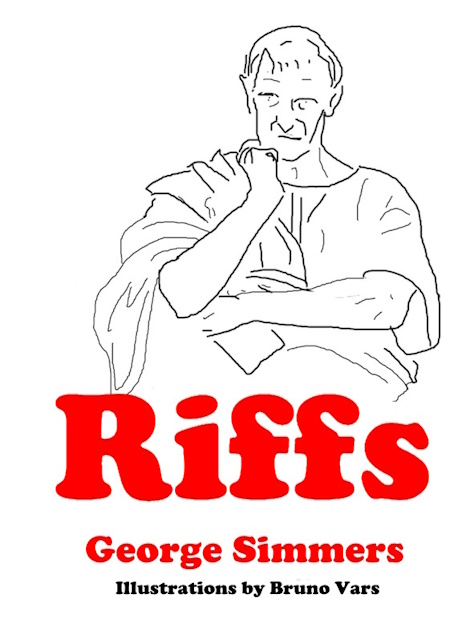
This is one of the translations from Catullus to be found in the recently published pamphlet, Riffs, by George Simmers, editor of Snakeskin, the world’s longest-running monthly ezine for poetry. Riffs is a grab-bag of translations of poems that have appealed to him, from Ovid, Virgil, Catullus, the Greek Anthology and Francois Villon. For sample pages (featuring Ovid’s version of the myth of Narcissus) click here.

The plentiful illustrations are by Bruno Vars, whose pictures enlivened George’s previous pamphlet, Old, Old.

Riffs costs £5, and should be available from Amazon, but if you’d like a signed copy, email him: simmersgeorge@yahoo.co.uk and he’ll arrange one for you at no extra cost.

Robert Frost said that poetry is what gets lost in translation. George Simmers has tried to find it again. This is the ideal Christmas gift for the classicist in your life.

Review: ‘Burial Grounds’ by Brian Gavin

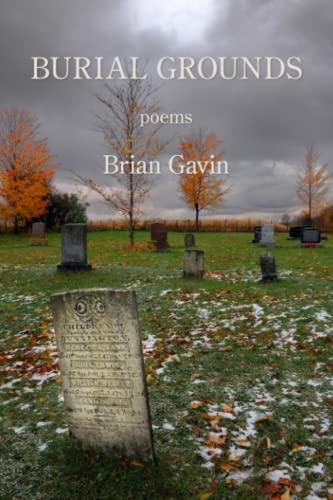
Gavin’s poems are quiet, elegant reflections on people—alive and dead—in danger of being forgotten, in towns not in the mainstream of modern life. His verse is quietly formal, usually rhymed, always rhythmic. Sometimes as brief as a sonnet, as with my personal favourite ‘Grand Opening’: an ex-serviceman, mopping floors and putting the coffee on at 4 a.m., running a business at which (apparently) four previous owners have failed, but simply doing what has to be done…

It isn’t so much hope behind these doors
as work to do. (…) He reaches for the light.
He sets his OPEN sign against the night.

There is an inherent mournfulness in these stories of people in places which once thrived but are now hanging on without major farming or industrial or commercial opportunities. Many poems are about people towards the end of their lives, or even later as the title suggests. And even when youth is included it shows up as a teen alone on a swing on a November evening, working her phone:

and nothing moves, but for the falling dark
and the quiver of her thumbs at work.

Railway stations close, businesses relocate, fires happen, towns empty out… but people are still there, poorer, aging, their prospects reduced. The overall tone is an almost religious attitude of accepting where you are, fighting the good fight, doing what must be done… moving, as we all must, into life’s inevitable landscape of burial grounds.

*****

Brian Gavin is a retired Distribution Manager who started writing poetry 10 years ago. His poems have appeared in The Journal of Formal Poetry, Peninsula Poets and Snakeskin Magazine, and in the Potcake Chapbook ‘Careers and Other Catastrophes. He lives in Lakeport, Michigan, USA, with his wife Karen. ‘Burial Grounds’ is available from Kelsay Books.

Resources: Salt Publishing returns!

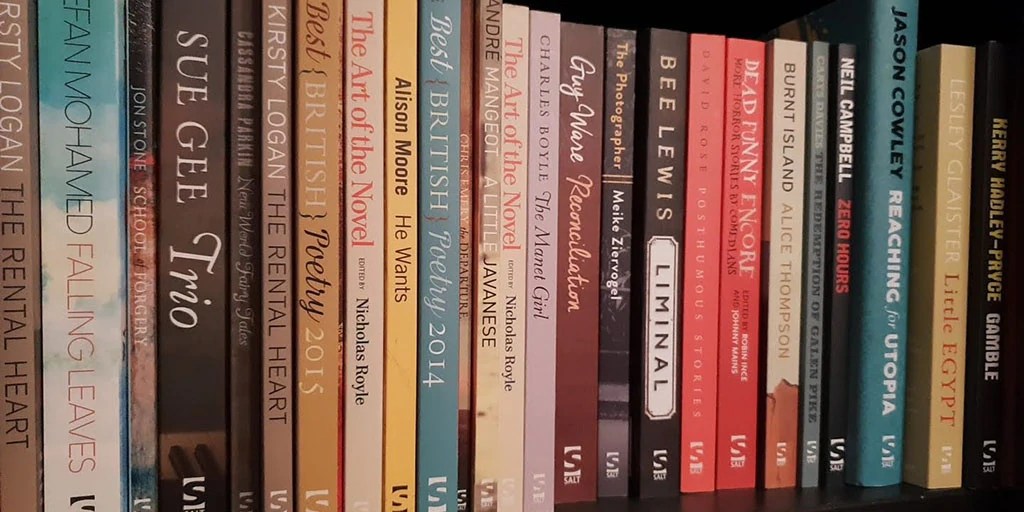
Begun in 1999 as a wide-ranging British literary publisher, Salt ran into difficulties with a declining market for poetry. In 2013 they posted in their blog that “after thirteen years and over 400 poetry collections, many by debut authors,” they were going to stop publishing poetry by individual poets and instead limit themselves to anthologies. For those who want to see how depressingly small the poetry market could be, here is a Guardian article on it and Salt from 2013.

By 2018 it looked as though Salt might be dissolving entirely, despite the wide praise and support they had from the literary community; and then came Covid and the halt to library and bookstore gatherings. Life got miserable for everyone (except, of course, Boris Johnson).

Happily, Salt hung on, focusing on fiction, and has now strengthened enough to once again be accepting submissions of poetry manuscripts. They may be very much a contemporary publisher, but can’t be completely averse to formal verse if their author list includes Christina Rossetti and Emily Brontë. From their Submissions page:

We are happy to consider full-length poetry collections by Welsh, Scottish, Irish or English poets of circa 64 pages. It will help if poets live in the British Isles to participate in publicity and promotion.
Please send your complete collection along with your magazine publication history and a biographical note.

Their blog even has a useful Guide to Poetry Submissions. Salt, distributed by Penguin Random House and with e-book distribution by Faber Factory, is a top-class independent publisher in the UK. It’s good to see them looking fully active again.

Review: A.E. Stallings, ‘Like’

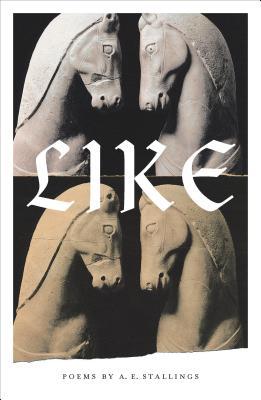
‘Like’ is the fourth volume of poetry from A.E. Stallings, the best poet that I know of who is writing in English today. The themes in ‘Like’ are the same as in her earlier collections: American childhood, Greek adulthood, children, memory, local wildlife, Greek mythology… and concern for the abused, whether women in the patriarchy or refugees in the Mediterranean. There is a difference of organization, though: instead of four or five different sections, ‘Like’ lumps all the poems together and arranges them alphabetically by title; the result is a smooth, wide-ranging read.

Stallings has a superb mastery of form, and plays endless tricks with it. Start on ‘Battle of Plataea: Aftermath’ and the apparent prose in 11 lines when read alertly turns out to be a rhymed sonnet in iambic pentameter. Or take the eponymous ‘Like, the Sestina’ which uses the word “like” as the rhyme for every one of the requisite 39 lines plus 3 mid-line rhymes (with such variations as “unlike”, “dislike”, “look-alike”). See how the most substantial poem, ‘Lost and Found’, carries its rambling dream-and-memory dissertation on for 36 stanzas of ottava rima in iambic pentameter, whereas the shorter and more time-sensitive ‘Swallows’ uses 6 stanzas in iambic tetrameter. Her ‘Refugee Fugue’ attacks the unmanageable and unimaginable horrors of the desperate and drowned through a blues poem, a host of epigrams, a found poem – an appropriately confused assemblage of forms for a situation not amenable to coherent resolution.

But forget the technicalities! The beauty is in the easy music of her verse, the casual wordplay as with the doorbell that
Portended importunity from Porlock,
the throwaway etymological observations as of nighttime thoughts:
To consider means to contemplate the stars,
the poem on a ‘Pencil’ that ends
And Time the other implement
That sharpens and grows shorter,
the playfulness of ‘Night Thoughts’ that begins
Night thoughts are not like bats
and then goes on to describe the flight of bats in extended lyrical detail, before finally ending with how night thoughts are different…
And always the underlying awareness of thousands of years of history, showing through in the description of sky, contemporary but ancient, as
the contrailed palimpsest of blue.

And that leads me to my only regrets about Stallings’ verse: too much Greek literature with which I’m barely familiar. I’m not saying it’s a failing on her part, it’s merely a regret on my part that I can’t keep up. Although I would love to come across work by her with Norse themes…

But I will settle for what she offers: a very wide range. She can be very succinct as with ‘Paradox’:
Of the ones that happened to die, the little ones and the old,
Of hypothermia, or drowning, all died of cold.

Equally, she can be extensive and thorough in her exploration of a theme as with ‘Lost and Found’, where she is wandering through a dream of mountainous moonscapes, landfill landscapes, of things lost – toys, gloves, loves, baby teeth, time, opportunities, keys, coins – led by Mnemosyne, Memory herself, the mother of all the muses. The smooth formal stanzas of ottava rima, maintained steadily for 288 lines, provide the same meditative state as the 250 lines of Matthew Arnold’s ‘Scholar Gypsy’ or Edward FitzGerald’s even longer ‘Rubaiyyat of Omar Khayyam’.

My personal favorite in ‘Like‘ is her semi-formal ‘Crow, Gentleman’ (whose title I am guessing was changed from the original ‘Gentleman Crow’ to prevent it from coming between two poems in ‘Like’ addressed to her daughter). It begins:
Pacing to and fro
Along the autumn shore
Among the wrack and reek

With your arms clasped behind your back
And sporting your grey frock coat
Trimmed in black

And your black hat and your lean long-legged stride,
Up and down the strand perusing
The headlines of the tide:

and ends:
Life is a joke you crack,
Wry and amusing,
And death a dainty snack.

I find Stallings’ work altogether delightful: by turns sardonic, detached, passionate, compassionate, always observing carefully, always expressing wittily, always in masterful control of rhythm and rhyme. I repeat: I don’t know of a better poet writing in English today.

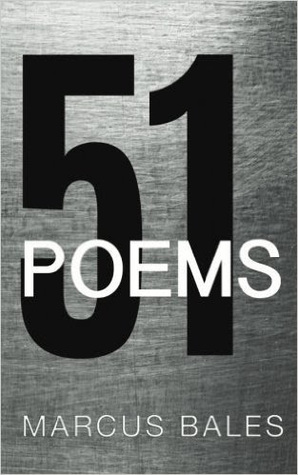
Review: ’51 Poems’ by Marcus Bales

This is poetry as it is meant to be: evocative and word-for-word memorable. Fair disclosure: I am an online friend of Marcus Bales – and I am so because his poetry is evocative, memorable, witty… and it all rhymes and scans in the most natural and elegant way.

His collection of ‘51 Poems‘ contains sections with very different moods. The first ones recapture childhood and wartime experiences and then give way to my personal favourites, a series of poems of love, love that in one way or another is unattained, incomplete: Pre-Flight, “I called goodbye. By then she couldn’t hear.//I pulled the chocks away, and she was gone.” Broken Sunlight “streaming down his face.” Have You Forgotten “it all, and all so soon?” Me and the Moon. Dancing with Abandon. And Precipice: “and knowing everybody knows//I’m dancing on a cliff edge, unaware//of where the precipice gives way to air.”

Others of his poems are portraits of very diverse people, political or social commentary, and (most memorably) flawless parodies of Keats, Poe, W.S. Gilbert, Auden, Shakespeare, Kipling among others. It is in the parodies that he shows the greatest diversity of rhyme and metre, because his ear catches the rhythms of other poets as easily as it understands iambic pentameters.

Online you will find him knocking out sarcastic little quatrains almost daily in Facebook. He was a standard contributor in The Rotary Dial (now sadly defunct), and frequently appears in the Potcake Chapbooks. Read 51 Poems for the wit and the human insights, and you will be rewarded with memorable earworms of wordplay and verbal dexterity.

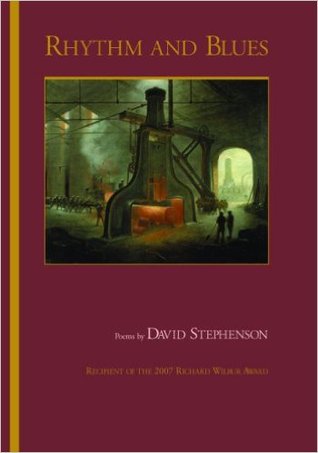
Review: ‘Rhythm and Blues’ by David Stephenson

David Stephenson’s ‘Rhythm and Blues’ was the 2007 Richard Wilbur Award winner, and contains some excellent poems. Its back-cover blurbs are accurate–as Kim Bridgford states, the collection has “wisdom, a plain-spoken, convincing style, and a sense of irony… all the time with impressive technical skill.”

Several of the sonnets are excellent: ‘Pilate’ meditates on the harshness of the law,
But why waste breath? In six months, who will mourn
This insect, or recall that he was born?

The ‘Geologist’ speaks of his passion for the history of rocks, ending:
The present is a world of dirt and sand
And people–they of the immortal soul–
Whom I do not pretend to understand,
Though I admire them in their long-term role
As precursors to limestone, chalk, and coal.

And beyond the sonnets are villanelles, and longer blank verse monologues in the voices of a toll collector, a housebreaker, a corporate hatchet man, and so on; and poems with various structures of stanza.

But there is a problem: the ruthless, relentless, metronomic use of iambics. The entire collection is in either iambic pentameter or iambic tetrameter. In general, the shorter pieces are good; the longer pieces are thematically interesting, but I find pages of blank verse unappealing. Stephenson can obviously think easily in iambic pentameter; but that skill tends towards blather. As the book title suggests, there is rhythm; but with insufficient variety for the claim of music.

But maybe this is expecting too much. Stephenson is a committed formalist, to the extent of having started his own Pulsebeat Poetry Journal for formal verse. His sonnets in particular are very good. And the book is highly readable and rereadable–though in small doses, not straight through in one go.

And there is actually one break in the unremitting use of iambics, in the shortest and most whimsical poem in the book–and for all those reasons perhaps my favourite. It is ‘To a Garbage Truck’:

Stop for me, romantic sloop,
When all your cargo is on board
And your ride low upon the waves,
For I would cast my lot with yours

And put forth on the open street
En route to some strange orient
Full of exotic ports of call
Beyond the gray horizon.