Category Archives: odd poems

Odd poem: Robert Frost, ‘The Draft Horse’

With a lantern that wouldn’t burn
In too frail a buggy we drove
Behind too heavy a horse
Through a pitch-dark limitless grove.

And a man came out of the trees
And took our horse by the head
And reaching back to his ribs
Deliberately stabbed him dead.

The ponderous beast went down
With a crack of a broken shaft.
And the night drew through the trees
In one long invidious draft.

The most unquestioning pair
That ever accepted fate
And the least disposed to ascribe
Any more than we had to to hate,

We assumed that the man himself
Or someone he had to obey
Wanted us to get down
And walk the rest of the way.

At a poetry reading in the Library of Congress, Robert Frost apparently described “The Draft Horse” as a poem “that nobody knows how to take“. That’s one way to look at it. Another way is that everyone who reads it seems to quite confidently take it in a different direction.

It has been called an allegory of the atom bomb–but, though first published in 1962, it was actually written in the 1920s, long before the bomb.

It’s been called an allegory of American expansionism.

It has been suggested as “a metaphor for the lives of ordinary citizens in totalitarian states, such as Nazi Germany, Soviet Russia and West Germany.” (West Germany. Really.) “Then the man could be an agent of the government, who does what he deems necessary and then disappears again.“

Again, “In many cultures, the horse is traditionally a symbol for power. The horse has played a large role in American history. Robert Frost’s The Draft Horse may be a reflection of the power struggles he saw around him and the senseless actions he perceived in the conflicts.“

How about “One analysis of the poem is that fate is unavoidable. Why struggle to stop or question fate when by its very definition it cannot be stopped?“

Here’s the complete commentary from one blogger: “I’m on a bit of a poetry moment right now. The Draft Horse by Robert Frost is possibly one of the best poems ever written and well worth sharing with anyone willing to read writing at it’s highest art form.” (“it’s”, sic. Also, he miscopied one of the lines as “Any more than we had to hate,” thereby losing the meaning.) A more extensive commentary is in a comment posted to that blog:

I love this poem ! i think it is a great description of postlapsarian life. Laterns wont burn buggies are frail, the horse is too heavy.the night is so dark …
amidst all that a fellow deliberately stabs your horse.

People of good will are always hesitant to blame problems on hate.
and any way walking is a fine way to get there

And then there’s this thesis towards an M.A.:
“WHY I KILLED THE DRAFT HORSE:
THE GOLDEN BOUGH, ROBERT FROST, AND “PROGRESS”
by Eugene Charles McGregor Boyle III

August 2013
The absence of criticism on Robert Frost’s “The Draft Horse” suggests that it is a challenge to Frost scholarship. This reading views Frost’s strange and neglected poem as a return to a monomyth offered by James Frazer’s hugely influential The Golden Bough. In “The Draft Horse,” Frost reconsiders the concept of ceremonial sacrifice that undergirds Frazer’s encyclopedic study of world culture and, by performing ceremony as a kind of modem poesis, Frost complicates the hero/sacrificial object role and critiques the progressive ideology that grounds Frazer’s account to fashion a troubling epic for modern America that implicates its national readers in a kind of savagery.
“

(Supported with references not just to Frazer’s “Golden Bough” and Eliot’s “Wasteland”, but also Dante’s “Inferno” and Lovecraft’s “Call of Cthulhu”, among others.)

Here is another take on it: “This is a very simple, straightforward story, but the reader cannot just leave it like that. Why would Frost have written this poem if he had only wanted to say “a stranger killed a horse”? The reader is therefore faced with the fact that “The Draft Horse” is a symbolic poem that must be read at another level, otherwise it has no purpose.“

Well, why does it have to have a “purpose”? It’s a poem, for god’s sake. Maybe the poem “means” exactly what one or other of the above-quoted commenters thinks… but maybe Frost just had a strange dream. Or maybe someone had told him of an incident. Maybe the rhymes and images just floated around in his head. Who knows? Who cares? It’s a poem and, for some reason, it resonates (differently) with a lot of people. It’s an odd poem. Enjoy!

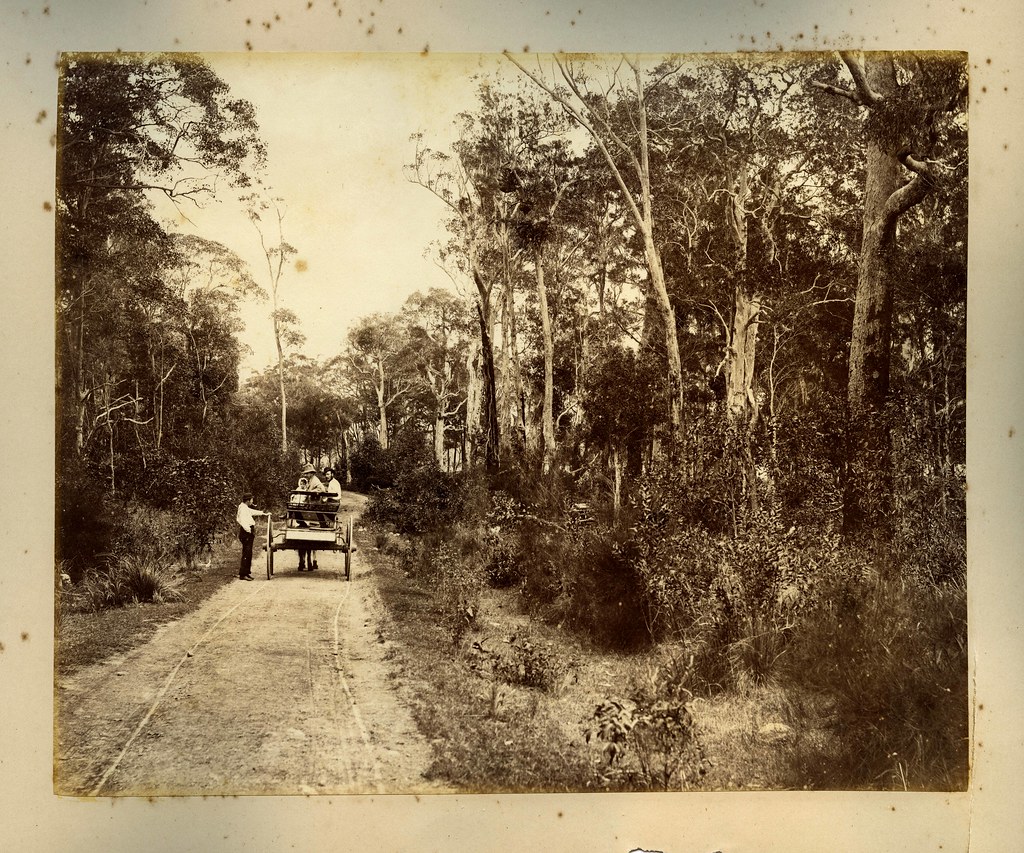
“Horse and Buggy on a Bush Track” by Blue Mountains Library, Local Studies is licensed under openverse from WordPress.org
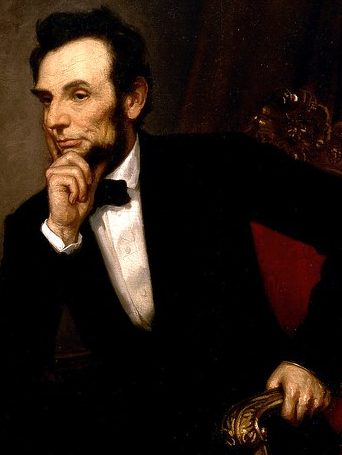
Odd poem: Abraham Lincoln, ‘The Suicide’s Soliloquy’

Here where the lonely hooting owl
Sends forth his midnight moans,
Fierce wolves shall o’er my carcase growl
Or buzzards pick my bones.

No fellow-man shall learn my fate,
Or where my ashes lie;
Unless by beasts drawn round their bait,
Or by the ravens’ cry.

Yes! I’ve resolved the deed to do,
And this the place to do it:
This heart I’ll rush a dagger through,
Though I in hell should rue it!

Hell! What is hell to one like me
Who pleasures never knew;
By friends consigned to misery
By hope deserted too?

To ease me of this power to think,
That through my bosom raves,
I’ll headlong leap from hell’s high brink,
And wallow in its waves.

Though devils yell, and burning chains
May waken long regret;
Their frightful screams, and piercing pains,
Will help me to forget.

Yes! I’m prepared, through endless night,
To take that fiery berth!
Think not with tales of hell to fright
Me, who am damn’d on earth!

Sweet steel! come forth from out your sheath,
And glist’ning, speak your powers;
Rip up the organs of my breath,
And draw my blood in showers!

I strike! It quivers in that heart
Which drives me to this end;
I draw and kiss the bloody dart,
My last—my only friend!

This poem was published anonymously in the April 25, 1838 edition of The Sangamo Journal of Springfield, Illinois, under this introduction: “The following lines were said to have been found near the bones of a man supposed to have committed suicide, in a deep forest, on the Flat Branch of the Sangamon, sometime ago.” For various reasons it is now commonly assumed that this is the poem that Lincoln’s friend Joshua Speed told Lincoln’s biographer William Herndon about, a poem that the President had written on suicide as he struggled through a period of deep depression.

A full discussion of the identification of the poem with Lincoln can be found in the magazine Shenandoah, and I happily quote their assessment of Lincoln’s merits as a poet:

The poem is similar to other mortality poems of the period, though even more melodramatic than most (the last stanza, in which the speaker continues to narrate his feelings after he has stabbed himself through the heart, is particularly painful). Aside from the historical curiosity of its authorship, the piece—with its glamourizing of suicide and its overwrought morbidity—does little to distinguish itself from other amateur poetry in the school of Poe.

Photo: “16 Abraham Lincoln” by US Department of State is marked with CC PDM 1.0

Odd poem: Samuel Johnson on wordplay

If I were to be punishèd
For every pun I shed
There would be no puny shed
For my punnish head.

Strictly speaking, of course, this isn’t a poem–it was merely an apparently spontaneous reply (but how many “spontaneous” remarks have been thought of and prepared in advance?)

The story was told in the following way:– “Sir,” said Johnson, “I hate a pun. A man who would perpetrate a pun would have little hesitation in picking a pocket.” Upon this Boswell hinted that his “illustrious” friend’s dislike to this species of small wit might arise from his inability to play upon words. “Sir,” roared Johnson, “if I were punishèd for every pun I shed, there would not be left a puny shed of my punnish head.”

The moral of the story was presumably for Boswell and others to guard their possessions when Doctor Johnson was around…

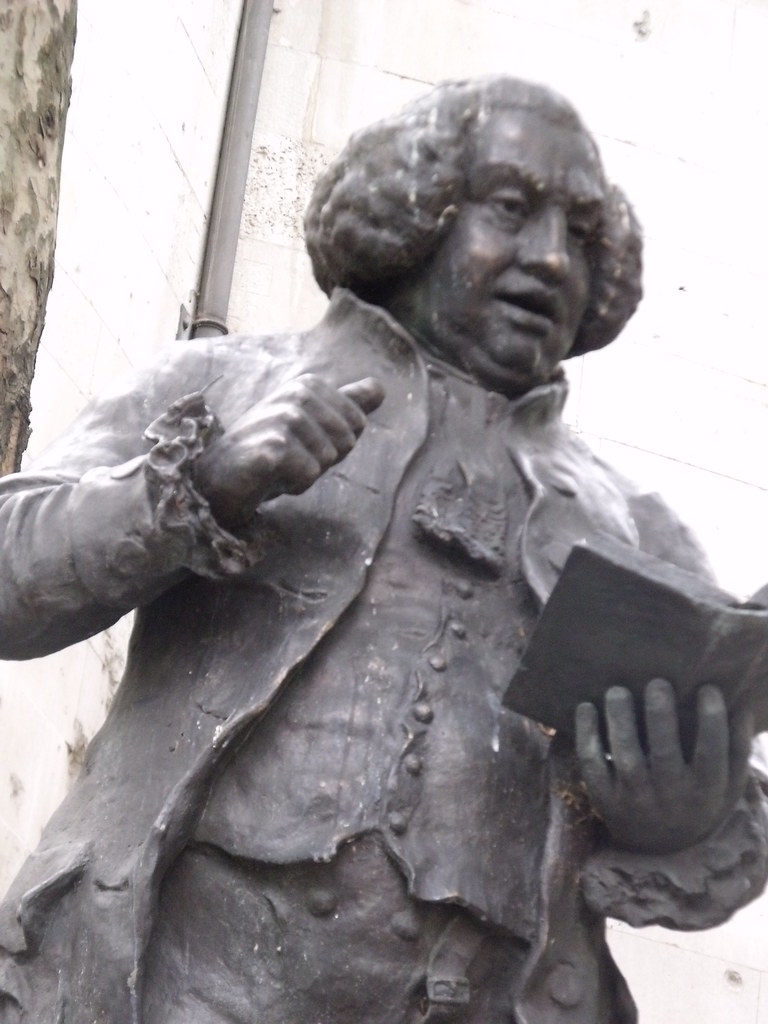
“statue of Samuel Johnson outside St Clement Danes Church” by ell brown is licensed under CC BY 2.0

Review: Max Gutmann, ‘Light and Comic Verse’

Quirkily-workily
Jorge Bergolio,
On a career path with
Quite a steep slope,

Unostentatiously
Worked as a janitor,
Then as a bouncer, and
Then as the Pope.

This elegant double dactyl on the life of Pope Francis is representative of ‘The Hearthside Treasury of Light and Comic Verse’: interesting, witty, technically perfect. The poems include limericks, clerihews, varieties of ballades, and are purported to be written by a variety of poets, several of whom are claimed to be the first-ever winner of the prestigious Blackfrier Prize for Poetry. The book’s veneer of being ‘edited by Max Gutmann’ is worn even thinner with the bio of his least likely poet, Ed Winters… “A devotee of Hemingway, Hart Crane and Sylvia Plath, Winters shot himself in the mouth while diving from a ship with his head in an oven.”

The book includes two pages of riddles in rhyme, of enjoyable difficulty: half were guessable for me, half not. There is also a full-length Poe parody (‘Quoth the Parrot: “Cracker. Now!”); scenes from The Merchant of Venice, King Lear and Titus Andronicus rewritten by W.S. Gilbert; outrage at the Trump presidency, the killing of Jamal Khashoggi, and the US Supreme Court’s appalling excuse for subverting the 2000 Presidential election; a poem appropriately written in the form of a dozen eggs; and various puns, off-colour jokes and random surprises. Many of the poems have previously appeared in Light poetry magazine, many others in a range from Asses of Parnassus to the Washington Post.

As for “The Hearthside Treasury” part of the book’s title… though there was (or is) a Hearthside Press, active from the mid-1950s to mid-70s; and an unrelated Hearthside Books, active from the mid-70s to the present, sort of; this “Hearthside Treasury” appears unconnected to anything. Indeed, it’s not even available on Amazon. It doesn’t have an ISBN. All this is a pity, as it is as enjoyable a book of light and comic verse as you can find anywhere. If you want a copy – and if you enjoy comic verse you really ought to have one – you’re going to have to contact the author directly through his website (which mostly focuses on his plays) at maxgutmann.com

Odd poem: Margaret Mead(?), ‘Hogamus Higamus’

Hogamus, higamus,
Man is polygamous;
Higamus, hogamus,
Woman’s monogamous.

I’m going to go out on a limb here and say this is American anthropologist Margaret Mead‘s creation. I have a clear memory of reading the story many years ago, probably in ‘Male and Female’, of her waking up in the middle of the night with an understanding of the secret of the universe. She grabbed the pencil and paper she kept by her bedside and wrote it down, then went back to the sleep. And in the morning she found she had written the above verse.

I was so certain it was Margaret Mead that I began this blog post about her before trying to check which book the verse came from and if I had the wording correct. (I last read Mead decades ago, and I leave beyond the reach of bookstores and real libraries.) To my frustration, all I can find in Google is attribution to William James, Dorothy Parker, Ogden Nash, Bertrand Russell, Alice Duer Miller… and Mrs. Amos Pinchot, who allegedly denied authorship. According to Quote Investigator, “The first known evidence of this unusual anecdote appeared in the Cleveland Plain Dealer newspaper in November 1939. The article ‘Thanksgiving Nightmare’ by Claire MacMurray (…) presented a supposed episode in the mental life of a person named Mrs. Amos Pinchot”, and tells the tale as I remember it. Mead’s ‘Male and Female’ came out in 1949, so (if the poem was in that book) it may have been referring to the Pinchot story, or it may have been something that had happened more than ten years previously to Mead, and she had shared the story and it had spread by itself.

The poem itself is brief, witty, amusing. It is rhythmic, repetitive, well rhymed, very catchy. Those are all excellent qualities. As for the content, it seems very 20th century: it gives the impression of having broken out of the conventions of society and church, and to be saying that the two sexes have differing needs for propagating themselves successfully. It is also 20th century in being simplistic. Where does the concept of serial monogamy fall? How does the rhyme relate to the LGBTQ+ members of society? The verse is definitely not comprehensive enough for the 21st century. But Margaret Mead was a controversial opener of cans of worms in the early 20th century, and that is where this little poem came from. Her obsession with gender roles and her self-deprecating humour make her a good candidate for its author.

And where the poem came from, apparently, was a communication from the unconscious, a gift to the dreamer. Always respect and preserve what the Muse offers you – who knows, a couple of lines of verse may be treasured and quoted for a hundred years!

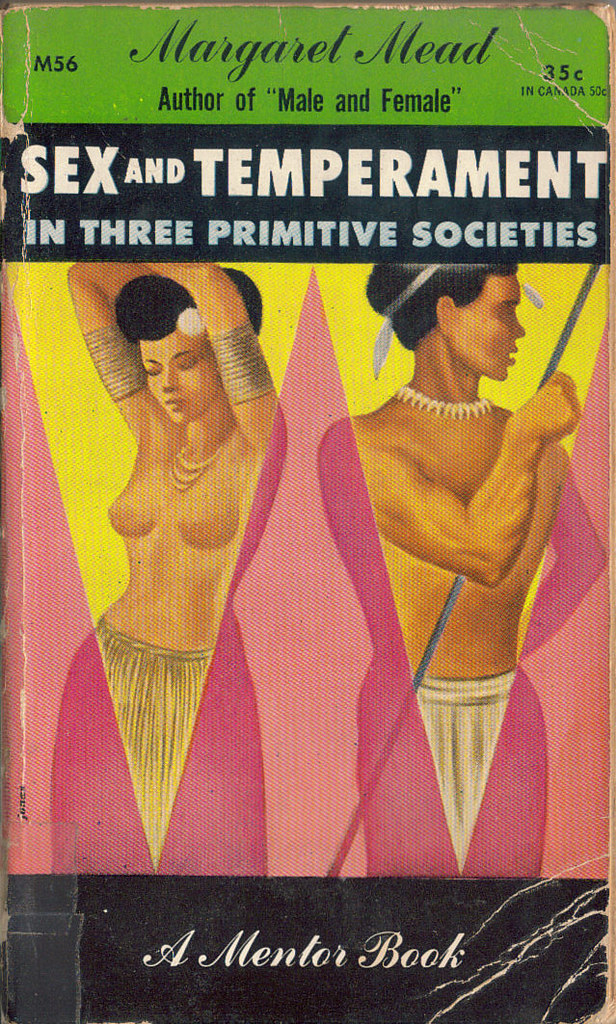
“Sex and Temperament in three primitive societies” by your neighborhood librarian is licensed under CC BY-NC-SA 2.0

Review: ‘¡OHO!’ by Rex Whistler, words by Laurence Whistler

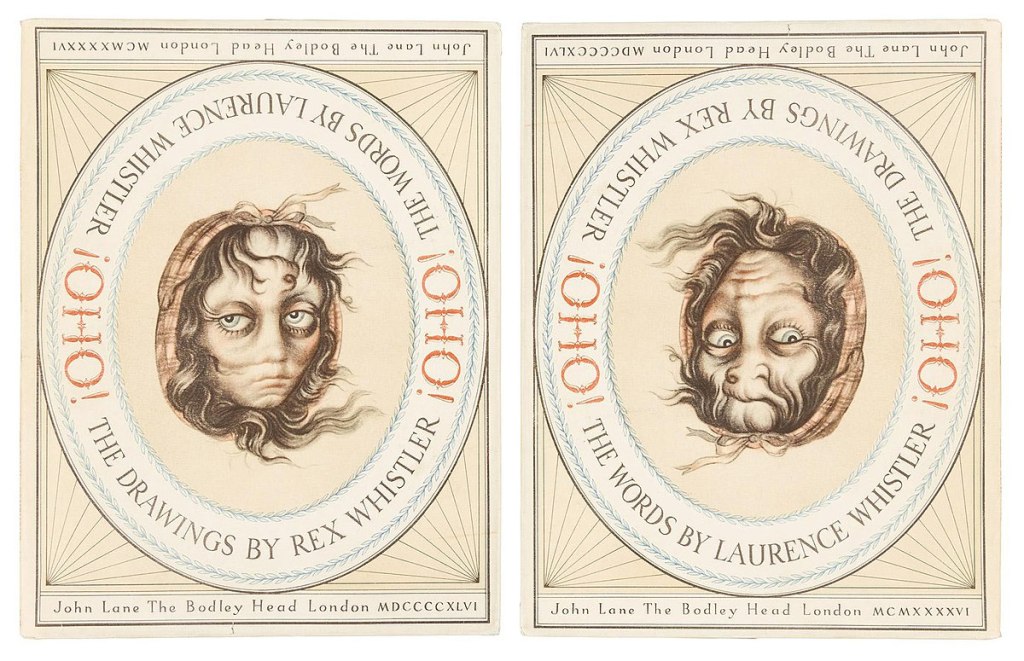
This is one of the most unusual volumes of poetry, because the poems are far less engaging and memorable than the illustrations for which they were made. The witty and whimsical British artist, Rex Whistler, produced a series of drawings of people which, when turned upside down, show a different but related person; his brother Laurence produced poems to describe the relationships. The front and back covers are identical–except that there is no front and back; the book can be opened and read from either end. There are two poems facing each illustration, the lower one describing the face you see, the upper one appearing upside down… until you turn the book around and find it describes the other face.

The nurse and the patient; the old man and the young one; the panicked householder calling the Fire Department and the fireman delighted to have work; the glum Mayor of Standon Ceremony and the gleeful Madam the Mayor of Stanster Reason… as for the cover illustration, the young and old women, Laurence Whistler begins the former’s poem:

The sisters truly thought she looked like that,
Cinderella, with her brush and pan,
Slip-slopping down-at-heel around the flat,
Ash-coloured where she sat,
Deep in some fatuous daydream of a Man.

The reverse poem is the Fairy Godmother’s, beginning:

Be home by twelve!
The one condition
For beauty tremulous
With ambition.

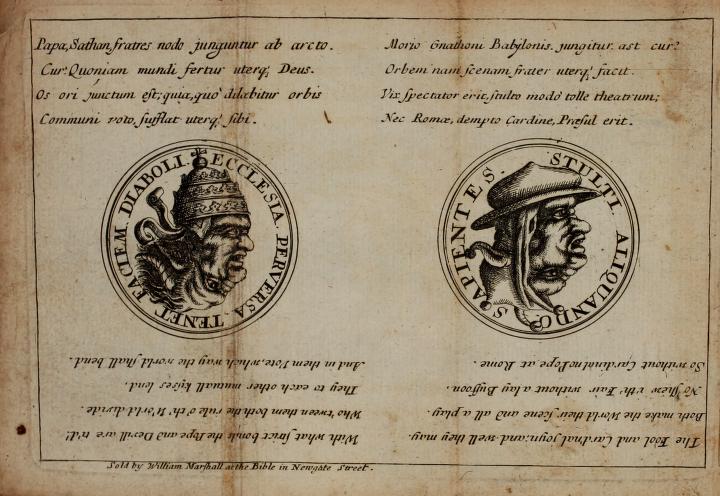
The drawings were inspired by this illustration in the 1682 book ‘The Church of Rome Evidently Proved Heretick’ by Peter Berault:

The ‘¡OHO!’ illustrations were done in the 1930s; Rex Whistler was killed in the Second World War, and the book with Laurence’s poems came out in 1946. A subsequent edition, ‘AHA’, was published in 1978 to include seven more of the double portraits, four very engaging, two less so, while one is an unprepossessing Henry VIII with Anne of Cleves; though without verses for any of them. But the poetry is clearly incidental, anyway… here is the sour Patient and upbeat Nurse:

It’s a wonderful book. As the publishers wrote: “However you put this book down it will lie face up, which is to say face down. And upside down is how it can never be slipped into a bookshelf.”

Odd poem: ‘Motor Bus’, macaronic poem by A. D. Godley

What is this that roareth thus?
Can it be a Motor Bus?
Yes, the smell and hideous hum
Indicat Motorem Bum!
Implet in the Corn and High
Terror me Motoris Bi:
Bo Motori clamitabo
Ne Motore caedar a Bo—
Dative be or Ablative
So thou only let us live:
Whither shall thy victims flee?
Spare us, spare us, Motor Be!
Thus I sang; and still anigh
Came in hordes Motores Bi,
Et complebat omne forum
Copia Motorum Borum.
How shall wretches live like us
Cincti Bis Motoribus?
Domine, defende nos
Contra hos Motores Bos!

This elegant piece of nonsense was written in January 1914 to celebrate the introduction of a motorised omnibus service in the city of Oxford–hence the reference to two of its main streets, the Corn(market) and High Street. Noticing that both ‘motor’ and ‘bus’ could be the nominative singular of Latin nouns, Professor Godley wrote this series of couplets, declining and rhyming the nouns through all their presumed cases, singular and plural. (The poem presumes the old-fashioned English pronunciation of Latin with many hard vowels needed for the rhymes.) And why not? ‘Motor’ is Late Latin for ‘mover’, and ‘bus’ is a casual modern abbreviation of ‘omnibus’, Latin for ‘for everyone’. The entire piece is written in a mixture of English and Latin, and translates roughly as:

What is this that roars so,
Can it be a motor bus?
Yes, the smell and hideous hum
Indicates a motor bus!
In the Cornmarket and the High Street
Terror of the motor bus fills me:
To the motor bus I will call out
Lest I be killed by the motor bus–
You can be Dative or Ablative
So long as you let us live:
Where shall your victims flee?
Spare us, spare us, O Motor Bus!
So I sang; while still
Motor buses came in hordes
And the whole market place was filled
With a mass of motor buses.
How shall wretches like us live
Surrounded by motor buses?
O Lord, defend us
From these motor buses!

Macaronic, or mixed languages, literature has ancient roots, showing up wherever two languages overlap in one population for a while, frequently in verse, frequently for humorous effect: alternating Persian and Arabic verses or hemistichs of Saadi and Hafez; Rumi’s occasional mix of Persian, Arabic, Turkish and Greek; Indian poetry written in alternating indigenous Hindi and the Persian of the Mughal rulers; and Latin and vernacular languages throughout Europe at the end of the Middle Ages. Modern examples include the Beatles’ ‘Michelle’ and José Feliciano’s ‘Feliz Navidad’.

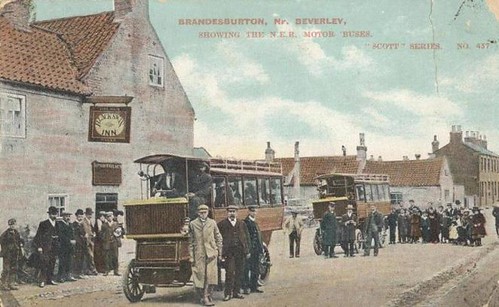
Photo: “Brandesburton, with NER motor buses 1915 (archive ref PO-1-18-1)” by East Riding Archives is marked with CC0 1.0

Odd poem: William Faulkner, ‘After Fifty Years’

Her house is empty and her heart is old,
And filled with shades and echoes that deceive
No one save her, for still she tries to weave
With blind bent fingers, nets that cannot hold.
Once all men’s arms rose up to her, ‘tis told,
And hovered like white birds for her caress:
A crown she could have had to bind each tress
Of hair, and her sweet arms the Witches’ Gold.

Her mirrors know her witnesses, for there
She rose in dreams from other dreams that lent
Her softness as she stood, crowned with soft hair.
And with his bound heart and his young eyes bent
And blind, he feels her presence like shed scent,
Holding him body and life within its snare.

William Faulkner began writing poetry at an early age; and in his late 20s he published his first book, a collection of poems titled ‘The Marble Faun’. Though much of the fiction for which he won the 1949 Nobel Prize carries a heavy southern accent or is written in stream of consciousness, it is engaging to see that he could be meditative in the iambic pentameter of a regular sonnet if he chose.

Photo: “William Faulkner’s Typewriter 2” by visitmississippi is licensed under CC BY-ND 2.0

Opposing poems: Ronald Knox on Berkeleyism

There once was a man who said “God
Must think it exceedingly odd
If he finds that this tree
Continues to be
When there’s no one about in the Quad.”

This limerick by the English priest and Sherlock Holmes fanatic Ronald Knox plays with the belief of Bishop George Berkeley that matter doesn’t exist – in the 18th century he wrote and preached that matter is only the product of mind and ideas, and needs to be observed in order to exist. Einstein, quantum physics and Schrodinger’s cat may lead us in that direction these days, but at the time it was radically new in the West. (In the East, ideas about the illusory nature of matter have been around for millennia.) It picked up the derisive name of “immaterialism“. And in his ‘Life of Samuel Johnson’, James Boswell recounts their hearing Berkeley preach:

“After we came out of the church, we stood talking for some time together of Bishop Berkeley’s ingenious sophistry to prove the nonexistence of matter, and that every thing in the universe is merely ideal. I observed, that though we are satisfied his doctrine is not true, it is impossible to refute it. I never shall forget the alacrity with which Johnson answered, striking his foot with mighty force against a large stone, till he rebounded from it — ‘I refute it thus‘.”

Philosophically, Johnson’s response is considered a logical fallacy, now called the “appeal to the stone“.

Ronald Knox, the 20th century priest, limerick author and Sherlockian, is probably also the author of this limerick that opposes the first one:

Dear Sir,
Your astonishment’s odd.
I am always about in the Quad.
And that’s why the tree
Will continue to be
Since observed by
Yours faithfully,
God

Perhaps we can think of the whole issue like this: if you play a strategy game like Civilization on the computer, you can only see part of the world at any one time. You move the cursor up, down or sideways, and you bring other parts of the world to the screen. What’s on the screen exists visually for you because that’s the part of the game world you can see; but the rest of the game world doesn’t exist visually – it exists as pure data in a program, and only materialises when you move the cursor to look at it. Berkeley suggests the physical world behaves similarly and, despite Samuel Johnson, this can’t be disproved. In that case, God would not cause the unobserved world to materialise – God would be the program, the organising principle for the data which would remain immaterial until observed…

Colour me Agnostic.

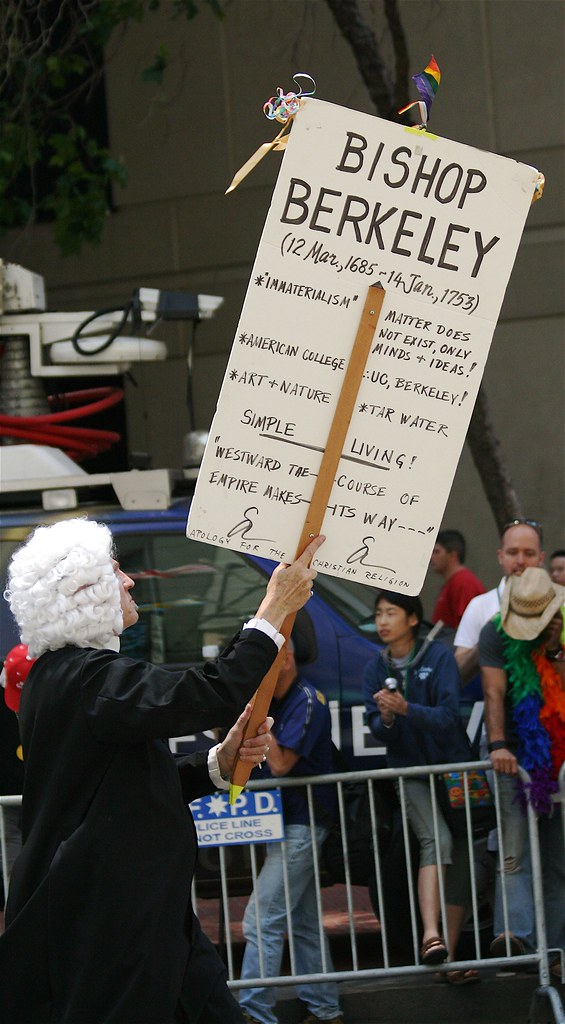
Photo: “Bishop Berkeley” by Infidelic is licensed under CC BY-NC-SA 2.0

Opposing poems: Alexander Pope and J. C. Squire

Nature and nature’s laws lay hid in night:
God said, Let Newton be! and all was light.

Pope’s “Epigram on Sir Isaac Newton” stood as a definitive statement until the 20th century, when J.C. Squire produced his “Answer to Pope’s Epitaph for Sir Isaac Newton”

It did not last: the Devil howling “Ho!
Let Einstein be!
” restored the status quo.

There is something very charming about an epigrammatic poem being answered by a poet with an opposite view. Some weeks ago I posted such a pair about 17th century Oxbridge rivalry, with Joseph Trapp referencing events of 1714 in six lines of verse to demonstrate Oxford’s superiority, answered by William Browne taking four lines to use the same events to argue for Cambridge. There are other such pairs… this obviously needs more research…

Illustration: “Alexander Pope” by immugmania is licensed under CC BY 2.0