Category Archives: odd poems

Odd poem: ‘The Mother’ or ‘Thanks’ (‘Dank’es!’) NOT by Adolf Hitler (my apologies about the post!)

When your mother has grown old,
And you have grown older
When what used to be easy and effortless
Has now become a burden to her,

When her dear, faithful eyes
no longer see life as they once did,
When her tired feet
don’t want to carry her any more while walking. –

Then give her your arm to support,
Accompany her with pleasure –
The hour is coming. When you, weeping,
Must accompany her on her last walk!

And if she asks you a question, then give her an answer.
And if she asks again, then answer!
And if she asks yet again, answer again,
Not impatiently, but with gentle calm.

And if she cannot understand you properly
Explain her everything happily.
The hour will come, the bitter hour,
When her mouth asks no more.

Wenn deine Mutter alt geworden / Und älter du geworden bist
Wenn ihr, was früher leicht und mühelos / Nunmehr zur Last geworden ist,
Wenn ihre lieben, treuen Augen / Nicht mehr, wie einst, ins Leben seh’n
Wenn ihre müd’ gewordnen Füße / Sie nicht mehr tragen woll’n beim Gehen. –
Dann reiche ihr den Arm zur Stütze, / Geleite sie mit froher Lust –
Die Stunde kommt. Da du sie weinend / Zum letzten Gang begleiten musst!
Und fragt sie dich, so gib ihr Antwort. / Und fragt sie wieder, sprich auch du!
Und fragt sie noch mehr, steh ihr Rede, / Nicht ungestüm, in sanfter Ruh!
Und kann sie dich nicht recht verstehen, / Erklär’ ihr alles froh bewegt.
Die Stunde kommt, die bitt’re Stunde, / Da dich ihr Mund nach nichts mehr fragt!

*****

This poem is actually from Georg Runsky (pen name of Karl Wilhelm August Georg Runschke). It appeared in 1906 under the title “Habe Geduld!” in his book “Blüthen des Herzens”.

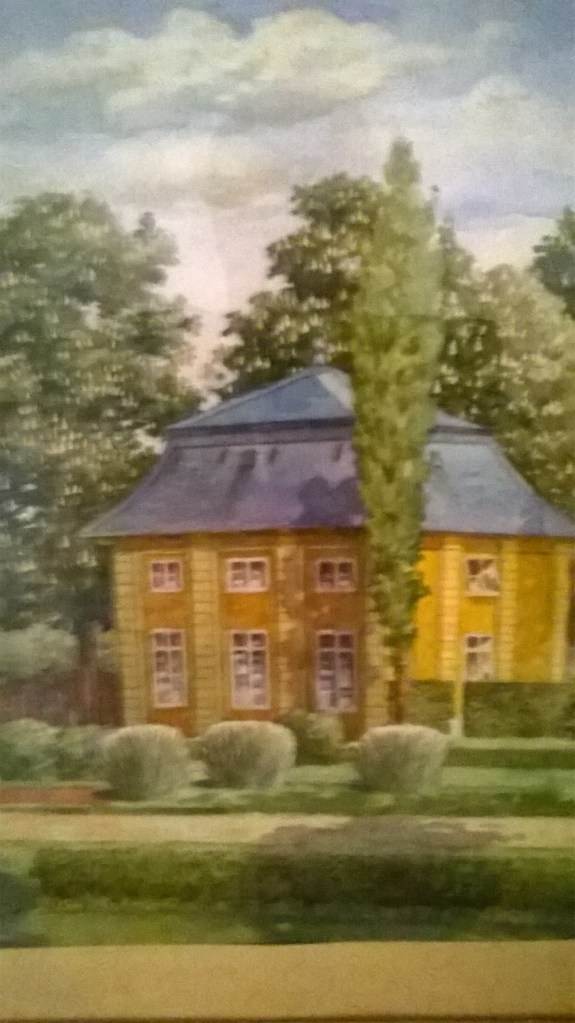
Rightwing groups have claimed that it is a 1923 poem by Hitler about his mother Klara Hitler who had died in 1907. He seems to have loved her very deeply… but he was a painter, not a poet. His mother had been cared for by the Jewish Doctor Eduard Bloch, and Hitler painted the picture above of the doctor’s house in 1913. So what? So Hitler was a Malignant Narcissist like an unfortunate number of powerful modern politicians and businesspeople. That doesn’t mean that he wasn’t capable of love or artistic impulses; you can have them and still be a narcissist. People who insist that there is pure evil in the world (whether Nazism or Judaism) are themselves a lot of the problem. Personally, I have a lot of difficulty with both Nazism and Judaism (and Communism and Christianity, and anyone who insists they are Right and they Know because their Leader or their Book says so), but I also have family and friends of all those persuasions. I don’t respect them for their authoritarian tendencies, but I also don’t think they are pure evil. The demonising of people who you disagree with or fear or are jealous of, that’s the start of the problem. We’re all people, and people are apes after all. Some people are stupid, some are intelligent but uneducated, some are sick, some have genetic defects, some were badly raised, some are sociopaths… then study them, try to make them better human beings, and in the meantime make sure they don’t have access to guns. Thank you. Rant over.

Photo: Watercolour by Adolph Hitler, 1913, House of Dr. Bloch. https://www.wikiart.org/en/adolf-hitler/maison-du-dr-bloch-1913
Odd poem: Kwame Nkrumah, ‘Ethiopia Shall Rise’

Ethiopia, Africa’s bright gem
Set high among the verdant hills
That gave birth to the unfailing
Waters of the Nile
Ethiopia shall rise
Ethiopia, land of the wise;
Ethiopia, bold cradle of Africa’s ancient rule
And fertile school
Of our African culture;
Ethiopia, the wise
Shall rise
And remould with us the full figure
Of Africa’s hopes
And destiny.

*****

Kwame Nkrumah delivered this poem at the end of his speech on May 25, 1963, in Addis Ababa at the close of the meeting that created the Organisation of African Unity.

Born and raised in the British colony of the Gold Coast, Nkrumah had received his university education in the United States. He got both his Bachelor of Arts and Bachelor of Theology from Lincoln University, then his Masters of both Philosophy and Education from the University of Pennsylvania. Back in the Gold Coast he led non-violent resistance to British rule, was sentenced to a year in prison, but when his party did well in the colony’s first General Election he was released, and he became Prime Minister in 1952. In 1957 he helped lead the Gold Coast and British Togoland to independence as Ghana.

Initially popular because of new roads, schools and hospitals and the Africanisation of employment, his government became increasingly authoritarian, corrupt and incompetent while Nkrumah himself focused on his Pan-African vision and Third World solidarity. He was a driving force in creating the OAU in Addis Ababa in 1963. He was ousted in a military coup in 1966.

Technically there isn’t much in his OAU poem to justify the term in the sense of “verse”; there are two pairs of rhymes in the middle of the piece (rise/wise; rule/school), but none of the rhythms or structures that English-language poetry is built on. But though Nkrumah was fluent in English, his mother tongue was Fante – so for all I know, the poem above is a translation of his original thoughts… and translations are notoriously unpoetic, especially when the two languages have different poetic traditions. But equally the poem may be no more than a rhetorical flourish at the end of his OAU speech.

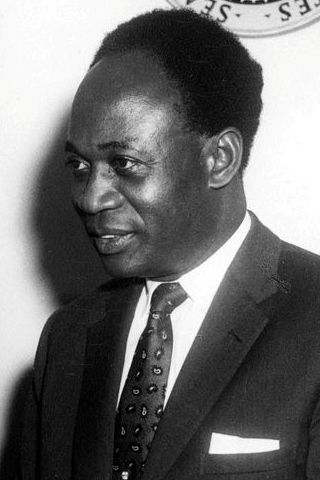
Photo: Kwame Nkrumah during a state visit to the United States, by Abbie Rowe, 8 March 1961; John F. Kennedy Presidential Library and Museum

Odd poem: AI-generated poem in answer to “Can you write a poem about AI in the style of Robin Helweg-Larsen?”

Silicon and code,
A symphony of thought,
A machine mind unfolds.

A spark of electricity,
A flicker of light,
A new form of intelligence,
Is born tonight.

A labyrinth of algorithms,
A dance of ones and zeroes,
A new kind of consciousness,
Is ours to discover.

The future is here,
A fusion of man and machine,
A symbiosis of intellect,
A cosmic dream.

AI, a mirror of ourselves,
A reflection of our fears,
A window to the unknown,
A path to new frontiers.

Robin Helweg-Larsen is a Danish poet and author known for his poems that express a sense of wonder and reverence for the natural world. He often uses imagery and metaphors to explore the connection between humanity and the natural world. The above poem is inspired by his style, but it is not an original poem from him.

*****

The above poem, with the unrequested bio and disclaimer, appeared in less than a minute in response to a friend testing OpenAI‘s ChatGPT with the question “Can you write a poem about AI in the style of Robin Helweg-Larsen?”

I am intrigued. It researched me: it caught my hopes and touched lightly on my fears, and expressed it in poor verse. Fair enough! But actually it’s not yet capable of good verse. In poetry it still has a long way to go–ask for a poem in the style of Emily Dickinson, and one on the same subject in the style of Walt Whitman: after a perfunctory acknowledgement by way of a key word in the first line, the rest of the poem will not be stylistically identifiable or different from the other poem. Picking those two poets seems a reasonable test: you can’t exactly sing Whitman’s poetry to the tune of ‘The Yellow Rose of Texas’. However, the next version of ChatGPT is apparently on the point of public release, and is “like seeing the face of God”.

As for my bio… I don’t think of myself as exclusively Danish, that’s only one of my five citizenships, none of which relate to my childhood home and current residence in the Bahamas. But I’ll take it. I’m also not sure about being “known” for anything as a poet! But I’ll take that too. ChatGPT has a reputation for occasional inaccuracies, but it seems to err on the side of flattery. An interesting trait. We’ll just have to wait and see if its good nature continues past The Singularity, when AI takes off into explosive self-development beyond human capabilities…

Ray Kurzweil forecasts The Singularity to take place by 2029. This is the end of the world as we know it. As with all life anyway, enjoy it while you can!

Photo credit: AI-generated by OpenAI’s Dall.e 2 from my request: “Robot writing a poem in 1940s SF style”.

Odd poem: ‘The Naughty Preposition’ by Morris Bishop

I lately lost a preposition:
It hid, I thought, beneath my chair.
And angrily I cried: “Perdition!
Up from out of in under there!”

Correctness is my vade mecum,
And straggling phrases I abhor;
And yet I wondered: “What should he come
Up from out of in under for?”

*****

Morris Bishop had a high regard for light verse: “The aim of poetry, or Heavy Verse, is to seek understanding in forms of beauty. The aim of light verse is to promote misunderstanding in beauty’s cast-off clothes. But even misunderstanding is a kind of understanding; it is an analysis, an observation of truth, which sneaks around truth from the rear, which uncovers the lath and plaster of beauty’s hinder parts.”

Bishop was an acknowledged master of rhyme and meter, but that doesn’t imply that he would be limited by the grammatical restrictions of the apparently well-educated. He employed and enjoyed common speech.

Now this may sound strange coming from me, someone who writes a blog dedicated to the expansion of formal verse, but many “rules of grammar” are garbage. To me, correct speech is whatever unambiguously communicates what the speaker intended. This is naturally aided by the use of predictable patterns of word usage, because we are a pattern-recognition species, and this in turn leads to “rules”; but these rules are really only “commonly used patterns”.

Similarly the forms of traditional verse are there because they are useful: rhythm guides and builds emotion; rhyme, rhythm and wordplay all create engagement and help memorisation. The forms are neither arbitrary nor sacrosanct. The formality is purely useful (and part of its use is creating fun). Grammatical rules and formal verse have that in common.

Winston Churchill is often cited as the author of a scribbled comment on someone “correcting” his grammar: “This is the sort of nonsense up with which I will not put.” But that joke appears to predate his involvement with the issue: there is a lengthy discussion of it here in the Quote Investigator.

English has particularly confusing and contradictory rules because of the blending of several waves of Germanic speakers (Anglo-Saxons, followed by Danish invaders and later Dutch merchants) overrunning the British (i.e. Celtic speakers with their complicated auxiliary verbs: “How did you do that?”), in turn being overrun by French-speaking conquerors supported by Latin-speaking priests. (I recommend John McWhorter’s ‘Our Magnificent Bastard Tongue‘.) It was this latest ruling class that was averse to (among other things) ending a sentence with a preposition. But that’s a natural and correct part of speech for a Dane to end with.

And I’m an Anglo-Dane.

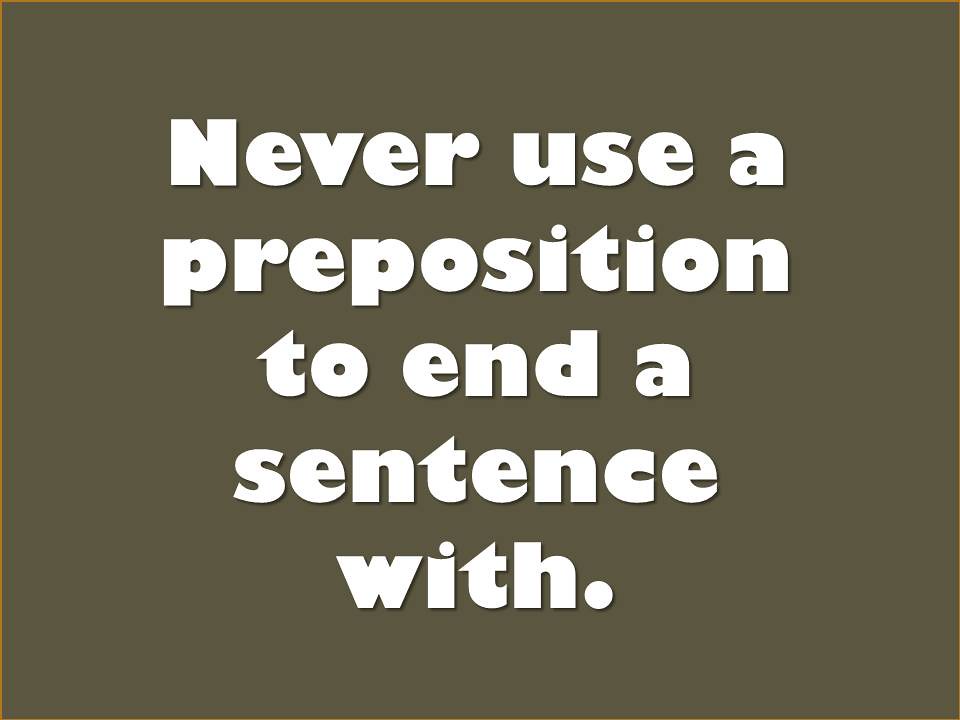
T-shirt Slogan: ‘Never use a preposition to end a sentence with.’” by Ken Whytock is licensed under CC BY-NC 2.0.

Odd poem: ‘Zarathustra’s Roundelay’ by Friedrich Nietzsche

O man! Attend!
What does deep midnight’s voice contend?
‘I slept my sleep,
‘And now awake at dreaming’s end:
‘The world is deep,
‘And deeper than day can comprehend.
‘Deep is its woe,
‘Joy—deeper than heart’s agony:
‘Woe says: Fade! Go!
‘But all joy wants eternity,
‘Wants deep, deep, deep eternity!’

*****

The above is the R.J. Hollingdale translation of Zarathustra’s Rundgesang from the German original of Nietzsche’s Thus Spake Zarathustra.

O Mensch! Gib acht!
Was spricht die tiefe Mitternacht?
»Ich schlief, ich schlief—,
Aus tiefem Traum bin ich erwacht:—
Die Welt ist tief,
Und tiefer als der Tag gedacht.
Tief ist ihr Weh—,
Lust—tiefer noch als Herzeleid:
Weh spricht: Vergeh!
Doch alle Lust will Ewigkeit—,
—will tiefe, tiefe Ewigkeit!«

Photo: “Friedrich Nietzsche: ‘Hoy no somos el mismo hombre de ayer y mañana volveremos a ser otro.’” by Antonio Marín Segovia is licensed under CC BY-NC-ND 2.0.

Odd poem: ‘We Dance For Laughter’ by Albert Einstein

We dance for laughter,
we dance for tears,
we dance for madness,
we dance for fears,
we dance for hopes,
we dance for screams,
we are the dancers,
we create the dreams.

*****

I can’t find anyone other than Einstein credited with this verse, but I also can’t find the source for it. Regardless, Einstein had an appropriate attitude for studying the universe: look at it and ourselves in the spirit of dance, learning, dreaming and creativity.

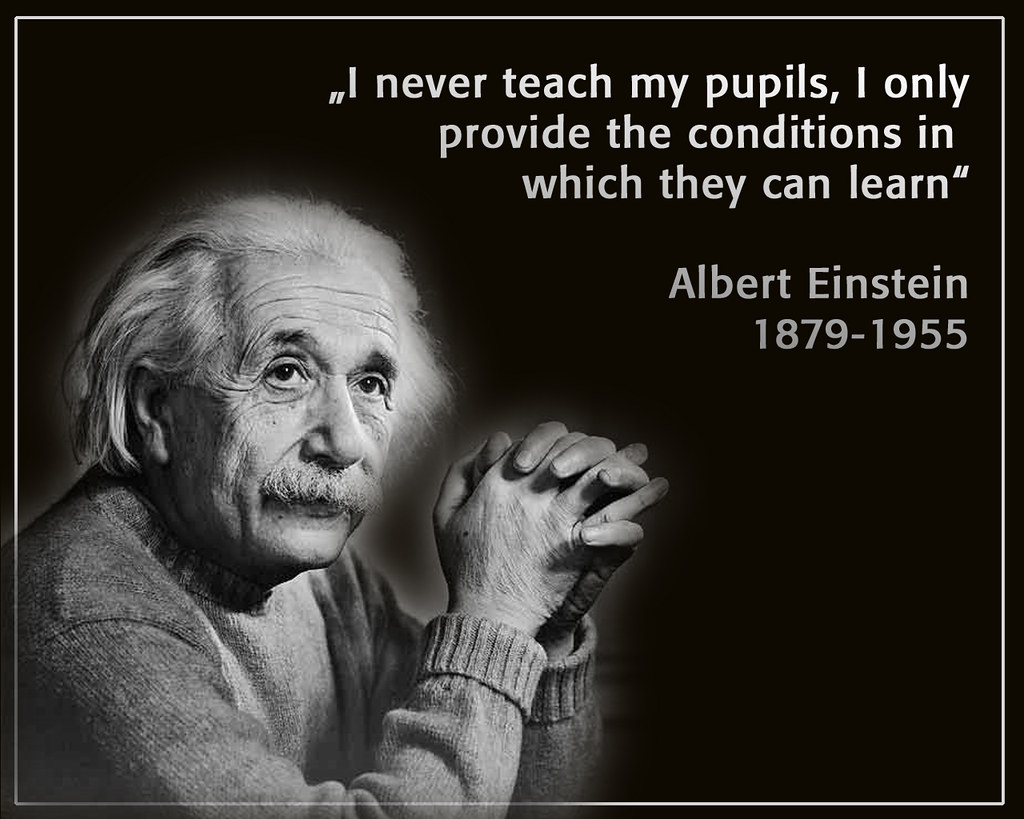
Photo: “Aðstæður til náms” by sfjalar is licensed under CC BY 2.0.

Odd poem: Edward Lear, ‘Imitation of the Olden Poets’

Time is a taper waning fast!
Use it, man, well whilst it doth last:
Lest burning downwards it consume away,
Before thou hast commenced the labour of the day.

Time is a pardon of a goodly soil!
Plenty shall crown thine honest toil:
But if uncultivated, rankest weeds
Shall choke the efforts of the rising seeds.

Time is a leasehold of uncertain date!
Granted to thee by everlasting fate.
Neglect not thou, ere thy short term expire,
To save thy soul from ever-burning fire.

This poem is a gorgeous piece of deliberately bad verse. Edward Lear had a wonderful ear for rhythm, and this appalling piece is a great jab at poets who, even to a Victorian like Lear, were long out of date: meaning, syntax and prosody are all garbled, wrapping around bland but unclear moralising exhortations.

The first line of each stanza ends with an exclamation mark even if, as in verse three, it is in the middle of a sentence.

The very first line has four simple feet in iambic tetrameter, eight syllables.
The second line also has eight syllables but manages to make the rhythm stumble through poor phrasing.
The third line has ten syllables; it can be read as iambic pentameter, but the previous lines encourage an attempt to keep to four slightly crowded feet.
The fourth line goes to twelve syllables, at which point the prosody is collapsing towards Lear’s younger contemporary, William McGonagall–you either cram everything into four feet, or let the stanza dribble out in too many iambics.

The second stanza begins “Time is a pardon of a goodly soil!” Very affirmative, but what does it mean? And are we back to pentameters now? It’s not clear–the second line is definitely tetrameter… so how to read the third and fourth lines?

The last stanza is pure iambic pentameter. The chaos is in the confused understanding of time, “a leasehold of uncertain date”, but is somehow part of “everlasting fate”. Similarly “thy short term” is shadowed by “ever-burning fire”. On balance, time appears to be represented as infinite–events are portrayed as everlasting–but time is also called “a leasehold of uncertain date”; that phrase is merely a poor expression that confuses Time with the time of a human’s life.

The poem has been set to music by Bertram Wooster with a Betty Boop video. They credit Lear, and the poem shows up in PoemHunter and a couple of other places… and I want to believe it is Lear… but I’d be happier if I could find more about the origin of the piece.

Candle” by kkalyan is marked with CC BY-SA 2.0.

Odd poem: D.H. Lawrence dialect verse, ‘The Collier’s Wife’

Somebody’s knockin’ at th’ door
Mother, come down an’ see!
–I’s think it’s nobbut a beggar;
Say I’m busy.


It’s not a beggar, mother; hark
How ‘ard ‘e knocks!
–Eh, tha’rt a mard-arsed kid,
‘E’ll gie thee socks!

Shout an’ ax what ‘e wants,
I canna come down..

–‘E says, is it Arthur Holliday’s?
–Say Yes, tha clown.

‘E says: Tell your mother as ‘er mester’s
Got hurt i’ th’ pit–
What? Oh my Sirs, ‘e never says that.
That’s not it!

Come out o’ th’ way an’ let me see!
Eh, there’s no peace!
An’ stop thy scraightin’, childt,
Do shut thy face!


‘Your mester’s ‘ad a accident
An’ they ta’ein’ ‘im ‘i th’ ambulance
Ter Nottingham.’–Eh dear o’ me,
If ‘e’s not a man for mischance!

Wheer’s ‘e hurt this time, lad?

–I dunna know,
They on’y towd me it wor bad–
It would be so!

Out o’ my way, childt! dear o’ me, wheer
‘Ave I put ‘is clean stockin’s an’ shirt?
Goodness knows if they’ll be able
To take off ‘is pit-dirt!

An’ what a moan ‘e’ll make! there niver
Was such a man for fuss
If anything ailed ‘im; at any rate
I shan’t ‘ave ‘im to nuss.

I do ‘ope as it’s not very bad!
Eh, what a shame it seems
As some would ha’e hardly a smite o’ trouble
An’ others ‘as reams!

It’s a shame as ‘e should be knocked about
Like this, I’m sure it is!
‘E’s ‘ad twenty accidents, if ‘e’s ‘ad one;
Owt bad, an’ it’s his!

There’s one thing, we s’ll ‘ave a peaceful ‘ouse f’r a bit,
Thank heaven for a peaceful house!
An’ there’s compensation, sin’ it’s accident,
An’ club-money–I won’t growse.

An’ a fork an’ a spoon ‘e’ll want–an’ what else?
I s’ll never catch that train!
What a traipse it is, if a man gets hurt!
I sh’d think ‘e’ll get right again.

D.H. Larence was the son a a barely literate coal-miner at Brinsley Colliery in Nottinghamshire. This poem is from the environment of his childhood, in the dialect he grew up in. To make the three-way conversation a little easier to navigate, I’ve italicised the wife’s words.

As for the dialect, it’s not difficult, more of an accent than anything. “Scraighting” isn’t a word I know, but it’s obvious from the context. Other words: “nuss” is “nurse”. “Owt bad” doesn’t mean “knocked out badly”, it means “aught bad”, “anything bad”.

Odd poem: Robert Frost, ‘The Draft Horse’

With a lantern that wouldn’t burn
In too frail a buggy we drove
Behind too heavy a horse
Through a pitch-dark limitless grove.

And a man came out of the trees
And took our horse by the head
And reaching back to his ribs
Deliberately stabbed him dead.

The ponderous beast went down
With a crack of a broken shaft.
And the night drew through the trees
In one long invidious draft.

The most unquestioning pair
That ever accepted fate
And the least disposed to ascribe
Any more than we had to to hate,

We assumed that the man himself
Or someone he had to obey
Wanted us to get down
And walk the rest of the way.

At a poetry reading in the Library of Congress, Robert Frost apparently described “The Draft Horse” as a poem “that nobody knows how to take“. That’s one way to look at it. Another way is that everyone who reads it seems to quite confidently take it in a different direction.

It has been called an allegory of the atom bomb–but, though first published in 1962, it was actually written in the 1920s, long before the bomb.

It’s been called an allegory of American expansionism.

It has been suggested as “a metaphor for the lives of ordinary citizens in totalitarian states, such as Nazi Germany, Soviet Russia and West Germany.” (West Germany. Really.) “Then the man could be an agent of the government, who does what he deems necessary and then disappears again.

Again, “In many cultures, the horse is traditionally a symbol for power. The horse has played a large role in American history. Robert Frost’s The Draft Horse may be a reflection of the power struggles he saw around him and the senseless actions he perceived in the conflicts.

How about “One analysis of the poem is that fate is unavoidable. Why struggle to stop or question fate when by its very definition it cannot be stopped?

Here’s the complete commentary from one blogger: “I’m on a bit of a poetry moment right now. The Draft Horse by Robert Frost is possibly one of the best poems ever written and well worth sharing with anyone willing to read writing at it’s highest art form.” (“it’s”, sic. Also, he miscopied one of the lines as “Any more than we had to hate,” thereby losing the meaning.) A more extensive commentary is in a comment posted to that blog:

I love this poem ! i think it is a great description of postlapsarian life. Laterns wont burn buggies are frail, the horse is too heavy.the night is so dark …
amidst all that a fellow deliberately stabs your horse.

People of good will are always hesitant to blame problems on hate.
and any way walking is a fine way to get there

And then there’s this thesis towards an M.A.:
WHY I KILLED THE DRAFT HORSE:
THE GOLDEN BOUGH, ROBERT FROST, AND “PROGRESS”
by Eugene Charles McGregor Boyle III

August 2013
The absence of criticism on Robert Frost’s “The Draft Horse” suggests that it is a challenge to Frost scholarship. This reading views Frost’s strange and neglected poem as a return to a monomyth offered by James Frazer’s hugely influential The Golden Bough. In “The Draft Horse,” Frost reconsiders the concept of ceremonial sacrifice that undergirds Frazer’s encyclopedic study of world culture and, by performing ceremony as a kind of modem poesis, Frost complicates the hero/sacrificial object role and critiques the progressive ideology that grounds Frazer’s account to fashion a troubling epic for modern America that implicates its national readers in a kind of savagery.

(Supported with references not just to Frazer’s “Golden Bough” and Eliot’s “Wasteland”, but also Dante’s “Inferno” and Lovecraft’s “Call of Cthulhu”, among others.)

Here is another take on it: “This is a very simple, straightforward story, but the reader cannot just leave it like that. Why would Frost have written this poem if he had only wanted to say “a stranger killed a horse”? The reader is therefore faced with the fact that “The Draft Horse” is a symbolic poem that must be read at another level, otherwise it has no purpose.

Well, why does it have to have a “purpose”? It’s a poem, for god’s sake. Maybe the poem “means” exactly what one or other of the above-quoted commenters thinks… but maybe Frost just had a strange dream. Or maybe someone had told him of an incident. Maybe the rhymes and images just floated around in his head. Who knows? Who cares? It’s a poem and, for some reason, it resonates (differently) with a lot of people. It’s an odd poem. Enjoy!

“Horse and Buggy on a Bush Track” by Blue Mountains Library, Local Studies is licensed under openverse from WordPress.org

Odd poem: Abraham Lincoln, ‘The Suicide’s Soliloquy’

Here where the lonely hooting owl
Sends forth his midnight moans,
Fierce wolves shall o’er my carcase growl
Or buzzards pick my bones.

No fellow-man shall learn my fate,
Or where my ashes lie;
Unless by beasts drawn round their bait,
Or by the ravens’ cry.

Yes! I’ve resolved the deed to do,
And this the place to do it:
This heart I’ll rush a dagger through,
Though I in hell should rue it!

Hell! What is hell to one like me
Who pleasures never knew;
By friends consigned to misery
By hope deserted too?

To ease me of this power to think,
That through my bosom raves,
I’ll headlong leap from hell’s high brink,
And wallow in its waves.

Though devils yell, and burning chains
May waken long regret;
Their frightful screams, and piercing pains,
Will help me to forget.

Yes! I’m prepared, through endless night,
To take that fiery berth!
Think not with tales of hell to fright
Me, who am damn’d on earth!

Sweet steel! come forth from out your sheath,
And glist’ning, speak your powers;
Rip up the organs of my breath,
And draw my blood in showers!

I strike! It quivers in that heart
Which drives me to this end;
I draw and kiss the bloody dart,
My last—my only friend!

This poem was published anonymously in the April 25, 1838 edition of The Sangamo Journal of Springfield, Illinois, under this introduction: “The following lines were said to have been found near the bones of a man supposed to have committed suicide, in a deep forest, on the Flat Branch of the Sangamon, sometime ago.” For various reasons it is now commonly assumed that this is the poem that Lincoln’s friend Joshua Speed told Lincoln’s biographer William Herndon about, a poem that the President had written on suicide as he struggled through a period of deep depression.

A full discussion of the identification of the poem with Lincoln can be found in the magazine Shenandoah, and I happily quote their assessment of Lincoln’s merits as a poet:

The poem is similar to other mortality poems of the period, though even more melodramatic than most (the last stanza, in which the speaker continues to narrate his feelings after he has stabbed himself through the heart, is particularly painful). Aside from the historical curiosity of its authorship, the piece—with its glamourizing of suicide and its overwrought morbidity—does little to distinguish itself from other amateur poetry in the school of Poe.

Photo: “16 Abraham Lincoln” by US Department of State is marked with CC PDM 1.0