Category Archives: Poems

Odd poem: Muhammad Ali, ‘Me, We’

Me?
We.

*****

Muhammad Ali was invited to talk to a group of Harvard students on June 4, 1975. Someone shouted, ‘Give us a poem, Muhammad’ and he paused, looked up and said: ‘Me? We’. But as it was spontaneous and spoken, the punctuation is what you will, and evokes a variety of ideas and responses. Questions of identity… of Ali himself being part of the roomful of attendees… of the needs of the group outweighing the needs of the individual… the human journey from selfishness to altruism… Certainly all that is in keeping with the speech he gave that night, excerpted here.

It claims title to the World Championship for the shortest poem, at least in the English language.

Using form: biform poem: Daniel Galef, ‘Casey to his Bat’

(as a sonnet after Eugene Lee-Hamilton’s 1888 collection “Imaginary Sonnets”)

You’re swell! No wizard’s-wand or Rod of Aaron
With this ease can whack one past the glove
The way a sparrow weaves through trees. No baron
Wields your power—you’re the scepter of
A king, and blood descendent of the club
That Hercules did swing. That bat was blessed!
It knocked the blocks off lions. (Not a cub—
A full-grown beast.) Herc wore its skin, the rest
Cooked up for grub. My point: We’ll stand immobile.
It’s beneath us—just a dud. To swing
At these poor lulus would insult your noble
Blood. One pitch will come—the air will sing—
We’ll know that this is it. We’ll swing. We’ll hit!
The crowd will cheer! We’ll run! We’ll win!—Oh, shit.

~ ~ ~ ~ ~ ~ ~ ~ ~ ~ ~ ~ ~ ~ ~ ~ ~ ~ ~ ~ ~ ~ ~ ~ ~ ~ ~ ~ ~ ~ ~ ~

(in the meter of Ernest Thayer’s 1888 poem “Casey at the Bat”)

You’re swell! No wizard’s-wand or Rod of Aaron with this ease
Can whack one past the glove the way a sparrow weaves through trees.
No baron wields your power—you’re the scepter of a king,
And blood descendent of the club that Hercules did swing.
That bat was blessed! It knocked the blocks off lions. (Not a cub—
A full-grown beast.) Herc wore its skin, the rest cooked up for grub.
My point: We’ll stand immobile. It’s beneath us—just a dud.
To swing at these poor lulus would insult your noble blood.
One pitch will come—the air will sing—we’ll know that this is it.
We’ll swing. We’ll hit! The crowd will cheer! We’ll run! We’ll win!—Oh, shit.

*****

Daniel Galef writes: “I wrote this poem in 2017 while I was a student at McGill University and looking for anything to work on except my work. I have always loved both math and language, as well as making them kiss like two Barbies you mash together, and “Casey” was inspired by a couple of happy arithmetical coincidences: First, that there are exactly 70 metrical feet (or 25.52 imperial metres) in either one sonnet or 20 lines of ballad meter. Second, that both Ernest Thayer’s famous ballad “Casey at the Bat” and Eugene Lee-Hamilton’s not-so-famous collection Imaginary Sonnets were published in 1888.
The speaker of “Casey” is the mighty mock-hero of Ernest Thayer’s poem, subtitled a “Ballad of the Republic,” which is composed of standard ballad meter: rhyming couplets in iambic heptameter or alternating lines of tetrameter and trimeter. Thayer’s was possibly the last American poem to have massive popular appeal to the extent that it was commonly memorized for fun, performed on the vaudeville stage, and adapted into multiple films and even Disney cartoons. I memorized it in college as a party trick, which I’m quite eager to try out if I ever get invited to any parties.
As far as I know, this is the first sonnet* of its kind. I wrote another after, which was published first. Now that my first book is out,** I’ve written a third and fourth, but am still in the process of trying to find them loving homes in some journal or website where they can frolic and play with the other little sonnets. Of course, nothing’s wholly original. When I was a child I read a short poem by Mary Youngquist in a Willard Espy book which was readable as eight lines of six syllables or six lines of eight syllables. Robin informed me when the second of these was first printed (“A Poke of Gold” in Snakeskin Poetry in 2019; “Casey” was published in Able Muse in 2020) that the French surrealist Louis Aragon was toying with similar four-six/six-four patterns in the 1940s. But I think these are the first sonnets!
If you liked these, by all means check out my book, Imaginary Sonnets, available wherever sonnets are sold—but try here first: danielgalef.com/book/

*Sometimes they’re sonnets! I don’t really know what to call these. “Convertible sonnets” makes it sound like the rain will get in if you leave the top down, and “transforming sonnets” are plastic toys that come with a kid’s meal. The inaugural issue of the Journal of Wordplay called it an “equivocal sonnet,” and linked it to the 19th century genre “equivoque.” If you alternate the letters of sonnet and ballad, you get “sboanlnleatd.”*** Or, if you change the lineation of the poem only on a full moon: “were-sonnets”?
**Imaginary Sonnets (Able Muse Press, 2023), inspired by the Lee-Hamilton book—70 persona poems all from the point of view of different historical figures, literary characters, and inanimate objects, including Lucrezia Borgia, Wernher von Braun, and a new brand of breakfast taco.
***Both “sonnet” and “ballad” come from the Old Occitan troubadours; “sonnet” is a diminutive of “song” whereas “ballad,” a cognate with “ballet,” comes from “dance.”

*****

Daniel Galef’s first book, Imaginary Sonnets, is a collection of persona poems all from the point of view of different historical figures and objects, including Nossis the Epizephyrian, Christopher Smart’s cat, and a breakfast taco. Besides poetry, he has written plays that won the McGill University Drama Festival, flash fiction selected for the Best Small Fictions anthology, and last year he placed second in the New Yorker cartoon caption contest, which doesn’t really mean anything but he’s been telling everyone anyway.

Photo: “Casey At The Bat at Games On The Boardwalk” by Castles, Capes & Clones is licensed under CC BY-ND 2.0.

Sonnet: ‘Sad, Actually’

Unreconstructed, with unhealthy heft—
the image of uncivilised great ape—
a fraud who tries to win by lies and theft,
a man who’d propagate by power and rape,
racist extoller of his genes alone,
a would-be genocidal patriarch,
successful in some twilight Darwin zone,
uncultured as a mugger in the park…
But note, behind the thin success veneer,
the shallow love of gold and gilt and glitz,
gloating dismissals and the bloated sneer,
the self-aggrandisement that never quits:
an unloved child’s in some deep down recess,
the secret of the man’s unhappiness.

*****

I can’t help feeling sorry for people who were raised so badly that they have never learnt to find security, inner peace, personal meaning. On the other hand I can’t help rejoicing when some destructive, selfish racist is exposed as a cheat and a fraud under the control of a foreign power, and is removed from positions of authority. I think of that sympathy/schadenfreud dichotomy as a healthily balanced contradiction; but then, I’m a Libra…

This sonnet (Shakespearean, being in iambic pentameter and rhyming ABAB CDCD EFEF GG) has just been published in Shot Glass Journal, an online journal of short poetry. Most of what they publish is not formal verse, but most of mine is.

Photo: “File:Vladimir Putin and Donald Trump (2019-06-28) 06.jpg” by Presidential Press and Information Office is licensed under CC BY 4.0.

Using form: irregular sonnet: Jane Blanchard, ‘Premises’

After an argument I listen hard
to noises in our common house—the ticking
of clocks, the humming of fans, the creaking of floors,
the rumbling of pipes, the ringing of phones, the groaning
of springs, the clacking or clinking of keys, the droning
of television, the drumming of laundry, the clicking
of locks, the tumbling of ice, the squeaking of doors—
all louder once a morning has been marred.
Hours may pass as I interpret sound
by sound—source, frequency, duration. Some
attention goes to silences, which pound
and pound, but not to show where each comes from.
Throughout, peace can be found in knowing you
are also wondering when words are due.

*****

Jane Blanchard writes: “This sonnet from Metes and Bounds was first published in Mezzo Cammin (Summer 2017). It is rather irregular, especially in the octave, but such deviation seems appropriate for the subject, at least to me. This poem is largely a list, yet it has narrative and lyrical elements, too, and the experience described, I hope, is easily perceived.”

A native Virginian, Jane Blanchard lives and writes in Georgia. Her latest collection with Kelsay Books is Metes and Bounds (2023).

Photo: detail of the cover of Metes and Bounds.

Using form: Accentual Metre: Susan McLean, ‘Stone’

Offered bread,
I asked for a stone.
The stone was good,
but I ate alone.

I took my bows
in a hail of rocks,
and built my house
of stumbling blocks.

But its walls are aligned
so true and tight
that they keep out the wind
that blows all night.

*****

Susan McLean writes: “And when the tempter came to him, he said, If thou be the Son of God, command that these stones be made bread.” Matthew 4:3 (King James Version)
“Or what man is there of you, whom if his son ask bread, will he give him a stone?” Matthew 7:9 (King James Version)

“I am not a religious believer, nor have I been one for many decades. But the poetry of the Old Testament and the metaphorical language of the New Testament both left their mark on me. Paradoxes and counterintuitive arguments, so integral to parables, are also at the core of poetry. Bread and stones—what does it mean to refuse the former in favor of the latter? To reject the normal and necessary, while choosing the impossible and unsustaining, can only lead to being misunderstood and rejected oneself, possibly even persecuted. Yet in this poem I argue that, paradoxically, taking the hard and lonely path has its own rewards. A stumbling block is solid; with a sufficient number of them, one can build a shelter that can withstand the strongest winds.
“The slant rhymes in lines 1 and 3 of each stanza, with their hint of dissonance, meet the resolution of the true rhymes in lines 2 and 4. Because dimeter lines, with just two stresses per line, can quickly become monotonous if the lines are too regular, I chose to use accentual meter instead of the more predictable accentual-syllabic meter. Therefore, the number of syllables per line varies from a low of three to a high of six. “This poem, originally published in the online journal The Chimaera, later appeared in my second poetry book, The Whetstone Misses the Knife.”

Susan McLean has two books of poetry, The Best Disguise and The Whetstone Misses the Knife, and one book of translations of Martial, Selected Epigrams. Her poems have appeared in Light, Lighten Up Online, Measure, Able Muse, and elsewhere. She lives in Iowa City, Iowa.
https://www.pw.org/content/susan_mclean

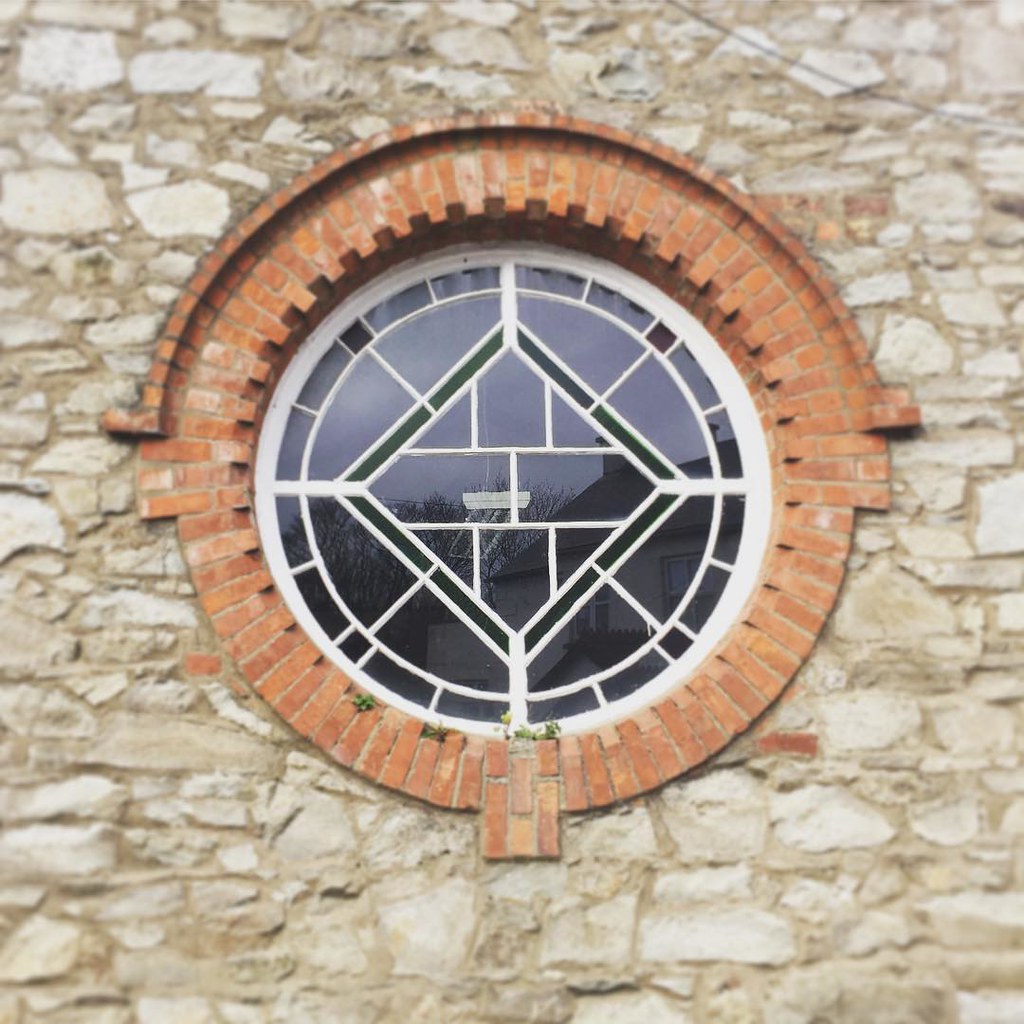
Photo: “Beautiful circular window and rough stone wall on this quaint little former school house in Arklow from the 1800s #windows #arklow #irisharchitecture” by irishhomemagazine is licensed under CC BY-SA 2.0.

NSFW Sonnet: ‘Restaveks’

Illegals, both of us; married last year,
now she cleans houses, I cut grass, sweep decks,
for superrich who see us as mere specks
while their big spaceship exit they prepare.
Earth will be fishless, treeless, plastic, bare.
They’ve offered us both jobs as restaveks,
but I said No, they just want us for sex.
She said Then suck them off, why should you care?
I said, We’ll stay. She said, I said I’d go.
I said, You’d leave me? She said, Stay, be dead.
I said, That makes you nothing but a whore.
She said, I fucked him for your job, you know;
I go to space, I’ll live, have food, have bed,
and, if I’m good, oh maybe so much more…

*****

“Restavek” is normally a term for a child of an impoverished Haitian family, sent to live as a domestic servant for a wealthier (or less poor) family. There are an estimated 300,000 in Haiti, mostly girls; and an unknown number in the Haitian communities in the US.

This sonnet (Petrarchan, rhyming ABBA ABBA CDE CDE) was recently published in the frequently NSFW Rat’s Ass Review – thanks, Roderick Bates!

Illustration: “Tiny Empires 3000” by Daniel Voyager is licensed under CC BY 2.0.

Using form: Sonnet within Sonnet: Daniel Kemper, ‘Her Petrarchan Heart’

a Petrarchan sonnet embedded inside an Elizabethan sonnet

I smile in my Italian heart—but English ways,
against emotions so taboo, require some tact
and so I’m hiding in plain view. My eye still strays.
My nerves are tinder. But the part below this act,
which kindles want, slips through the art I layer on
and now that art is burning too. It’s civil war:
I smother it, but when I do, though flames seem gone,
the smolderings rebel, restart, and billow more.
And yet I’ve learned to love this dance and my disguise
far more than I let on I do. I bait and stare.
I turn demure. It draws you in, intensifies,
and stops. I am not queen by chance. I hold you there:
But if I let you go will you pull through your doubt,
let my Elizabeth stay in…and Petrarch out?

*****

Daniel Kemper writes: “Her Petrarchan Heart is a sonnet within a sonnet, tetrameter within hexameter, to illustrate the real personage inside the speaker.”

Editor’s note: You can indeed read down the poem, line by line, skipping the last four syllables in each line:
I smile in my Italian heart
against emotions so taboo

you will find the rhythm and rhymes easily enough to guide you, and it is a complete poem in itself, the heart sonnet (Petrarchan, rhyming ABBA ABBA CDE CDE) within the speaker sonnet (Shakespearean, rhyming ABAB CDCD EFEF GG).

The poem(s) first appeared in The Society of Classical Poets.

Daniel Kemper is a systems engineer living in California. He writes that his “poetry rebels against the constraints of form, not by destroying it and discarding it, but by turning the tables” in his approach. Only recently emerging into the poetry scene Kemper has already been accepted for publication at thehypertexts.com, The Creativity Webzine, Amethyst Review, Rat’s Ass Review, and Ekphrastic Review. He earned a BA from NC State, and an MBA from University of Phoenix, is currently enrolled in an MA program in Creative Writing at Cal State U, Sacramento, and is working towards being certified to teach community college.

Illustration: “Marie Spartali Stillman – Love’s Messenger [1885]” by Gandalf’s Gallery is licensed under CC BY-NC-SA 2.0.

Brian Gavin, ‘Death Watch at the Nursing Home’

Two rows of heads puffed white for show
are turned to watch the gurney go
parade-like down the hall and through
the double doors, and out of view.

They linger, as the swinging doors
are gazed to stillness, and intercourse
is but the mingling of silhouettes.
Beyond the tumults of regret

and wonder, they are elsewhere, all
their architecture of recall
connecting lives to family plots,
or maybe – further back – in what

may be a keepsake memory – light
parade, perhaps – a child’s delight
in clowns and cotton candy, high
and wispy as puffed hair. Friends die

often, but not in violence –
not here, where death comes to the sense
in not-quite-joy, and not-quite-grief,
but trembling, lightly, like a leaf

that might be blown, or not, or light
as dandelion fields puffed white
and wispy, wavering. In slow surmise
they gaze on quiet with quiet eyes,

filling the hall with noiselessness,
and dreaming but to acquiesce
to dream, and but to linger some
in thrall to stillness yet to come.

*****

Brian Gavin writes: “My poem sort of rips off (shamelessly!) the form and rhyme scheme of the famous A E Housman poem ‘To An Athlete Dying Young‘. It is, however, about a different kind of death – extreme old age – and the gentleness of it. It’s based on something I actually saw in a nursing home, when white heads once leaned out of their rooms to see a friend taken away on a gurney. The image of a parade struck me, and the heads of puffed white hair reminded me of cotton candy at the parades of my youth. Eventually the images of puffed hair and puffed candy morphed into a field of puffed white dandelions wavering in the wind.
I almost left the title at ‘Death Watch‘ – which I kind of preferred for the double meaning – but opted to add the rest of it for the sake of clarity. This piece ran in my collection Burial Grounds.”

Brian Gavin is a retired Distribution Manager who started writing poetry 10 years ago. His poems have appeared in The Journal of Formal Poetry, Peninsula Poets and Snakeskin Magazine, and in the Potcake Chapbook ‘Careers and Other Catastrophes. He lives in Lakeport, Michigan, USA, with his wife Karen. ‘Burial Grounds’ is available from Kelsay Books.
You can see more of his work at briangavinpoetry.com

Photo: “Dandelions Gone to seed, Dandelion puff ball seeds weeds lawn infestation roundup herbicide Pics by Mike Mozart of TheToyChannel and JeepersMedia on YouTube #Dandelions #Weeds #DandelionSeeds #Lawn #DandelionFlowers #Dandelion” by JeepersMedia is licensed under CC BY 2.0.

Excerpt: ‘You, Yes You’

You, yes you, contain multitudes, conflicted mobs-–
the adroit who holds two jobs,
the maladroit who fails and sobs,
the shortcut thug, dacoit, who simply robs-–
you’ve urges to protect and to exploit:
be just! (but help yourself when you’ve the chance
and no one’s there to look at you askance.)
Priests educate, instruct and rape their flock
as farmers care for, milk and eat their herd
and statesmen love the country they extort.

*****

This is (apparently) the most interesting excerpt from a longer rant that was more than the Rat’s Ass Review wanted. Thanks Roderick Bates for selecting this piece!

Disagreement” by Petri Damstén is licensed under CC BY-NC-ND 2.0.

Poem on Poetry: ‘Poets Do Tricks With Words’

Poets do tricks with words,
play games, weld rhyme,
but we don’t do this nicely all the time–
we’ve also anger at unfairness, anger hot-white
at wasteful power, at greed and spite,
where fear meets selfishness, drives right and left
to persecution, torture, war and theft.

Each trick sticks bricks, fixed and unfixed,
into an apartheid verbal wall
that warbles claims to separate
sense from nonsense–though we appreciate
all’s one, all’s all the same,
word walls are just a Jenga game,
and all bricks fall.

We can play games with words,
thread and unthread them in a silly tangle,
loom and illuminate light warp, dark weft,
wrong them and wring them ringing through a mangle
as sometimes the only way
to find a new way to say
things said ten thousand times before:
how brightness has a rightness,
whether in the sky, the sea, a face or an idea.

So cook with words, mix, bake,
packing in raisins, nuts, half cherries for a cake
with flour just enough for a pretence
that it’ll hold together and make sense.

*****

Formal? Free? The arguments about the appropriate structure for poetry in English never seem to end. The semi-formal compromise has been around for a long time: take the rhythmic, rhyme-rich ramblings of Arnold’s ‘A Summer Night’ from 170 years ago, or Eliot’s ‘Prufrock’, written in 1911. To me, the test of good verse is that it is easy to memorise and recite: the ideas and imagery have to be memorable, but so does the expression, word for word. The tricks may vary by language and culture, but whatever tricks the poet can manage to achieve memorableness are legitimate.

‘A Summer Night’ was in my English A Level curriculum <cough> years ago, and the middle section which I still know by heart encouraged me to run away from school. (I was found trying to sleep in a phone booth while waiting for a morning train, and brought back to school at 2 in the morning.) The poem’s semi-formal structure has always appealed to me with its rhetorical power, and over the years I’ve often used that freedom when writing about poetry, as in ‘Some Who Would Teach‘ and ‘Inspiration 2‘ and ‘Memorableness‘.

‘Poets Do Tricks With Words’ has just been published in Orbis, edited by Carole Baldock.

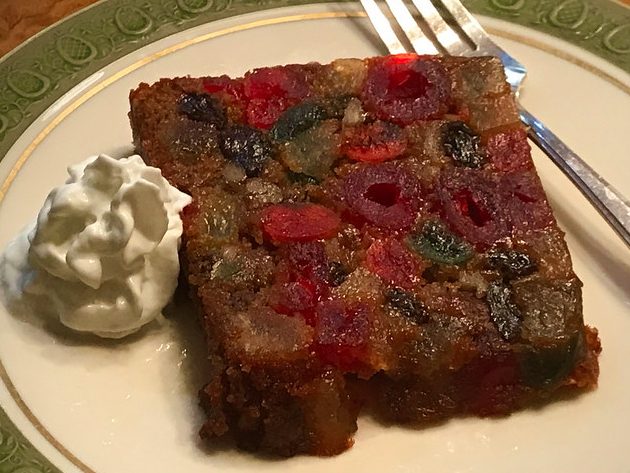
Photo: “National Fruitcake Day” by outdoorPDK is licensed under CC BY-NC-SA 2.0.