Category Archives: Poems

Potcake Poet’s Choice: Jean L. Kreiling, ‘The Waves’

Sprawled on a pew of sand, you meditate
on miracles of tide and time. Without
a prayer but apparently devout,
and humbled by the water’s shifting weight,
you watch with wonder, even venerate
this higher power rolling in and out:
omnipotence too obvious to doubt,
authority too awful to debate.
Like salty spray, some blue-green grace may cling
and seep unsanctified into your soul,
without a psalm or sermon—for the sea
makes its own joyful noise: the breakers ring
uncounted changes, and no church bells toll
more faithfully or irresistibly.

Previously published in 14 by 14. 

Jean L. Kreiling writes: “Growing up on the beach, and living on another coast in adulthood, I have never lost the sense of awe and humility that the sea inspires.  And of course I have never succeeded in capturing its magic in words, but I hope I’ve made a start in this poem.  Its form, my favorite, imposes the sonnet’s graceful structure onto what might otherwise have been an amorphous rhapsody; in addition, its meter and rhyme might suggest a bit of the ocean’s own rhythms and harmonies.”

Jean L. Kreiling is the author of two collections of poetry: Arts & Letters & Love (2018) and The Truth in Dissonance (2014). Her work appears widely in print and online journals, and has been awarded the Able Muse Write Prize, three New England Poetry Club prizes, the Plymouth Poetry Contest prize, and several other honors.  She is Professor Emeritus of Music at Bridgewater State University, and an Associate Poetry Editor for Able Muse: A Review of Poetry, Prose & Art.   

Her poem ‘The Salisbury Crags’ which first appeared in the Orchards Poetry Journal, is included in the ‘Travels and Travails’ Potcake Chapbook.

Songs as poems: Paul Simon, ‘I Know What I Know’

She looked me over and I guess she thought I was all right–
All right in a sort of a limited way for an off-night–
She said, “Don’t I know you from the cinematographer’s party?”
I said, “Who am I to blow against the wind?”

I know what I know
I’ll sing what I said
We come and we go
That’s a thing that I keep in the back of my head

She said, “There’s something about you that really reminds me of money,”
She is the kind of girl who could say things that weren’t that funny
I said, “What does that mean I really remind you of money?”
She said, “Who am I to blow against the wind?”

I know what I know, etc

She moved so easily all I could think of was sunlight
I said, “Aren’t you the woman who was recently given a Fulbright?”
She said, “Don’t I know you from the cinematographer’s party?”
I said, “Who am I to blow against the wind?”

I know what I know, etc

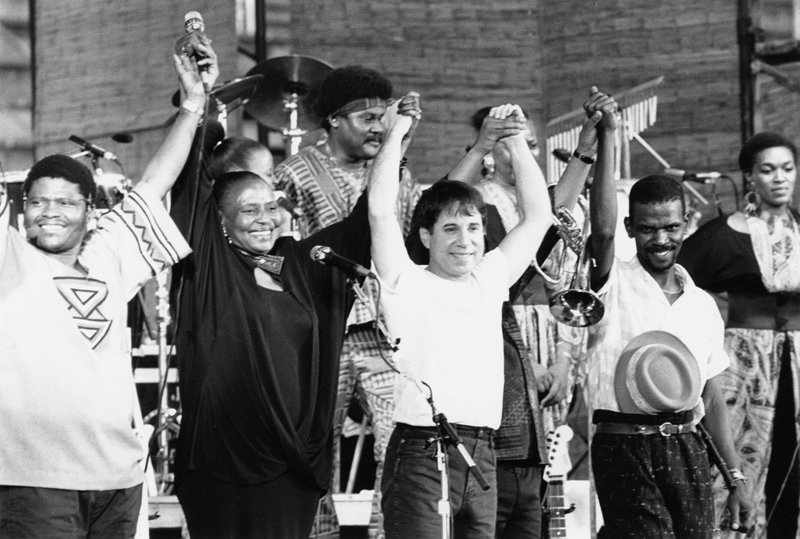
Paul Simon’s 1986 ‘Graceland‘ album is packed full of these little character sketches and snippets of conversation – and all done with rhythm, part-rhyme, and structured repetition in both verse and chorus. The song gives him the right to a repetitive chorus (as well as memorable tune), but he moves away from a traditional song’s full narrative into fragmented images that give a complete impression – here, an upscale event with two people assessing each other’s social and economic status and relationship possibility, as they talk of Fulbright Scholarships and a previous “cinematographer’s party”. It all sounds very New York.

It is a very extensive picture in a few words, leaving the sort of impression you get from an Alice Munro short story. And it is backed by the chorus that appears to verify that the conversation was real, as well as to state Simon’s recognition of how his mind and creativity work. So the song’s structure allows him to enrich the verses’ pictured conversation by stepping back to be more reflective and philosophical in the chorus.

And as it’s a song, he is carried by melody and instrumentation and can be a little free with metre without it being in any way jarring.

I view songs as a branch of formal verse. But in many ways, as shown here, song can easily flex into areas that are less natural for pure verse.

Photo by Luise Gub

Potcake Poet’s Choice: Max Gutmann, ‘Old Growth’

So rooted
seem couples to a child! Firm-trunked and tall.
Some scrawny: sparsely leaved or badly fruited,
but fixed and solid, works of nature all.
It challenges imagination
that choice was part of the creation.

That they,
these halves, weren’t mingled always, childhood fails
to comprehend. The stories of the way
one’s parents met are magic, fairy tales.
To know the seed becomes the tree
does not dispel the mystery.

Divorce,
unless it strikes our parents, flashes where
it cannot burst our faith. A sudden force
that leaves the broken trunks deformed but there,
disaster-stricken, strangely ill,
but giving partial shelter still.

We feel
this all collapse as childhood’s shed. The trees
we thought so firm and fixed were never real.
To navigate by them can only tease.
Whatever fantasies persist,
unmoving couples don’t exist.

To find
one’s half and gather height and leaves are less
like acts of nature than like hiking blind.
Soil shifts and landmarks vanish. We must guess,
our one-time orchard morphing to
a wood no map can guide us through.

Max Gutmann writes: “It took me a long time to make a poem I liked of this thought/experience. The form supports emphasis where it’s helpful, and that it varies from the iambic pentameter some readers expect mirrors the sense. I rarely feel my verse quotable, but I feel that about ‘To know the seed becomes the tree/does not dispel the mystery’.”

Max Gutmann has worked as, among other things, a stage manager, a journalist, a teacher, an editor, a clerk, a factory worker, a community service officer, the business manager of an improv troupe, and a performer in a Daffy Duck costume. Occasionally, he has even earned money writing plays and poems.

‘Old Growth’ was first published in Able Muse. Some of his ‘Travels with Alice’ limericks appear in the Potcake Chapbook ‘Travels and Travails‘. You can find more of his work at maxgutmann.com

Potcake Poet’s Choice: Marcus Bales, ‘Shore’

They grind across the continental shelf,
enormous in their long, well-muscled swells;
I know their sweaty smells of staling spray
and fishy sand; and oh, all by myself
I’ve heard the tide tell what it always tells:
some things wash up and others wash away.

They rise out there a long way from the beach,
and curl and pitch up face down on the sands
from roaming just too far to make it home,
and try to hold with fingers scrabbling, reach
for us, and fail and, failing, trail their hands
under water backwards in the foam.

Finally, though, the greyest weather clears:
small lapping waves replace exploding spume,
and one deep-breathing moment seems sublime;
sweet breezes sway embroidered window sheers
while pleasant sunlight fills the hospice room,
now empty, clean, and ready for the next time.

Marcus Bales writes: ‘The problem with me choosing or talking about one of my poems is that the impetus behind most of them is the same: a phrase or circumstance became a donnee because it resonated in some instant way, and I used it — and sometimes the actual donnee doesn’t survive the process of writing — to write something. It’s the resonance that interests me to turn the phrase over and look at it, clean it up, smear it with something, make it start, make it finish, bury it in the middle, whatever. The question that strikes me about a phrase with resonance is why does it resonate? The poem is the answer. In my view poetry is what a poet does to make a reader feel that resonance by putting it in a context that moves the reader to a feeling. I reject the notion that poetry is the poet expressing their feelings — at least, I don’t say poets cannot express their feelings, but that that expression must be in the service of making the reader feel the reader’s feelings in a directed way. Poetry is a method to make the reader resonate emotionally in response to the words.. If the best you can do is blurt out your pain or joy or whatever, then you’re doing it wrong. Yes, wrong. Write it in your diary, because poetry has never been about the poet. It’s always been about how the poet can make the reader feel in a directed way by using words, not a therapy-substitute for the poet. If you need therapy, get it, but don’t scatter the resulting words across ragged-margined pages and call it poetry.’

Not much is known about Marcus Bales except that he lives and works in Cleveland, Ohio, and that his work has not been published in Poetry or The New Yorker. However his “51 Poems” is available from Amazon.

Marcus Bales has appeared in several of the Potcake Chapbooks:

Tourists and Cannibals
Rogues and Roses
Careers and other Catastrophes
“Strip down,” she ordered
Wordplayful
Murder!
Houses and Homes Forever
Robots and Rockets

all available at https://sampsonlow.co/potcake-chapbooks/ for the price of a coffee.

Potcake Poet’s Choice: Amit Majmudar, ‘Eyespots’

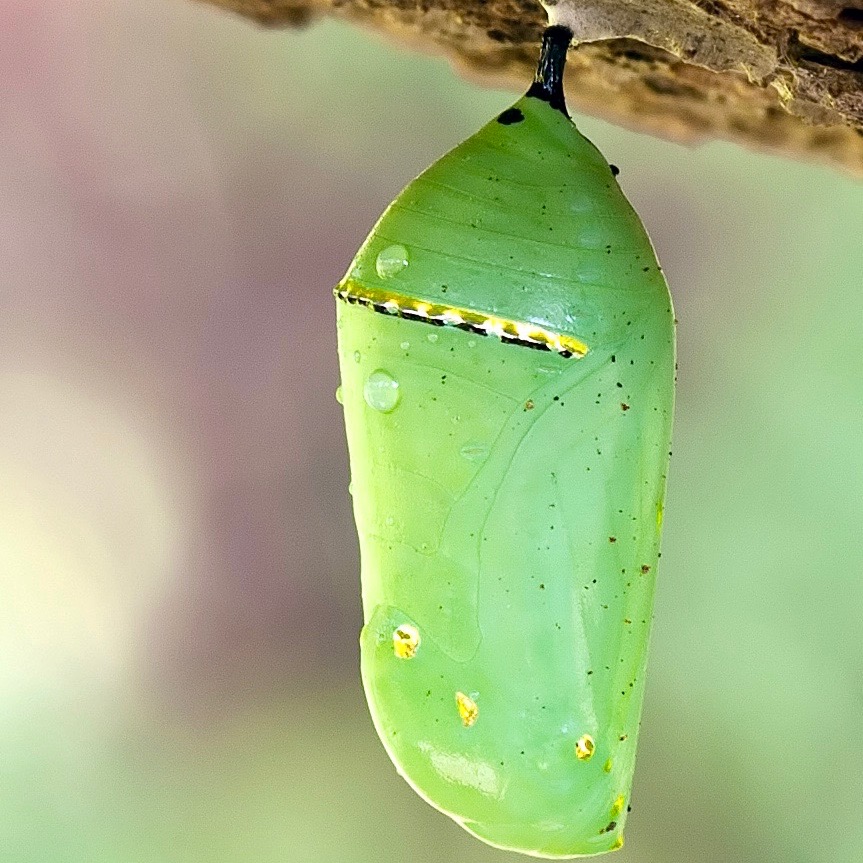
Caterpillars build their bunkers out
of terror. Transformation hunts them, haunts them
as oak leaf peepholes open underfoot
to bare the air, the emptiness that wants them.
I have a measure of infinity
inside me. A is no and mit is measure
in an ancestral tongue that haunts me, hunts me.
I’m half in love with what I have to be.
The other half is looking for a razor
to make of me the Amit who was once me,

my yogi’s beard a clump of Spanish moss
limp at my feet, a piece of furry roadkill.
I’m no ascetic. Half in love with loss,
I’ll seek out beauty, or at least my ode will,
night-blooming jasmines dooming my samadhi,
scenting, resenting my hermetic dark
because they know a yogi, breathing in
his first girlfriend’s perfume, unarchives her body,
and drives her, after dusk, to the vanished park
where memory of sin cocoons the sin.

Caterpillars ravel bunkers into
bodybags—no way for them to know
the moment that they poke themselves a window,
the rebirth they were hiding from will show:
Two stained-glass windows mounted on my back,
two earshaped eyespot petals I can flex
and fold, a flailing that transforms to flight
while all the darkling jasmines that I lack,
past loves that called me onward to the next,
unpetal in the bodybag of night.

In love, or half in love, with mere aesthetics,
I’ve daydreamed Himalayan caves, a hive
that hums with “Aum” from ninety-nine ascetics,
their senses hibernating, half alive.
No one has ever scaled Kailash, the peak
where Shiva sits in bud, in shut-flytrap samadhi
with ashes smeared across his chest and arms.
But that’s just not the changelessness I seek.
I want my language, shapely as a body,
to weave and rive cocoons, enchantments, forms

with giant wings inside their ashgray berries.
I want my transience to live in speech,
if only as a resonance that carries,
like jasmine scent, beyond my voice’s reach.
I tell myself: Old soul, don’t be afraid
of changing. You are old enough to know,
whenever something changes, something dies,
but the dark you flowered in won’t let you fade.
A crack in this cocoon admits a glow.
The blue moon butterfly will wear your eyes.

Amit Majmudar writes: “This poem, ‘Eyespots’, is what I think of as a Keatsian ode, borrowing its stanzaic form and (I hope) something of its musicality. Yet the poem incorporates Hindu religious imagery throughout and sings of self-transformation in a way that isn’t to be found in Keats. This hybridization of Eastern and Western traditions in the poem feels idiosyncratic. There remain elements still opaque to me about it; so I never really delved into the metaphysical significance of the title’s false eyes, these seeming sense organs that are not actually sensing anything, but, given the focus on ascetic imagery, there seems to be something in that. Maybe in another essay? Or another poem….

I feel as though there are poems I have written that someone else could conceivably have written. But not this one; even ignoring that my name hides caterpillar-like inside the cocoon of the poem, I feel that the range of influences and ideas is simply too idiosyncratically “me” for this to have come from any other poet’s hand. Will everyone like it? Probably not, for precisely that reason. But I know that no one else could have produced this sequence of words, so I confess a certain fondness for it. It’s the one of my literary children who most resembles me. And it’s as good a way as any to get to know me as a writer.”

Amit Majmudar is a diagnostic nuclear radiologist who lives in Westerville, Ohio, with his wife and three children. The former first Poet Laureate of Ohio, he is the author of the poetry collections What He Did in Solitary and Dothead among other novels and poetry collections. Awarded the Donald Justice Prize and the Pushcart Prize, Majmudar’s work has appeared in The New York Times, The New Yorker, Best of the Best American Poetry, and the eleventh edition of The Norton Introduction to Literature. Two novels are forthcoming in India in 2022: an historical novel about the 1947 Partition entitled The Map and the Scissors, and a novel for young readers, Heroes the Color of Dust. Visit www.amitmajmudar.com for more details.

‘Eyespots’ was first published in Measure Review.
Poem: ‘Love Poetry’

All the love expressed in poems overtly
Seems so pure they can be taught in schools,
Yet reading lives of all these divine fools
You realise that the impulses
That drove them to express themselves in verse
Include love that repulses
(Differing by era), and was forbidden:
Incest, same sex, underage, interracial,
Interfaith, cross-generational,
BDSM – even a pet, a dog.
Scandalous, and kept hidden,
At worst horrific and at best uncouth –
Yet all identity is just a fog
Of “You, my love”, expressed covertly.
And kids in school are never taught the truth.

Seriously, no one seems to pay any attention to the realities behind the love poetry that is taught and studied in schools. But much of the reason for the admired poem being so forceful is often that the poet was conflicted about being able to express their love at all – gay in a time of homosexual suppression is the one most easily identified now (in Shakespeare, Byron, etc, just as there are similar non-poetic gay passages in the Bible), but any strong but forbidden desire is capable of producing fine art.

This poem is not really formal. It has rhyme and meter but it is unstructured. Semi-formal, then, like much of the best work of Arnold and Eliot. It was published in that edgy, carefree journal the Rat’s Ass Review – thanks, Rick Bates!

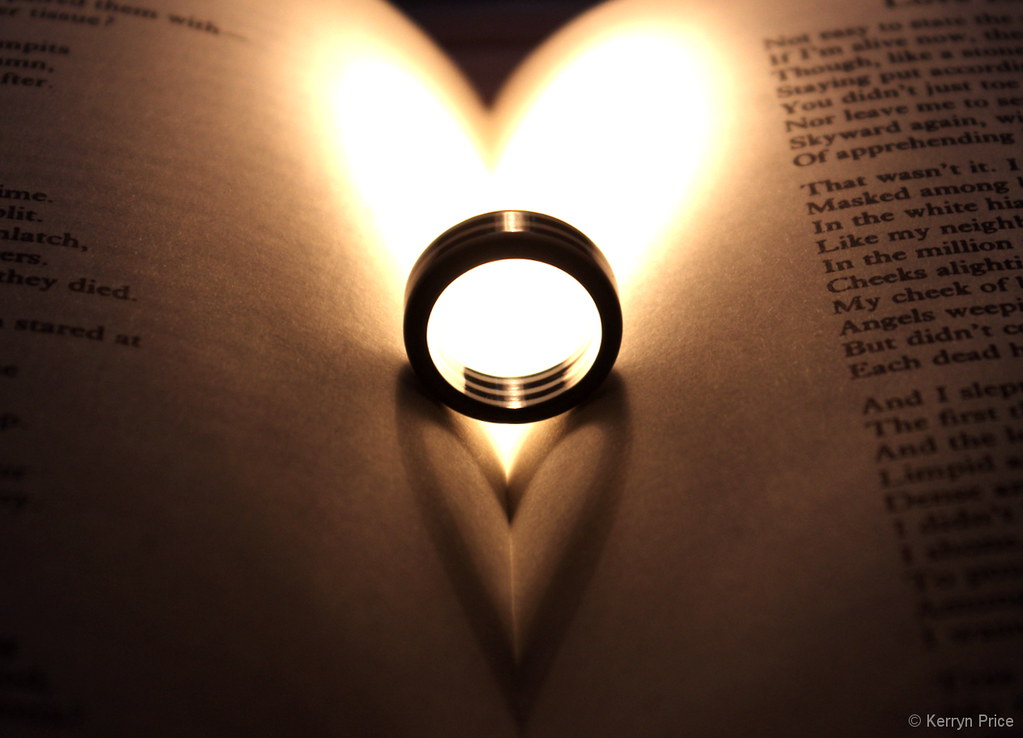
“Love Poetry” by Kez Price is licensed under CC BY 2.0

Sonnet: ‘Fat-shaming’

Gorging on food, an atavistic trait
useful, essential, in the paleolithic–
like a man’s lust for teenage girl as mate–
is one not needed now, shamed as horrific.
It’s healthy, though, to recognise such drives,
note where they came from, why they once were good:
these traits in which the primitive survives,
inbuilt components of our personhood.

It’s acting on them, though, that we deplore:
those who fuck teens and those who overfeed,
like those who steal, or lie, or start a war,
aren’t shamed for primitive desire, but deed–
like those who pray to gods, follow religions,
or skry the future from entrails of pigeons.

It’s not PC these days to even mention various issues, and I seem to have covered a lot of them in this sonnet. But it’s a decent enough Shakespearean sonnet (iambic pentameter, ABAB CDCD EFEF GG, volta between the octave and sestet) and also a good enough expression of an opinion, so what is there to complain about? Originally published in that not-always-comfortable but always formal ‘The Road Not Taken – A Journal of Formal Poetry’. Thanks, Dr. Kathryn Jacobs!

“Young and Fat” by Tobyotter is licensed under CC BY 2.0

Short Poem: ‘Cryo Limerick’

The correct thing to do, when you’re dead,
Is have someone take care of your head;
There’s no chance of more drama
Without Futurama –
Don’t say you weren’t warned – act, instead.

Humans have tried to beat death since forever. Chinese herbs, Egyptian mummification, unlikely (but lucrative) promises of Paradise. In the present rapidly-evolving environment, transhumanism thrives on the ideas of physically and genetically modifying us for a longer life, and cryonics suggests being frozen as an “ambulance to the future” when repairs might be possible. The “head in a jar” image captures the wry appreciation that this stuff may work in the future, but won’t be of any use to us. But so what if the chance of success is a fraction of a percent? That still beats the chances of further life after cremation, or after being processed through the bodies of worms…

This limerick was originally published in ‘Transhumanity‘, edited by James Hughes. Both the magazine and the transhumanist movement have gone through changes of name and state, but the ideas are no longer as far on the fringe as they were a couple of decades ago.

“Futurama…?” by Emanuele Rosso is licensed under CC BY-NC-ND 2.0

Sonnet: ‘The Fall of Rome’

Jesus, a preacher with fake miracles,
his “Sea” of Galilee just eight miles wide–
rebelling against Rome and crucified–
his failure clear (though words were lyrical)…
you’d think “Messiah” was satirical!
But epileptic Paul a chance descried
to shut out other gods and thoughts worldwide,
thus sealing up Rome’s vital spiracles.
So, building on apocalyptic fears,
the Jewish Jesus ends where Paul begins.
Scientists, artists, poets, engineers,
are suffocated as the new faith wins.
All progress is set back a thousand years.
The Roman Empire died for Jesus’ sins.

Belief is strange. Take Covid vaccination: two thirds of us believe it’s an effective way to save lives, one third of us believe it’s a dangerous and unscrupulous way to make money and control people. Virtually no one has actually done any research and analysis of the issue, we just listen to our preferred sources of information and the community we’re a part of.

Or take religion: for the most part, children raised in Christian families remain Christian believers all their lives, Muslims remain Muslim, Buddhists remain Buddhist, and so on. Which makes it all the more impressive when someone can radically change the belief structure that surrounds them. Kudos then to the epileptic Paul of Tarsus, who created a Jewish-Mithraist-polytheist mishmash that has lasted almost 2,000 years. Pity about the Roman Empire, though.

This happily Petrarchan sonnet (iambic pentameter, and rhyming ABBAABBA CDCDCD) was originally published in Rat’s Ass Review, where respectfulness and respectability are not required. Thanks, Roderick Bates!

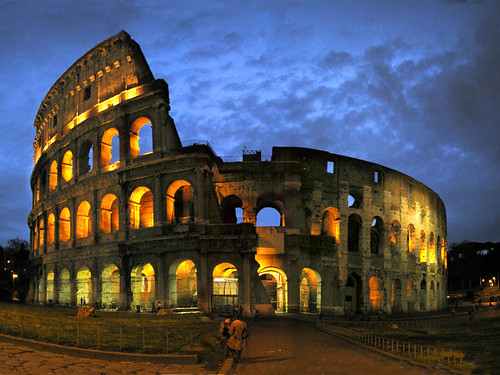
“Darkness Falls in Rome” by Storm Crypt is licensed under CC BY-NC-ND 2.0

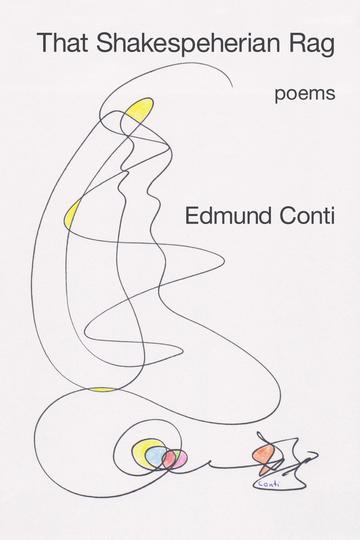
Review: ‘That Shakespeherian Rag’ by Edmund Conti

The problem of being
a 17-year
locust
is trying to stay
for 16 years
focused.

That poem is ‘Short Attention Span’ from Edmund Conti’s latest collection of verse. Originally the title was to be ‘O O O O’ in reference to T.S. Eliot’s lines from The Waste Land where the poet is being criticised by his wife:

“Are you alive, or not? Is there nothing in your head?”
But
O O O O that Shakespeherian rag—
It’s so elegant
So intelligent

It seems that the publishers sensibly preferred a title that would be more comprehensible, without the confusions of O and 0. So the next part of the quote was chosen–still idiosyncratic, but more useful. And, yes, Conti seems to have poetry singing rhythms in his head all the time, and he produces beautiful jazz-like drawings as in the book’s cover.

Both titles for the collection are pure Conti–he has a playful, Zen-like approach to life, highly literate, constantly referencing other writers (and other writers referencing other writers), expecting a level of knowledge and engagement from the reader, and often reducing his expositions to the shortest possible. So this latest volume is full of memories and meditations, jokes and puns, and threaded through with the words of others. Conti divides the book into 11 Shakespearean sections, starting with memories of childhood and youth, and then weaving through reading and writing, books and poetry, his neighbors and family (and their views of his verse), into a closer and closer look at mortality: the last four pieces having respectively four lines, two lines, one line, and nothing.

Conti writes both formal and free verse, depending what kind of playfulness he’s up to. When he parodies Emily Dickinson, of course it’s in her standard ‘The Yellow Rose of Texas’ meter and rhymes ABAB. But he’s a lot more free when he just wants some snide commens and a punchline. Here’s ‘Losing Battle’:

In a final desperate attempt
at survival, the sun sets
fire to the western sky.
Overblown, say my poet friends.
Cute, say my non-poet friends.
What does it mean? asks my neighbor.
How much will you get paid for it?
That’s from my wife.

My father’s an astronaut,
my son lies.

Engaging, amusing, thought-provoking, with many short passages that stay in the memory. A fun book for all poets. Just published this month by Kelsay Books.