Category Archives: Poetry

Poetry Resources: The Lyric

As its website says, “Founded in 1921, The Lyric is the oldest magazine in North America in continuous publication devoted to traditional poetry.” It provided one of the only outlets for serious formal verse on the continent throughout the decades in which formal verse seemed otherwise limited to pop songs, advertising jingles and Burma-Shave roadside signs.

The Lyric poetry magazine

The Lyric Foundation, established in the early 1950s, provides financial support for the magazine as well as for the university education of young poets and care for older ones. The magazine is currently edited by the daughters of formalist poet Leslie Mellichamp – he edited it himself until his death in 2000.

The magazine suffers from being somewhat behind the times. It is hard to imagine that it gets the same richness of submissions as other outlets, when it is resolutely old-fashioned in management as well as themes. “Email submissions are only accepted from out of country.”  The tone of the printed work is consequently less varied and dynamic than other formalist and formal-friendly magazines. Even the Foundation that supports it is hard to learn about and, as far as I can tell, has no website.

However The Lyric remains a good resource for new poets, as well as more established ones, to place their work in if it falls within the lyric tradition. And with almost a century of publication behind it, there is hope that it will survive and thrive indefinitely.

Poetry Resources: Snakeskin

Probably the oldest continuously published poetry zine on the web – possibly the oldest literary zine of any type – is Snakeskin, published monthly by George Simmers since December 1995.

George Simmers

George Simmers, editor of Snakeskin

There are many unique aspects to Snakeskin, including in the archives:

  • the pervasive wit and humour, tolerantly secular, expressed in the zine’s name from the first issue with Wayne Carvosso’s poem “Credo” – “we are the kindred of the snake.”
  • a long interview of George conducted by Helena Nelson, entirely in iambic pentameter (for George is a skilled and fluent poet, though he rarely publishes in Snakeskin these days)
  • projects and experiments, including various hypertexts
  • and a standard feature for the past several years, Bruce Bentzman’s blog-like soliloquies, or essays – a very sensitive and deeply emotional journey.

But what is particularly nice for poets is that George has no interest in names, reputations or bios – he just reads the poems, and chooses what takes his fancy. Very few of the issues are themed in advance, but they may reflect his mood or the time of year or whatever, and end up with a mood of their own.

And, despite what the Credo states —

“Nor shall we sit to lunch with those
Who moralise in semi-prose.
A poem should be rich as cake,
Say the kindred of the snake” —

George takes any form or lack of form, so long as the piece works for him. This may reflect the tolerance of someone who had a career as a teacher; or it may reflect the Yorkshireman’s well-known preference for the practical over mere theory. In either case, it presents a wonderful opportunity for a new poet to break into publication in an internationally recognised magazine.

Read an issue or two – there’s something for everyone!

Formal launch! Potcake Chapbooks 1 & 2

The first two chapbooks in Sampson Low’s Potcake series are up and running! Not only that, but they have already made it into the Official UK Chapbook Chart, with one of them at No.1 for two weeks in a row. And I was going to try to make it as easy as possible for you to buy a copy… they’re not expensive, about the cost of a fancy greeting card, and easily mailed as they weigh less than an ounce.

Hey Potcake, wanna buy a chapbook...

Hey Potcake! Wanna buy a chapbook?

However, the problem is that they are too inexpensive! It simply isn’t worth this blog paying all the fees to upgrade to business class in order to have a Paypal button, or to pay Amazon’s monthly fees or initiation fees or fulfilment fees or sales commissions or whatever else, in order to make them easily available in North America.

So we will treat this a formal launch… and you’ll just have to go to that Sampson Low website and put your order in there. Don’t worry, it’ll be mailed right away. Just be glad you’re not trying to do things through the Bahamas post office, where domestic mail takes 1-3 months, and international takes up to a year…

And with “Tourists and Cannibals” and “Rogues and Roses” up and running, the next two in the series are now in preparation. Expect “Careers and Other Catastrophes” and “Families and Other Fiascoes” in the beginning of the year, with many of the earlier poets reappearing but supplemented by many others joining us for the first time. And, of course, with Alban Low’s illustrations.

The series is joyful, lighthearted, and already popular!

Using form to convince: Poem: “Conviction”

Verse has magical powers to engage the minds of its audience and, through that engagement, sway opinions and change attitudes. This is more than the tricks that make it easy to learn verse. It is more than Coleridge’s “Prose: words in their best order; poetry: the best words in the best order.” It is that poets and singers chant, and enchant. The musician chants, the magician chants, if it is well done it creates enchantment. It changes moods, it changes minds. It is used by all religions, all football teams, all angry mobs, and all gentle singers of lullabyes. The fact of the idea being expressed in verse is used as unspoken proof of the idea’s appropriateness.

Chanting

Poetry in motion

In my last post I said that “rhyme can be used to create a sense of inevitability”. Let me explain:

CONVICTION

True verse has a rhythmic twitch
that needs ongoing action.
Rhyme’s an open pattern which
asks for satisfaction.
Give the right words, strong and bright,
and the listener knows “That’s right!”

Conviction carries over, bought
with the words expressed.
The listener believes the thought
because it came well dressed.
Give the right words, strong and bright,
and the listener knows “That’s right!”

In other words, because the words sound right (in meter and in rhyme), our minds are prepared to accept that their meaning is right, their argument is valid. As O’Shaughnessy wrote,

“With wonderful deathless ditties
We build up the world’s great cities
(…)
And three with a new song’s measure
Can trample a kingdom down.”

And that is why Shelley was able to claim that “poets are the unacknowledged legislators of the world”. Poets everywhere agree!

Using form for argument: Poem: “To Myself in 50 Years Time”

Arguing a point has a structure, which tricks of rhetoric can enhance. Additional tricks of reinforcement are possible in verse, where meter can set a tone, rhyme scheme can create a sense of inevitability, and line length can be used to differentiate between premises and conclusion.

Ageing Man in Mirror

TO MYSELF IN 50 YEARS TIME

Old fool! You really think yourself the same
As I who write to you, aged 22?
Ha! All we’ve got in common is my name:
I’ll wear it out, throw it away,
You’ll pick it up some other day….
But who are you?

My life’s before me; can you say the same?
I choose its how and why and when and who.
I’ll choose the rules by which we play the game;
I may choose wrong, it’s not denied,
But by my choice you must abide….
What choice have you?

If, bored, I think one day to see the world
I pack that day and fly out on the next.
My choice to wander, or to sit home-curled;
Each place has friends, good fun, good food,
But you sit toothless, silent, rude….
And undersexed!

Cares and regrets of loss can go to hell:
You sort them out with Reason’s time-worn tool.
Today’s superb; tomorrow looks as well:
The word “tomorrow” is a thrill,
I’ll make of mine just what I will….
What’s yours, old fool?

(First published in Snakeskin No. 147, September 2008)

Each stanza presents an aspect of the superiority of present youth over future age. (Premise and conclusion aren’t necessarily made as statements, many times rhetorical questions are used instead.) The structure of each stanza is to begin with pentameters for a sense of reasonableness in the first three lines, pick up the pace for the next two lines, and end with a short punchline. I find it aggressive and effective.

I admire the chutzpah, the audacity, of the 22-year-old I was. I still have some years–not many–to think of a suitable answer.

Poetry Resources: Better Than Starbucks

BTS logoBetter Than Starbucks (BTS) is a literary magazine that all poets should be aware of because of its enormous and well-structured diversity. Apart from several types of poetry, it also has some short fiction and creative non-fiction.

It has (currently) eight separate poetry sections with a variety of editors, covering such areas as Free Verse, Haiku, African Poetry and, of most interest to me, Formal & Rhyming Poetry edited by Vera Ignatowitsch.

The poets who show up in the formal section vary from issue to issue, but the range of poetry is always impressive: you can expect to find a couple of lighthearted limericks, a couple of serious sonnets, and a few lyrical poems in nonce forms.

Of particular interest to active poets is that BTS will take previously published as well as fresh work. This allows the poet to republish their strongest individual pieces and gain a wider audience for them; and the magazine gets to publish the best of the poet’s work, not necessarily their most recent (or hardest to place). For the reader, too, it means that the standard of work is higher than usual.

My own work has been published or republished in BTS several times, and I was lucky enough with the current (November 2018) edition to have two poems in the Formal & Rhyming section, and one in Free Verse, and two in International Poetry. (I haven’t achieved such a trifecta before, and don’t expect to again. So now is obviously the right time for this blog post… even if I am confessing to writing Free Verse. Sort of.)

Better Than Starbucks is a very good-looking magazine. It now comes out every two months in both hard and soft copy. Strongly recommended.

Poetry Resources: Measure for Measure anthology

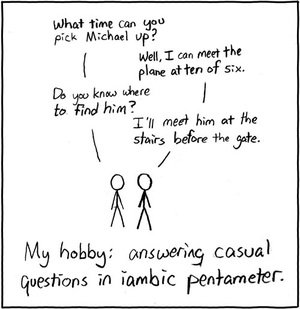
xkcd iambic pentameter

xkcd – another engaging commentator

The ‘Measure for Measure’ anthology clarifies and extols the delights of the variety of metres available to the poet, from the accentual verse of our Anglo-Saxon roots, through the familiar and natural iambs, dactyls and trochees, to the more obscure sapphics and so on based on Greek and Latin forms.

The book is edited by Annie Finch and Alexandra Oliver, two of the most accomplished formal poets of North America writing today. The preface by Annie Finch and the introductions to the various sections include encouraging exercises for developing skills in both reading and writing poetry, and the tone of the anthology is more expository than a mere collection of poems would be.

The selections for each metre are enjoyable in themselves, and by being grouped in that way they drive a fresh awareness and insight into their nature. The only negative for me came towards the very end, where the section on Sapphics and Alcaics confirmed for me that they are not really relevant for English verse.

Overall, an extremely interesting and informative anthology.

Poetry of Louis MacNeice

Louis MacNeice wrote one perfect poem, “The Sunlight on the Garden”. Insightful, wistful, tightly rhymed in a pattern maintained for four stanzas, easy to memorise, it is frequently anthologised and rightly so:

Louis MacNeice, Selected Poems

The sunlight on the garden
Hardens and grows cold,
We cannot cage the minute
Within its nets of gold,
When all is told
We cannot ask for pardon.

Others of his poems are easy to find, “Bagpipe Music”, “The Truisms”, and so on. They and a lot more, including good excerpts from his longer works, are in this excellent selection.

The similarity of much of his work to Auden is clear (for example in “Postscript to Iceland” after their shared journey there), but the thing that intrigued me unexpectedly was the similarity to the poems of T.H. White. The Irish background, English education, writing of cities and countrysides and cultures of both places, the being in Ireland at the outbreak of World War II… the rhyming, the frequently loose structures, the general tone of many of the character sketches… all those aspects of White’s “A Joy Proposed” echoed as I read MacNeice.

MacNeice, however, is without question the superior poet. After all, he wrote one of the most elegant poems in the English language.

Using form for fun: “Auntie’s Model Niece”

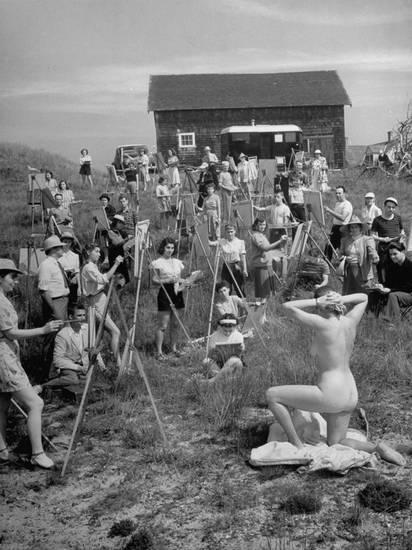
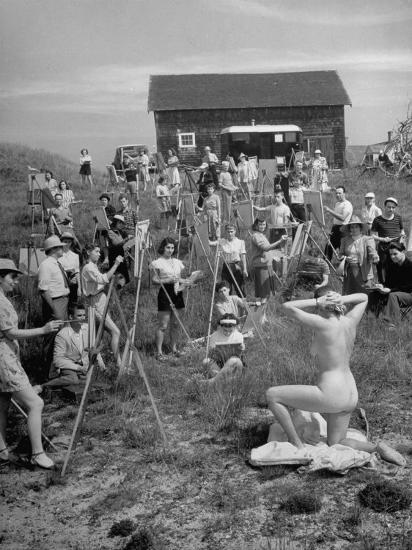
Image result for art school model

Posing bare

AUNTIE’S MODEL NIECE


Auntie got her
Maid to knit a
Set of under-
Wear,

For my frozen
Sister Flo’s end
That was posing
Bare;

Flo then wore ’em
With decorum
And she swore ’em
Grand,

Undismayed by
Undies made by
Auntie’s maid by
Hand!

First published in Snakeskin, republished in The HyperTexts, this poem has been a family favourite. It shows some of the strengths of form: a playful form suits a playful idea, and simple structure and heavy rhyme make the poem easy to learn by heart.

Using Form: Sonnet: “The Squirrel in the Attic of his Brain”

Sometimes when you get the first idea for a poem with a line or so, such as “The squirrel in the attic of his brain / Shreds photographs and memories”, and the very nature of the idea leads to a long straggly exposition.

Image result for papers in a mess

Papers in the attic

If a squirrel is in his brain destroying his memories… and if he is an old house, of which his brain is the attic… then what other creatures might there be in the house? What other parts of the body might be represented by creatures? Can we get all the way from the hair to the toenails?

Here is how the rest of the squirrel poem worked out–it took a few months, the last image to make it into a sonnet coming while I was in the dentist’s chair having a root canal. You can guess which line that was.

THE SQUIRREL IN THE ATTIC OF HIS BRAIN

The squirrel in the attic of his brain
Shreds photographs, pulls memories apart;
The old dog in the basement of his heart
Howls, lonely, soft, monotonous as rain;
And somewhere further underneath, a snake
In hibernation stirs, irked by its skin.
Up where the world’s news and supplies come in
Through the five senses of his face, to make
The room in which a garrulous parrot squawks
And sometimes songbirds sing – it’s his belief
Mice gnaw behind the wainscots of his teeth.
The cat of consciousness, impassive, walks
Towards the door to go out for the night:
Is everything (oh dog, shut up!) all right?

The sonnet is useful for imposing order. Initial long thoughts get compressed into quatrains or couplets, long lines get compressed into pentameters. And then the search for a rhyme triggers an additional related thought or image, and it has to get squeezed in, which means unnecessary words get squeezed out. And hopefully you end up with something that feels both rich and compact.

The two most traditional forms of the sonnet are the Italian or Petrarchan, and the Shakespearean. The former lays out a position, argument or question in the first eight lines, the octave, rhyming ABBA ABBA; and then makes a turn or volta to provide a resolution in the last six lines, the sestet, rhyming CDE CDE. Shakespeare popularised a sonnet structure of three quatrains (ABAB CDCD EFEF) to lay out a position, with the volta coming for the final couplet, GG.

There is a lot to be said for following those formal sonnet structures, because their rhyme schemes support a clarity of exposition of thought. But people frequently allow themselves unconventional rhyme schemes in order to achieve the meaning they want in the poem. And from more varied rhyme schemes, you can easily move to more varied line lengths, or shifting metre, or a different number of lines–yet still call it a sonnet. Merrill Moore, an American psychiatrist and poet, used loose sonnet-like structures to write down his observations several times during the day. He wrote thousands of poems a year, which, though rarely meeting strict definitions of formal verse, all have a sonnet feel to them.

So you can feel comfortable with sonnets which adhere to the sonnet concept, but use a non-iambic metre, or maintain four feet to the line, or six feet, or use a different rhyme scheme, and so on. I think the metre should still be regular, and there should be solid rhyme, for the poem to be labeled a sonnet. The sonnet above doesn’t adhere strictly to either the Petrarchan or Shakespearean format, but uses a mixture of them. Although I like it, it fails to achieve their true elegance.