Category Archives: Poetry

Marcus Bales, ‘This Be The Verse’

Post this, post that, post-modernists –
   Denying narrative’s cabal.
The story that they tell insists
   It’s not a story after all.

New Criticism made them see
   That reading closely what was said
Meant cutting off biography,  
   And authors might as well be dead.

Like raisin oatmeal cookies, picked
   In hopes of chocolate chip, they bust
Your faith in how things seem. You’re tricked
   To only trust in doubting trust.

Without the person or the text,
   No human mind, no human heart,
I guess we know what’s coming next:
   Let the AIs do the art.

*****

Marcus Bales writes: “This is one of what I call my habitual poems. I have a perfectly good stand-alone idea, and start to work on it, but the parody turntable in my head takes over and the needle slides down into the groove and instead of stealing only the world-weary and faintly snarky Larkin tone it turns out I steal the whole poem. 

I have a file of these to be revised away from parody and into something that is less parodic, or at least less immediately noticeable as theft. 

The problem is I’m lazy about this stuff. There is a straightforward tradition of doing these kinds of parodicish things in song, called ‘filks’, and I’ve done some of them. It’s carried over into the same sort of thing in poems. The groove is there, the tonality is familiar, the original is familiar, and like the soap coming out of your hand in the shower, clunk, it hits the floor. 

So, since Robin asked me to write this, I’ve got a revised version for you. It loses some of the immediacy of Larkin’s opening, of course, but I’ll bet if you hadn’t got that in your head associated with this one first, this second version would only have marked a faint echo — and you might not of noticed how Larkinesque it is at all.”

Editor’s note: Bales revised the first and fifth lines; the originals read:
They fuck you up, post-modernists,
(…)
But others fucked them up to see

Hence his Larkin references.

Not much is known about Marcus Bales except that he lives and works in Cleveland, Ohio, and that his work has not been published in Poetry or The New Yorker. However his ‘51 Poems‘ is available from Amazon. He has been published in several of the Potcake Chapbooks (‘Form in Formless Times’).

Photo: “Post-Modern Urinal” by ~MVI~ (warped) is licensed under CC BY 2.0.

Using form: Ottava Rima: Max Gutmann, ‘Conscious Agents’ (from Don Juan Finish’d)

You sages aren’t surpris’d to learn that cowardice
Is courage. Truths illumine and conceal.
The dulcet affirmation and the sour diss
Can equally be true. That’s no big deal.
The world is full of paradox — and now word is
That even space and time may not be real.
We only think we see and smell and touch things.
The “world” is like, say, Donkey Kong and such things.

It’s all just icons on an interface:
The sound of rain, that contract you just sign’d,
The microbe on a slide, the feel of lace,
The smell of skunks, the corner you were fined
For parking at, your arm, the very space
You (think you) move through — products of your mind.
And even little quarks, atomic particles,
Are not, as thought, the fundamental articles.

No, “conscious agents” are what’s fundamental.
The theory says it’s they and they alone
We’re sure of. Space? Time? Objects? Incidental.
They hint at some reality unknown.
The dawn, the dung, the breeze, the brain, the lentil:
In all of these, our faith is overblown.
Those conscious agents compass us and we
Create those things — though not, um, consciously.

*****

Max Gutmann writes: “Don Juan Finish’d fancifully completes Lord Byron’s unfinished comic epic. Excerpts have been contributed to LightLighten Up Online, Orbis, Slant, Think, the website of the Byron Society, and Pulsebeat, where ‘Conscious Agents’ is among the excerpts to have appeared. Formalverse has also reprinted another excerpt. ‘Conscious Agents’ is part of a digression from the plot, digression being an aspect of Byron’s epic mimicked in Don Juan Finish’d.”

Max Gutmann has contributed to dozens of publications including New StatesmanAble Muse, and Cricket. His plays have appeared throughout the U.S. and have been well-reviewed (see maxgutmann.com). His book There Was a Young Girl from Verona sold several copies.

Photo: “Consciousness Awakening on Vimeo by Ralph Buckley” by Ralph Buckley is licensed under CC BY-SA 2.0.

Using form: alliteration: RHL, ‘How Brashly Brave’

How brashly brave, embroiled in this brief life,
we chance our challenge to the unchanging gods!
Strike poses, strut the strident stage of strife,
take optimistic oaths against all odds.

Fearless of foes, false friends, futility,
we wrack our reason to reach, undestroyed—
though usually of no utility—
a burst of brightness bettering the void.

*****

Although I prefer to maintain an unobtrusive persona myself, I subscribe to this philosophy of bravado existentialism. The florid alliteration suits the message.

This poem is published in the current issue of Light – thanks, Melissa Balmain and all.

Photo: “Flamboyant Emperor of the United States” by PeterThoeny is licensed under CC BY-NC-SA 2.0.

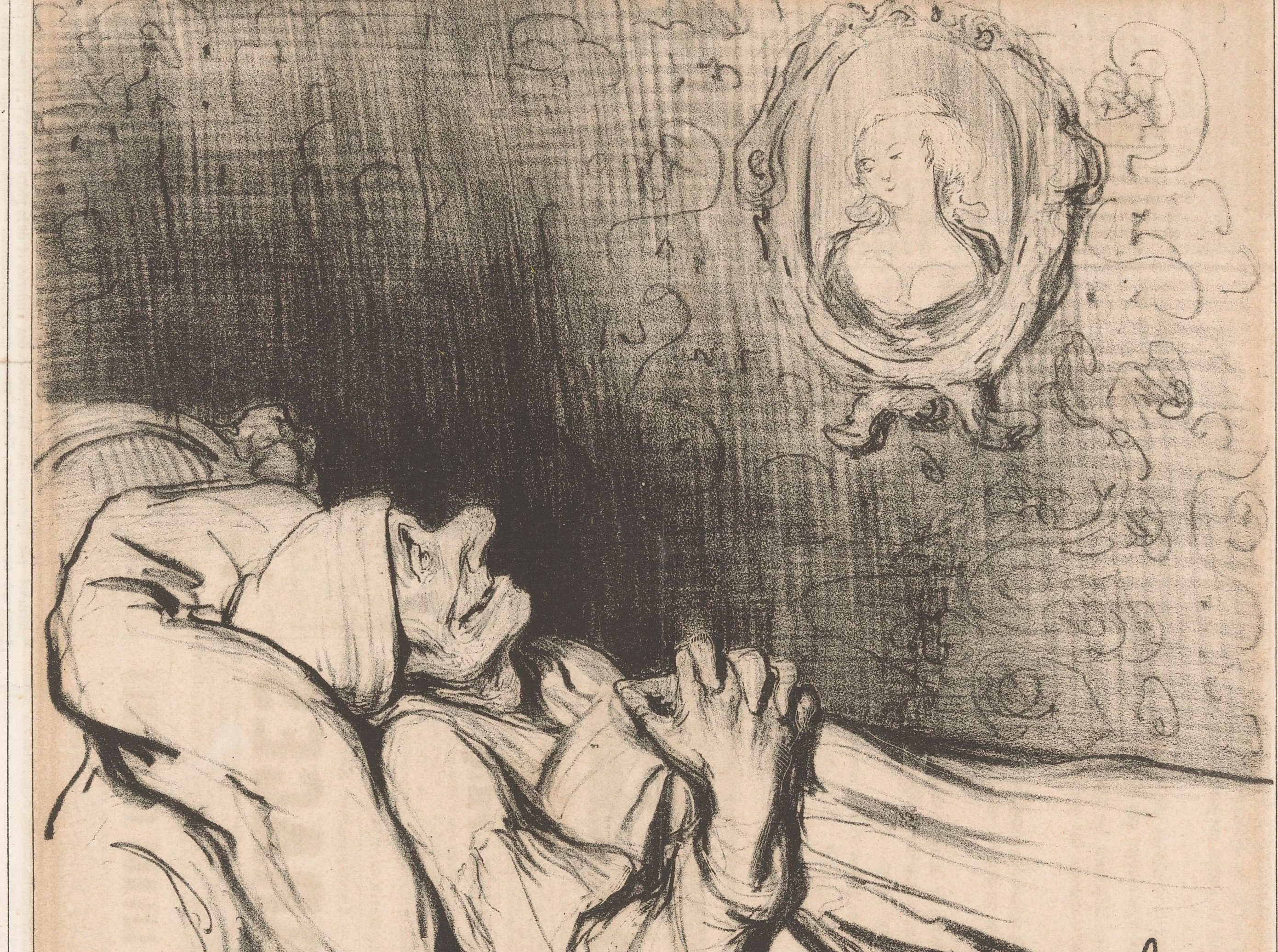
Sonnet: Helena Nelson, ‘Dream’

I found myself in bed with an old man.
His beard was silvery, his scrawny chest
a rack of ribs, his loose-lipped mouth open
and toothless as a baby. There he was,
there in our bed, as if he owned the place.
He snored and grunted like some ancient king
asleep after a banquet. But what feast
had led, dear heart, to this? What partying?
He turned his head to me. I saw his face—
a travesty. Some metamorphosis
had happened in our sleep, my love replaced
by a bag of windy bones. I need a piss,
he muttered, and got up. O then I knew
what age had done to us, and who was who.

*****

Helena Nelson writes: “Everyone experiences it eventually. You glance at your own reflection in the mirror and get a shock at how old you look. So that’s one of inspirations for this poem. The other spur to write this was a dream I had one night, though in the poem it’s intentionally unclear whether the experience is or isn’t real. I started with near rhymes in the octet and moved towards perfect rhyme at the end to convey the shock. I do hope the reader feels that shock at the end.” 

‘Dream’ was originally published in The Dark Horse.

Helena Nelson runs HappenStance Press (now winding down) and also writes poems, one of which appears in the Potcake Chapbook, ‘Lost Love’. Her most recent collection is Pearls (The Complete Mr and Mrs Philpott Poems). She reviews widely and is Consulting Editor for The Friday Poem.

Using form: SF sonnet: RHL, ‘On a Dead Spaceship’

On a dead spaceship drifting round a star,
the trapped inhabitants are born and die.
The engineers’ broad privileges lie
in engine room and solar panel power.
The fruit and vegetables and protein co-ops
are run by farmers with genetics skills:
the products of their dirt and careful kills
help service trade between the several groups.
Others — musicians, architects — can skip
along the paths of interlinking webs.
Beyond these gated pods that the rich carve
for their own selves (but still within the ship),
in useless parts, are born the lackluck plebs.
Heard but ignored, they just hunt rats or starve.

*****

This sonnet was republished in Bewildering Stories in April 2024 – original publication had been in Star*Line five years previously. I find something very satisfying about using a formal sonnet structure to express science fiction and speculative fiction ideas – the ideas are by nature open-ended, unconstrained, and it feels good to tie them down as in a neat package with a bow on top. Topiary.

As for what political comments can be read into the poem, read away!

Photo: “Deepstar 2071 at Io” by FlyingSinger is licensed under CC BY 2.0.

Melissa Balmain, ‘Notes From a Jaded Traveler’

I dreamed I went to Heaven–
it wasn’t all that great.
The angel choir was tone deaf;
its harps were second rate.
St. Pete was glumly scrubbing
the bird shit off one gate.

I dreamed I went to Hell next–
it wasn’t all that grim.
I’d felt worse heat in Brooklyn,
worse torture at the gym;
Satan and his minions
were belting out a hymn.

I dreamed that neither visit
surprised me much–oh sure,
the Bible promised plenty
that wasn’t on my tour,
but what location ever
lives up to its brochure?

*****

From Walking in on People © Melissa Balmain, 2014. Used by permission of Able Muse Press.

Melissa Balmain writes: “This poem, first published in Light Quarterly (now Light), sparked one of my rare disagreements with LQ‘s founding editor, John Mella. He balked at the term “bird shit.” It might offend older readers, he said, and he asked for a substitute. This led to the following message, which is undoubtedly the sort of high-toned correspondence that poetry readers imagine happening behind the scenes:

Dear John,
Thanks for your latest note on “Notes from a Jaded Traveler.” I think we may have had a communication glitch—my preference is “bird doo,” not “doo-doo.” I agree with you that the latter does smack of the nursery. Plus, it doesn’t make the bird connection clear.
“Bird doo” is a fairly common expression—a Google search of the term yields more references than “bird poop.” But the main reason I prefer it to “bird poop” is that—at least among parents I know—“poop” is the nursery term for diaper contents.
So… if “bird shit” is out, I vote for “bird doo.”
All best,

Melissa

John went with “bird doo.”  When ‘Notes from a Jaded Traveler’ ran in my first collection, I finally got to change it back.”

Melissa Balmain’s third poetry collection, Satan Talks to His Therapist, is available from Paul Dry Books (and from all the usual retail empires). Balmain is the editor-in-chief of Light, America’s longest-running journal of light verse, and has been a member of the University of Rochester’s English Department since 2010. She will teach a three-day workshop on comic poetry at the Poetry by the Sea conference in Madison, CT, in May 21-24, 2024.

Photo: “Life’s Trail” by quinn.anya is licensed under CC BY-SA 2.0.

Using form: Sonnet: Max Gutmann, ‘How to Inspire a Sonnet – advice from the pros’

Inspire amore first, but molto forte
If in sonetti dolci you’d be sung.
Then see that you stay bella. You’ll support a
Passione deep and long by dying young.
— Laura

If thou upon his stage the Muse’s part
Wouldst play, each act thou study’st must prolong
Thy Poet’s pain. ‘Tis pain shall prompt great Art.
Then con thy lines with style, and do him wrong.
— The Dark Lady

Stay always by her. Never for a day
Be from her cherished side. ‘Tis paramount
To share the highest love. (And, by the way,
It helps to choose a lover who can count.)
— Robert Browning

‘Tis mystery that fires the crucial spark,
So make him wait–and keep him in the dark.
— Milton’s blindness

*****

Max Gutmann writes: “A reader of Light Quarterly (the marvellous Light back in its days as a print journal) was so offended by a poem of mine ridiculing a lousy president that he cancelled his subscription. Beloved editor John Mella forwarded a copy of the note to me. It was a sonnet! I’d never thought I could inspire a sonnet. I had a ways to go before rivaling Laura or the Dark Lady, but I’d taken the first step. That inspired this poem.

“John declined the poem, so it first appeared in a journal that didn’t specialize in light verse, one highly thought of. (Digging it out now, I see that contributors to the issue the poem appeared in included, among others I admire, Updike, Espaillat, Turner, Gioia, and Hadas.) But the journal goofed. They changed sonnetti dolci to sonnetti dolce (plural noun, singular adjective). This must have been a typo, I imagined, but when I asked, the chief editor not only admitted the change had been intentional, but defended the decision. Dolce being the more familiar form, he argued, it was reasonable to make the change without consulting the writer. I never sent them anything again

“This story calls for a shout-out to Jerome Betts, who reprinted ‘How to Inspire a Sonnet’ in Lighten Up Online (LUPO). (To avoid the impression that Jerome is less than meticulous about acknowledgements–or about anything–I should make clear that I asked him not to acknowledge the earlier journal, and I didn’t name it for him.) Jerome, like most editors I’ve worked with, always asks before making changes–and his proposed changes are usually improvements, often big ones!”

Editor’s note: This poem suggests what might be appropriate ways to inspire sonnets, according to the subjects of sonnets: Petrarch’s Laura, Shakespeare’s Dark Lady, Elizabeth Barrett Browning’s Robert and Milton’s blindness. Self-referentially, the poem is itself a Shakespearean sonnet, written in response to being the subject of a sonnet. Gutmann is therefore both sonneteer and sonnetee, and has the credentials to write a “How to –“

Max Gutmann has worked as, among other things, a stage manager, a journalist, a teacher, an editor, a clerk, a factory worker, a community service officer, the business manager of an improv troupe, and a performer in a Daffy Duck costume. Occasionally, he has even earned money writing plays and poems.

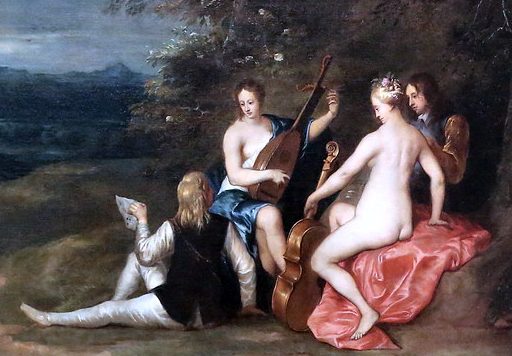
Photo: “IMG_0323C Frans Wouters. 1612-1659. Antwerp. The rural concert. 1654. Dole” by jean louis mazieres is licensed under CC BY-NC-SA 2.0.

Using form: simple, classical: Sara Teasdale, ‘May Day’

A delicate fabric of bird song
Floats in the air,
The smell of wet wild earth
Is everywhere.

Red small leaves of the maple
Are clenched like a hand,
Like girls at their first communion
The pear trees stand.

Oh I must pass nothing by
Without loving it much,
The raindrop try with my lips,
The grass with my touch;

For how can I be sure
I shall see again
The world on the first of May
Shining after the rain?

*****

Sometimes clean and simple is best for capturing the uncomplicated emotion of appreciating nature. Sara Teasdale in her element. As Louis Untermeyer commented on her verse: its “beauty is in the restraint” of its “ever-present though never elaborated theme.”

Photo: “Leonardslee Lakes and Gardens May 2022 18” by Timelapsed is licensed under CC BY-NC 2.0.

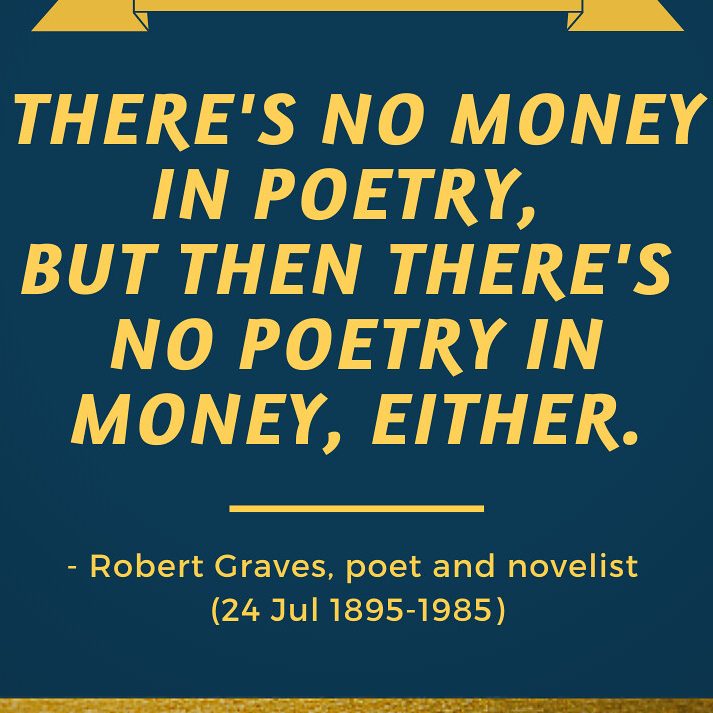
Donald Wheelock, ‘Worthless’

What a worthless thing is poetry,
a product of hard labor I adore;
a counter full of year-old toiletries
will always fetch considerably more.

A merchant selling gift-wrapped bars of soap
will come away with profit and some change;
to sell a poem is no more than a hope
washed clean of what a market can arrange.

Here! Have a few of mine, two for a quarter—
a dime apiece—the bargain of the day…
just name it! I’m here to take your order.
Hard labor’s even hard to give away.

*****

Donald Wheelock writes: “I have spent most of my life as a composer of vocal, orchestral and chamber music. While remuneration for song cycles and string quartets is not unknown, the profits from commissions and other sources rarely exceed the expenses. I don’t have to tell the readers of formalverse that the same could be said for formal poetry. The conceit of this poem has been an assumption in my life for many years, and equivalent jokes among composers of “classical concert music” are not uncommon.

I have written formal poetry for almost as long as I have music, often to set to music. But it is relatively recently that I have submitted it to journals welcoming formal poetry. Snakeskin (where this poem was first published), Able Muse, Think, Blue Unicorn, Rue Scribe, Quadrant and many other journals have published my poems. My first full-length book, It’s Hard Enough to Flywas published by Kelsay Books in 2022. My second book, With Nothing but a Nod, will appear in May of this year from David Robert Books.”

Photo: “A THOUGHT FOR TODAY from A.Word.A.Day” by Wordsmith.org is licensed under CC BY-NC-SA 2.0.

Using form: Limericks: RHL, ‘Attitudes in the Holy Land’

Moses says God says: (Deuteronomy 20:16-18)

God’s ruthless. Just read Deuteronomy,
believers get zero autonomy:
“You must kill all non-Jews
in this land that I choose.”
Just back then? Or still now? (Love His bonhomie!)

Luke says Jesus says: (Luke 19:27)

Christ was often less peaceful than stormy,
with disciples both pushy and swarmy;
to the rest he made plain
if they’d not have him reign:
“Bring them hither and slay them before me.”

Muhammad says God says: (Qur’an 9:5)

“Polytheists, wherever you find them,
you should ambush and capture and bind them,
and only relax
if they pray and pay tax;
elsewise kill them, and in the dust grind them.”

*****

Given that Jews, Christians and Muslims all claim to be worshipping the same god, the only God, the God of Abraham, it’s somewhat surprising how much time they spend fighting each other. But then, factions within the same religion have been known to slaughter each other. It seems to be something inherent in religions, especially monotheistic ones – if you believe there is only one god, your god, then everyone else’s belief is blasphemy.

Somehow these tribal religions of preliterate herders have continued to the present. They are so illogical and – despite beautiful architecture etc – so frequently violent that the best response I can think of is the mockery of limericks and other forms of light verse. That, and mourning the dead children, and supporting efforts to impose peace.

These limericks were first published in The HyperTexts, Michael R. Burch’s enormous anthology which includes extensive poetry about both the Holocaust and the Nakba, the Palestinian Catastrophe.

Moses causes the Levites to kill the idolators” is marked with Public Domain Mark 1.0.