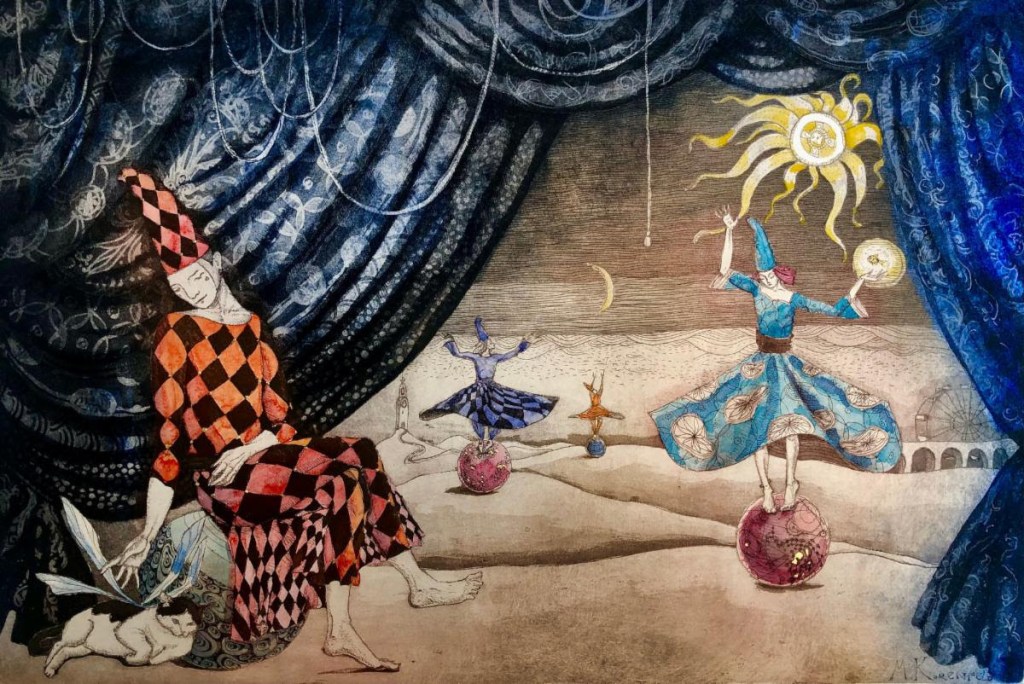
Lee Evans, ‘Late in the Evening’

The more she strained her mother wit
To put the jigsaw into place,
The more the pieces wouldn’t fit.
 
Too bad the cat had felt the need
To leap into the midst of things—
The puzzle would have been complete.
 
Somehow she had misplaced the lid,
Which had a picture stamped on it
Of what she searched for in her head.
 
The work lay spread in front of her;
The shapes appeared and disappeared,
Each morphing into metaphor.
 
Sometimes they’d stay where they belonged—
But then, to her weak eyes, it seemed
She’d put them all together wrong.
 
She kept on shuffling scattered bits;
Meanwhile a lifetime passed beneath
Her aged, trembling fingertips.

*****

Lee Evans writes: “This particular poem arose from the year-long habit my wife and I have of doing jigsaw puzzles. (Big surprise!) In such circumstances one gets to thinking a lot about putting the pieces of one’s life together, especially those of us who are in our mid seventies. I may have stolen the title from a Paul Simon song, but that has nothing to do with it. Several people I have known have suffered from dementia late in life, but the poem is more about trying to grasp fluid realities than dementia, and attempting this in the frailty of one’s declining years. But that’s not all there is to the poem…”

‘Late in the Evening’ was first published in Snakeskin.

Lee Evans was born in Annapolis, Maryland and worked for the Maryland State Archives. Having retired to Bath, Maine, he worked for the local YMCA and retired from there. He has self-published 13 books of poetry, which can be found on Amazon and Lulu.com. He occasionally puts poems on a blog, The Road and Where It Goes  (Formal purists should be forewarned that he has written a fair amount of free verse!)

Photo: “Cosmo Helping with Jigsaw Puzzles – 2020” by cseeman is licensed under CC BY-NC-SA 2.0.

RHL, ‘How Sweet It Is’

To be loved by you is like floating on my back,
falling asleep in the sea’s slack.
Sometimes. Sometimes it is more unnerving,
leaping with a wave for bodysurfing,
being swept facedown up the beach,
hair and ears full of sand.
That too is love, and grand.
Sometimes, again, I hope for more that’s out of reach –
(and you do too – don’t glower!)
and sometimes we get gifts hard to believe,
dolphins swimming with us half an hour
till mutually we and they
just turn away,
they to sea and we to shore,
and then they come back suddenly once more
and leap, so close, and leap, and leap again… and leave.

All those are in “loved by” –
the calm; the turbulent rift,
the sparkling fizz,
the sudden unexpected gift.
What can I say? I couldn’t, wouldn’t, choose to deny
how sweet it is.

*****

Thirty-five years with Eliza and still going strong. Who knew.

‘How Sweet It Is’ was published in the current Snakeskin.

Free sea summer scenery background image” by Ajda Gregorčič is licensed under CC BY-SA 2.0.

Using form: Triolet: Susan McLean, ‘In Arcadia’

We hadn’t pictured paradise
with vultures circling overhead.
Edenic lushness has a price
we hadn’t pictured. Paradise
seems changeless, but its clock’s precise.
“It’s feeding time,” the watchers said.
We hadn’t pictured paradise
with vultures, circling overhead.

*****

Susan McLean writes: “This triolet was inspired partly by the Latin phrase “Et in Arcadia ego” (which means “I too [am or was] in Arcadia”), partly by the famous Nicolas Poussin painting in which that phrase appears on a tombstone surrounded by gawking Arcadian shepherds, and partly by a family trip to Florida at Christmas, to celebrate my parents’ sixtieth wedding anniversary. Arcadia, a region in Greece, was made famous by Vergil in his Eclogues as an idyllic rural land mainly populated by shepherds. “Arcadia” thus came to be associated with a relaxed bucolic paradise. Yet the Latin phrase reminds us that no earthly location is immune to death.

“In contemporary America, one of the locations associated with tropical warmth and pleasant leisure is Florida, where many Americans from more northerly locales go to vacation or retire. While my family was staying at a rented home near Sarasota Bay, on the highway we often passed signs for Arcadia, Florida, which was not far away. The weather and the natural beauty of Sarasota came up to our expectations, but we did not foresee that every time we went outside we would see vultures circling overhead. Given our parents’ ages, the vultures were a poignant reminder of mortality.

“A triolet is one of the shorter French repeating forms. One of the challenges it presents is how to vary the repeated lines so that they do not become boring, usually done by adding slight changes to the punctuation of those lines. This poem originally appeared in Able Muse and later in my second poetry book, The Whetstone Misses the Knife.”

Susan McLean has two books of poetry, The Best Disguise and The Whetstone Misses the Knife, and one book of translations of Martial, Selected Epigrams. Her poems have appeared in Light, Lighten Up Online, Measure, Able Muse, and elsewhere. She lives in Iowa City, Iowa.
https://www.pw.org/content/susan_mclean

Photo: “Road Trip Santa Clara to Camajuani via Central Road of Cuba (banda Placetas) passing through La Movida, Pelo Malo, Manajanabo, Miller town and Falcon city. Villa Clara province, Cuba, November 2023” by lezumbalaberenjena is licensed under CC BY-NC-ND 2.0.

Limericks: Jerome Betts, ‘Jingle Tills, Jingle Tills’

With the annual arrival of Yule,
The world becomes all slop and drool.
    Like that song with the sleigh
    They incessantly play
The points I award it are nul.

Turkey-slaughter is callous and cruel
While the weather turns vile as a rule.
     It is cold, wet, and grey,
     Life becomes pay-pay-pay,
And the thought makes me blanch, puke and mewl.

Who requires the great brain of George Boole
To find lands needing no winter fuel
    And spend Christmas away
    Where the sun shines all day
Sipping drinks beneath palms by a pool?

*****

Jerome Betts writes: “I suppose it’s not the festival itself itself at the darkest point of the northern hemisphere year that provokes a jaundiced reaction but the ever-lengthening relentless commercial run- up to it, almost merging with over-hyped Halloween.”

‘Jingle Tills, Jingle Tills’ was first published in Better Than Starbucks.

Jerome Betts edits Lighten Up Online in Devon, England. His verse appears in Amsterdam Quarterly, Light, The Asses of Parnassus, The New Verse News, The Hypertexts, Snakeskin, and various anthologies.

Photo: “Jingle Bell Bokeh” by aronalison is licensed under CC BY-NC-SA 2.0.

Sonnet: RHL, ‘Mirror Shades’

Trust’s been essential to our global rise,
and humans have a unique way to build trust:
we’ve left all other primates in the dust
because, alone, we have whites to our eyes.

With dark eyes, what they look at they disguise,
whether they see it with disgust or lust.
Why we look may leave other folks nonplussed,
but that they know what we’ve seen stops some lies.

We’ve sacrificed a natural secrecy
to raise our social aspects several grades.
Hiding your eyes now means active deceit.
So, those upholding laws and decency
can’t be allowed sunglasses; mirror shades,
especially, alienate and self-defeat.

*****

I guess this isn’t a good example of a sonnet. There’s no real turn, it’s just an essay beating on the same point over and over: the eyes being the windows of the soul (even to an agnostic), if you are trying to build trust and community you have to be able to see each other’s eyes. If you are just trying to dominate, then sure, go ahead, hide behind shades and mirrors and blinds and curtains… but you’re giving up one of the greatest innovations that let our species of ape achieve social complexity.

The poem was recently published in the weekly ‘Bewildering Stories‘.

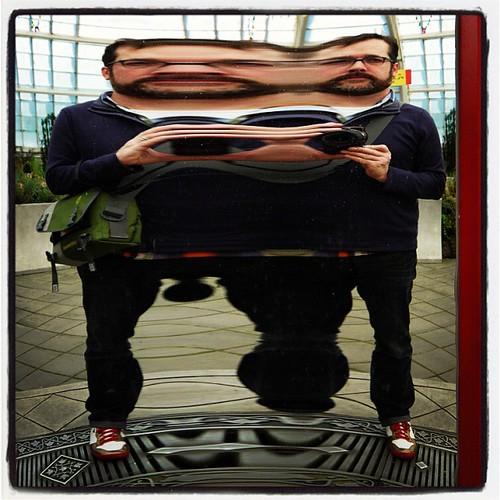
As for the photo, it appears to be a selfie by a young Chinese police officer, more concerned with style and image than with making his community safer. But who knows what is important in his life and for his career.

Cutie Police” by Beijing Patrol is licensed under CC BY 2.0.

Odd poem: Xi Jinping, ‘In Memory of Jiao Yulu’

Ten thousand miles away your soul has flown;
the rivers, mountains and land yearn for your return.
The people mourn the loss of a caring official,
tears flooding under the empress trees you planted.
Having dedicated your life to the desert,
to the betterment of people’s lives, your legacy lives on
no matter how many years come and go.

The moon shining bright as always,
I think of you and your life’s work.
You toiled long and hard, claiming no credit.
Serving and benefiting the people:
such was your ambition and is also mine.
Many a trickle will add a touch of green to the desert
and create a wellspring of hope.”

*****

Xi Jinping, born in 1953, has been the general secretary of the Chinese Communist Party and chairman of the Central Military Commission, and thus the paramount leader of China, since 2012. Since 2013, Xi has also served as the president of China.

Jiao Yulu was a Chinese politician, highly respected for his hard work even as he was dying of liver cancer in his early 40s.

From the Chinese Embassy in the US:
Xi Jinping has always held Jiao Yulu in high esteem and regarded him as a role model. At the time of writing this poem, Xi was the Party Secretary of Fuzhou. One night in July 1990, he read an article entitled “People Yearn for the Return of Jiao Yulu.” The poem was inspired as literary thoughts surrounding the deceased upright man welled up in Xi’s heart. When he inspected Lankao in 2014, Xi recalled emotionally how he learned from the example of Jiao Yulu more than 40 years ago. “On February 7, 1966, the People’s Daily carried a long article by Comrade Mu Qing and others entitled ‘Jiao Yulu: A Model County Party Secretary.’ Back then, I was a grade one student in junior high school. The teacher of political education choked with sobs while reading the article to us. I was deeply moved when I heard Comrade Jiao Yulu kept on working even in the late stage of liver cancer, pressing a stick against his liver to relieve the pain. The pressure from the stick wore a hole into the right side of his rattan chair over time.”

Jiao Yulu is no stranger to the Chinese people. After being appointed Party Secretary of Lankao County, he mobilized the local residents in a great struggle to tackle water-logging, sandstorm, and alkaline soil. Leading by example, he was always at the frontline at the height of sandstorms and in torrential rainfalls to identify the wind corridor, forecast quicksand and gauge flood waters. Amid blinding blizzards, he visited poor families to deliver food and financial relief to their homes. He was devoted entirely to all the people of his county but himself. Despite severe illness, he carried on work till the last moment of his life, and is revered as the “model county Party secretary.”

R.I.P. Edmund Conti, ‘Button, Button’

Just ask the poet, life’s a dumb thing.
Button, button, eating, swilling.
Life isn’t much but, still, it’s something.

Existence is a rule-of-thumb thing.
Buying now with later billing.
Just ask the poet, life’s a dumb thing.

To dream, to sleep, a ho-and-hum thing.
Boring, boring, mulling, milling.
Life isn’t much but, still, it’s something.

Mum’s the word, the word’s a mum thing.
Button lips and no bean spilling.
Just ask the poet, life’s a dumb thing.

Life, of course–the known-outcome thing.
Death and taxes. God is willing.
Life isn’t much but, still, it’s something.

Life is short, a bit-of-crumb thing.
Dormouse summer, daddies grilling.
Just ask the poet, life’s a dumb thing.
Life isn’t much but, still, it’s something.

*****

In his 2021 collection ‘That Shakespeherian Rag‘, Ed Conti threads poetic references throughout (the title is from Eliot); ‘Button, Button’ appropriately begins with:

When one subtracts from life infancy (which is vegetation),–sleep, eating and swilling, buttoning and unbuttoning–how much remains of downright existence?
– The Summer of a Dormouse, Byron’s Journals.

Much of ‘That Shakespeherian Rag’ (including Button, Button) was first published in Light. The collection is divided into 11 sections, organised from youth through adulthood to the prospect of mortality, and each prefaced with a quote from Shakespeare. The preface for the final Section reads:

Make no noise. Make no noise. Draw the curtains–
– King Lear, Act II Scene 6

There is no poem after it.

The charming, delightful, witty and tolerant Edmund Conti died on November 12th, aged 96.

Martin Parker, ‘Fifty Ways to Leave a Lover. No. 51’

No bitterness and no recriminations,
no flesh hacked off in gladiatorial sport,
no claims for unpaid debts, no scornful laughter
to mock experience so dearly bought.

But differences all gently papered over,
cracks filled and memory’s cobwebbed cupboards cleared.
Receipts for all the good times carbon copied
our life divides more simply than we’d feared,

with dogs and books and vinyl all apportioned,
all ledgers balanced with forgiveness sought
and paid for with a parting smile.
For this had once been love – or so we’d thought.

*****

Martin Parker writes: “Sadly I can offer no significant thoughts about its background.  I simply wrote it then left it in a drawer for about ten years as it did not seem to fit with anything I was writing at the time.  But I do remember hoping that I had written something gentler and more civilised and sympathetic than much of what was appearing on the net at the time. And my ancient hope seems to have been justified in the light of recent reactions to the poem.

“My website at www.martinparker-verse.co.uk gives details and excerpts from my two hopefully humorous and only occasionally wrily depressing books in which parody, pastiche, satire, farce and poetic irreverence should appeal to all but the most po-faced of poetry fans.”

‘Fifty Ways to Leave a Lover. No. 51’ was originally published in Snakeskin.

Martin Parker is a writer of mainly light and humorous verse much of which has appeared in national publications including The Spectator, The Oldie and The Literary Review. In 2008 Martin founded the quarterly light verse webzine, Lighten Up Online at www.lightenup-online.co.uk, now edited by Jerome Betts.

Illustration: “|||||||| DIVIDER |||||||| — *** CAUGHT UP! ***” by Claire CJS is licensed under CC BY-NC-SA 2.0.

Using form: RHL, ‘Formal vs Free’

Look: formal verse can be china for tea,
a golden goblet, a mug made of clay.
Free verse is putting mouth to stream to drink.
Yes, you could cup your hands… but do you think
museums want to buy that to display
your “memorable skill”, your “artistry”?

*****

‘Formal vs Free’ is published in the current ‘Blue Unicorn‘, in a section loaded, as often, with verse about verse.

Photo: “Red-figured Greek Red-Figure Kantharos (Drinking Vessels) with Female Heads 320-310 BCE Terracotta” by mharrsch is licensed under CC BY-NC-SA 2.0.

Sonnet: Paul Burgess, ‘Reynadine’s Farm’

“The chickens should have been a tighter group,
and Farmer should have purchased stronger locks
instead of whining now about the coop
and getting mad at Reynardine, the fox.

The chickens didn’t mend defensive flaws
or try to get a gun or sharper beak.
Why blame the beast with wits and stronger jaws
for weeding out the losers and the weak?

The victim here, whose name they’ve tried to harm,
has suffered public shame and sad disgrace.
To make it right, he must receive the farm.
I thank Your Honors now and rest my case.”

The judges ruled in Reynardine’s support
because the fox had also bought the court.

*****

Paul Burgess writes: “The Elizabethan sonnet, which I love to adapt to many purposes, is a natural fit for the structure I like best: a setup, a volta, and a jolt at the end.  Many of my best poems succeed, and my worst fail, because of my persistent embrace of tonal ambiguity. This poem is no exception. I like the tension between a seemingly folksy and witty parable and a traditionally serious, elegant form. For me, there’s humor in darkness and darkness in humor. The balance shifts, but I don’t think I could ever completely separate the two and still be myself, as a person or as a writer.”

‘Reynadine’s Farm’ was first published in Snakeskin.

Paul Burgess, an emerging poet, is the sole proprietor of a business in Lexington, Kentucky that offers ESL classes in addition to English, Japanese, and Spanish-language translation and interpretation services. He has recently contributed work to Blue Unicorn, Light, The Orchards, The Ekphrastic Review, Pulsebeat, The New Verse News, Lighten Up On Line, The Asses of Parnassus, and several other publications.

About

Photo: “Ely Cathedral: Stained Glass Museum” by Phil McIver is licensed under CC BY-NC 2.0.