Tag Archives: Amsterdam Quarterly

RHL, ‘Raised by Expatriates’

When I was young, best thing I’d seen
was Morgan’s fort gone under green
in jungled Panama.
The only flags in forests there
were what leaf-cutting ants could bear:
for planet’s anima.

I touched skulls resting in plain view
in empty deserts in Peru:
mud walls stood rainlessly.
I sailed on seas beyond all land,
stood with a sloth, yes, hand in hand,
saw men drink sugared sea.

I learned to bodysurf in waves;
I climbed cliffs, and saw bats in caves,
saw beaches of pink sand.
Result? I always loved to roam
but nowhere lets me call it home,
All lands are not my land.

Some places I’m a citizen
but never been a denizen;
with others, the reverse:
the places that I’ve lived in most
ignore me like an unseen ghost,
foreign, vague-skinned, perverse.

The wind has blown me since my birth,
my home is nowhere on the earth,
from place to place I roam.
My parentage determined that
my citizenship’s “Expatriate”…
so… everywhere is home.

*****

Not all my poems are autobiographical, even if first-person. This one is. It was published recently in the Amsterdam Quarterly (thanks, Bryan R. Monte!)

RHL, ‘On Disrespecting Ancestors’

I disrespect my ancestors fighting in wars,
Europeans fighting Europeans, blame without cause;
my English grandfather killed fighting the Germans,
my Danish uncle executed for killing with Germans,
my earlier German ancestors fighting the French,
my French ancestors fighting (and marrying) the English…
and the cause of the wars always indefensibly wrong.
Why should anyone glorify them in song?
Pride, greed and stupidity – these are the drivers of war.
I turn my back on all of them, stand on the sea shore,
marvel at wind and wave, at sun, moon and stars,
despising, ignoring, forgetting their idiot wars.

*****

I’m so sick of Putin, Netanyahu… and Bush Jr, Dick Cheney, Tony Blair… war criminals, the lot of them. But they’re the products of our genetic makeup as social animals, dividing everything into “us” and “them”, and then through crafty hysteria and massively organised mob violence, grabbing everything they can for themselves.

Anyway, this semi-incoherent rant of a poem was published in the current Amsterdam Quarterly, and editor Bryan R. Monte wanted one change in my submission: to change the last line’s “ape-idiot wars” to “their idiot wars”. As usual, I acquiesced. Also as usual, I’m not sure whether it is a good suggestion or not. Apes figure in a lot of my verse, as being an underlying reality of humans, essential to acknowledge, equally essential to try to control. In the context of my other work, I think I prefer “ape-idiot”.

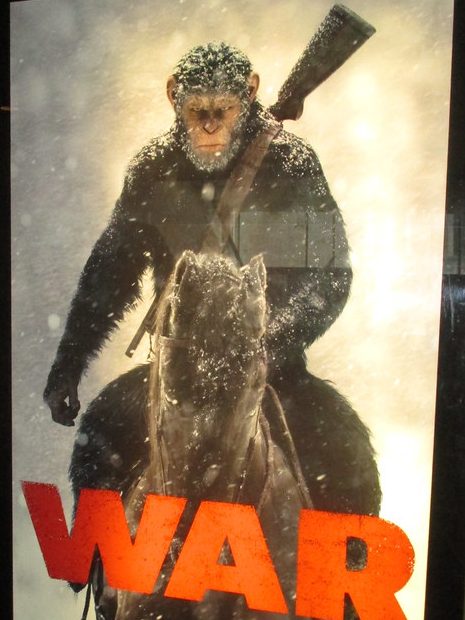
Photo: “War of the Planet of the Apes Poster 2671” by Brechtbug is licensed under CC BY-NC-ND 2.0.
SF Poem: RHL, ‘Out Of Many…’

Two hundred million sperm
in one ejaculation;
and we are standing firm
and spouting with elation,
though but a single germ
survives to incarnation.

And much in nature throws
vast clouds into the ocean,
where myriad embryos
become a magic potion
consumed by all that goes
with food its only notion;

yet one or two survive
to adulthood and, later,
will make the species thrive
and serve up like a waiter
new young crowds that arrive
like cargo crammed on freighter.

This is how nature lives;
we should not think it foolish
eight billion of us gives
but forty fierce and mulish
posthuman narratives,
godlike as much as ghoulish,

in retrospect appearing nature’s plan
for how we cross to Nietzsche’s Superman.

*****

This poem was originally published in the Amsterdam Quarterly, although without the final couplet. I usually allow editors to make changes if they suggest them, and often the changes are an improvement that I retain. But in this case I’m afraid the science fiction speculation may be lost without those last lines: the idea that the present billions of us are on the point of being superseded by the first handful among us who achieve a godlike state of posthumanity… and that this ratio of 200,000,000 seeds being sacrificed to achieve one mature adult in the next generation is not unusual in nature.

Photo: “Stinging nettle stem with +/-15 billion seeds” by esagor is licensed under CC BY-NC 2.0.

Ekphrastic sonnet: RHL, ‘Ghosts of Dead Parents’

Her ashes spread on Skirrid that she loved;
and his bones buried by the Harbour bay…
Why choose views for the dead? Once in earth shoved,
dirt in the dark is all they’d see, not day,
even if they lived. And if cremated, well…
So is it for our own guilt’s absolution?
Or status, that their graves our standing tell?
Or rites for social change’s resolution?
Those who were always here are here no more –
Their alwaysness runs out when they decease,
and life will now sound different from before,
like insect shrills not heard until they cease.
Dead ghosts sleep twittering in our heads’ domed caves,
waking to fill night skies from dreams and graves.

*****

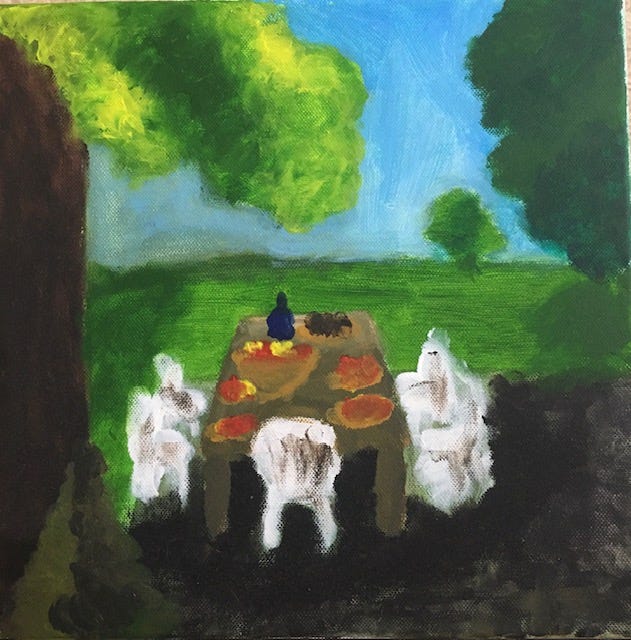
This sonnet was published by The Wee Sparrow Poetry Press as a response to their ekphrastic challenge for the illustration, a painting by Žofia Katriňáková. It was written for my parents who, although they died decades ago, are still a background to my thoughts. My father is buried by the bay of Governor’s Harbour, my mother’s ashes were scattered on Skirrid Fawr, the Welsh mountain she loved and lived within sight of in Abergavenny. And I have another short poem for them, published in the Amsterdam Quarterly:

In the night’s jam jar of my memory
my long-dead parents live as fireflies.
My thoughts of them worn by time’s emery,
their faint light still suggests where my path lies.

Is it reasonable to hope to be a firefly for your children and grandchildren?

Calls for Submission: formal verse

Of the various publication opportunities specifically for formal/traditional poets, three are taking submissions until July 15, and four other formal-friendly publications have submission deadlines of July 31. There is no submission fee for any of them. Here they are – the links are to the submission requirements:

Able Muse (magazine) Deadline, July 15.
Submit one to five metrical poems (or one long poem), rhymed or unrhymed. (A poem of more than 40 lines is considered a “long” poem.)
All types of formal poetry are welcome, from traditional to boundary-pushing. We want well-crafted poems that use meter skillfully and imaginatively (with rhyme or not), in a contemporary idiom that reads as naturally as free verse.

Able Muse Press (book-length manuscript) Deadline, July 15.
At least 50 pages of poems – same preferences as for the magazine.
There’s NO reading fee.
“We respond within 9 months or so.”

Helen Schaible International Sonnet Contest Deadline, July 15.
Categories:
1 Traditional Sonnet – Shakespearean or Petrarchan
2 Modern Sonnet
Open to All. Free. Enter only one poem in either Category #1 or #2, or one poem in each.
Prizes for both categories: First Prize: $50. Second Prize: $30. Third Prize: $20.

Formal-friendly magazines, themed and with July 31 cut-offs:

Snakeskin (short poem issue, nothing over 10 lines). At the link, read the tabs on the left side for submission details. Submit earlier than the very end of July, as publication is scheduled for August 1st. Editor: George Simmers.

Allegro (theme: Freedom) Four poems max. Editor: Sally Long.

Amsterdam Quarterly (theme: City and/or Country) Two poems max. Editor: Bryan R. Monte.

Rat’s Ass Review (unthemed – the editor publishes whatever he damn well feels like publishing, as you might have guessed.) Five poems max. Editor: Roderick Bates.

In addition:

Rhizome Press (not to be confused with Rhizome Books) publishes anthologies of formal verse. Editor Beth Houston is taking submissions of up to 10 sonnets for Extreme Sonnets III, and up to 10 “extreme formal poems of at least twelve lines” for Extreme Formal Poems II. The submission deadlines are not given on the website, but will presumably follow on the publication of Extreme Sonnets II which is currently in the works.

UPDATE from Beth Houston, 11 July 2022: “At long last Extreme Sonnets II is published and available on Amazon! Will there be an Extreme Sonnets III? Likely, but not for awhile. In the meantime I’ll be putting together an anthology of love sonnets—extreme sonnets, of course. I’ll post submission details on the Rhizome Press website soon. All sonnets included in Extreme Sonnets, Extreme Sonnets II, and Extreme Formal Poems will automatically be considered. Stay tuned for more details.”

Sonnet: “Bring on the Violins”

Bring on the violins, the falling leaves,
the wistful ending to a misty day.
The long game’s over and we ride away
to sunset Heaven that no one believes.
Our world is dying, yet here no one grieves:
Earth warms, seas rise, but Wall Street’s still in play…
and we ourselves are aging anyway.
We all face death, and there’ve been no reprieves.
And yet, and yet…robotics and AI,
gene therapy, unlimited life span,
promise an almost-here-and-now sublime,
an unknown life, with our old life gone by.
Trumpet a fanfare for the Superman,
music for dancing to the end of time.

This sonnet has just been published in the Amsterdam Quarterly, this spring’s issue being on the theme of Beginnings and Endings. That may be relevant for our Covid-19 catastrophe, but of course the theme was determined a year ago, and life and death have merely decided to smile on AQ ironically.

But we were all facing death before this latest coronavirus came along. As the saying goes, “Perfect health is simply the slowest rate at which you can die.” And interwoven with death is always new life, never an exact repetition of the old life and often dramatically better. The real issue is, will the new life come at the expense of the old, or can the old reform and regenerate itself, renew itself without needing to die? The avoidance of death has been the quest of religion and medicine since those disciplines (or that discipline) originated. It is great driver of culture, and the pot of gold at the foot of the never-quite-reached rainbow.

Technically this is a correctly structured Petrarchan sonnet, with an initial octave (in this case of existential doom and gloom) rhyming ABBAABBA, followed by a volta (in this case a reversal to hope) for the sestet that rhymes CDECDE.

The sonnet is a marvellous structure for expressing an argument in a compact way.

Poem: “Jam Jar” (was “Fireflies”)

In the night’s jam jar of my memory
My long-dead parents live as fireflies.
My thoughts of them worn by time’s emery,
Their faint light still suggests where my path lies.


“Jam Jar” was published last year in the September issue of
Amsterdam Quarterly (as well as in the AQ 2018 Yearbook). I originally titled it “Fireflies”, but AQ editor Bryan Monte had published a piece with that name in the previous issue, and naturally requested a change. Such are the vagaries of the publishing world.

Catching fireflies in a jar is such a childlike activity. And that’s appropriate here: no matter how old you become, you will always be the child of your parents.

Technically: it’s a short, simple poem. Iambic pentameter suits the meditative mood, the ABAB rhyme scheme is a natural for four lines.

Uses of Poetic Structure: Poem: “Jam Jar”

One of the great things about writing formal poetry is that, if you approach it the right way, it can force you to reduce unnecessary words to meet the structural requirements, and simultaneously add more ideas to meet the rhyme scheme. Here is an example:

Jam Jar

In the night’s jam jar of my memory
My long-dead parents live as fireflies.
My thoughts of them worn by time’s emery,
Their faint light still suggests where my path lies.

(This from the Amsterdam Quarterly, which produces three themed issues a year, the current one being related to “Genealogy”.) The original expression of the image behind the first two lines was longer than the end result; tightening it up and finding “emery” as a rhyme for “memory” extended it again, but this time as a regular quatrain.

If you write an outline of a poem that comes out to 15-20 lines, in free verse but with a couple of rhymes showing up, consider condensing it into a sonnet. All the unnecessary words get squeezed out, and the search for additional rhymes will only make the thoughts richer.

Structure and rhyme can be used to compress, condense, and hopefully intensify the ideas and their expression. But, amusingly, it is also possible to search for rhyme by increasing words, rambling until the rhyme can be tracked down. Scotland’s 19th century William McGonagall comes to mind, his most famous work being “The Tay Bridge Disaster”.

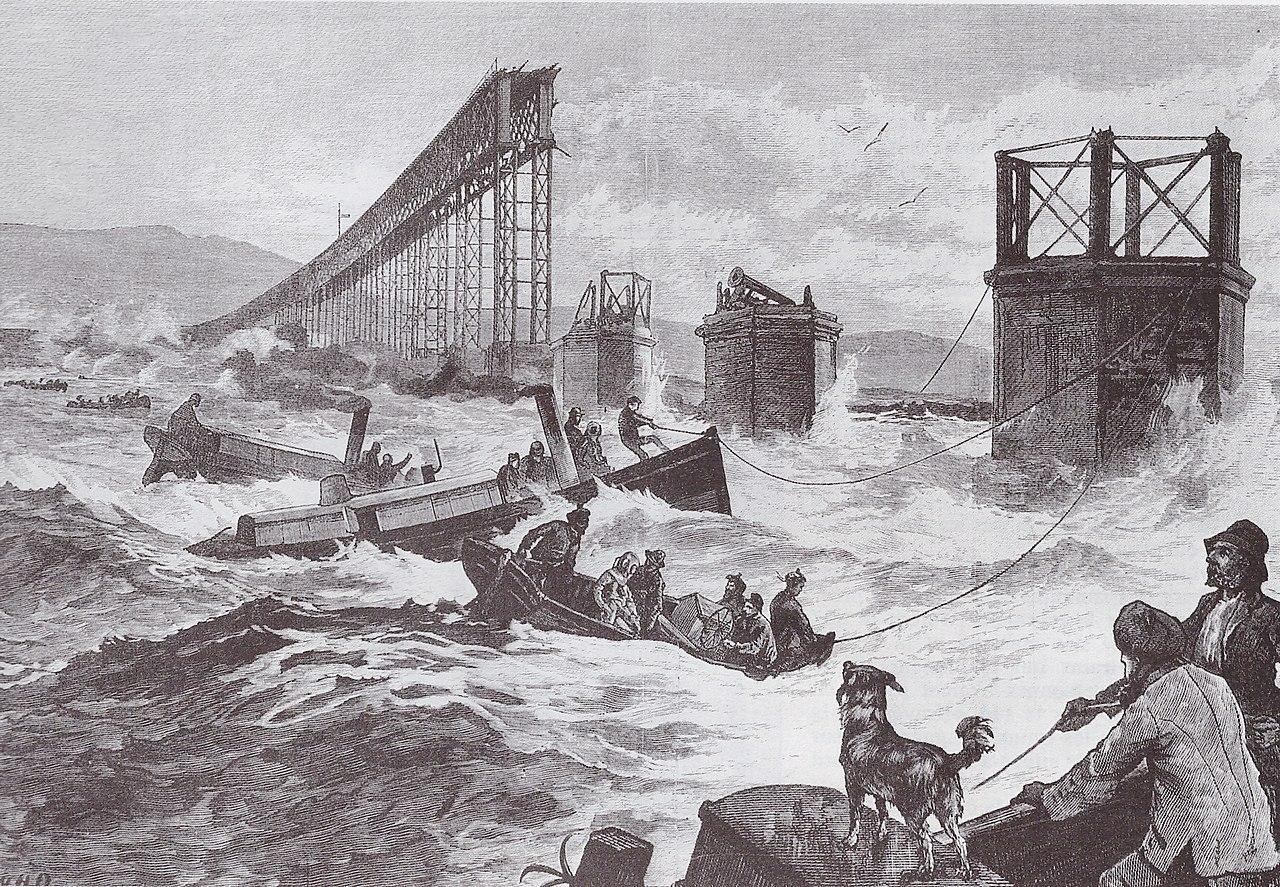
Contemporary illustration of the search after the disaster

The Tay Bridge Disaster

It tells of the collapse of the railway bridge during a storm, while a passenger train was on it:

Beautiful Railway Bridge of the Silv’ry Tay!
Alas! I am very sorry to say
That ninety lives have been taken away
On the last Sabbath day of 1879,
Which will be remember’d for a very long time.
(…)
I must now conclude my lay
By telling the world fearlessly without the least dismay
That your central girders would not have given way,
At least many sensible men do say,
Had they been supported on each side with buttresses,
At least many sensible men confesses,
For the stronger we our houses do build,
The less chance we have of being killed.

The structural requirements of formal verse are only justified when they are at the service of the poem’s aesthetics (or esthetics, depending on your residence). Rhyme, metre/meter and so on should be thought-provoking or relaxing sources of enjoyment, beauty, humo(u)r, memorableness. There is no merit in rhyme that destroys those things.