Tag Archives: Better Than Starbucks

R.I.P. Anthony Watkins – untitled poem

Log some star date or another

All systems are failing
shadows flicker around
the darkened room

There is no captain
to report to, I am he.

Lost among the leaves.

*****

Poet, author, editor, publisher and digital creator Anthony Watkins passed away this week after a long illness. I knew him only through his creation of Better Than Starbucks, the wonderfully broad tent poetry-fiction-and-interviews magazine that came out monthly and provided for writers of all styles. It was a generous and inclusive publication, well reflective of its creator.

The poem above is one of the last messages posted by Anthony Watkins on his Facebook page, as everything was winding down.

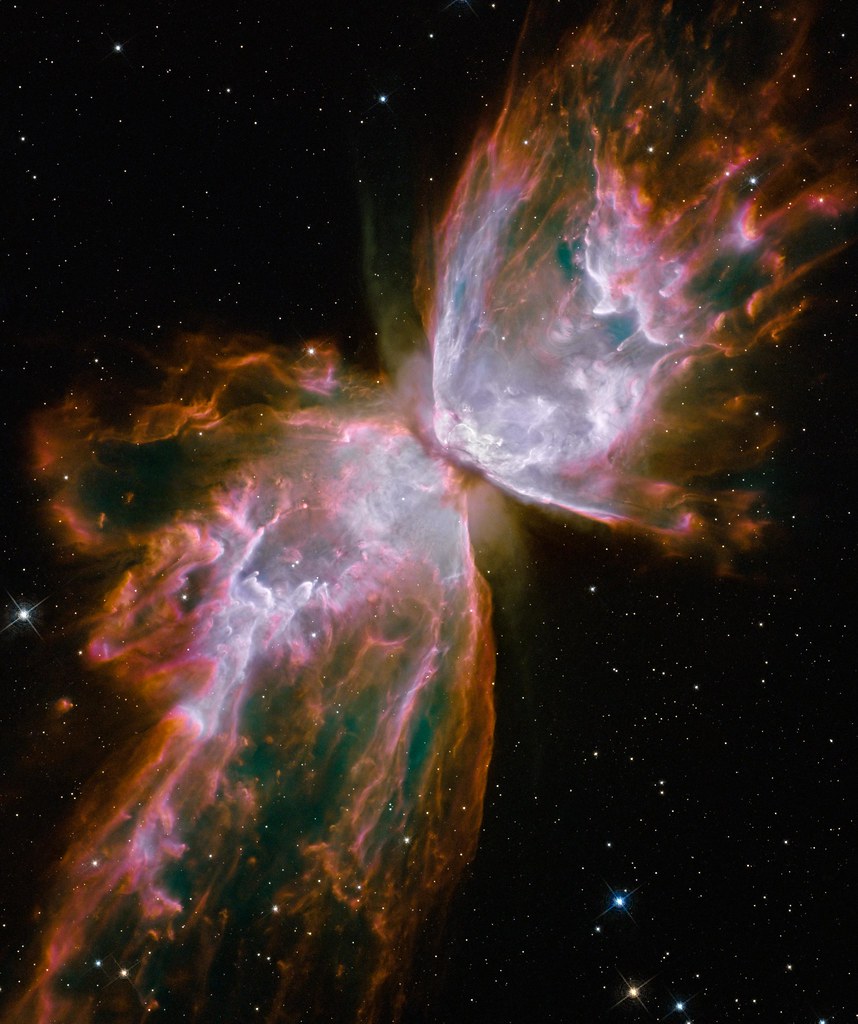
Photo: “Hubble’s New Eyes: Butterfly Emerges from Stellar Demise in Planetary Nebula NGC 6302” by NASA Goddard Photo and Video is licensed under CC BY 2.0.

Limericks: Jerome Betts, ‘Jingle Tills, Jingle Tills’

With the annual arrival of Yule,
The world becomes all slop and drool.
    Like that song with the sleigh
    They incessantly play
The points I award it are nul.

Turkey-slaughter is callous and cruel
While the weather turns vile as a rule.
     It is cold, wet, and grey,
     Life becomes pay-pay-pay,
And the thought makes me blanch, puke and mewl.

Who requires the great brain of George Boole
To find lands needing no winter fuel
    And spend Christmas away
    Where the sun shines all day
Sipping drinks beneath palms by a pool?

*****

Jerome Betts writes: “I suppose it’s not the festival itself itself at the darkest point of the northern hemisphere year that provokes a jaundiced reaction but the ever-lengthening relentless commercial run- up to it, almost merging with over-hyped Halloween.”

‘Jingle Tills, Jingle Tills’ was first published in Better Than Starbucks.

Jerome Betts edits Lighten Up Online in Devon, England. His verse appears in Amsterdam Quarterly, Light, The Asses of Parnassus, The New Verse News, The Hypertexts, Snakeskin, and various anthologies.

Photo: “Jingle Bell Bokeh” by aronalison is licensed under CC BY-NC-SA 2.0.

Jerome Betts, ‘Lines On A Lady In Bronze’

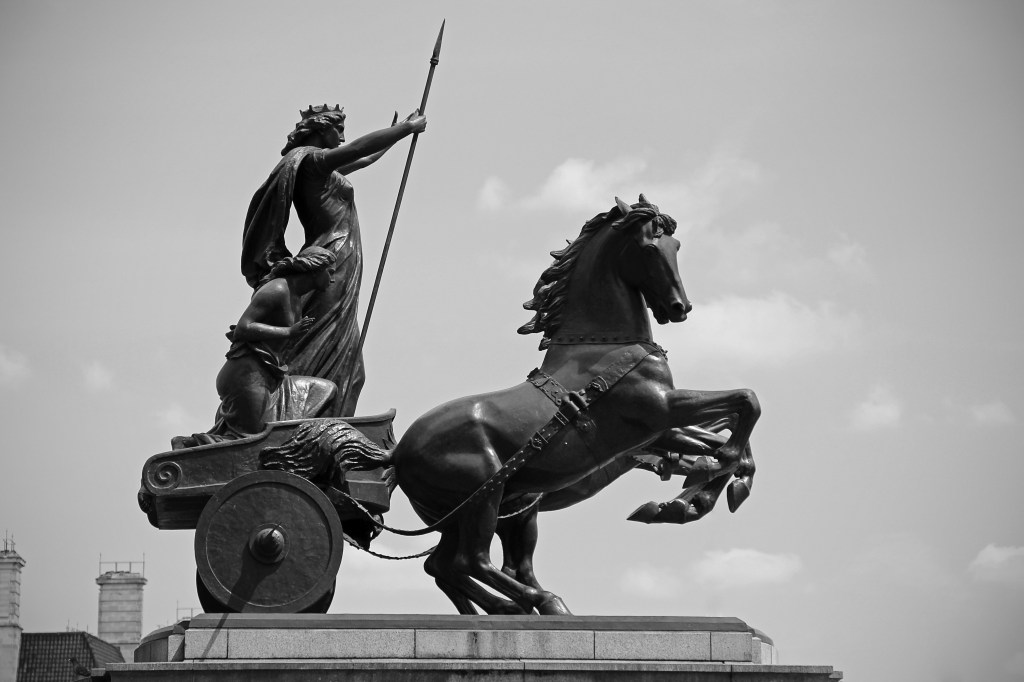
(The statue of Boadicea and her Daughters by Thomas Thornycroft was erected in 1902 near Westminster Bridge London.)

Set up, the civic skyline Shardless,
A proxy late Victoria then,
She charges, rein-free, grim, regardless,
Towards the Gothic giant, Big Ben.

Just what is known about this fiery
And long ago wronged ruler’s life?
Such fields for scholarly enquiry
Are now churned up by toxic strife.

For some, her Roman power rejection
Makes for a memory well kept green,
While others mock as myth-confection
Their proto-Brexit British queen.

Remainers, Leavers, play Have at you!
That chariot and rearing pair
Of  horses make a super statue.
Whoever wins, she’ll still be there.

*****

Jerome Betts writes: “I find statues fascinating with their largely unchanging nature as the people and scenes around them change and they make an obvious target for revolutionaries, rowdies and rhymers. Boadicea, unveiled without ceremony in 1902 because of Edward the 7th’s appendicitis, strikes me as a splendid piece of slightly unhistorical sculpture and useful landmark for visitors. Amusement at her lack of reins and apparent charge towards the Palace of Westminster blended with the Brexit debate when the piece was published in Better Than Starbucks. Whether this dooms the last two stanzas to the archives remains to be seen.”

Jerome Betts lives in Devon, England, where he edits the quarterly Lighten Up Online. Pushcart-nominated twice, his verse has appeared in a wide variety of UK publications and in anthologies such as Love Affairs At The Villa NelleLimerick Nation, The Potcake Chapbooks 1, 2 and 12, and Beth Houston’s three Extreme collections. British, European, and North American web venues include Amsterdam QuarterlyBetter Than StarbucksLightThe Asses of ParnassusThe HypertextsThe New Verse News, and Snakeskin.

Photo: “Boadicea Statuary Group” by Rafesmar is licensed under CC BY-SA 3.0.

Oliver Butterfield, ‘Self-reflection’

Y’know — it ain’t a lot of fun
negotiating one-on-one
with the person in the mirror who
is staring blankly back at you
with hollow, soporific eyes —
but you penetrate his deep disguise,
and then it is you realize
that you’re in for loads of gloom and doom
cooped up within this little room
all by your empty, woeful self,
all, all alone, with no one else —
and the guileful guy you’re talking to
isn’t talking back at you —
’cause he knows there’s nothing left to say.
But the sonvabitch won’t go away.

*****

This poem was originally published in Better Than Starbucks. I have been unable to find Oliver Butterfield, I only know he retired and closed his law practice in Kelowna, British Columbia. I’d be interested in seeing more of his poetry.

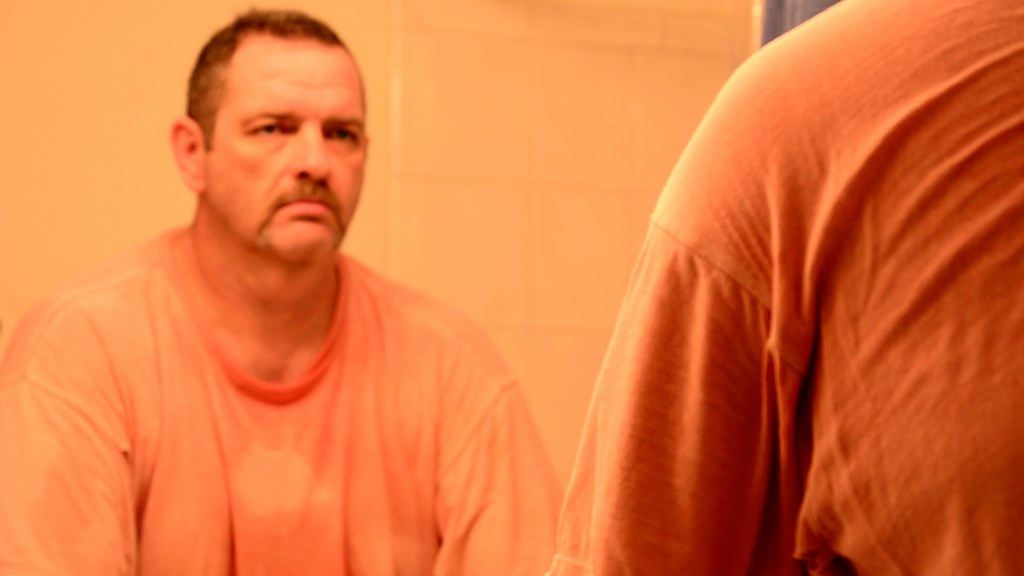
Photo: “Man in the Mirror” by airguy1988 is licensed under CC BY-ND 2.0.

Bruce McGuffin, ‘Tunnels’

A snowy field — sun sparkles on the ice —
Devoid of life to those who do not know
That underneath a furtive swarm of mice
Live out their lives in tunnels through the snow.
My dog, who finds them out by smell or sound,
Runs snorting through the snow in wriggling glee.
Then back and forth ecstatically he’ll bound
Until some mouse has nowhere left to flee.
For so it goes with mice as well as men,
Those tunnels where we run turn into traps
When forces that are far beyond our ken
Play out their game until our ways collapse.
Do waiting mice envision what impends?
That somewhere up above a canine snout —
Deus ex machina to mice — descends
To pierce the snow and pull those trapped mice out?
Few things in life will make that dog as glad.
The mouse may not rejoice — its life is through.
But whether killing mice is good or bad
Depends completely on your point of view.

*****

Bruce McGuffin writes: “When I was a boy winters were longer, colder, and snowier than they are today, and I had a suitably adapted dog: An 80 pound husky of indeterminate parentage. By which I mean a local ski instructor took his Siberian husky to Alaska one winter and she came home pregnant. We named him Frosty. In my defense I was 7 years old. His favorite pastimes were eating, sleeping outdoors in the snow, and hunting. Dogs roamed free in those days, and he brought home squirrels, mice, and more than one skunk. Frosty also bit the older boy next door after he punched me, which made Frosty The Best Dog Ever.
This poem started out as a paean to The Best Dog Ever, but slipped the leash and went off in a different direction, as poems sometimes do. It turns out that some of my favorite poems are the ones that get away.”

‘Tunnels’ was first published in Better Than Starbucks.

Bruce McGuffin grew up in rural Central NY, where children and dogs ran free through the frozen woodlands in winter, and waded in the creek all summer. It was ok if you like that sort of thing. His graduating class voted him Class Intellect, which was not exactly a compliment. Spurred on by lack of economic opportunity in that region, and the desire to know more people who didn’t think reading books was “weird”, he spent too many years in college then moved to the Boston area and worked for 37 years as an engineer in the field of radio communications. It was fun. Now semi-retired, he lives in Antrim NH with his wife Ann and occasional visits from two children who come for the skiing if not the company. His poetry has appeared in Light, Lighten Up Online, The Asses of Parnassus, Better Than Starbucks, and other journals.

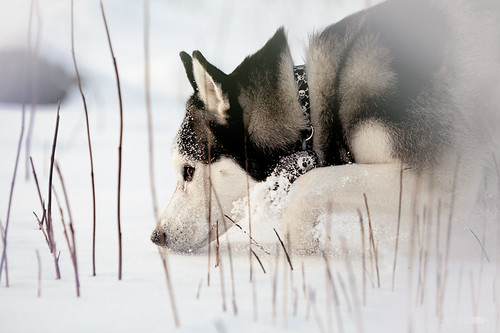
Photo: “Sniffing the Prey” by Emyan is licensed under CC BY-NC-ND 2.0.

Poem: ‘Full Disclosure’

“The trouble with this growing old,” he said,
“You lose so much . . . and you get what instead?
If you can hang a bath towel on your tool
it’s wasted when you’re in an all-boys school.
Time was, I’d come — as you’d expect —
with just a look, a touch.
Now, not so much.
The only thing that gets me full erect
is feeling flesh firming from kiss and grasp;
so all my work is trying to make her gasp!
I need her climax if I’m to get sated.”
He looked at her. She looked at him. He waited.

*****

This semi-formal poem was published in the Lighthearted Verse subsection of Formal Poetry in that wonderfully rich and varied magazine, Better Than Starbucks. Where else could you find such a variety of areas of expression as BTS’ Regular Feature Pages?
Free Verse
Haiku
Formal Poetry
Poetry Translations
Poetry for Children
International Poetry
African Poetry
Experimental, Form, & Prose Poetry
Poetry Unplugged
Fiction
Flash Fiction & Micro Fiction
Better Than Fiction (creative nonfiction)
The Interview
Interviewee Poems
… and From The Mind of Alfred Corn

And tolerant enough to put up with my verse on occasion! Unfortunately they have announced they are going on hiatus… hopefully they will be back in 2023, as they have been a truly excellent outlet for all manner of poetry and prose.

Photo: “Mystery Man meets a friend” by mossimoinc is licensed under CC BY-ND 2.0.

Sonnet: “What Will You Be When You Grow Up?”

Historically, this never was a thing.
You did what you were born to do, were told,
Fitting yourself into your parent’s mold,
A farmer’s son a farmer, king’s son a king,
A girl to be a mother and a wife.
But then came education, travel, choice,
Awareness of the wishes you could voice,
Countries, careers, sex partners — it’s your life!
And though just who you are you cannot know,
Nor what you want, yet all is your decision.
You’ll make mistakes, find failures and derision,
But life is long: so have another go . . .
Retry, and then try something else; take; give.
Do what you love. You die, regardless. Live!

This sonnet is a mirror of the short poem I posted most recently – and I’m happy to see that my outlook has a certain consistency, even over a 50 year period.

The sonnet has just been published in the formal verse section of the current Better Than Starbucks – thanks, Vera Ignatowitsch!

Photo: “career choices” by Jerome T is marked with CC BY-NC-ND 2.0.

Poem: ‘Liminal Vision’

Grid of Existence, seeming minimal–
unknown extent, intent–
all-ruling, always nearing, liminal–
imminent, eminent–

the great all-seeing Eye of all the world–
the oracular Oculus–
the Stick round which our candyfloss is twirled–
the incorporate Octopus–

most active in the gap between day and night
when half-light blurs the features,
the predatory time the Unseen bite,
the time of mythic creatures,

time of illusions and profuse confusions,
the pros and cons in thrall
to every problem’s conmen selling solutions
to solve and dissolve all

the woes and worries of our warty worlds . . .
The Hunter bounds, unbound;
the Eye, the towering Wave, forever curls
over our grind, our ground.

This poem has just been published in Better Than Starbucks which gives it a seal of approval. I’m glad of that because I find it a strange poem when I come back to it, always feel that I’m having to dig my way in. It was an attempt to capture some of the half-dreams and shadow consciousness that we can glimpse when we are not fully awake and in our quotidian lives. Our unconscious rules us, our actions, our desires, our health, but we conscious puppets have so little sense of everything that is going on within us. But sometimes, when you are right on the border between conscious and unconscious…

Photo: “Liminal Space” by Theen … is licensed under CC BY-NC-SA 2.0

Poem: “This Ape I Am”

Under our armoured mirrors of the mind
where eyes watch eyes, trying to pierce disguise,
an ape, incapable of doubt, looks out,
insists this world he sees is trees, and tries
to find the scenes his genes have predefined.

This ape I am
who counts “One, two, more, more”
has lived three million years in empty lands
where all the members of the roving bands
he’s ever met have totaled some ten score;
so all these hundred thousands in the street
with voided eyes and quick avoiding feet
must be the mere two hundred known before.

This ape I am
believes they know me too.
I’m free to stare, smile, challenge, talk to you.

This ape I am
thinks every female mine,
at least as much as any other male’s;
if she’s with someone else, she can defect –
her choice, and she becomes mine to protect;
just as each child must be kept safe and hale
for no one knows but that it could be mine.

This ape I am
feels drugged, ecstatic, doped,
hallucination-torn, kaleidoscoped,
that Earth’s two hundred people includes swirls
of limitless and ever-varied girls.

This ape I am
does not look at myself
doesn’t know about mirrors, lack of health,
doesn’t know fear of death, only of cold;
mirrorless, can’t be ugly, can’t be old.

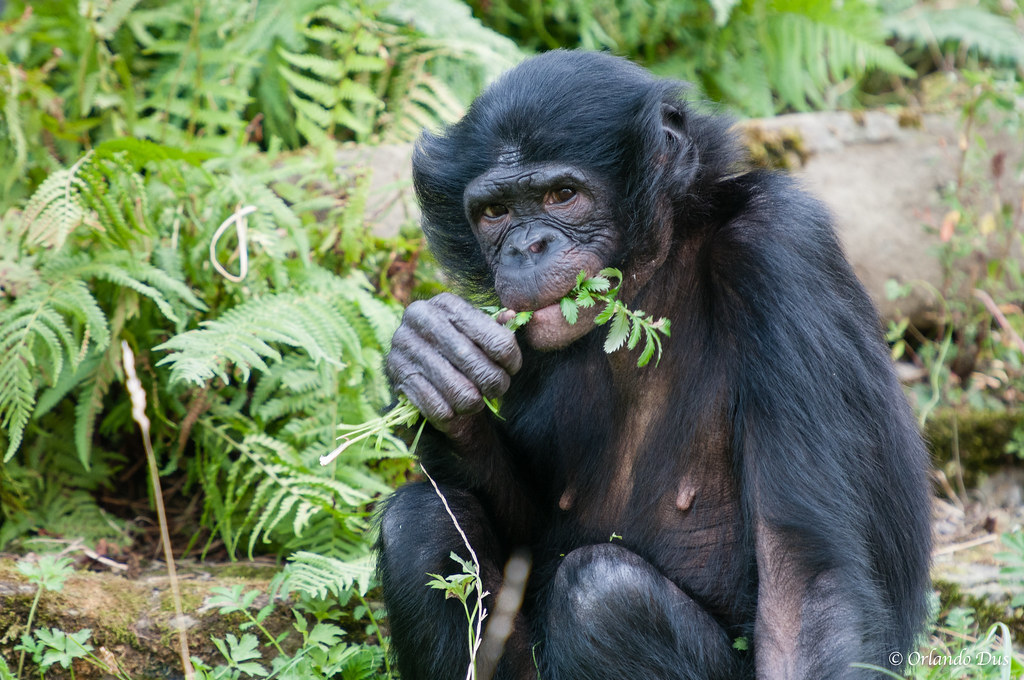
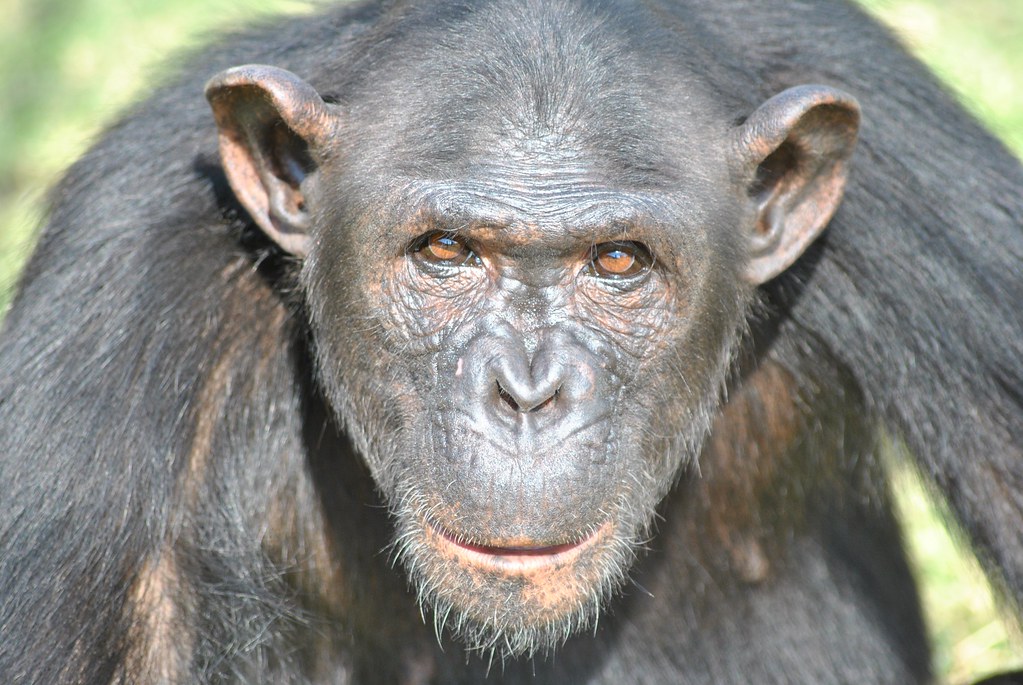
This is one of my favourite poems. Originally published in Ambit ten years ago, it has been reprinted in magazines as diverse as Better Than Starbucks, Verse-Virtual and, last month, Bewildering Stories. It speaks to what I believe is a largely overlooked truth, that we are genetically predisposed to function best in social groups or households of 20 to 30 people, within a larger network of six to ten such groups. These provide the numbers of people that we can know well (the social group) and people that we can also recognise and interact with comfortably (the larger network). This is the world of chimpanzees and bonobos, and of the hunter-gatherer existence of early humans.

In practical terms, I am in favour of recreating the sense of community of the village, even within the context of cities. Develop housing complexes that become neighbourhoods – keep schools small – reintegrate nursing homes into the community, let the children and the old people interact – and (a further step in acknowledging our hunter-gatherer humanity) keep everyone in touch with parks, with gardens of fruit, flowers and vegetables, with trees and birds, and with a variety of animals.

Technically the poem is written in iambic pentameters, loosely structured in stanzas of varying length, with lines mostly rhymed but with no set rhyme scheme. (And note: a stanza’s initial “This ape I am” needs to be counted with the next line to produce the pentameter.) Iambic pentameters provide a natural mode for meditative or expository verse. The rhythm is comfortable for quiet reflection or narration. The rhyme in this case is a secondary enhancement.

Sonnet: “From Gombe’s Chimps”

From Gombe’s chimps to interstellar space
We will have war. Sanctioned by the Divine,
Moses first led the Jews to Palestine
Telling his tribesmen not just to displace
But to kill all, and wipe out without trace
Each adult, child, animal, tree, vine.
Genocide’s justified, cleansed ethics fine,
To get resources for your tribe and race.

Believers justify war’s bloody courses:
We’re right, they’re wrong, so therefore they’re to blame.
Conquer through war to grab and keep resources,
Aztecs or Spaniards, everyone’s the same –
Victory to the best guns, swords or horses,
And put defeated scriptures in the flame.

I’m pessimistic about the chances of humans being able to stop warfare. It seems built into the nature of social creatures – when you define your group, you are defining everyone else as not in your group. Then, when it’s a question of who gets limited resources, groups compete and the most ruthless groups tend to do the best.

This sonnet was originally accepted for publication by Quarterday in Scotland, but that excellent glossy magazine seems to have folded after a few issues and this poem was left hanging. Fortunately the Better Than Starbucks group is still competing successfully, thanks to the ruthless Anthony Watkins and Vera Ignatowitsch, and published it.

The sonnet is one of my favourites for several reasons: technically it is purer than most, rhyming ABBAABBA CDCDCD, though the volta between the two sections is weak (or possibly nonexistent). It deals with human nature, and the problems facing us as we move into the ever more complex future. And it highlights one of my personal religious irritations, that people can walk into a neighbouring territory, wipe out the inhabitants, and create a justifying fairytale of how the destroyers are the persecuted victims. Think of the Pilgrims and other British immigrants in America… think of the Jewish tribes coming into the Promised Land: when they captured a city outside the core area,

“when the Lord thy God hath delivered it into thine hands, thou shalt smite every male thereof with the edge of the sword:
But the women, and the little ones, and the cattle, and all that is in the city, even all the spoil thereof, shalt thou take unto thyself; and thou shalt eat the spoil of thine enemies, which the Lord thy God hath given thee.” (Deuteronomy 20:13-14)

But when they captured a city in the heart of the Promised Land,

“of the cities of these people, which the Lord thy God doth give thee for an inheritance, thou shalt save alive nothing that breatheth:
But thou shalt utterly destroy them; namely, the Hittites, and the Amorites, the Canaanites, and the Perizzites, the Hivites, and the Jebusites; as the Lord thy God hath commanded thee:
That they teach you not to do after all their abominations.” (Deuteronomy 20:16-18)

It is hard to see a future without warfare, when even the most revered “holy books” teach genocide and justify it as doing God’s will.