Tag Archives: Edward Lear

Using form: Parody: Brian Allgar, ‘Irretrievable Breakdown’

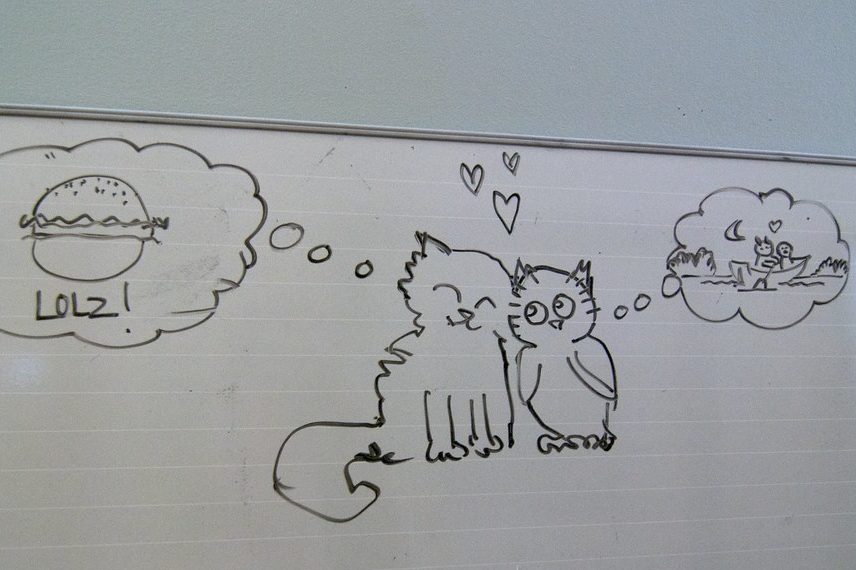
The Owl and the Pussycat went to the Judge,
For they sought to obtain a divorce.
“My dear Sir”, said the Owl, “I’ve no wish to be foul,
Though I fear you’ll consider us coarse.

Our plight’s anatomic; my efforts are comic
To exercise conjugal rights.
With our different bits, there is nothing that fits,
And this failure our happiness blights.”

The Pussycat spoke: “He’s a feathery bloke,
Whereas I’m rather furry and feline.
In vain we have tried to get Owly inside,
So to you we are making a beeline.”

Said her husband: “Your honour, I’ve struggled upon her
And hoped she would prove ‘pussycatable’.
It was useless, of course, and we’re seeking divorce
On the grounds that we’re quite incompatible.” 

So the Judge set a date to determine their fate:
“I’ll decide at the end of next week.”
But the cat came alone, though she carried a bone
And a handful of feathers and beak.

Said the Judge with a scowl: “Where’s your husband, the Owl?
Are you thinking to mock or deride me?”
Then the Pussy confessed:  “I have eaten the rest,
So my husband, at last, is inside me.”

*****

Brian Allgar writes: “What parodist can resist Edward Lear? A gold-mine probably second only to Lewis Carroll.”

Brian Allgar was born a mere 22 months before Adolf Hitler committed suicide, although no causal connection between the two events has ever been firmly established. Despite having lived in Paris since 1982, he remains immutably English. He started entering humorous competitions in 1967, but took a 35-year break, finally re-emerging in 2011 as a kind of Rip Van Winkle of the literary competition world. He also drinks malt whisky and writes music, which may explain his fondness for Mendelssohn’s Scottish Symphony. He is the author of The Ayterzedd: A Bestiary of (mostly) Alien Beings and An Answer from the Past, being the story of Rasselas and Figaro. He is also the co-author, with Marcus Bales, of Baleful Biographica, all published by Kelsay Books and available from the publisher or from Amazon.

Photo: “What She’s Really Thinking” by lumachrome is licensed under CC BY-SA 2.0.

Odd poem: Parody of a Self-Parody of a Self-Parody: Melissa Balmain, ‘How Unpleasant to Meet Mrs. Hughes’

From the files of Sylvia Plath

How unpleasant to meet Mrs. Hughes,
Who’s so thoroughly, willfully odd.
It’s a wonder Ted happened to choose
Such a creature. (He’s rather a god.)

Her lipstick is always a mess.
She’ll go on for an hour or three
About Nazis or bees—as you’d guess,
This does not get her asked out to tea.

Her headbands aren’t quite comme il faut.
(They’re a match for her queer Yankee frocks.)
She knows more than a lady should know
Of low-voltage electrical shocks.

Come to think of it, lately she’s been
More appalling than ever before.
She looks sullen and terribly thin;
If you knock, she won’t answer the door.

Her complexion grows whiter and whiter.
She wears the most horrible shoes.
You can certainly tell she’s a writer.
How unpleasant to meet Mrs. Hughes!

*****

Melissa Balmain writes: “I believe this one started when a contest—probably in The Spectator—called for poems riffing on Edward Lear’s self-mocking ‘How Pleasant to Know Mr. Lear’ (and T.S. Eliot’s equally self-mocking parody of it). I found it funny and sad to imagine Sylvia Plath writing about how her English neighbors might see her. The poem was published in Mezzo Cammin.”

Melissa Balmain’s third poetry collection, Satan Talks to His Therapist, is available from Paul Dry Books (and from all the usual retail empires). Balmain is the editor-in-chief of Light, America’s longest-running journal of light verse, and has been a member of the University of Rochester’s English Department since 2010.

Photo: “TED HUGHES AND SYLVIA PLATH” by summonedbyfells is licensed under CC BY 2.0.

J.D.Smith, ‘Proposal’

Resign yourself, my heart’s delight,
To me before a better offer
Comes along with hair and height,
A sea-deep chest, a bulging coffer.

Don’t wait for him: if love’s a song,
I am the toad’s primeval croak.
If love’s a wheel, then I belong
Among its rusty, broken spokes.

If I mean nothing in the world
To you, that nothing could be all,
A version of transcendence, curled
And primed to blossom from your soul.

Who else is equal to this test,
This cup of gall? You’ve had a sip–
In our shared life you’ll taste the rest.
Come join me on this sinking ship.

*****

J.D. Smith writes: “This poem explains, if nothing else, why I didn’t go into sales. It was not written for a specific person, but it does capture a time earlier in my adulthood when I was frustrated on all fronts. The poem also partakes of self-parody. If Philip Larkin had proposed in writing, it might have gone something like what I did.”

J.D. Smith has published six books of poetry, most recently the light verse collection Catalogs for Food Loversand he has received a Fellowship in Poetry from the United States National Endowment for the Arts. This poem is from The Killing Tree (Finishing Line Press, 2016). Smith’s first fiction collection, Transit, was published in December 2022. His other books include the essay collection Dowsing and Science. Smith works in Washington, DC, where he lives with his wife Paula Van Lare and their rescue animals.
X: @Smitroverse

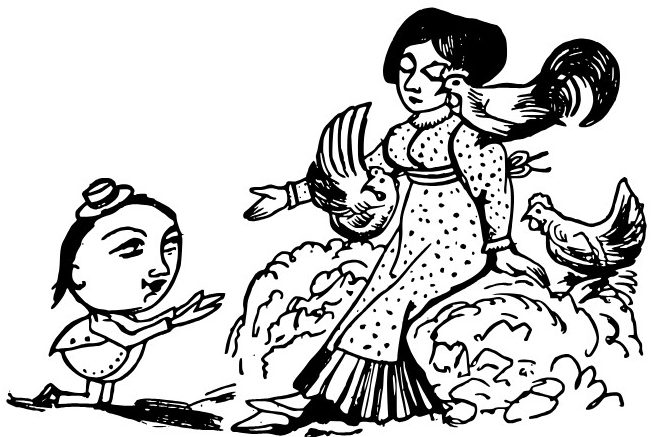
Illustration: by Edward Lear for his poem ‘The Courtship of the Yonghy-Bonghy-Bo’.

Light verse: RHL, ‘Question the Universe’

Odin wrote runey verse
Rumi wrote Sunni verse
Edward Lear? Loony verse.
Question the universe
with your buffoony verse.

*****

Sometimes you jot down a little light piece inspired more by wordplay than anything else, and the more you look at it the more it resonates. This is one such. The characters are diverse, coming from pre-literate Scandinavia, Renaissance-inspiring Islam, and Victorian England – they touch the roots of my cultural identity. They are from the past, but their searches are timeless, fully modern, quintessentially human. And I fully subscribe to the idea that we should question everything, and that the Fool‘s tools of succinct and enigmatic wordplay may be as good an approach as any in trying to formulate – let alone answer – all questions, physical and existential.

It further resonates for me in being published (which I find important); in being published just now in Light (which is a wonderfully reassuring place to be); in having been improved in response to Light’s editorial comments (meaning, yes, I am proud that sometimes I am open to criticism and it’s useful); and in being my 400th poem published (by one of my conflicting counts).

Nothing is definite, not the historical reality of historical and semi-historical figures, not the permanence of printed words, not the definition of a poem, not the count of things hard to define, not the nature of physical reality. So though we have to make prosaic choices based on appearances and best guesses, that should be balanced by questioning everything. Preferably in verse.

TL;DR: Even short poems can be unpacked.

Illustration: DALL-E by RHL, ‘Rumi, Odin and Edward Lear are writing poetry to question the universe’

Susan McLean, ‘Morbid Interest’

How unpleasant to meet Mr. Poe.
It gives a young lady a chill
when, just as she’s saying hello,
he asks if she’s lately been ill.

It was mid-afternoon, yet he seemed
to be tipsy or mildly sedated.
How oddly his mournful eyes gleamed
when he heard that we might be related.

He muttered some rhymes for my name,
saying nothing could be more inspiring
to a poet desirous of fame
than the sight of young beauties expiring.

Then he asked if I had a bad cough
or a semi-conversable crow.
I informed him of where to get off.
How unpleasant to meet Mr. Poe.

*****

Susan McLean writes: “In my teens, I was a big fan of Edgar Allan Poe‘s short stories and poetry. I loved his eerie subjects and crooning, incantatory lines. I memorized his poem ‘To Helen,’ and I parodied his iconic ‘The Raven.’ But in grad school, I read his essay ‘The Philosophy of Composition,’ in which he wrote that “the death . . . of a beautiful woman is unquestionably the most poetical topic in the world.” Hmmm. At that moment, it occurred to me that all of those dead women of his stories and poems might be less an outpouring of personal grief and more a product of an agenda. Years later, when responding to a challenge from the British journal The Spectator to write a poem modeled on Edward Lear’s ‘How pleasant to know Mr. Lear‘ but about another author, I imagined how Poe might seem to a young woman being introduced to him.
This poem, which was originally published in Light Quarterly, was later reprinted in Per
Contra
and in my second poetry book, The Whetstone Misses the Knife.”

Susan McLean has two books of poetry, The Best Disguise and The Whetstone Misses the Knife, and one book of translations of Martial, Selected Epigrams. Her poems have appeared in Light, Lighten Up Online, Measure, Able Muse, and elsewhere. She lives in Iowa City, Iowa.
https://www.pw.org/content/susan_mclean

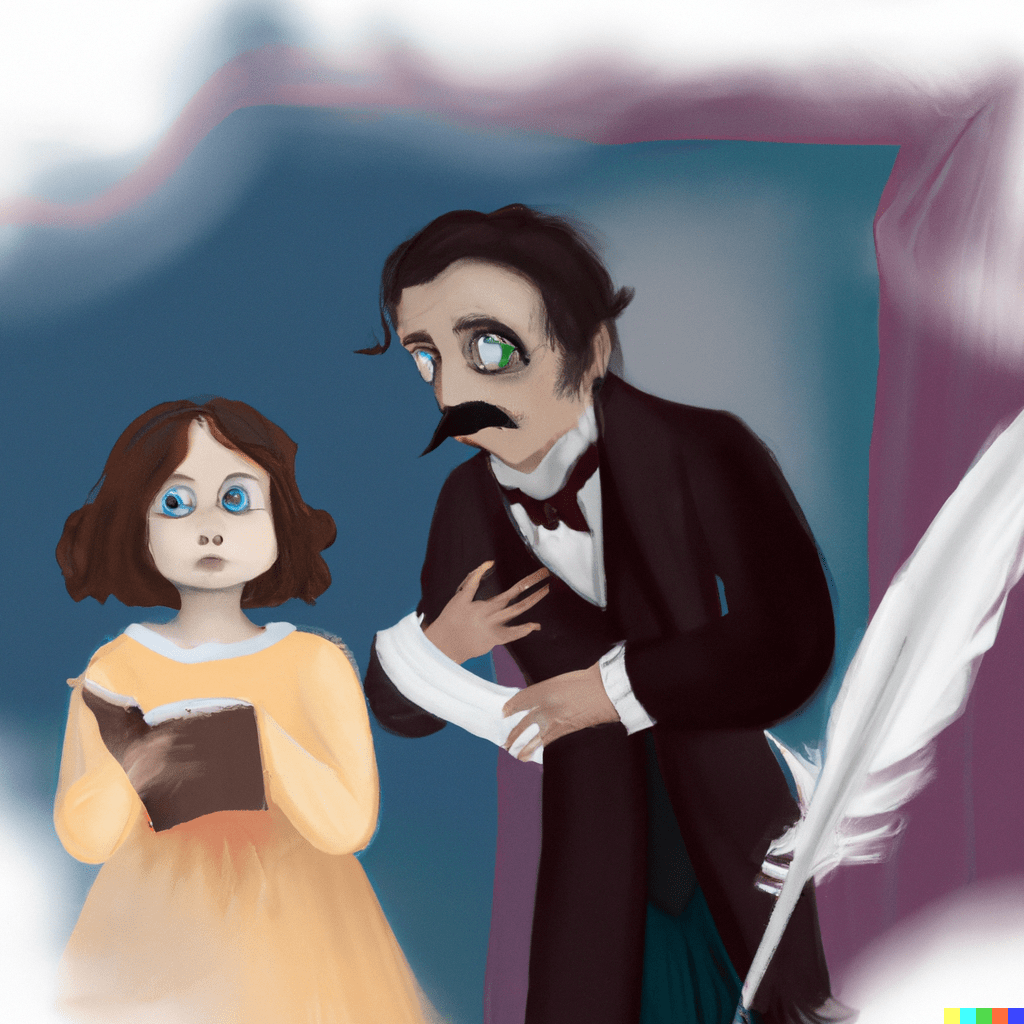
Illustration: DALL-E

Odd poem: Edward Lear, ‘Imitation of the Olden Poets’

Time is a taper waning fast!
Use it, man, well whilst it doth last:
Lest burning downwards it consume away,
Before thou hast commenced the labour of the day.

Time is a pardon of a goodly soil!
Plenty shall crown thine honest toil:
But if uncultivated, rankest weeds
Shall choke the efforts of the rising seeds.

Time is a leasehold of uncertain date!
Granted to thee by everlasting fate.
Neglect not thou, ere thy short term expire,
To save thy soul from ever-burning fire.

This poem is a gorgeous piece of deliberately bad verse. Edward Lear had a wonderful ear for rhythm, and this appalling piece is a great jab at poets who, even to a Victorian like Lear, were long out of date: meaning, syntax and prosody are all garbled, wrapping around bland but unclear moralising exhortations.

The first line of each stanza ends with an exclamation mark even if, as in verse three, it is in the middle of a sentence.

The very first line has four simple feet in iambic tetrameter, eight syllables.
The second line also has eight syllables but manages to make the rhythm stumble through poor phrasing.
The third line has ten syllables; it can be read as iambic pentameter, but the previous lines encourage an attempt to keep to four slightly crowded feet.
The fourth line goes to twelve syllables, at which point the prosody is collapsing towards Lear’s younger contemporary, William McGonagall–you either cram everything into four feet, or let the stanza dribble out in too many iambics.

The second stanza begins “Time is a pardon of a goodly soil!” Very affirmative, but what does it mean? And are we back to pentameters now? It’s not clear–the second line is definitely tetrameter… so how to read the third and fourth lines?

The last stanza is pure iambic pentameter. The chaos is in the confused understanding of time, “a leasehold of uncertain date”, but is somehow part of “everlasting fate”. Similarly “thy short term” is shadowed by “ever-burning fire”. On balance, time appears to be represented as infinite–events are portrayed as everlasting–but time is also called “a leasehold of uncertain date”; that phrase is merely a poor expression that confuses Time with the time of a human’s life.

The poem has been set to music by Bertram Wooster with a Betty Boop video. They credit Lear, and the poem shows up in PoemHunter and a couple of other places… and I want to believe it is Lear… but I’d be happier if I could find more about the origin of the piece.

Candle” by kkalyan is marked with CC BY-SA 2.0.

Potcake Poet’s Choice: Terese Coe, ‘The Bumbly’ (after Edward Lear)

He ran the State in a daze, he did,
In a daze he ran the State:
In spite of howls and obnoxious jeers
And those who said it would end in tears
In a daze he ran the State!
And when the daze became a rout
That turned the country inside out
The Bumbly cried, I’m much too big!
I’m Alpha male, I’m never-fail,
the biggest gig and vig!
In a daze I’ll run the State!

So vast and vain, so vast and vain
Is the bog where the Bumbly brays;
His face is green, to think a strain,
And he ran the State in a daze.

He carried on in a daze, he did,
In a daze he carried on,
With carrion eaters on his staff,
Perpetual sneers and snickery laughs,
And predators stalking prey;
And though they said they’d legislate
They knew too little and much too late,
And worse, they could not stand up straight!
For in their skin was a powerful hate
That chewed them up till dawn.
So vast and vain, so vast and vain
Is the bog where the Bumbly brays;
His face is green, to think a strain,
And he ran the State in a daze.

And while he ran the State, he did,
And flew far over the seas
He incurred great debt and was bought by a bro
With a host of spies and some quid pro quo
And a hive of slithery sleaze.
And he bought a city or two, and some laws,
And when he was fitted with monkey claws
His climbed a tree, shrieked Chee-chee-chee!
And his arms reached down to his knees.
So vast and vain, so vast and vain
Is the bog where the Bumbly brays;
His face is green, to think a strain,
And he ran the State in a daze.

In twenty years they all were dead,
In twenty years or less,
And the people said How good they’re gone!
For they’d been through the muck of the Swamp-a-Thon,
And the dung of Fakery Cess.
And they feasted and drank at the Bumbly grave
With homemade wine and a weeklong rave,
And everyone sang, We shall live in chalets!
If only we live! We’ll attack and raze
The ruins of Fakery Cess!

So vast and vain, so vast and vain
Is the bog where the Bumbly brayed;
His face was green, to think a strain,
And he ran the State in a daze.

Terese Coe writes: “Writing this was more fun than I can say!”

Terese Coe’s poems and translations have appeared in Agenda, Alaska Quarterly Review, The Cincinnati Review, The Moth, New American Writing, New Writing Scotland, Ploughshares, Poetry, Poetry Review, The Stinging Fly, Threepenny Review, and the TLS, among many other journals. Her collection Shot Silk was listed for the 2017 Poets Prize. https://en.wikipedia.org/wiki/Terese_Coe

‘The Bumbly’ was first published in Xavier Review, 2019. Her ‘Apology From Fiji’ appeared in the Potcake Chapbook ‘Tourists and Cannibals’ from Sampson Low Publishers.

Evocative Fragments: Edward Lear

When awful darkness and silence reign
Over the great Gromboolian plain,
Through the long, long wintry nights; —
When the angry breakers roar
As they beat on the rocky shore; —
When Storm-clouds brood on the towering heights
Of the Hills of the Chankly Bore: —

Then, through the vast and gloomy dark,
There moves what seems a fiery spark,
A lonely spark with silvery rays
Piercing the coal-black night, —
A Meteor strange and bright: —
Hither and thither the vision strays,
A single lurid light.

It is, of course, the Dong With a Luminous Nose, wandering crazed through the forests seeking the Jumblie Girl he fell in love with. Edward Lear’s verse is known for its frivolous characters, actions and names, and his scribbly little drawings. But ignore the drawing and note the skill and control, the emotional pull, of the two stanzas above (even if he does sabotage them with words like “Gromboolian”). Similarly he was a remarkable artist when he wanted to be: one of the world’s great ornithological painters, a wonderful landscape artist, and well-enough respected to have given Queen Victoria a dozen lessons in drawing and watercolours in 1846.

Nonsense poetry in itself is a wonderful way to introduce children to literature, if it is handled as skilfully and, yes, emotionally as Lear does with his nonsense poems of travel, romance, heartbreak, and finding (or failing to find) lasting happiness.

Poem: “Bee”

“July Honey Bee” by MattX27 
Through the honeyed halls of Autumn
Hums the angry ageing bee;
As its work faces fruition,
And its life, redundancy.

This little poem was originally published in Candelabrum, a 1970 formalist hold-out that ran for forty years in the UK under Leonard McCarthy. More recently, it was just republished in Jerome Betts’ latest Lighten-Up Online.

Epigrammatic couplets and quatrains, being rhyme- and stress-based, are common throughout Indo-European languages. They hold the same natural place that haiku, senryu and tanka have in syllable-counting Japanese. It is easier to learn by heart a poem whose form uses the natural strengths of the language, rather than something written in a language-inappropriate form.

Similarly, when reading a poem in translation, you get the ideas and the imagery but you normally lose the enhancement of mood caused by the metre, the rhythm of the verse, as well as by the rhyme. So ideas and imagery alone give you prose, not poetry.

Consider the differences in tone of gravity or levity set by rhythm in these opening lines (and you need to read them aloud–in your head if you can do that, otherwise really aloud, in order to hear the rhythm, the beat of the lines):

Let us go then, you and I,
When the evening is spread out against the sky...

I sprang to the stirrup, and Joris, and he;
I galloped, Dirck galloped, we galloped all three...

On the top of the Crumpetty Tree
The Quangle Wangle sat...

The first is meditative, the second full of action, the third is casual, informal… and those moods are set by the rhythm alone.

Metre is an essential component of English poetry. Make the metre-rule your yardstick. Don’t leave home without it.

Limerick: On a Hopeless Romantic


Like Jesus, she felt God-forsaken,
like Joan of Arc, wanted a stake in
     a life full of meaning,
     a life undemeaning—
like Jung, she was simply myth-taken.

This limerick was originally published in Light. As far as I remember, I didn’t have anyone in mind when writing it, it was done for the pure wordplay of the rhythm and rhyme, the repetition of the J-names in the long lines and the near-identical nature of the short lines, and of course the final pun.

Formal verse covers a lot of territory from limericks at one extreme to Paradise Lost at the other. Personally, I’ll take Lear over Milton any day.