Tag Archives: Formal poetry

Sonnets: John Keats’ 64 Sonnets

The 64 extant sonnets of John Keats make for a very interesting read for anyone interested in formal verse. Not only do we have the poet developing his skills and The 64 Sonnets by John Keatsexpression in the last five years of his short life (he was 18 when he wrote his first sonnet, and died at 23), but he consciously experimented with the form, outlining in his letters the shortcomings that he saw in the Petrarchan and Shakespearean versions while he looked for a better structure.
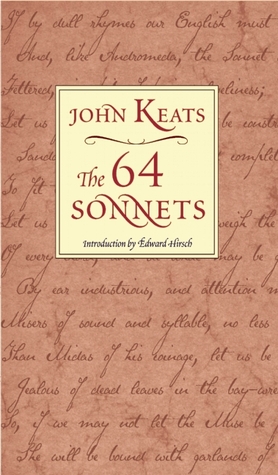
This collection has a useful but insufficient introduction by Edward Hirsch and incompetent notes by Gary Hawkins. Hirsch writes of the development of Keats’ themes, but fails to tie the poems into the details of his life. I suggest reading at least the Wikipedia entry on Keats to get a fuller sense of what was going on in his mind, his life, his environment.

The notes by Hawkins appear to have been thrown together without either care or insight. There is a facing page of three or four comments for each poem, and there is a further note on the rhyme scheme in an appendix at the back. The appendix catches four of the lengthened lines (6 or even 7 feet in a line) but misses three of them; and notes one of the shortened lines but misses another. Worse, the analysis of the rhyme scheme for the technically most interesting sonnet (“If by dull rhymes our English must be chain’d”) fails to understand the structure Keats was creating, despite quoting his comments in the letter containing the poem.

Hawkins gives the structure as
abc ad (d) c abc dede (tercets, quatrain)

This is wrong on so many levels… First, the fifth line’s rhyme is b, not d. Second, there is no quatrain at all. Third, Keats has shown how to analyze the sonnet – which is a single sentence – by breaking it into tercets with the use of semicolons to clarify the structure of his thought. Its structure is
abc; abd; cab; cde; de.

That this doesn’t fit into Hawkins’ categories of Petrarchan and Shakespearean sonnets is precisely the point Keats makes in his letter (“I have been endeavouring to discover a better sonnet stanza than we have”) as well as in the sonnet itself (“Let us find out, if we must be constrain’d, / Sandals more interwoven and complete / To fit the naked foot of Poesy;”)

Hawkins also makes errors of fact and interpretation in the notes facing the sonnets themselves. The very first sonnet, written in 1814, references “the triple kingdom” which Hawkins explains as “Great Britain, composed of England, Scotland and Wales.” Wrong. With the Act of Union of 1801 the three kingdoms of England, Scotland and Ireland were united, as represented by the simultaneous creation of the Union Jack with its combination of the crosses of the three flags. Wales was not a kingdom but a principality, and its flag never figured in the larger national flags.

In the sonnet “How many bards gild the lapses of time!”, Keats writes “A few of them have ever been the food / Of my delighted fancy.” Hawkins annotates this as “namely, the epic poets Milton and Spenser.” Oh really? How about Shakespeare, whom Keats addresses directly as “Chief Poet!” in another sonnet. And this is quite apart from sonnets addressed to Byron, Chatterton, Hunt, and Burns.

I have to smile at Hawkins’ interpretation of “artless daughters”:

Happy is England, sweet her artless daughters;
Enough their simple loveliness for me,
Enough their whitest arms in silence clinging:
Yet do I often warmly burn to see
Beauties of deeper glance, and hear their singing,
And float with them about the summer waters.

Hawkins interprets the “artless daughters” as “Scotland and Wales”. Oh come on! Keats could fall in love at a girl’s glance, at a stranger pulling off a glove. I don’t think he meant Scotland and Wales – he meant girls, classic “English rose” girls, and contrasted them with what he might find in the Mediterranean. Where he went, and died.

Few of the sonnets are near as memorable as “On first looking into Chapman’s Homer” or “When I have fears that I may cease to be”, but they are all readable and rereadable, and to have them as this collection is a treat.

Poetry of Gerard Manley Hopkins

Hopkins being difficult to read, this edition with very insightful introduction and notes by 20th century English poet James Reeves is about as good as it gets.

That said, most of Hopkins’ poetry is uninteresting in content except to a religious person, or to a person interested in poetic technique and the elasticity of the English language. His ‘sprung rhythm’ work and his use of alliteration and assonance draw on Anglo-Saxon rather than Norman French roots, though he frequently uses the sonnet and other rigid structures. His phrasing of his thoughts, however, is idiosyncratic and often dense to the point of unreadability.

His best-known poems date mostly to 1877, when he suddenly felt free to express an ecstatic joy in nature – God’s Grandeur, Pied Beauty, and The Windhover. Spring and Fall (“Margaret, are you grieving / Over Goldengrove unleaving?”) dates from 1880, As Kingfishers Catch Fire a year or two later. Living an isolated and unappreciated and religiously constrained life, his health and emotional balance became ever weaker and his poetry ever bleaker. His last two completed poems, Thou art indeed just, Lord, and To R. B. (Robert Bridges), were written in despair shortly before his death in 1889 at age 44.

His output was not extensive, but half a dozen of his poems posthumously charged and changed English verse forever.

Poetry Resources: The Lyric

As its website says, “Founded in 1921, The Lyric is the oldest magazine in North America in continuous publication devoted to traditional poetry.” It provided one of the only outlets for serious formal verse on the continent throughout the decades in which formal verse seemed otherwise limited to pop songs, advertising jingles and Burma-Shave roadside signs.

The Lyric poetry magazine

The Lyric Foundation, established in the early 1950s, provides financial support for the magazine as well as for the university education of young poets and care for older ones. The magazine is currently edited by the daughters of formalist poet Leslie Mellichamp – he edited it himself until his death in 2000.

The magazine suffers from being somewhat behind the times. It is hard to imagine that it gets the same richness of submissions as other outlets, when it is resolutely old-fashioned in management as well as themes. “Email submissions are only accepted from out of country.”  The tone of the printed work is consequently less varied and dynamic than other formalist and formal-friendly magazines. Even the Foundation that supports it is hard to learn about and, as far as I can tell, has no website.

However The Lyric remains a good resource for new poets, as well as more established ones, to place their work in if it falls within the lyric tradition. And with almost a century of publication behind it, there is hope that it will survive and thrive indefinitely.

Call for Submissions: Careers, Families

The next titles in the Potcake Chapbooks series are tentatively named “Careers and Other Catastrophes” and “Families and Other Fiascoes”. This is a call for submissions to them.

Potcake Chapbooks

Poems should be in formal verse, from 2 to 24 lines in length preferred but up to 50 lines possible, witty, vivid, elegant, and previously published.  Contributors receive five copies, and a discounted rate on additional purchases.

By submitting you acknowledge you are the sole author and give us the right to publish your poem; you retain copyright. Please identify the place of prior publication so that we can acknowledge it. Simultaneous submissions are fine. The chapbooks are scheduled for publication in January/February 2019.

Email in a doc file to robinhelweglarsen -at- gmail.com


Poetry of Louis MacNeice

Louis MacNeice wrote one perfect poem, “The Sunlight on the Garden”. Insightful, wistful, tightly rhymed in a pattern maintained for four stanzas, easy to memorise, it is frequently anthologised and rightly so:

Louis MacNeice, Selected Poems

The sunlight on the garden
Hardens and grows cold,
We cannot cage the minute
Within its nets of gold,
When all is told
We cannot ask for pardon.

Others of his poems are easy to find, “Bagpipe Music”, “The Truisms”, and so on. They and a lot more, including good excerpts from his longer works, are in this excellent selection.

The similarity of much of his work to Auden is clear (for example in “Postscript to Iceland” after their shared journey there), but the thing that intrigued me unexpectedly was the similarity to the poems of T.H. White. The Irish background, English education, writing of cities and countrysides and cultures of both places, the being in Ireland at the outbreak of World War II… the rhyming, the frequently loose structures, the general tone of many of the character sketches… all those aspects of White’s “A Joy Proposed” echoed as I read MacNeice.

MacNeice, however, is without question the superior poet. After all, he wrote one of the most elegant poems in the English language.

Using form for fun: “Auntie’s Model Niece”

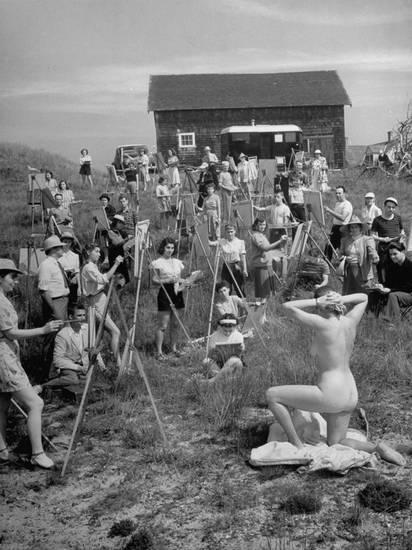
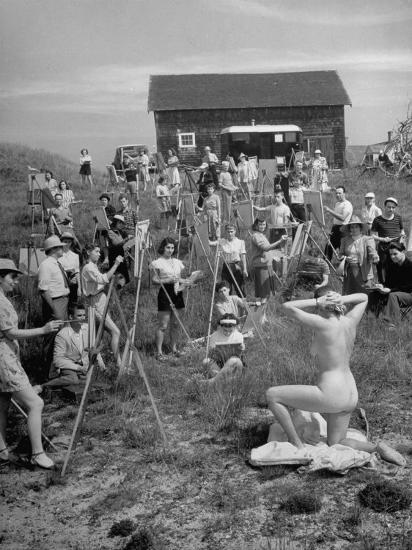
Image result for art school model

Posing bare

AUNTIE’S MODEL NIECE


Auntie got her
Maid to knit a
Set of under-
Wear,

For my frozen
Sister Flo’s end
That was posing
Bare;

Flo then wore ’em
With decorum
And she swore ’em
Grand,

Undismayed by
Undies made by
Auntie’s maid by
Hand!

First published in Snakeskin, republished in The HyperTexts, this poem has been a family favourite. It shows some of the strengths of form: a playful form suits a playful idea, and simple structure and heavy rhyme make the poem easy to learn by heart.

Using form for fun: “Old Sailors”

This poem was written purely for fun–and the use of form was essential.

Lantern Slide - Two Sailors Having a Cigarette

Two old tars

OLD SAILORS

Two tars talked of sealing and sailing; one said with a sigh
“Remember gulls wheeling and wailing, we wondering why,
“And noting bells pealing, sun paling — it vanished like pie!
“And then the boat heeling, sky hailing, the wind getting high,
“And that drunken Yank reeling to railing and retching his rye,
“John missing his Darjeeling jailing, and calling for chai?
“While we battened, all kneeling and nailing, the hurricane nigh,
“And me longing for Ealing, and ailing?” His mate said “Aye-aye;
“I could stand the odd stealing, food staling, not fit for a sty,
“And forget any feeling of failing, too vast to defy –
“Home-leaving your peeling-paint paling too far to espy –
“All because of the healing friend-hailing, the hello! and hi!
“And, with the gulls squealing, quick-scaling the mast to the sky.”

The poem started as an exploration of rhymes for both sealing and sailing, which seemed like interestingly paired words. Many of the rhymes (and the third one, “sigh”) fell easily into a nautical mood. The metre flowed on from “sealing and sailing”. Add in alliteration wherever possible, and look for a coherent story and resolution… and there is the poem.

It was originally published in George Simmers’ online poetry journal, Snakeskin–a highly eclectic journal–and it made for what one reader called a “good nautical rhythm”, and another comment was “finely composed wordy-whirlwind of images”. Both those strengths of the poem come from the use of form: the nautical rhythm from the choice of metre, the whirlwind of images from the requirement to compress everything into the rhyme scheme.

It isn’t a deep, meaningful poem; but form can be used purely for enjoyment.

Poetry Resources: The HyperTexts

One of the most fascinating – as well as ENORMOUS – repositories of poetry on the Internet is a vast, rambling, straggling site called The Hypertexts. The link here will take you to a listing of hundreds and hundreds of good poets, ancient and modern, well-known and obscure, formal and free, with and without expositions by the site’s creator, poet Michael R. Burch.

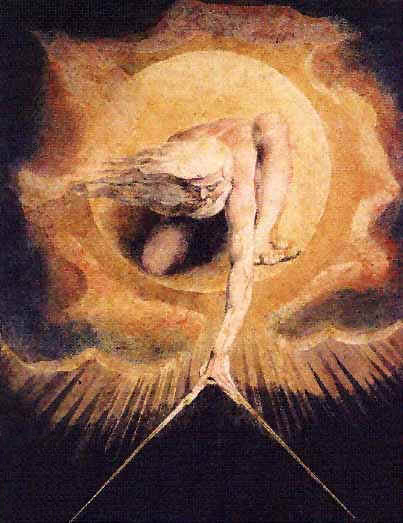
William Blake Ancient of Days

William Blake’s “The Ancient of Days”

Want to read William Blake? Or Ronald Reagan’s (surprisingly competent) verse? They’re both here.

Want to read poems on the Holocaust next to poems on the Nakba, the Palestinian Catastrophe? There’s a whole section on it.

Ancient Greek Epitaphs and Epigrams? Anglo-Saxon Riddles and Kennings? Walt Whitman? Wit and Fluff? Everything you could hope for, with more being added all the time.

Truly one of the greatest resources in the world for lovers of poetry!

Our First Chapbook: “Tourists and Cannibals”

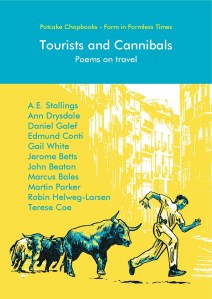
The first chapbook in the Potcake Chapbooks series–“Tourists and Cannibals – poems on travel”–is now out, and available through Sampson Low’s page. It features 11 well-known formal poets (“formal” in the sense of structured rhyme and metre/meter). Spellings wander between British and American, as the poets are writing from half a dozen countries. The variety of voices is part of the charm of the series, from the flippant to the wistful to the analytic, writing in a wide variety of forms.

01 Tourists and Cannibals cover

Alban Low’s drawings capture the right tone!

These chapbooks are made from a single large sheet of high quality bond paper printed both sides in colour, folded four times, cut and stapled. This gives a 16-page booklet, with enough space for a dozen poems and some illustrations by Alban Low. As you can see by the title and the front cover above, the chapbooks are lighthearted.

The poems can’t be too long in a format like this, and lightheartedness is well served by rhythm and rhyme. The chapbooks are designed to be the sort of enjoyable, witty, interruptable collection that serves well on a journey or as a little gift at the price of a fancy greeting card.

But of course their true, insidious intent is to help with the reinvigoration of traditional verse within popular culture. Will this work? We’ll just have to see.


Why “formal” verse?

This blog is dedicated to the proposition that not all poetry is equal – indeed, that not all of it is even poetry. “Poetry” went off the rails in the 20th century for a variety of reasons – accidentally? suicidally? – but it is slowly getting back on track.

Chatterton

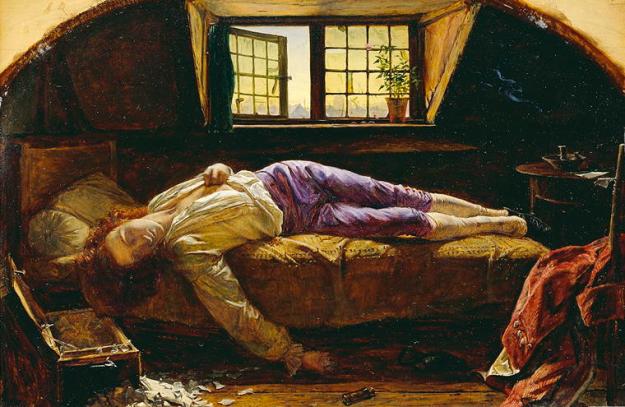
“The Death of Chatterton” – the poet died at 17 (it is uncertain whether he committed suicide or took an accidental overdose, trying to cure himself of venereal disease).

“Poetry – the best words in their best order,” said Coleridge. Aristotle says “rhythm, language and harmony,” and that it is the use of harmony that distinguishes poetry from the other language-based forms. “Harmony” again from Thomas Campion, talking of poetry as the “ioyning of words to harmony”. Ezra Pound rewrites Aristotle’s definition as “Poetry is a composition of words set to music”.

This requirement for “rhythm”, “harmony”, “music” is what has been missing from most of what people styled “poetry” through the last 50 years. But it never goes away from popular culture, because it lives in musicals, rock, c&w, rap, the chants of street protests, and the nursery rhymes and lullabyes sung to babies. It never goes away from popular culture, because it is deeply ingrained in all of us, beginning with the heartbeat that surrounds us before we are born.

And rhyme, rhythm, alliteration and other tricks of formal poetry are not just some meaningless style: they are the hooks on which we hang our memory of the exact words. Ask anyone to recite a poem, and it will be a song, a nursery rhyme, or something else with strong formal elements to it. If you want something to be memorable – not in the sense of remembering the experience, but of remembering a text word for word – if it is anything more than a dozen words, it is far, far more easily remembered if it has rhythm and rhyme.

This blog argues that formal elements are essential to poetry. “Free verse” may be insightful, emotional, witty, descriptive (or, often, none of those), but it isn’t poetry. It’s prose.