Tag Archives: formal verse

Potcake Poet’s Choice: Julia Griffin, ‘The Buck Stops’

A buck stopped here last Saturday early,
Just as the streets were turning blue.
A fine six-pointer, bronzed and burly:
What had it come for? Nobody knew.

It took its stand at the central bus stop,
Silent, proud-footed, thorny-topped.
There perhaps it had once seen us stop;
All that morning, nobody stopped.

It hardly seemed the thing to confront it.
We’ve little practice with bucks or deer;
Anyway, nobody tried to hunt it;
Anyway, nobody asked it here,

Maimed it, lamed it, blamed or shamed it!
This, in fact, is the most one can say:
A buck stopped here and nobody claimed it.
It waited a while, then it wandered away.

Julia Griffin writes: “I like the central image of a buck stopping. And it seems so widely applicable… I turn everything into an animal poem if I can.”

Julia Griffin lives in south-east Georgia/ south-east England. She has published in Light, LUPO, Mezzo Cammin, and some other places, though Poetry and The New Yorker indicate that they would rather publish Marcus Bales than her.

More of her poetry can be found in Light, at https://lightpoetrymagazine.com/?s=julia+g&submit=Search

Poem: ‘Friendly Advice’

“Listen, old feller-me-lad,” he said
With a rugger-player’s laugh
(Not that he was big and brawny,
Only about scrum-half)
“You can muck about till you’re blinking dead
Without a career or a wife,
But (I know that it sounds damn corny)
You’re wasting your bloody life!

“Look, Slater Walker would snap you up!
Anyone can see you’re no fool.
Or why not go round to the Honkers and Shankers?
You’ve been to a decent school.
But before you do, go and have a haircut
You can’t go through life as a clown.
Get a good job! You’ll only thank us
For helping you settle down.

“Work with a Bank, and go overseas,
That’s where you’ll get the best pay.
Look at us: Jill and I are content,
With our two kids, and one on the way.
We’ve enough for a car, and boarding-school fees,
And her clothes, and my drinking and smoking;
And the Bank pays us our large flat’s rent,
And we’ve got our own place in Woking.

“So we’ve got our means, and we’ve got our ends,
And we’re happy through and through;
But you, you do nothing, although you’re clever,
And we worry a bit about you.
Now look, we like you, we’re speaking as friends:
Settle down! Get a job and a wife!
You can’t go on mucking about for ever –
You’re wasting your bloody life!”

In my gap year between school and university I worked in the local Barclays Bank in my home town of Governor’s Harbour. My subsequent university career only lasted a matter of months and I began wandering between countries, but my former boss at Barclays had friendly advice for getting me back on track. His Englishness is there in the poem, which dates itself with references to the once-mighty Slater Walker investment house and with the nickname of the Hongkong & Shanghai Bank before it became HSBC. It was a while ago… if Tim Clark is back in Woking with his wife Jill, they must be in their 90s by now.

The scansion of the poem is a little casual, but there are alternating 4 and 3 feet to a line. The rhyme scheme is tighter, ABCBADCD in each verse. I think it works well as a piece of casual one-sided discussion. First published in Lighten-Up Online – thanks, Jerome Betts!

Photo: “Bored at Work” by D Street is licensed under CC BY-NC-ND 2.0

Poem: ‘Warfare’

The mother’s nightmare
The child’s terror
The rapist’s freedom
The girl’s death.
The killer’s ecstasy
The band’s brotherhood
The youth’s excitement
The dying breath.

The glory of the lucky
The scream of the unlucky
The lost limbs, blindness, madness
The lifelong PTSD, homeless in the streets.
The poet’s puzzle
The politician’s porn
The aphrodisiac
The power-soaked sheets.

The demagogue’s cause
The demagogue’s solution
The warmonger’s profits
The fearmonger’s skill.
The blacksmith’s trade
The scientist’s incentive
The human fascination
The tribe’s need to kill.

The acceptance by the boys
The eagerness of teens
The avoidance by the men
The manipulation by the old.
The girl’s adoration
The woman’s greed
The widow’s grief
The body cold.

The king’s invocation
The priest’s sanctification
The scared population
The desolation.

The peasant’s loss
The trader’s loss
The teacher’s loss
The city’s loss.

The mortician’s gain
The tombstone maker’s gain
The coffin maker’s gain
The graveyard’s gain.

The medal maker’s gain.

And over it all God sits in His rocking chair
On His front porch in the sky
Saying, A crop, a very fine crop, an excellent crop this year.

Sits in His deck chair to look at the warfare waves
In the shade of a cloud in the sky
Watching the sandcastles washing away.

Sits in the night coming down on the battlefield
Watching crows, ravens, hyenas, stray dogs
Men and women pulling gold teeth from the dead.

Sits in His laboratory, looking at His guinea pigs
Sits in His concert hall, listening to the music
Thinking, All this is so interesting
All this is so tragic
All so inspiring
How far will they get till they blow themselves up?
Will these ones escape? Will they figure it out?
Can they conquer themselves and discover the universe?

Maybe it’s out of line to put this poem into a ‘formal verse’ blog… But there are two points to consider. First, there is a lot of form in the outraged chant of the beginning half–rhyme, rhythm, balance, some alliteration. Second, transitioning from that form to a less structured meditation in itself a use of form; it transitions the entire poem from one viewpoint to another by making the two halves so different. That’s my argument, anyway. Is it reasonable?

The poem originally appeared in Bewildering Stories. Thanks Don Webb and John Stocks!

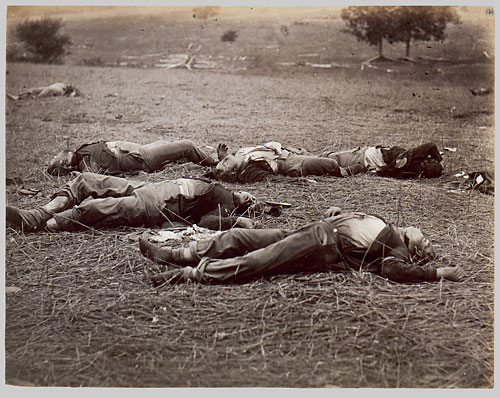
Photo: “Battlefield Dead After the Battle of Gettysburg” by elycefeliz is licensed under CC BY-NC-ND 2.0

Updated Call for Submissions: Potcake Chapbooks

I am always keen to read and consider rhymed and metered verse that has already been published. There are several chapbooks that are jostling in the queue for completion and publication:

Travels and Travails (travel)
City! O city! (urban life)
Just a Little Naughty
Portraits Unpleasant
Various Heresies (religion)
Lost Loves
The Horror of Spring! (seasons)

and there are more; but the last one, Rockets and Robots, wasn’t part of my original plans: I just ran across a bunch of Science Fiction poems that I liked, and they filled a chapbook nicely. So I’m an unashamed opportunist. I’ll modify my plans if I think something better is available. All the chapbooks listed above are nearly full already but, as with all of them, if I run across another poem I really like, I’ll include it. And if I receive enough good poems on an unplanned theme, that theme will get slotted in.

When there is enough good material on a single theme to fill 13 pages of a chapbook (still leaving room for Alban’s artwork, of course), then it may become the next project. But until a chapbook actually goes to print everything is subject to change. An even better poem may show up and displace one tentatively placed. A slew (or slough) of poems on a new theme may cause a reprioritisation of planned chapbooks.

This is one of the reasons that I prefer to consider only poems that have already been published–so that I don’t feel guilty about having a bunch of poems that will sit with me for months, years, and may or may not be included in the Potcake series. I have flagged a thousand poems that interest me; but I can only publish a dozen in a chapbook, and only a few chapbooks will get produced in a year.

Poems in the chapbooks run from two or three lines to some 40 lines in length–obviously, with space at a premium, poems over 20 lines and running over one page are less likely to be included… but it does happen. Other criteria: I’m looking for wit, elegance, a variety of traditional and nonce forms, a variety of voices and moods: happy, sad, angry, sardonic, meditative… anything interesting I can scrounge. If you have something you think I might like, on any topic, please send it along to robinhelweglarsen@gmail.com

I can’t promise to use it, but I will read it and reply!

Launch: Potcake Chapbook 9, ‘Robots and Rockets’

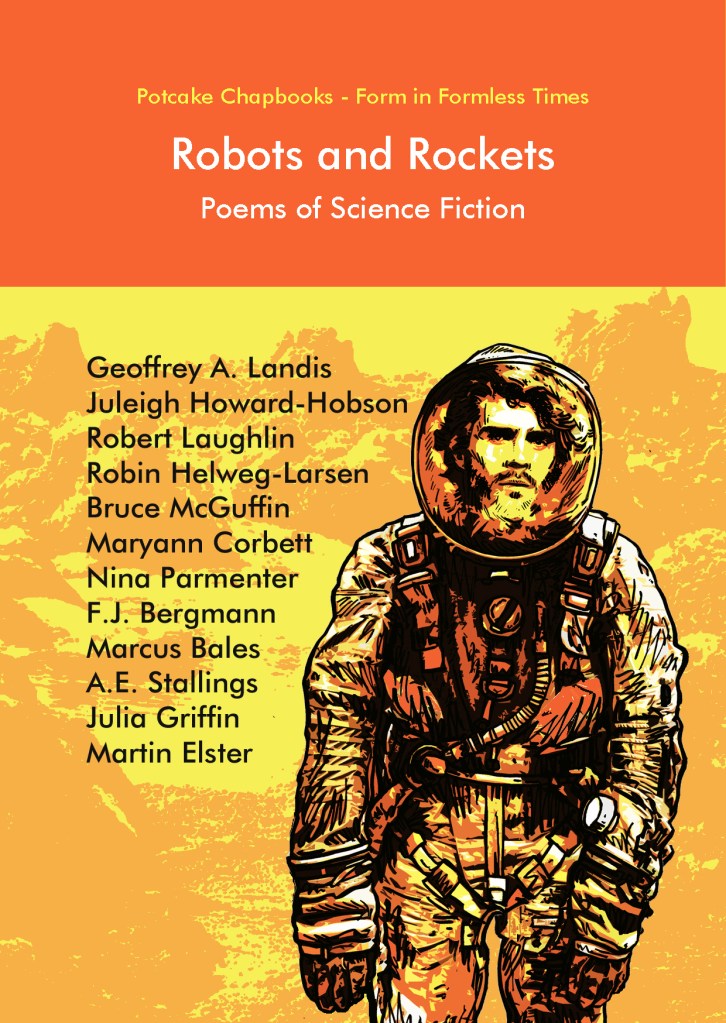
I’m very happy to announce that the ninth in the series of Potcake Chapbooks has been launched into orbit: ‘Robots and Rockets’ is an SF issue (could you guess?) and has poems by five newcomers to the series: Bruce McGuffin, Juleigh Howard-Hobson, F.J. Bergmann, Julia Griffin and Geoffrey A. Landis – many already known outside SF through Light poetry magazine and other places. Returning poets are Maryann Corbett, Nina Parmenter, Marcus Bales, A.E. Stallings, Martin Elster and myself.

Copies can be ordered from Sampson Low for four or five Pounds or Dollars, including postage worldwide. Enjoy it! It is, of course, a blast(-off)!

Potcake Poet’s Choice: Kate Bernadette Benedict, ‘The Sureties’

Some things you can still rely on.
Forsythia hedges contribute their usual yellow;
Callery pears exhibit their annual white.
The vernal light is cast as it was cast last year—
Cimmerian, then milky, then bright.
Tulips accrue, woodpeckers adhere
to their nourishing boles, a piccolo.
sounds in the park. Lovers have new grass to lie on.

Some things you can still depend on.
I buried my mother today in the family plot.
Her ashes were housed inside a simple casket—
an easy-to-carry container with little heft,
light as an already plundered Easter basket
when only a couple of elegant eggs are left.
I’d been there before; I’d stood on the very spot.
I’m accustomed to the conditions that lives end on.

Kate Bernadette Benedict writes: “Sureties are few in life yet I feel sure that many of us today are going through our daily motions in an elegiac mood—because of the pandemic, of course, and the illness and deaths we learn of on the news and experience in our lives. Last spring (2020), we were all in a panic and this spring we are, perhaps, inured to loss, at least to some degree. So I feel this poem about spring and death fits my mood perfectly, and perhaps the mood of you, the reader, too.”

Kate Bernadette Benedict may have lost a portion of herself when she took on her pen name; still, she has grown accustomed to its saintly qualities which represent, she well knows, an unattainable goal. She is the author of three full-length collections, the most recent being Earthly Use: New and Selected Poems. Kate has been holed up for a year in her apartment in Riverdale, the Bronx, but is now twice-jabbed and hopes to be re-materializing very soon. Her website suffered a crash but some content is still readable at katebenedict.com, where links to three formal-friendly publications may be found: Umbrella, Bumbershoot, and Tilt-a-Whirl.

Short poem: ‘Nothing’s Yours Always’

Nothing’s yours always, anyhow,
And Time shall lift from off your brow
Your troubles, wrinkles, hat and wig,
Leave you the basis for “long pig”.

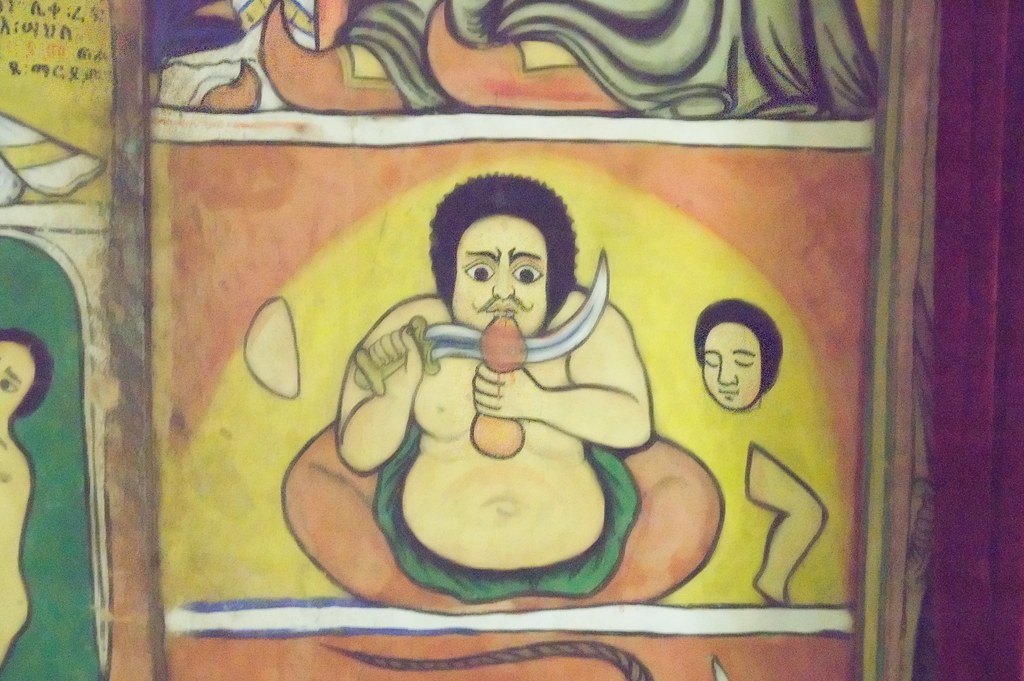
So many unusual foods are described as “tastes like chicken”; it’s worth remembering that there is one that apparently tastes like pork. And really, when you’re dead, does it matter who benefits from the recycling of your atoms? The picture is of a figure from Ethiopian legend, Belai the Cannibal.

This poem was published in Metverse Muse, a long-established Indian journal that champions traditional verse, edited by Dr. Tulsi Hanamanthu.

Photo: “Belai the Cannibal” by A.Davey is licensed under CC BY 2.0

Short Poem: ‘The Hitchhiker’

Sometimes you’d sell your soul just to get warm! –
Your clothes are rags in the wind, your skin goes blue,
You doubt your mouth can ever smile again;
The lonely world grows dark before the storm
Whose icy rain’s a mile away… and then,
The sun breaks through!

I used to do a lot of hitchhiking – 25,000 miles is my best estimate, on five continents. It can be miserable, it can be ecstatic, but as a way of exploring the world without plans and preconceptions, it’s hard to beat. It used to be safe, then it became unsafe, but now it’s probably safe again – if you send a picture of the vehicle from your cell phone before you get in. Or if you live on an island with no public transportation, where everyone seems to know everyone and it’s just common courtesy to give people a ride.

The poem was published in the now-defunct Candelabrum, a twice-yearly British publication that championed traditional verse through the darkest days of “free verse” from 1970 to 2010. The magazine has ceased publication, but thank goodness the sun has broken through again!

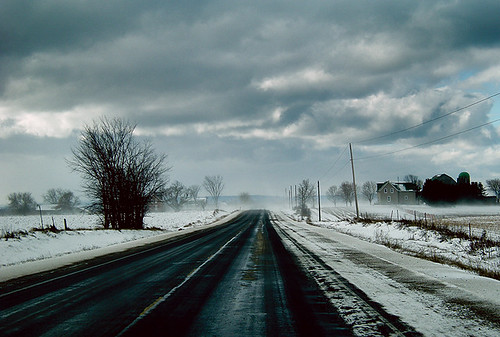
“Winter Road” by ryanmcgilchrist is licensed under CC BY-SA 2.0

Political poems: Byron on Castlereagh

Posterity will ne’er survey
a Nobler grave than this:
Here lie the bones of Castlereagh:
Stop, traveller, and p*** !

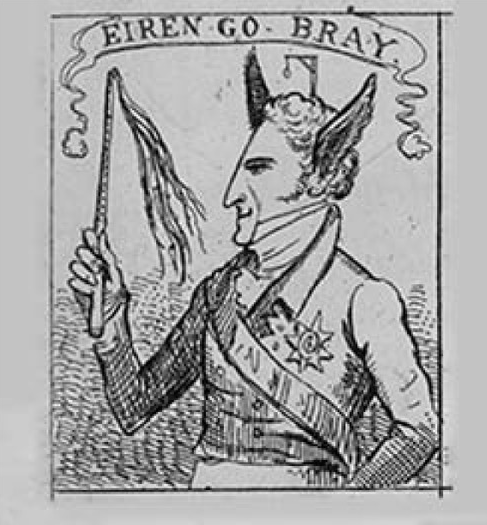
Robert Stewart, Viscount Castlereagh (which rhymes with “pray”, if you choose to have that, rather than “piss”, as the last word of Byron’s little poem) was an Anglo-Irish politician who managed to make himself throughly hated.

Though generally in favour of concessions to the Irish he did not support Catholic Emancipation from the discrimination and civil disabilities they suffered under as disenfranchised second-class citizens. He took the lead in suppressing the Irish Rebellion of 1798; he advocated leniency to the common people but had leaders executed – including a Presbyterian minister who had canvassed for him in an election. From 1812 to 1822 he was the British Foreign Secretary, instrumental in managing the alliance that defeated Napoleon; and then at the Congress of Vienna, with the conservative Bourbons back on the throne of France, he advocated leniency for France and non-intervention by the UK in European affairs – which was seen as siding with the repressive Eastern European powers. This is from the ‘Dedication’ to Byron’s ‘Don Juan’:

Cold-blooded, smooth-faced, placid miscreant
Dabbling its sleek young hands in Erin’s gore,
And thus for wider carnage taught to pant,
Transferred to gorge upon a sister shore
The vulgarest tool that Tyranny could want,
With just enough of talent, and no more,
To lengthen fetters by another fixed,
And offer poison long already mixed.

Castlereagh’s suicide in 1822 further occasioned this from Byron:

Oh, Castlereagh! thou art a patriot now;
Cato died for his country, so didst thou:
He perish’d rather than see Rome en­slaved,
Thou cutt’ st thy throat that Britain may be saved!
So Castlereagh has cut his throat!–The worst
Of this is, – that his own was not the first.
So He has cut his throat at last!–He! Who?
The man who cut his country’s long ago.

Odd poem: ‘Changsha’ by Mao Zedong

Alone I stand in the autumn cold
On the tip of Orange Island,
The Xiang flowing northward;
I see a thousand hills crimsoned through
By their serried woods deep-dyed,
And a hundred barges vying
Over crystal blue waters.
Eagles cleave the air,
Fish glide under the shallow water;
Under freezing skies a million creatures contend in freedom.
Brooding over this immensity,
I ask, on this bondless land
Who rules over man’s destiny?
I was here with a throng of companions,
Vivid yet those crowded months and years.
Young we were, schoolmates,
At life’s full flowering;
Filled with student enthusiasm
Boldly we cast all restraints aside.
Pointing to our mountains and rivers,
Setting people afire with our words,
We counted the mighty no more than muck.
Remember still
How, venturing midstream, we struck the waters
And the waves stayed the speeding boats?

Mao Zedong wrote this poem in 1925, when he was 31. He had previously spent five years in Changsha at university, young, bold and enthusiastic. Now he returned, reflected, remembering his student days, pondering the land’s immensity and the nature of destiny, and he wrote his poem. And today the young Mao gazes again at the river from Orange Island… or would, if it wasn’t just a stone statue of his head.

Despite his revolutionary tendencies in other areas, Mao wrote in Classical Chinese verse. ‘Changsha’ is annotated “to the tune of Chin Yuan Chun”, marking it as belonging to the type of verse called tzu. The tzu originated in the Tang Dynasty (618-907 CE) as lines sung to certain tunes. Each tune prescribes a strict tonal pattern and rhyme scheme, with a fixed number of lines of a standardised varying length. Obviously, a translation into a European language is going to lose the structural form inherent in the original. Mao may not be one of the best Chinese poets, but his poems are generally considered to have literary quality. Arthur Waley, the eminent British translator of Chinese literature, however, described Mao’s poetry as “not as bad as Hitler’s paintings, but not as good as Churchill’s.”

Photo: “A young Chairman Mao” by timzachernuk is licensed under CC BY-NC 2.0