Things have a tendency to lose themselves: hammer, needle, the necessary spring, a button, the keys–they disappear like elves, like roses, wishes, the words for everything.
Dive in. Ransack a drawerful of debris. Wrestle with irritation, grief, self-doubt. One earring, that pen, eyesight, dignity: small things we learn, in time, to do without.
***** Barbara Loots writes: “The small losses and lapses of memory that happen to everyone seem more vivid and alarming as I grow older. I realize that it isn’t things but myself I must gradually, inevitably let go of. Even so, the vast, abundant universe brings perspective to the human situation, including mine.”
Barbara Loots resides with her husband, Bill Dickinson, and their boss Bob the Cat in the historic Hyde Park neighborhood of Kansas City, Missouri. Her poems have appeared in literary magazines, anthologies, and textbooks since the 1970s. She is a frequent contributor to lightpoetrymagazine.com. Her three collections are Road Trip (2014), Windshift (2018), and The Beekeeper and other love poems (2020), at Kelsay Books or amazon. More bio and blog at barbaraloots.com
Unpacking it, we wondered who had sent it and why they felt we needed it. We thought we’d managed fine without it. Had they meant it as tribute or rebuke? We had been taught to view unsought donations with suspicion. Inspecting it, we found a hairline crack. It doesn’t suit our taste or disposition. In short, we must insist they take it back.
*****
Susan McLean writes: “Finding new meanings in old phrases is one of my favorite games. In the case of the poem’s title, I was thinking about how each generation wants to pass along advice to the next generation, which the next generation tends to reject. Advice always feels like criticism, however well intended it may be. Moreover, the world is changing so fast that advice that worked for one generation no longer fits the reality of the next generation.
“The alternating feminine and masculine rhymes in the poem are meant to mimic the interplay between two generations, or any two groups that have differing views. ‘Received Wisdom’ was originally published in Free Inquiry and later appeared in my second book of poems, The Whetstone Misses the Knife.”
Susan McLean has two books of poetry, The Best Disguise and The Whetstone Misses the Knife, and one book of translations of Martial, Selected Epigrams. Her poems have appeared in Light, Lighten Up Online, Measure, Able Muse, and elsewhere. She lives in Iowa City, Iowa. https://www.pw.org/content/susan_mclean
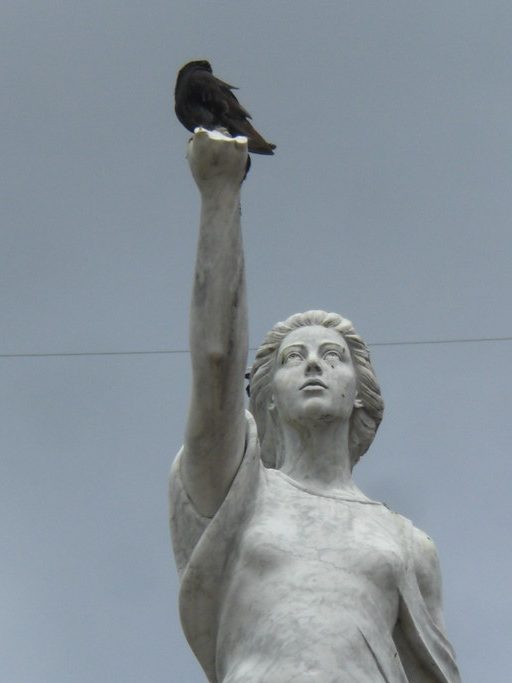
It doesn’t caw or hunt or fly. It can’t peck anybody’s eye, or even grow a single lousy feather. One-clawed, no match for any tom, it’s stranded on a leafless palm, regardless of the season, time or weather.
Yet what’s the bird that, all alone, sticks up for you when gibes have flown and you don’t care to verbalize or linger; when someone’s mocked you to your face or cut you off or swiped your space – what bird? The one that moonlights as a finger.
*****
Melissa Balmain writes: “I’m pretty sure this would have been the Sphinx’s riddle if she had guarded the Brooklyn Bridge.”
Melissa Balmain’s third poetry collection, Satan Talks to His Therapist, is available from Paul Dry Books (and from all the usual retail empires). Balmain is the editor-in-chief of Light, America’s longest-running journal of light verse, and has been a member of the University of Rochester’s English Department since 2010. She will teach a three-day workshop on comic poetry at the Poetry by the Sea conference in Madison, CT, in May 2024.
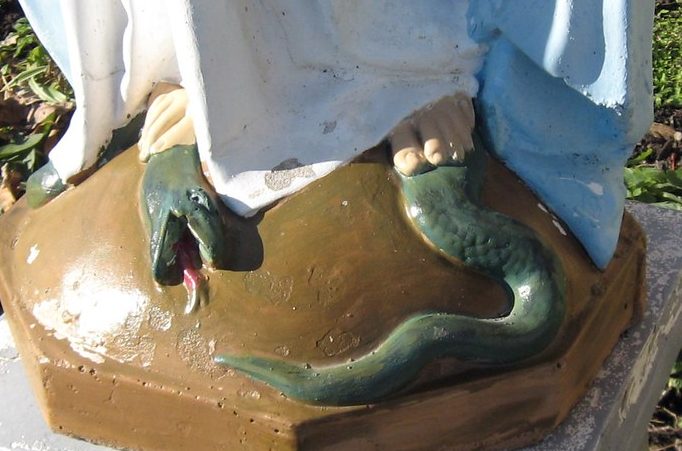
One sunny morning, strolling in my garden, I stumbled, and my foot crushed something’s head. “Me dammit!” I exclaimed, “I beg your pardon”, Looked down, and saw my Serpent lying dead.
Now this was most vexatious, for I’d planned That this poor snake would implement my scheme To give my little friends a helping hand, And lead them gently from their childish dream.
The Serpent was supposed to tempt the couple With luscious fruit that Eden’s trees bedecks; My chosen agent, sinuous and supple, Would lead the pair to knowledge – and to sex.
Omniscience can have its limitations, And even Godly schemes may gang agley. I’d once envisaged teeming populations, But this, perhaps, was better, in its way.
No Spanish Inquisition, no Crusades, No slaves, and no Industrial Revolution, No mining sites where once were leafy glades, No factory chimneys belching out pollution.
No nation-states, no border wars to settle, No Holocaust, no tribal genocide, No Rap, no Hip-Hop, Punk or Heavy Metal, No hamburgers with coleslaw on the side.
No guns, no bullets, no demented shooters, Since nothing could be made, except of wood; No mobile phones (thank Me!) and no computers … I looked on all of this, and found it good.
Yet what of those who should have lived hereafter? No Homer, Shakespeare, Mozart, Botticelli? No P. G. Wodehouse? (I was fond of laughter, Though, being God, I didn’t have a belly).
Descendants all, but only if they had ’em. (No Michelangelo, no Sistine Chapel?) My mind made up, I called to Eve and Adam: “I wondered if you’d care to try an apple?”
*****
Brian Allgar writes: “As a devout atheist, I felt it my duty to shed some light on the truth behind the Creation myth.”
Brian Allgar was born a mere 22 months before Adolf Hitler committed suicide, although no causal connection between the two events has ever been firmly established. Despite having lived in Paris since 1982, he remains immutably English. He started entering humorous competitions in 1967, but took a 35-year break, finally re-emerging in 2011 as a kind of Rip Van Winkle of the literary competition world. He also drinks malt whisky and writes music, which may explain his fondness for Mendelssohn’s Scottish Symphony.
In times of no change, the advantage lies with those who are receptive to being taught. Parents and teachers may seem truly wise, avoiding dangers with which life is fraught; the stories of the old none would despise when they hold all the answers that are sought.
In times of constant change, advantage shifts to those who, hating school, go and explore. Old answers fail. Fresh questions cause great rifts with parents who are seen as wise no more; questions now turn up unexpected gifts in crossing unknown seas to virgin shores.
Remain alert that there’s a range of change from none, to gradual, to fast, to strange.
*****
A sonnet, or not? 14 lines of iambic pentameter, rhyming regularly and with a final couplet. Though not in either of the standard English forms, it has the organised, compressed, reflective sense of the sonnet. Recently published in Shot Glass Journal, Online Journal of Short Poetry. Thanks, Mary-Jane Grandinetti!
Illegals, both of us; married last year, now she cleans houses, I cut grass, sweep decks, for superrich who see us as mere specks while their big spaceship exit they prepare. Earth will be fishless, treeless, plastic, bare. They’ve offered us both jobs as restaveks, but I said No, they just want us for sex. She said Then suck them off, why should you care? I said, We’ll stay. She said, I said I’d go. I said, You’d leave me? She said, Stay, be dead. I said, That makes you nothing but a whore. She said, I fucked him for your job, you know; I go to space, I’ll live, have food, have bed, and, if I’m good, oh maybe so much more…
*****
“Restavek” is normally a term for a child of an impoverished Haitian family, sent to live as a domestic servant for a wealthier (or less poor) family. There are an estimated 300,000 in Haiti, mostly girls; and an unknown number in the Haitian communities in the US.
This sonnet (Petrarchan, rhyming ABBA ABBA CDE CDE) was recently published in the frequently NSFW Rat’s Ass Review – thanks, Roderick Bates!
Two rows of heads puffed white for show are turned to watch the gurney go parade-like down the hall and through the double doors, and out of view.
They linger, as the swinging doors are gazed to stillness, and intercourse is but the mingling of silhouettes. Beyond the tumults of regret
and wonder, they are elsewhere, all their architecture of recall connecting lives to family plots, or maybe – further back – in what
may be a keepsake memory – light parade, perhaps – a child’s delight in clowns and cotton candy, high and wispy as puffed hair. Friends die
often, but not in violence – not here, where death comes to the sense in not-quite-joy, and not-quite-grief, but trembling, lightly, like a leaf
that might be blown, or not, or light as dandelion fields puffed white and wispy, wavering. In slow surmise they gaze on quiet with quiet eyes,
filling the hall with noiselessness, and dreaming but to acquiesce to dream, and but to linger some in thrall to stillness yet to come.
*****
Brian Gavin writes: “My poem sort of rips off (shamelessly!) the form and rhyme scheme of the famous A E Housman poem ‘To An Athlete Dying Young‘. It is, however, about a different kind of death – extreme old age – and the gentleness of it. It’s based on something I actually saw in a nursing home, when white heads once leaned out of their rooms to see a friend taken away on a gurney. The image of a parade struck me, and the heads of puffed white hair reminded me of cotton candy at the parades of my youth. Eventually the images of puffed hair and puffed candy morphed into a field of puffed white dandelions wavering in the wind. I almost left the title at ‘Death Watch‘ – which I kind of preferred for the double meaning – but opted to add the rest of it for the sake of clarity. This piece ran in my collection Burial Grounds.”
That is the country we go to, all of us Made young again by music, smooth with oil And lust, all generations generous With youth and laughter. Couples coil And uncoil, casually amorous, With booze in the blender and shrimp beginning to boil. Everybody dreams they have the chance To chase the charms and challenge of romance.
A laughing bard is the essential thing. A patterned shirt, an old six-string guitar, Who urges us to sing and louder sing And clap and dance and order from the bar, And thank hard-working servers as they bring The stuff that lubricates this whole bazaar. And though the bard is covering the bill, Tip well when you’re in Margaritaville.
Oh, parrotheads — imagination’s fire Illuminates the marvel of it all, And conjures every sorcery we require, The call to the response, response to call, A consummation fevered with desire, Beatified by the local alcohol. The song creates the dream. The dream creates Another song the dreamer celebrates.
And once reality is far away, Our youth returned, our stamina restored, We eat and drink and sing and dance and play And manifest ourselves within each chord As if we might entrance ourselves to stay Within this reverie we’ve found aboard The magic vessel Margaritaville, Distilling what distillers can’t distill.
*****
Marcus Bales writes: “Someone immediately floated a raft of shit my way over this poem, claiming, in a local Cleveland group generally given to local music, that I’m normalizing alcoholism. I know — it’s an astonishing misinterpretation, but there it is. And in spite of my protestations, he insisted on shouting that I was a lush, a drunk, and an idiot for promoting and approving a disease. Well, it’s not as if poets aren’t used to being misunderstood.
The odd thing to me about this is that I work hard to trigger people through poetry. That’s what art does, in my view, confront us with our frauds and foibles, and makes us look at them in detail. If, of course, we read poetry at all. There must be some corollary to Murphy’s Law that states that when a poem can be misinterpreted it will be misinterpreted. Normally I’m delighted by responses to my poems that are outraged and offended, because normally those responses are from the people I’m trying to outrage and offend. But this blindsided me. The entire Jimmy Buffett phenomenon was built on the fantasy of sun and sand and sea, which is only tangentially alcohol-fueled. No doubt alcohol plays a role in lubricating the enchantment, but it’s the enchantment people go for, not alcoholism.
And that enchantment is powerful. It makes people wear loud clothes and play loud music. But the central lure is that we can think of ourselves as all multi-talented and tanned, slim and young and horny. It’s not the lure of tales of drunkenness and cruelty on a summer afternoon, but rather the opposite: tales of slightly disreputable fun, but tales of the lure of the freedoms from regimentation for the freedoms of a more relaxed like-minded culture where everyone is youthfully attractive and eagerly lascivious.
And what a lure! Even those of us whose only encounter with youthfully attractive and eagerly lascivious were our own dreams had those dreams. And with Jimmy Buffett the price of admission was a seducing tune and a clever lyric. You didn’t need a white sportcoat, much less a pink crustacean. All you needed was a sense of lockstepness of the modern bourgeoisie and a desire to escape it. The whole thing is all in your mind. You create your own sensitive young poet self in a lubricious setting among the young and eager to love you. It’s thrilling, it’s fulfilling, it’s art.”
*****
(Editor’s note: From the title, to the ottava rima form, to the themes, ‘Sailing to Margaritaville’ pays homage to Jimmy Buffett by riffing on W.B. Yeats’ ‘Sailing to Byzantium‘. Beginning with Yeats’ opening words, “That is no country for old men” and all the way through, Bales echoes and plays with Yeats’ words, bringing everything to Buffett’s Margaritaville.)
Not much is known about Marcus Bales except that he lives and works in Cleveland, Ohio, and that his work has not been published in Poetry or The New Yorker. However his ‘51 Poems‘ is available from Amazon. He has been published in several of the Potcake Chapbooks (‘Form in Formless Times’).
If we could but instill in Life–that hack!– The element’ry rules of composition, Prevent the crude and sloppy maniac From spoiling every scene with his tradition Of shouting in our faces like a pack Of drunken sailors wailing their rendition Of “Captown Races” or “My Drawlin’ Clementime,” Their rhythmic belching almost keeping them in time.
For Life to utilize the art of Art Could help in many ways that we could mention. Some structure and suspense would be a start. To get us upright in our seats, fists clenchin’, A little rising action would be smart (Or something that would help us pay attention, Instead of simply zoning out a lot And missing half the details of the plot).
But Life, I fear, shall never learn to craft A decent tale. (It hasn’t that ambition.) It uses characters extremely daft, And wastes far too much time in exposition. It never bothers to revise a draft, Too taken with its own first thoughts. Perdition! Each aspect of the story is a shame– And worst, the ending’s always just the same.
Max Gutmann writes: “Don Juan Finish’d fancifully completes Lord Byron’s unfinished comic epic. Excerpts have been contributed to Light, Lighten Up Online, Orbis, Slant, Think, the website of the Byron Society, and Pulsebeat, where ‘Life, That Hack!’ is among the excerpts to have appeared. The complete poem is still unpublished, though I privately printed some copies to share with friends and colleagues. Like Byron’s poem, Don Juan Finish’d is often philosophical, at times facetiously, as here.”
Editor’s note: As with Byron’s original, Gutmann’s Don Juan Finish’d is written in ottava rima: eight-line stanzas in iambic pentameter rhyming ABABABCC, with the final line or two typically used to humorously deflate whatever more high-sounding statements were made earlier in the stanza.
Max Gutmann has worked as, among other things, a stage manager, a journalist, a teacher, an editor, a clerk, a factory worker, a community service officer, the business manager of an improv troupe, and a performer in a Daffy Duck costume. Occasionally, he has even earned money writing plays and poems.
Although not of their class, I went to church with Bryce and Nicky in the congregation. In a shop’s parking lot and in the lurch I asked Bryce for a job, loan, or donation. Then Nicky’s car came up and Bryce got in, the bastards swerved to hit me, ran me down; when I got up, they ran me down again, hit the wall with their car, left with a frown. They don’t apologise, don’t feel the need – “You caused it all ill-manneredly,” they say. “Our car was damaged too.” (But did they bleed?) I bothered them; they wanted me away. The congregation says “Forgive, forget.” Decades have passed. Forget? Forgive? Not yet.
*****
This Shakespearean sonnet (iambic pentameter, rhyming ABAB CDCD EFEF GG) has just been published in this month’s Snakeskin. Editor George Simmers expressed concern that it might be a true story… let me reassure everyone, I neither attend church nor get hit by cars. The poem is at most a parable, a parabolic approach to events.




 Form in Formless Times