Tag Archives: rhyme

New magazine’s Call For Submissions – Pulsebeat Poetry Journal

Poet (and engineer) David Stephenson contacted me recently with the message “I am starting a new journal, Pulsebeat Poetry Journal, for poems with a strong musical element, especially poems in meter and rhyme. I don’t think there are enough venues for rhyming poetry.” He is putting out a general Call for Submissions on his web page https://pulsebeatpoetry.com/guidelines/

“Poems full of music, using meter and rhyme or other means, previously unpublished… Theme should be the human condition… Submissions by December 31, 2021, for the first issue to be posted in January, 2022.” More submission details are at that link above.

David Stephenson has published in The Formalist, The Lyric, etc. His ‘Rhythm and Blues‘ won the Richard Wilbur Award in 2007, which puts him in excellent company. On the Masthead page of his web site you can find links to more recent poems of his, published in Autumn Sky Poetry and Avatar Review.

I look forward to reading the Pulsebeat Poetry Journal, and wish David Stephenson good luck with the venture.

Review: ‘101 Sonnets’ edited by Don Paterson

This has to rank as one of the all-time great poetry anthologies. Yes, it contains only sonnets. Yes, several of them are dense in structure or in language (several are in Scots, with words and phrases translated in footnotes). Yes, there is only one sonnet per poet. It is very rich material, and took me a couple of weeks for a first read because there is a lot of absorb. And it has a fabulous Introduction by the British editor Don Paterson – a well-respected poet who avoided including any sonnet of his own.

The sonnets are not put into any formal grouping, but rather flow conversationally from one to the next, the themes often shifting through unexpected juxtaposition. So the first nine run through an amazing sequence of idealised love, woman as muse, kissing, sensual religiosity, obscenity, and charm. It starts with Robert Frost’s
She is as in a field a silken tent
and progresses to Robert Graves’ woman/muse
This they know well: the Goddess yet abides.
Though each new lovely woman whom She rides

to Jo Shapcott’s ‘Muse’
When I kiss you in all the folding places
to Alexander Montgomerie’s
So swete a kis yistrene fra thee I reft
to Wilfred Owen’s
Between the brown hands of a server-lad
The silver cross was offered to be kissed

John Donne’s
Batter my heart, three-personed God
William Alabaster’s ‘Upon the Crucifix’
Feed greedy eyes and from hence never rove,
Suck hungry soul of this eternal store,
Issue my heart from thy two-leaved door,
And let my lips from kissing not remove.

Craig Raine’s ‘Arsehole’
I dreamed your body was an instrument
and this was the worn mouthpiece
to which my breathing lips were bent.

to Robert Herrick
A sweet disorder in the dress
Kindles in clothes a wantonness

The 101 Sonnets provide a wild ride. The next in the book are Poe’s ‘An Enigma’, Wordsworth’s
The world is too much with us; late and soon,
Getting and spending, we lay waste our powers

(incidentally the first sonnet I learnt by heart, one that helped shape my life) and J.K. Stephens’ parody critique of Wordsworth
Two voices are there: one is of the deep (…)
And one is of the old half-witted sheep (…)
And, Wordsworth, both are thine
.

And so on through all aspects of life and death, English landscapes, Irish history, real parents, imaginary children, mythology, poetry, the seasons, the close observation of small everyday items… Wendy Cope paired with Edmund Spenser, Gwendolyn Brooks with John Milton… A very rich and rewarding collection.

And the 17-page Introduction is the single best essay on poetry that I’ve ever read. Naturally it is focused on the sonnet, covering its definition, its history, its structure; but in so doing it talks about wider issues such as the nature of iambic pentameter, and in a couple of places it goes into the nature of poetry itself: it mentions one of the advantages of the sonnet being that it is small enough
to be easily memorised, which is the whole point of the poem–that it should lodge itself permanently in our brains. We should never forget that of all the art forms, only the poem can be carried around in the brain perfectly intact. The poem is no more or less than a little machine for remembering itself: every device or trope, whether rhyme or metre, metaphor or anaphora, or any one of the thousand others, can be said to have a mnemonic function in addtion to its structural or musical one. Poetry is therefore primarily a commemorative act–one of committing worthwhile events and thoughts and stories to memory.

Later Paterson states
Poetic arguments appear to cohere simply because they rhyme. Rhyme always unifies sense, and can make sense out of nonsense; it can trick a logic from the shadows where one would not have otherwise existed. This is one of the great poetic mysteries.

All in all a brilliant book, and highly rereadable.

Short Poem: ‘Cultural Field Trip’

Properly stroppily,
Off to Thermopylae
Busloads of schoolchildren
Grudgingly go;
Hoovered, manoeuvred
Off into the Louvre’d
Be better for profs who are
Trudgingly slow.

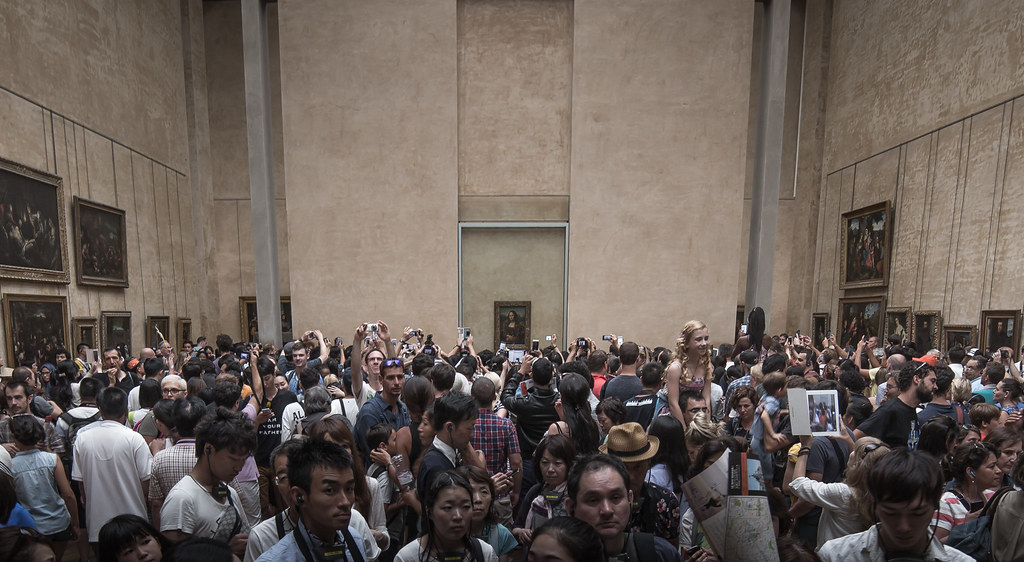
No, I agree, that’s not a true Double Dactyl because it doesn’t have a single-word double dactyl line. It’s just one of those poems I’ve written for no other purpose than to play with rhymes. The poem was published in this month’s Snakeskin, editor George Simmers privately commenting: “As an ex-teacher I empathise with the trudging profs.”

“Mona Lisa Madness” by Joe Parks is licensed under CC BY-NC 2.0

Evocative Fragments: from Macaulay’s ‘Horatius at the Bridge’

But the Consul’s brow was sad,
And the Consul’s speech was low,
And darkly looked he at the wall,
And darkly at the foe;
“Their van will be upon us
Before the bridge goes down;
And if they once may win the bridge,
What hope to save the town?”

Then out spake brave Horatius,
The Captain of the Gate:
“To every man upon this earth
Death cometh soon or late.
And how can man die better
Than facing fearful odds,
For the ashes of his fathers,
And the temples of his gods!”

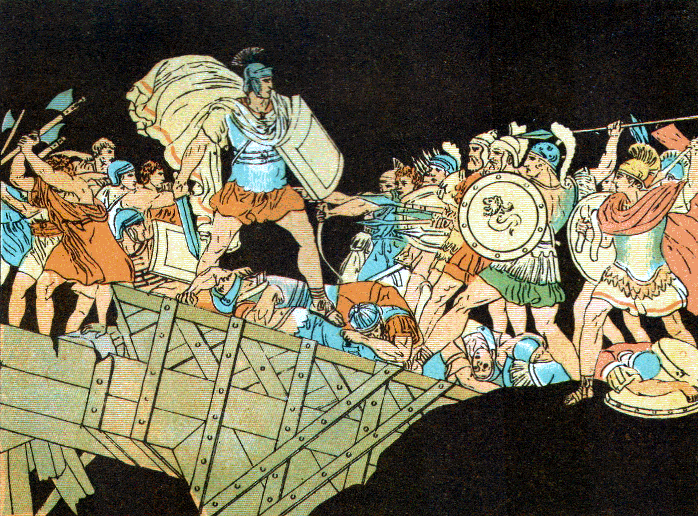
An alliance of neighbouring city-states is attacking the young Roman republic with 10,000 cavalry and 80,000 foot soldiers. The River Tiber provides a natural defence, but the broad wooden bridge is a weak spot. Horatius with two friends will try to hold off the enemy while the bridge is being destroyed underneath them. Enemy champions attack them in single combat and are defeated, until the huge Astur strides up with his “four-fold shield”, shaking the sword “which none but he can wield”. He attacks Horatius and gashes his thigh. Horatius

… reeled, and on Herminius
He leaned one breathing-space,
Then, like a wild-cat mad with wounds,
Sprang right at Astur’s face.
Through teeth and skull and helmet
So fierce a thrust he sped,
The good sword stood a handbreadth out
Behind the Tuscan’s head.

(…)

On Astur’s throat Horatius
Right firmly pressed his heel,
And thrice and four times tugged amain,
Ere he wrenched out the steel.
And “See,” he cried, “the welcome,
Fair guests, that waits you here!
What noble Lucumo comes next
To taste our Roman cheer?”

I was probably 11 when our English classes in my Jamaican boarding school were enlivened by Macaulay’s nearly 600-line poem (though, truthfully, our textbook cut out a lot of the slow introductory verses). As someone who otherwise lived on works like Tarzan of the Apes and Bomba the Jungle Boy (and of course banned comics of Superman and Batman when I was home for the holidays), it was wonderful to discover that verse could deliver just as dramatic, violent and heroic a story as novels and comics. Further, verse can do so in passages of enormous emotional power, heightened by the drama of their rhythm and rhyme, with short passages sticking in the mind forever even if you aren’t trying to learn them by heart.

The other qualities that appealed to me were undoubtedly the feelings of patriotism and religious approval that I suspect are natural in children – the sense of community, of tribe, of duty, of being morally in the right, of overcoming difficulties, of excelling, of supporting and saving people, of being praised for it. And what I value in that today is that it was done without any reference to an actual modern-day country or an actual modern-day religion. In other words the emotions could be stirred up and the child could be (at least temporarily) ennobled, without the poisons of nationalism or religious fundamentalism finding a place. Indeed, by placing the heroic emotions outside the here and now, I think the poem helped inoculate me against such diseases.

I was already very comfortable with poetry when I was introduced to ‘Horatius’ – A.A. Mine, Edward Lear, Robert Service and the Anglican hymn book come to mind – but this poem took poetry into another dimension entirely!

Evocative Fragments: from Arnold’s ‘A Summer Night’ (1)

For most men in a brazen prison live,
Where, in the sun’s hot eye,
With heads bent o’er their toil, they languidly
Their lives to some unmeaning taskwork give,
Dreaming of naught beyond their prison wall.
And as, year after year,
Fresh products of their barren labor fall
From their tired hands, and rest
Never yet comes more near,
Gloom settles slowly down over their breast.
And while they try to stem
The waves of mournful thought by which they are prest,
Death in their prison reaches them,
Unfreed, having seen nothing, still unblest.

I’m very grateful to my schooling for putting Matthew Arnold on the curriculum – this subversive little passage seems designed to undermine the office and factory culture which has flourished since his time, to undermine even the student writing endless essays. Arnold was an inspector of schools as well as a poet and social critic, so we can assume he knew what he was doing. But isn’t it suggesting that a dissatisfied person should just drop out? More on that in the next fragment.

The other thing I like about the piece is its easy, flowing style. Every line rhymes, but without pattern. The lines are iambic, mostly pentameter, but a scattering of them are shorter. It feels very conversational, and it is certainly very easy to learn by heart (which is one of the reasons that poetry evolved in the first place). The only hiccup to natural speech are the displacement of ‘live’ and ‘give’ to the ends of their lines for the sake of the rhyme and even that, though artificial, is done conventionally enough to read smoothly. The rest of it is in normal speech. When T.S. Eliot came out with ‘Prufrock’ some decades later, though it had a different, Imagist sensibility, the only real difference in style was in dropping the thou’s and thee’s that Arnold still clung to.

Photo: “Office workers in Executive Building Room No. 123 prior to alterations, Brisbane” by Queensland State Archives is marked with CC PDM 1.0

Potcake Poet’s Choice: John Beaton, ‘Bedtime Story’

The sun has smouldered low. Its flaxen light
drizzles through the birches to the snow
where sheep stand still as hay-bales, beige on white.
A shepherd with a shoulderful of straw,
brindled by the shadows, softly walks.
The sheep flock round; he swings his load to strew
the strands on pillowed drifts like yellow locks,
then hastens homewards bearing sustenance
against the ghostly dark. He holds small hands
and spins his children tales of happenstance
and golden fleeces in enchanted lands.
Their minds woolgather. Snuggled down in bed,
they drift on snowy pillows; yellow strands
of hair glow like the hay their father spread.

John Beaton writes: “My wife and I have five children and one of my great delights was reading to them in bed when they were little. We covered a lot of ground, from Shel Silverstein’s poems and Roald Dahl’s stories to whole books like “Watership Down” and “The Old Man and the Sea.” This poem came to me when I was looking at the painting “Shortening Winter’s Day” by Joseph Farquarson (shown above). It was reminiscent of the place where I grew up in Scotland. The image of the shepherd feeding sheep in the gloaming light evoked the feeling of security and contentment that imbued those evenings of reading. I recite my poetry and tend to write for sound almost as much as for sense. I like the sounds of this one. Also, when picking subjects for poems, I’m more drawn to happiness and beauty than to sadness and misery. All in all, this poem fits my preferences quite nicely.”

John Beaton’s metrical poetry has been widely published and has won numerous awards. He recites from memory as a spoken word performer and is author of Leaving Camustianavaig published by Word Galaxy Press. Raised in the Scottish Highlands, John lives in Qualicum Beach on Vancouver Island.

https://www.john-beaton.com/

Updated Call for Submissions: Potcake Chapbooks

I am always keen to read and consider rhymed and metered verse that has already been published. There are several chapbooks that are jostling in the queue for completion and publication:

Travels and Travails (travel)
City! O city! (urban life)
Just a Little Naughty
Portraits Unpleasant
Various Heresies (religion)
Lost Loves
The Horror of Spring! (seasons)

and there are more; but the last one, ‘Rockets and Robots‘, wasn’t part of my original plans: I just ran across a bunch of Science Fiction poems that I liked, and they filled a chapbook nicely. So I’m an unashamed opportunist. I’ll modify my plans if I think something better is available. All the chapbooks listed above are nearly full already but, as with all of them, if I run across another poem I really like, I’ll include it. And if I receive enough good poems on an unplanned theme, that theme will get slotted in.

When there is enough good material on a single theme to fill 13 pages of a chapbook (still leaving room for Alban’s artwork, of course), then it may become the next project. But until a chapbook actually goes to print everything is subject to change. An even better poem may show up and displace one tentatively placed. A slew (or slough) of poems on a new theme may cause a reprioritisation of planned chapbooks.

This is one of the reasons that I prefer to consider only poems that have already been published–so that I don’t feel guilty about having a bunch of poems that will sit with me for months, years, and may or may not be included in the Potcake series. I have flagged a thousand poems that interest me; but I can only publish a dozen in a chapbook, and only a few chapbooks will get produced in a year.

Poems in the chapbooks run from two or three lines to some 40 lines in length–obviously, with space at a premium, poems over 20 lines and running over one page are less likely to be included… but it does happen. Other criteria: I’m looking for wit, elegance, a variety of traditional and nonce forms, a variety of voices and moods: happy, sad, angry, sardonic, meditative… anything interesting I can scrounge. If you have something you think I might like, on any topic, please send it along to robinhelweglarsen@gmail.com

I can’t promise to use it, but I will read it and reply!

Fantasy Analysis: Auden’s ‘Jumbled in the common box’

Jumbled in the common box
Of their dark stupidity,
Orchid, swan, and Caesar lie;
Time that tires of everyone
Has corroded all the locks,
Thrown away the key for fun.

In its cleft the torrent mocks
Prophets who in days gone by
Made a profit on each cry,
Persona grata now with none;
And a jackass language shocks
Poets who can only pun.

Silence settles on the clocks;
Nursing mothers point a sly
Index finger at the sky,
Crimson with the setting sun;
In the valley of the fox
Gleams the barrel of a gun.

Once we could have made the docks,
Now it is too late to fly;
Once too often you and I
Did what we should not have done;
Round the rampant rugged rocks
Rude and ragged rascals run.

In January 1941, W.H. Auden had been living in New York for nearly two years. The Second World War had started, but not yet in the US. Auden had fallen in love with Chester Kallman who was now turning 20 and was too young to want to be sexually faithful; Auden had also returned from atheism to the existential Christianity that is common in the Anglican/Episcopalian church. It was a period of change, backgrounded by the widening war.

Regarding the poem from this time, I choose to imagine Auden rambling, reminiscing, muttering to himself: “Around the rugged rocks the ragged rascal ran… Nice metre as well as alliteration and, for people with difficulty pronouncing their Rs, a twuly tewwible tongue-twister. Rhythmic, memorable. Nonsense; not meaningful, but not meaningless; nonsense and nursery rhymes are right on the border. And it splits in two, you could easily rhyme it: rocks, box, blocks, brocks, cocks, cox, clocks, crocks… ran, Ann, ban, bran, can, clan, cran… or easy to change to run, or runs. A lot of rhymes, anyway. Run them out, see what transpires.

“Once we could have made the docks, / Now it is too late to fly; that adds another rhyme, not a problem, maybe a 6-line stanza. Once too often you and I / Did what we should not have done; and into the last two lines, have to fill them out a bit to maintain the metre, keep the alliteration of course: Round the rampant rugged rocks / Rude and ragged rascals run… So that’s all right, that would make an ending.

“Then of course we can have more stanzas leading up to it. Flick a bit of paint at the canvas, see what sort of patterns we can find to elaborate on. Time, decay, trepidation, warnings… out come the words and images around the rhymes, and suddenly it’s all as evocative and semi-coherent as a reading of tarot or yarrow or horoscope. Hm, tarot or yarrow, I hadn’t noticed that before, wonder if I can use that somewhere else…”

(Remember, this is a fantasy analysis, presupposing the poem to have been written with full skill to capture both rhymes and a mood, but without any serious intent beyond that. For a completely different intellectual analysis, you can always try this…)

Photo: “Jumble Box” by .daydreamer. is licensed under CC BY-NC-ND 2.0

Political poem: Amanda Gorman’s ‘The Hill We Climb’, excerpts

First: a warning: I haven’t seen the printed version, but I have modified a transcription to try to catch the essence of the various types of wordplay that the poet engaged in, with bold for rhyme and italics for alliteration and repetition. These excerpts are from the earlier parts of her poem, skipping some less poetic portions.

When day comes we ask ourselves where can we find light in this never-ending shade?
The loss we carry, a sea we must wade.
We’ve braved the belly of the beast.
We’ve learned that quiet isn’t always peace.
In the norms and notions
of what just is
isn’t always justice.
And yet, the dawn is ours before we knew it.
Somehow we do it.
…
And yes, we are far from polished,
far from
pristine,
but that doesn’t mean
we are striving to form
a union that is perfect.
We are striving to forge
our union with purpose.
To compose a country committed to all cultures, colors, characters, and conditions of man.
And so we lift our gazes not to what stands between us,
but what stands before us.
We close the divide
because we know to put our future first, we must first put our differences aside.
We lay down our arms
so we can reach out our arms
to one another. We seek harm
to none and harmony
for all. Let the globe, if nothing else, say this is true.
That even as we grieved, we grew.
That even as we hurt,
we hoped.

That even as we tired,
we tried
that will forever be tied
together victorious. Not because we will never again know defeat,
but because we will never again sow division.

Scripture tells us to envision
that everyone shall sit under their own vine and fig tree and no one shall make them afraid.
If we’re to live up to her own time, then victory won’t lie in the blade,
but in all the bridges we’ve made.
That is the promise to glade
the hill we climb if only we dare. It’s because being American is more than a pride we inherit.
It’s the past we step into and how we repair it.
We’ve seen a force that would shatter our nation rather than share it.
Would destroy our country if it meant delaying democracy. This effort very nearly succeeded.

Amanda Gorman’s poem for President Biden’s inauguration was an extremely well received performance of Spoken Word. As the Wikipedia entry states, Spoken Word focuses on “the aesthetics of recitation and word play, such as the performer’s live intonation and voice inflection.” With its roots in preliterate societies, it searches for all possible tricks for both capturing the audience’s attention, and making it easier to memorise the words. Amanda Gorman did this extremely well in her recitation, with clarity and with effective pacing, pausing and emphasis, carrying the thoughts along in a chant-like flow of rhymes, half-rhymes, puns and alliteration. It was a superb piece of Spoken Word, and left listeners enthused and uplifted. It was perfect for the mood of the inauguration.

But it wasn’t flawless. In places either the transcription is flawed or the poet has sacrificed meaning for the sake of a rhyme. Take “even as we tired, we tried that will forever be tied together victorious”. There is a flow of suggestion that imparts a meaning, but looked at under a bright light the words sound like those of a drunk.

Or take the rhyme sequence “afraid, blade, made, glade”. OK, but I stumbled over “That is the promise to glade”. Perhaps she means “the promise to make an open clearing through the forested hill we are climbing.” My bias is that I think of a glade as a flat clearing in woodland–I didn’t see the meaning of the verb she created, I didn’t think of a hill being climbed as being forested, but that may all be my problem. Similarly, I like the rhyming of “inherit” with “repair it” and “share it”; but what does this mean: “We’ve seen a force that (…) would destroy our country if it meant delaying democracy.” This is clumsy. It’s not clear exactly what is being said. If “would” means “is intended to”, then presumably she should have inverted the phrase: the force wanted to delay democracy, even if it meant destroying the country. Yet it is clearly all part of a political message: the end of Trump’s deliberate White America divisiveness, a return to the modern world’s multiethnic inclusiveness. As she triumphantly ends her piece:

The new dawn blooms as we free it.
For there is always light.
If only we’re brave enough to see it.
If only we’re brave enough to be it.

So we have an inspiring piece of performance art, of spoken word, by a 22-year-old who has a lot of talent and a great stage presence. I’m sure we’ll hear a lot more from her. But I suspect that if her words are to last, she will have to develop a stronger control of meaning. The jagged nature of her lines is not a problem; the lack of structure to her rhyme is not a problem; in some ways she seems close to Old English and other Germanic poetry with their emphasis on a heavy beat (rather than a set number of syllables), and a long way from the “modern poetry” that, without metre or rhyme, tries to get an effect by being laid out provocatively on a page.

Amanda Gorman is an interesting but unformed poet, and a superb presenter. You can see the recitation here towards the bottom of The Guardian coverage. And the full transcript is here.

Sonnet: ‘The Poem’

Poems are merely words you can remember
word for word. Question: What makes them so?
Think of the earliest nursery rhymes you know,
held from child’s January to old December:
rhymes, rhythms, imagery—rich as meringues.
Then complicate discussion, don’t reduce
odd imagery, words foolish, strange, diffuse—
aim for rijsttafel with tongue-tingling tangs.
Use richness to engage the memory:
conflicting quotes from Bible, Shakespeare, Yeats,
with Bach-like sense of heaven’s opening gates
or hall of mirrors, or sun-scattering sea…
Mesmerized readers have to puzzle out
in memory mazes what it’s all about.

My firm belief is that poetic structures originate as nothing more than memory aids, so that a work can be recited word for word. This was invaluable in preliterate societies and was used for tribal histories and spiritual revelations (Muhammad was illiterate, and the most powerful passages of the Quran are in strongly rhythmical rhyme) as well as for lullabyes and love songs. But the use of our human love of rhythmic beat, and our enjoyment of rhyme and wordplay, have helped verse develop into elaborate, engaging, memorable forms, varying by culture because of the different opportunities of the different languages. Enjoy the diversity, and the complexity!

This sonnet, like ‘The Four Duties‘, has just been published in the Winter 2020 edition of The Orchards magazine of formal poetry.

Photo: “Indonesisch Rijstafel” by johl is licensed under CC BY 2.0