Tag Archives: Robin Helweg-Larsen

Calling the Poem: 1. ‘Invocation’

O Odin,
Living outside me or within,
Share your mead of poetry you earned in night’s delight,
Spare me from the mead you shitted out in flight and fright.
By Thought and Memory, I swear
A poem needs your care,
For poems… magic poems… are nothing,
and come from your nowhere…

A poem comes in flurries:
A phrase that catches, sticks,
A rhyme that matches
With some thought that dog-worries,
And a verse that clicks.

*****

Just to be clear, I’m no more a believer in the Norse gods than I am in Yoruba, Hindu or Christian deities. Also, I’m not a white nationalist. But mythology has a couple of uses for me: pure enjoyment of the tangled tales; a way of looking at historical mindsets; and a tool for trying to communicate with the unconscious, i.e. to let the creative unconscious funnel ideas and images to the conscious mind.

What I do believe is that invoking the Muse, or a god, is a way of telling your unconscious that you are receptive to its comments… it is a fishing expedition, and you never know what you’re going to get. But I believe it is a system that works (sometimes), and I don’t practise another. (Various drugs are alleged to get results, too.)

So a few years ago I set out to describe the process that I follow to try to bring poetry to me. The result was a series of 15 poems, published by Snakeskin as an e-chapbook in January 2017. It was available as a free download from Snakeskin No. 236, and it should be again, when the Snakeskin archives are again operational. I named it ‘Calling the Poem’.

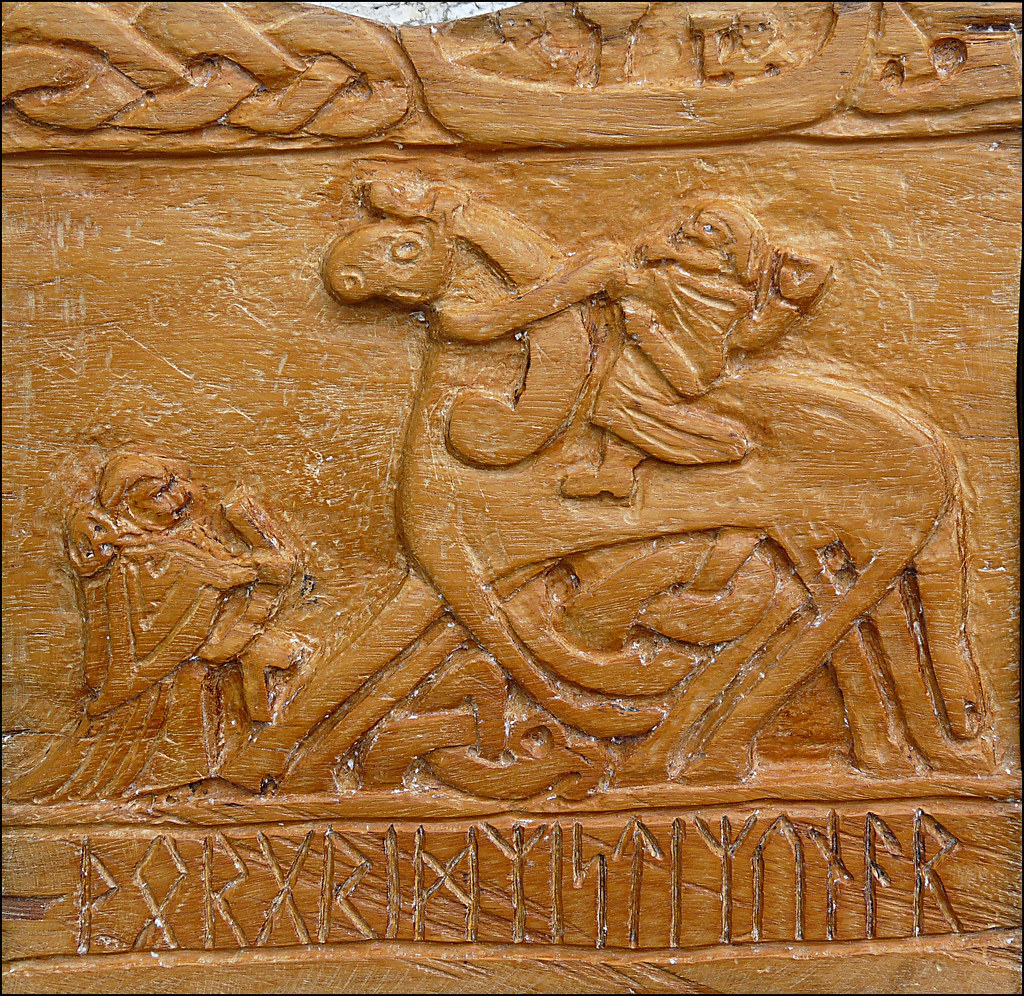
‘Calling the Poem’ starts by invoking the Muse – male, female, human, animal, I think the Muse can be however you choose to imagine it. But the Muse should be a dream-image, for the Muse, the unconscious, is as likely to communicate through dream as anywhere. Odin is a good figure, with his ravens of Thought and Memory who give him the news of the world, his eight-legged horse Sleipnir who can carry him through all the worlds, his ability to shapeshift and prophesy, the sacrifices he made to obtain wisdom such as gouging out an eye to put in Mimir’s well, and of course the mead of poetry that he stole and disburses as he feels.

And so the first poem – somewhat rough-hewn, semi-formal – is the invocation addressed to Odin.

Photo: “Odin on Sleipnir” by Hornbeam Arts is licensed under CC BY-NC 2.0.

Sonnet: ‘Zombies and Wolves’

Women I’ve failed or wronged or left behind
Approach my thoughts like zombies for the kill;
I’ve literary walled defences – still,
Given the chance, they’ll eat my brains, my mind.
Through forest, orchard, farmyard in decay,
A shadow of a wolf slips greyly in,
My thoughts of death, grim, wasted, ill, rib-thin,
Tracking my weak resolve, hungry to slay.

Mountaintops blown apart, forests clear-cut,
Where’s there to hide? Nature doesn’t exist;
Her landscapes crushed in patriarchal fist.
This former farmland hides my ruined hut.
Impotent, I still write, thus giving birth
To future wolves and zombies of the earth.

*****

What on earth triggered this sonnet 15 years ago? I have no idea. What’s it really about? Well, it seems the volta between the octave and the sestet moves the narrative from purely personal regrets to our current planetary destruction. More than that, I can’t say. Your suggestions are welcome!

Anyway, the poem was published in that now-defunct British beacon of formal verse, Candelabrum.

Photo: “Wolves in Action” by iam_photography is licensed under CC BY-NC-SA 2.0.Copy text

Short poem: ‘Into the Cryonics Dewar’

We had no destination ever, from birth,
save into the ultimate ocean, or ultimate fire, or ultimate earth.
Now we have not quite so ultimate ice.
For now, it will have to suffice.

The chance of reanimation from cryonic suspension may be small, but still greater than the chance of reanimation after cremation or burial in land or at sea. And I guess we now have a fifth option – ending up off-planet, adrift in space. But in effect that will be a variant on “not-quite-so-ultimate ice”. In space you’d end up near Absolute Zero, as with cryonics – but whereas with cryonics there is the miniscule hope of eventual reanimation, in space your ultimate fate would be that of all space debris: drifting for millions of years until burning up into a star or planet, or getting sucked into a black hole.

Life, death, quite fascinating. Not many options for changing the outcome, though various billionaires are throwing some of their money at the search for immortality, as people have done since at least the time of the pharaohs and early Chinese emperors. And why not? think it’s “just science fiction”? For thousands of years we used to dream we could fly to the moon, and that happened eventually…

This poem was originally published in Snakeskin #274, July 2020. Thanks, George Simmers!

Photo: cryonics.org

Launch: Potcake Chapbook 11, ‘Lost Love’

‘Lost Love – poems of what never happened, and of the end of things that did’… how bittersweet; but what a collection of poets, and what a diversity of stories and observations!

Seventeen poets are packed into this chapbook. Seven have appeared before: Marcus Bales, Melissa Balmain, Michael R. Burch, Vera Ignatowitsch, Martin Parker, Gail White and myself. Ten are new to the series, with wicked little pieces from Brooke Clark, Cody Walker and three from Wendy Cope, and with longer poems from N.S. Thompson, James B. Nicola, Mary Meriam, Helena Nelson, David Whippman, Richard Fleming and Vadim Kagan. Bios, photos and links to read more of their work can all be found on the Sampson Low site’s Potcake Poets page, while all the chapbooks in the series, showing which poets are in which, are here. Each of the 11 chapbooks is profusely illustrated (of course) by Alban Low, and can be yours (or sent to an ex) for the price of a coffee.

Heartbreak has never had a happier manifestation!

Sonnet: “What Will You Be When You Grow Up?”

Historically, this never was a thing.
You did what you were born to do, were told,
Fitting yourself into your parent’s mold,
A farmer’s son a farmer, king’s son a king,
A girl to be a mother and a wife.
But then came education, travel, choice,
Awareness of the wishes you could voice,
Countries, careers, sex partners — it’s your life!
And though just who you are you cannot know,
Nor what you want, yet all is your decision.
You’ll make mistakes, find failures and derision,
But life is long: so have another go . . .
Retry, and then try something else; take; give.
Do what you love. You die, regardless. Live!

This sonnet is a mirror of the short poem I posted most recently – and I’m happy to see that my outlook has a certain consistency, even over a 50 year period.

The sonnet has just been published in the formal verse section of the current Better Than Starbucks – thanks, Vera Ignatowitsch!

Photo: “career choices” by Jerome T is marked with CC BY-NC-ND 2.0.

Short poem: ‘Remember’

Remember the whole world’s in your range,
When all your strength is gone.
If you can’t accept, then rearrange;
Can’t rearrange, move on.

I wrote this little poem when I was a very unsettled and directionless 20-year-old, and I lived by its tenets for several years, constantly changing jobs, countries and relationships. Eventually I slowed down, only changing jobs, countries and relationships once every few decades. But I still hold to the principle that you have no obligation to stay in an unsatisfactory situation, that you should actively try to identify what makes you happiest at the deepest level and then change your life in that direction. And sometimes random change is an appropriate if temporary solution.

This poem was finally published, decades later, in The Asses of Parnassus.

Photo: “File:Banksy Hitchhiker to Anywhere Archway 2005.jpg” by User:Justinc is marked with CC BY-SA 2.0.

Kyrielle: ‘Desire is the Last Domino to Fall’

Religion starts as trying to explain,
Progresses to high priests’ financial gain.
I’ve tried religions, and seen through them all;
Desire is the last domino to fall.

Explore the world – well, fifty lands’ enough;
Novelty fades; folks are just folks; stuff’s stuff.
I’ve seen both rich and poor round this blue ball;
Desire is the last domino to fall.

And I’ve gone barefoot, and I’ve gone first class:
The trinkets pall beside bare feet on grass.
Markets go up and down and they too pall;
Desire is the last domino to fall.

The fearful right, the overtrusting left:
Politics, history, both of sense bereft.
Reagan’s road leads to Trump and hits a wall;
Desire is the last domino to fall.

My arts expression’s been in writing verse–
The arse end, clearly, of the universe.
There’s rarely silver in the nets I haul;
Desire is the last domino to fall.

I’ve had my fill of sex – but when I see
A vibrant youth, my thoughts are freshly free.
I want, though why I want I mayn’t recall…
Desire is the last domino to fall.

This poem, published by George Simmers in April’s Snakeskin, flowed straight out of a comment by Jackson Browne in a Guardian article on his latest album, ‘Downhill From Everywhere’. My thanks go to Mindy Watson, creator of poems in every form she hears of, for identifying this one as a kyrielle. I hadn’t set out to write within a specific form, I merely wrote a poem that used a repeating last line of the stanza. And this highlights one of the things about form: form follows function, in poetry as in architecture. Metre, rhyme scheme, line length, all these are chosen for their appropriateness for the mood and content of the poem. Ballads, sonnets, couplets, villanelles, each type finds its best use in a different situation, each evolved to provide a good expression of a different mood, each became popular as its expressive strength was demonstrated.

A kyrielle seems to me a natural poetic construct for an expression of prayer or despair or wherever all avenues of thought lead back obsessively to the same essential fact or wish. It was formalised in the time of the troubadours, and its name derives from the Late Latin phrase “kyrie eleison“, “Lord, have mercy”. Very appropriate.

Photo: “Where It All Began” by mckinney75402 is marked with CC BY 2.0.

Poem: ‘Poems Like Motes of Dust’

Like tiny midges, poems in the air
were unseen all my life, presence unclear,
occasionally one would land, bite, sting…
I’d be aware
a poem had come, was singing by my ear.
Now everything, literally every thing,

is a poem: a car, a dog, a glass,
a chair, a seagull, every blade of grass,
all people and each thing they pass.
Now I see swarms, millions of flies,
or like light’s dots of darkness thickening as day dies,

the poems are visible in the air around,
a pointillist canvas, every dot
a poem in itself, an image, word, rhyme, thought,
or like neutrinos streaming from the sun,
billions a second passing with no sound
unseen, unfelt, through everyone,
the poetry of existence, raw, untaught.

The Universe: a cloud of dust that hangs and floats,
dust like a drive of cattle on the range,
or when you fill a barn with dusty motes
by sudden action, and a sunbeam’s slice;
or as Sumerian gods convene, converse,
swarming like flies around burnt sacrifice,

summoned by smell of sacrificial meal…
was it my sacrifices made this change,
made poems visible like motes of dust?
Is this the Universe’s thrust?
Hide them, and then reveal?
For all the poems make one UniVerse.

This is the fourth of a series of five poems recently published in The Brazen Head. It is semi-formal: written in iambics with lines of uneven length, fully rhymed but not to any pattern. My model for this style of verse is Matthew Arnold’s ‘A Summer Night‘, a poem that I have loved and recited since high school. (We can leave for another time the debate about whether his poem should have stopped as originally at the final question mark, or whether the years-later addition of the subsequent lines is an improvement.)

Smoky Dusty Light Rays Texture” by Sprogz is marked with CC BY-NC 2.0.

Poem: ‘Leadership Transition’

Julius Caesar, Antony, King Lear,
Hamlet, Macbeth – corrupted, vain, impure,
Irrational, bombastic, insecure –
He’s no more clarity or veritas
Than the deceptions of a covert war,
All morals blurred.

That tyrant rant, Tyrannosaurus roar,
Forecasts he’ll suffer a dictator’s fate:
His proud obsessed confusion first seems great,
Then grates, unravels at the seams, slips gear,
Loses its moral metaphors, grows crass;
He dies absurd.

Octavius, Malcolm, Edgar, Fortinbras,
Comes from the wings and strides to centre stage –
Competent, measured, reasonable, sane –
To rule the wreckage of the tragic reign;
Restores some structure, closes out the age,
Speaks the last word.

This archetypal character’s strong thump
Will get his nation out of the morass;
The raucous self-styled hero being dead,
A truer leader takes the throne instead.
(How Shakespeare’d end the Tragedy of Trump
Can be inferred.)

The common fate of Shakespeare’s flawed protagonists–death, and replacement by a more worthy ruler–is a story that humans enjoy and wish applied in their own times and countries… although they may naturally disagree on which ruler is disgraceful and which would be more worthy. Speaking for myself, I don’t need to see a death–I’d be happy for Putin and Trump to avoid assassination or jail by going into comfortable exile at a golf hotel in southern Russia. (You read it first here.) But Shakespeare would deal with them more definitively.

This poem is the third of the five poems published this month in The Brazen Head. Its four stanzas are in iambic pentameter with a short 6th line. The rhymes largely carry over between stanzas–the 6th lines only rhyme with each other. The rhymes and the stanza structure are designed to create a sense of satisfactory achievement–exactly what I feel with Biden taking over from Trump. (Similarly I would love to see Navalny take over from Putin, and almost anyone replace Boris Johnson.)

York Minster – June 2013 – Emperor Constantine – One Cool Dude” by Gareth1953 All Right Now is marked with CC BY 2.0.

Experimental Poem: ‘Pointillist’

(Note: this poem is so named because if you look at it closely you may not find as much meaning as if you step back, let it flow past you, and see an outline of a story.)

Awake
Anew
Awhile
Askew;
Afoot
Among
Amass
Along;
Abet
Aback
Ado
Alack;
Alas!

Abroad
Again
Astride
Amain;
Atop
Alight
Aglow
Afright;
Afar
Ahead
Aloft
Abed;
Alone!

Aware
Amused
Affair
Accused;
Away
Aboard
Affray
Abhorred;
Aground
Alive
Abound
Arrive;
Ahoy!

Array
Await
Assay
Abate;
Appraise
Accord
Amaze
Adored;
Apprise
Appoint
Arise
Anoint;
Adieu!

This poem started (if I remember correctly) as four or five of the early words coming into my head with a sense of rhyme and rhythm when I was on the point of falling asleep. I roused myself enough to write the words down, doing what I consider an essential part of the communication I long for with my unconscious, my Muse–acknowledge the Muse by writing whatever is offered to you, whether or not it is complete or makes sense.

The next day I wrote more, keeping to iambic monometer and words of Anglo-Saxon derivation beginning with A. As a hint of a story took shape, I kept writing. After the first two stanzas I moved over into words of Latin derivation and went for more intense rhyme. Long lists of words were involved. After four days I had the whole poem.

As for the story itself… I see a hero setting out, failing, trying again, under threat, escaping by boat, shipwrecked, and finally rewarded. Are they male or female, and of what age? Did they have a love affair? Did they end up at home or in foreign lands? If you look at the poem sideways you may find an answer that suits you. Or (of course) not.

‘Pointillist’ was the second of five poems recently published in the Poetry section of The Brazen Head.

Pointillistically abstracted” by readerwalker is marked with CC BY-NC-SA 2.0.