Tag Archives: sonnet

Sonnet: RHL, ‘The Days Have Come Unhooked’

The days have come unhooked from passing time,
its little Brio trucks are off their tracks;
the past and future mix to make their rhyme,
with pieces placed at random in fresh stacks.
Clear memories blend their present, future, past.
The days stretch out, and yet the months fly by –
you turn in circles, facing first, not last.
As childhood deepens, old age pools go dry.
Behind its smoke and mirrors, whores and pimps,
its harshly lovely playful attitude,
reality is thinning – you now glimpse
an indescribable infinitude.
The game is won – your enemies are no more,
yet you don’t end it while you max your score.

*****

Published in the Spring 2024 issue of The Road Not Taken.

Photo: “Brio freight train set” by Ben Sutherland is licensed under CC BY 2.0.

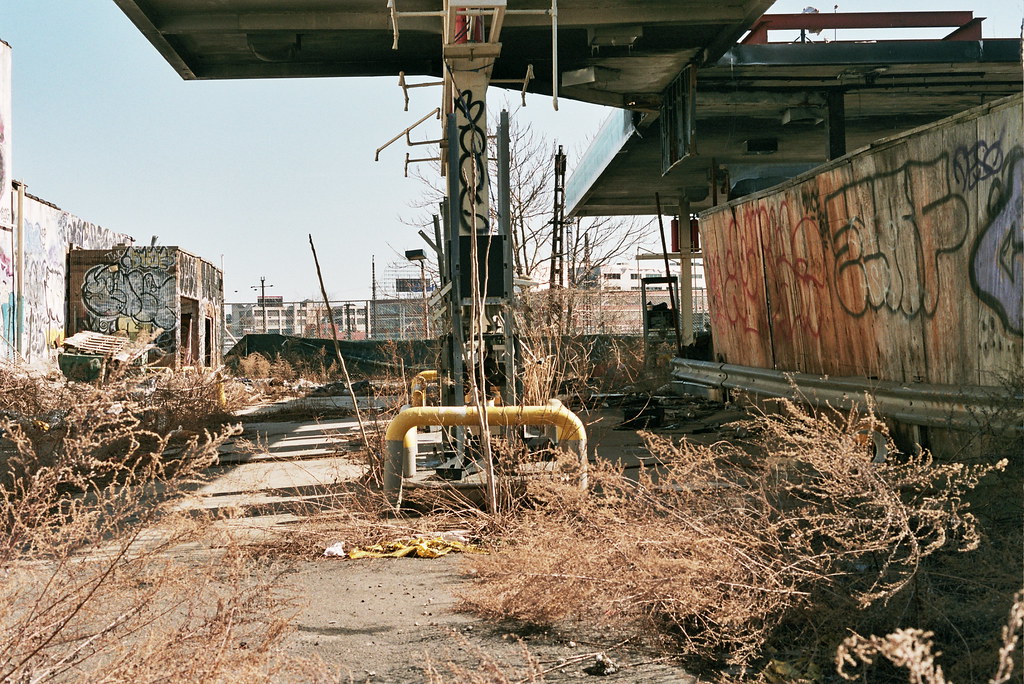
Kelly Scott Franklin, ‘Shell Station, Tennessee’

It was the ravage of the scene that shocked:
the concrete torn by trees and ragged grass,
red guts of fuel pumps over splintered glass,
the wreckage clawed by climbing vines and mocked
by moth and rust. There in concentric rings
obscene graffiti spelled out every sin.
(The smell of something even worse within.)
It’s like we saw into the death of things.
But what about the ruins I can claim?
What of the loves that I have let decay,
the hand withheld, the times I didn’t say
I’m sorry, didn’t pray for you by name?
We leave shell stations, call them what you will.
Neglect is the unkindest way to kill.

*****

Kelly Scott Franklin writes: “Originally sparked by an ekphrastic prompt over at Rattle Magazine (declined; first published in Ekstasis Magazine), this poem was ALSO inspired by a real abandoned gas station somewhere along the highway through the mountains on the way to Knoxville, TN. But I think it had been cooking in me for a while. I took a trip across the American heartland, from Southern Michigan to Central Kansas, and was absolutely depressed by the neglect and decrepitude. I stopped at a rest stop to use the restroom somewhere along the way. The restroom had a sign that said, “We take pride in the quality of our service. If anything in this restroom is not up to your satisfaction, please contact the management.” I looked around the restroom and there was garbage everywhere. Everywhere. It’s like people have stopped living the basic human things. The poem was also inspired by my troubled relationship with my late mother.”

Kelly Scott Franklin lives in Michigan with his wife and daughters. He teaches American Literature and the Great Books at Hillsdale College. His poems and translations have appeared in AbleMuse Review, Literary Matters, Driftwood Literary Magazine, Iowa City Poetry in Public, National Review, Thimble Literary Magazine, Ekstasis, and elsewhere. His essays and reviews can be found in Commonweal, The Wall Street Journal, The New Criterion, Local Culture, and elsewhere. 
https://www.hillsdale.edu/faculty/kelly-scott-franklin/

Abandoned Gas Station, 2013” by Genial23 is licensed under CC BY-NC-ND 2.0.

Sonnet: Gail White, ‘Why I Failed to Attend My High School Reunion’

Because it would have gone like this: Hello,
hello, hello. (You never like me, did you?
Where was this friendship 15 years ago?)

You’re looking wonderful. I wouldn’t kid you
about it – you look great. (You hefty cat.)
And Jeffrey – are you married? Oh, you are!
Three kids? However did you manage that?
(For God’s sake, someone point me to the bar.)
Me? I’ve just spent the summer in Tibet
learning some basics from a Buddhist nun.
It’s an experience I won’t forget.
(As if you cared.) More crab dip, anyone?
(And here’s the Great Class Bore. You’re still the same.)
Forgive me. I can’t quite recall your name.

*****

Gail White writes: ” ‘Why I Failed to Attend My High School Reunion’ is humor based on truth. I’m now 78 and have never been to a class reunion. Nobody who likes me would be there. I didn’t make real friends until I went to college and started meeting people who read books.”

Gail White is the resident poet and cat lady of Breaux Bridge, Louisiana. Her books ASPERITY STREET and CATECHISM are available on Amazon. She is a contributing editor to Light Poetry Magazine. “Tourist in India” won the Howard Nemerov Sonnet Award for 2013. Her poems have appeared in the Potcake Chapbooks ‘Tourists and Cannibals’, ‘Rogues and Roses’, ‘Families and Other Fiascoes’, ‘Strip Down’ and ‘Lost Love’. ‘Why I Failed to Attend My High School Reunion’ was first published in Light Poetry Magazine and is collected in her chapbook, ‘Sonnets in a Hostile World‘, also available on Amazon.

Photo: “High School 5 Year Reunion” by Oliver Mayor is licensed under CC BY-SA 2.0.

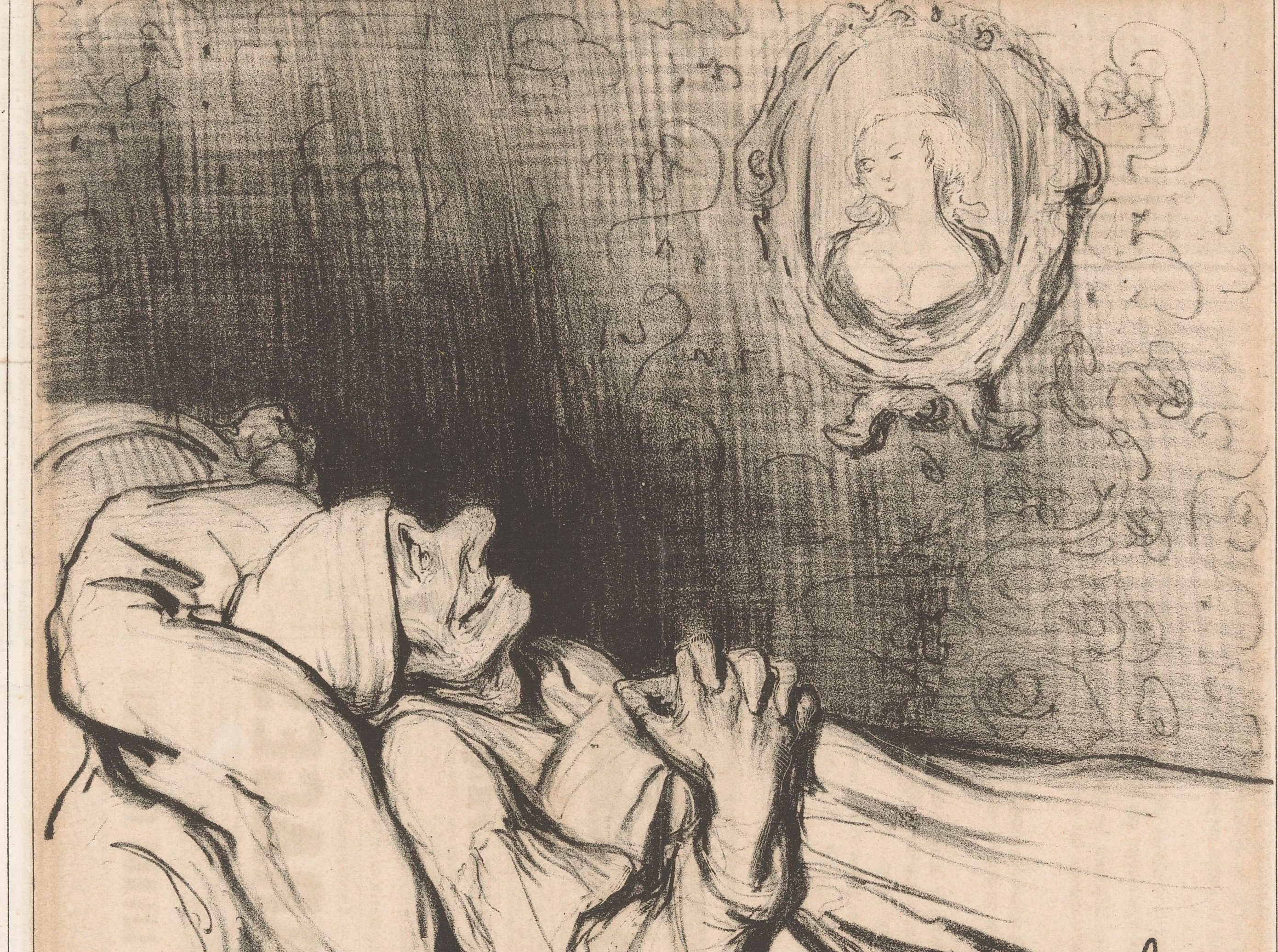
Sonnet: Helena Nelson, ‘Dream’

I found myself in bed with an old man.
His beard was silvery, his scrawny chest
a rack of ribs, his loose-lipped mouth open
and toothless as a baby. There he was,
there in our bed, as if he owned the place.
He snored and grunted like some ancient king
asleep after a banquet. But what feast
had led, dear heart, to this? What partying?
He turned his head to me. I saw his face—
a travesty. Some metamorphosis
had happened in our sleep, my love replaced
by a bag of windy bones. I need a piss,
he muttered, and got up. O then I knew
what age had done to us, and who was who.

*****

Helena Nelson writes: “Everyone experiences it eventually. You glance at your own reflection in the mirror and get a shock at how old you look. So that’s one of inspirations for this poem. The other spur to write this was a dream I had one night, though in the poem it’s intentionally unclear whether the experience is or isn’t real. I started with near rhymes in the octet and moved towards perfect rhyme at the end to convey the shock. I do hope the reader feels that shock at the end.” 

‘Dream’ was originally published in The Dark Horse.

Helena Nelson runs HappenStance Press (now winding down) and also writes poems, one of which appears in the Potcake Chapbook, ‘Lost Love’. Her most recent collection is Pearls (The Complete Mr and Mrs Philpott Poems). She reviews widely and is Consulting Editor for The Friday Poem.

Using form: SF sonnet: RHL, ‘On a Dead Spaceship’

On a dead spaceship drifting round a star,
the trapped inhabitants are born and die.
The engineers’ broad privileges lie
in engine room and solar panel power.
The fruit and vegetables and protein co-ops
are run by farmers with genetics skills:
the products of their dirt and careful kills
help service trade between the several groups.
Others — musicians, architects — can skip
along the paths of interlinking webs.
Beyond these gated pods that the rich carve
for their own selves (but still within the ship),
in useless parts, are born the lackluck plebs.
Heard but ignored, they just hunt rats or starve.

*****

This sonnet was republished in Bewildering Stories in April 2024 – original publication had been in Star*Line five years previously. I find something very satisfying about using a formal sonnet structure to express science fiction and speculative fiction ideas – the ideas are by nature open-ended, unconstrained, and it feels good to tie them down as in a neat package with a bow on top. Topiary.

As for what political comments can be read into the poem, read away!

Photo: “Deepstar 2071 at Io” by FlyingSinger is licensed under CC BY 2.0.

Ekphrastic sonnet: RHL, ‘Ghosts of Dead Parents’

Her ashes spread on Skirrid that she loved;
and his bones buried by the Harbour bay…
Why choose views for the dead? Once in earth shoved,
dirt in the dark is all they’d see, not day,
even if they lived. And if cremated, well…
So is it for our own guilt’s absolution?
Or status, that their graves our standing tell?
Or rites for social change’s resolution?
Those who were always here are here no more –
Their alwaysness runs out when they decease,
and life will now sound different from before,
like insect shrills not heard until they cease.
Dead ghosts sleep twittering in our heads’ domed caves,
waking to fill night skies from dreams and graves.

*****

This sonnet was published by The Wee Sparrow Poetry Press as a response to their ekphrastic challenge for the illustration, a painting by Žofia Katriňáková. It was written for my parents who, although they died decades ago, are still a background to my thoughts. My father is buried by the bay of Governor’s Harbour, my mother’s ashes were scattered on Skirrid Fawr, the Welsh mountain she loved and lived within sight of in Abergavenny. And I have another short poem for them, published in the Amsterdam Quarterly:

In the night’s jam jar of my memory
my long-dead parents live as fireflies.
My thoughts of them worn by time’s emery,
their faint light still suggests where my path lies.

Is it reasonable to hope to be a firefly for your children and grandchildren?

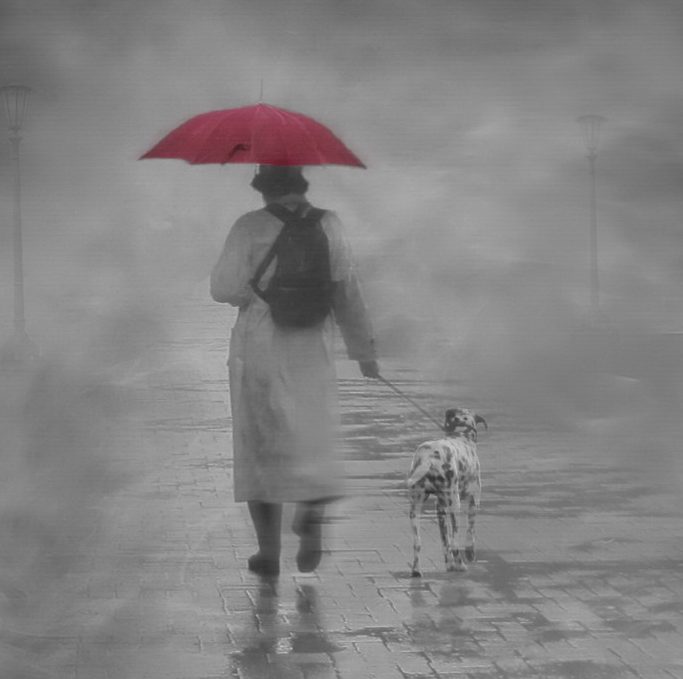
Sonnet: Marcus Bales, ‘Walking in the Rain’

Today when we went walking it was raining,
Not so hard to keep us from it — still
Distinctly wet. We thought about abstaining,
But March this year has lost its normal chill,
So on we went. She did her bombs away,
I bagged, and she looked up, with fur-soaked skin,
And shook some water off, as if to say,
Open up the door let’s go back in.
Well you’re the one who brought us out this far
I said as if I thought she had a plan.
She body-languaged Well, since here we are,
We’ll sniff back slow and get wet as we can.
And now we’re on the rug here, somewhat dryer,
Breakfasted, and dozing by the fire.

*****

Marcus Bales writes: “If ever a poem cried out for explication, this poem is that poem. Its hidden meanings and elusive innuendos chase each others’ tails with such sly allusions that even the b in subtle seems to thrust itself forward in comparison.

“The depths this poem sounds, the heights beyond which it reaches, evinces nothing of the feline grace other poets aim for and achieve. Nothing here looks at the reader and refuses to respond to the call for extra petties. This is a poem that trots wetly over and rubs eagerly against knees, and receives the towelling-off and the “Who’s a wet one, eh, who’s a wet one, today?” with effervescent attempts to put its muddy feet on the reader’s shirt. This poem has but one thing to say, and it says it by leaning in for another pat on the head, and then swiftly shaking that fine final spray of mist into the reader’s face before they can back quickly enough away.

“It is the doggily doggish dogness of the thing that dogs the dogging dog of this poem, and makes it so, well, dogilicious.

“Cry havoc, and let slip the hounds of love.”

*****

Not much is known about Marcus Bales except that he lives and works in Cleveland, Ohio, and that his work has not been published in Poetry or The New Yorker. However his ‘51 Poems‘ is available from Amazon. He has been published in several of the Potcake Chapbooks (‘Form in Formless Times’).

Walking in the Rain” by h.koppdelaney is licensed under CC BY-ND 2.0.

Using form: Sonnet: Josh Geffin, ‘A Guide to Renting in London’

So, when it says delightful take it as
a word for small. Make sure to steer away
from cosy – that just means it likely has
no place to put your things or even pray.

A huge and gorgeous room is medium size
while well-maintained denotes a certain lack
of charm and won’t be winning Best Home prize.
A friendly house is code for watch your back.

And please avoid affordable single room
you’ll have to fall or jump from door to bed
(no space to walk around the side). Assume
your rent will cost no less than half your bread.

For something nice you’ll need a partner to live with.
That or move to Hull – or Aberystwyth.

*****

Josh Geffin writes: “A Guide to Renting in London was inspired by my own experience living in London and my frustration at trying to find reasonable rental accommodation. It was also a response to a writing exercise that was part of a video course by Billy Collins on masterclass.com. The writing exercise was to write a strictly rhyming sonnet with a strong metre! I enjoy working with fixed forms, and with humour.”

Josh Geffin is a folk musician and writer from Dorset, based in London. He works as a guitar teacher, composer and performer and his music has appeared on Netflix, BBC, and Sky. Josh’s often playful poems explore themes of mindfulness, memory and belonging. His poems have been published in The Rialto, Acumen (where this poem was first published), Allegro and The Friday Poem‘Shronedarragh, Co. Kerry’ won second prize in the Jack Clemo Poetry Competition 2023. He has also been commissioned to write poetry for Montcalm Hotels.
Follow or buy his music at his Bandcamp page: https://joshgeffin.bandcamp.com/music
Contact: joshgeffin@gmail.com
Instagram: @joshgeffin

Tiny Room” by Peter Kaminski is licensed under CC BY 2.0.

Louise Walker, ‘Octave/Sestet’

With each deep breath, the flute will utter prayer,
its voice vibrating with the purest note
of G in the first octave. Then you can float
up to the next because you know it’s there.
The painter knows how to balance sea and air,
concealing rules that have been learned by rote;
the same that give the poet secret hope
that all will be in order, nothing spare.

But look – the sunflower makes a perfect turn
with each new seed; at heart it knows the code
which gives each one sufficient space to grow,
facing the light. It never had to learn
to ask the question Fibonacci posed
of eight and six, the golden ratio.

*****

Louise Walker writes: “After 35 years of teaching English to 11–18-year-olds, I retired to have more time for writing,but I also started flute lessons. Learning my first instrument is fascinating, exhilarating and frustrating by turns; the experience has found its way into my poetry in unexpected ways.
In ‘Octave/Sestet’ I’m exploring the idea that there is a beauty in the proportions of the natural world, which finds its way into painting, architecture, the musical scale and the sonnet. I love the idea that we respond to this beauty instinctively, without conscious recognition of the maths – not my strongest subject, by any means!
Don Paterson’s introduction to his anthology ‘101 Sonnets’ was the final push to get me started on this poem. I often write sonnets, sometimes unrhymed, sometimes with slant rhyme, because I find the division into eight and six really helpful in developing my ideas. But here, I was faithful to the rhyme scheme and iambic pentameters of the Petrarchan sonnet. Recently, I’ve been trying forms such as triolets and terza rima, inspired perhaps by A.E. Stallings who I saw read in London last Spring.”

Louise Walker’s poems have appeared in anthologies by the Sycamore Press and Emma Press, as well as journals such as South, Oxford Magazine, Acumen, and Prole. She was Highly Commended in the Frosted Fire Firsts Award in 2022; in 2023 she was long-listed by The Alchemy Spoon Pamphlet Competition and won 3rd prize in the Ironbridge Poetry Competition. Commissions include Bampton Classical Opera and Gill Wing Jewellery for their showcase ‘Poetry in Ocean’. She is working on her first collection; at its core is her journey onwards from the sudden death of her brother in his/her twenties.
Instagram @louise_walker_poetry; direct message if you would like one of the last few
copies of her pamphlet ‘An Ordinary Miracle’.
‘Octave/Sestet’ was first published in Acumen; you can read a couple more sonnets here:
https://foxglovejournal.wordpress.com/2023/02/14/longwood-louise-walker/
https://acumen-poetry.co.uk/louise-walker/
and a prize-winning psalm:
https://pandemonialists.co.uk/ironbridge-poetry-competition-2023/

Photo: “Sunflower” by auntiepauline is licensed under CC BY-NC 2.0.

Using form: Sonnet: David Stephenson, ‘Hold My Beer’

One day a great idea just comes you,
like using some old stuff stored in your shed
for some pyrotechnic derring-do,
and you can’t get the thought out of your head,
and you’re excited but a little scared,
since carrying the stunt out would require
some tricky timing. You feel unprepared
and think of all the ways it could backfire…

And yet key elements are on the scene—
the tires and lumber, and most critically
a full two-gallon can of gasoline—
as if assembled there by destiny.
You know you won’t rest till this thing gets done.
Carpe diem. Light the fuse and run.

*****

David Stephenson writes: “On the background for the poem (just published in Rat’s Ass Review), I thought of the title first, as sometimes happens, and was trying to think up some verse that would go with it.  I have habitually written sonnets for years, but hadn’t written one in a while when I was working on this, and I thought it had potential for a good sonnet, since most things do.  One thing I like about the form, in addition to the technical challenge, is its endless flexibility.   Some of the details comes from bonfire videos that I’ve seen on Youtube, in which somebody pours a couple of gallons of gas on a woodpile and lights a match, resulting in an explosion.  I find these videos fascinating and always wonder what they were thinking.  I was also thinking of one of my favorite quotes, from the Kurt Vonnegut novel Galápagos:
That, in my opinion, was the most diabolical aspect of those old-time big brains: They would tell their owners, in effect, ‘Here is a crazy thing we could actually do, probably, but we would never do it, of course. It’s just fun to think about.’ And then, as though in trances, the people would really do it…

David Stephenson is a retired engineer.  He writes: “I worked in the automotive business and have lived in Detroit for many years, although I am originally from the same part of rural Illinois as Carl Sandburg, my favorite poet.  I was a technical expert in machining operations, first at General Motors and later at Ford.  My mother was a school teacher and my father was a skilled craftsman who worked in various factories for John Deere, mostly the big ones along the Mississippi River in Moline.  I write poetry out of a desire to make music; if I could play an instrument and was more presentable, I would have formed a band instead.  I have two collections out, Rhythm and Blues, which won the 2007 Richard Wilbur Award, and Wall of Sound, which was published by Kelsay Books in 2022.  Both are available on Amazon.  And as you know, I am also editor of Pulsebeat Poetry Journal.”

Photo: “Fire man!” by redeye^ is licensed under CC BY-ND 2.0.