Author Archives: Robin Helweg-Larsen

Unknown's avatar

About Robin Helweg-Larsen

Director, Andromeda Simulations International, Bahamas: a global education company providing online and in-person workshops in business finance. Series Editor, Sampson Low's 'Potcake Chapbooks'. Formal verse about traveling, family, love, etc...

Susan Jarvis Bryant, ‘Armadillo’

A hand for the bandit in leathery livery
Advancing through grass to go grubbing in shrubbery –
Escaping the squeal and the squish of the rubbery
To comb and to roam neath the sun.

A bow to the wow of the charmer in armor,
A friend to the poet, a foe to the farmer –
This bug-crunching muncher, this flowerbed harmer,
Is digging up dirt just for fun.

A nod to the plod of this sod-lobbing critter
Whose shovel-shaped nose prods the gardeners bitter –
He begs me to bless him with lexical glitter
Till wittiest ditties are spun.

*****

Susan Jarvis Bryant writes: “When I first arrived in Texas from the UK, I had an overwhelming urge to feast my curious eyes upon an armadillo. I saw plenty of squished unfortunates callously labeled “roadkill”, but there wasn’t a live one in sight… until five years later on a bike ride at the local wildlife refuge, I saw my first wild armadillo (silver armor gleaming in the midday sun) rooting for grubs on the grass verge. Brimming with joy, I leapt off my bicycle and oohed and aahed from as near as I could possibly get. A lady walked towards me. My husband warned me not to get too exciteable about my find, as armadillos weren’t the most charming of Texas critters. I beg to differ, and the lady (from northern parts, apparently) was as excited as I was. To my husband’s undisguised surprise, we simply couldn’t get enough of this fascinating fellow. I had heard many stories (nearly all bad) and simply had to honor him the only way I know how – hence this poem. I love British hedgehogs and the armadillo is most certainly up there with his Kentish-countryside counterpart.”

Susan Jarvis Bryant is originally from the UK and now lives on the coastal plains of Texas. Susan has poetry published on The Society of Classical Poets, Lighten Up Online, Snakeskin, Light, Sparks of Calliope, and Expansive Poetry Online, The Road Not Taken, and New English Review. She also has poetry published in The Lyric, Trinacria, and Beth Houston’s Extreme Formal Poems and Extreme Sonnets II anthologies. Susan is the winner of the 2020 International SCP Poetry Competition and was nominated for the 2022 and 2024 Pushcart Prize. She has published two books – Elephants Unleashed and Fern Feathered Edges.

Photo: “Nine-banded Armadillo” by http://www.birdphotos.com is licensed under CC BY 3.0.

Daniel Brown, ‘Isn’t That The Way’

A river’s winter-silver
Discerned through screening trees
Takes on a certain sorrow
From the barrenness of these;

Of these whose summer glory
Can seem a little sad,
There being not a glimmer
Of river to be had.

*****

Daniel Brown writes: “I used to live in a seventh-story apartment in Manhattan whose kitchen window gave on Riverside Park and the Hudson River beyond. But this prospect had its limitations. I could see the river’s grandeur only in winter, when the intervening trees in the park were bleakly bare.  In the summer the trees were in glorious leaf—thereby blocking my view of the river. I wrote to a friend that this impossibility of having it all, view-wise, was “an emblem of our plight.”  Over the years I’d occasionally think about doing this predicament up as a poem, but my heart would sink at the anticipated tedium of laying out the situation’s physical set-up—the apartment, its location and elevation, its view—so I never attempted the piece. Then, not long ago, I found myself re-interrogating the poem’s possibilities—and recalling the phrase “emblem of our plight.”  It occurred to me that the poem could be cast as, well, emblematic: that laying out the physical set-up needn’t be burdensome because I didn’t have to lay it out; I could leave it out. Suddenly the poem seemed worth a try.”

‘Isn’t That The Way’ was published some years ago in a journal called Parnassus: Poetry in Review.

Daniel Brown’s poems have appeared in Poetry, Partisan Review, PN Review, Raritan, Parnassus, The New Criterion and other journals, as well as in a number of anthologies including Poetry 180 (ed. Billy Collins) and The Swallow Anthology of New American Poets (ed. David Yezzi). His work has been awarded a Pushcart prize, and his collection Taking the Occasion (Ivan R. Dee, 2008) won the New Criterion Poetry Prize. His latest collection is What More?  (Orchises Press, 2015). Brown’s criticism of poets and poetry has appeared in The Harvard Book Review, The New Criterion, PN Review, The Hopkins Review  and other journals, and the LSU Press has published his critical book, Subjects in Poetry. His Why Bach? and Bach, Beethoven, Bartok are audio-visual ebooks available at Amazon.com. His website is danielbrownpoet.com .

Photo: “Riverside Park South, June 2014 – 01” by Ed Yourdon is licensed under CC BY-NC-SA 2.0.

Short poem: RHL, ‘Heart Attack’

Lust –
Thrust –
Bust –
Dust.

*****

One of the things that intrigues me is the way certain word endings fall into groups, evoke a common mood, sometimes seem to tell their own story. Some of these groups seem natural with overall positive “light, bright, flight, height, white” or negative “dusty, musty, fusty, gusty”; “bumble, crumble, grumble, fumble, stumble, tumble” connotations… but I acknowledge that with the first set I’m ignoring “blight, night, shite” and so on. Some seem random, especially perhaps when the different spellings suggest unrelated origins: “beauty, duty, fruity, snooty,” but still lead to a story.

Happily, I’m not alone in these idle thoughts. Melissa Balmain’s Tale of a Relationship in Four Parts comes to mind… and from Maz (Margaret Ann Griffiths) we have ‘The Drowning Gypsy’:

Flamboyant
Clairvoyant
Unbuo
o
o
o
o
y
a
n
t

Maz’s work is collected in ‘Grasshopper‘; Melissa Balmain’s poem is collected in ‘Walking in on People‘ from Able Muse Press; ‘Heart Attack’ was recently in The Asses of Parnassus.

Photo: “heart-attack” by Pixeljuice23 is licensed under CC BY-SA 2.0.

Weekend read: Stephen Edgar, ‘Murray Dreaming’

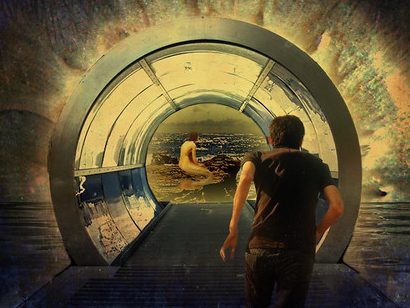
It’s not the sharks
Sliding mere inches from his upturned face
Through warps of water where the tunnel arcs
Transparent overhead,
Their lipless jaws clamped shut, extruding teeth,
Their eyes that stare at nothing, like the dead,
Staring at him; it’s not the eerie grace
Of rays he stood beneath,
Gaping at their entranced slow-motion chase

That is unending;
It’s not the ultra-auditory hum
Of ET cuttlefish superintending
The iridescent craft
Of their lit selves, as messages were sent,
Turning the sight of him they photographed
To code: it is not this that left him dumb
With schoolboy wonderment
Those hours he wandered the aquarium.

It is that room,
That room of Murray River they had walled
In glass and, deep within the shifting gloom
And subtle drifts of sky
That filtered down, it seemed, from the real day
Of trees and bird light many fathoms high,
The giant Murray cod that was installed
In stillness to delay
All that would pass. The boy stood there enthralled.

Out in the day
Again, he saw the famous streets expound
Their theories about speed, the cars obey,
Racing to catch the sun,
The loud fast-forward crowds, and thought it odd
That in the multitudes not everyone
Should understand as he did the profound
Profession of the cod,
That held time, motionless, unknown to sound.

In bed at night,
Are his eyes open or is this a dream?
The room is all dark water, ghosted light,
And midway to the ceiling
The great fish with its working fins and gills
Suspended, while before it glide the reeling
And see-through scenes of day, faintly agleam,
Until their passage stills
And merges with the deep unmoving stream.

*****

Stephen Edgar writes: “As the reader may guess, although the poem is cast in the third person, in the figure of a young boy, it describes a visit to an aquarium that I made myself, and as an adult. And on the occasion of this visit I was struck, and deeply impressed, by the single large Murray cod, seemingly floating motionless in its large room-sized tank of water, designed to mimic a section of the Murray River. Impressed in what way? Well, it is hard to say, but there seemed to be a certain mystery and power embodied in this fish, which was sealed off from me, inaccessible. The image stayed with me. However, it was only when I revisited the aquarium some years later that this original mood was reawakened and prompted me to write a poem about it. 

“The challenge was to find the right way to express it.  I didn’t want the poem to seem too portentous and self-important, so I thought that by seeing it through the eyes of a young boy I could give it a certain lightness of touch. But also the young are often considered to be more in touch with the natural world than adults, with their worldly preoccupations. In the midst of all the other superficially more attractive and appealing creatures in the aquarium, this particular boy is transfixed by this large fish. He has, I suppose you could say, a vision. What of? Well, some kind of vision of timelessness and continuity represented in nature, in comparison with which the speed and hubbub of daily life—represented by the city traffic and crowds—seem trivial and unimportant.

“In a way, the poem is already over by the end of the fourth stanza. The main point has been made. But a poem has an aesthetic shape as well as a meaning and I felt the need to round it off in some emotionally satisfying way. So I placed the boy, after the day was over and he was home again, lying in bed reliving his vision. Maybe he is dreaming; maybe he is awake and having a waking dream: either way he sees the fish in the midst of his ordinary everyday room, and overlaid on this he sees the city scenes, which are gradually absorbed by the dream river and dream fish. 

“The word “dreaming” in the poem’s title, while it can refer to this last stanza, is also meant to imply the use of the word in indigenous Australian culture, signifying a body of lore connected to a totemic animal or sacred place.

“The poem is written in a nonce stanza form of my own devising, with nine lines rhyming ABACDCBDB, in pentameter, apart from line one in dimeter, and lines four and eight in trimeter.

“The poem first appeared in Poetry (Chicago). It then appeared in The Red Sea: New and Selected Poems (Fort Worth, Baskerville Publishers, 2012), now out of print; then in my ninth book, Eldershaw; and also in The Strangest Place.”

*****

Stephen Edgar was born in 1951 in Sydney, where he grew up. From 1971 to 1974 he lived in London and travelled in Europe. On returning to Australia he moved with his then partner to Hobart, Tasmania, where he attended university, reading Classics, and later working in libraries. Although he had begun writing poetry while still at high school, it was in Hobart that he first began writing publishable poems and found his distinctive voice. He became poetry editor of Island Magazine from 1989 to 2004. He returned to Sydney in 2005. He is married to the poet Judith Beveridge.

He has published thirteen full collections: Queuing for the Mudd Club (1985), Ancient Music (1988), Corrupted Treasures (1995), Where the Trees Were (1999), Lost in the Foreground(2003), Other Summers (2006), History of the Day (2006), The Red Sea: New and Selected Poems (2012), Eldershaw (2013), Exhibits of the Sun (2014), Transparencies (2017), The Strangest Place: New and Selected Poems (2020) and Ghosts of Paradise (2023). A small chapbook, Midnight to Dawn, came out in 2025, and a new collection, Imaginary Archive,will be published in late 2025. His website is www.stephenedgar.com.au, on which publication details of his books, and where they can be purchased, are given.

He was awarded the Australian Prime Minister’s Award for Poetry in 2021 for The Strangest Place.

Photo: “Murray Cod at Melbourne Aquarium” by brittgow is licensed under CC BY-NC 2.0.

John Gallas ‘A Comforting Sonnet’

‘Caring means a whole new world’ – Croatian Proverb

Rosa Horvat’s hound attacked my legs.
My toes went green. I had a dizzy fit.
They took me to the hospital in Split.
The wards were all full up, so Uncle Dregs
sat by my trolley till he went to work,
then Erno, who’s my mum’s half-brother’s son,
pushed me up and down the hall for fun,
until his grandad’s nephew, who’s a Turk,
came and told me jokes. I wet the bed.
Then someone in a helmet held my hand
and sang a song I couldn’t understand.
Then it was morning, and I wasn’t dead.

I’m home now. Hvala vam if you were there.
Or not. Or sometimes. Friends are everywhere.

*****

Hvala vam – thank you all (Croatian)

John Gallas writes: “As with Camaguey – same collection, the proverb this time being as the little epigraph says. I particularly wanted here a certain tone: I am not a my-thoughts/my-feelings/interesting me sort of poet, and write mostly objective tales, descriptions, experiences that contain anything ‘I’ might want to say. A firm believer in show-not-tell.
“This one has won a couple of prizes: I regularly enter competitions, testing my poems anonymously before judges from The Cats’ League to National Poetry Society. This one won the ‘Caring’ section of a national competition. They liked the ‘humour-and-kindness’ of it all – which pleased me, as that was exactly the tone-intention.
“Wee note: I often set poems – I have travelled much – in various lands and cultures: I have been in trouble for this (my Maori friend, Vaughan Rapatahana, just said ‘Don’t’ when I embarked on some Pacific Island tales-in-verse) but as a Man With No Culture (white NZer?) I feel free to roam, creatively, as long as certain sensitivities are observed. (I have a complex theory as to objection/offence as far as cultures go, but I’ll leave that for now). ‘The Song Atlas’, my best-selling Carcanet book, was a translation of one poem from every country in the world.”

John Gallas, Aotearoa/NZ poet, published mostly by Carcanet. Saxonship Poet (see http://www.saxonship.org), Fellow of the English Association, St Magnus Festival Orkney Poet, librettist, translator and biker. Presently living in Markfield, Leicestershire.
Website is http://www.johngallaspoetry.co.uk which has a featured Poem of the Month, complete book list, links and news.

Photo: John Gallas, Carcanet official photo

RHL, ‘Privelitch’

Some suffer from a travel itch
but I call that a snivel glitch
I only want to travel rich
and love it: it’s my privelitch.
O privelitch, o privelitch!

I only go to schools most rich,
(and only eat foods superrich),
then college has to be Oxbritch,
for that’s my privelitch.
I love you, love you, bitch!

I wear the robes and coronitch,
I swear by God I’ve found my nitch,
for, be I tubby, tall or titch,
I’ve got my privelitch.
O privelitch, o privelitch,
I love you, love you, bitch!

I never on my class would snitch
(or if I do, it’s just a smitch);
I’m faithful – cept for those I ditch,
for that’s my privelitch.
O privelitch, o privelitch!

I down it nail, I up it stitch,
call me a wizard or a witch,
I’ve got it all, with perfect pitch,
for that’s my privelitch.
I love you, love you, bitch!

My life with none I’d ever switch,
I’m over all, no slightest twitch,
and even when I’m in Death’s ditch
my tomb shouts Privelitch!
O privelitch, o privelitch,
I love you, love you, bitch!

*****

Don’t think I’m unaware of my own privilege: white males with above-average education are a privileged minority in any country. But also you reading this, whoever you are, you are privileged to not be a child in Gaza or any of the other hells that humans make for each other on an otherwise beautiful planet; you are privileged to be alive during this affluent and pivotal time in human history. And of course those who in addition have cultivated a taste for poetry… is there maybe a hint of privilege there?

This poem, like Buccaneer, was recently published in Magma.

Photo: “General Election Bullingdon Club Members in 1987, including Boris Johnson and David Cameron” by Diego Sideburns is licensed under CC BY-NC-ND 2.0.

Double sonnet, Daniel Galef, ‘A Nightingale to a Sad Poet’

(Keats’s ‘Ode to a Nightingale’ from the other side)

You slump at my tree’s foot, complex angsts brewing
While our red-clawed, red-beaked animal furies
In these shadowy plots hatch our own undoing.
If thinking is man’s ruin, have no worries.
If you could speak the whistling words of birds
Whose sound to you like music now appears,
As nature’s snow-white cream man sours to curds
To chew, our songs would curdle in your ears:
‘Fly!, fly! The bearded fox is on the prowl!’—
And ‘Keep away! These berries are quick poison!’—
‘I need a mate, or I was born for nought’—
‘Go south, go south!’—‘The horned and hoary owl
Brings swift, crook-taloned death.’ You seek strange joys in
Ignorance, to envy lives so fraught!
Now dull-brained human scientists proclaim
That tool-use is no more unique to apes
Than language, war, or thumbs. They’re all the same
Emergent properties, like wine from grapes.
I am not certain that is Hippocrene;
The Pierian Spring leaves no such scarlet stain.
A jug of wine might well complete the scene:
Your book of verse, &c. A brain
Like smiling Aesop’s, where morals mask the roar
Of lions, the flopping fear of fish in the net,
The worm-wove cloak we dress up in our tomb in—
I think that must be Lethe. Drink, and soar
Above your brain, and me, and quite forget
That you were all too sentient, all too human.

*****

Daniel Galef writes: “I’m a sucker for parodies and response poems! My first book features riffs on Byron, Swift, Ernest Thayer, the ancient epigrammatist Nossis the Epizephyrian, and Doris Day. A few years ago in my master’s program I took a[n excellent] poetry workshop with Barbara Hamby focusing on the history of the Ode, as part of which she had everyone memorize Keats’s “Ode to a Nightingale.” We’d all read the poem before, but engaging with it so closely for a sustained duration was a really lovely experience, and having the whole poem by rote is an excellent party trick if you ever need to clear the room at the end of a party. At the end of the class I sent Professor Hamby a little parody piece, a rebuttal from the nightingale’s point of view to the moping poet sitting underneath its tree. (It was also a gesture of peace because I had gotten on her bad side by insinuating that the speaker calling the nightingale “dryad of the trees” was redundant because all dryads are by definition of the trees.) That poem was three pages or so and more directly parodying Keats’s style, as well as being written with the same stanzaic structure as Keats’s. It was also just for fun and thoroughly unprintable. But something I’ve been doing lately when I can’t bring myself to write an original poem is to sonnet-ize other things I’ve written—short lyric poems, long narrative poems, free verse, even short short stories—as I’m currently putting together a second collection of Imaginary Sonnets, a series of persona poems I’ve been writing for years inspired by the Victorian poet Eugene Lee-Hamilton. I cherrypicked a handful of my favorite lines from the long nightingale poem and spun some sonnet-stuff around them and ended up with this. It was still too much material for fourteen lines but fit into a double-sonnet, which is half as good.”

Daniel Galef’s poetry, half-serious and half-non-, has been published in a variety of venues themselves both serious and non-. His first book, Imaginary Sonnets, collects 70 persona poems from the point of view of various historical figures and literary characters, including Lucrezia Borgia, Christopher Smart’s cat, and a taco. “A Nightingale to a Sad Poet” first appeared in the Spring/Summer 2025 issue of Sein und Werden. Other recent writing can be found in the Indiana Review, the Best Small Fictions anthology, and Scientific American.

Bard of the Mossy Cot” by Giles Watson’s poetry and prose is licensed under CC BY-SA 2.0.


Sonnet: Maryann Corbett, ‘Saturday Edition’

Page one, above the fold: the world in flames.
A luxury hotel gapes like a sore.
In mammoth type, the headlines yell the names
of prophets stoking hells of holy war.

In Business, meanwhile, there is calm discussion
of sales rates for the sexy underclothes
pitched by Victoria’s Secret, and a fashion
for surgical revision of the nose.

It isn’t news to those who sell the paper:
their readers can take only so much hell.
They proffer me the surgeon and the draper
as pastures where my bovine brain may dwell,

ignoring, while it chews on this confection,
the screams of children from the other section.

*****

Maryann Corbett writes: “My records tell me that ‘Saturday Edition’ is one of my very earliest sonnets and very earliest acceptances, appearing in The Barefoot Muse in 2007 and included in Mary Meriam’s Irresistible Sonnets in 2014. It was among the poems that gave me the lightbulb realization that I tend to write sonnets when I’m angry.”

Maryann Corbett earned a doctorate in English from the University of Minnesota in 1981 and expected to be teaching Beowulf and Chaucer and the history of the English language. Instead, she spent almost thirty-five years working for the Office of the Revisor of Statutes of the Minnesota Legislature, helping attorneys to write in plain English and coordinating the creation of finding aids for the law. She returned to writing poetry after thirty years away from the craft in 2005 and is now the author of two chapbooks and six full-length collections, most recently The O in the Air (Franciscan U. Press, 2023). Her work has won the Willis Barnstone Translation Prize and the Richard Wilbur Award, has appeared in many journals on both sides of the Atlantic, and is included in anthologies like Measure for Measure: An Anthology of Poetic Meters and The Best American Poetry.

Photo: “UN School in Gaza Attacked” by United Nations Photo is licensed under CC BY-NC-ND 2.0.

Lucius Falkland, ‘Sado-Masochism in Love Poetry’

Some like being bound up in leather and chains,
Others spanked with a branch from a tree,
But the people who truly get turned on by pain
Try to publish their love poetry.

The poet’s not known for his psychical health:
He wrestles despair, feels dejected,
Not that undisposed to killing himself,
Yet his heart’s work so often rejected.

Sometimes he must wait the best part of a year,
Like an innocent man on death row,
To have to him confirmed his most terrible fear,
For they are quite sadistically slow.

And the hurt they inflict? It’s not over yet.
Do they find wounding fragile souls funny?
Some journals won’t read the submissions they get
If the poets don’t first send them money!

Once it’s crafted and honed and as good as Ted Hughes,
On a par with their earlier choices,
They find a new method to mentally abuse:
They prioritize “marginalised voices.”

The agony felt by a hounded young deer
As he’s brought to the ground by a predator
Is as nothing compared to the suffering and fear
That’s induced in a poet by an editor.

*****

Lucius Falkland writes: ‘I wrote this poem in response to having so many of my love poems rejected by poetry journals. It struck me as absurd that poets experience feelings, including being in love, so intensely that they must process them via poetry, they share the most poignant aspects of their lives with journal editors, and yet they know they will frequently get rejected. It is as though they write about their deepest pain only to then subject themselves to the further pain of being told that they can’t even express their pain properly. ‘Are we poets Masochists?’ I wondered. Naturally, this poem was itself rejected by a number of editors – with one even commenting that he was sympathetic to my plight. before rejecting it anyway because ‘it’s not the right fit’ (euphemism for ‘I don’t like it!) – before being published in The New English Review.”  

Lucius Falkland is the nom de plume of a writer and academic originally from London. His first poetry volume, The Evening The Times Newspaper Turned Into Jane Eyre, was published in 2025 with Exeter House Publishing. It can be purchased here.

Illustration: “Vinegar Valentine – 05” by BioKnowlogy is marked with Public Domain Mark 1.0.

Rachel Hadas, ‘Rag Rug’

It has arrived—the long rag rug
multiply folded. On top, one alien hair.
I put my face to the folds and smell despair
palpable as salt air
in all those rooms and houses, small and smug—
enclosures I passed through on my way where?

Whoever did the weaving appears old
in my mind’s eye. I can’t make out her face,
can only conjure up the faintest trace
of an abstracted grace,
clack of the loom. Does she know they’ll be sold
these precious things, in some unheard-of place?

I perch her on a hill, precariously
beyond the reach of waves’ daily boom.
Sun blazes overhead, but her dim room
(no bigger than the loom)
is proof against the violence of the sky
From it I further spin what I once called my home:

Endless horizons fading into haze,
the mornings dawn came up so rosy clear;
snails in the garden, sheep bells everywhere,
the brightness of the air,
terraces, valleys organizing space
and time’s cessation. So this package here

I’m now unwrapping, in New York, today
(rugs like rainbows, woven with a grace
my strands of language barely can express;
dishrags of dailiness
dispersed and recombined and freshly gay)
comes to me imbued with images,

slowly and faithfully across the water,
across the world. It represents a time
I myself snipped and recombined as rhyme
as soon as I went home,
if that is where I am. These rugs recover
the sense of stepping twice into a single river.

*****

Rachel Hadas writes: “Rag Rug, written probably around 1980 or sometime in the early Eighties, describes my experience opening packages of rag rugs handwoven by a woman or women in Samos, the Greek island where I’d lived between 1971 and 1974. The rags in question were blue jeans, pajamas, tablecloths, you name it – I’d cut these into narrow strips which I sewed together and rolled into a ball, and when I had enough such balls I mailed them to my former mother-in-law in Samos; she eventually sent me the finished project, long rag rugs perhaps eighteen inches wide, colorful, washable, which eventually faded and blended as madras does. The evocative smell of the cloth; the memories of the island and my life there; the fact that poetry, like the making  of these rugs, like quilting, is a piecing together, recombining and recycling of fragments – reading the poem now brings all this back.”

Rachel Hadas’s recent books include Love and Dread, Pandemic Almanac, and Ghost Guest. Her translations include Euripides’s Iphigenia plays and a portion of Nonnus’s Tales of Dionysus. Professor Emerita at Rutgers-Newark, where she taught for many years, she now teaches at 92Y in New York City and serves as poetry editor of Classical Outlook. Her honors include a Guggenheim fellowship and an award from the American Academy-Institute of Arts and Letters.

Photo: “Colourful rag rug” by theihno is licensed under CC BY-ND 2.0.