Author Archives: Robin Helweg-Larsen

Unknown's avatar

About Robin Helweg-Larsen

Director, Andromeda Simulations International, Bahamas: a global education company providing online and in-person workshops in business finance. Series Editor, Sampson Low's 'Potcake Chapbooks'. Formal verse about traveling, family, love, etc...

Poetry Resource: “Shot Glass Journal”, Poem: “In the Metal Box”

You sit in the humming metal box
And the unlikely landscape rolls
Beneath you in its crumpled seas and rocks
Seen from some miles above on long papyrus scrolls.

This little poem was recently published in Shot Glass Journal, whose motto is “… brevity is the soul of wit …” Accepting only short verse (although “16 lines or less” seems overly generous for “short”) in either free or form, it is remarkable for an American institution in reserving half its space for non-US poets. In the current issue, the left-hand column of 21 US poets is balanced by the right-hand column of 21 poets from Australia, the Bahamas, Canada, India, Ireland, Israel, New Zealand, South Korea, Turkey and the UK. This in itself adds richness and interest to the journal, all the more tasty and accessible in a short-form environment.

Normally edited by Mary-Jane Grandinetti, the current issue (#29) is guest-edited by poet R.G. Rader, the poet and playwright who founded Muse-Pie Press. Muse-Pie Press publishes Shot Glass Journal, as well as two other idiosyncratic magazines, Bent Ear Review of spoken poetry (audio or video submissions only, naturally) and the fib review of Fibonacci poetry. All are open to both formal and free verse.

Technically, this might or might not be a “throwaway poem”. That’s how I would describe it, meaning just a casual thought in verse; but on the other hand some people use the term to mean hand-written thoughts (usually not well-formed) on scraps of paper left behind on public transit or in the park. This one has a bit of form: rhyme, meter, and the last two lines lengthening in imitation of the endlessness of air travel and of the landscape that is being flown over.
 

Sonnet: “Unanswered”

The Afterlife – some Happy Hunting Ground?
Or Jesus, virgins, merging flesh and breath?
Or god of your own world, white-robed and crowned?
Or ghost? Rebirth? Just, please, no final death!

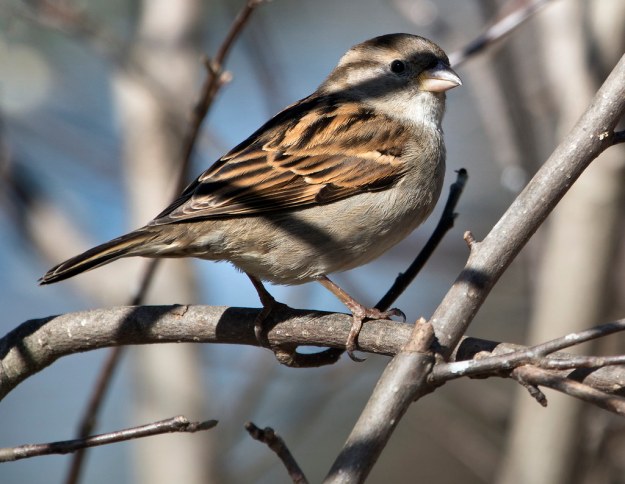
The sparrow through the Saxon hall at night –
Brief light and warmth, then cold obscurity.
Is this our life? But yet the bird in flight
lived in the dark, both pre and post. Do we?

Frogs, living in a buried water tank,
spend all their time in darkness. Then the lid
is lifted and sun shines into the dank –
lid down, light gone… but they live on, though hid.

We work and play throughout our brief day’s sun –
Day raises many questions – night, just one.

This sonnet was published in Snakeskin No. 265, edited by George Simmers. I write both religious and irreligious poetry as the muse suggests, but my own personal views are Fundamentalist Agnostic: “Nescio et tu quoque”, “I don’t know and neither do you.” The sparrow reference is to a passage in the Venerable Bede’s Ecclesiastical History of the English People which usually seems to resonate well.

Technically the sonnet is Shakespearean: iambic pentameter rhyming ABAB CECD EFEF GG. The three quatrains are each self-contained, but leading to the resolution (or lack of resolution) in the couplet. The last line is the strongest, which is always satisfying.

Sonnet Contest: Cash prizes, no entry fee!

poetry magazine, Better than Starbucks logo

Better Than Starbucks has just opened its annual sonnet contest, an opportunity for all lovers of formal poetry to practice their skills and show off their best work.

Open through October and November (closes December 1), the contest has no entry fee but awards prizes of $100, $50 and $25 for the top three sonnets, which will be published in the magazine along with seven runners-up.

Expect the competition to be fierce! Better Than Starbucks already has a solid following among formal poets. Last year’s competition drew 560 sonnets, this year’s will undoubtedly see more. And you can only send two sonnets. Make sure they are good!

What “good” means can be gleaned from looking at last year’s results in the January 2019 issue, and more sonnets on the Formal Poetry page in March 2019. There are explanatory notes on the contest page, showing some leniency in the definition, and clarifying that previously-published work is acceptable:

This contest is for a metrical sonnet.
Your sonnet can be shakespearean, petrarchan, spenserian, rhymed, or slant-rhymed.
Blank verse is fine, as long as the sonnet form is clearly identifiable.
We’ll consider tetrameter, hexameter, etc. as well as pentameter.
Some metrical variation is fine, but don’t forget the volta!
As always, we do accept previously published work.

Good luck!

Sonnet: “Beat This Level”

Forget that crap about some God or Devil –
you’re on your own against the Universe;
but till you’re free of our Stage One’s perverse
orientation, you won’t beat this level.
The Heaven idea is fraudulent, and worse:
Father McKenzie wields a deadly shovel.
Stage Two’s extended life – hard, but don’t snivel.
Stage Three: genetic change, youthful reverse.

You must want Life – must fight Death all the way,
ignoring social norms, pressure from peers;
such life will need a gamer’s vigilance.
Your other futures are: ashes, or clay.
And if help’s late, as you slide down the years,
cryonics is your waiting ambulance.

This sonnet, written over 20 years after the previous “Death Will Be Harder Now”, was first published as a pair to it in Ambit No. 190, October 2007. (Also like the earlier sonnet, it was reprinted in Bewildering Stories, edited by Don Webb.)

The theme is our age-long human dream of avoiding death, including that celebrated by Father McKenzie, “wiping the dirt from his hands as he steps from the grave.” (No one was saved.) For the first time in history we can see the realistic prospect of indefinite lifespans coming closer, if we can just live long enough for genetic modification to give us not only better hair and wrinkle-free skin, but actual rejuvenation. If you die before that happens, cryonic suspension is your ambulance to the future… you may not survive the ride, but you’ll have a better chance of a fresh lease of life than if you let them cremate you or pass you through the bodies of worms.

Technically the sonnet is unconventional, reversing the rhymes in the second quartet rather than echoing them, so that the poem reads ABBABAAB CDECDE. I don’t think that’s a problem; probably the bigger sin was splitting noun from adjective in lines 3 and 4, breaking the rhythm of the pentameters, which the other lines hold comfortably.


Sonnet: “Death Will Be Harder Now”

“trying to sneek a peek” by lastbeats 

Death will be harder now, as, year by year,
We solve the clues of immortality:
Emotions sink to animality
As false hopes tighten screws of desperate fear.
Hormone control will make age disappear—
After false starts, most horrible to see—
But those already old must beg to be
Frozen for the genetic engineer.
While war, starvation, pipe Earth’s gruesome jigs,
Successful businessmen will fight to gain
Some dead teen’s body, to transplant their brain,
The already-old beg to be guinea-pigs.
Children, look back, hear our despairing cry:
We bred immortals, but we had to die!

This sonnet was originally published in the British quarterly Ambit in 2007, back when the amazing pediatrician and novelist Martin Bax was editing it and accepting formal verse. Perhaps the best-known piece Martin published was J.G. Ballard’s “The Assassination of John Fitzgerald Kennedy Considered as a Downhill Motor Race”…

But although the poem’s subject-matter seems current, it dates from 1982 when I was first becoming aware of cryonics and the speculative thinking around genetics and nanotechnology. I believe if a person is truly aware of their surroundings, they are going to be aware of both their historical context and their possible science fiction futures. Otherwise, to repeat, they aren’t truly aware of their surroundings.

As Heraclitus said, “The only constant in life is change.” He couldn’t have imagined our present world. The rate of change is accelerating. I doubt anyone today can imagine the world a hundred years hence.

Poem: “Agenda for a Political Career”

Help the peaceniks
With their cut-backs
To the Army,
It’s fulfilling;

Once elected,
Buy cheap arms stocks,
Start a war and
Make a killing.

This poem was originally published in Lighten Up Online, edited by Jerome Betts. I dislike war, but even more I loathe “chicken hawks“, those who personally avoided combat when their country called them up but who later in their careers advocated war and made a fortune from it. That includes a lot of American politicians.

Good guys: Eisenhower and his military-industrial complex warning. Kennedy, assassinated when he was trying to pull US troops out of Vietnam. Jimmy Carter. All military men who understood war.

Total jerks: Johnson, ramping up the Vietnam war while everyone was distracted by the Kennedy funeral. Kissinger even more than Nixon. Cheney even more than George W. Bush. Trump. Chicken hawks.

The US doesn’t have a monopoly on avaricious politicians. The UK’s Tony Blair has been rewarded by the world of oil and wars to the extent of acquiring an estimated $90 million and a property portfolio worth $37.5 million in the first eight years since leaving office (i.e. 2007-2015).

Poem: “Optimism”

Do you have a clear detection
Of an unexpired affection?
Are you reckoned to come second in her life?
Was there someone there before you?
Let it be, don’t let it bore you;
It’ll maintain her somewhat saner as your wife.

This little throwaway poem was recently published in Lighten Up Online. In my mind its value is not so much as a commentary on modern marriage, as an enjoyable way to string some rhymes together. I no longer have any idea what was on my mind when I wrote it.

Many poets would analyse this as written in trochees with lines of either four or six feet, the third line being

ARE you RECKoned TO come SECond IN her LIFE?

but to my mind the lines have only either two or three strongly accented syllables, with the third line being

Are you RECKoned to come SECond in her LIFE?

It is a short piece of patter, which is emphasised by the internally stressed rhymes of reckoned/second and maintain-her/saner. But that leads to a problem: there is a difficulty with the beginning of the last line, and it is hard to find a smooth flow.

Originally it read

‘Twill maintain her —

Archaic, said LUPO editor Jerome Betts, and requested a change for publication as

It’ll keep her —

I accepted this, not noticing that I was losing the rhyme with saner. So why not

It’ll maintain her —

Now the problem is that there is one syllable too many, and we don’t have a smooth flow from the previous line.

You’ll maintain her —, perhaps?

That gives a brand new problem, a subtle shift of meaning from the abstract “it” to the personal “you”, with a much more active sense of “maintain her” and even a suggestion of financial concern.

If it was just an oral presentation, you could probably slide by with

‘t’ll maintain her —

but is that acceptable, comprehensible, in print?

My operating principle with poetry is that there is always a solution. But in this case I haven’t yet found it. 

Poem: “The Fig Tree”


The fig leaf symbol’s one of History’s greats
As, inter alia,
It hides, discloses and exaggerates
Male genitalia.
The fruit itself suggests the female form —
Dripping with honey
The little hole breaks open, pink and warm . . .
The Bible’s funny.

First published in The Asses of Parnassus, this poem has just been republished in Better Than Starbucks, which earned a “Kudos on your brilliant ‘The Fig Tree'” from Melissa Balmain, editor of Light. That’s a trifecta of editorial acceptance – it makes me proud, and I have to erase my lingering suspicion that the poem would be thought too rude for publication. Now I rate the poem more highly, as being not just a personal favourite but also acceptable to a wider audience.

It sometimes feels that all I write is iambic pentameter. It is always reassuring when a poem presents itself with half the lines being something else, and the result is a lighter, less sonorous verse. The rhymes are good; the poem’s succinct and easy to memorise. I’m happy with it.

Poem: “Move Along Folks, Nothing to See”

JFK.jpg

“Kennedy(s)” by Garrett Leo Augustyn

There was a sharp psychic who lived in DC,
They told her their troubles, she told them “I see”.
She told Mr. Kennedy “Don’t go to Texas”
He went and was killed, it’ll always perplex us.
Amazing, amazing and true
Move along folks, nothing to see.

There was a small bullet was fired from a gun,
You wouldn’t believe the damage it done:
Through Kennedy’s neck, Connally’s chest, wrist and thigh,
Fifteen layers of clothing… and ended up fine.
Amazing, amazing and true
Move along folks, nothing to see.

There was a young drifter, a Commie, Marine,
Who shot and then lunched in the schoolbook canteen
As though he weren’t flustered – two minutes before
He’d been killing, then must have rushed down six floors.
Amazing, amazing and true
Move along folks, nothing to see.

There was a club owner who carried a gun
A friend of the cops, of HQ he’d the run.
“I did it for Jackie” – prevented a trial,
No chance now for Oswald to prove his denial.
Amazing, amazing and true
Move along folks, nothing to see.

There was a Vice President, swallowed his pride
At the President’s insults – when JFK died
He ramped up the war while the nation was grieving –
His weapons and copter stocks passed all believing.
Amazing, amazing and true
Move along folks, nothing to see.

There was a commission that looked for the truth.
Conclusion: a loner, no plot, not like Booth.
The psychic? Ignored. The bullet? Just lucky.
The VP? Heart-broken. The club owner? Plucky.
Amazing, amazing and true
Move along folks, nothing to see.

This was first published in Snakeskin #246, December 2017. It mentions some – but by no means all – of the anomalies surrounding the first Kennedy assassination, reported on but not resolved by the Warren Commission. JFK’s assassination is a rabbit-hole that you can disappear down and never see daylight again, full of intriguing Lewis Carroll-like logic puzzles such as the magic bullet theory.

Unnamed characters here are psychic Jeane Dixon, assassin Lee Harvey Oswald, nightclub owner Jack Ruby and of course Vice President Lyndon Baines Johnson.

Technically the poem is closer to a song than to a formal poem. It has a regular structure of verse and refrain. The rhymes and metre are a little loose, which you can get away with when a song is sung. It just needs the music added.

Poem: “My Outside”

My outside stroking your inside
Your inside gloving my outside
My outside stroking your
Inside gloving my
Stroking your
Gloving my
Stroking
Gloving
Stroking
Gloving
My your my your my your
Our

This poem was originally published in “The Fifth International Anthology on Paradoxism“, edited by Florentin Smarandache – who appears to live as a mathematician in a universe of paradox. It was republished in the Experimental section of Better Than Starbucks.

This blog advocates for the use of form, to the extent of questioning whether a piece that doesn’t rhyme and scan can even be considered poetry. Is this poetry, then? I think it hovers paradoxically on the edge. It may not rhyme or scan, but it has certain qualities of form:

It is word-for-word memorable through its expression. After all, it only uses seven different words, and they are clearly structured.

The lines are paired all the way, the second of each pair mirroring (or even fusing) the first.

There is a rhythm – a very human rhythm – to the piece, even if it doesn’t fall within poetic norms.

There is even, if you care to consider it, an aspect of concrete poetry about it.

And, if read in my English accent, the last word is a pun, being pronounced “Ahh!”

The simplicity of words, the structure of the lines, the rhythm of the piece, the aspect of concreteness and the pun all contribute to what the poem is trying to communicate.

If it is a poem.