Category Archives: odd poems

Weekend read: Odd poem: French President Emmanuel Macron, ‘Pour Sophie’

On a trip to Paris one day, little Sophie
Met a giant lady lighting up the night sky.
“What’s your name, you magical monster?”
“My many visitors call me the Eiffel Tower.”
“In all your attire, don’t you sometimes tire
Of being seen only as a humdrum tower?
You, a dragon, a fairy watching over Paris,
An Olympic torch held aloft in grey skies?”
“How you flatter me! So few poets these days
Ever sing the praises of my Parisian soul,
As did Cocteau, Aragon, Cendrars,
Trénet and Apollinaire… Since you’re so good
At seeing beneath the surface, you could
– If you like, when you’re back from France –
Take up your pen and write down
Why you like me – it would be nice and fun!”
“You can count on me! There’s so much to say!
I’ll write twenty lines… but who will read them?”
“Well, I know a man who’ll read your verse.”
“Really? Who?”
“The President of France.”

En voyage à Paris, la petite Sophie
Croisa une géante illuminant la nuit.
“Comment t’appelles-tu, monstre surnaturel?”
“Mes nombreux visiteurs m’appellent Tour Eiffel.”
“N’es-tu pas parfois lasse, avec tes mille atours
Que l’on ne voie en toi qu’une banale tour?
Toi le dragon, la fée, qui veille sur Paris,
Toi, immense flambeau planté dans le ciel gris!”
“Quel plaisir tu me fais! Ils sont devenus rares
Ceux qui comme Cocteau, Aragon ou Cendrars,
Trenet, Apollinaire, avaient su célébrer
Mon âme parisienne aux charmes singuliers.
Puisque tu sais si bien percer les apparences,
Tu pourrais, si tu veux, à ton retour de France,
Prendre à ton tour la plume et conter en anglais
(It would be nice and fun) ce qui chez moi te plaît!”
“Tu peux compter sur moi! Il y a tant à dire!
Je t’écrirai vingt vers… Mais qui voudra les lire?”
“Oh, moi j’en connais un qui lira ton cantique.”
“C’est?”
“Monsieur le président de la République.”

*****

This poem by French President Emmanuel Macron is in French alexandrine: 12 syllable lines, rhyming couplets. The translation is either by him (he is fluent in English) or by the French Embassy in London, as the poem was written for the English girl Sophie’s 13th birthday. She herself had initiated everything with the poem below, which she had sent in April 2017 to the French President… at that time the President was François Hollande, but Macron won the presidency later that year, and responded for Sophie’s birthday on November 1st. Her poem was 20 lines long, written out on her drawing of the Eiffel Tower; his response is also 20 lines long (counting the final question and answer as a single line, which it clearly is by metre and rhyme).

Here is 12-year-old Sophie’s ‘Centre of Attention’:

She has four beautiful legs,
Which help her stand proud,
She looks over everyone,
With her head in the clouds,
She is elegant and tall,
Wears a pretty, lacy skirt,
Whilst staring at her in awe,
Your eyes will not avert,
Her spine is amazingly straight,
Whilst her head touches the sky,
People look up and take pictures of her,
As they are passing on by,
You need to tilt your head up,
To be able to see all of her,
But when you do,
She is as pretty as a picture,
She is the centre of attention,
Noticed by everyone.
She is the Eiffel Tower,
She is second to none.

Macron created a nice circularity with his response to Sophie’s poem, by pretending it was written first and caused Sophie’s poem, rather than the other way round. All very playful.

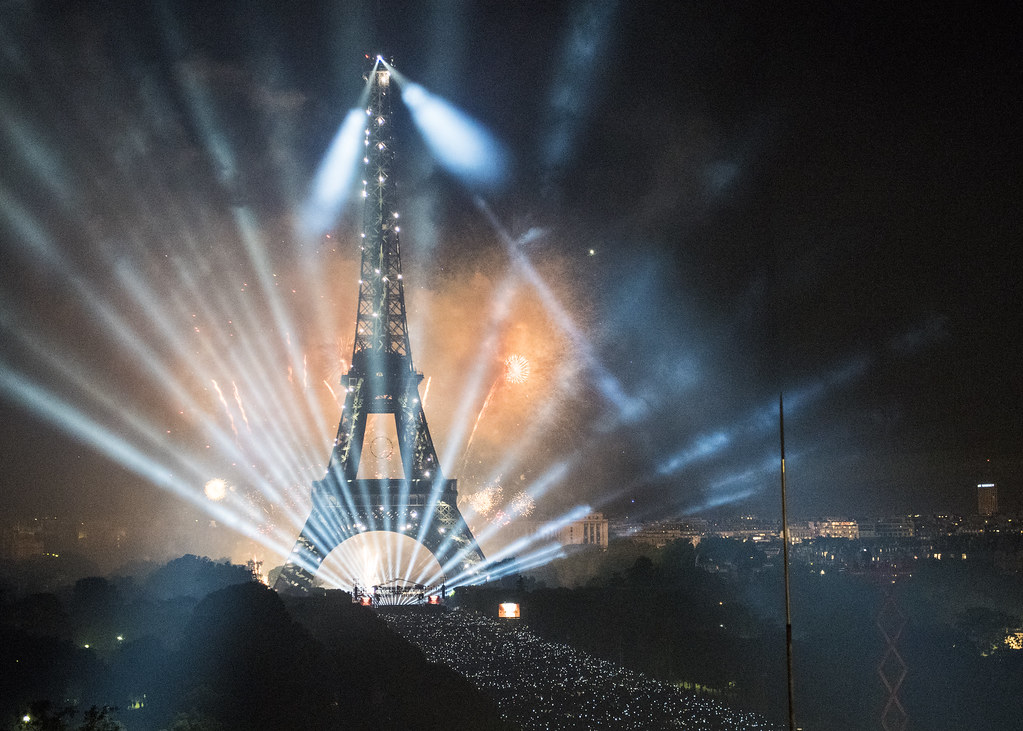
Photo: “170714-D-PB383-151” by Chairman of the Joint Chiefs of Staff is licensed under CC BY 2.0.

Odd poem: Brian Bilston, ‘Brie Encounter’

the skies are gruyere since she left me
i’ve never felt so danish blue
caught between a roquefort and a hard cheese
i stilton’t know what to do

don’t give edam about the future
now my babybel’s walked out the door
can’t believe i’ve double gloucester
i camembert it any more

i’ve ricotta get myself together
and build my life back caerphilly
cheddar tear for the final time
say goodbye to us and halloumi

*****

Brian Bilston is “the Banksy of the poetry world”.
You can find a daily poem on Facebook, and his books here.

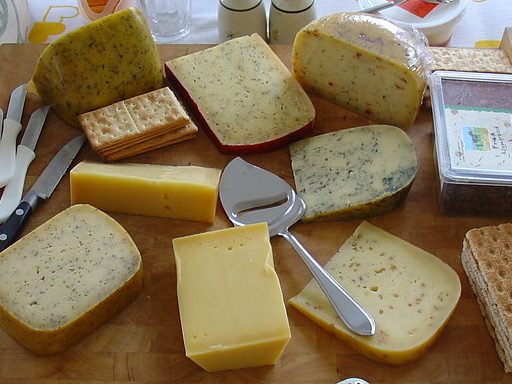
Photo: “Cheese, cheese, cheese” by kurafire is licensed under CC BY-NC 2.0.

Poems on poems: Ogden Nash, ‘The Collector’

I met a traveler from an antique show,
His pockets empty, but his eyes aglow.
Upon his back, and now his very own,
He bore two vast and trunkless legs of stone.
Amid the torrent of collector’s jargon
I gathered he had found himself a bargain,
A permanent conversation piece post-prandial,
Certified genuine early Ozymandial
And when I asked him how he could be sure,
He showed me P. B. Shelley’s signature.

*****

Ogden Nash‘s teasing take on Shelley’s Ozymandias is collected in ‘The Old Dog Barks Backwards’.

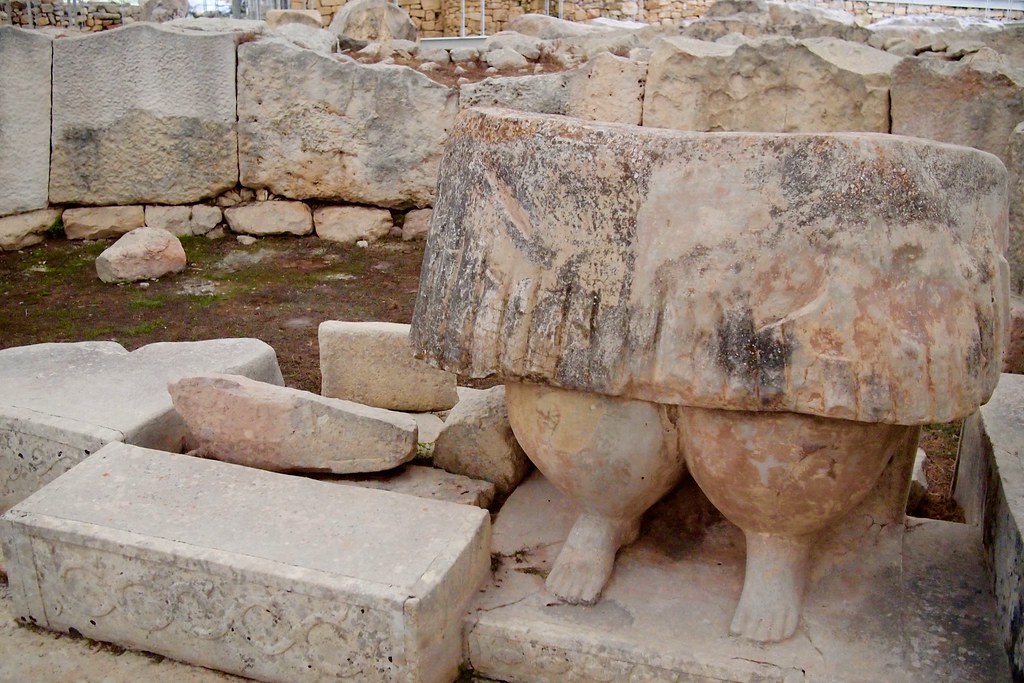
Photo: “Two vast and trunkless legs of stone” by skittledog is licensed under CC BY-NC-SA 2.0.

Unforgettable nonsense: Samuel Wilberforce, ‘If I Were a Cassowary’

If I were a cassowary
On the plains of Timbuctoo
I would eat a missionary,
Cassock, bands, and hymn-book too.

*****

Yes, cassowaries are from Australia and New Guinea, and Timbuktu is in Africa… but so what? The rhymes are too good to ignore. ‘Bands’, btw, refers to the pseudo-necktie thingies that priest-types and lawyer-types affect in some countries – little cloth flaps, plural because you wear two of them.

The probable author is Bishop Samuel “Soapy Sam” Wilberforce, best known nowadays for debating  Thomas Henry Huxley on evolution in 1860. Huxley (Aldous Huxley’s grandfather) was commonly referred to as ‘Darwin’s bulldog’. Wilberforce is remembered for his question as to whether it was through his grandmother or his grandfather that Huxley considered himself descended from a monkey. Huxley is said to have replied that he would not be ashamed to have a monkey for his ancestor, but he would be ashamed to be connected with a man who used his great gifts to obscure the truth.  Apparently everyone enjoyed the debate, and they all went off happily to dinner together afterwards.

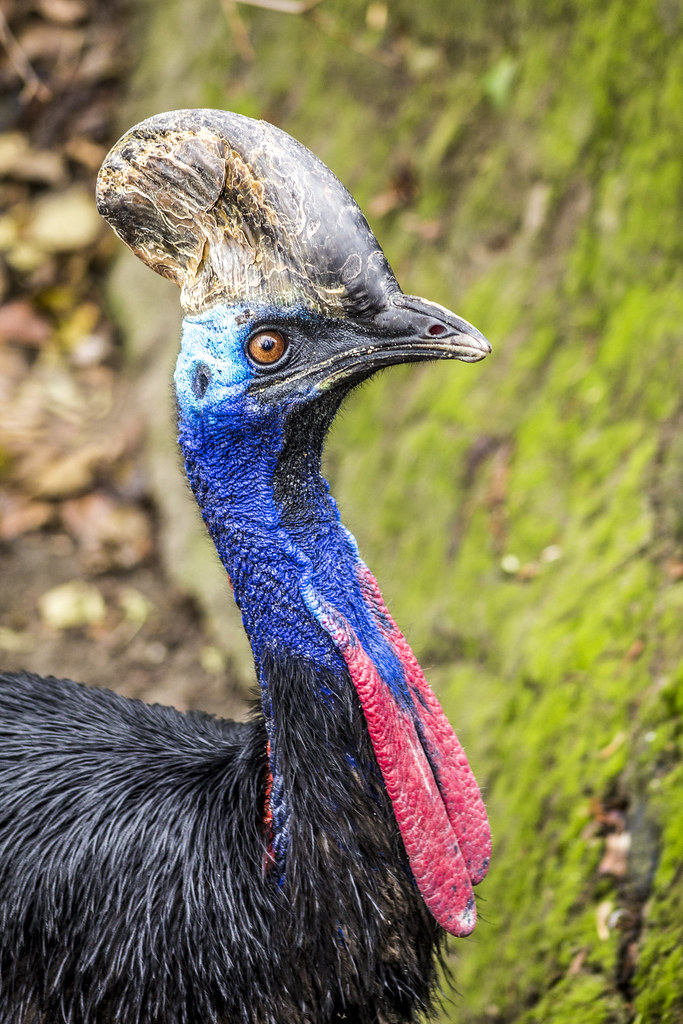
Cassowaries are more formidable than either Wilberforce or Huxley. Standing over six feet tall, capable of running at 30 mph (and good swimmers in rivers and sea), and able to leap and strike chest-high with razor-sharp 5-inch talons, they are omnivores not to be confronted. Yes, they might well eat a missionary. Also, the cassowary’s bands are more impressive.

Photo: “Cassowary at the Budapest zoo” by brenkee is marked with CC0 1.0.

Weekend read: Odd poem: Benjamin Disraeli, ‘To A Beautiful Mute (The Eldest Child of Mr. Fairlie)’

Tell me the star from which she fell,
Oh! name the flower
From out whose wild and perfumed bell
At witching hour,
Sprang forth this fair and fairy maiden
Like a bee with honey laden.

They say that those sweet lips of thine
Breathe not to speak:
Thy very ears that seem so fine
No sound can seek,
And yet thy face beams with emotion,
Restless as the waves of the ocean.

‘Tis well. Thy face and form agree,
And both are fair.
I would not that this child should be
As others are:
I love to mark her indecision,
Smiling with seraphic vision

At our poor gifts of vulgar sense
That cannot stain
Nor mar her mystic innocence,
Nor cloud her brain
With all the dreams of worldly folly,
And its creature melancholy.

To thee I dedicate these lines,
Yet read them not.
Cursed be the art e’er refines
Thy natural lot:
Read the bright stars and read the flowers,
And hold converse with the bowers.

*****

This poem for a mute girl and another (‘To a Maiden Sleeping After her First Ball’) can be found in All Poetry; they each have an accurate but uninspiring AI-driven analysis after them; the subsequent comments are more engaging:
WolfSpirit – “keep writing, Benjamin. you may just be a known poet someday. 
Linda Marshall – “I know Disraeli as a novelist and (of course) as a politician.
This is the first poem of his I’ve ever read!
It has its moments and of course tastes were different in those days but there are rhythmical infelicities and some rhymes that verge on the comic.
I can see why he’s known for his prose rather than his poetry!”

Benjamin Disraeli was born into a Jewish family in 1804; his father quarrelled with the synagogue and renounced Judaism, and had all the children baptised into the Church of England when Disraeli was 12. After school, Disraeli was articled to a law firm at age 16, and his career went from there to stock market speculation, financial ruin, novel writing, and then politics. He was twice Prime Minister of the United Kindom, and was appointed Earl of Beaconsfield by Queen Victoria in 1876. He died in 1881, unmourned as a poet.

Photo: Earl of Beaconsfield, K.G. Photographed at Osborne by Command of H.M. The Queen, July 22, 1878. This file was derived from: Benjamin Disraeli CDV by Cornelius Jabez Hughes, 1878.jpg

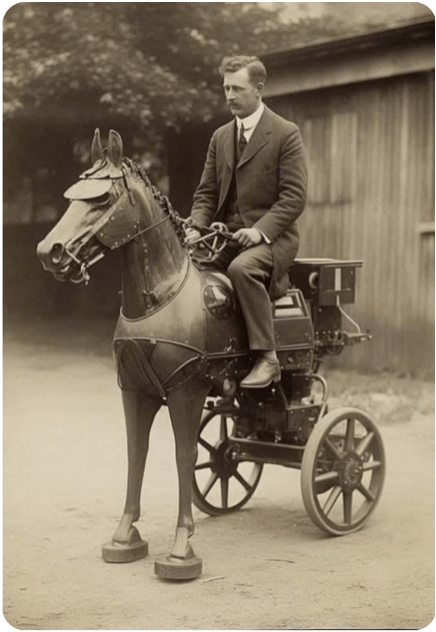
Odd poem: Light verse: Richard Fleming, ‘The Equestropede’

George, wishing to proceed at speed,
built the world’s first Equestropede.
This fusion of a horse and cart,
a tribute to the welder’s art,
had a strong engine, 12 hp,
which meant George travelled speedily.
It ran on oats and gasoline,
a strange concoction, unforeseen
by Elon Musk and the X folk
who would have seen it as a joke.
George, Michelangelo reborn,
treated the neigh-sayers with scorn.

*****

Richard Fleming writes: “The Equestropede, when it was first unveiled at the Exposition Universelle in 1901, proved to be the centaur of attraction. I post a rhyming poem every day on my Facebook page https://www.facebook.com/richard.fleming.92102564/ and accompany it with a quirky image that I’ve found online. Does the poem precede the image or vice versa? That depends. In the case of ‘The Equestropede’ the strange image definitely preceded the rhyme and fairly begged to be ‘poeticised’. The Equestropede name, however, is purely my invention as is its unveiling at the Exposition Universelle.”

Richard Fleming is an Irish-born poet (and humorist) currently living in Guernsey, a small island midway between Britain and France. His work has appeared in various magazines, most recently Snakeskin, Bewildering Stories, Lighten Up Online, the Taj Mahal Review and the Potcake Chapbook ‘Lost Love’, and has been broadcast on BBC radio. He has performed at several literary festivals and his latest collection of verse, Stone Witness, features the titular poem commissioned by the BBC for National Poetry Day. He writes in various genres and can be found at www.redhandwriter.blogspot.com or Facebook https://www.facebook.com/richard.fleming.92102564/

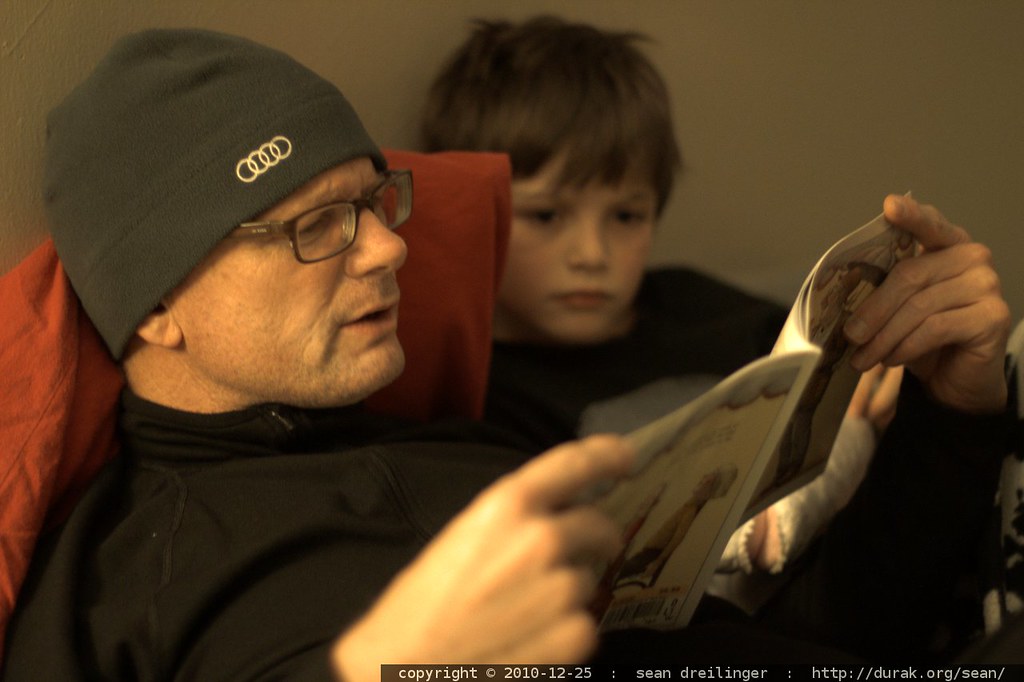
Edmund Conti, ‘My Son the Critic’

Read me a bedtime poem, said my son.
So I read him this:

We say hippopotami
But not rhinoceri
A strange dichotomy
In nature’s glossary.

But we do say rhinoceri, he said. Look it up.
So I read him this:

Life is unfair
For most of us, therefore
Let’s have a fanfare
For those that it’s fair for.

I smell a slant rhyme, he said, sniffing.
So I read him this:

While trying to grapple
With gravity, Newton
Was helped by an apple
He didn’t compute on.

My teacher says that’s not poetry, he said.
So I read him this:

René Descartes, he thought
And therefore knew he was.
And since he was, he sought
To make us think. He does.

That made me think, he said. But not feel.
So I read him this:

My hair has a wonderful sheen.
My toenails, clipped, have regality.
It’s just all those things in between
That give me a sense of mortality.

Did the earth move? I asked. Anything?
Nothing moved. He was asleep.

*****

Edmund Conti writes: “This is one of my favorites today. Tomorrow I might have different ones. I like it because it makes me nostalgic for an event that never happened. (My persona has a better life than me.) It came about after I sent the following quatrain to John Mella of Light Magazine (with appropriate punning title, of course).

We say hippopotami
But not rhinoceri
A strange dichotomy
In nature’s glossary.

John liked it and accepted it. I few weeks later he wrote and said he couldn’t use. Talking to a fellow editor, he learned there is such a plural as ‘rhinoceri.’ But now I was in love with my little piece and wanted to salvage it. But how? All I could think of was to take advantage of the poem’s failing. I came up with the idea of showing several possibly flawed quatrains to my son and having him disparage each one. And lo, the poem! I have 2 sons and when either one questions the reality, I just say it was the other one.”

Edmund Conti has many reasons for wanting his poems published—Power! Fame! Money!—but not (as you can see) as a venue for his bio notes.

Edmund Conti has recent poems published in Light, Lighten-Up Online, The Lyric, The Asses of Parnassus, newversenews, Verse-Virtual and Open Arts Forum. His book of poems, Just So You Know, is published by Kelsay Books,
https://www.amazon.com/Just-You-Know-Edmund-Conti/dp/1947465899/
and was followed by That Shakespeherian Rag, also from Kelsay
https://kelsaybooks.com/products/that-shakespeherian-rag

Photo: “grandpa reading nick a bedtime story – MG 6291.JPG” by sean dreilinger is licensed under CC BY-NC-SA 2.0.

Odd poem: Muhammad Ali, ‘Me, We’

Me?
We.

*****

Muhammad Ali was invited to talk to a group of Harvard students on June 4, 1975. Someone shouted, ‘Give us a poem, Muhammad’ and he paused, looked up and said: ‘Me? We’. But as it was spontaneous and spoken, the punctuation is what you will, and evokes a variety of ideas and responses. Questions of identity… of Ali himself being part of the roomful of attendees… of the needs of the group outweighing the needs of the individual… the human journey from selfishness to altruism… Certainly all that is in keeping with the speech he gave that night, excerpted here.

It claims title to the World Championship for the shortest poem, at least in the English language.

Using form: Sonnet within Sonnet: Daniel Kemper, ‘Her Petrarchan Heart’

a Petrarchan sonnet embedded inside an Elizabethan sonnet

I smile in my Italian heart—but English ways,
against emotions so taboo, require some tact
and so I’m hiding in plain view. My eye still strays.
My nerves are tinder. But the part below this act,
which kindles want, slips through the art I layer on
and now that art is burning too. It’s civil war:
I smother it, but when I do, though flames seem gone,
the smolderings rebel, restart, and billow more.
And yet I’ve learned to love this dance and my disguise
far more than I let on I do. I bait and stare.
I turn demure. It draws you in, intensifies,
and stops. I am not queen by chance. I hold you there:
But if I let you go will you pull through your doubt,
let my Elizabeth stay in…and Petrarch out?

*****

Daniel Kemper writes: “Her Petrarchan Heart is a sonnet within a sonnet, tetrameter within hexameter, to illustrate the real personage inside the speaker.”

Editor’s note: You can indeed read down the poem, line by line, skipping the last four syllables in each line:
I smile in my Italian heart
against emotions so taboo

you will find the rhythm and rhymes easily enough to guide you, and it is a complete poem in itself, the heart sonnet (Petrarchan, rhyming ABBA ABBA CDE CDE) within the speaker sonnet (Shakespearean, rhyming ABAB CDCD EFEF GG).

The poem(s) first appeared in The Society of Classical Poets.

Daniel Kemper is a systems engineer living in California. He writes that his “poetry rebels against the constraints of form, not by destroying it and discarding it, but by turning the tables” in his approach. Only recently emerging into the poetry scene Kemper has already been accepted for publication at thehypertexts.com, The Creativity Webzine, Amethyst Review, Rat’s Ass Review, and Ekphrastic Review. He earned a BA from NC State, and an MBA from University of Phoenix, is currently enrolled in an MA program in Creative Writing at Cal State U, Sacramento, and is working towards being certified to teach community college.

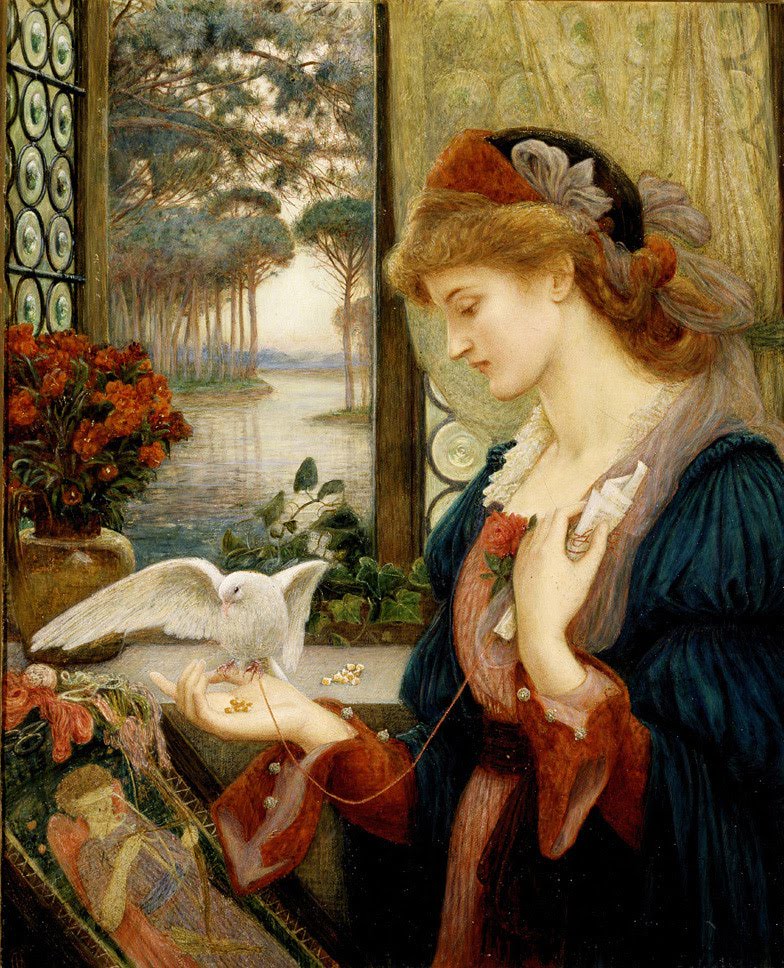
Illustration: “Marie Spartali Stillman – Love’s Messenger [1885]” by Gandalf’s Gallery is licensed under CC BY-NC-SA 2.0.

Odd poem: Henri Rousseau, ‘Inscription pour La Rêve’

Yadwigha dans un beau rêve
S’étant endormie doucement
Entendait les sons d’une musette
Dont jouait un charmeur bien pensant.
Pendant que la lune reflète
Sur les fleuves [or fleurs], les arbres verdoyants,
Les fauves serpents prêtent l’oreille
Aux airs gais de l’instrument.

Yadwigha in a beautiful dream
Having fallen gently to sleep
Heard the sounds of a reed instrument
Played by a well-intentioned [snake] charmer.
As the moon reflected
On the rivers [or flowers], the verdant trees,
The wild snakes lend an ear
To the joyous tunes of the instrument.

*****

Henri Rousseau‘s last completed work, ‘The Dream‘ is huge – almost 7′ x 10’ – and is remarkable for a couple of reasons: it features his Polish mistress of decades before, and it was the first of his pieces to bring him wide-spread acceptance. Completed and sold in early 1910, it was exhibited for six weeks in the early spring, was praised by poet and critic Guillaume Apollinaire, and gave him long-sought recognition. He died in September of that year.

Picasso and Matisse understood and admired Rousseau’s work, but many people did not. Rousseau wrote the poem to help viewers understand the painting; he also wrote in a letter to art critic André Dupont, “The woman asleep on the couch is dreaming she has been transported into the forest, listening to the sounds from the instrument of the enchanter.”

‘The Dream’ is one of the most striking pieces of art on display in MoMA, the Museum of Modern Art, in New York.