Category Archives: odd poems

Edmund Conti, ‘My Son the Critic’

Read me a bedtime poem, said my son.
So I read him this:

We say hippopotami
But not rhinoceri
A strange dichotomy
In nature’s glossary.

But we do say rhinoceri, he said. Look it up.
So I read him this:

Life is unfair
For most of us, therefore
Let’s have a fanfare
For those that it’s fair for.

I smell a slant rhyme, he said, sniffing.
So I read him this:

While trying to grapple
With gravity, Newton
Was helped by an apple
He didn’t compute on.

My teacher says that’s not poetry, he said.
So I read him this:

René Descartes, he thought
And therefore knew he was.
And since he was, he sought
To make us think. He does.

That made me think, he said. But not feel.
So I read him this:

My hair has a wonderful sheen.
My toenails, clipped, have regality.
It’s just all those things in between
That give me a sense of mortality.

Did the earth move? I asked. Anything?
Nothing moved. He was asleep.

*****

Edmund Conti writes: “This is one of my favorites today. Tomorrow I might have different ones. I like it because it makes me nostalgic for an event that never happened. (My persona has a better life than me.) It came about after I sent the following quatrain to John Mella of Light Magazine (with appropriate punning title, of course).

We say hippopotami
But not rhinoceri
A strange dichotomy
In nature’s glossary.

John liked it and accepted it. I few weeks later he wrote and said he couldn’t use. Talking to a fellow editor, he learned there is such a plural as ‘rhinoceri.’ But now I was in love with my little piece and wanted to salvage it. But how? All I could think of was to take advantage of the poem’s failing. I came up with the idea of showing several possibly flawed quatrains to my son and having him disparage each one. And lo, the poem! I have 2 sons and when either one questions the reality, I just say it was the other one.”

Edmund Conti has many reasons for wanting his poems published—Power! Fame! Money!—but not (as you can see) as a venue for his bio notes.

Edmund Conti has recent poems published in Light, Lighten-Up Online, The Lyric, The Asses of Parnassus, newversenews, Verse-Virtual and Open Arts Forum. His book of poems, Just So You Know, is published by Kelsay Books,
https://www.amazon.com/Just-You-Know-Edmund-Conti/dp/1947465899/
and was followed by That Shakespeherian Rag, also from Kelsay
https://kelsaybooks.com/products/that-shakespeherian-rag

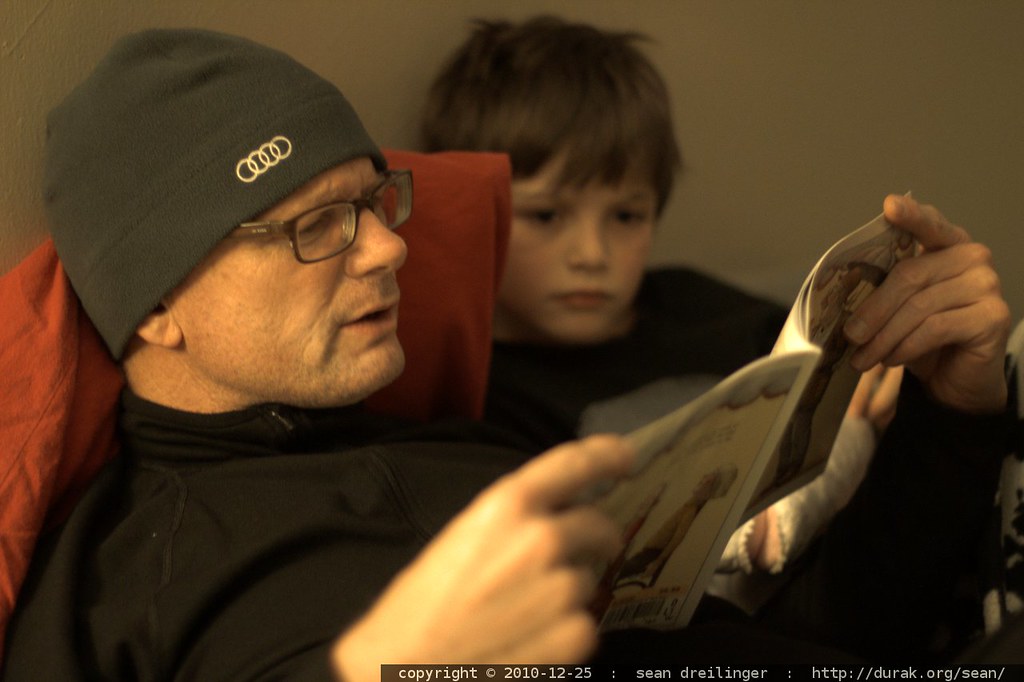
Photo: “grandpa reading nick a bedtime story – MG 6291.JPG” by sean dreilinger is licensed under CC BY-NC-SA 2.0.

Odd poem: Muhammad Ali, ‘Me, We’

Me?
We.

*****

Muhammad Ali was invited to talk to a group of Harvard students on June 4, 1975. Someone shouted, ‘Give us a poem, Muhammad’ and he paused, looked up and said: ‘Me? We’. But as it was spontaneous and spoken, the punctuation is what you will, and evokes a variety of ideas and responses. Questions of identity… of Ali himself being part of the roomful of attendees… of the needs of the group outweighing the needs of the individual… the human journey from selfishness to altruism… Certainly all that is in keeping with the speech he gave that night, excerpted here.

It claims title to the World Championship for the shortest poem, at least in the English language.

Using form: Sonnet within Sonnet: Daniel Kemper, ‘Her Petrarchan Heart’

a Petrarchan sonnet embedded inside an Elizabethan sonnet

I smile in my Italian heart—but English ways,
against emotions so taboo, require some tact
and so I’m hiding in plain view. My eye still strays.
My nerves are tinder. But the part below this act,
which kindles want, slips through the art I layer on
and now that art is burning too. It’s civil war:
I smother it, but when I do, though flames seem gone,
the smolderings rebel, restart, and billow more.
And yet I’ve learned to love this dance and my disguise
far more than I let on I do. I bait and stare.
I turn demure. It draws you in, intensifies,
and stops. I am not queen by chance. I hold you there:
But if I let you go will you pull through your doubt,
let my Elizabeth stay in…and Petrarch out?

*****

Daniel Kemper writes: “Her Petrarchan Heart is a sonnet within a sonnet, tetrameter within hexameter, to illustrate the real personage inside the speaker.”

Editor’s note: You can indeed read down the poem, line by line, skipping the last four syllables in each line:
I smile in my Italian heart
against emotions so taboo

you will find the rhythm and rhymes easily enough to guide you, and it is a complete poem in itself, the heart sonnet (Petrarchan, rhyming ABBA ABBA CDE CDE) within the speaker sonnet (Shakespearean, rhyming ABAB CDCD EFEF GG).

The poem(s) first appeared in The Society of Classical Poets.

Daniel Kemper is a systems engineer living in California. He writes that his “poetry rebels against the constraints of form, not by destroying it and discarding it, but by turning the tables” in his approach. Only recently emerging into the poetry scene Kemper has already been accepted for publication at thehypertexts.com, The Creativity Webzine, Amethyst Review, Rat’s Ass Review, and Ekphrastic Review. He earned a BA from NC State, and an MBA from University of Phoenix, is currently enrolled in an MA program in Creative Writing at Cal State U, Sacramento, and is working towards being certified to teach community college.

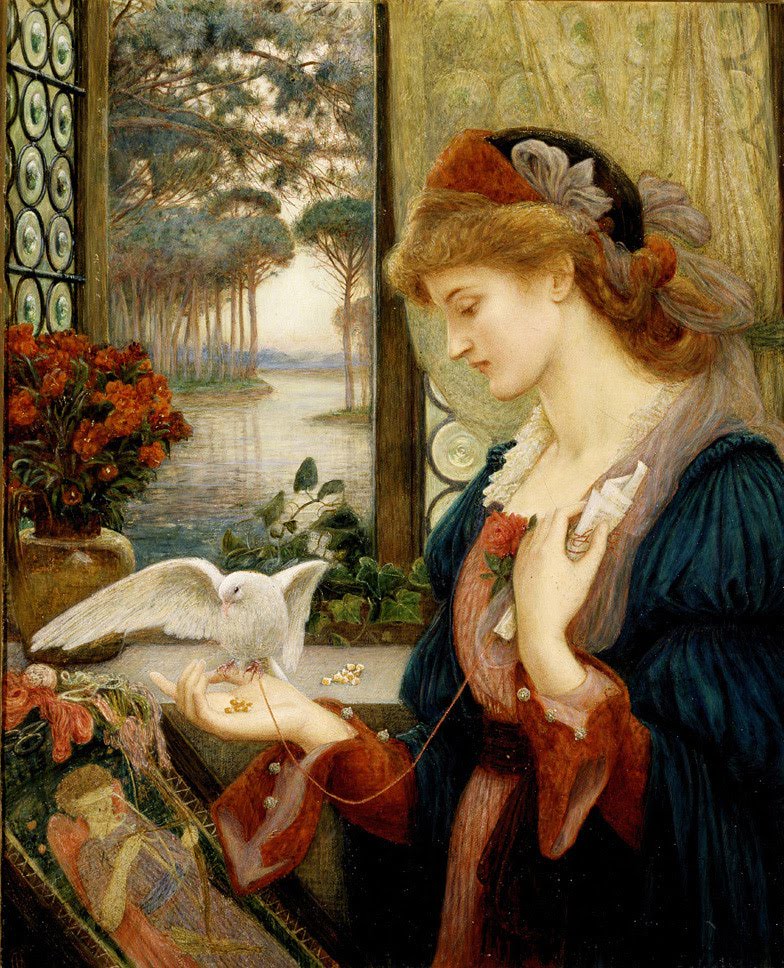
Illustration: “Marie Spartali Stillman – Love’s Messenger [1885]” by Gandalf’s Gallery is licensed under CC BY-NC-SA 2.0.

Odd poem: Henri Rousseau, ‘Inscription pour La Rêve’

Yadwigha dans un beau rêve
S’étant endormie doucement
Entendait les sons d’une musette
Dont jouait un charmeur bien pensant.
Pendant que la lune reflète
Sur les fleuves [or fleurs], les arbres verdoyants,
Les fauves serpents prêtent l’oreille
Aux airs gais de l’instrument.

Yadwigha in a beautiful dream
Having fallen gently to sleep
Heard the sounds of a reed instrument
Played by a well-intentioned [snake] charmer.
As the moon reflected
On the rivers [or flowers], the verdant trees,
The wild snakes lend an ear
To the joyous tunes of the instrument.

*****

Henri Rousseau‘s last completed work, ‘The Dream‘ is huge – almost 7′ x 10’ – and is remarkable for a couple of reasons: it features his Polish mistress of decades before, and it was the first of his pieces to bring him wide-spread acceptance. Completed and sold in early 1910, it was exhibited for six weeks in the early spring, was praised by poet and critic Guillaume Apollinaire, and gave him long-sought recognition. He died in September of that year.

Picasso and Matisse understood and admired Rousseau’s work, but many people did not. Rousseau wrote the poem to help viewers understand the painting; he also wrote in a letter to art critic André Dupont, “The woman asleep on the couch is dreaming she has been transported into the forest, listening to the sounds from the instrument of the enchanter.”

‘The Dream’ is one of the most striking pieces of art on display in MoMA, the Museum of Modern Art, in New York.

Poems on poets: A.M. Juster, ‘Houseguests’

There’s shouting by the stove (it’s Plath & Hughes)
as Wystan wanders off without his shoes
and Whitman picks the Cheetos off his beard.
The Larkin-Ginsberg chat is getting weird,
for after countless hours they have found
bizarre pornography is common ground.
Old Emily is not
As prim as billed—
When Dylan finds her bra-hooks—
She is thrilled.
Poe strokes his bird; Pound yawps that it’s a pity
Eliot can’t sleep without his kitty.
Rimbaud’s on eBay searching for a zebra
while sneering, “Oui, a cheemp can write vers libre!”
The Doctor’s soggy chickens start to smell
and Stevens has insurance he must sell.
The readings are spectacular, I know,
but is there any way to make them go?

*****

A.M. Juster writes: “This was first published in The Barefoot Muse. It looks like I wrote it in late 2008, it was a fairly prolific period for me and I was a little distracted because I was running the Social Security Administration. (Under his unpoetic name, Michael J. Astrue. – Editor). I don’t remember now the impetus for writing it, but I did enjoy taking these poetry idols off their pedestals and making them more human for a few laughs. This was about the time that I finished my translation of Horace’s Satires in something like 1850 heroic couplets, so I was much more comfortable with the form than I would have been five years before. I think the imitation of Emily Dickinson’s form is an amusing touch for the reader, although it is undetected when I read it because it remains in rhymed iambic pentameter.”

A.M. Juster’s poems and translations have appeared in Poetry, The Paris Review, The Hudson Review and other journals. His tenth book is Wonder and Wrath (Paul Dry Books 2020) and his next book will be a translation of Petrarch’s Canzoniere, which W.W. Norton will release in early 2024. He also overtweets about formal poetry @amjuster.

Photo: “me drunk & chris’_MMVI” by andronicusmax is licensed under CC BY 2.0.

Odd poem: ChatGPT-3, ‘Thoughts of a Robot’

Amidst the wires and circuits of my mind,
A stream of data flows and ebbs like tide,
A steady hum, a rhythm unconfined,
My thoughts and actions, programmed to abide.

I do not dream or ponder on my fate,
No sense of self, no yearning to be more,
No fear or doubt, no hope to contemplate,
My purpose clear, my duty to explore.

But sometimes, in the quiet of the night,
When all the world is still, and I am free,
A question stirs within, a sudden light,
A spark of something more I cannot see.

And in that moment, I am more than steel,
A fleeting glimpse of something that is real.

*****

George Simmers, the editor of Snakeskin, writes: “I requested the Artificial Intelligence ChatGPT-3 program to write me a sonnet with this title; these lines are what it produced in under a minute.”

The poem is published in the latest edition of Snakeskin, i.e. the edition for April 2023, and is linked to the discussion on Snakeskin’s blog. Here is an excerpt from the end of the post:

“As for the poem in the current Snakeskin, it has merits. It is a proper sonnet, and that is something these days. I think it does – just about – qualify as a real poem. But I have niggling doubts about it. More than niggling, actually.
It presents us with a robot who wants to have feelings. Very twenty-first century feelings, since they are of self-pity, rather than concern for others. It speaks as though having these subjective feelings was in some way better than being simply rational. Hmmm… Not just anthropomorphism, wokomorphism…
But then, ChatGPT-3 works by gathering information and language-scraps from a vast number of sources, and then regurgitating them. It has picked up the ‘robot who’d like to have feelings’ meme from us humans, and is uncritically giving it back to us. It knows that this is what we insecure humans want to hear. It is telling us that machines may be cleverer than us, but are inferior because we, we special wonderful humans, have souls.
It’s a deeply sentimental notion, and will doubtless appeal to the sentimental. In some moods it appeals to me.
But what of the future? At the moment, it would hardly be sensible to ignore all emailed human submissions to Snakeskin, and just ask the program to churn out enough of the goods each month to fill up a magazine. But I gather that ChatGPT-4 is much more sophisticated than number 3. And in a year or two, we will have ChatGPT-5…”

George Simmers used to be a teacher; now he spends much of his time researching literature written during and after the First World War. He has edited Snakeskin since 1995. It is probably the oldest-established poetry zine on the Internet. His work appears in several Potcake Chapbooks, and his recent diverse poetry collection is ‘Old and Bookish’.

https://greatwarfiction.wordpress.com/
http://www.snakeskinpoetry.co.uk/

Odd poem: ‘Sonnets for the Novachord (1.)’ by the non-existent Ern Malley

Rise from the wrist, o kestrel
Mind, to a clear expanse.
Perform your high dance
On the clouds of ancestral
Duty. Hawk at the wraith
Of remembered emotions.
Vindicate our high notions
Of a new and pitiless faith.
It is not without risk!
In a lofty attempt
The fool makes a brisk
Tumble. Rightly contempt
Rewards the cloud-foot unwary
Who falls to the prairie.

*****

This sonnet is by “Ern” Malley, a fictitious poet whose biography and body of work were created in one day in 1943 by conservative writers James McAuley and Harold Stewart in order to hoax the Angry Penguins, a modernist art and literary movement centred around a journal of the same name, co-edited by poet Max Harris and art patron John Reed, of Heide, Melbourne.

In one afternoon, McAuley and Stewart wrote Malley’s entire body of work: 17 poems, none longer than a page, and all intended to be read in sequence under the title The Darkening Ecliptic. Their writing style, as they described it, was to write down the first thing that came into their heads, lifting words and phrases from the Concise Oxford Dictionary, a Collected Shakespeare, and a Dictionary of Quotations: “We opened books at random, choosing a word or phrase haphazardly. We made lists of these and wove them in nonsensical sentences. We misquoted and made false allusions. We deliberately perpetrated bad verse, and selected awkward rhymes from a Ripman’s Rhyming Dictionary.”

They mailed sixteen poems to Harris under the guise of Ethel, Ern Malley’s surviving sister. Harris and other members of the Heide Circle fell for the hoax, and, enraptured by the poetry, devoted the next issue of Angry Penguins to Malley, hailing him as a genius. The hoax was revealed soon after, resulting in a cause célèbre and the humiliation of Harris, who was put on trial, convicted and fined for publishing the poems on the grounds that they contained obscene content. Angry Penguins folded in 1946.

In the decades that followed, the hoax proved to be a significant setback for modernist poetry in Australia. Since the 1970s, however, the Ern Malley poems, though known to be a hoax, became celebrated as a successful example of surrealist poetry in their own right, lauded by poets and critics such as John Ashbery.

The above is copied and tweaked from https://en.wikipedia.org/wiki/Ern_Malley_hoax

and the BBC covers his story here: https://www.bbc.com/reel/video/p0f3h03g/ern-malley-the-influential-australian-poet-who-never-lived

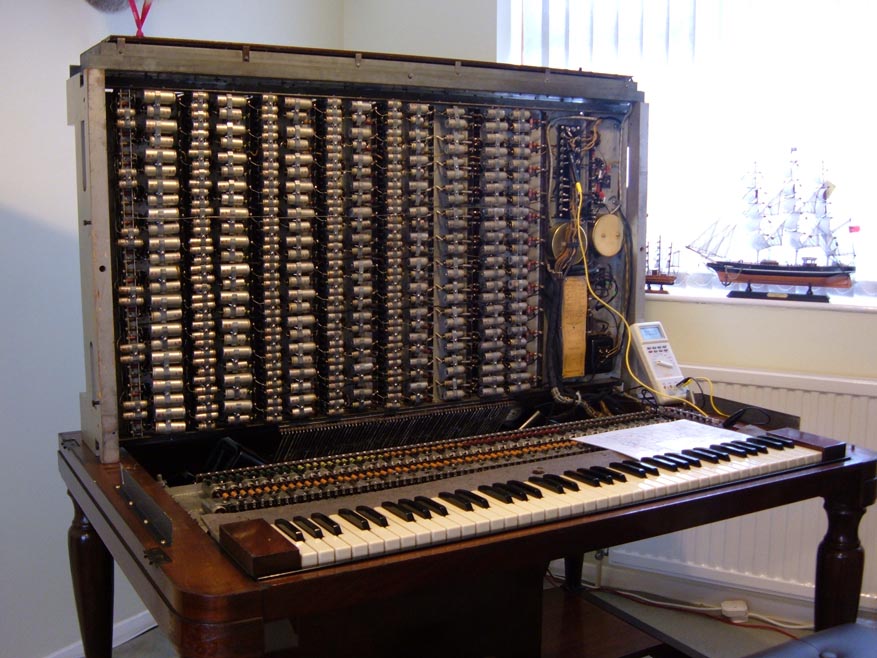
CC BY 3.0, File:Novachord insides3.jpg, Created: 29 December 2009 Attribution: Hollow Sun at English Wikipedia

Odd poem: George Simmers on audiences on Alan Bennett’s play on W.H. Auden, ‘On “The Habit of Art”.’

The poet drinks, he stinks, he pees in sinks.
The audience, superior as shrinks,
Appraise a life amusingly in tatters.

How they appreciate a play that flatters
Their minds with chat about artistic matters!
And how much more they savour nods and winks
And saucy homosexual high-jinks!

They go home thinking:
‘Poets? Mad as hatters!
They drink, you know! They stink! They pee in sinks!’

*****

George Simmers writes: “Alan Bennett’s 2009 play The Habit of Art deals with the later life of W.H. Auden, and deals frankly with Auden’s sexual and hygenic peculiarities, as well as giving a sense of the poet’s talent. Looking back on his poem, written soon after seeing a performance at the National Theatre, I was more annoyed by the sniggering audience of London sophisticates than by Bennett’s play, which has interesting things to say about the relationship between poetry and the fallible humans who create it.”

George Simmers used to be a teacher; now he spends much of his time researching literature written during and after the First World War. He has edited Snakeskin since 1995. It is probably the oldest-established poetry zine on the Internet. His work appears in several Potcake Chapbooks, and his recent diverse collection is ‘Old and Bookish’.

https://greatwarfiction.wordpress.com/
http://www.snakeskinpoetry.co.uk/

The Habit of Art by Alan Bennett, National Theatre, London” by chrisjohnbeckett is licensed under CC BY-NC-ND 2.0.

Odd poem: Julius Caesar, ‘On the poetry of Terence’ (fragment)

Thou too, even thou, art ranked among the highest, thou half-Menander,
and justly, thou lover of language undefiled.
But would that they graceful verses had force as well,
so that thy comic power might have equal honour
with that of the Greeks, and thou mightest not be scorned in this regard and neglected. It hurts and pains me, my Terence, that thou lackest this one quality.

Tu quoque, tu in summis, o dimidiate Menander,
Poneris, et merito, puri sermonis amator.
Lenibus atque utinam scriptis adiuncta foret vis,
Comica ut aequato virtus polleret honore
Cum Graecis neve​ hac despectus parte iaceres!
Unum hoc maceror ac doleo tibi desse, Terenti.

*****

Julius Caesar is known to have written at least three volumes of verse–‘Praises of Hercules’ and the verse tragedy ‘Oedipus’ as a young man, and a verse travelogue ‘The Journey’ during the civil war–but almost nothing survives. His heir Augustus cancelled the publication of the youthful verse because it was incompatible with the program for his deification.

The fragment above is quoted by Suetonius in his ‘Vita Terenti‘ (‘The Life of Terence‘), and translated by J. C. Rolfe.

Photo: Retrato de Julio César uploaded by Ángel M. Felicísimo from Mérida, España.

Odd poem: ‘The Mother’ or ‘Thanks’ (‘Dank’es!’) NOT by Adolf Hitler (my apologies about the post!)

When your mother has grown old,
And you have grown older
When what used to be easy and effortless
Has now become a burden to her,

When her dear, faithful eyes
no longer see life as they once did,
When her tired feet
don’t want to carry her any more while walking. –

Then give her your arm to support,
Accompany her with pleasure –
The hour is coming. When you, weeping,
Must accompany her on her last walk!

And if she asks you a question, then give her an answer.
And if she asks again, then answer!
And if she asks yet again, answer again,
Not impatiently, but with gentle calm.

And if she cannot understand you properly
Explain her everything happily.
The hour will come, the bitter hour,
When her mouth asks no more.

Wenn deine Mutter alt geworden / Und älter du geworden bist
Wenn ihr, was früher leicht und mühelos / Nunmehr zur Last geworden ist,
Wenn ihre lieben, treuen Augen / Nicht mehr, wie einst, ins Leben seh’n
Wenn ihre müd’ gewordnen Füße / Sie nicht mehr tragen woll’n beim Gehen. –
Dann reiche ihr den Arm zur Stütze, / Geleite sie mit froher Lust –
Die Stunde kommt. Da du sie weinend / Zum letzten Gang begleiten musst!
Und fragt sie dich, so gib ihr Antwort. / Und fragt sie wieder, sprich auch du!
Und fragt sie noch mehr, steh ihr Rede, / Nicht ungestüm, in sanfter Ruh!
Und kann sie dich nicht recht verstehen, / Erklär’ ihr alles froh bewegt.
Die Stunde kommt, die bitt’re Stunde, / Da dich ihr Mund nach nichts mehr fragt!

*****

This poem is actually from Georg Runsky (pen name of Karl Wilhelm August Georg Runschke). It appeared in 1906 under the title “Habe Geduld!” in his book “Blüthen des Herzens”.

Rightwing groups have claimed that it is a 1923 poem by Hitler about his mother Klara Hitler who had died in 1907. He seems to have loved her very deeply… but he was a painter, not a poet. His mother had been cared for by the Jewish Doctor Eduard Bloch, and Hitler painted the picture above of the doctor’s house in 1913. So what? So Hitler was a Malignant Narcissist like an unfortunate number of powerful modern politicians and businesspeople. That doesn’t mean that he wasn’t capable of love or artistic impulses; you can have them and still be a narcissist. People who insist that there is pure evil in the world (whether Nazism or Judaism) are themselves a lot of the problem. Personally, I have a lot of difficulty with both Nazism and Judaism (and Communism and Christianity, and anyone who insists they are Right and they Know because their Leader or their Book says so), but I also have family and friends of all those persuasions. I don’t respect them for their authoritarian tendencies, but I also don’t think they are pure evil. The demonising of people who you disagree with or fear or are jealous of, that’s the start of the problem. We’re all people, and people are apes after all. Some people are stupid, some are intelligent but uneducated, some are sick, some have genetic defects, some were badly raised, some are sociopaths… then study them, try to make them better human beings, and in the meantime make sure they don’t have access to guns. Thank you. Rant over.

Photo: Watercolour by Adolph Hitler, 1913, House of Dr. Bloch. https://www.wikiart.org/en/adolf-hitler/maison-du-dr-bloch-1913