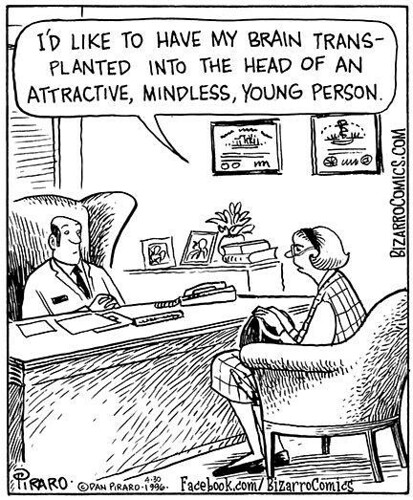
One day we’ll all be dead; survival chances: slim. So concentrate instead on aspects you prefer: “I’m winding down,“ he said, “but not as fast as him.” “Losing my looks,” she said, “but not as fast as her.”
*****
Speaking as someone now in the 4th quadrant of my 1st century, what other options are there? Anyway, this was first published in the Asses of Parnassus – thanks, Brooke Clark!
She drinks a bit more she loves a bit less she no longer fits in her wedding dress.
She’s given up trying, accepted her fate, feels herself thinning while she stacks on the hate.
Doesn’t feel like his partner his mate or his wife, all she feels is as hard and as sharp as a knife.
She reels her mind back but can’t seem to recall, what she ever saw in him, why she married at all.
It’s a dead man’s float, face down on the bed, they sleep separate, unsound in their queen sized dread.
So she’ll tread bitter water as she has done for years, not so much married to him as she is to her fears.
*****
Lindsay McLeod writes: “‘She’ was written in my head, wearing ear protection in a factory. It was about my (then) partner who had recently escaped a toxic relationship.” The poem was originally published in Fine Flu.
Lindsay McLeod is an Australian writer who lives quietly on the coast of the great southern penal colony with (yet another ferocious Aussie animal) his cattle dog, Mary. Lindsay still drives a forklift to support his poetry habit.
I fail at them, these scenes where beauty is married to fear. I have failed before with this one. How can I make it clear
when the moment itself was a blur? My son and I, that night, stepped through the warm, wet air that had magicked every light
to a wide, all-hallowing halo. He said–I think he was ten, still with his clear soprano– It’s lovely out here. And then
the edge of every nimbus, pale gold through a fog scrim, shivered, knowing that beauty soon would be bullied out of him.
*****
Maryann Corbett writes: “This poem (first published in Mezzo Cammin) is indeed based on one of those indelible memories, the sort that lodge in a parent’s brain for decades. And I have in fact tried to write about it before without succeeding. I’ve never asked my very adult son whether he remembers this moment at all.”
Maryann Corbett earned a doctorate in English from the University of Minnesota in 1981 and expected to be teaching Beowulf and Chaucer and the history of the English language. Instead, she spent almost thirty-five years working for the Office of the Revisor of Statutes of the Minnesota Legislature, helping attorneys to write in plain English and coordinating the creation of finding aids for the law. She returned to writing poetry after thirty years away from the craft in 2005 and is now the author of two chapbooks and six full-length collections, most recently The O in the Air (Franciscan U. Press, 2023). Her work has won the Willis Barnstone Translation Prize and the Richard Wilbur Award, has appeared in many journals on both sides of the Atlantic, and is included in anthologies like Measure for Measure: An Anthology of Poetic Meters and The Best American Poetry.
Michael R. Burch’s poems have been published by hundreds of literary journals, taught in high schools and colleges, translated into 23 languages, incorporated into three plays and four operas, and set to music, from swamp blues to classical, 78 times by 35 composers. He is also the founder and editor-in-chief of The HyperTexts.
Suddenly the kids, the car, the house, the spouse, the local bar, the work, have made you what you are. What doesn’t chill you makes you fonder.
Should you stay or should you go? The thrill you’re looking for, you know, could be right here at home, although what doesn’t thrill you makes you wander.
If, avoiding common truth, you dye your hair and act uncouth, will you find your misplaced youth – really, will you if you’re blonder?
It doesn’t matter if you’re strong or if you sing a pretty song, something, and it won’t be long, will come to kill you, here or yonder.
You’re human in the human fray, and choose among the shades of grey. No matter if you go or stay what might fulfill you makes you ponder.
*****
Marcus Bales writes: “This is a little more than a decade old, back when I still had a full time job. There is something looming in a life about a full time job that’s hard to escape entirely even when you’re determined to try. Must have been a bad day on the sales floor.
“This is one of those poems where a rhythm enters my mind and won’t go away until I put words to it. Of course it already HAD words to it, but I couldn’t use those. So after one quatrain it became a challenge to see how many of that refrain rhythm it was possible to make sense with. That’s actually sort of freeing, because once that becomes the challenge, it opens the poem, for me anyway, to using the randomness of the rhyme words, as they arise, to drive each stanza’s, and thus the whole poem’s, sensibility. This is a good example of how the aleatory dice of rhyme can be used to open up opportunities to say things I wouldn’t have thought of to say at all without having to work toward the rhyme word. This can be very bad for a poem, of course — one of the main ways to judge poems in meter and rhyme is on how hard it is to tell whether the poet was using the rhyme words that way or not. The goal, of course, in almost all rhyme, is to delicately decorate the poem rather than for it to be clear that the poet was merely chasing a rhyme. And when there’s a rhyming refrain line the danger is extreme.
“I remember being pretty happy with it at the time. I do like the way something seems to loom over the narrator, pressing him onward through his meditation, and providing, I hope, the reason that meditation is needed.”
Not much is known about Marcus Bales, except he lives and works in Cleveland, Ohio, USA, and his work has not appeared in Poetry or The New Yorker. His latest book is 51 Poems; reviews and information at http://tinyurl.com/jo8ek3r
I feel a kinship with those, never met, who live, uncertain and displaced in the wrong place on planet earth and sea: with different languages at home and school, without a passport from the place they’re raised, their natural faith despoiled by pointless war, their sex uncertain, orphaned from themselves, poets of restlessness, pilots adrift, obscure, uncertain in their rootlessness, chameleons of constant camouflage, and all the little that they know deep down forever hidden from some foreign frown.
*****
My sense of being displaced is largely one of nationality: in every country I’ve lived in, I feel the closest connection to other expats; and there is no country in which I don’t feel like an expat myself. But that also gives me a sense of commonality with all others in all forms of insecurity and displacement. And maybe it is a natural part of being human… after all, all adults have been displaced from the very different world of childhood.
“Auden thought the triolet was too trivial a form to bother with…” –James Fenton
Practally dactally W. H. Auden Mastered his verse forms with Scarcely a miss.
Some he found slight. There’s no Abecedarius, No triolet, and he Didn’t write this.
*****
When I first started thinking about double dactyls I made a list of words and when I saw that James Fenton quote I knew I had a poem. I no longer recall what word got paired with Kevin E. Federline.
Reese Warner lives in Toronto and does things with computers for money. Reese’s poems have shown up in journals such as Asses of Parnassus, The Malahat Review, The Rotary Dial, The Dalhousie Review among others. For more information see http://pubs.reesewarner.com
Double Dactyl was first published in The Asses of Parnassus.
Clip clop clip clop steady up yon stuntgrass rise, boy, long as low and stony-brown, slow like weeks with nothing in them: saddle-tick, dirt-crump, poker-face.
Clip clop clip clop privy-top and anchor-wires, church-cross, store-spike, steady boy, up yon one-street, just more-trodden dust: saddle-tick, dirt-crump, poker-face.
Clip clop clip clop steady, boy, through sad wood civics, rippled in yon saloon-glass store-side, road-end, horses maybe leaving: saddle-tick, dirt-crump, poker-face.
Clip clop clip clop rise, boy, steady, way ahead, purple-white mountains, nothing in them maybe, like weeks maybe: saddle-tick, dirt-crump, poker-face.
2.
My brother’s name was Crazy Sean. They shot him in the head. He rattled through the summer corn and turned the green shucks red.
I laid him in the willowbrake. I couldn’t stand to pray. I kissed his cheek for pity’s sake, and then I rode away.
The plains are full of buffalo. The woods are red and gold. The mountaintops are white with snow. His memory keeps me cold.
I’ve rode through Hope and Whisky Creek. I’ve rode through Faith and Love. I’ve laid in Hate and Hide-and-Seek, and run from God-Above.
The prairie shines, the buckdeer cry. The hawks hang in the heat. Clipclop clipclop, the world rolls by. They say revenge is sweet.
3.
Somewhere still, stark as an afternoon; Ached in long planks of sunshine; Like a gambler’s card dropped on an empty land; Vauntsquare, the nailed-up main street creaks Against the air. Clipclop – hotel, laundry, saddles, Telegraph, clap-houses, guns. The horse stops. Into this hollow spine of fellowship blows a slow O of wind. Three men clatter at a boardwalk: Nacarat boots, sharktooth mojos – oh my brother.
4.
I shot one on the shithouse board. His head smashed like a squash and sprayed the backboards red. He pissed his boots and died. The stinking hole spit up a fat, black fly, which was his soul. I shot one in the barbershop. The chair caught fire, and ate his o-colonied hair. He fell out like a slice of spitroast meat. The duster wrapped him in its winding-sheet. I shot one in the cornfield. Larks of blood flew off his skull and twittered in the mud. He rattled through the stalks. His mashy head threw up its brain and turned the green shucks red. I took a bath and threw away my gun. I rode away wherever. I was done.
5.
drizzle pops on his hatbrim, cord and wool and steam-sodden, saddleticks like an empty stomach.
windpump wires and tin-dump, like horizon-drowning, horse, then man, hat, gone, clipclop, dusk drips in.
paraffin lamplight pricks the town, glo-worms, night hunched above, coyotes carry their eyes like stars.
6.
reckoning done how will he ever be warm
purpose gone how will he outrun the storm
bearings none how will he find another
riding alone how will he tell his brother
*****
John Gallas writes: “‘Western Man’ is a weird one: I have a quite spooky love of Westerns, jogging as they do some very deep links with Old En Zed, remnants (many remnants!) of which I grew up with and in. Those old wooden towns, the dim General Stores, the slightly grim and mostly silent (mostly) men, the cheek-by-jowlness of town and bush. It means quite a lot to me. I find the end of most Clint Eastwood films, and especially ‘Once Upon A Time in the West’, as the hero says ‘I gotta go now’, and rides away into lonliness after some bloody vengeance or other, inexpressibly moving.”
John Gallas, Aotearoa/NZ poet, published mostly by Carcanet. Saxonship Poet (see http://www.saxonship.org), Fellow of the English Association, St Magnus Festival Orkney Poet, librettist, translator and biker. Presently living in Markfield, Leicestershire. Website is www.johngallaspoetry.co.uk which has a featured Poem of the Month, complete book list, links and news.
Baby you’re the Reichstag I’m setting you on fire You no longer represent me I’m immediate desire Our constitution is suspended on a fence of barbed wire Baby you’re the Reichstag I’m setting you on fire
I’ve cancelled your election I’ve exposed your fatal flaw Trapped in your reflection we argued to a draw The people want perfection they love to be in awe Baby you’re the Reichstag my will is the law
Our union needs annulment our wedding was a sham The preacher stole the word of God now he’s on the lam He said he’d bless the devil he didn’t give a damn Baby you’re the Reichstag who do you think I am
Like lightning this befell me not you but I self-crowned No court can now compel me my power is unbound I dare you try to tell me my methods are unsound Baby you’re the Reichstag I’ll burn you to the ground
I’m rounding up your lovers each one of them a liar They tell me they don’t know you say it’s me they most admire Now I alone can save them or throw them on the pyre Baby you’re the Reichstag I’m setting you on fire
*****
Matthew King writes: “Many, not on only one side of the political divide, have been watching for a “Reichstag Fire moment.” The thing about historical echoes is you’re never sure what you’re hearing is exactly what it sounds like, but with some things sounding like them at all is bad enough. A hat tip to Leonard Cohen, whose shade I seem to be channelling in this poem, and who would have turned 91 on Sept. 21. Leonard! thou shouldst be living at this hour; lucky for you you’re not, I guess.”
‘Incendiary Song’ was first published in New Verse News.
Matthew King used to teach philosophy at York University in Toronto; he now lives in what Al Purdy called “the country north of Belleville,” where he tries to grow things, counts birds, takes pictures of flowers with bugs on them, and walks a rope bridge between the neighboring mountaintops of philosophy and poetry. His photos and links to his poems can be found at birdsandbeesandblooms.com.
Photo: Reichstag Fire, 27 February 1933, public domain.
They’re selling dreams, they like to say; their storefront photographs display the pricey, well-staged fantasies they call rare opportunities and gems. They hope you’ll overpay
for your townhouse, ranch, or chalet, your great investment, your doorway to debt. You’re lured in by degrees: they’re selling dreams
of closet space, kitchens (gourmet!), and pride. Why shouldn’t wants outweigh misgivings and realities? The realtors ply their expertise, and you’re an easy mark to sway— they’re selling dreams.
*****
Jean L. Kreiling writes: “The rondeau form seemed appropriate for suggesting a realtor’s technique—that insistent commitment to your purchase, both nerve-wrackingly relentless and, somehow, appealing.”
Jean L. Kreiling is the author of three collections of poems, with another forthcoming soon from Able Muse Press. Her work has been awarded the Kim Bridgford Memorial Sonnet Prize, the Rhina Espaillat Poetry Prize, and the Frost Farm Prize, among other honors. An Associate Poetry Editor for Able Muse: A Review of Poetry, Prose & Art, she lives on the coast of Massachusetts.