I’m tired of Love: I’m still more tired of Rhyme. But Money gives me pleasure all the time.
*****
Hilaire Belloc, the author most famously of ‘Cautionary Tales for Children‘ (including “Jim, who ran away from his nurse, and was eaten by a lion” and “Matilda, who told lies and was burned to death”) is always good for a deflationary mood.
No matter what you do, it doesn’t last: Your best endeavours are gone in an hour. If you could see the present become past, Your better weather just a passing shower, If you could see your garden run to weeds That once was hoed and tended with such care And understand you only bury seeds That will outlive us, and will still be there When we are gone, to sprout and live anew, Would you think that your labour is worth while To do the things you feel you have to do, To make the effort, go the extra mile? What else is there to do but push ahead? So damn them all and be glad you’ll be dead.
***** Bob Trewin writes: “This is my first poem in Snakeskin. I have previously appeared in some anthologies produced by the Holmfirth Writers’ Group (published by George Simmers, who is a founder member). I have also self-published two collections: Snowflakes in the Night, available from Amazon and the Lulu bookstore and Sonnets and Sundries, available from the Lulu bookstore.
“As for where this poem came from, I wonder how much you, living elsewhere, are aware of the rapid transformation that is happening in the UK, a transformation that no recent government has had a mandate to sanction, let alone actively pursue. If it is reversible, I will certainly not be around to witness it.”
Since scribbling some mediocre verse as a teenager, Bob Trewin put aside his pen for the best part of half a century. He began writing poetry again after retirement and now belongs to a number of groups scattered across the Pennines in West Yorkshire. He has won first and second prize in successive years in the National Association of Writers and Groups’ Open Poetry Competition.
“Jansen, you gotta wear gloves when you work on the grinder. You want hurt yourself?” And then Kaczmarek looked down at Frank’s left hand. He saw the scar before the boy could jerk his arm away. “It’s nothing. An accident is all, ya know?” He’d done it Sunday night. Sometimes the burning made you feel alright when you were getting lonely. He had meant to do it somewhere hidden, but it felt good, the old man noticing like he had. That’s probably how it was to have a dad— he’d hit your backside with a leather belt when you were a little shit, but he’d care if you were hurt. He’d even stroke your hair.
*****
Alex Rettie writes: “Protection” was first published in the Summer 2026 issue of Nimrod International, edited by Boris Dralyuk. It’s part of an as-yet unpublished manuscript called “The Triangles,” which follows the lives of two gay men (including Frank, the speaker of the poem) and a nun (the former teacher of one of the men).”
Alex Rettie is a Calgary poet who has been published in print and online journals in Canada, Australia, the UK and the US. He co-edits the online poetry journal Poems for Persons of Interest (https://pfpoi.blogspot.com/). You can find more of his work on Substack at https://poemsforpoi.substack.com/.
From worship and tenderness to profanity. Two poems becoming one through the contrapuntal technique.
Quatorzain I: Secrecy.
Solemn prayers fill the empty church; hallow’d songs arise from pews of birch.
Midnights are when angels fill the halls— neither flaw nor sin to weight their calls— right where Heaven’s ardent mercy falls. Yes, Amen, and God, they sing aloud, earnest praises proudly thus avowed, bless’d by secrecy’s embrace and shroud.
Only God may hear them. Only he knows the meaning of their cry and plea. Yet-unknown and his alone to see, choirs outbreathe a psalm when no one’s near as an offering at last sincere, echoed up in majesty and fear.
Quatorzain II: In Sacred Places.
Caressing, smiling, both confiding, enamored dreamers kiss in hiding. In sacred places coinciding, grotesque to Earth, they birth a treasure, humanity devoid of measure, melodic in its throes of pleasure.
Secure’s the love away from judges— revealed to none who touch begrudges, observes the bruising lips and smudges— liturgical in eyes’ occlusion. Neglect has borne them disillusion, religion out of shared seclusion.
Nocturnal lovers taste affection seduced by solitude. Perfection.
Contrapuntal: Secrecy in Sacred Places.
Solemn prayers fill the empty church; Caressing, smiling, both confiding, Hallow’d songs arise from pews of birch.
Enamored dreamers kiss in hiding. Midnights are when angels fill the halls— In sacred places coinciding,
Neither flaw nor sin to weight their calls— Grotesque to Earth, they birth a treasure, Right where Heaven’s ardent mercy falls.
Humanity devoid of measure, Yes, Amen, and God, they sing aloud, Melodic in its throes of pleasure.
Earnest praises proudly thus avowed, Sincere’s the love away from judges— Bless’d by secrecy’s embrace and shroud.
Revealed to none who touch begrudges, Only God may hear them. Only he Observes the birth of bruising smudges—
Knows the meaning of their cry and plea. Liturgical within seclusion. Yet-unknown and his alone to see,
Neglect has borne them disillusion— Choirs outbreathe a psalm when no one’s near Religion out of shared seclusion.
Asan offering at last sincere, Nocturnal lovers taste affection, Echoed up in majesty and fear. ’ Seduced by solitude. Perfection.
*****
Brooklyn Crane writes:
This God-Forsaken Contrapuntal!
Contrapuntal poetry seems complicated, and it actually is. Merging lines and meanings can be quite tricky! However, I’ve read several of them either composed of poems which barely hold up on their own or too short enough to be manageable, and in response to this, I obviously went over the top. Let’s see everything you can do by blending two poems together!
A contrapuntal text is the result of the intercalary arrangement of two separate pieces of writing which creates a hidden meaning.
When I prepared to pitch the idea of writing a complex-as-all-hell contrapuntal to my friend and fellow writer Narcisse Tardif, the very first thought that came to mind was that of how most contrapuntal poetry out there simply isn’t formal at all. I mean, who has the time for that? Of course, this being my publication, the name of which is Scheming Rhymes, I naturally had to do something about that. Two questions came out of this train of thought, and these were:
What if it was a contrapuntal between two sonnets?
What if I could produce an acrostic resulting from their intercalation?
If you’ve actually read my poem, you will obviously notice that the sonnets are not sonnets at all—or at least not in the traditional sense of the word. They are indeed quatorzains, as the silly French call the 14-line arrangements that most sonnets adhere to, but the only thing these have in common with them is the couplet of the Shakespearean variant. Undeniably, I could have just written two sonnets. However, it’s never that simple on Scheming Rhymes, and you’re here for it. We’ll get there in a bit.
Regarding the acrostic, yes—there’s a reason for the italicized start of every line. Why did I do this? I just wanted to leave a signature in this poem. Here it is!
Fourteen and fourteen from each poem constituting this contrapuntal add up to twenty-eight lines for me to work with. Scheming Rhymes perfectly fills half of that space while Brooklyn Crane sadly leaves me one letter short. Upon this ill-fated realization, I added the S at the end and pretended myself to be a brilliant strategist who can overcome anything with enough delusion. Surely the reader will know that an apostrophe precedes itbecause, you know, the poem is mine.
It is now that we can address the odd rhyme schemes of the quatorzains as, with the previous information in mind, I went ballistic.
“Could I arrange the poems in a way that their merging results in a different form? If so, which form would that be?”
SO! Because I had just recently posted my terza rima composition breakdown, it was freshly in my mind that a possible solution to this conundrum was such a form. I mean, think about it. Terza rima poems work on a formula of 3x + 1 (or 2), so I did 28 minus 1, divided by 3, and I landed on– I KNOW YOU ARE NOT HERE FOR THE MATH! Anyway, I landed on 9 tercets plus 1 loose line, accounting for all twenty-eight verses.
Next was the question of what the rhyme schemes had to be in order to fulfill this crazy dream. Terza rima works on a ABA BCB CDC … YZY Z (or ZZ) scheme, so I superimposed it on the acrostic as follows.
I hope that you are starting to see the way these two bastards came into existence. We now have the structural guidelines for both quatorzains and the resulting terza rima. This would absolutely be enough for a sane person to go about their day. It’s a double quatorzain/terza rima/contrapuntal/acrostic after all.
It was not enough for me, but I will not bore you with the metrical choices made in this poem. It’s explained on the paid-for section of my terza rima post, though.
Oh, yes. This is a shameless plug for my paid subscription. Come on—you already love Scheming Rhymes!
With all of these guardrails to work with, it was finally time to write. It was absolute hell.
But why do this?
The short answer is: because I can, lol. The actual answer, however, is that I do it because it can be done. Scheming Rhymes is all about exploring what we can do to enrich poetry, understanding both the traditions that educate our verse today and the techniques that might innovate its composition tomorrow. This work is not perfect, I’m aware, and there is sure to be someone who executes the planning behind it more expertly, but we ought to encourage writers to challenge themselves and produce beauty through effort, not through simply making poetry easier.
So there you have it. Here’s to more brutal antitheses to free verse poetic prose!
Join the madness—or don’t!
As with all previously explored forms and techniques, I am not here to police you about how you write and what decisions you make. You can make lines vary in syllable count, ditch the rhymes, change the number of lines per stanza, or anything else you want to do. All I intend on this publication is to give you a starting point from which to find your identity as a writer. Here’s the text by Ani Beeler that inspired me to explore this technique using a completely different approach:
Brooklyn Crane: Celebrating human ingenuity in poetry! Writer, advocate, unapologetic rhyme addict, and public enemy of AI content. Subscribe to Scheming Rhymes—read more of my work and learn more about poetry forms and techniques.
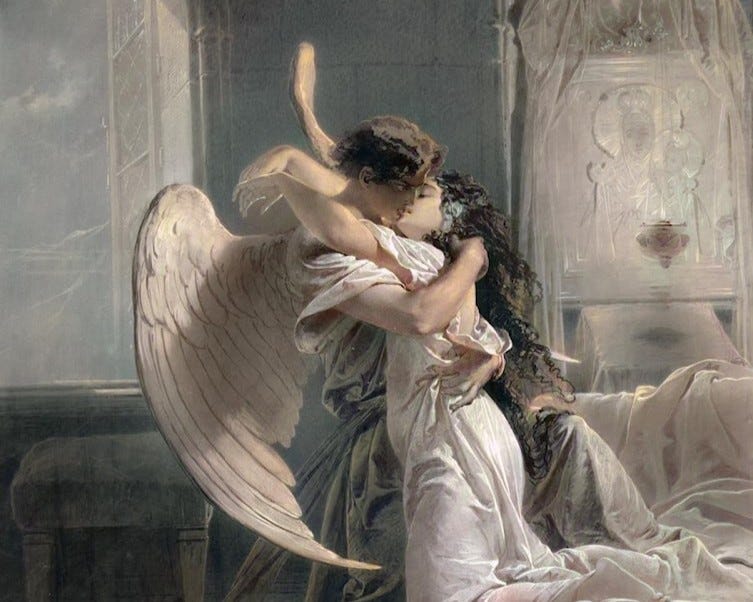
Illustration attributed to Mihály Zichy based on Mikhail Lermontov’s poem The Demon, via Art Renewal Center.
In the narrow hallway, almost out of reach, Is a cord you pull down, lowering stairs To access the attic, which is stuffed With all manner of wonderful, half-forgotten things.
Imagine if you could find another cord there, To pull down to access the entire world above– Overhanging trees and sky and space and planets and all.
*****
There is so much magic in attics–and even more so if they can only be accessed by pull-down stairs. My five-year-old grandson in Canada will be visiting us in the Bahamas in a few weeks, and he only had one question when I called him on his birthday: Would he be allowed in the attic? Whether he heard wild stories from his father, or whether he was put up to be the petitioner by his older siblings, I have no idea. But in the attic and on the roof are both super exciting places…
‘Into the Attic’ was originally published in Snakeskin–thanks, George Simmers!
Illustration by RHL and Quill, my ChatGPT. (I told Quill that an engineer might question the integrity of the mechanics, but I’m not an engineer so I’ll live with it. The mood is perfect!)
Throne of my lonely niche, my wealth, my love, my moonlight. My most sincere friend, my confidant, my very existence, my female Sultan, The most beautiful among the beautiful… My springtime, my merry-faced love, my daytime, my sweetheart, laughing leaf… My plants, my sweet, my rose, the one only who does not distress me in this world… My Istanbul, my Caraman, the earth of my Anatolia My Badakhshan, my Baghdad, my Khorasan My woman of the beautiful hair, my love of the slanted brow, my love of eyes full of mischief… I’ll sing your praises always I, lover of the tormented heart, Muhibbi of the eyes full of tears, I am happy.
*****
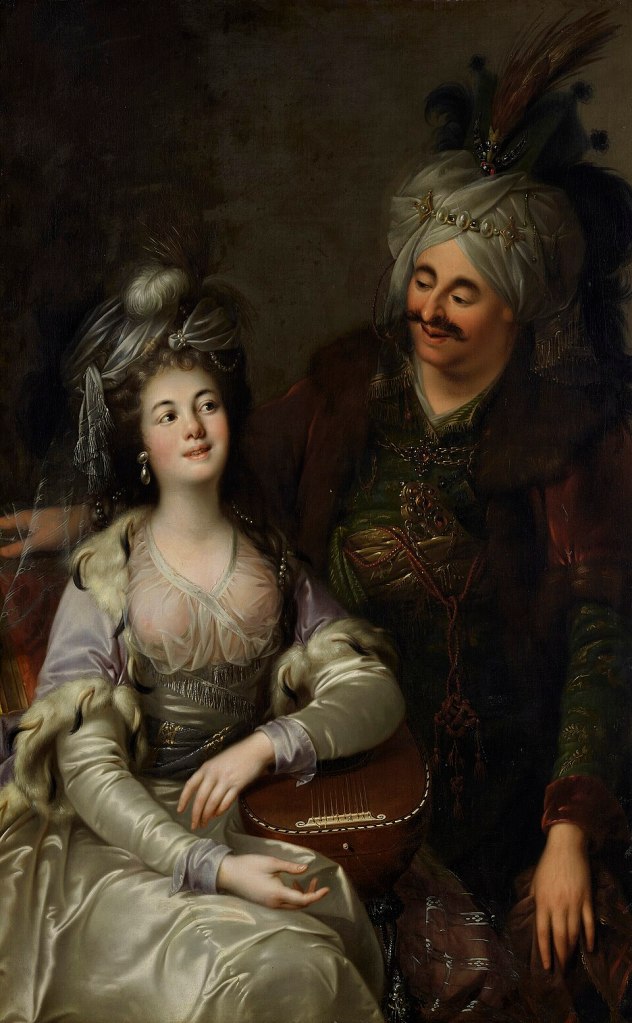
Suleiman the First, born in 1494, was Ottoman emperor from 1520 to 1566. Known to his subjects as The Lawgiver from his extensive reforms of education, society, taxation and criminal law, he was known in the West as The Magnificent for his court surpassing Europeans in grandeur. He formed an alliance with the French against the Hapsburgs, extended the empire in the Balkans and North Africa, and broke with tradition by marrying a Ukrainian or possibly Polish slave from his harem: Roxelana, or Hürrem, the mother of his successor Selim the Second. Under the pen name Muhibbi, he wrote love poems for Roxelana.
Painting: Attributed to Anton Hickel (1745-1798), Roxelana and Suleiman the Magnificent
Our mother was a mousetrap under the stairs. She used as bait the things she never said. We’d hear a snap and find three silver hairs in an old passport, pinned like something dead.
Our father was an occupying force in a town of collaborators. Good behavior meant not signaling in morse enemy troops camped in a distant wood.
Our parents paced—her mind a radio playing the classic dirges until dawn, his heart a spider web spun in the snow catching the dusk sun before it was gone.
For supper, they would feed us each a crumb of moonlight. Our house was a moving train. Evenings they danced in a delirium of silence, drunk on a thimbleful of rain.
*****
Morri Creech writes: “I don’t really have comments for this poem. The first line came to me, and the rest of the poem found its way as I continued to search for context to support that sentence. I didn’t know what I was going to say until I was saying it.”
Morri Creech is the author of five collections of poetry: Paper Cathedrals (Kent State U P, 2001), which received the Stan and Tom Wick Poetry Prize; Field Knowledge (Waywiser, 2006), which received the Anthony Hecht Poetry prize and was nominated for both the Los Angeles Times Book Prize and the Poet’s Prize; The Sleep of Reason (Waywiser, March 2013), a finalist for the 2014 Pulitzer Prize; Blue Rooms (Waywiser, October 2018); and, most recently, The Sentence (LSUP, September 2023). A recipient of NEA and Ruth Lilly Fellowships, as well as grants from the North Carolina and Louisiana Arts councils, he is the Writer in Residence at Queens University of Charlotte, where he teaches courses in both the undergraduate creative writing program and in the low residency M.F.A. program. He lives in Charlotte, North Carolina with the novelist Sarah Creech.
Awakening alone, Proceeding on my own To negotiate the day As I’d done too long to say—
Now that I had a lover That life of mine was over. My next would be with her, And doubtless happier—
Though fondness, truth to tell, Inflected my farewell To the solitude that I Had been companioned by.
*****
Daniel Brown writes: “I’d like to think some readers will identify with the sentiment expressed here. The poem appeared in The New Criterion, and in my collection What More?”
Daniel Brown’s poems have appeared in Poetry, Partisan Review, PN Review, Raritan, Parnassus, The New Criterion and other journals, as well as in a number of anthologies including Poetry 180 (ed. Billy Collins) and The Swallow Anthology of New American Poets (ed. David Yezzi). His work has been awarded a Pushcart prize, and his collection Taking the Occasion (Ivan R. Dee, 2008) won the New Criterion Poetry Prize. His latest collection is What More? (Orchises Press, 2015). Brown’s criticism of poets and poetry has appeared in The Harvard Book Review, The New Criterion, PN Review, The Hopkins Review and other journals, and the LSU Press has published his critical book, Subjects in Poetry. His Why Bach? and Bach, Beethoven, Bartok are audio-visual ebooks available at Amazon.com. His website is danielbrownpoet.com .
Like an obsequious waiter runs the attendant Equator round the fat gut of our obscenely glutted world. This great gobbed globe of God’s glory, spat by Him into space and spinning in spirals and falling forever further from Faith’s Face.
*****
A religious poem? I don’t know, I like the sound of it though. Anyway, the continuing and global nature of the drift away from Faith suggests it is all part of God’s plan…
“Water causes the mind to become.” Pratītyasamutpāda
Impossible love is the spirit of poems escaping the rhythms, and forms, and the former expressions of lovers like Shakespeare and Ovid. Reshaping traditions re-feathers the beds for the sensual sessions and canopy-shaking delights of The Muse, yet neither The Lady, so dark and complex, nor Corinna her equal, nor any persona She dons, entertains the idea of a breather; instead, with a tumble of laughter, it’s time for a sequel. Impossible love is eternal renewal; The Muse’s allure is forever unique, yet the heart of her dances is primal and deep. The relationship calms and confuses the poet: the infinite love. But the finite romances. The union of poet and Muse re-invents and recovers the poetry born of the love of impossible lovers.
*****
Daniel Kemper writes: “On first read The Muse will likely be understood as “the muse,” IOW, the actual, earthly woman who inspires a poet. The bit about “any persona she dons” will get read as merely “her varied moods” or some such. But there’s a reason for the Buddhist epigram. There’s a reason for capitalizing The Muse. This is The Muse as a spirit, a spirit whose visit inspires and is itself an inspiration who arrives, created (or summoned?) by aspiration. Writing then, is making love to The Muse, who sometimes inhabits the bodies of mortals, the personae she dons… Alas, is it possible for spirit and flesh to commingle?
“Clearly this poem is all-in on the classical style, save that it’s a sonnet in amphibrachian meter (x / x). Few poems exist at all in the canon in amphibrachs, but there are some. All sloppy. No sonnets. Few realize that when you read through the end of the line, as generally one should, these become a simple anapestic meter (x x /) like “…[Christ]mas and ALL through the HOUSE not a CREATure was STIRRing not EVen a MOUSE.]
x / x x / x x / x x / x x / x x / x x / x x / x becomes x / x x /x x /x x /x x /x x /x x /x x / x
meh. Anyway…
“PS: There’s a little meta-textual play where the poem talks about “escaping the rhythms and forms and former expressions.” The line is self-referential. This poem, being a sonnet in a meter that no sonnet has yet been written in, is itself “escaping the rhythms and forms and former…”
‘Impossible Love’ is previously unpublished.
Daniel Kemper, a former tournament-winning wrestler, black belt in traditional Shotokan karate, and infantryman has earned a BA in English, an MCSE (Systems Engineering), an MBA, and an MA in English and had works accepted for publication at more than a dozen magazines, including a pushcart nomination. He’s been an invited presenter at PAMLA 2024 and presided over the Poetics Panel in 2025 and has been the feature poet at several Sacramento venues.