Category Archives: Poems

Sonnet: ‘Maya’

When God took Time to spin a length of Matter,
And, nothing at each end, tied the ends together,
He held between his fingers and surveyed
The first cat’s-cradle, and since then has played.

Flames flicker, flare, re-form as a friend’s face;
Dogs mime all features of the human race;
The willow weaves a walker from the air;
All Nature helps us see things that aren’t there.

To read Life’s Meanings, we must write the text:
What’s Right one day is often Wrong the next –
I’m rich or poor only as I profess,
Must ask your love or hate, for you can’t guess.

If love’s illusion, so are hate and fear…
Why not choose love?, when it’s so great, and near?!

Reareading this poem after a number of years, I have my doubts about it. It seems to start strong, and ends weak. What to do about a poem like that? The stuff about Maya, the illusory nature of the universe, is OK; but maybe cut it off after eight lines, before it starts preaching. But then maybe it would be lacking an ending, and I’d have to come up with something better than what’s there now.

As it is, it was first published in the defunct ‘Rubies in the Darkness’, and republished in India’s ‘Metverse Muse’. But I’m not happy with the poem…

“Cat’s Cradle by N.O. Bonzo” by wiredforlego is licensed under CC BY-NC 2.0

Short Poem: ‘Young Men Go Off To War’

Young men go off to war
And score
Deaths, rapes, across an alien nation
Which they chimp-like can revel in –
Which they in later years regret,
Never discuss, never forget.

The one thing that Donald Trump and Joe Biden could agree on: get out of the trillion-dollar waste of Afghanistan. Trump had Pompeo negotiate with the Taliban–the US would leave in 2021 so long as the Taliban didn’t kill any more US personnel; he presumably wanted to wait until the 2020 election was over, because the withdrawal might be chaotic and would look bad anyway. Biden stuck with the Trump agreement, and his calculation must be that, messy or not, hopefully it will be ancient history by the 2024 election.

You can’t fault the US for wanting to go after Osama Bin Laden after 9/11… but that’s separate from trying to stay and nation-build a supremely difficult and corrupt country. And it was probably not criminal under international law, whereas the subsequent Iraq invasion *was* illegal and breached the UN Charter, as Secretary-General Kofi Annan said. Bush, Cheney, Rumsfeld, Wolfowitz (and Tony Blair)… many people see them all as war criminals, unpunished, and leaving their front-line pawns (if they survived) to live with guilt and PTSD.

The American defeat in Vietnam turned out to be very good for the Vietnamese. Let’s just hope things turn out well for the Afghans. And congratulations to Joe Biden for getting the US out – you can’t impose human rights on a corrupt tribal society by invasion. It doesn’t work like that. There are far more constructive ways to approach international human rights issues… like cleaning your own house first.

This poem was published by Visions International, a poetry journal with perhaps a brighter past than present.

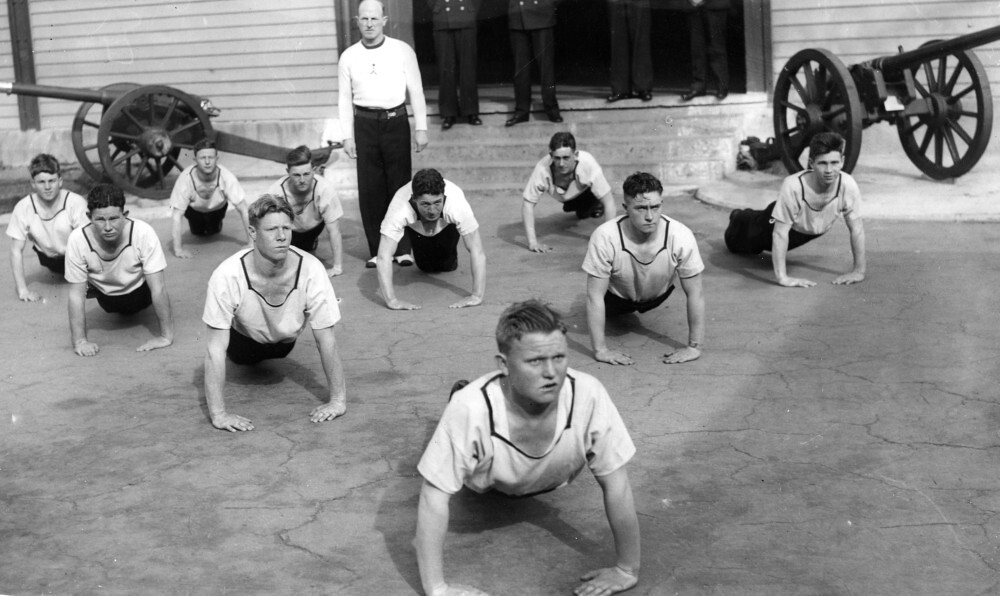
“New recruits at physical jerks – Flinders” by State Library Victoria Collections is licensed under CC BY-NC 2.0

Evocative Fragments: from Macaulay’s ‘Horatius at the Bridge’

But the Consul’s brow was sad,
And the Consul’s speech was low,
And darkly looked he at the wall,
And darkly at the foe;
“Their van will be upon us
Before the bridge goes down;
And if they once may win the bridge,
What hope to save the town?”

Then out spake brave Horatius,
The Captain of the Gate:
“To every man upon this earth
Death cometh soon or late.
And how can man die better
Than facing fearful odds,
For the ashes of his fathers,
And the temples of his gods!”

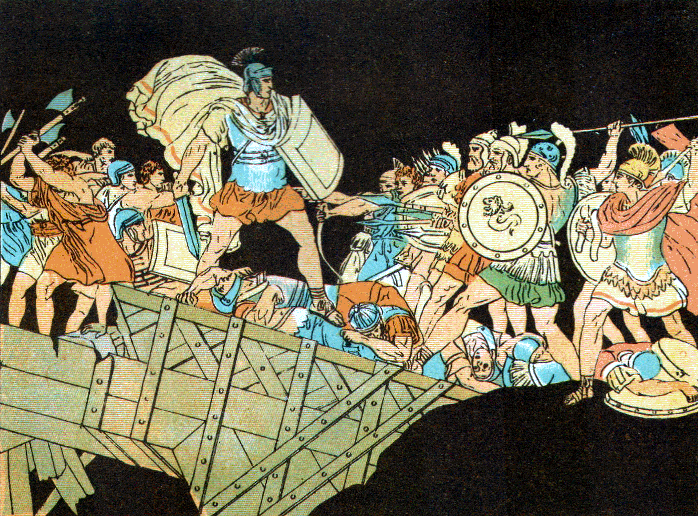
An alliance of neighbouring city-states is attacking the young Roman republic with 10,000 cavalry and 80,000 foot soldiers. The River Tiber provides a natural defence, but the broad wooden bridge is a weak spot. Horatius with two friends will try to hold off the enemy while the bridge is being destroyed underneath them. Enemy champions attack them in single combat and are defeated, until the huge Astur strides up with his “four-fold shield”, shaking the sword “which none but he can wield”. He attacks Horatius and gashes his thigh. Horatius

… reeled, and on Herminius
He leaned one breathing-space,
Then, like a wild-cat mad with wounds,
Sprang right at Astur’s face.
Through teeth and skull and helmet
So fierce a thrust he sped,
The good sword stood a handbreadth out
Behind the Tuscan’s head.

(…)

On Astur’s throat Horatius
Right firmly pressed his heel,
And thrice and four times tugged amain,
Ere he wrenched out the steel.
And “See,” he cried, “the welcome,
Fair guests, that waits you here!
What noble Lucumo comes next
To taste our Roman cheer?”

I was probably 11 when our English classes in my Jamaican boarding school were enlivened by Macaulay’s nearly 600-line poem (though, truthfully, our textbook cut out a lot of the slow introductory verses). As someone who otherwise lived on works like Tarzan of the Apes and Bomba the Jungle Boy (and of course banned comics of Superman and Batman when I was home for the holidays), it was wonderful to discover that verse could deliver just as dramatic, violent and heroic a story as novels and comics. Further, verse can do so in passages of enormous emotional power, heightened by the drama of their rhythm and rhyme, with short passages sticking in the mind forever even if you aren’t trying to learn them by heart.

The other qualities that appealed to me were undoubtedly the feelings of patriotism and religious approval that I suspect are natural in children – the sense of community, of tribe, of duty, of being morally in the right, of overcoming difficulties, of excelling, of supporting and saving people, of being praised for it. And what I value in that today is that it was done without any reference to an actual modern-day country or an actual modern-day religion. In other words the emotions could be stirred up and the child could be (at least temporarily) ennobled, without the poisons of nationalism or religious fundamentalism finding a place. Indeed, by placing the heroic emotions outside the here and now, I think the poem helped inoculate me against such diseases.

I was already very comfortable with poetry when I was introduced to ‘Horatius’ – A.A. Mine, Edward Lear, Robert Service and the Anglican hymn book come to mind – but this poem took poetry into another dimension entirely!

Poem: ‘God Modernises’

We sealed Joe’s body in its envelope
for dropping in the mail slot in the ground,
addressed to God. But the Recording Angel
coughed, said, “God has an online work-around,
so doesn’t take them like that any more.”
How email Joe to God, to bless or damn?
Cremation goes to Heaven… but, knowing Him,
souls just end up in limbo, marked as spam.

Another strange little poem; who knows where they come from, or why? Where they go is more knowable: to whoever is most likely to accept them! In this case, The Road Not Taken–a journal of formal poetry. Thank you for tolerating my morbid flippancy, Dr. Kathryn Jacobs!

I think we have all lost friends and family during the pandemic. The good news now is that vaccines are so widely available. We still have a “pandemic of the unvaccinated”, and the sooner those people come to their senses, the sooner everyone can focus on the other major issues: climate catastrophe and corrupt demagoguery. (But it’s still a beautiful world!)

“capper or beginning? (crematorium Zuerich/Schweiz)” by SphotoE is licensed under CC BY 2.0

Sonnet: ‘Marion Campbell of Kilberry, 1919-2000’

In winter’s broken skies, in spring’s thin drizzle,
The gardens wall in sun to warm the ground,
Can still be worked: vegetables grow year-round.
Fingers are cold – but hearths will crackle, sizzle.
It’s drear – but through a week’s rain, and two fair
Days’ sun, daffodils flood the world with light.
Otters slide down rocks, lambs jump in delight,
Rooks tumble, jump and slide, in empty air…
You love their flight; but, grounded, here you stand.
The summer dry and hot, sea almost warm,
Unpeopled heather hills, long days, no storm.
And you, embodying castle and land:
Stone walls and floors, trophies and weaponed walls,
Books read, books written, haunting ancestral halls.

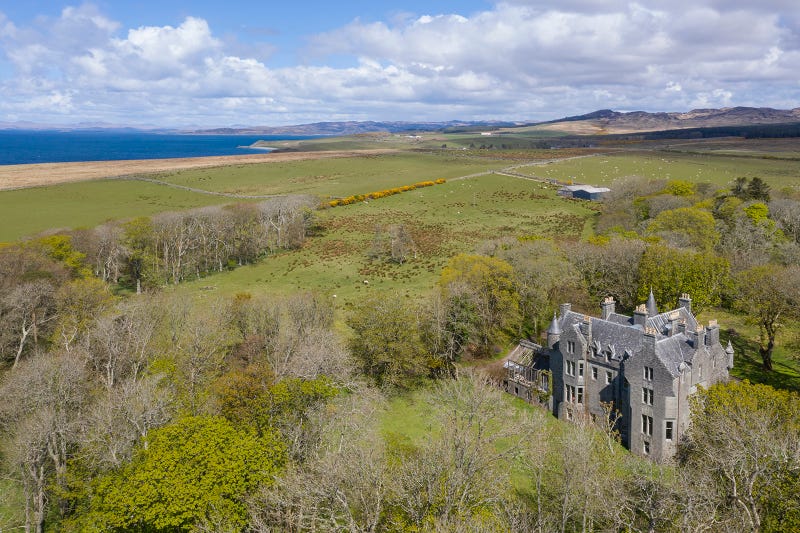
Marion Campbell was a truly remarkable archaeologist, author and cultural activist. Her enormous store of memory of history and lore blended with personal experience, together with her desire to share her knowledge through writing books and creating local museums, is summed up in a charming anecdote at the start of her obituary in The Herald:

Two days before her death, as she lay apparently unconscious in the hospital at Oban, I was telling someone in the same ward about a lost standing-stone at Ballymeanach and remarking that nobody knew when it had fallen. Suddenly a muffled voice from behind the oxygen mask said: ”Well, I know! It was in 1943, when a Shetland pony was sheltering against it from the storm. The poor beast was nearly scared to death.”

She was a cousin of my mother’s, and I was fortunate enough to spend weeks and months with her at Kilberry in my teens and 20s. This sonnet, written in fond tribute, was published in The Orchards Poetry Journal a couple of years ago.

Evocative Fragments: from Arnold’s ‘A Summer Night’ (2)

And the rest, a few,
Escape their prison and depart
On the wide ocean of life anew.
There the freed prisoner, where”er his heart
Listeth, will sail;
Nor doth he know how there prevail,
Despotic on that sea,
Trade-winds which cross it from eternity.
Awhile he holds some false way, undebarred
By thwarting signs, and braves
The freshening wind and blackening waves.
And then the tempest strikes him; and between
The lightning-bursts is seen
Only a driving wreck,
And the pale master on his spar-strewn deck
With anguished face and flying hair
Grasping the rudder hard,
Still bent to make some port he knows not where,
Still standing for some false, impossible shore.
And sterner comes the roar
Of sea and wind, and through the deepening gloom
Fainter and fainter wreck and helmsman loom,
And he too disappears, and comes no more.

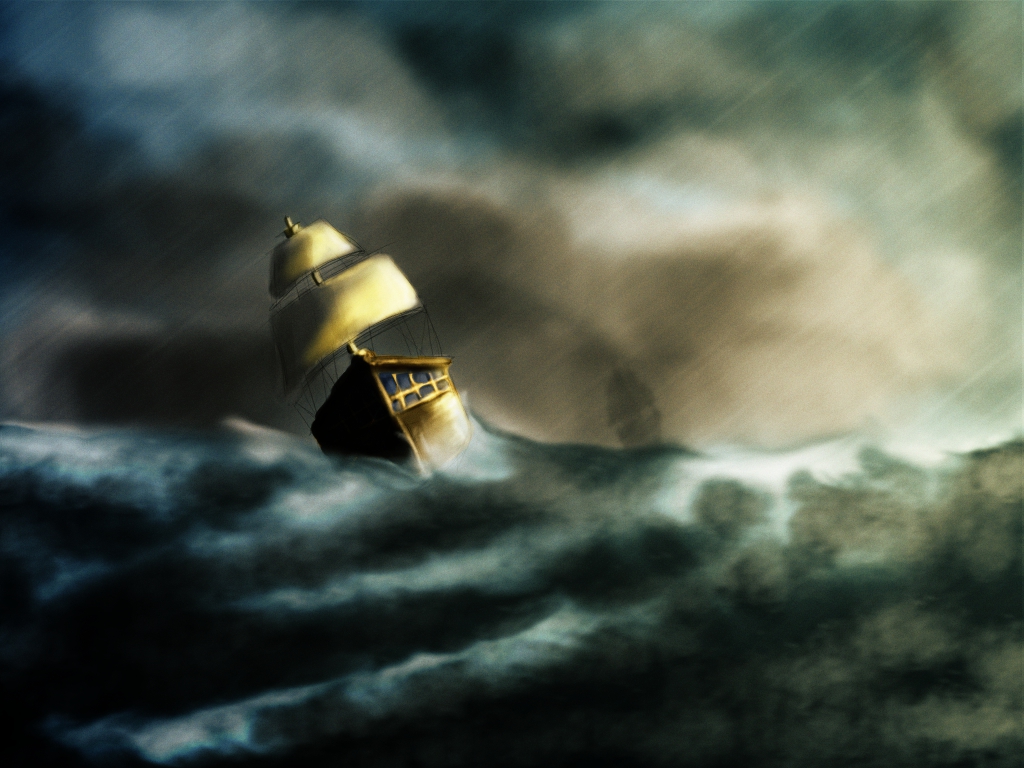
This fragment is the response to the previous fragment from Matthew Arnold’s ‘A Summer Night’ that I blogged a few days ago. As a teen in a well-regimented boarding school I found that previous fragment terrifying with its prospect of living as a bored wage-slave forever, and this second fragment exhilarating in its freedom despite the expectation of catastrophe. Altogether a very subversive poem, and I thank my schooling for including such works. For the next couple of decades I followed its path, failing to earn a degree at universities in three countries, never holding a job for more than 18 months, frequently moving. Eventually I found an occupation that was constantly changing, where I was my own boss, and that took me to dozens of countries to teach business seminars. So it all worked out.

Arnold originally ended his poem:

Is there no life, but these alone?
Madman or slave must man be one?

but ten years later added a much more wishy-washy piece about learning from the pure heavens and seeing what a nice life you could make for yourself. I always thought he should have stopped with the original “madman or slave” view of life. Much more dramatic – even though I have to admit his addition may have been justified.

“Storm at Sea” by gentlemanbeggar is licensed under CC BY-NC-SA 2.0

Poem: ‘Liminal Vision’

Grid of Existence, seeming minimal–
unknown extent, intent–
all-ruling, always nearing, liminal–
imminent, eminent–

the great all-seeing Eye of all the world–
the oracular Oculus–
the Stick round which our candyfloss is twirled–
the incorporate Octopus–

most active in the gap between day and night
when half-light blurs the features,
the predatory time the Unseen bite,
the time of mythic creatures,

time of illusions and profuse confusions,
the pros and cons in thrall
to every problem’s conmen selling solutions
to solve and dissolve all

the woes and worries of our warty worlds . . .
The Hunter bounds, unbound;
the Eye, the towering Wave, forever curls
over our grind, our ground.

This poem has just been published in Better Than Starbucks which gives it a seal of approval. I’m glad of that because I find it a strange poem when I come back to it, always feel that I’m having to dig my way in. It was an attempt to capture some of the half-dreams and shadow consciousness that we can glimpse when we are not fully awake and in our quotidian lives. Our unconscious rules us, our actions, our desires, our health, but we conscious puppets have so little sense of everything that is going on within us. But sometimes, when you are right on the border between conscious and unconscious…

Photo: “Liminal Space” by Theen … is licensed under CC BY-NC-SA 2.0

Poem: ‘Poets’

We are the natterers,
We are the masters of arts polyglot;
We are the patterners,
We are the marks on the paths that you plot;
We are the batterers,
We are the iron-headed rams that you fear;
We are the chatterers,
We are the sons of the sins that you bear;
We are the flatterers,
Down on our knees to those who stand tall;
We are the smatterers,
Giving out dangerous knowledge and small;
We are the shatterers,
We are the haters of forces above;
But, most, we are the clatterers,
We are the hooves of the horses we love.

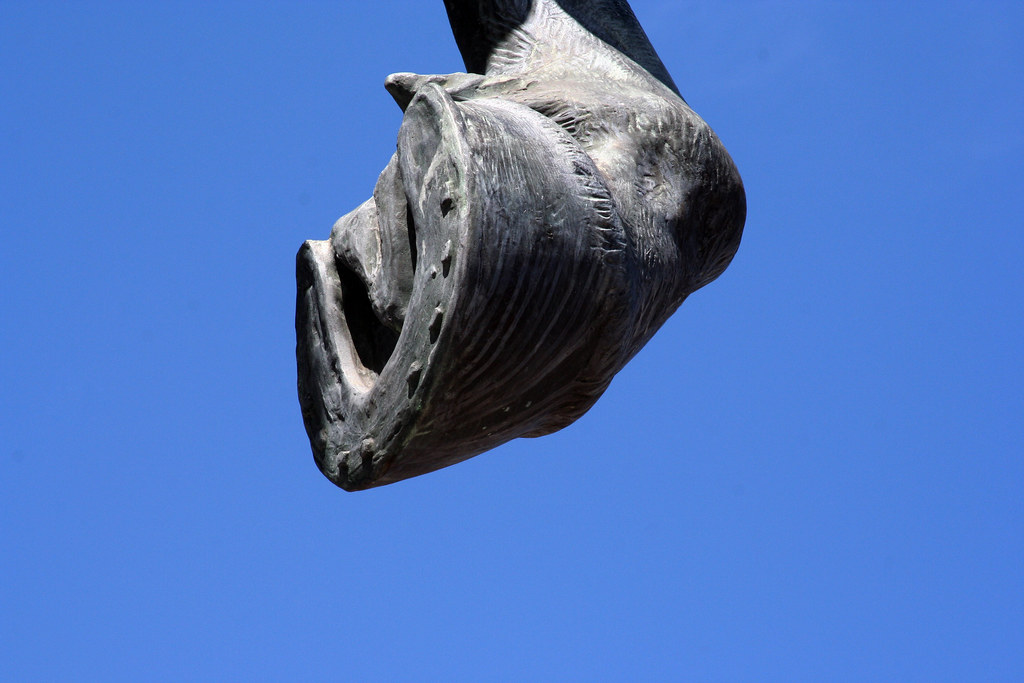
This was first published (I think) in Rubies in the Darkness (UK) and then in Metverse Muse (India). As for the word “clatter”, when I wrote the poem it only referred to sound, the verb “making a continuous rattling sound as of hard objects falling or striking each other.” The word is evolving though, as words do, with the meaning in football of a hard physical tackle that knocks your opponent over. I only meant the noise, of course…

Photo: “horse hoof” by Leo Reynolds is licensed under CC BY-NC-SA 2.0

Evocative Fragments: from Arnold’s ‘A Summer Night’ (1)

For most men in a brazen prison live,
Where, in the sun’s hot eye,
With heads bent o’er their toil, they languidly
Their lives to some unmeaning taskwork give,
Dreaming of naught beyond their prison wall.
And as, year after year,
Fresh products of their barren labor fall
From their tired hands, and rest
Never yet comes more near,
Gloom settles slowly down over their breast.
And while they try to stem
The waves of mournful thought by which they are prest,
Death in their prison reaches them,
Unfreed, having seen nothing, still unblest.

I’m very grateful to my schooling for putting Matthew Arnold on the curriculum – this subversive little passage seems designed to undermine the office and factory culture which has flourished since his time, to undermine even the student writing endless essays. Arnold was an inspector of schools as well as a poet and social critic, so we can assume he knew what he was doing. But isn’t it suggesting that a dissatisfied person should just drop out? More on that in the next fragment.

The other thing I like about the piece is its easy, flowing style. Every line rhymes, but without pattern. The lines are iambic, mostly pentameter, but a scattering of them are shorter. It feels very conversational, and it is certainly very easy to learn by heart (which is one of the reasons that poetry evolved in the first place). The only hiccup to natural speech are the displacement of ‘live’ and ‘give’ to the ends of their lines for the sake of the rhyme and even that, though artificial, is done conventionally enough to read smoothly. The rest of it is in normal speech. When T.S. Eliot came out with ‘Prufrock’ some decades later, though it had a different, Imagist sensibility, the only real difference in style was in dropping the thou’s and thee’s that Arnold still clung to.

Photo: “Office workers in Executive Building Room No. 123 prior to alterations, Brisbane” by Queensland State Archives is marked with CC PDM 1.0

Short poem: ‘Life Extension’

Religion leers
“Join me, or you face death”
And History jeers
“Inevitable death”,
But Science still adheres
To schemes to postpone death…
The path of a 1000 years
Starts with a single breath.

It’s interesting to speculate how long it will take before humans can start regenerating enough key pieces of our ageing and failing bodies that we can uncap our lifespan. A matter of decades rather than centuries, I think–but not soon enough for me, I fear.

The last sentence of the poem riffs on the Chinese saying attributed to Lao Tzu (also rendered as Laozi and Lao-Tze) that “The journey of a thousand miles starts with a single step.”

The poem was originally published in Bewildering Stories, a weekly of speculative writing of all types, edited by a multinational team but headquartered in Guelph, Ontario.

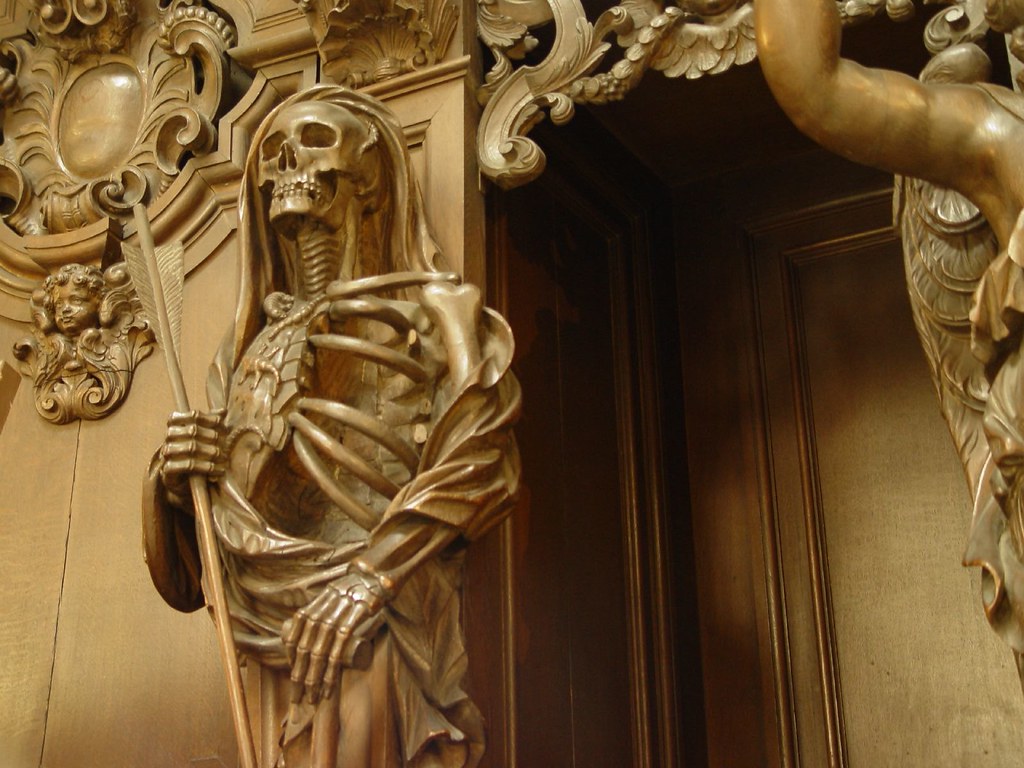
Photo: “Death” by Andrea Kirkby is licensed under CC BY-NC 2.0