Category Archives: Poetry

Poem: ‘Body Surfing’

Standing hip deep in the sea
Is nice in itself, but the reason for being there
Is the wait for a big wave.

A wave rising, a sudden tower
Smooth with devouring power
But one you can launch yourself forward in tune with – and
Hurtle ecstatic, unseeing and breathless
For as long as breath can hold
Through the water and up along over and onto the sand,
Sand thick in your hair, jammed in every fold,
Scraped, battered and rolled,
Triumphant, beached, deathless.

For this the saint prays,
For this the artist stares open-eyed,
For this the poet lets wounds bleed unstanched,
For this: this hope of being launched,
Controlled and uncontrolled
By what can’t be withstood or denied.

(Or else you could duck under the wall,
Let it pass over while you count three,
Hear the boom of its crested fall,
Yourself unbroken, inactive, safe, free.)

The sea is always there
Whether or not you are in it
Standing hip deep in it
Waiting for the next big wave.

Another of my “Is it formal?” poems. How much rhyme, rhythm and consistent structure do you need in order to consider it formal? Where is the cut-off between form and free? I don’t know. But I felt the alternation – between quiet waiting sections and the breathless rush of a good wave – was an appropriate expression in itself.

The poem was originally published in Snakeskin. Thanks, George Simmers!

“Superman body position while body surfing” by benaston is licensed under CC BY 2.0

Poem: ‘Warfare’

The mother’s nightmare
The child’s terror
The rapist’s freedom
The girl’s death.
The killer’s ecstasy
The band’s brotherhood
The youth’s excitement
The dying breath.

The glory of the lucky
The scream of the unlucky
The lost limbs, blindness, madness
The lifelong PTSD, homeless in the streets.
The poet’s puzzle
The politician’s porn
The aphrodisiac
The power-soaked sheets.

The demagogue’s cause
The demagogue’s solution
The warmonger’s profits
The fearmonger’s skill.
The blacksmith’s trade
The scientist’s incentive
The human fascination
The tribe’s need to kill.

The acceptance by the boys
The eagerness of teens
The avoidance by the men
The manipulation by the old.
The girl’s adoration
The woman’s greed
The widow’s grief
The body cold.

The king’s invocation
The priest’s sanctification
The scared population
The desolation.

The peasant’s loss
The trader’s loss
The teacher’s loss
The city’s loss.

The mortician’s gain
The tombstone maker’s gain
The coffin maker’s gain
The graveyard’s gain.

The medal maker’s gain.

And over it all God sits in His rocking chair
On His front porch in the sky
Saying, A crop, a very fine crop, an excellent crop this year.

Sits in His deck chair to look at the warfare waves
In the shade of a cloud in the sky
Watching the sandcastles washing away.

Sits in the night coming down on the battlefield
Watching crows, ravens, hyenas, stray dogs
Men and women pulling gold teeth from the dead.

Sits in His laboratory, looking at His guinea pigs
Sits in His concert hall, listening to the music
Thinking, All this is so interesting
All this is so tragic
All so inspiring
How far will they get till they blow themselves up?
Will these ones escape? Will they figure it out?
Can they conquer themselves and discover the universe?

Maybe it’s out of line to put this poem into a ‘formal verse’ blog… But there are two points to consider. First, there is a lot of form in the outraged chant of the beginning half–rhyme, rhythm, balance, some alliteration. Second, transitioning from that form to a less structured meditation in itself a use of form; it transitions the entire poem from one viewpoint to another by making the two halves so different. That’s my argument, anyway. Is it reasonable?

The poem originally appeared in Bewildering Stories. Thanks Don Webb and John Stocks!

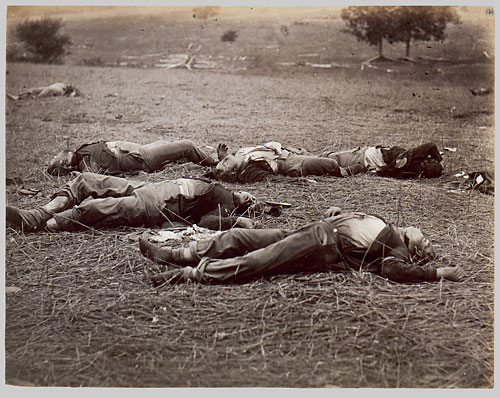
Photo: “Battlefield Dead After the Battle of Gettysburg” by elycefeliz is licensed under CC BY-NC-ND 2.0

Poem: ‘Zippori Story’

Context, people, context! Remember that
Herod was building his new royal city
Zippori some four miles from Nazareth
when Jesus was a child. And Joseph would
have walked there, worked there, daily; Jesus too.

When Judas of Galilee raised his revolt,
captured and burned it–Roman legions came,
defeated him, cast him in the Sea
of Galilee, a millstone round his neck,
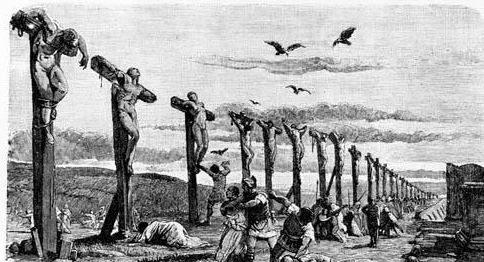
and crucified two thousand rebel Jews.

This was the year that Joseph disappears
from Gospel narratives, all unexplained.
When Jesus chased two thousand Legion pigs
over a cliff into that selfsame sea,
think retribution; think guerrilla strike.

The lack of stories and legends about Jesus’ step-father is one of the great Christian mysteries. He simply disappears from the narrative in the year of Judas of Galilee’s revolt, and is never mentioned again in polite society. Nor is Zippori ever mentioned in the Bible, either by that name or the Romanized Sepphoris, although it was the local capital of Galilee. I have laid out what seem to me obvious suspicions in The Gospel According to the Romans, and blogged about it here and there.

This poem was just published in The Road Not Taken, a Journal of Formal Poetry, in the section themed on ‘Replies’. My thanks to Dr. Kathryn Jacobs.

Potcake Poet’s Choice: Daniel Galef, ‘Proverbs for Engraving onto Imperial Monuments’

War is the price of freedom. Depths bewilder.
The blow aimed at the beast hits him who shields it.
The sword of Justice best serves him who wields it.
The gibbet’s final victim is its builder.
A round coin rolls to him who most deserves it.
A tree outlives its leaves; an age, its fashions.
A carthorse needs its blinders; man, his passions.
The word of Justice best shields him who serves it.
The ardent spirit breaks the firm retort.
Power bears scrutiny like the sun the gaze.
God speaks His queer commands one thousand ways.
The worm awaits. The butterfly is dreaming.
The price of peace is bondage. Chains support.
Persuasion is a proof. Seeing is seeming.

Daniel Galef writes: “I majored in philosophy in college, and it’s very rare that I get a chance to use my degree in any way! (Even everyday critical thinking I engage in not without a little self-conscious embarrassment to be reliving those madcap cogitating days of my youth.) This sonnet began as an un-metrical list of aphorisms, vaguely inspired by Blake’s Marriage of Heaven and Hell, but with an eye less to individual ideas and more to “ideology.” I’m very interested in how philosophy is appropriated by the state, in the form of slogans or anthems or little red books—it’s all fine and dandy to debate competing theories of morality until it’s time to order the transplant waiting list, or convene the board of censors.

“I don’t always do a lot of surgical revision on a poem, but it was after about two years of lying in a drawer [a digital drawer] that I took the loose collection of prose sentences and started pruning, finding and inserting rhymes, and arranging them into pentameter. I’m a poor free verse poet, and verses that start off free end up in metrical shackles much more often than the reverse, even though logically it ought to be tougher to turn prose into verse than vice-verse-a.

“I could write a page on every line in this sonnet, which says much more about my own pretentiousness than about the poem, but will limit myself to saying I chucked in snips and snatches from Plato, Maimonides, Zhuangzi, Lucullus, David Hume, Thomas Jefferson, Aesop, W. H. Auden, Slavoj Žižek, Wernher von Braun, George Orwell, and Groucho Marx. Just about every maxim in the poem has certain levels, interpretations, or applications that I agree with and others which lead to perverse, abhorrent, or outright dangerous positions—which is of course what makes them so useful.

“The poem was published in Philosophy Now, a glossy magazine with a specialized readership but a glossy magazine nonetheless, and one of the highlights of the first summer after I graduated was driving to the Barnes and Noble in Clifton Commons and finding myself there on the shelf along with the movie tie-in reprints and tote bags with snarky quotations on them. It’s probably normal for most poems published, even in larger or well-respected publications, to go essentially unnoticed. I don’t hear back from strangers about the majority of poems I send out into the world and my meager stream of fanfiction is archived in an email folder I dip into when depths start to bewilder. Yet this is the poem that keeps coming back—and the comments I receive on it indicate that different readers draw very different conclusions from it. The year after it was published it was awarded second place in the “Best Poems of 2020” list at the Society of Classical Poets Journal. Someone sent me a Chinese blog where it had been translated into Mandarin, with (Google Translate revealed) a spirited discussion in the comments section as to whether the “blinders” were the same device whether the line was translated as “horse” or as “donkey” (the verdict: they are distinct: the blindfold put on a donkey driving a wheel totally blocks its vision, whereas the blinders put on a horse drawing a vehicle do so only selectively).”

Daniel Galef is a graduate instructor of English at Florida State University and Associate Poetry Editor of Able Muse. His poetry has appeared in Atlanta Review, Able Muse, Measure, The Lyric, Light, First Things, The Christian Century, and Philosophy Now. He is listed in Webster’s dictionary under the entry for “interfaculty (adj.),” which means “brilliant and handsome.” Besides poems he also writes short fiction, humor, and plays, with a story published last year in Juked just awarded a spot in the 2020 Best Small Fictions anthology. He is currently searching for a publisher for a debut poetry collection, Imaginary Sonnets.

More of his work is listed at http://goo.gl/mpRUrs
Poem : ‘Some Who Would Teach’

Some who would teach
Preach,
But speech cannot reach
As far as silence.

Even the stars perhaps are noisy, but, far as they are,
We hear their silence, not their sound.

Words are not for teaching, adding or changing.
Words can only express
What is already known
To one who already knows.

Words feathered together
Can lift aloft
Any body of men.
Opinions are pinions
With which men fly.
But they come down again
And with their descent
What was meant
Is often lost, or is known
To have never been known.
For a word is a wing
But a body’s a thing
And the body is always the body
But the wing only is when it flies.

Therefore not by talking but being
Does one teach how to be,
And words are for singing–
A song sung
By those knowing their winging as being but having no meaning.
And the best words
Come from birds.

I wrote this, but do I subscribe to the ideas? Did I ever? Not in any absolute sense, but as a rejection of all noisy preachers of faiths, and a rejection of those who put academic lectures ahead of experiential learning. In that sense this (early) poem prefigured my 25-year career teaching business finance through the Income-Outcome interactive games we developed for global clients like Beam Suntory, Michelin and hundreds of other companies and universities.

In another sense this poem is just about the enjoyment of words and songs, regardless of any meaning that the words may have.

It was published by Anima Magazine in the UK, unfortunately quiescent since 2018.

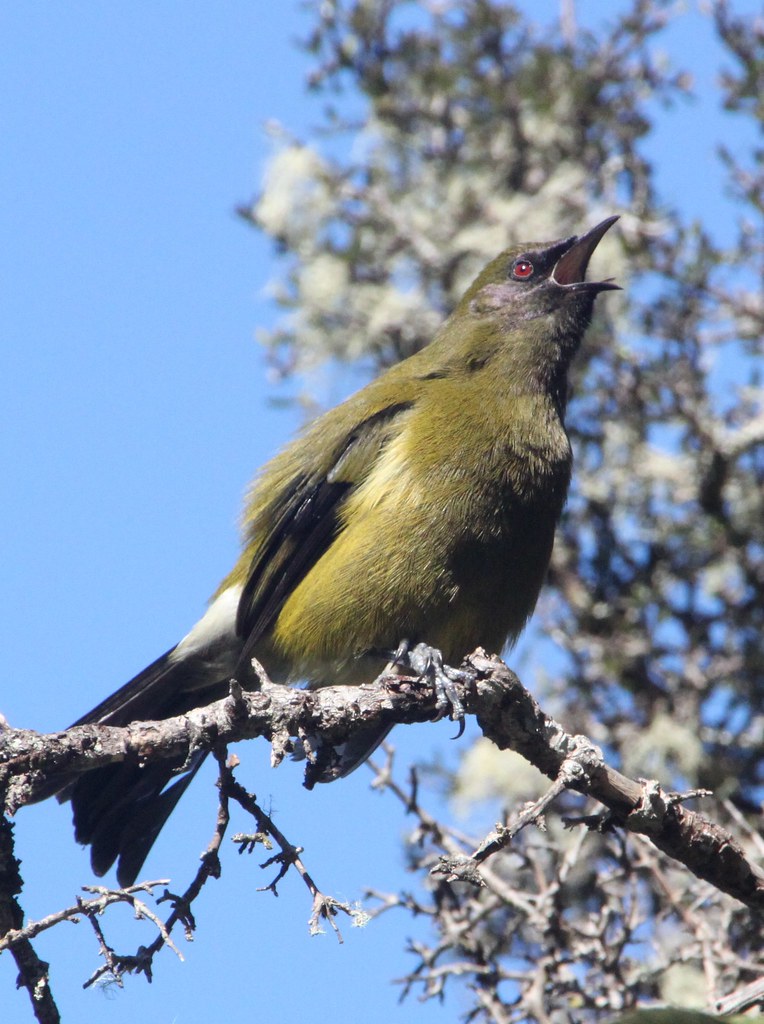
Photo: “Korimako (Bell Bird) singing” by theirishkiwi is licensed under CC BY-NC-ND 2.0

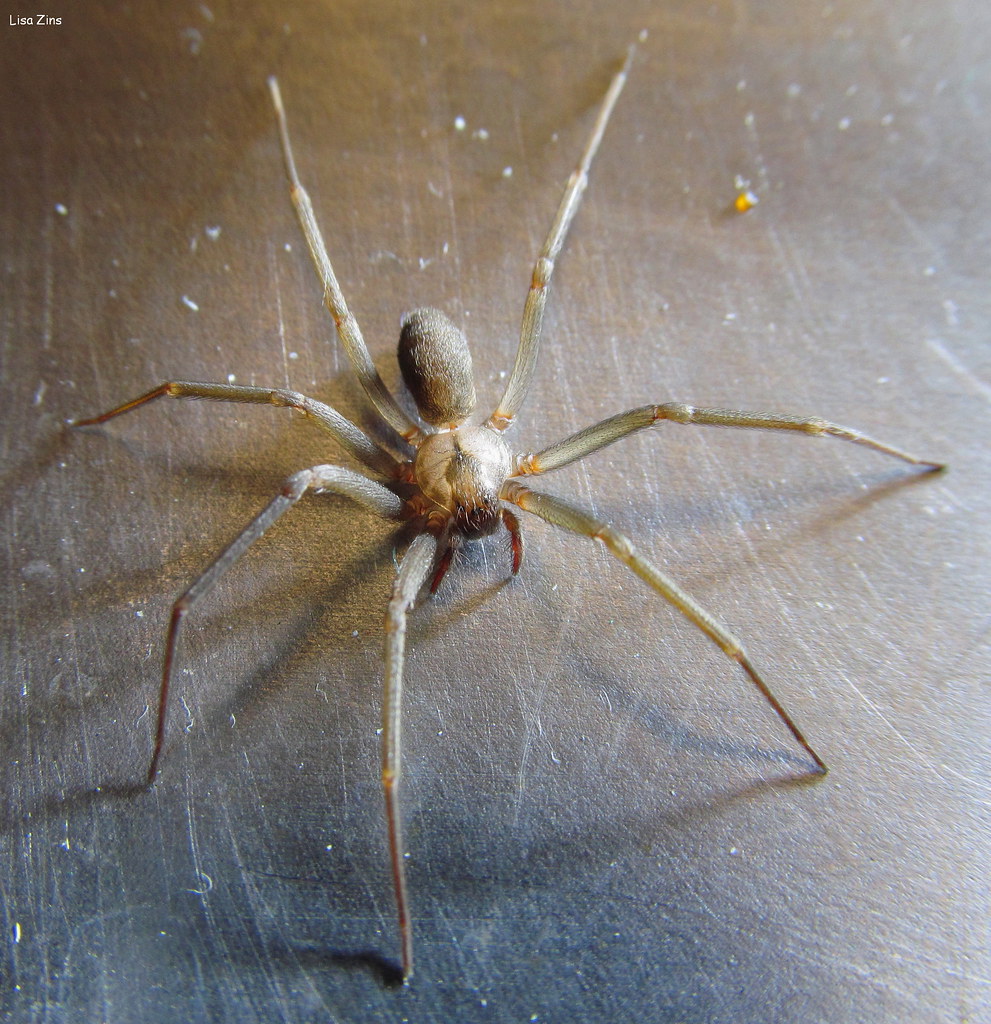
Short poem: ‘White Recluse’

Her thoughts were all inside her –
Free from reality –
Poor little cramped-up spider
Who never saw the sea.

Much though I love her insightful and often wicked little poems, and deeply though I sympathise with her for (as I have heard) the traumatic and embarrassing seizures that restricted her life, I still have difficulty with this specific Emily Dickinson poem:

I never saw a Moor —
I never saw the Sea —
Yet know I how the Heather looks
And what a Billow be.

I never spoke with God
Nor visited in Heaven —
Yet certain am I of the spot
As if the Checks were given —

(There are two versions of this poem in circulation; but her poems were only edited and published after her death, and subsequently researched, de-edited and republished.) With all due respect, Miss Emily, if you had actually experienced the sea you would have realised that there is no way that a description and a couple of paintings can hope to capture the totality of waves: their warmth or chill, their taste, their sound, their movement against the body, the enjoyment, the danger, their feel in the water, their feel on a boat, their impact on a sandy beach or on a reef or against a cliff…

This also suggests to me that her understanding of God and Heaven is way too simplistic. She is making a good unwitting case for agnosticism. ‘White Recluse’ was published in The Asses of Parnassus, a suitable place for snippy little poems.

“Six Eyed Danger (Brown Recluse Spider)” by Lisa Zins is licensed under CC BY 2.0

Short Poem: ‘The Hitchhiker’

Sometimes you’d sell your soul just to get warm! –
Your clothes are rags in the wind, your skin goes blue,
You doubt your mouth can ever smile again;
The lonely world grows dark before the storm
Whose icy rain’s a mile away… and then,
The sun breaks through!

I used to do a lot of hitchhiking – 25,000 miles is my best estimate, on five continents. It can be miserable, it can be ecstatic, but as a way of exploring the world without plans and preconceptions, it’s hard to beat. It used to be safe, then it became unsafe, but now it’s probably safe again – if you send a picture of the vehicle from your cell phone before you get in. Or if you live on an island with no public transportation, where everyone seems to know everyone and it’s just common courtesy to give people a ride.

The poem was published in the now-defunct Candelabrum, a twice-yearly British publication that championed traditional verse through the darkest days of “free verse” from 1970 to 2010. The magazine has ceased publication, but thank goodness the sun has broken through again!

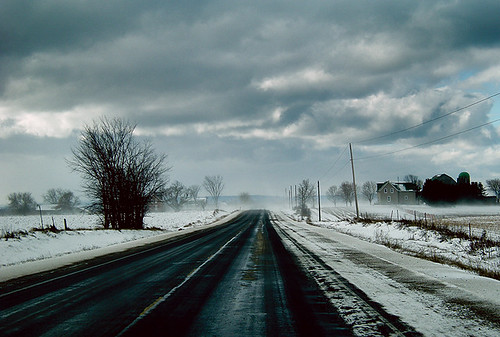
“Winter Road” by ryanmcgilchrist is licensed under CC BY-SA 2.0

Poem: ‘Spring Sprang’

Spring sprang full force with sudden storms then stopped.
Of which vertu engendred were the floods. We mopped.
Summer so wet dried into humid dank.
Sweat dripped, dried, dripped, and as we worked we stank.

This little poem was published in The Asses of Parnassus, where poems range from the short to the very short. Epigrams translated from the Greek or Latin alternate with modern insults and with odd little observations such as this post’s verse. It is a site for people who enjoy the occasional small random thought.

Why I wrote the poem, I don’t know. It probably started with the evocative sounds of “spring sprang”. Spring rains always bring Chaucer’s Prologue to my mind, whence the “of which vertu engendred” phrase. The whole thing is inconsequential, except that in one very important sense no creative act, not even the most trivial, is inconsequential: your creativity speaks to you, and your decision of whether or not to act on it determines many aspects of your life: not just your creative output, but your sense of satsfaction, your happiness, your mental balance, even your physical health. When the muse speaks, listen and act – the output doesn’t have to be significant, but keeping the lines of communication open to the inner and unconscious (but in several ways wiser and more knowledgeable) parts of yourself is supremely important. Call it the soul, if you want. Call it God, for all I care. There is something essential there: honour it. Your happiness, maybe even your life, depends on it.

OK, rant over. Back to other inconsequentialities.

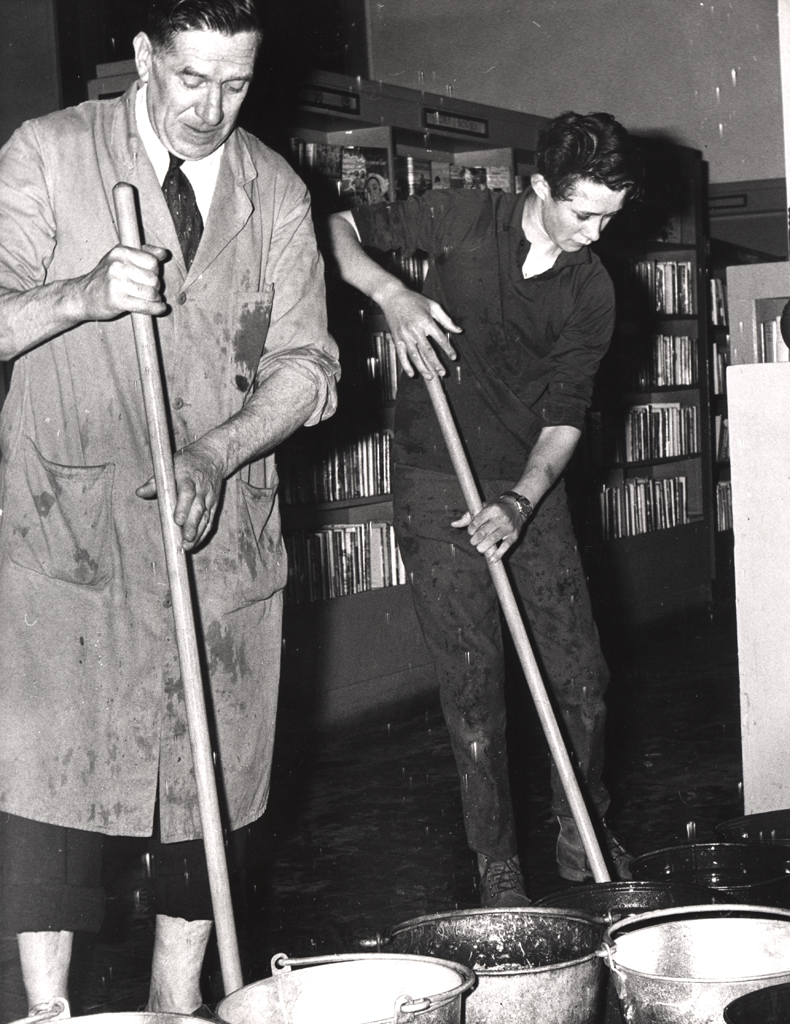
Photo: “025457:Floods Central Library New Bridge Street Newcastle upon Tyne Unknown 1966” by Newcastle Libraries is marked with CC PDM 1.0

Short poem: ‘Subduction’

All human nature, conflicts, nations, and all races
will be washed as by tides on beaches, all loves and lusts
will with Time disappear, all human traces
washed under as all plates are washed
by the subduction of Earth’s crusts.

This poem was published this month in Lighten Up Online – an excellent place to read light verse on subjects both light and heavy. Every issue has a mixture of longer and shorter poems, and a competition. This March 2021 edition concludes with the results of the eco-crisis competition, headed ‘The Airing of the Green’; ‘Subduction’ was one of the winners. Other sections of the magazine were also focused on the environment. Pollution and climate change are twin disasters, and you can express outrage, despair, or (more usefully) proposals for action. The million-year view of my poem isn’t useful but it’s low-hanging fruit, there to be taken.

I’m delighted to be in a magazine along with poems by fellow Potcake Poets Martin Elster, Michael R. Burch, D.A. Prince, George Simmers, Nina Parmenter, Gail White, Chris O’Carroll, Tom Vaughan, Jane Blanchard, Jerome Betts, Martin Parker and Melissa Balmain, as well as two poets who will be appearing in the next Potcake Chapbook, Bruce McGuffin and Julia Griffin, and the ever-anomalous Max Gutmann. Several of us have more than one poem in this issue.

“File:Tectonic-plates-subduction-zone-17280738.jpg” by Benjilrm is licensed under CC BY-SA 4.0

Sonnet: ‘Irritated Muse’

My muse is angered by my Covid cares –
“You worry if the shops have food and beer,
and what a Zoom attendee rightly wears!
You’re just as mortal as you were last year,
and wrote of life and death, sickness and health.
Well, now’s an actual existential crisis!
Think family and friends, the world, your self…
forget the shopping and the product prices!
You’ll die; the question’s When. The only tool
for immortality is me, that clear?
You should be writing poetry, you fool!
This is your chance. Focus on me.” (Yes, dear.)
“Respect me as your muse: I’m not your shill.
If you can’t write a poem, write your will.”

This sonnet has just been published in Allegro in the UK, edited by Sally Long. The magazine comes out twice a year, one issue themed and the other open. It focuses on formal verse, but on a long continuum between fully formal and free.

Photo: “Thalia, Muse of comedy.” by Egisto Sani is licensed under CC BY-NC-SA 2.0