Category Archives: Poetry

Short poem: ‘Subduction’

All human nature, conflicts, nations, and all races
will be washed as by tides on beaches, all loves and lusts
will with Time disappear, all human traces
washed under as all plates are washed
by the subduction of Earth’s crusts.

This poem was published this month in Lighten Up Online – an excellent place to read light verse on subjects both light and heavy. Every issue has a mixture of longer and shorter poems, and a competition. This March 2021 edition concludes with the results of the eco-crisis competition, headed ‘The Airing of the Green’; ‘Subduction’ was one of the winners. Other sections of the magazine were also focused on the environment. Pollution and climate change are twin disasters, and you can express outrage, despair, or (more usefully) proposals for action. The million-year view of my poem isn’t useful but it’s low-hanging fruit, there to be taken.

I’m delighted to be in a magazine along with poems by fellow Potcake Poets Martin Elster, Michael R. Burch, D.A. Prince, George Simmers, Nina Parmenter, Gail White, Chris O’Carroll, Tom Vaughan, Jane Blanchard, Jerome Betts, Martin Parker and Melissa Balmain, as well as two poets who will be appearing in the next Potcake Chapbook, Bruce McGuffin and Julia Griffin, and the ever-anomalous Max Gutmann. Several of us have more than one poem in this issue.

“File:Tectonic-plates-subduction-zone-17280738.jpg” by Benjilrm is licensed under CC BY-SA 4.0

Sonnet: ‘Irritated Muse’

My muse is angered by my Covid cares –
“You worry if the shops have food and beer,
and what a Zoom attendee rightly wears!
You’re just as mortal as you were last year,
and wrote of life and death, sickness and health.
Well, now’s an actual existential crisis!
Think family and friends, the world, your self…
forget the shopping and the product prices!
You’ll die; the question’s When. The only tool
for immortality is me, that clear?
You should be writing poetry, you fool!
This is your chance. Focus on me.” (Yes, dear.)
“Respect me as your muse: I’m not your shill.
If you can’t write a poem, write your will.”

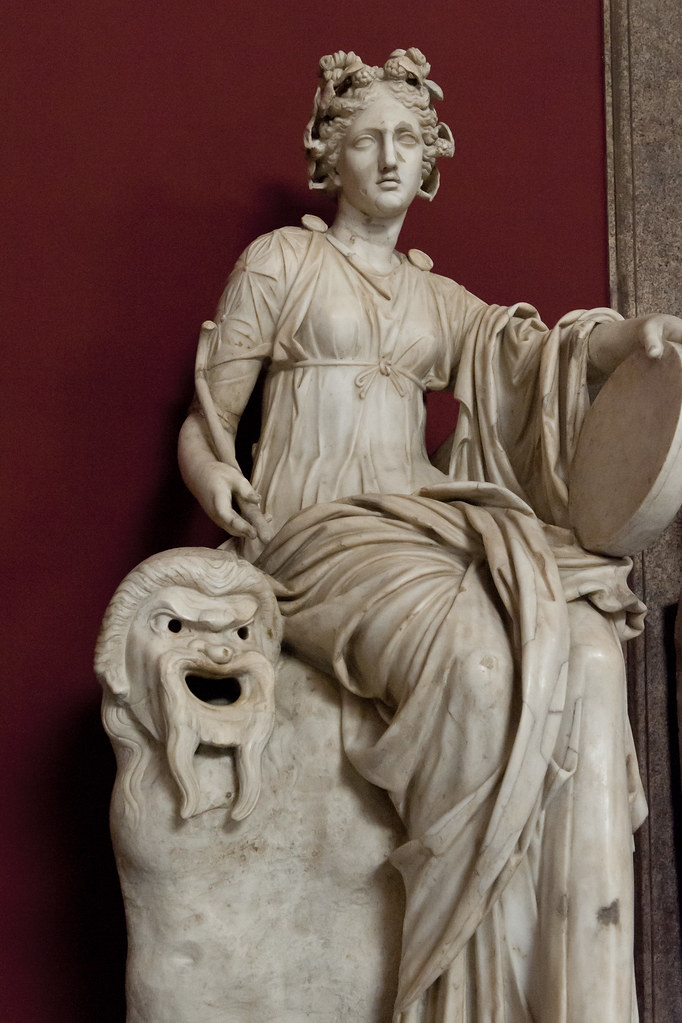
This sonnet has just been published in Allegro in the UK, edited by Sally Long. The magazine comes out twice a year, one issue themed and the other open. It focuses on formal verse, but on a long continuum between fully formal and free.

Photo: “Thalia, Muse of comedy.” by Egisto Sani is licensed under CC BY-NC-SA 2.0

Fantasy Analysis: Auden’s ‘Jumbled in the common box’

Jumbled in the common box
Of their dark stupidity,
Orchid, swan, and Caesar lie;
Time that tires of everyone
Has corroded all the locks,
Thrown away the key for fun.

In its cleft the torrent mocks
Prophets who in days gone by
Made a profit on each cry,
Persona grata now with none;
And a jackass language shocks
Poets who can only pun.

Silence settles on the clocks;
Nursing mothers point a sly
Index finger at the sky,
Crimson with the setting sun;
In the valley of the fox
Gleams the barrel of a gun.

Once we could have made the docks,
Now it is too late to fly;
Once too often you and I
Did what we should not have done;
Round the rampant rugged rocks
Rude and ragged rascals run.

In January 1941, W.H. Auden had been living in New York for nearly two years. The Second World War had started, but not yet in the US. Auden had fallen in love with Chester Kallman who was now turning 20 and was too young to want to be sexually faithful; Auden had also returned from atheism to the existential Christianity that is common in the Anglican/Episcopalian church. It was a period of change, backgrounded by the widening war.

Regarding the poem from this time, I choose to imagine Auden rambling, reminiscing, muttering to himself: “Around the rugged rocks the ragged rascal ran… Nice metre as well as alliteration and, for people with difficulty pronouncing their Rs, a twuly tewwible tongue-twister. Rhythmic, memorable. Nonsense; not meaningful, but not meaningless; nonsense and nursery rhymes are right on the border. And it splits in two, you could easily rhyme it: rocks, box, blocks, brocks, cocks, cox, clocks, crocks… ran, Ann, ban, bran, can, clan, cran… or easy to change to run, or runs. A lot of rhymes, anyway. Run them out, see what transpires.

Once we could have made the docks, / Now it is too late to fly; that adds another rhyme, not a problem, maybe a 6-line stanza. Once too often you and I / Did what we should not have done; and into the last two lines, have to fill them out a bit to maintain the metre, keep the alliteration of course: Round the rampant rugged rocks / Rude and ragged rascals run… So that’s all right, that would make an ending.

“Then of course we can have more stanzas leading up to it. Flick a bit of paint at the canvas, see what sort of patterns we can find to elaborate on. Time, decay, trepidation, warnings… out come the words and images around the rhymes, and suddenly it’s all as evocative and semi-coherent as a reading of tarot or yarrow or horoscope. Hm, tarot or yarrow, I hadn’t noticed that before, wonder if I can use that somewhere else…”

(Remember, this is a fantasy analysis, presupposing the poem to have been written with full skill to capture both rhymes and a mood, but without any serious intent beyond that. For a completely different intellectual analysis, you can always try this…)

Photo: “Jumble Box” by .daydreamer. is licensed under CC BY-NC-ND 2.0

Poem: ‘So Listen Now’

      So listen now to what the prophet saith, 
          He teaches anything, he gladly learns, 
             He follows scientists and what they say, 
             And now, Philosophy of DNA. 
           Regard the spiral of it as it turns, 
      And listen now to what the prophet saith: 
  The two as one, entwining intercourse, 
Then separate from toes to very head, 
And, separated, seek another bed, 
  Their separation procreation’s cause. 
      So listen now to what the prophet saith— 
           And this the canniballed male spider learns, 
                Eaten by her, as her he’d try to lay, 
                Who procreates in separation’s day— 
           No spark of love or life or hate there burns, 
      But, listen now to what the prophet saith, 
      Only a life of procreating death. 

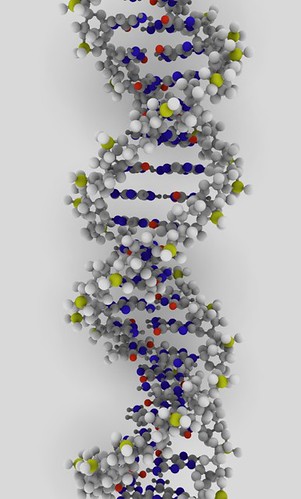
Another of my early poems: I wrote this when I was 17, in my last year at school. DNA was still a newish concept to the general public, and it appealed to my nihilistic teenage state of mind. My opinions decades later are still pretty similar, though my attitudes are much more relaxed and happy.

I had been thoroughly immersed in iambic pentameter by then, studying several of the Canterbury Tales, several of Shakespeare’s plays, and a whole slew (or slough) of poets from Donne and Milton to Cummings and Frost–learn enough poetry by heart, and you become very comfortable writing in the forms you know. I developed the rhyme scheme to allow the indentation-by-rhyme to reflect as best I could the spiral of the subject: ABCCBADEEDABCCBAA, the rhymes winding back and forth across the much-repeated central line, ending with a couplet to round it out at 17 lines.

The poem was originally published in Metverse Muse, an Indian periodical that champions traditional verse.

Photo: “DNA rendering” by ynse is licensed under CC BY-SA 2.0

Poem: ‘Hail Deth’

Hail Deth, that from alle Natur’s birth
Hast kept each living thing thy thrall!
Teech me to love thy quiet call,
To rest
Among the blest,
To be at peace with every thing on earth.

Come soft, without impediment;
Let mee slide sleeping to thy armes,
Discover alle thy soothing charmes;
And kill
My every ill,
Leave mee uninterrupted sediment.

This is one of my very earliest poems, with the form, theme and erratic spelling all obviously influenced by studying the Metaphysical Poets in school. I’ve always been fascinated by death–at least since the time I gave up Christianity, thanks to my excellent Church of England schooling. The poem was written tongue-in-cheek, of course: I’m in no hurry to die.

‘Hail Deth’ has just been published in the Shot Glass Journal which, in accordance with Shakespeare’s “brevity is the soul of wit”, publishes both formal and free verse so long as a poem doesn’t exceed 16 lines. It also divides contributions into American and International groups and lists them separately, which is interesting if not necessarily useful in any functional sense.

Photo: “NS-01023 – Death Head” by archer10 (Dennis) is licensed under CC BY-SA 2.0

(Loosely) Anapestic Sonnet: ‘A Run’

Over the island from beaches this side where it’s blowing,
it’s only a mile to the side where today it’s flat calm;
so over the hill’s potholed tarmac, to tracks of sand going
along under southern pine, seagrape, gum elemi, palm;
and then between sea-oats and cocoplums over the dunes
and down to the beach where the sand is as dusty as powder,
then lower across the high tide mark that seaweed festoons,
to harder packed sand under sun hot as bird-pepper chowder —
the sand at the ocean low tide, flat and hard as a ledge,
so flat you don’t feel that you’re running the side of a slope
where the ocean runs up inches deep and you splash through its edge,
one more mile to the end, where the sand is as pink as fresh hope,
is as pink as a conch shell, as pink as the still morning skies —
and you rest on the rocks in the shade while the southern pine sighs.

Eleuthera, the island where I was raised and where I live, is long and skinny like many of the Bahama Islands. A hundred and ten miles long, mostly a mile or two wide. I live on the south side (local name), the west side (tourist name), the sea side, the Sound side, the Caribbean side. It’s a great run of a mile over a 60 foot hill to the north side (or east side, ocean side, Atlantic side). On the south side the sand is white, and all the way out to the horizon the water is only 20 feet deep or so. On the north side the sand varies from powdery white to coarse pink, and long before you got to the horizon you would be in 8,000 feet of water. You can tell immediately from a photo which side you’re looking at: vegetation, beach, colour of the water, they’re all different.

This poem was published this month in Snakeskin, edited for 25 years by George Simmers. He is receptive to both traditional and free verse, everything depending on what appeals to him at the time. This is good for me, because I am inconsistent with what I produce. With this one, I went for the rhythm, the da-da-dum, da-da-dum which may not be the sound one person makes when running, but for me captures the mood of running. I can’t define it more than that. And so long as that rhythm is in the heart of each line, I don’t have a problem with being a syllable short at the beginning, or having an extra one at the end, so long as it all flows from one line to the next without a big hiccup.

Poem: ‘For Peter, Drugged in a Mental Hospital’

In the winter the Interior stops
The shops close
Clocks unwind
Clothes hang frozen on the line.

With the summer tourists gone
Birdsong is ended
The water is locked away in the hills
And the waterfall hangs suspended.

No one takes down the signs that read
“Entering tunnel, remove sunglasses”.
Stopped by the wind at the top of the passes
We look down
On some tiny, frozen, unmoving town,
Down on a land without seed.

The city, car-filled, cascading, bickering,
Seems so long, long ago.
Look down on the river trickling
Through the desert dusty with snow –
The tracks of coyote and deer
Echo the unseen in our own austerity.
Will Spring ever come, here?
In this desolate clarity?
With blossoming fruit trees and softening lakes?

It will, and the snow will be brushed from the sage
But until then the only life that we see
Is:
Giant snowflakes
Lily pads of ice
Flowing down the Fraser to the sea.

In 1975 I had started living in British Columbia (where every landscape is monumental and dramatic), and I was friends with a young man who was in and out of mental hospitals. Under the stresses of university finals and high parental expectations, he had flipped out: as best I remember, he had boarded an airplane that was being cleaned and tried to hijack it from the cleaning lady with a pocketknife. At the time of writing the poem I believed he would work through his mental breakdown and return to a quiet, charming, intelligent existence. Unfortunately that was happening too slowly, and he died a couple of years later in a fire at a halfway house.

The poem was published in Candelabrum Poetry Magazine, a British publication that appeared twice yearly from April 1970 to October 2010, dedicated to keeping traditionalist poetry alive through those darkest of poetry decades.

Photo: “ice-pancakes” by JeremyOK is licensed under CC BY-NC-SA 2.0

Sonnets: ‘Confronting Churches and the Void’

A man-like god creates the universe?
Two hundred billion galaxies? Each holding
a hundred billion stars? And each star moulding
its planets into life, teeming, diverse!
All this from some bearded old angry face
who says “Build me a temple, pray, and pay
the priests who’ll guide you onto Heaven’s way,
erase your sins . . . or you’ll go in disgrace
to torment underground — eternally.”
No way your life gains from such small belief,
passed on by some royal or holy thief
who says “God wants your money, send it me —
my palace honours Him . . .” The human lurches
fearful, confused, through wastes of wasteful churches.

As social animals, we find our place
by walling others out, putting them down:
these walls, my family; those walls, my town.
Even more walls: tribe, country, faith or race.
This atavism’s bad for mental health,
supports no sense of personal strengths or meaning,
allows no purpose, individual leaning,
denies achievement to your inner self.
Identity’s reduced to football fan,
or something uniformed, or some group prayer;
without those — alcohol, drugs or despair,
not knowing how to move past Nowhere Man.
Know yourself, human, to confront the Void:
your proper study’s all that’s anthropoid.

You can think of these two sonnets as the result of ten years of Church of England boarding school–five years in Jamaica, five in England–where Scripture lessons and daily church services were complemented by solid science and rigourous literature. And of course the Church of England recognises no Pope except the man who wrote “Know then thyself, presume not God to scan; the proper study of Mankind is Man.” So here you see the fruits of a well-rounded education.

This poem has just been published in Better Than Starbucks, a remarkably extensive poetry journal (and with some fiction too). The bulk of my BTS-published poems are in the Formal Poetry section, but there are many other sections–it’s a 100-page magazine. The online version is free, and well worth exploring.

“stepping across the bridge” by Max Nathan is licensed under CC BY-NC-ND 2.0

Sonnet: “The Word”

“In the beginning was the Word.” What word?
Said by what tongue? Indeed, said in what tongue?
And by what consciousness was the Word flung
Out into Nothing, as from Ark a bird?
Nothing will come of nothing, we’ve concurred.
A billion galaxies, from Nothing sprung?
How “the beginning,” if a lowest rung
Requires both ground and ladder? It’s absurd.
Religions, sects, philosophies and schools,
Simple or complex, always come to grief
Because our grasp of Nothingness is flawed.
The atheist rightly shows all gods are fools;
The agnostic claims that any held belief —
Including one in Nothing — is a fraud.

I’ve written poems for and against various religions, depending on my mood and on whatever idea I was exploring. But in the end I come back to disbelief. I’m a militant agnostic: “I don’t know, and neither do you!” And this acknowledgement of ignorance of where the Universe comes from is emphatically NOT an endorsement of any religion. It is an endorsement of the (probably hopeless) search by science for all the answers.

This sonnet, with Petrarchan rhyme scheme ABBA ABBA CDE CDE, was originally published in Bewildering Stories, issue 789. I’ve tinkered with the penultimate line since then, trying to improve the metre.

Photo: “WORDS” by Pierre Metivier is licensed under CC BY-NC 2.0

Political poem: Amanda Gorman’s ‘The Hill We Climb’, excerpts

First: a warning: I haven’t seen the printed version, but I have modified a transcription to try to catch the essence of the various types of wordplay that the poet engaged in, with bold for rhyme and italics for alliteration and repetition. These excerpts are from the earlier parts of her poem, skipping some less poetic portions.

When day comes we ask ourselves where can we find light in this never-ending shade?
The loss we carry, a sea we must wade.
We’ve braved the belly of the beast.
We’ve learned that quiet isn’t always peace.
In the norms and notions
of what just is
isn’t always justice.
And yet, the dawn is ours before we knew it.
Somehow we do it.

And yes, we are far from polished,
far from
pristine,
but that doesn’t mean
we are striving to form
a union that is perfect.
We are striving to forge
our union with purpose.
To compose a country committed to all cultures, colors, characters, and conditions of man.
And so we lift our gazes not to what stands between us,
but what stands before us.
We close the divide
because we know to put our future first, we must first put our differences aside.
We lay down our arms
so we can reach out our arms
to one another. We seek harm
to none and harmony
for all. Let the globe, if nothing else, say this is true.
That even as we grieved, we grew.
That even as we hurt,
we hoped.

That even as we tired,
we tried
that will forever be tied
together victorious. Not because we will never again know defeat,
but because we will never again sow division.

Scripture tells us to envision
that everyone shall sit under their own vine and fig tree and no one shall make them afraid.
If we’re to live up to her own time, then victory won’t lie in the blade,
but in all the bridges we’ve made.
That is the promise to glade
the hill we climb if only we dare. It’s because being American is more than a pride we inherit.
It’s the past we step into and how we repair it.
We’ve seen a force that would shatter our nation rather than share it.
Would destroy our country if it meant delaying democracy. This effort very nearly succeeded.

Amanda Gorman’s poem for President Biden’s inauguration was an extremely well received performance of Spoken Word. As the Wikipedia entry states, Spoken Word focuses on “the aesthetics of recitation and word play, such as the performer’s live intonation and voice inflection.” With its roots in preliterate societies, it searches for all possible tricks for both capturing the audience’s attention, and making it easier to memorise the words. Amanda Gorman did this extremely well in her recitation, with clarity and with effective pacing, pausing and emphasis, carrying the thoughts along in a chant-like flow of rhymes, half-rhymes, puns and alliteration. It was a superb piece of Spoken Word, and left listeners enthused and uplifted. It was perfect for the mood of the inauguration.

But it wasn’t flawless. In places either the transcription is flawed or the poet has sacrificed meaning for the sake of a rhyme. Take “even as we tired, we tried that will forever be tied together victorious”. There is a flow of suggestion that imparts a meaning, but looked at under a bright light the words sound like those of a drunk.

Or take the rhyme sequence “afraid, blade, made, glade”. OK, but I stumbled over “That is the promise to glade”. Perhaps she means “the promise to make an open clearing through the forested hill we are climbing.” My bias is that I think of a glade as a flat clearing in woodland–I didn’t see the meaning of the verb she created, I didn’t think of a hill being climbed as being forested, but that may all be my problem. Similarly, I like the rhyming of “inherit” with “repair it” and “share it”; but what does this mean: “We’ve seen a force that (…) would destroy our country if it meant delaying democracy.” This is clumsy. It’s not clear exactly what is being said. If “would” means “is intended to”, then presumably she should have inverted the phrase: the force wanted to delay democracy, even if it meant destroying the country. Yet it is clearly all part of a political message: the end of Trump’s deliberate White America divisiveness, a return to the modern world’s multiethnic inclusiveness. As she triumphantly ends her piece:

The new dawn blooms as we free it.
For there is always light.
If only we’re brave enough to see it.
If only we’re brave enough to be it.

So we have an inspiring piece of performance art, of spoken word, by a 22-year-old who has a lot of talent and a great stage presence. I’m sure we’ll hear a lot more from her. But I suspect that if her words are to last, she will have to develop a stronger control of meaning. The jagged nature of her lines is not a problem; the lack of structure to her rhyme is not a problem; in some ways she seems close to Old English and other Germanic poetry with their emphasis on a heavy beat (rather than a set number of syllables), and a long way from the “modern poetry” that, without metre or rhyme, tries to get an effect by being laid out provocatively on a page.

Amanda Gorman is an interesting but unformed poet, and a superb presenter. You can see the recitation here towards the bottom of The Guardian coverage. And the full transcript is here.