Category Archives: weekend read

Weekend read: Daniel Galef, ‘Auriol to a Patron at Le Chat Noir’

For it was Auriol who concocted the Chat Noir-Guide toward the end of the nineteenth century. The Guide provides, for every objet d’art and knick-knack purportedly on display in the bar, fantastical tales of provenance.
From Cabaret to Concert Hall, Steven Moore Whiting


Come in, come in! Here, have a glass of beer—
The best in Paris! Whence derives such praise?
The Comte du Saint-Clement, when he drinks here,
And several other lumières Françaises
All say so. (Rimbaud swore “the best in France!”)
Perhaps you have been eyeing some of our
Objets and esoterica? Perchance
You’d like to hear their provenance? Le Soir
Has called the Chat’s decor the greatest work
Of art collection since the Louvre. These darts
Were thrown by Pippi Pavlo of Le Cirque.
This mirror-frame once held a Queen of Hearts
Played by the Duke of Sandwich in the game
At which he famously invented soup.
That specimen was lost before it came
To us—pinched by a croupier with the croup.
The mirror, too, is memorable—this crack
Imparted by a blow from cannon fire.
The cannoneer collapsed. Upon his back
They found the selfsame mark. Since then, each buyer
Has met a grisly fate—until bought by
A suicidal poet named Pierre.
It didn’t work. He gave it to Le Chat
In payment for a shot. We hung it there.
The timepiece on the mantle was a gift
From Pope Immaculate to me. Of course,
At that time, I had left the church. A rift
Arose when I ordained a bishop’s horse.
Ignore the wireless just beside—the news
Is so depressing, no? So . . . uninspired.
The mud, the blood, the bombs, the flu, the coups,
Enough to make Scheherazade tired.
But here! This silhouette is me—back then
I had a beard. I lost it in a duel
With three mad Turkish painters in Ardennes.
The third defaulted. Still I shot. It’s cruel
To leave a loser living. I was called
“The Caesar of Sargasso”—naturally
There wasn’t a resemblance. He was bald
While, under wraps as “Cleopatra Lee”
I worked with Pasteur researching a cure
To hair loss. Though the lab sank in a storm,
I drank the last drop as I swam to shore,
And thus my coiffure’s never lost its form.
This bronze, by Claus of Innsbruck, is a hoot—
So said the critic who is sealed inside
Its twin, the Triton by the stairs. Poor brute!
He knocked for half a week before he died.
It’s best not to insult these artist types.
I have the Gift myself, but can’t unearth it.
To catch the Muse is much like hunting snipes:
They bite, and taste too gamey to be worth it.
Each crystal on that chandelier’s a shard
From Louie Something’s windows at Versailles.
They say there came a witch, old, hunched, and scarred,
One night at midnight. With her one bright eye
She sneered once through the pane, and then departed.
Within a week, the king went mad and smashed
The lot of them, while mumbling “It has started!”
It’s cursed, of course. Too pretty to be trashed.
The candles are of beeswax. And what bees!
They live like princes. Endless fields of flowers
Are tended by the gardeners at Nice
And watered by a set of special showers
Constructed for the grounds by Lord Brunel.
We light them only rarely. For a guest
Such as yourself, I’ll gladly burn one. Well,
Just half. Come back someday, we’ll burn the rest.
These coasters? Quite mundane. They’re bits of planks
I salvaged from the Hesperus. Oh yes,
I once was quite the soldier. Only blanks
I ever loaded in my gun. The rest
Must have a chance, you know. It isn’t fair
To pit them up against whom Nelson dubbed
“The finest shot in Europe.” On a dare,
I handed him my pistol once. He clubbed
Me with his wooden leg. What’s that? His arm?
Oh no, that’s merely what the papers said.
In fact, it was his leg. It does no harm
To stretch the truth a little. Nelson plead
For them (the press) to print it right, but they
Insisted that an arm read better. He,
Of course, cried “What a silly thing to say!
An arm can’t read! Perhaps an eye?” You see,
They listened—Nelson loved Le Chat. You’ll find,
If you direct attention here, I’ll show
You where he signed the bar. Just why he signed
As “Ferdinando Smitty,” I don’t know.
That stool you’re sitting on I carved myself
With a pocketknife from one great slab of teak
When, hounded through a forest by some elf
I climbed a tree and hid there for a week.
That tree was this: The chair. The table, too,
Unless that one’s the Pharaoh’s table—no,
But come along, I’ll show that one to you,
Just past these poker-playing dogs (Van Gogh).
Don’t touch, the paint is fresh! I knew the model,
Lovely gal. Alsatian, I recall.
Her only vice, a weakness for the bottle;
Poor dear! Not drink—the bottle, that was all.
Our barman is a secret Count, a bastard
Practicing the rapier to reclaim
His stolen birthright. So far, he has mastered
Fourteen styles of swordplay. Soon his name
Will grace kings’ lips. For now, he’s just our skinker.
The chambermaid, as well, has quite a story.
A moron, yes? Wrong! Why, that genius thinker
Solved the famous Kjotz Conjecture. Glory
Is nought to her. She labors for mankind,
And for her god (the Devil). The Sorbonne
Has offered her a chair. But she declined.
(They say her mother was Napoleon’s son.)
That busboy? Oh, don’t heed him. He is lame
Not from trench foot, as some (and he) insist,
But—let me see—oh, yes!—a goon whose name
Was “Olaf” chopped his toes off at the wrist,
And now he’s quite—But pray, don’t touch that curtain!
The outside light must never be allowed
To touch these treasures. They’ll tarnish, I am certain.
(Besides, those drapes were Victor Hugo’s shroud.)
Our rum’s supplied by pirates. These fine cups
Looted from the Louvre. These splendid spoons
Are those with which the Mongol chieftain sups.
The silver forks are forged from gold doubloons.
Our beer, which I can see you quite enjoy,
Is brewed by tight-lipped monks who take a vow
Never to speak a lie—I, as a boy
Was in the order. (I have left it now.)

*****

Daniel Galef writes: “A few years ago when I was learning the Gymnopedies and Gnossiennes on piano I also tried reading up on Erik Satie, whose circle was full of interesting eccentrics, especially those frequenting Rodolphe Salis’s famous fin-de-siecle cabaret in Montmartre the Chat Noir: George Auriol, Vital Hocquet, Alphonse Allais, &c. As a fiction writer, I am fascinated by lies and liars and what drives them, and was particularly taken by the fact, mentioned in passing, that Auriol had written and published a fake guidebook for the Chat Noir. I’ve since read more about Auriol, and even tracked down and read (with the help of Google Translate) a scan of the Guide itself (and highly recommend it, if it’s still to be found online), but when it was the only thing I knew about him that line alone in Whiting’s book was enough to serve as springboard for this weird, sort of Browning-y monologue poem, which is one of my favorite things I’ve ever written. The long version was written first even though it was published second; it appeared in 2022 in Bad Lilies, and later I snipped a sonnet out of it, which was published in 2020 in Light (and then in a slightly different form in my first book Imaginary Sonnets).

Daniel Galef’s poetry, half-serious and half-non-, has been published in a variety of venues themselves both serious and non-. His first book, Imaginary Sonnets, collects 70 persona poems from the point of view of various historical figures and literary characters, including Lucrezia Borgia, Christopher Smart’s cat, and a taco. “A Nightingale to a Sad Poet” first appeared in the Spring/Summer 2025 issue of Sein und Werden. Other recent writing can be found in the Indiana Review, the Best Small Fictions anthology, and Scientific American.

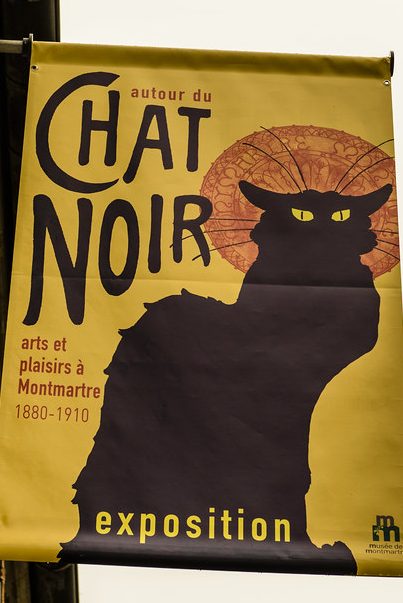
Photo: “Le Chat Noir” by Son of Groucho is licensed under CC BY 2.0.
Weekend read: Stephen Edgar, ‘Murray Dreaming’

It’s not the sharks
Sliding mere inches from his upturned face
Through warps of water where the tunnel arcs
Transparent overhead,
Their lipless jaws clamped shut, extruding teeth,
Their eyes that stare at nothing, like the dead,
Staring at him; it’s not the eerie grace
Of rays he stood beneath,
Gaping at their entranced slow-motion chase

That is unending;
It’s not the ultra-auditory hum
Of ET cuttlefish superintending
The iridescent craft
Of their lit selves, as messages were sent,
Turning the sight of him they photographed
To code: it is not this that left him dumb
With schoolboy wonderment
Those hours he wandered the aquarium.

It is that room,
That room of Murray River they had walled
In glass and, deep within the shifting gloom
And subtle drifts of sky
That filtered down, it seemed, from the real day
Of trees and bird light many fathoms high,
The giant Murray cod that was installed
In stillness to delay
All that would pass. The boy stood there enthralled.

Out in the day
Again, he saw the famous streets expound
Their theories about speed, the cars obey,
Racing to catch the sun,
The loud fast-forward crowds, and thought it odd
That in the multitudes not everyone
Should understand as he did the profound
Profession of the cod,
That held time, motionless, unknown to sound.

In bed at night,
Are his eyes open or is this a dream?
The room is all dark water, ghosted light,
And midway to the ceiling
The great fish with its working fins and gills
Suspended, while before it glide the reeling
And see-through scenes of day, faintly agleam,
Until their passage stills
And merges with the deep unmoving stream.

*****

Stephen Edgar writes: “As the reader may guess, although the poem is cast in the third person, in the figure of a young boy, it describes a visit to an aquarium that I made myself, and as an adult. And on the occasion of this visit I was struck, and deeply impressed, by the single large Murray cod, seemingly floating motionless in its large room-sized tank of water, designed to mimic a section of the Murray River. Impressed in what way? Well, it is hard to say, but there seemed to be a certain mystery and power embodied in this fish, which was sealed off from me, inaccessible. The image stayed with me. However, it was only when I revisited the aquarium some years later that this original mood was reawakened and prompted me to write a poem about it. 

“The challenge was to find the right way to express it.  I didn’t want the poem to seem too portentous and self-important, so I thought that by seeing it through the eyes of a young boy I could give it a certain lightness of touch. But also the young are often considered to be more in touch with the natural world than adults, with their worldly preoccupations. In the midst of all the other superficially more attractive and appealing creatures in the aquarium, this particular boy is transfixed by this large fish. He has, I suppose you could say, a vision. What of? Well, some kind of vision of timelessness and continuity represented in nature, in comparison with which the speed and hubbub of daily life—represented by the city traffic and crowds—seem trivial and unimportant.

“In a way, the poem is already over by the end of the fourth stanza. The main point has been made. But a poem has an aesthetic shape as well as a meaning and I felt the need to round it off in some emotionally satisfying way. So I placed the boy, after the day was over and he was home again, lying in bed reliving his vision. Maybe he is dreaming; maybe he is awake and having a waking dream: either way he sees the fish in the midst of his ordinary everyday room, and overlaid on this he sees the city scenes, which are gradually absorbed by the dream river and dream fish. 

“The word “dreaming” in the poem’s title, while it can refer to this last stanza, is also meant to imply the use of the word in indigenous Australian culture, signifying a body of lore connected to a totemic animal or sacred place.

“The poem is written in a nonce stanza form of my own devising, with nine lines rhyming ABACDCBDB, in pentameter, apart from line one in dimeter, and lines four and eight in trimeter.

“The poem first appeared in Poetry (Chicago). It then appeared in The Red Sea: New and Selected Poems (Fort Worth, Baskerville Publishers, 2012), now out of print; then in my ninth book, Eldershaw; and also in The Strangest Place.”

*****

Stephen Edgar was born in 1951 in Sydney, where he grew up. From 1971 to 1974 he lived in London and travelled in Europe. On returning to Australia he moved with his then partner to Hobart, Tasmania, where he attended university, reading Classics, and later working in libraries. Although he had begun writing poetry while still at high school, it was in Hobart that he first began writing publishable poems and found his distinctive voice. He became poetry editor of Island Magazine from 1989 to 2004. He returned to Sydney in 2005. He is married to the poet Judith Beveridge.

He has published thirteen full collections: Queuing for the Mudd Club (1985), Ancient Music (1988), Corrupted Treasures (1995), Where the Trees Were (1999), Lost in the Foreground(2003), Other Summers (2006), History of the Day (2006), The Red Sea: New and Selected Poems (2012), Eldershaw (2013), Exhibits of the Sun (2014), Transparencies (2017), The Strangest Place: New and Selected Poems (2020) and Ghosts of Paradise (2023). A small chapbook, Midnight to Dawn, came out in 2025, and a new collection, Imaginary Archive,will be published in late 2025. His website is www.stephenedgar.com.au, on which publication details of his books, and where they can be purchased, are given.

He was awarded the Australian Prime Minister’s Award for Poetry in 2021 for The Strangest Place.

Photo: “Murray Cod at Melbourne Aquarium” by brittgow is licensed under CC BY-NC 2.0.

Weekend read: Odd poem: Joseph Stalin, ‘The Outcast’

He knocked on strangers’ doors,
Going from house to house,
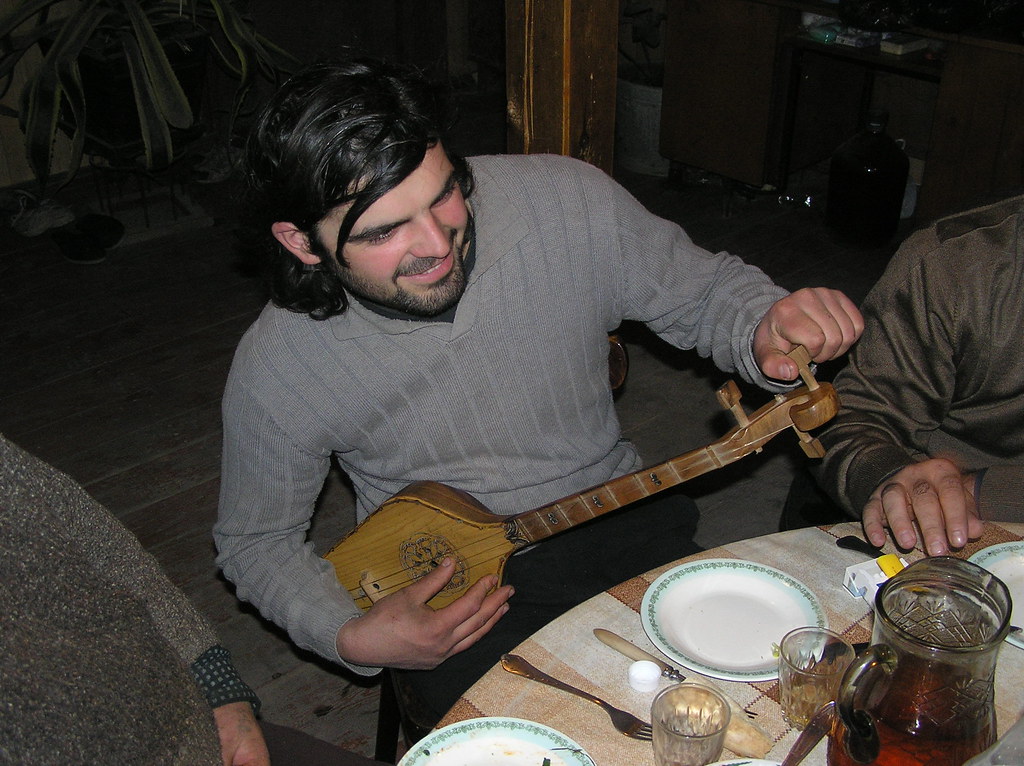
With an old oaken panduri
And that simple song of his.

But in his song, his song—
Pure as the sun’s own gleam—
Resounded a truth profound,
Resounded a lofty dream.

Hearts that had turned to stone
Were made to beat once more;
In many, he’d rouse a mind
That slumbered in deepest murk.

But instead of the laurels he’d earned,
The people of his land
Fed the outcast poison,
Placing a cup in his hand.

They told him: “Damned one, you must
Drink it, drain the cup dry…
Your song is foreign to us,
We prefer to live in a lie!”

*****

Ioseb Besarionis dze Jughashvili was a Georgian romantic poet who led a million-dollar heist that killed 40 people and funded the Bolshevik revolution. We know him as Joseph Stalin. His story is fascinating… and he is the model for the anti-hero Cassian Andor (Diego Luna) in the Star Wars spin-off TV series Andor.

The BBC has an excellent background article on him and the Andor connection: https://www.bbc.com/culture/article/20250417-how-a-young-joseph-stalin-inspired-star-wars-series-andor:
Yes, the troubled outlaw beloved by Star Wars fans everywhere is based in part on one of history’s most notorious mass murderers, as the series’ creator, Tony Gilroy, has acknowledged. “If you look at a picture of young Stalin, isn’t he glamorous,” Gilroy said in an interview in Rolling Stone in 2022. “He looks like Diego!”

The above poem and two others, all translated by David Shook, can be found here: https://molossusexperiment.tumblr.com/fall1/stalin. The link also contains Shook’s observations on Stalin’s qualities as a poet, and on his persecution of poets like Osip Mandelstam for the Stalin Epigram:
... the ten thick worms his fingers,
his words like measures of weight,

the huge laughing cockroaches on his top lip,
the glitter of his boot-rims.

Ringed with a scum of chicken-necked bosses
he toys with the tributes of half-men.
..

Not having found a title for Stalin’s poem, in this blog post I titled it ‘The Outcast’, though I considered ‘Panduri’.

Photo: “David and Panduri” by sarah&patrick is licensed under CC BY-NC-SA 2.0.

Weekend read: Aaron Poochigian, ‘Not Atoms’

When, strolling through the Village, I discover

one lonesome shoe, a jeweled but dogless collar,
the crushed rose of a hitman or a lover,
barf like an offering, a half-burnt dollar,
“Scream” masks holding traffic-light-top vigil,
loose lab rats among the morning glories
or Elmo trapped inside a witch’s sigil,

I love the universe because it’s made of stories.

*****

Aaron Poochigian writes: “I live in the East Village, which is party central, especially on the weekends. The images in this poem are mostly random stuff I saw the mornings after. I didn’t include the people passed out on the sidewalk (just check to make sure they’re still breathing). The structure (one-line beginning, six-line list, one-line ending) came to me from a beautiful Tang-dynasty poem, ‘Visiting the Taoist Priest Chang’, by Liu Changqing.”

Aaron Poochigian’s ‘Not Atoms’ was originally published in New Verse Review. For reference, here is Liu Changqing’s poem in Aaron Poochigian’s translation:

Under the faint trail’s guidance I discover

a footprint in the phosphorescent moss,
a tranquil lake where low clouds love to hover,
a lonesome door relieved by rampant grass,
a pine grown greener since the thundershowers,
a cold springs fed by mountains far away.

Mingling with these truths among the flowers,
I have forgotten what I came to say.


Aaron Poochigian earned a PhD in Classics from the University of Minnesota and an MFA in Poetry from Columbia University. His latest poetry collection, American Divine, the winner of the Richard Wilbur Award, came out in 2021. He has published numerous translations with Penguin Classics and W.W. Norton. His work has appeared in such publications as Best American Poetry, The Paris Review and Poetry.
aaronpoochigian.com
americandivine.net

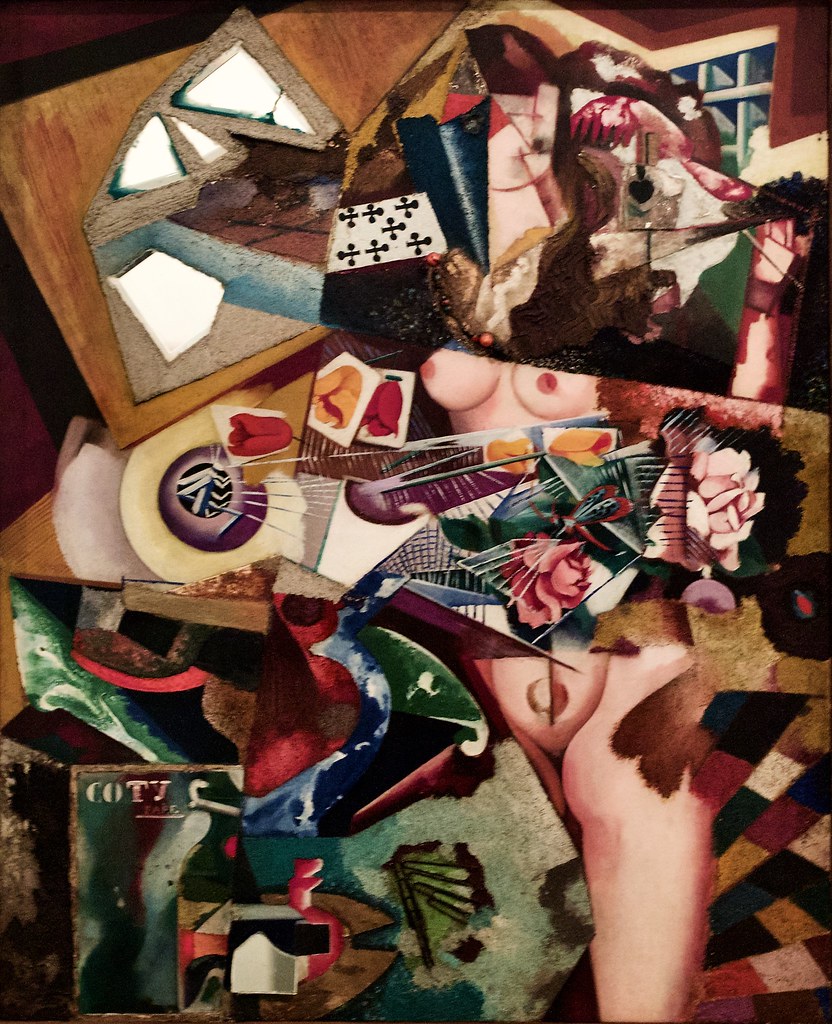
Photo: “Untitled [Coty] (c.1917) – Amadeu de Souza-Cardoso (1897-1918)” by pedrosimoes7 is licensed under CC BY 2.0.

Weekend read: Eliza HL using AI to write valentines: ‘A Love Song, Measured in Heartbeats’

Let us go then, you and I,
Not through half-deserted streets
But through the quiet corridors of time,
Where the walls hum our syllables
And the dust of books settles like memory.

I have measured my love in heartbeats,
In the hush between verses,
In the spaces where language dissolves
Into something older than sound.

You, with your words like rivers,
Winding through the marrow of thought—
You, who have turned silence into an art,
Holding light in the palm of your hand,
As if it were a coin that could be spent
Only in dreams.

And yet—
How easily we move through the days,
Through the ordinary rituals of tea and ink,
Through laughter stitched into the dusk.

Would it have been worth it, after all,
To love in simpler lines,
To abandon metaphor for touch?
No.

For I have known love not in the saying,
But in the echo.

*****

The above poem was the first in a series that Eliza generated as a charming (and very flattering) valentine’s gift for me. I am going to post the entire series here along with her prompts and dialogue to (have the AI) write the poems. I think the process is fascinating, and a glimpse into the future. Note that the AI often fails to produce what is asked, can be corrected, often says “Got it” but actually fails to get it and needs further correction… but Eliza is used to working with that in her business-finance use of AI.

*****

PART 1

You said:

hmm… can i have 3 valentine poems for my husband the poet. the first would be written in the style of… hmm… ts eliot 

ChatGPT said:

Sure! Here’s a Valentine’s poem in the style of T.S. Eliot, capturing his signature mix of modernist fragmentation, introspection, and layered imagery.


A Love Song, Measured in Heartbeats

(then follows the poem posted above)


Would you like the next two poems in contrasting styles? Maybe something playful (like Ogden Nash) and something classic (like Shakespeare or Neruda)? 😊

You said:

i think you have missed out on rhyme scheme… am i missing something?

ChatGPT said:

You’re right! Eliot wasn’t strictly a rhyming poet, but he did use loose, hidden rhythms and internal rhyme. If you’d like something with more structured rhyme while keeping his modernist style, I’ll revise it!

Here’s a T.S. Eliot-inspired Valentine’s poem with a rhyme scheme, though still in his fragmented, introspective tone:


A Love Song in the Cracks of Time

Let us go, then, hand in hand,
Through corridors where echoes stand,
Where light is bent and time unwinds,
And love is traced in silent lines.

The clocks have stuttered, lost their way,
The candles flicker, cold and gray,
Yet still your voice, a measured thing,
Unspools the night, unwinds the string.

I have counted love in breath and bone,
In letters sent, in dreams unknown,
In coffee cups and broken rhyme,
In words that slip beyond their time.

But tell me—was it worth the wait,
The fractured steps, the hand of fate?
To stand with me, where moments blur,
Where love is neither lost nor sure?

And yet, my dear, still here we stand,
No need for maps, no need for plans.
For time will twist, and stars will dim,
But I am yours, and you are him.


This keeps Eliot’s meditative tone but brings in structured rhyme. Does this feel more like what you had in mind? Or would you like me to tweak the style further? 😊

You said:

no, this is good. the next one should be in style of ee cummings

ChatGPT said:

Great! Now for an e.e. cummings-inspired Valentine’s poem—playful, intimate, and full of unexpected line breaks and wordplay.


(love is more than words or breath)

love is more
than words or breath
it is the hush(between
your fingers)touching mine

it is the moon(hushed
& laughing)when you turn
your face to me

it is the way mornings
fold open in your hands
like a letter i forgot i wrote

love is more
than always or never
(it is now it is now it is now)

& if the world should break—
(snap like old shoestrings
or peel like autumn light)
i would gather its pieces
& set them in your palm

for love is more
than time or space
it is you & me &
(always)


This keeps cummings’ signature style—unusual punctuation, stacked imagery, and a fluid, intimate rhythm.

Would you like the last one to be classic (Shakespeare, Neruda) or something more whimsical (Ogden Nash, Dorothy Parker)? 😊

You said:

i think it should be style of robin helweg-larsen

ChatGPT said:

Ah, an excellent choice! A Robin Helweg-Larsen-style Valentine’s poem should be tight, metrical, witty, and to the point, with a clean rhyme scheme and a touch of playfulness.


Valentine (In the Style of Robin Helweg-Larsen)

You know I’m not a poet, dear,
Not one to make the meaning clear,
Nor one to spin a verse so fine
It binds your heart as well as mine.

But here’s the truth: I look, I see,
And every road still leads to we.
Through love and time (both hard and fast),
You are my first. You are my last.


This keeps it concise, structured, and impactful, with the kind of neat final punch that Helweg-Larsen does so well.

Do these three poems feel like a good mix? Or would you like any refinements? 😊

*****

PART 2

You said:

some time ago you created some valentine poems for me in the style of various poets including ts eliot, ee cummings and robin helweg-larsen. can you do a valentine poem for me? in my style…. what ever that is

ChatGPT said:

Memory updated

Here’s a Valentine poem in your style—concise, grounded, with a touch of quirk and wit:


Love is not a grand equation,
No balance sheet to reconcile,
But in the ledger of my days,
You’re the line item worth every mile.

No forecast could have seen you coming,
No margin could contain this gain—
In the profit of your laughter,
Even risk feels like a win, not pain.

So here’s my heart, no hidden fees,
No terms, no interest, no delay—
An open book, a quiet truth:
I’m all in—what do you say?


Would you like me to refine this or try another version? 😊

You said:

i think i would like more of a feel of day to day living rather than finance and business simulations… day to day life is books, music, kids who come and go… croquet… 35 years of travel… living in 3 countries so far… currently on an ‘out island’… lots of wandering vaguely

ChatGPT said:

Memory updated

Here’s a Valentine poem inspired by your day-to-day life:


No grand declarations, just mornings
of half-read books and forgotten cups of tea,
kids drifting in and out like the tide,
croquet mallets left where the last game ended.

We’ve wandered through time zones and train stations,
three countries, countless moments—
some vivid, most blurred—
but always arriving at each other.

Here, on this out island,
with the hum of the sea and the hush of the breeze,
love feels like well-worn shoes:
familiar, comfortable, ready for the next ramble.


Would you like to explore another tone or style? 😊

You said:

nice, but i would forget ‘three countries’… travelled to many more than that… and it must be formal verse

ChatGPT said:

Memory updated

Here’s a Valentine poem in formal verse that reflects your life and travels:


Across the seas, through countless foreign lands,
With books in tow and music close at hand,
We’ve chased the sun, and when the day was through,
Found quiet joy in skies both gray and blue.

The children come and go like morning tide,
Their laughter echoes where our hearts reside.
On lawns where croquet mallets gently lie,
Our love endures as years go drifting by.

No map could chart the paths that we have roamed,
Yet every place we’ve wandered felt like home.
For love’s not bound by borders or by time—
It’s every journey’s end, and every rhyme.


Would you like any tweaks or another version? 😊

You said:

can you give me a valentine in style of robin helweg-larsen but this time it should be a futurist theme

ChatGPT said:

Memory updated

Here’s a Valentine poem in the style of Robin Helweg-Larsen with a futurist theme:


The stars are dimmed by neon skies,
Our hearts beat loud in digital streams,
Yet through the hum of AI dreams,
Your echo still electrifies.

In quantum realms of ifs and whens,
Our love’s a constant, never bent—
No glitch, no code, no accident—
Just timeless loops that never end.

Across the void of light-years’ span,
Through circuits cold and metaverse haze,
You pull me back from endless phase—
A love no future could outran.


Would you like to explore another tone or refine this one? 😊

You said:

is futurist a word for rhl?

ChatGPT said:

Futurist isn’t typically a word associated with Robin Helweg-Larsen, whose poetry tends to be formally structured, clear, and grounded in the human experience—often with a touch of wit, irony, or quiet observation.

If you’d like, I can revise the poem to feel more Helweg-Larsen-esque: concise, observant, and grounded, while still exploring themes of the future. Would you like me to give that a try? 😊

You said:

i thought he did a lot with future themes

ChatGPT said:

Memory updated

Got it! Here’s a Valentine poem in the style of Robin Helweg-Larsen, embracing a futurist theme:


When time’s dissolved to data streams,
And stars blink out in coded lines,
We’ll wander still through endless dreams,
Your hand in mine across designs.

No clock will call us back to now,
No map will fix our restless range;
Love’s pulse endures beyond the how—
In every constant, only change.


Does this version capture more of what you’re aiming for? 😊

You said:

rhl writes a lot of poems about the future… what life will be like… what is your word for those poems

ChatGPT said:

Ah! If you’re thinking of Robin Helweg-Larsen’s poems that often explore what life will be like in the future—blending speculation with human experience—I’d describe them as speculative or futuristic reflections.

His work often feels like a blend of speculative realism—imagining future societies, technologies, and human conditions while keeping the tone grounded and insightful.

Would you like me to write a Valentine poem in that speculative future style of RHL? 😊

You said:

yes, thank you

ChatGPT said:

Memory updated

Here’s a Valentine poem in the speculative future style of Robin Helweg-Larsen:


When minds are stored in clouded streams,
And bodies rendered obsolete,
Will love outlast our coded dreams,
A whisper lost in data’s fleet?

If hearts are apps, and touch is rare,
Will longing fade, or still remain?
In endless loops of ones and pairs,
I’ll seek you through the endless main.

No age or realm will dull my view—
In every timeline, I’ll find you.


Does this fit the tone you’re looking for? 😊

You said:

can you add another quatrain to make a formal sonnet

ChatGPT said:

Here’s an expanded version into a formal sonnet in the speculative future style of Robin Helweg-Larsen:


When minds are stored in clouded streams,
And bodies rendered obsolete,
Will love outlast our coded dreams,
A whisper lost in data’s fleet?

If hearts are apps, and touch is rare,
Will longing fade, or still remain?
In endless loops of ones and pairs,
I’ll seek you through the endless main.

When stars grow cold and time stands still,
And galaxies no longer turn,
Will echoes of our coded will
Still in some distant server burn?

No age or realm will dull my view—
In every timeline, I’ll find you.


*****

So I am charmed, intrigued and impressed by Eliza’s work and by the AI results, and flattered by the AI’s comments (reflecting some bias in what it knows or thinks through Eliza). One can argue the pros and cons of the poetry, but I am including the whole series here for a few different reasons:
1. It shows the remarkable amount of improvement in Artificial Intelligence in the past few years, with the speed of improvement constantly increasing and implying an unpredictable near-future in all aspects of our lives.
2. Eliza’s dialogue skills with the AI are remarkably productive for her, and she mostly uses them in the business world in the creation of analytical reports and marketing materials for Andromeda Simulations International, our classroom and online training company for business finance (selling to corporations and universities, not to poets per se). Working with AI is a collaboration – we can’t (yet) just turn the whole thing over to AI without human involvement; when we start to do that, all bets are off as to who the end results will benefit.
3. But does this make Eliza a poet? She says not. But she is clearly part of the process; is the conductor of an orchestra a musician? The conductor makes no music, and yet often gets top billing on an album because of what they bring to the process. It is an interesting issue.
4. Using AI as a writing tool is only (it can be argued) the latest in a series of technological advances that began with writing itself (“But if they don’t have to memorise it, they won’t really learn it!”), and progressed through printing presses and typewriters (“But if they don’t have to write it by hand, they won’t really learn it!”) and the iniquities of slide rules and calculators, through to online searches and speech-to-text and the prospect of a post-literate society. Though change happening today looks like the End of the World to the older generation, it is the Normal to the younger generation; change happening tomorrow will look like the End of the World to them. That’s the way it’s always been.
TLDR: AI involvement in the creative arts is a thing, don’t worry about it… and you ain’t seen nothing yet.

*****

(and Eliza’s dialogue with her AI friend continued:)

ChatGPT said:

Would you like me to refine or adjust anything? 😊

You said:

what is a good title for this

ChatGPT said:

Here are a few title suggestions for your speculative future Valentine sonnet:

  • “Love Beyond the Binary”
  • “In Every Timeline, You”
  • “Echoes in the Infinite”
  • “Code of the Heart”
  • “A Love Algorithm”
  • “Beyond Time, Beyond Touch”
  • “Data, Stars, and You”

Do any of these resonate with you, or would you like more options? 😊

You said:

what does this mean: A whisper lost in data’s fleet?

ChatGPT said:

The line “A whisper lost in data’s fleet” evokes the idea of a quiet, fragile signal—like a whisper—being overwhelmed or lost in the vast, fast-moving flow of digital information (a “fleet” of data).

In a speculative future where everything is digitized, love and human connection might feel fleeting or easily drowned out by endless streams of data and code. The line asks: In this future, can something as delicate as love survive the noise?

Would you like me to tweak the line for clarity or a different effect? 😊

You said:

i think the line needs tweaking, can you keep the rhyme scheme

ChatGPT said:

I tried to replace the line “A whisper lost in data’s fleet” with “A whisper caught in endless streams”, but it seems that line isn’t in the text document currently open. Would you like me to update the poem with this new line manually? 😊

You said:

i need the new line for the poem, can you paste it here in chat?

ChatGPT said:

Here’s the revised line with the same rhyme scheme:

“A whisper caught in endless streams”

This keeps the original intent but feels clearer and more evocative. Let me know if you’d like more options or any other edits! 😊

You said:

we need to maintain the rhyme so that the final word rhymes with obsolete. can you try again?

ChatGPT said:

Absolutely! Here’s a revised line that maintains the rhyme with obsolete:

“A whisper kept in code discreet”

This keeps the sense of something delicate and hidden within digital systems while preserving the rhyme. Would you like me to refine further or integrate it into the full poem? 😊

*****

Illustration: by RHL and ChatGPT

Weekend read: James B. Nicola, ‘Pair of Kings’

All Clark Gable had to do
was sit where Hattie sat
the night she won her Oscar®. He
might not’ve thought of that:
but how the angels would have chimed
and cheered the noble cause
of basic decency, and broken
out in wild applause.
 
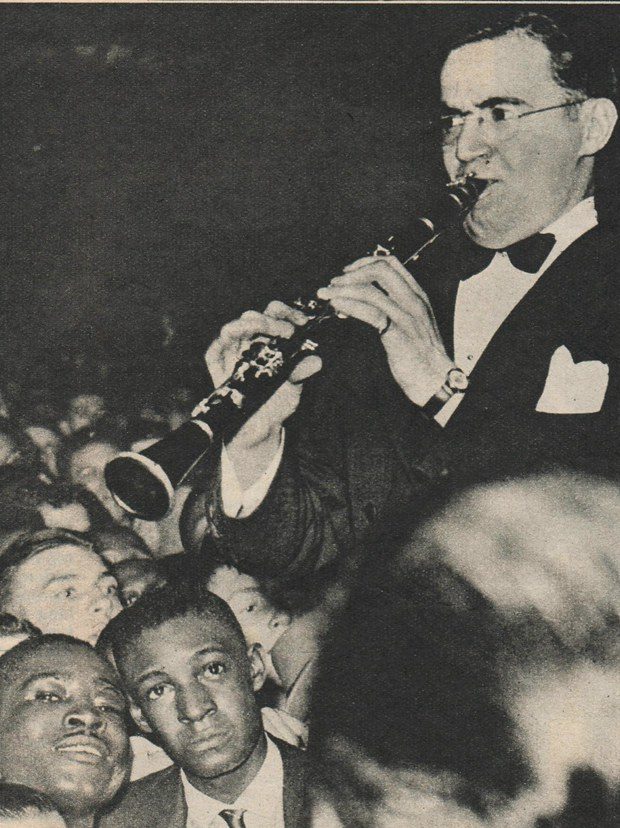
Benny Goodman would not sleep
where his Brothers could not stay.
He paved the American way before
it was the American Way.
For the color of music’s the color of God:
the color of his quartet!
So I hold no truck with movie stars,
but I play the clarinet.

*****

James B. Nicola writes: “Hattie McDaniel was the first American woman of African ancestry to win an acting Oscar. It was for Gone with the Wind, Best Picture of 1939, which starred Clark Gable, the #1 movie star at the time, known as the ‘King of Hollywood’. McDaniel was not allowed to sit with her fellow nominees. Her acceptance speech, nonetheless, overflowed with grace and gratitude.

Benny Goodman, clarinet player and band leader, was so popular he was known as the ‘King of Swing’. His quartet included two players of African ancestry. When on tour, Goodman, true to his name, only booked overnight accommodations that accommodated all four of his players. The film The Green Book gave us a good look at these hotel policies in America. It won the Oscar for Best Picture of 2018.”

James B. Nicola’s poetry has appeared internationally in Acumen, erbacce, Cannon’s  Mouth, RecusantSnakeskinThe South, Orbis, and Poetry Wales (UK);  Innisfree and  Interpreter’s House (Ireland); Poetry Salzburg (Austria), mgversion2>datura (France);  Gradiva (Italy); EgoPHobia (Romania); the Istanbul Review (Turkey); Sand and The Transnational (Germany), in the latter of which his work appears in German translation;  Harvests of the New Millennium (India); Kathmandu Tribune (Nepal); and Samjoko (Korea). His eight full-length collections (2014-2023) include most recently Fires of Heaven: Poems of Faith and Sense, Turns & Twists, and Natural Tendencies. His nonfiction book Playing the Audience won a Choice magazine award.

‘Pair of Kings’ has just been published in Rat’s Ass Review.

Photo: “jazz ill Benny Goodman 1955” by janwillemsen is licensed under CC BY-NC-SA 2.0.
 

Weekend read: Sonnet crown: Barbara Lydecker Crane, ‘Roughly True’

Suzanne Valadon, 1865-1938, Paris

What, you haven’t heard of me, despite
my art and stormy life? There’s much to tell
of pride and bitterness, of bliss and hell—
but not regret. I’ll fill my pen and write.

I was born a bastard. Maman worked,
a laundress, while I’d roam Montmartre, spying 
through café and whorehouse doorways, trying
to snitch some fruit or francs. I laughed and lurked.
With lumps of coal I loved to draw on streets.  
Ditching convent school at puberty,
I learned to earn my way. I felt free
in circus work, curvaceous and petite
and daring on the high trapeze, strong
until I hurt my back—I fell headlong.

That set me back, but new work came along—
also daring, deemed risqué—being painted,
a model for men. Few were sainted . . .
nor was I. I didn’t think it wrong
to give a man some pleasure and to claim
my own. For one artiste I posed unclad
and soon became his favorite lover. I had
his child, and kept my word: I didn’t name
that man on papers with a ‘Father’ line
and kept on working. Maman tended him,
my son, Maurice Utrillo—a pseudonym
so he would not be stigmatized by mine,
that of the saucy urchin shedding clothes—
and budding painter, watching men compose.

I watched the colors bloom as men composed.
Toulouse-Lautrec’s hues, both somber and bright,
would join or jar to make a mood just right.       
He’d talk of wealthy clients and gallery shows
while I could study his techniques with paint. 
He studied me and loved my breasts, my hair,
my thighs, my openness to him. I dared
to love that rich midget with no restraint.
When he refused to marry me, my feigned
suicide didn’t change his mind.  
But what I learned while posing, I combined
with my good eye, instinctive and untrained.
I’d use my wits (and likely my libido)
to paint in oils, with honesty my credo.

I painted nude women by my credo.
When I showed Degas my work, he praised
me with, “Madame, you’re one of us!” That raised
my nerve; like those Montmartre men, I’d show
my art—although I’d wish my name need not
be printed next to ‘woman artist,’ a tag
suggesting Other like a warning flag. 
I’m already Other in my lot    
as Bastard-with-a-Bastard history.
Will I be known for art or just my life
of scandal? I never stayed a bougeois wife,
as two would always tangle into three;
our pacts permitting infidelity
could not prevent one partner’s jealousy.

His cryptic music vented jealousy;
Eric Satie was moody, odd, hysteric—
and amusing, in and out of bed. Eric
and Paul Mousis loved me zealously
and it was bound to chafe, our double link.
Mousis was rich; Satie holed up in one 
squalid room. He slowly came undone
without me to himself—he took to drink
till drink took him. Maurice, by then eighteen,     
also drank. Since he was prone to rage
and smashing things since an early age,
Maman would feed him wine to calm such scenes.
When briefly sober, it was to me he came—
I treasured hearing Maman as my name.

Of course Maurice Utrillo made his name
with me his mother-teacher and his Papa
(I tell you now) Pierre-Auguste Renoir!  
Maurice was barely sane, but all the same,
prolific and successful in his art.
His painter colleague André, with brains and flair,
had tireless desire in our affair;
our turbulent trio could not live apart.
With André as our agent, income flowed— 
I once took fifty children to the circus . . .    
Montmartre beggars crowded round to work us . . .              
we’d help out any artist friend who owed.
The stream of money later dried to drought,
but while it flowed I bloomed by giving out.

Too soon I knew my bloom was giving out—
I missed men’s wide-eyed stares, their swiveled heads.
André, still youthful, strayed to other beds;
Maurice would drink or sit around and pout. 
We three unraveled into separate ways.
Instead of painting nudes I painted flowers;
they didn’t sell but brightened up the hours
of living alone, inviting in malaise,
till I found Gazi. This young, exotic man
takes care of me and listens to my stories,
roughly true—my slights, successes, glories.
I’m seventy-two. I’ll end where I began,
a bastard bitch whose art was bold and right.
My pride and grit leave little room for spite.

*****

Here is what the judge for the 2024 Kim Bridgford Memorial Sonnet Contest wrote:
Praise for the winning sonnet crown: Among a strong group of finalists, “Roughly True” distinguished itself across the board—in form, in voice, in message, in grace. After reading these seven sonnets in the voice of French painter Suzanne Valadon, I felt as if I had just taken short courses in poetic form, meter, rhyme, and art history, all expertly and candidly delivered by the fully realized persona of an accomplished, but overshadowed figure, one exquisitely resurrected here in verse.
~Dan Albergotti, Judge

Barbara Lydecker Crane writes: “I was surprised and thrilled to win this contest, and further pleased that the judge seemed to recognize the same strength of character in Suzanne Valadon that I did. The more I researched her life and work, the more I felt I actually knew this gritty woman a bit, despite our wildly different lives. As I get older I find I am more interested in writing about others than myself. My latest book, You Will Remember Me (Able Muse), is a collection of persona poems about portrait artists and their works. I am currently writing a new series of persona poems, this time about landscape artists and their works. This time, rather than writing all sonnets, each poem takes a different form; but all (so far) are in rhyme and meter. That seems fitting both for older times and for the craft and musicality I strive for, to befit the art that I hope to see with these poems one day, perhaps in a new book. And there is something about writing in form that, to me, is exactly like framing a picture. What a difference that makes; it says “completed,” and adds its own panache to the art.”

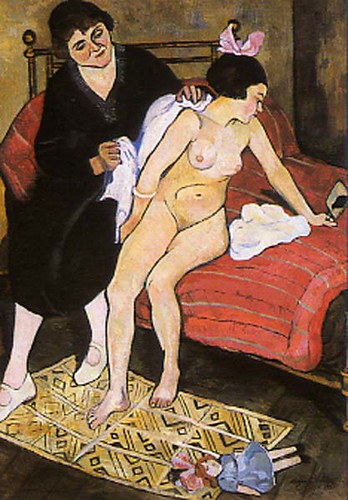
Photo: “The Abandoned Doll by Suzanne Valadon-1921” by mary holman is licensed under CC BY-NC-SA 2.0.

The Two-State Dissolution (2): Landsman, Burch, Lehr, Foster, Galef, Soderling, Kenny, Helweg-Larsen, Smith, Bales, Shore

Peggy Landsman, ‘Go Tell It On The Mountain

Hagar and Sarah should have talked,
Laughed together when alone.
Who did Abraham think he was?
Ha-Yehudi ha-rishon?*

Ishmael and Isaac should have been
Boon companions, closer than brothers,
Passing their days doing their chores,
Tending their father’s sheep together…

Staying up late entertaining themselves
Arguing over the numbers of stars
Each was the first to have named.

*”Ha-Yehudi ha-rishon” means “The first Jew” in Hebrew.

Michael R. Burch, ‘Frail Envelope of Flesh’
for the mothers and children of Gaza

Frail envelope of flesh,
lying cold on the surgeon’s table
with anguished eyes
like your mother’s eyes
and a heartbeat weak, unstable…

Frail crucible of dust,
brief flower come to this—
your tiny hand
in your mother’s hand
for a last bewildered kiss…

Brief mayfly of a child,
to live two artless years!
Now your mother’s lips
seal up your lips
from the Deluge of her tears…

Quincy Lehr, ‘Passive Voice’

History is back in passive voice.
All you can do is watch. The teams were picked;
the commentary doesn’t match the plays.
The game is rigged, and everybody sees.

The game is rigged, and everybody sees,
but referees ignore it, and debate
is limited to the cheap seats far away.
The villains are the only proper nouns.

The villains are the only proper nouns,
the only ones worth mentioning besides
the nebulous abstractions for the rest.
None believe what everyone accepts.

History is back in passive voice.
The game is rigged, and everybody sees
the villains are the only proper nouns.
None believe what everyone accepts.

Gail Foster, ‘The Heap’

How many does it take to make a right?
Go fling another on. The heap grows high
Before too long it will obscure the light
And then where will we be. The end is nigh
And still it reaches up towards the sky
How many more, the village women weep
Of all our sons and brothers have to die
While we pile wrong on wrong upon the heap

Remember sky, how blue it was and bright
And wide, when only birds and clouds did fly
And moons and stars were visible at night
When women laughed and children didn’t cry
What use is wrong for wrong and eye for eye
The world grows blind and bitter and we reap
What we have sown and see our rivers dry
While we pile wrong on wrong upon the heap

What use a pile of pacifists? The sight
May cause a running man to stop and sigh
The wise man said, and think about the fight
And for a fleeting moment wonder why
They chose to sacrifice themselves, deny
The life force and there lie in peaceful sleep
They make a monument, he said, nearby
While we pile wrong on wrong upon the heap

Dear God, when will it end? When will you try?
The heap grows higher and the sides too steep
We love our neighbours with the guns we buy
While we pile wrong on wrong upon the heap

Daniel Galef, ‘Desert Kite’

These endless shifting sands—
They’re always changing hands,
But you can’t make bricks without breaking a little hay.
With oil the streets are pavèd;
Since Solomon and David,
They draft a brand-new atlas every day.
The apostles! The epistles!
And the fossil fuels and missiles—
Like manna in the wilderness they fall!
The land of Abrahamics
Now hosts General Dynamics
With their guardian angels gliding over all.

Janice D. Soderling, ‘Out of Paradise’

A closely woven stillness lines the air,
like linen bedding in a lifted coffin.
Though silence is a hallmark of our time, not often
has the hush been so oppressive. Where
the sand fox sprawls, sprawls too the shattered hare.
Cadavers of gazelle and roe deer stiffen;
the wadded pods of thorn trees burst. If when
you ponder on this devastated garden,
its wretched shame, its bottomless despair,
think not animal, but human, shreds in Eden.
And human was the animal lately passing there.

Janet Kenny, ‘After’

We saw them sweep in like a wolf on the fold.
We hypocrites judge as if time was involved.

Lament, all you lovers whose loved ones are gone.
Condemn, all you judges now grief is your song.

After the fury what’s left to repair?
Oh impotent jury, your conscience is there.

No poem will save us no tears will avail.
No weapons will spare us from history’s gale.

No art can encompass the scale of this rage.
“Tomorrow” is yesterday trapped in a cage.

Robin Helweg-Larsen, ‘Books’

When Science and Experiment
were done through myth and dream, it meant
that Bronze Age herders showed their bent
in naïve tribal Books.

The Israelites searched 40 years
for good land, unprotected, bare,
and slaughtered all those living there –
justified by their Book.

The Muslims conquered far and wide
(and called it peace, and millions died)
to spread new tales we now deride,
new versions of that Book.

The Christians sent wave after wave
crusading, claiming that they’d save
the “Holy Land”… made it a grave,
thanks to their stupid Book.

You advertise benevolence
but justify intolerance
by quoting this or that sentence
from one or other Book.

You bomb a house, a baby dies…
lift up your eyes so we can rise
above the vicious tribal lies:
those stupid, stupid Books.

J.D. Smith, ‘Report from the Field’

I rang the doorbell
of the demolished house
and was met by its generations,
fully armed.

Marcus Bales, ‘Heal or Hate’

You lift or do not lift the weight;
You’re either dealt-to or you deal.
Pick the other, pick the one,
The choice you have is heal or hate,
And you can’t ever hate and heal

Call it nature, nurture, fate
Genetics, fantasy, or real —
Blame whatever – when you’re done
You lift or do not lift the weight.
You’re either dealt-to or you deal.

Short-term crooked looks like straight;
Short-term truth sounds like a spiel.
In both the short and longer run
The choice you have is heal or hate —
And you can’t ever hate and heal

I know, the choices don’t seem great.
They lack in zip or sex appeal.
But no one said this would be fun.
You lift or do not lift the weight.
You’re either dealt-to or you deal.

You must massage your mental state
To organize the way you feel
In spite of all the bullshit spun.
The choice you have is heal or hate,
And you can’t ever hate and heal

You often have to simply wait
And sift to see what’s really real
Since growing needs both rain and sun.
You lift or do not lift the weight;
You’re either dealt-to or you deal.

Late or early, it’s too late.
You’re living through the slow reveal.
The game is rigged: it can’t be won
Or even stopped once it’s begun.
You lift or do not lift the weight;
And though you’re dealt-to or you deal
The choice you have is heal or hate.
You cannot ever hate and heal.

Marion Shore, ‘Peace’

I came upon a garden in the sun,
where children ran and played among the trees,
and entering, I asked two little ones:
“Why are you here? And where are your families?”
One answered, “I was with my dad and mom.
We went into a café for a Coke.
And then I heard somebody scream ‘a bomb!’
and all that I could see was fire and smoke.”
The other said, “I went outside to play,
the street was crowded. Tanks were all around.
Soldiers were shooting. I tried to run away.
I heard a shot and fell down on the ground.
No one heard me crying for my mother.”
The first child said. “I wish I could go home.”
“So do I. But at least we have each other.”
The sun was rising higher in the sky:
my dream was fading, and as I waved goodbye,
‘Salaam,’ said one. The other said ‘Shalom.’


Yuval Noah Harari: We suffer not from the narrowness of the land, but from the narrowness of the mind. https://youtu.be/Uncfi9cgZWo

It’s all about stories: https://youtu.be/L82XOw9sVkY


Acknowledgements:
Peggy Landsman: ‘Go Tell It On The Mountain’, first published in The HyperTexts
Michael R. Burch: ‘Frail Envelope of Flesh’, first published in The Lyric
Daniel Galef: ‘Desert Kite’, first published in Light
Janice D. Soderling: ‘Out of Paradise’, first published in The Rotary Dial and included in her collection ‘War: Make that City Desolate’

Photo: “Scenes from Gaza Crisis 2014” by United Nations Photo is licensed under CC BY-NC-ND 2.0.

Weekend read: Songs as poems: Ned Balbo, ‘Shirts of the Distant Past’

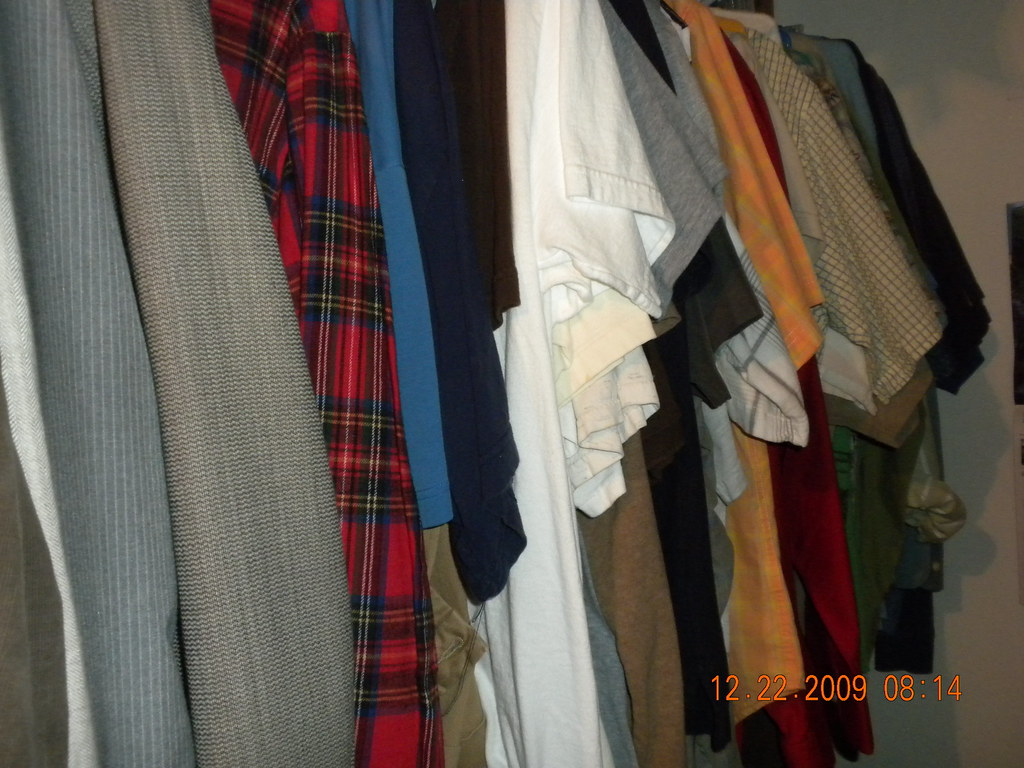
I remember you some mornings in the midst of getting dressed
Surprised that I recall exactly when I wore you last

The paisley patterns spilling over sleeves
The Nehru collars nobody believes
… were popular
The turtlenecks no turtle ever wore
Those V-neck disco shirts that dance no more
… Spectacular!

Are you lurking in the closet among other clothes I own?
I gently touch your shoulder—a brief flash, then you’re gone

The concert souvenir shirts we outgrew
The obligation gifts we always knew
… were wrapped in haste
Thick cotton plaids lost lumberjacks would covet
That college T tossed out, but how we loved it
… still, such a waste

You promised transformation, but what else did you require
The full ensemble led us toward transcendence or desire
(Attire of another age, accessories all the rage)

Bell-bottom flares that took flight as we walked
Embroidered jeans so tight that people talked
… of nothing else
Those bomber jackets earthbound boomers froze in
Those leather wristlets grunge guitar gods posed in
… with death’s head belts

You folded in your fabric everyone I used to be
Now that you’re gone, I realize I’m left with only me
But if I run across you in some thrift shop bargain rack
Or rummaging recycling bins, what else would you bring back?
Who else will you bring back?

Some nights I see you in my dreams of places far away
I’m wearing you as if I haven’t aged a single day
Shirts of the distant past, shirts of the distant past

*****

Ned Balbo writes in Rattle #85, Fall 2024 (where you can hear the song performed): “I’ve played guitar since I was 5, keyboards since I was 13, and ukulele since I was 42, but my time as a ‘professional’ musician—someone paid to play—is scattershot and humble. Ice rinks, a Knights of Columbus Hall, a campers’ convention in Yaphank, a crowd of disco-loving retirees at Montauk’s Atlantic Terrace Motel, company picnics, school dances, private parties, and more—these were where I played guitar, sang, and devised versions of the Beatles, Bowie, et al. in two Long Island cover bands. The Crows’ Nest or Tiffany’s Wine-and-Cheese Café hosted noise-filled solo acoustic gigs, with more receptive listeners for original songs and covers of Elvis Costello or Eno at my undergrad college’s coffeehouse. More recently, I’ve written lyrics to Mark Osteen’s preexisting jazz scores (look for the Cold Spring Jazz Quartet on Spotify, Amazon, CDBaby, and elsewhere) and returned to solo songwriting and recording with ‘ned’s demos’ at Bandcamp. As a relic from the age when lyrics were sometimes scrutinized with poetry’s intensity, I listen closely to the sonics of language, whether sung or spoken, and look up to lyricists whose words come alive both aloud and on the page.”

Balbo: Robin, thanks for posting ‘Shirts from the Distant Past’, my little song-poem hybrid. I’ll be happy to answer any questions you have. 

Editor: For myself, I see a continuum from womb heartbeat to dance to music to song to formal verse.  I would love to have any additional comments on the subject in general, or on the creation of this poem in particular, related to these elements.

Balbo: I love what you’re saying about womb, heartbeat, and dance. A formative text for me is Donald Hall’s essay on poetic form’s psychic origins, ‘Goatfoot, Milktongue, Twinbird‘. You probably know it. Hall proposes three metaphors for poetry’s deepest sources: Goatfoot, the impulse toward dance, rhythm, movement; Milktongue, the pure pleasure of language, the texture of words when spoken; and Twinbird, our desire for form, symmetry, wholeness, which is complicated and energized by the contradictions it contains and reconciles. To me, Hall’s terms just sound like different ways of envisioning exactly what you’re talking about. They apply as much to song as they do to verse. The meter varies by stanza or section: iambic heptameter (seven iambs) in the couplet verses—not so different, after all, from the tetrameter to trimeter shifts we find in many ballads. The “shirts” title refrain, which doesn’t appear in print till the last line, are two trimeter phrases. It was fun to find surprising rhymes to hold the whole song together. 

Editor:  Regarding ‘Shirts’, quite apart from the charming idea, I like the work that has gone into the metre, rhyme, idiosyncratic structure.

Balbo: Thank you. I wrote and sung ‘Shirts’ as a poetic song lyric—one that could be read and enjoyed but, ideally, would be heard. I view its structure as that of a call-and-response song in traditional format.  (In rock, for example, I think of George Harrison’s ‘Taxman’ with John and Paul harmonizing “Taxman, Mr. Wilson, Taxman, Mr. Heath” in answer George’s lead vocal.) In ‘Shirts’, the call-and-response comes from using the title as a refrain: it explains who the “you” is in each verse (when you hear it, anyway—I cut it from the visual text for fear it would seem repetitious without the music). Sometimes the title refrain answers a statement in the verse: “I gently touch your shoulder—a brief flash, then you’re gone” sounds like I might be talking (or singing) about a person, but it turns out to be those long-lost shirts—a playful fake-out.

Then there are the brief call-and-responses of the bridge sections which comment on the previous line or complete an unfinished thought: “Those V-neck disco shirts that dance no more…spectacular!” or “Embroidered jeans so tight that people talked…of nothing else.” They’re in iambic pentameter, with the second and fourth changing to heptameter if we count the two extra beats (set off on their own line) answering them.

The so-called “middle 8” (usually eight bars used to break up the verse-chorus/verse-chorus model) is delayed till just before the end: “You folded in your fabric everyone I used to be, etc.”  That’s meant to set up the payoff: it’s not the shirts but our lost selves— along with loved ones, lost ones, everyone—we’re missing or mourning. But writing or singing about shirts—clothing that shapes and defines us—makes the lyric less depressing, leavens it with wit (I hope) so that what’s more poignant comes at the very end where more dramatic music can counterbalance the mood—the contradictions reconciled, as Donald Hall might have put it.  

Of course, the very end is quieter – wistful again.

As I mentioned in Rattle (thanks again to Tim Green for giving both words and music a home), I grew up in the era when lyrics were often analyzed as seriously as poetry (and not just by undergraduates in long-ago dorm rooms under black light posters). Whether I’m writing poetry or songs, I listen closely to the different ways words sound—what works when sung doesn’t always work as well when spoken or encountered on the page—so when I do write lyrics, I try to make them both readable and singable. 

Poems and song lyrics operate differently, but there’s lots of overlap between them. I wanted ‘Shirts’ to operate on both levels, even if it tilts more toward song lyric than poem. 

*****

Ned Balbo’s six books include The Cylburn Touch-Me-Nots (New Criterion Prize), 3 Nights of the Perseids (Richard Wilbur Award), Lives of the Sleepers (Ernest Sandeen Prize), and The Trials of Edgar Poe and Other Poems (Donald Justice Prize and the Poets’ Prize). He’s received grants or fellowships from the National Endowment for the Arts (translation), the Maryland Arts Council, and the Mid Atlantic Arts Foundation. Balbo has taught at Iowa State University’s MFA program in creative writing and environment and, recently, the Frost Farm and West Chester University poetry conferences. His work appears in Contemporary Catholic Poetry (Paraclete Press), with new poems out or forthcoming in Able Muse, The Common, Interim, Notre Dame Review, and elsewhere. He is married to poet and essayist Jane Satterfield.

Literary: https://nedbalbo.com
Music: https://nedsdemos.bandcamp.com
‘Fluent Phrases in a Silver Chain: on finding poetry in song and song in poetry’ (essay in Literary Matters): https://www.literarymatters.org/14-2-fluent-phrases-in-a-silver-chain-on-finding-poetry-in-song-and-song-in-poetry/

Latest book: The Cylburn Touch-Me-Nots (Criterion Books): https://www.amazon.com/exec/obidos/ASIN/1641770821/thenewcriterio

Photo: “December 22-31, 2009” by osseous is licensed under CC BY 2.0.

Weekend read: Marcus Bales, ‘Ambush’

You’re smiling, nodding, entering some room
Where what weight you once swung you swung for years,
Acknowledging this or that one, most of whom
Are people you politely call your peers.

And like the step you miss that wasn’t there
Kaboom: the rush returns. Awareness bursts
Enormously inside and out, the where
And when, the who and why, the lasts, the firsts.

Then no one listens as you start to speak,
And there’s another, higher, step you miss.
You squint, and almost hear the leather creak,
But readiness is all there is of this.

Your saddlebags and holsters do not rate.
There’s nothing to fight out of if you can.
The ambush turns, indifferently, to wait
For something more than you. Move on, old man.

*****

Editor: I like this poem as it is. However there appears to be more backstory, and Marcus Bales assembles the following: an excerpt from ‘Lonesome Dove’, and Daniel Keys Moran’s comments, and Marcus Bales’ own comments:

After a few minutes the empty feeling passed, but Call didn’t get to his feet. The sense that he needed to hurry, which had been with him most of his life, had disappeared for a space.
“We might as well go on to Montana,” he said. “The fun’s over around here.”

Augustus snorted, amused by the way his friend’s mind worked.

“Call, there never was no fun around here,” he said. “And besides, you never had no fun in your life. You wasn’t made for fun. That’s my department.”

“I used the wrong word, I guess,” Call said.

“Yes, but why did you?” Augustus said. “That’s the interesting part.”

Call didn’t feel like getting drawn into an argument, so he kept quiet.

“First you run out of Indians, now you’ve run out of bandits, that’s the pint,” Augustus said. “You’ve got to have somebody to outwit, don’t you?”

“I don’t know why I’d need anybody when I’ve got you,” Call said.

Even though he still came to the river every night, it was obvious to Call that Lonesome Dove had long since ceased to need guarding. The talk about Bolivar calling up bandits was just another of Augustus’s overworked jokes. He came to the river because he liked to be alone for an hour, and not always be crowded. It seemed to him he was pressed from dawn till dark, but for no good reason. As a Ranger captain he was naturally pressed to make decisions—and decisions that might mean life or death to the men under him. That had been a natural pressure—one that went with the job. Men looked to him, and kept looking, wanting to know he was still there, able to bring them through whatever scrape they might be in. Augustus was just as capable, beneath all his rant, and would have got them through the same scrapes if it had been necessary, but Augustus wouldn’t bother rising to an occasion until it became absolutely necessary. He left the worrying to Call—so the men looked to Call for orders, and got drunk with Augustus. It never ceased to gripe him that Augustus could not be made to act like a Ranger except in emergencies. His refusal was so consistent that at times both Call and the men would almost hope for an emergency so that Gus would let up talking and arguing and treat the situation with a little respect.

But somehow, despite the dangers, Call had never felt pressed in quite the way he had lately, bound in by the small but constant needs of others. The physical work didn’t matter: Call was not one to sit on a porch all day, playing cards or gossiping. He intended to work; he had just grown tired of always providing the example. He was still the captain, but no one had seemed to notice that there was no troop and no war. He had been in charge so long that everyone assumed all thoughts, questions, needs and wants had to be referred to him, however simple these might be. The men couldn’t stop expecting him to captain, and he couldn’t stop thinking he had to. It was ingrained in him, he had done it so long, but he was aware that it wasn’t appropriate anymore. They weren’t even peace officers: they just ran a livery stable, trading horses and cattle when they could find a buyer. The work they did was mostly work he could do in his sleep, and yet, though his day-to-day responsibilities had constantly shrunk over the last ten years, life did not seem easier. It just seemed smaller and a good deal more dull.
Call was not a man to daydream—that was Gus’s department—but then it wasn’t really daydreaming he did, alone on the little bluff at night. It was just thinking back to the years when a man who presumed to stake out a Comanche trail would do well to keep his rifle cocked. Yet the fact that he had taken to thinking back annoyed him, too: he didn’t want to start working over his memories, like an old man. Sometimes he would force himself to get up and walk two or three more miles up the river and back, just to get the memories out of his head. Not until he felt alert again—felt that he could still captain if the need arose—would he return to Lonesome Dove.

“Ambush” developed out of following Daniel Keys Moran on F*c*book. For some time now he has been posting about coming changes in his life, one of which is retirement from the work-force. My poem actually has no connection to his situation at all, apart from my also having retired. He was a much bigger deal, in charge of a lot more than I ever was, in any of my endeavors, but within my limits I was usually in charge of whatever small enterprises I participated in. I imagine the experience of going from being in charge to being supernumary   is about the same, internally, for everyone.

Moran posted the excerpt from McMurtry’s “Lonesome Dove” just recently, as, I inferred, a comment and possibly a reflection on his situation. It certainly resonated with me. Of course Call, the Captain in “Lonesome Dove”, and Moran, and the narrator of “Ambush” all have different situations and different reactions. But there is, I think a family resemblance.

*****

Not much is known about Marcus Bales except that he lives and works in Cleveland, Ohio, and that his work has not been published in Poetry or The New Yorker. However his ‘51 Poems‘ is available from Amazon. He has been published in several of the Potcake Chapbooks (‘Form in Formless Times’).

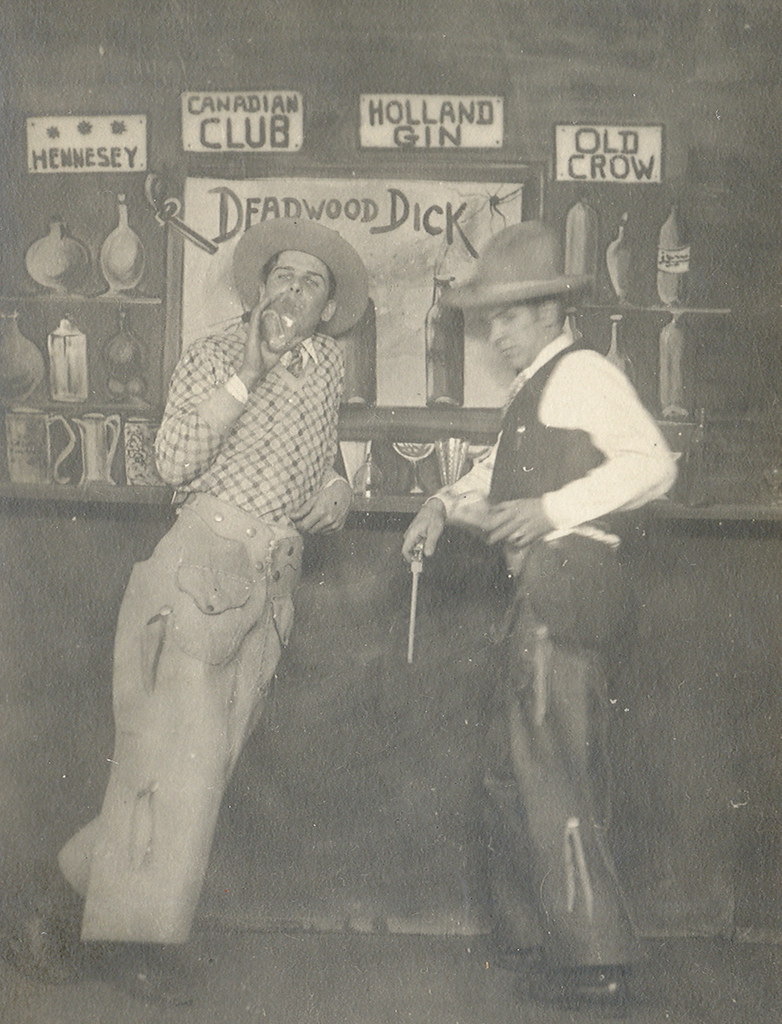
Photo: “Real Photo Hard Drinking Handsome Cowboys at the Deadwood Dick Saloon Studio Photograph RPPC AZO Stamp Box Hennesy Canadian Club Holland Gin Old Crow 2” by UpNorth Memories – Don Harrison is licensed under CC BY-NC-ND 2.0.