Category Archives: poets

Potcake Poet’s Choice: Frank Hubeny, “True”

Frank Hubeny

Frank Hubeny

The cloudy image on the lake
Comes from the gracious morning light
We left the darkness of the night,
Became aware of what’s at stake.
We now renew, rejoice, remake,
Reflect on what we know as true.
Our part seems small, like morning dew,
But later when the victory’s won
We may find out it was well done
And fully know and be known too.

Frank Hubeny writes: “I often write to prompts. I know other people who are also participating in the prompt will at least give the poem a glance. Ronovan is one of the many people out there posting writing prompts. He has a weekly Décima Poetry Challenge. This form has ten 8-syllable lines with a particular rhyme scheme: abbaaccddc. I do like the sound of four beats per line. I often post my own photos and so write about them if the theme of the prompt permits. For this poem I posted two photos of clouds on a pond in Techny Prairie in Northbrook, Illinois. The last line of the poem is intended to suggest 1 Corinthians 13:12 about seeing reflections, knowing in part and then knowing fully and being fully known. The being “fully known” is what was foremost in my mind. That thought along with the reflections on the pond in the photographs and Ronovan’s challenge to use the word “true” as a rhyme word in a décima motivated me to write this poem.”

Frank Hubeny lives between Miami Beach, Florida, and Northbrook, Illinois.  He has been published in The Lyric Magazine, Snakeskin Poetry Webzine, Ancient Paths Literary Magazine, Visual Verse and Vita Brevis.  He regularly posts photographs, short prose and poetry to his blog, https://frankhubeny.blog

Potcake Poet’s Choice: LindaAnn LoSchiavo, “A Visit to Cemetery Hill”

LindaAnn LoSchiavo

When was it? How did I become the kind
Who failed to cherish life, discarded laughs?

I’d done no Christmas shopping since Dan died.

Strange forces urged me out as more snow fell,
Filling the windows, decorating trees,
Avoiding certain branches — — just like folks
Who know how to keep apart. The weatherman
Advised pedestrians to stay indoors.

Barely protected, wearing an old coat,
Worn out boots, steered by impulses alone,
I trudged along until I realized
The yuletide hypnotized my weary eyes.

Against my will, those luminarias
Attracted. Coffined lights, like sentinels,
Marked gates of Cemetery Hill, where we
Had bid adieu. Temptation made me stoop
To steal a souvenir — — when he appeared.

I tried to run. My heavy rubbers clung,
Wet mud imprisoning me like quicksand.
My footprints left a useless trail behind,
Uncertain as redemption once denied.

The faceless creature merged with me. Mid-gait,
My right leg was suspended, awkwardly,
When I heard singing — — yes! — — “Die Fledermaus,”
Our favorite, the last performance Dan
And I enjoyed together — —happy times
Resurrected at Prince Orlofsky’s ball,
As Strauss’s music peeled away sorrow,
A ghostly partner lifting me, leading
Us effortlessly in a waltz. I felt
Like Rosalinde, my shearling a silk gown,
Fond debutante who danced, dipped, all aglow.

As quick as this possession overtook
Me, it departed. My boots made contact
With earth. I watched as the transparent male
Took two steps, disappeared. The sun came up.

I headed home, discovering the snow
Completely cleared away, and whistling
That overture. Attempting to make sense
Of this experience, all I knew was
Words do not live entirely inside
Language and neither does such new found joy.

LindaAnn Schiavo writes: “This ghost poem (pasted in below) is based on an actual New York City yuletide encounter with a spirit.

Back-story:
Right before Xmas, in the mid-1990s, I had just left The Strand Bookshop in NYC.
The sidewalk is unusually wide on Broadway by Grace Church.
But when I saw the ghost, I deliberately altered my path to collide with it.
Poor soul, roaming around, was probably visiting a neighborhood he once knew.
He was wearing a dark hooded tracksuit.
His nylon work-out pants had light stripes down the side of each leg.
He had a slim, athletic build — — a man cut down in his prime.

I just had to “make contact.”
Why? To offer my warmth, my joy, my essence as temporary comfort to this restless spirit.

Process notes:
Twenty years later, I fictionalized it.
My protagonist became a lonely, joyless widow who meets a ghost [i.e., her dead husband].
I imagined an emotional yet mysterious “reunion” on Xmas Eve that would somehow offer comfort to a woman, enabling her to regain her joy even though she can’t quite explain what happened.

After my 1,500-word short story was published and also translated into Russian, I revised it as a poem.”


LindaAnn LoSchiavo, recently Poetry SuperHighway’s Poet of the Week, is a member of SFPA and The Dramatists Guild. Her poetry collections “Conflicted Excitement” [Red Wolf Editions, 2018], “Concupiscent Consumption” [Red Ferret Press, 2020], and Elgin Award nominee “A Route Obscure and Lonely”‘ [Wapshott Press, 2020] along with her collaborative book on prejudice [Macmillan in the USA, Aracne Editions in Italy] are her latest titles.

“A Route Obscure and Lonely” speculative poetry by LindaAnn LoSchiavo is available on Amazon.

Potcake Poet’s Choice: Rob Stuart, “Bliss”

Rob Stuart


Rob Stuart


The Bible offers this advice;
Repent of all your sins. The Lord
Will grant the worthy Paradise
As their reward.

But what kind of incentive’s this?
Who wants to spend eternity
With upright folk? Who’d deem that bliss?
Not bloody me.

When dying, I’ll abjure the priest
And trust St. Peter recommends
Damnation, for in Hell at least
I’ll be with friends.

Rob Stuart writes: “Whatever this poem’s shortcomings may be, it has the rare distinction of having turned out exactly as I had intended, making the journey from concept to page without incurring any significant damage along the way. You can deduce quite a lot about my world view from these twelve short lines, I think, and it’s very much representative of the kind of poem I am always trying to write – short, snappy, and simultaneously humourous and barbed. I showed it to a colleague once and she immediately declared ‘I want that read at my funeral.’ I thought that the best possible endorsement.”

Rob Stuart’s poems and short stories have been published in numerous magazines, newspapers and webzines including Ink Sweat and Tears, Light, Lighten Up Online, M58, Magma, New Statesman, The Oldie, Otoliths, Popshot, The Projectionist’s Playground, Snakeskin, The Spectator and The Washington Post. He lives in Surrey, England with his family.
http://www.robstuart.co.uk/

Review: Lord Macaulay, “Lays of Ancient Rome”

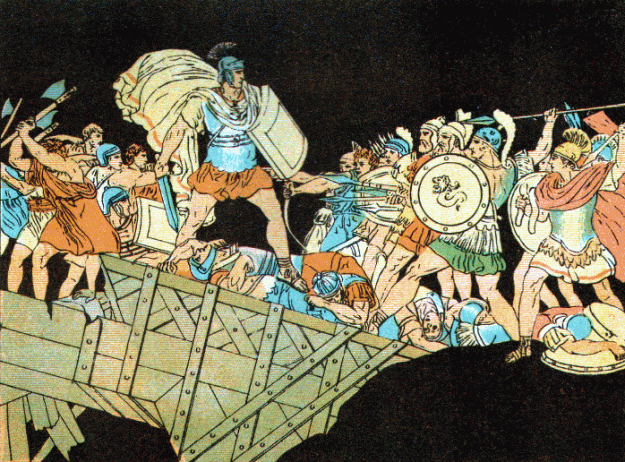
horatius

Macaulay’s ‘Lays of Ancient Rome’ are remarkable in several ways. The well-known ‘Horatius’ (aka ‘Horatius at the Bridge’) is glorious, memorable, stirring, heroic, in lovely rolling ballad-type stanzas:

Then up spake brave Horatius,
The Captain of the Gate:
“To every man upon this earth
Death cometh soon or late.
And how can man die better
Than facing fearful odds,
For the ashes of his fathers,
And the temples of his gods?”

Great stuff! It seems in keeping that Winston Churchill (love him or loathe him) would have learnt all 70 stanzas as a schoolboy, inspiring himself to develop courage (and oratory).

But the second remarkable thing is how bad the rest of the material in the volume is. The poetry is uninteresting, and the pure heroism of ‘Horatius’ is replaced either by gods winning the human battle, or by a girl being ‘saved’ from being despoiled by a tyrant by her father killing her when the three are together in the Forum (and not attempting to kill the tyrant), or by the poems deteriorating into blathery fragments.

Macaulay was wordy from an early age. The story is told of him that, uninterested in toys, he was reading avidly by the age of three and he already talked like a book. When hot coffee was accidentally spilled on his legs and a kindly woman asked “Is Diddums all right?” he replied, “Thank you, madam, the agony is abated.”

The third way in which this volume is remarkable is in the main Preface and in the shorter prefaces to each of the poems, especially ‘Horatius’. Here Macaulay lectures in detail on a perceived universal process of ballad creation in preliterate societies (and on the value of verse for memorisation), ballads’ subsequent devaluation when higher standards of literacy come in, and finally their total loss or partial recovery. He recounts the differences between two ballads of the Battle of Otterburn which have quite different outcomes for the protagonists, even though both ballads were probably written by people who were alive at the time of the battle.

And in a throw-away paragraph he inadvertently highlights the changes in education and culture that have taken place in the past 150 years: “The early history of Rome is indeed far more poetical than anything else in Latin literature. The loves of the Vestal and the God of War, the cradle laid among the reeds of Tiber, the fig-tree, the she-wolf, the shepherd’s cabin” (to these five he adds a further 23 examples, ending with) “the combat between Valerius Corvus and the gigantic Gaul, are among the many instances which will at once suggest themselves to every reader.”

As if! Well, that was then, this is now. But ‘Horatius’ itself has a timeless quality to it. Although if you are trying to invoke heroism by reading it to a 10-year-old which I strongly recommend, you should pre-read it and comfortably skip some of the unnecessary early verses.

Potcake Poet’s Choice: Jane Blanchard, “Transactions”

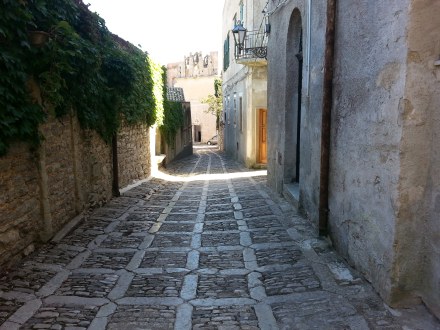
Erice, Jane Blanchard

Erice, Sicily

Transactions (in Sicilia)

The merchant was polite as I came in
on Monday afternoon to browse for wine,
but conversation happened only when
we spoke the common language of the vine.

A dozen bottles were selected, then
examined, labels studied, line by line,
at last set back into the proper bin,
except for one most likely to taste fine.

It did, so I returned to that same store
throughout the week and found the bill to be
a little less each time. I said no more
than grazie, smiling ever pleasantly.

By Saturday, I had a patron’s status,
awarding me a bar of chocolate gratis.

Jane Blanchard writes: “Transactions, first published in The Tau (2017), appears in my latest collection, In or Out of Season (2020). I am inordinately fond of reading and writing sonnets, perhaps because I studied so many of them while in graduate school. This particular sonnet is anecdotal; its speaker is my husband Jimmy, who accompanied me to Bread Loaf in Sicily in 2013 and wandered around Erice while I was in a workshop led by Stanley Plumly. Currently, it is hard not to feel nostalgic about such experiences.”

A native Virginian, Jane Blanchard lives and writes in Georgia, USA. She has earned degrees from Wake Forest and Rutgers Universities. Her collections to date have been published by Kelsay Books.

Potcake Poet’s Choice: Marcus Bales, “Single Malt Drinker”

Marcus Bales

Marcus Bales

Single Malt Drinker

He’s a single malt drinker, and he’s told us a story or two,
And everyone’s heard one they swear has just got to be true.
He always has money whenever it’s his turn to buy,
And carries himself so that bigger men nod and don’t try;
And all sorts of women have paused there to give him the eye,
And some of us do and some of us don’t wonder why.

He’s a single malt drinker and he’s got a nice touch with a cue.
I won’t say that he’s never lost but the times have been few.
He doesn’t get drunk though he sips through a fourth of a fifth;
His memory’s remarkable, poems, sport, science, or myth.
But he never has hinted which outfit that he was once with,
And there’s hardly a pause when you ask and he says his name’s Smith.

He’s a single malt drinker, no piercing, no ring, no tattoo,
And unlike the most of us he doesn’t snort, smoke, or chew;
He knows the back alleys that we know, Berlin to Lahore,
And speaks all the languages we do and a couple of more.
We’re waiting ‘til spouses have called us to stop at the store
On the way home to comfort — and wonder what he’s waiting for.

He’s a single malt drinker, and he’s told us a story or two,
And maybe we’ve missed out on hearing the one that is true:
Those wound up too tight for too long will all wind up unwound,
And everyone knows that each of us ends in the ground,
So find you a place where you choose your own unwinding sound —
We’re laughing and drinking and swapping our stories around.

Marcus Bales writes: “No comment from me. I think it’s narrative enough to not need one. Mike Whitney sings it here, if you want to call his interpretation of it an author’s comment.”

Not much is known about Marcus Bales except that he lives and works in Cleveland, Ohio, and that his work has not been published in Poetry or The New Yorker. However his “51 Poems” is available from Amazon.

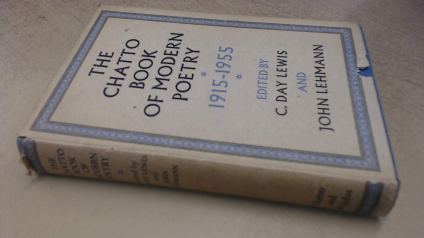
Review: “The Chatto Book of Modern Poetry, 1915-1955”

Chatto Modern Poetry

1915 to 1955 provides quite a range of poetry! From Hardy, Housman, Kipling, Yeats, through two world wars, to Dylan Thomas and twenty poets younger than him. Editors C. Day Lewis and John Lehmann confined themselves to (loosely defined) British poets, and to those aged at least 30 by their final selection. Among the 260 poems are many standards–Hardy’s ‘Afterwards’, Yeats’ ‘Sailing to Byzantium’, Eliot’s ‘East Coker’, Auden’s ‘Lay Your Sleeping Head’, Dylan Thomas’ ‘Fern Hill’–but the real joy is in discovering good work by less well known poets. I give a few excerpts as examples: pastoral, autobiographical, of mortality, a war poem, wistfulness:

Andrew Young, ‘Wiltshire Downs’

The cuckoo’s double note
Loosened like bubbles from a drowning throat
Floats through the air
In mockery of pipit, land and stare.

And one tree-crowned long barrow
Stretched like a sow that has brought forth her farrow
Hides a king’s bones
Lying like broken sticks among the stones.

Laurie Lee, ‘First Love’

Then it was she put up her hair,
inscribed her eyes with a look of grief,
while her limbs grew as curious as coral branches,
her breast full of secrets.

But the boy, confused in his day’s desire,
was searching for herons, his fingers bathed
in the green of walnuts, or watching at night
the Great Bear spin from the maypole star.

Alun Lewis, ‘Water Music’

Cold is the lake water
And dark as history.
Hurry not and fear not
This oldest mystery.

This strange voice singing,
This slow deep drag of the lake,
The yearning, yearning, this ending
Of the heart and its ache.

Keith Douglas, ‘How to Kill’

Now in my dial of glass appears
the soldier who is going to die.
He smiles, and moves about in ways
his mother knows, habits of his.
The wires touch his face: I cry
NOW. Death, like a familiar, hears

and look, has made a man of dust
of a man of flesh. This sorcery
I do. Being damned, I am amused
to see the centre of love diffused
and the waves of love travel into vacancy.
How easy it is to make a ghost.

Sidney Keyes, ‘The Gardener’

Do you resemble the silent pale-eyed angels
That follow children? Is your face a flower?
The lovers and the beggars leave the park–
And still you will not come. The gates are closing.
O it is terrible to dream of angels.

As a collection the poetry is overwhelmingly formal, rural and male. It is titled ‘The Chatto Book of Modern Poetry’, but it predates the formless chaos of what we now call “modern poetry”, the unstructured confessional outpourings of the past half century. The anthology isn’t perfect, but very rewarding for lovers of traditional poetry. (Not hard to find. Used hardcovers are available from $0.99 on Amazon.)

Potcake Poet’s Choice: Chris O’Carroll, “Ode to Old Age”

Chris O'Carroll

Chris O’Carroll

Ode to Old Age

I walk into a room and suddenly
I’m at a loss. What did I want in here?
That puckish brain-tweaker, reality,
Has learned to shift its shape or disappear.
I used to have to smoke expensive weed
To tune in to this zoned-out paradigm.
Today my skull packs all the buzz I need.
I’m high on failing cells and passing time.

Each friend or relative that I outlive
Is one less witness to my foolish youth.
Now any version of the past I give
Is more or less the undisputed truth.
What names and numbers I may have forgotten
Are obligations I’ve been glad to shed.
Untangled from the past I once was caught in,
I rest in peace before I’m even dead.

Chris O’Carroll writes: “When my late mother was in her early 80s, and could still notice and comment on the progress of her dementia, “losing my marbles” was her term of choice for the experience. I gave some thought to titling this poem “Ode to Lost Marbles” in her honor. Laughter can’t make decline and death any less terrible, but it sure does make life more fun in the meantime.”

Chris O’Carroll is the author of The Joke’s on Me (White Violet Press, 2019).  He has been Light magazine’s featured poet, and his poems have appeared in Literary ReviewThe New StatesmanThe SpectatorLove Affairs at the Villa Nelle, and The Great American Wise Ass Poetry Anthology. “Ode to Old Age” was originally published in Light.

Potcake Poet’s Choice: Martin Elster, “The Black Dog of the Hanging Hills”

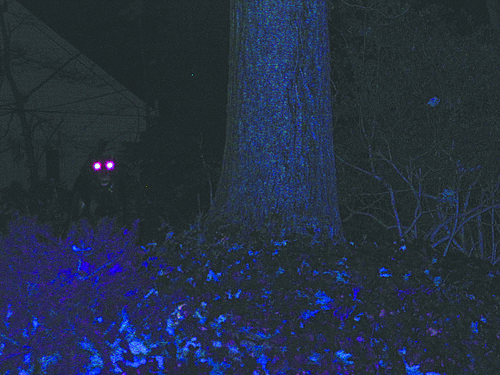
The Black Dog of the Hanging Hills
will tip its head to howl,
yet not a woof nor a whimper spills
from him, not one faint growl.

He savors human company
and charms you with sad eyes;
but when those orbs turn fiery,
they herald your demise.

He leaves no prints in sand or snow,
appears when the sun is bright,
or at dusk on a crest in the full moon’s glow—
ethereal as night.

It’s said that long ago a pup
that wandered with its master
en route to rugged heights trudged up
a path, straight to disaster.

On the loftiest ledge its keeper lurched
and plunged from ridge to gorge.
The mongrel, lost and restless, searched
the woods for broken George,

but never found the man who’d reared
and steered him through those wilds.
I’d hiked there once, and a dog appeared;
it tagged along some miles,

beguiling me as it larked and leapt,
then bounded off like a buck.
The next time it appeared, it crept
in shadow. Terror-struck,

I lost my footing, nearly tumbled
into a gulch; discerned
a phantom’s gaze. My courage crumbled.
Unruffled, I returned

one early April dawn to climb
those treacherous traprock trails
where copperheads and deer kill time
with toads and cottontails.

Hawks wheeled and whistled, corvids clamored,
thrushes thrilled to fill
the ears of Earth, woodpeckers hammered—
when all went suddenly still.

The cursed cur, his eyes cerise,
materialized anew.
I free-fell, easy as the breeze.
My backbone cracked in two.

My eyes flew open: there I saw
the milky fangs of death,
watched venom dribbling from its maw,
although I felt no breath.

Way up above us hung the cliff
I fell from. Then I stirred
and rose, refreshed; I wondered if
a time warp had occurred.

My steps, as light as a lunar cricket’s,
drew me toward the summit
far from the mass of tangled thickets.
Flying! Soaring from it!

Now night and day and all year round
I hike here with a breed
as black as ravens, hushed—a hound
I never have to feed.

Martin Elster writes: “I used to occasionally hike in the hills above the town of Meriden, Connecticut with my friend, Joe Z., who grew up in that town. We were always accompanied by one or two of my dogs. For the last few years, however, my friend has been in a nursing home (in a different town) and recently tested positive for COVID-19.

I called him up to ask him if he could name his favorite poem in my new book, Celestial Euphony, thinking his feedback might help me pick a poem for the Potcake Poet’s Choice. Without hesitation, he said, ‘The Black Dog’. It didn’t surprise me since my poem was inspired by and is loosely based on a local Meriden legend about a ghost dog that is said to haunt those ‘Hanging Hills’.

My friend couldn’t talk anymore, as he was coughing a lot. But I thanked him and knew then and there which poem I would submit. Incidentally, neither Joe nor I have ever encountered that supernatural canine—which is a good thing!”

Martin Elster, who never misses a beat, is a percussionist with the Hartford Symphony Orchestra. Aside from playing and composing music, he finds contentment in long walks in the woods or the city and, most of all, writing poetry, often alluding to the creatures and plants he encounters.
His career in music has influenced his fondness for writing metrical verse, which has appeared in 14 by 14, Autumn Sky Poetry Daily, Better than Starbucks, Cahoodaloodaling, Eye to the Telescope, Lighten Up Online, The Centrifugal Eye, The Chimaera, The Flea, The Speculative Edge, THEMA, and numerous other journals, e-zines, and anthologies including of course Sampson Low’s Potcake Chapbooks.
His honors include Rhymezone’s poetry contest (2016) co-winner, the Thomas Gray Anniversary Poetry Competition (2014) winner, the Science Fiction Poetry Association’s poetry contest (2015) third place, and four Pushcart nominations. His new book Celestial Euphony is available from Amazon.


Potcake Poet’s Choice: Brian Gavin, “The Work of Trees”

Brian Gavin 2020

Brian Gavin

The Work of Trees

Things, like people, in the business of decay
depend on trees. Within this latticed dusk
the wearying pretensions fall away
like flecks of paint from off a shrouded husk
of clapboard, and green stones spilling from a fence.
The house leans forward now, nails soft with rust —
it is the way an aged woman bends
forward in prayer, shapeless in shawl. There must
be trees beneath which things grow ripe and rot,
to be again with other things, in dreams —
old women at mass, men at bars, forgotten
things, distilled of story. Underneath the beams
the brush ebbs; all change is by degrees
of lessening – that is the work of trees.

Brian Gavin writes: “This poem ran a couple of years ago in The Road Not Taken: A Journal of Formal Poetry. I chose it because, for me anyway, the compelling thing about writing poetry is the way that a poem kind of leads the poet where it wants to go. With this poem, for example, I had absolutely no idea what it was going to be about. Then I started playing around with the image of the dilapidated house and the other images and rhymes until it seemed like the poem was satisfied!

I find writing this stuff to be most gratifying when the process plays out this way, and least gratifying when I try to tell the poem what to do.”

Brian Gavin is a retired Distribution Manager who started writing poetry about 5 years ago. His poems have appeared in The Journal of Formal Poetry, Peninsula Poets and Snakeskin Magazine, and in the Potcake Chapbook ‘Careers and Other Catastrophes’. He lives in Lakeport, Michigan, USA, with his wife Karen.