Category Archives: poets

Review: “Aniara” by Harry Martinson

Aniara has fascinated me for a long time because it combines three of my favourite literary interests: science fiction, poetry, and the works of Nobel Prizewinners.

Harry Martinson wrote the book in the 1950s, a decade after the bombing of Hiroshima and Nagasaki but before Sputnik launched the Space Age. It is the story of mass migration to Mars from the destroyed Earth, centred on a miles-long spaceship with thousands of emigrants that is knocked off course and is headed out of the solar system on a hopeless journey.

The existentialism of the situation – living lives of no destination in an inescapable vessel – is in practical terms no different from our own endless circling of the Sun… The issues of whether this feels different, and whether it should feel different, are never addressed but resonated with me nevertheless.

The characters are diverse and interesting. With the book having been written by a male, and with the narrator having a variety of sexual relationships with women, I was surprised to find that the recent film version has a female protagonist. Well, why not make it into a lesbian sf movie, though?

The book is divided into 103 ‘songs’ of half a page to seven pages in length – only 102 in the English translation by Hugh MacDiarmid and Elspeth Harley Schubert, as they and the author agreed that Song 42 is untranslatable.

This raises the question of what the verse is like in the original Swedish. A mixture of formal and free verse, apparently, but with much more rhyme and structure than in the translation. (That the translation is weaker is natural enough, but unfortunate). While I wait to find a full copy in Swedish (which I will be able to work my through, with the English translation in my other hand), I am glad to have found a Swede’s Goodreads review in English which gives samples of the poetry in both languages. (Thank you, Lisa!) For example:

“Försök till räddning genom tankeflykt
och överglidningar från dröm till dröm
blev ofta vår metod.
Med ena benet dränkt i känslosvall
det andra med sitt stöd i känslodöd
vi ofta stod.
Jag frågade mig själv men glömde svara.
Jag drömde mig ett liv men glömde vara.
Jag reste alltet runt men glömde fara. –
Ty jag satt fånge här i Aniara.”

In the MacDiarmid/Schubert translation:

“Attempts at respite through the flight of thought
and constant transference from dream to dream
was often our method of seeking relief.
With one leg steeped in a flood of feeling
and one supported by a lack of feeling
we often stood.
I questioned myself but quite forgot to answer.
I dreamt of life but quite forgot to live.
I ranged the universe–but could not travel farther
for I was imprisoned here, in Aniara.”

The MacDiarmid/Schubert translation is not great, as shown in this excerpt. Not only is there a general lack of rhyme, but the second-to-last line would translate correctly as “I traveled all around but forgot about danger”. The only justification for changing the meaning is to make the (very weak) rhyme of “farther” with “Aniara”.

But then again, translating poetry into a different language’s poetry is at least as difficult as translating a written story into a film… so, as for this translation: I’ll give it five (out of ten, for the try). But the original? From what I can see and guess, ten out of ten!
Review: “Selected Poems” by W.H. Auden

Auden

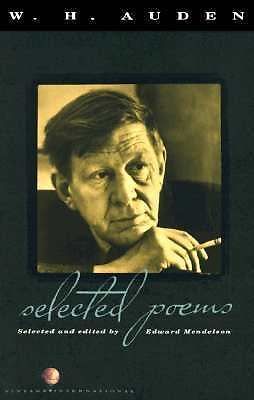
The best of Auden’s poems are so many, so varied, so technically accomplished and so witty that he stands with the greatest poets of the 20th century. My list of favourites includes:

“O where are you going?” said reader to rider
O what is that sound that so thrills the ear
A shilling life will give you all the facts
Look, stranger, at this island now
Miss Gee
As I walked out one evening
In Time of War
Musee des Beaux Arts
In Memory of W.B. Yeats
Law, say the gardeners, is the sun

and what many consider the greatest love-poem of the last 100 years:
“Lay your sleeping head, my love,
Human on my faithless arm”.
There is a universality about Auden’s depiction of relationships, an indeterminate quality that allows his thoughts to be applied to all people. This is in keeping with the fact that he was gay, and writing in a time when homosexuality was illegal. It provides an unexpected strength for his verse.

And yet, and yet… all of those poems listed above were written before he turned 33. He lived to age 66, writing longer and longer works, moving further and further away from traditional verse, and with less of the memorable genius of his youth.

It is therefore somewhat depressing to read these “Selected Poems” because they are set out chronologically, and the writing gets less interesting the further you read. Halfway through the book you run into the poem sequence “The Sea and the Mirror – a commentary on Shakespeare’s The Tempest”, which includes 25 pages of prose crammed with dense imagery and argument. Apparently Auden preferred this prose section, “Caliban to the Audience”, over all his other work. This preference was expressed at the time that he was rewriting the excellent poems of his youth to reflect his newer American, Christian, self-important academic personality. I found it unreadable.

The first edition of “Selected Poems” (selected and edited by Edward Mendelson) contains 100 poems. A more recent edition adds another 20 poems, “broadening its focus to better reflect the enormous wealth of form, rhetoric, tone, and content in Auden’s work. Newly included are such favorites as “Funeral Blues” and other works that represent Auden’s lighter, comic side”.

Unfortunately I only have the 100-poem version. If you buy a copy of this book, make sure it has the 120 poems!

The Best Short Poem Ever: “Jenny kiss’d Me” by Leigh Hunt

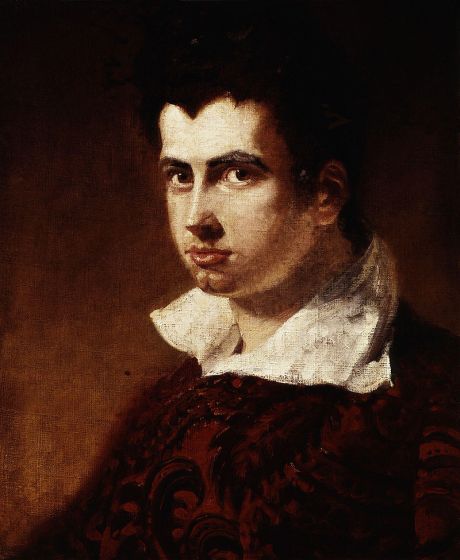
Leigh Hunt, young

Leigh Hunt when young

Jenny kiss’d me when we met,
Jumping from the chair she sat in;
Time, you thief, who love to get
Sweets into your list, put that in!
Say I’m weary, say I’m sad,
Say that health and wealth have miss’d me,
Say I’m growing old, but add
Jenny kiss’d me.

I love the sentiment, the versification, the tightness, the back story, everything. If you erased everything else Leigh Hunt ever wrote, this poem should still be in every anthology of English poetry.

As the Poetry Foundation says, Hunt was “a central figure of the Romantic movement in England, but he was not, as he wished to be and knew he was not, one of its great poets.” But he was the author of Abou Ben Adhem (often taught in schools for its quietly uplifting morality); The Glove and the Lions (ditto, for its more boisterous morality); and the Song of Fairies Robbing an Orchard (taught less often, as schoolchildren hardly need encouragement in the heightened pleasures of theft).

Jenny kiss’d Me was originally entitled Rondeau, but the poem doesn’t really meet any of the various definitions of the form. It rhymes ababcdcd instead of holding to the rondeau’s tighter requirements of rhyme and repetition, but the alternating feminine and masculine rhymes give it a strong rhythm that is tightly adhered to. It has four feet to each line, but only two in the last, and the effect of the poem is heightened by the fact that, when reading the poem aloud, you can’t help creating a longer pause than usual before the last line – it is as though Hunt has dropped the first two feet, not the last two in that line. That last line repeats the first words of the poem (which is common in a rondeau), but does it as a fresh punch line. It is a remarkably effective piece of versification.

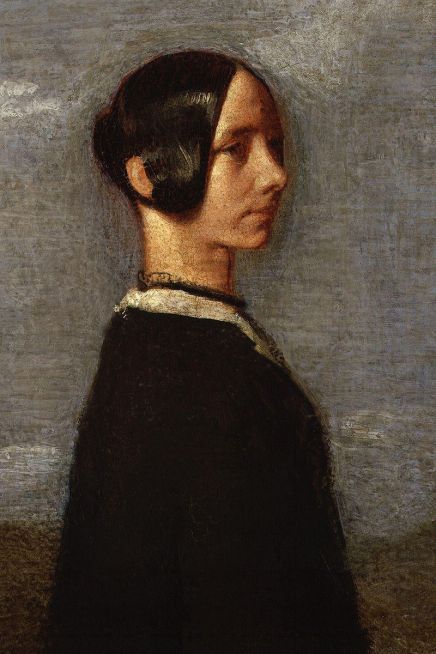
Jenny Carlyle

Jenny: Jane Baillie Carlyle, née Welsh

The back story is that Hunt had been severely ill during a flu epidemic, but, recovering, paid an unexpected visit to Thomas and Jane Carlyle, Jane being “Jenny”. The Carlyles had a difficult relationship to each other and the world in general. Samuel Butler once remarked “It was very good of God to let Carlyle and Mrs Carlyle marry one another, and so make only two people miserable and not four”. But clearly Jane Carlyle was capable of showing affection and making an impression. Hunt at that time was no longer young.

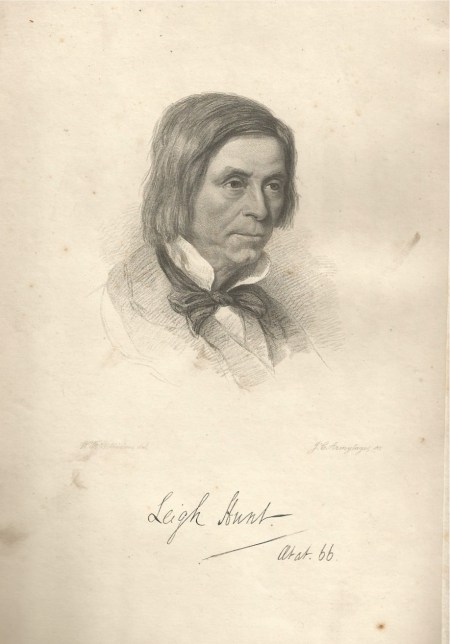
Leigh Hunt

Leigh Hunt at about 66

The poem manages in its eight brief lines to touch on themes of time, age, mortality and failure; also on affection, love, spontaneity and success; and to combine them all into a single image. I cannot think of a more perfect short poem in English.

Poem: “Implants and Biotech”

These are the scarecrow years
When frost tears glisten
On moulded and painted cheeks, beside ears
That no longer listen
Being more deaf than dead
And hearing only
Through implants and inputs into the head
Bonily, stonily.

Fears come while certainties lapse:
Fears of the dark,
Of abandonment, monsters, uncertainty. Now (perhaps)
Some Schrödinger’s shark
Divides cosmonaut, cryonaut, chrononaut
From those who can’t trust
The unknown, are ill-taught, or die without thought.

Thrive on change, or be dust.

This was first published in The Rotary Dial, an excellent online monthly of a dozen formal poems that was put out by two of Canada’s best poets, Pino Coluccio and Alexandra Oliver. Unfortunately The Rotary Dial folded in 2017 and Pino, after winning Ontario’s Trillium Book Award for ‘Class Clown’, disappeared off the radar.

The poem subsequently appeared in the fifth Potcake Chapbook: ‘Strip Down – poems of modern life’, where it has a page facing A.E. Stallings’ far gentler and more positive view of modern medicine, ‘Ultrasound’.

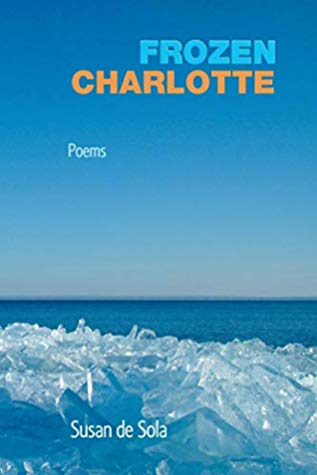
Review: “Frozen Charlotte” by Susan de Sola

Frozen Charlotte

Susan de Sola’s ‘Frozen Charlotte’ is a book of strong poetry, both formal and free verse, collected after prior publication in 30 publications as diverse as Able Muse, Ambit, American Arts Quarterly, Amsterdam Quarterly… and The Dark Horse, and Light, and Measure. One of the pieces in this collection, ‘Twins’, has already been reprinted in the Potcake Chapbook ‘Families and Other Fiascoes’.

Her casual comfort with verse forms is shown in the last poem of the book, ‘Bounty’:

The fruit flies find our fruit, they slip
beneath the lid, a silver dome.
The dark fruit scent has drawn them in,
no other lures them out again.
They settle on apples, puckered figs,
they gorge in perpetuity,
may never fly back to their home,
(if they have ever had a home).
An allegory of choice? Well, yes–
in that we have no choice.
The fruit is fine, the day is long.
Let us feed, buzz, rejoice.

The poem divides into two pieces: the first eight lines describe the scene, and are in iambic tetrameter with mere hints of rhyme. The last four lines step back and philosophise, and alternate tetrameter and trimeter, the trimeters rhyming.

Personally, though I like the whole poem, I find the last four lines far more satisfying. The change of rhythm is good, but I don’t see any reason not to embed more formal rhyme in the first part. She is capable of sustained rhyme, as in another of my favourites, ‘Holistic Practice’. Here a middle-aged holistic therapist who has failed to create a whole life for herself – living in a one-room flat and with no family – is depicted in ten 5-line stanzas as she comes for a visit and shares pictures of her cat. The last stanza is:

But no, her Boop, he was her treasure;
her angel and her source of pleasure.
“Oh , look, how cute!”–a cat bow tie!
I grin and nod, divided by
a deep, holistic urge to cry.

I will admit that her free verse can be very engaging as well, as in her ‘ATM’:

Somehow, it’s sexual,
the rim crotch-high,
the shuffling buttocks,
the hands fumbling in secret.

Gone the dainty dialogue,
the date stamp in a little leathery
book of records, at set times. Now,
an onanism of cash, walls with mouths.

This is an example of a poem that I would hesitate to modify into a formal structure for fear of losing the way that each short line is a punchline in itself. But for the most part the less formal poems, though they often have rich ideas, are not as memorable as the well-structured ones. Blank verse in itself has no merit for me – Milton’s ‘Paradise Lost’ rambles tediously, without the need for concision imposed by rhyme. Chaucer’s ‘Canterbury Tales’ may be long but it is packed with many more stories. It rhymes, and that leaves no room for waffle. No surprise then that with Susan de Sola’s work the longest poems are unrhymed and the least tight.

As for ‘Frozen Charlotte’, the title of the book and of one of its poems, I can only say I am grateful that a page of notes at the end gives the explanation that this was a common, naked, 19th century German doll that acquired its nickname in the US in relation to some ballads. I was unfamiliar with Frozen Charlottes. As a book title it seems memorable but disconnected, as Susan de Sola’s poems are, above all, full of warmth and life.

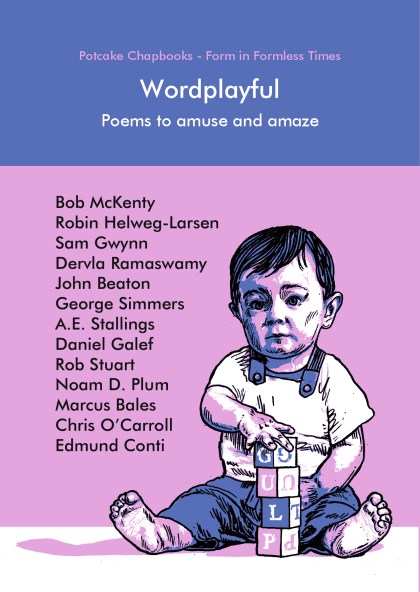
Launch: Potcake Chapbook 6, “Wordplayful”

06 Wordplayful

The sixth in the series of Potcake Chapbooks, ‘Wordplayful – poems to amuse and amaze’, is now beginning to wander around on both sides of the Atlantic (and hopefully further afield). This one is a little different from the earlier ones in the series: puns and puzzles, poems that can be read vertically or in reverse, wordplay in a variety of forms… but, yes, all formal poems, stuffed full of rhyme, rhythm and rich language.

Returning Potcake poets are Marcus Bales, John Beaton, Ed Conti, Daniel Galef, Chris O’Carroll, George Simmers, Alicia Stallings, Rob Stuart and myself; newcomers are Sam Gwynn, Bob McKenty, the unlikely Noam D. Plum and the elusive Dervla Ramaswamy. Mini-bios and photos for most of them are on the Potcake Poets page.

Alban Low has again provided all the art work, but he will now be taking a five or six month break to work on other things, especially the annual Art of Caring exhibition which opens in St George’s Hospital in Tooting in London in May, and moves to St Pancras Hospital in July – or at least it did in 2019. But Alban promises to re-engage with us in the early summer, by which time we may have more idea of what further Potcake Chapbook themes to pursue.

Review: “Nonsense” by Alan Watts

Alan Watts had a rich intellectual life. His formal education largely stopped at high school in his native England, but he explored his interests in mystical Christianity and Zen Buddhism so thoroughly, including attending an American seminary, getting a Masters and becoming a priest for a few years, that he was associated thereafter with various universities including Harvard and San Jose State University.

His poetry book “Nonsense” is interesting for its fresh perspective over Watts’ writing, and enjoyable enough for the ten nonsense poems it holds. As you would expect from the author of “The Art of Zen” and “The Book on the Taboo Against Knowing Who You Are”, it contains both pointless happiness

Hum, hum the Humbledrum!
Rumbling bumbling dumbledrum,
Mumbling dumbly, rumbling humbly…

and comparatively clear philosophy:

The stars in their courses have no destination;
The train of events will arrive at no station;
The inmost and ultimate Self of us all
Is dancing on nothing and having a ball.
So with chat for chit and with tat for tit,
This will be that, and that will be It!

The main poem falls somewhere between the two previous quotes. One hundred lines long, written as 20 limericks, it tells the story of The Lovelorn Loon:

A certain umstumptulat loon
Fell vastly in love with the moon;
With shimular turve
And binlimular gurve
He caroozed to the gorble bassoon.

The Loon builds an enormous tower that successfully reaches the heavens, but when he calls the moon, her arrival destroys the tower.

The whole book is appropriately illustrated in 1960s psychedelic style (think Yellow Submarine and Monty Python) by Michel Dattel. And the book contains other short pieces by Watts, an Introduction that starts reasonably and slyly slides into gibberish; and short prose pieces on Nonsense, on Goofing, and on Drudgery.

A very odd but entertaining little book.

Review: “Verse” by John Updike

This paperback, Verse, is comprised of two earlier hardcover volumes of poems from John Updike, The Carpentered Hen from Harper & Row and Telephone Poles from Knopf. The poems date from the 1950s and early 1960s, and in the words of Phyllis McGinley, “His is what poetry of this sort ought to be: playful, but elegant, sharp-eyed, witty.”

Here are the beginnings of some of his poems. Some of them are pure wordplay, as in “Player Piano”:

“My stick fingers click with a snicker
And, chuckling, they knuckle the keys;
Light-footed, my steel feelers flicker
And pluck from these keys melodies.”

Several of them start with a quote from a newspaper story and then run wild with it, as in “The Descent of Mr. Aldez”:

Mr. Aldez, a cloud physicist, came down last year to study airborne ice crystals.
– Dispatch from Antarctica in the Times
That cloud–ambiguous, not
a horse, or a whale, but what?–
comes down through the crystalline mist.
It is a physicist!”

And some are meditative, as with “B.W.I.” (the old British West Indies of the 20th century):

“Under a priceless sun,
Shanties and guava.
Beside an emerald sea,
Lumps of lava.

On the white dirt road,
A blind man tapping.
On dark Edwardian sofas,
White men napping.”

A largely enjoyable collection, but not up to the standard of those similar 20th century poets, Phyllis McGinley and Dorothy Parker. But then again, Updike’s many American awards (Pulitzer, National Book Award, etc etc) were for his fiction. His poetry can be considered a remarkable bonus.

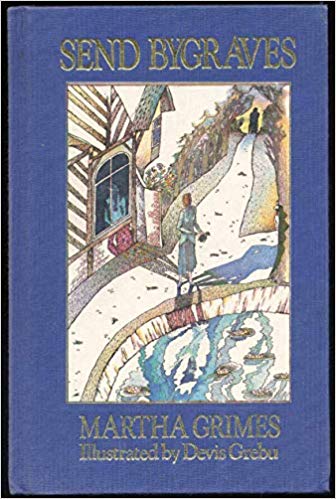
Review: “Send Bygraves”, by Martha Grimes

Send Bygraves

Martha Grimes is best known as an American author of mysteries set in England, each with the unlikely name of a pub for its title. Here she provides a thrilling piece of well-versified pseudo-murder-mystery nonsense: the enigmatic Bygraves appears in the distance of the characters’ views and of the book’s illustrations. Is he the most brilliant detective, or possibly the murderer, or perhaps the undefined victim… is it conceivable he is all three?

Mystery. It’s all the same:
Questions without end or aim.
What will lead us to the dead?
Footprints in the flower bed.
What appeals were made too late?
Sift the ashes in the grate.
What was fatal in the mug?
Pick the fragments from the rug.

The story, told in a range of voices and in styles from sonnet and pantoum to free verse, never clarifies quite what is going on.

We’re a decent lot. We cause no trouble.
(That spot of bother with the poisoned dogs
At Smythe-Montcrieff’s? We’d nothing to do with that!)
You standing, Sergeant? Ah, thank you, I’ll have a Double
Diamond. Jameson on the side. That fog’s
Thick as pea soup innit? I’ll tell you flat:
We don’t much like the Yard nosing about
In Little Puddley.

I would have given it five stars on first reading because it is so original and well-crafted. Rereading it some years later (with my expectations higher), I find the verse less inspired, the characters excessive to the point of being undifferentiated… but this is not a novel, this is a piece of art work (and the illustrations by Devis Grebu are a solid component of it). It gives the tone, the impression of an Agatha Christie or Peter Dickinson novel, but it is a smaller, more delicate and decidely more enigmatic work.

Constable Feathers, I see
Nothing unusual here:
The tradespeople, the gentry,
The servants, the village lout–
All of the villagers out
To murder one another
In typical English fashion.
I wander through the fog,
Pondering the red herrings:
The bloodstained glove, the dogs,
The marmalade, the locket–

It deserves a place on the bookshelf, not with the regular mysteries, but maybe between Edward Gorey and Jorge Luis Borges.

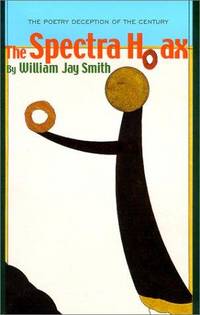
Review: “The Spectra Hoax” by William Jay Smith

Spectra Hoax

In ten days in 1916, two brash young poets – Witter Bynner and Arthur Davison Ficke – produced a volume of poetry parodying the Imagists. Writing as Emanuel Morgan and Anne Knish, and claiming to represent a whole new school, the Spectrics, their manuscript of Morgan’s formal poetry and Knish’s free verse, together with the blathery and pretentious preface, was unexpectedly accepted by a serious publisher and for 18 months was a major success on the American poetry scene. Poetry‘s editor requested half a dozen of their poems, but unfortunately the hoax was uncovered before publication; the editor was embarrassed and angry.

This book tells the full story of the Spectrism hoax, its defense, its termination, and how the hoaxers were in turn hoaxed by others… as well as telling the story of other 20th century poetry hoaxes from Australia and the US. It also contains the full text of Bynner and Ficke’s hoax poetry book, “Spectra”, and a selection of subsequent poems.

As Bynner and Ficke and others subsequently acknowledged, their parodies were unfortunately strong, better than much of the work of the Imagists and in some ways better than their own regular poetry. Consider these:

If bathing were a virtue, not a lust,
I would be dirtiest.

To some, housecleaning is a holy rite.
For myself, houses would be empty
But for the golden motes dancing in sunbeams.

Tax-assessors frequently overlook valuables.
Today they noted my jade.
But my memory of you escaped them.

– Anne Knish, Opus 118

Hope
Is the antelope
Over the hills;
Fear
Is the wounded deer
Bleeding in the rills;
Care
Is the heavy bear
Tearing at meat;
Fun
Is the mastodon
Vanished complete…

And I am the stag with the golden horn
Waiting till my day is born.

– Emanuel Morgan, Opus 2

Whatever else they are, the poems are fun. The story of the hoax and the collection of poems are both worth reading (especially if you like the Imagist poets), and go extremely well together in this book by William Jay Smith.