Tag Archives: creativity

Sonnet: Rick Mullin, ‘Shrine to Satan’

The neighbor’s child has built a muddy shrine
to Satan in our yard. And I’m supposed
to cut the lawn? OK, but look at those
croquet clubs that she used (good God, they’re mine)
to pound her pentagrams of chicken bone
into the ground. The handles are unscrewed
from all the hammer heads. It’s kind of shrewd
the way she placed that PlayskoolTM telephone.

Still, little girls should not touch garden tools
or take the plastic rake out of the shed–
she’s tied it with those jump ropes to the tree.
A shattered flower pot. The Barbie head.
Horrific how this child has learned the rules
of Belial for sculpting in debris.

*****

Rick Mullin writes: “The little girl, A., is a friend of our family and was one of three girls that spent most days playing in our yard. One day they split up, each doing their own thing in their own corner of the yard. The Shrine to Satan, as I called it, was crafted by A. The architect of the horror described in this poem is getting married today.”

Rick Mullin’s poetry has appeared in various journals and anthologies, including American Arts Quarterly, Measure, The New Criterion, The Dark Horse, The Raintown Review, Epiphany, and Rabbit Ears: TV Poems. ‘Shrine to Satan’ is from his chapbook “Aquinas Flinched”, Exot books, 2008. His books include Soutine and Sonnets from the Voyage of the Beagle (Dos Madres Press, 2012 and 2014), Lullaby and Wheel (Kelsay Books, 2019), and Huncke (second edition, Exot Books, 2021). He is a painter and retired journalist living in northern New Jersey. His website is rickmullin.com and his art blog is onlyofobjects.wordpress.com

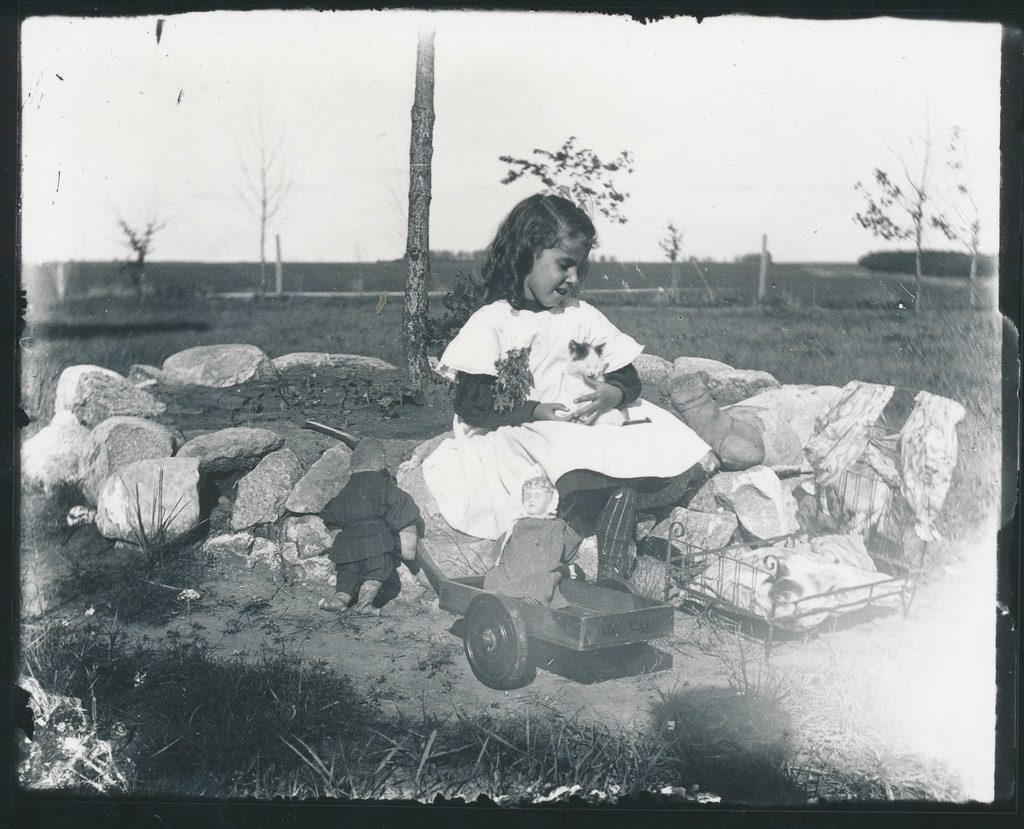
Photo: “Little girl playing with a kitten and dolls.” by simpleinsomnia is licensed under CC BY 2.0.

Poem on poetry: Sonnet: Marcus Bales, ‘White Water’

A poem is so obdurate and small
Compared to what you wanted it to say
And sometimes isn’t even close at all.
For instance, this. I’ve worked on it all day,
A metaphor for all of love’s affairs.
I failed to ride the energy it gave,
My form and balance gone. Nothing prepares
You for the wildness of the standing wave.
Possessing and possessed and then propelled
Abruptly past the point of no control
To merely peril, having once beheld
The moving stillness of it all, all whole.
Your head’s what every poem wants to split,
While you stroke hard to stay ahead of it.

*****

Marcus Bales writes: “My online pal, the poet Liam Guilar, was a kayak adventurer, sneaking across borders to paddle the most dangerous rivers in the world. I went white water rafting once. You’re stuck in cold, wet, awkward positions that often turn suddenly painful. Why people do it over and over seems not just unreasonable but cold, wet, and painful. There are exhilarating moments, but you’re still cold, wet, and out of control. I could feel in my one experience that the out of controlness might be the point. Still, it was wet and cold. Very wet. Very cold. 

“The confluence of Liam’s many tales, my paltry experience, and he and I both struggling to write poems is the impetus for this poem. I’ve often thought that maybe what it needs is a bucket of ice water suspended over the reader like a, well, like a bucket of Damocles, that sloshes over the head and down the back of the neck in order to make it work.”

Not much is known about Marcus Bales except that he lives and works in Cleveland, Ohio, and that his work has not been published in Poetry or The New Yorker. However his ‘51 Poems‘ is available from Amazon. He has been published in several of the Potcake Chapbooks (‘Form in Formless Times’).

Photo: “Kayaking through the white waters of the Gorge” by Grand River Conservation Authority is licensed under CC BY-NC-ND 2.0.

Sonnet: Eric McHenry, ‘Lives of the Poets’

They rubbed two sticks together and made friction.
They made a fist but couldn’t make a hand.
Their dictionary wasn’t made of diction.
Their diction made them hard to understand.

Trying to make a poem, they made a list.
Trying to make the team, they made the choir.
They made up stories whose protagonist
would rub two sticks together and make fire.

Mistakes were made, and mixtapes to go with them.
They made a couch their bed and made their bed.
They tried to make a joke at the expense
of love and money. “Make me,” money said.
They made up stories but they made no sense.
They rubbed two cents together and made rhythm.

*****

Eric McHenry writes: “Strangely, I remember almost nothing about writing this poem, except that I was thinking about the etymology of ‘poet’ (‘maker’) and about the versatility of the verb ‘make’.”

‘Lives of the Poets’ was first published in Literary Matters.

Eric McHenry is a professor of English at Washburn University and a past poet laureate of Kansas. His books of poetry include Odd Evening, a finalist for the Poets’ Prize; Potscrubber Lullabies, which received the Kate Tufts Discovery Award; and Mommy Daddy Evan Sage, a collection of children’s poems illustrated by Nicholas Garland. He lives in Lawrence, Kansas, with his wife and two children.
Eric McHenry – The Waywiser Press
Eric McHenry, Author at The American Scholar

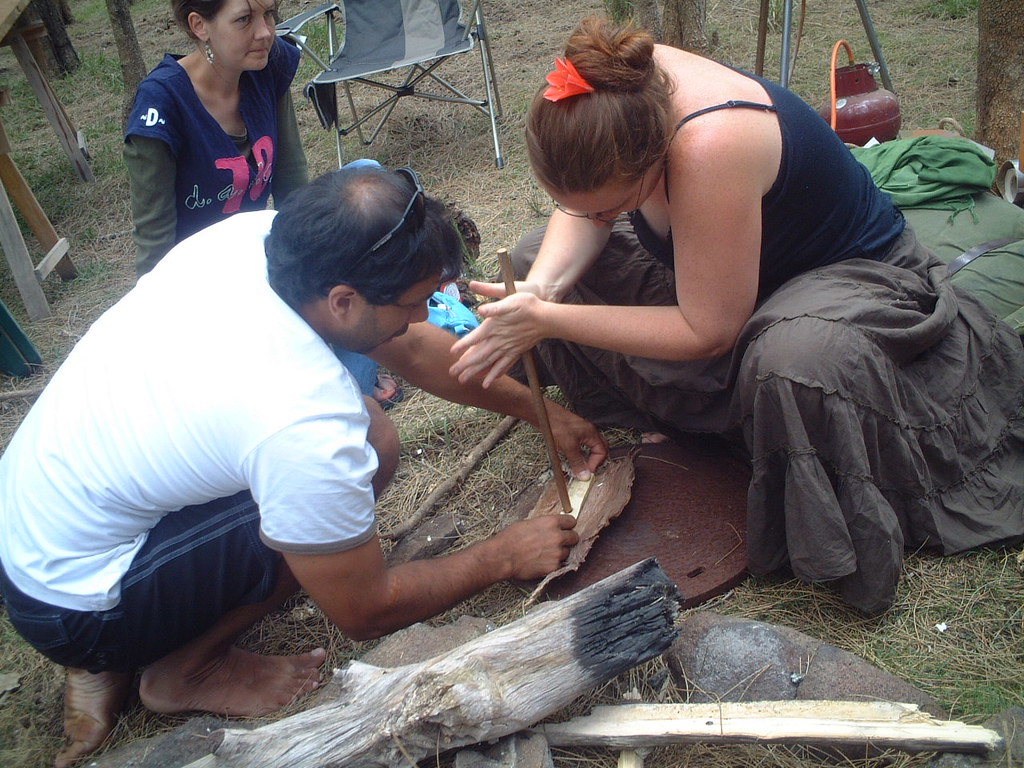
Photo: “Master Sacha twirls the fire stick” by one thousand years is licensed under CC BY 2.0.

Odd poem: ‘We Dance For Laughter’ by Albert Einstein

We dance for laughter,
we dance for tears,
we dance for madness,
we dance for fears,
we dance for hopes,
we dance for screams,
we are the dancers,
we create the dreams.

*****

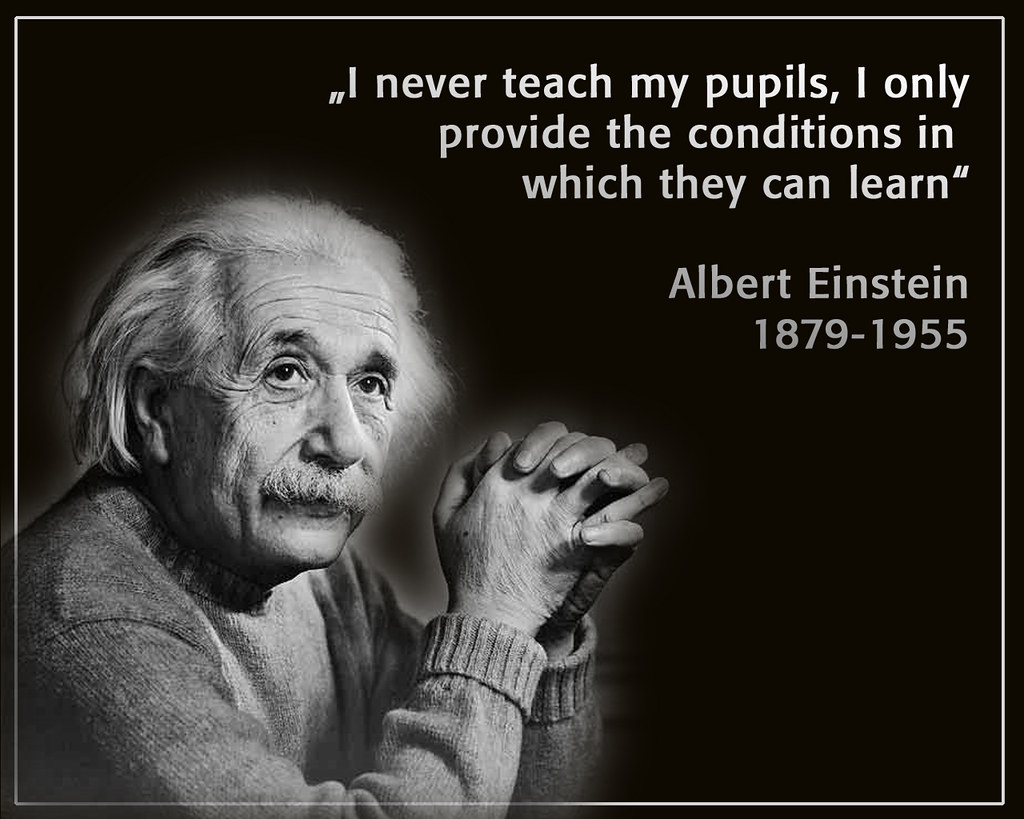
I can’t find anyone other than Einstein credited with this verse, but I also can’t find the source for it. Regardless, Einstein had an appropriate attitude for studying the universe: look at it and ourselves in the spirit of dance, learning, dreaming and creativity.

Photo: “Aðstæður til náms” by sfjalar is licensed under CC BY 2.0.

Calling the Poem: 3. ‘Self-Belief’

Can you handle the wild poem? Can you tame the thing, or kill?
The certainty, uncertainty, of writing as a skill,
The being told to “find your voice”, the crawling like an ant
Across the skin of Literature, that giant, to implant
Some token of your individuality, some pin
To jab into the giant’s vast and ant-infested skin,
To make your mark by scrawling words, tattoos, to claim a win…
You can’t succeed alone against such odds!
But there are gods…

*****

This is the third poem in the ‘Calling the Poem’ chapbook sequence in Snakeskin. The question of self-belief can be difficult for any artist – given the thousands of years of recorded paintings, sculptures, poems, music, etc, how can you know that your tiny ant-like efforts will be enough to make a mark in the world? Can you hope to succeed? The choice might seem to be between the hubris of Yes and the defeatism of No – but you have a secret ally, if you pay attention: the Muse. If you are self-aware and mindful, if you stay alert for scraps from the unconscious, the dream-world including daydreams, if you are respectful enough to try to capture the little hints you are given, then the Muse (She, or He, or Them, Yourself, your unconscious, God or Gods or Angels, however you visualise this force and process) will provide you with insights and material you never knew you could access.

Your Muse is available to you… if you stop and listen, remain open and respectful of the unexpected. Again, the learning and the workloads imposed by others tend to act against this attitude. Take heart from T.S. Eliot: “a poet ought to know as much as will not encroach upon his necessary receptivity and necessary laziness.” That was not a flippant comment of his: it goes to the heart of learning to work with your Muse.

Photo: 8/17/09 Houston – Fire Ant Bite by stefan.klocek used under OpenVerse license

Calling the Poem: 2. ‘Awareness of the Mood’

The possibility before the poem, the mood,
Is premonition more than vision: loath
To admit, like the repressed and skewed
Response on seeing god-like demon, or young witch…
Not even genitals’ light twitch,
But mere awareness of that energy, potential thrust,
That tightness in the chest,
A heart-tight feeling of both loss and lust.
Then don’t ignore that feeling, for you’re blessed:
A poem is lurking in your undergrowth.

*****

This series of poems, ‘Calling the Poem’, is about the process of writing poetry – an art for which some people appear to have an affinity, an intangible ability. My sense is that such creativity is available to all humans, but requires a certain mindset, an openness to the unconscious, an interest in unplanned internal upwellings and dreams and fortuitous images; in other words, it is not available to those who plan and schedule their lives rigorously, who meticulously follow the teachings imposed from the outside by others.

The process starts before the poem begins to appear. I find it starts with a mood that feels like… like a mixture of curiosity (whether filled with hope or despair), and of awareness of the vastness of the world (whether manifested in a sunset or an ant), and of some small but significant personal power even in the presence of the forces of the universe, and of that formless twitch of yearning desire when glimpsing an unconnected but desirable object for the first time.

My sense is that when you find yourself in this mood – and I trust you’re aware of having experienced it – you are entering a state of receptivity to the messages that your unconscious wishes to share with the conscious you; and those messages will come as creative images, or dreams, or ideas, or words and phrases. But they will only come if you are receptive to them. So honour the mood: relax, listen, observe, and be prepared to express in rough draft whatever occurs to you. The mood is not the creativity; but if you accept the mood, the creative communication of the unconscious can occur.

Photo: “14. Premonition of Concusia 2009” by Anne Marie Grgich is licensed under CC BY-NC-ND 2.0.

Short Poem: ‘For Eliot’

I guess
Success
Not elation
Or creation
Alone may men not mock;

God bless
T.S.,
Spared the temptation
Of our generation —
Writing rhymes for rock.

First published in Metverse Muse in India. As you might guess, I wrote this before Andrew Lloyd Webber set that “Old Possum” T.S. Eliot‘s rhymes to music for the West End and Broadway hit Cats, disturbing everyone (except the Poetry Foundation)’s understanding of both Eliot and musicals.

Photo: “T.S. Eliot” by duncan is licensed under CC BY-NC 2.0

Poem: ‘Spring Sprang’

Spring sprang full force with sudden storms then stopped.
Of which vertu engendred were the floods. We mopped.
Summer so wet dried into humid dank.
Sweat dripped, dried, dripped, and as we worked we stank.

This little poem was published in The Asses of Parnassus, where poems range from the short to the very short. Epigrams translated from the Greek or Latin alternate with modern insults and with odd little observations such as this post’s verse. It is a site for people who enjoy the occasional small random thought.

Why I wrote the poem, I don’t know. It probably started with the evocative sounds of “spring sprang”. Spring rains always bring Chaucer’s Prologue to my mind, whence the “of which vertu engendred” phrase. The whole thing is inconsequential, except that in one very important sense no creative act, not even the most trivial, is inconsequential: your creativity speaks to you, and your decision of whether or not to act on it determines many aspects of your life: not just your creative output, but your sense of satsfaction, your happiness, your mental balance, even your physical health. When the muse speaks, listen and act – the output doesn’t have to be significant, but keeping the lines of communication open to the inner and unconscious (but in several ways wiser and more knowledgeable) parts of yourself is supremely important. Call it the soul, if you want. Call it God, for all I care. There is something essential there: honour it. Your happiness, maybe even your life, depends on it.

OK, rant over. Back to other inconsequentialities.

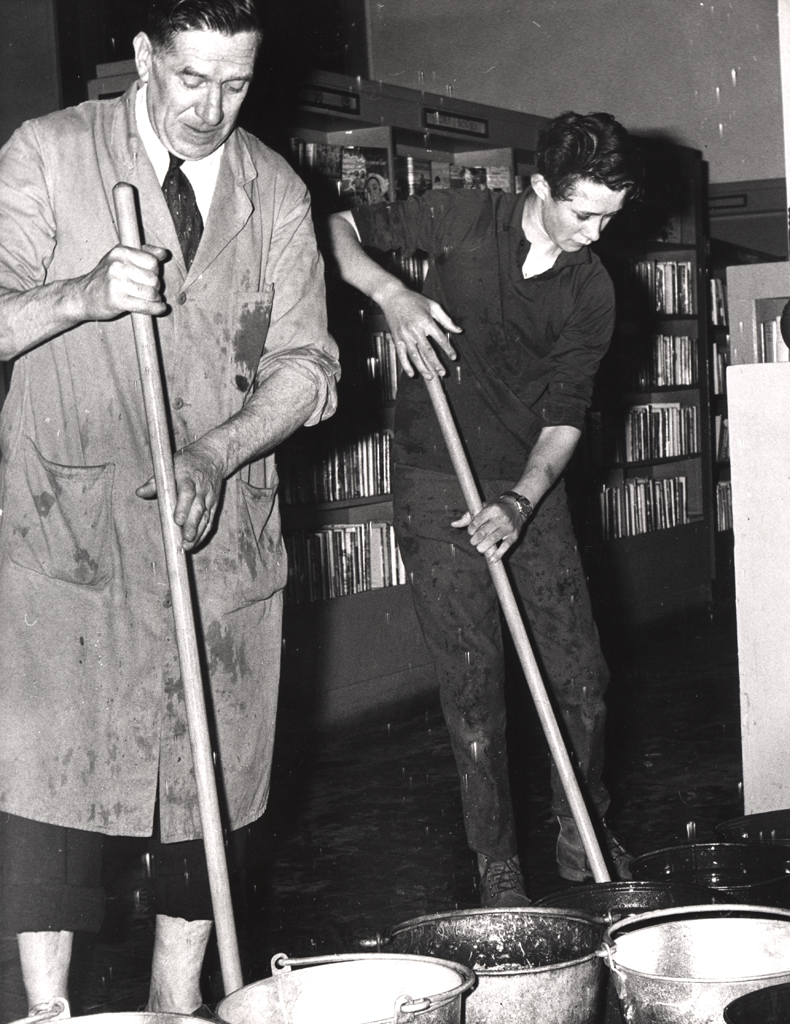
Photo: “025457:Floods Central Library New Bridge Street Newcastle upon Tyne Unknown 1966” by Newcastle Libraries is marked with CC PDM 1.0