Tag Archives: existentialism

R.I.P. Edmund Conti, ‘Button, Button’

Just ask the poet, life’s a dumb thing.
Button, button, eating, swilling.
Life isn’t much but, still, it’s something.

Existence is a rule-of-thumb thing.
Buying now with later billing.
Just ask the poet, life’s a dumb thing.

To dream, to sleep, a ho-and-hum thing.
Boring, boring, mulling, milling.
Life isn’t much but, still, it’s something.

Mum’s the word, the word’s a mum thing.
Button lips and no bean spilling.
Just ask the poet, life’s a dumb thing.

Life, of course–the known-outcome thing.
Death and taxes. God is willing.
Life isn’t much but, still, it’s something.

Life is short, a bit-of-crumb thing.
Dormouse summer, daddies grilling.
Just ask the poet, life’s a dumb thing.
Life isn’t much but, still, it’s something.

*****

In his 2021 collection ‘That Shakespeherian Rag‘, Ed Conti threads poetic references throughout (the title is from Eliot); ‘Button, Button’ appropriately begins with:

When one subtracts from life infancy (which is vegetation),–sleep, eating and swilling, buttoning and unbuttoning–how much remains of downright existence?
– The Summer of a Dormouse, Byron’s Journals.

Much of ‘That Shakespeherian Rag’ (including Button, Button) was first published in Light. The collection is divided into 11 sections, organised from youth through adulthood to the prospect of mortality, and each prefaced with a quote from Shakespeare. The preface for the final Section reads:

Make no noise. Make no noise. Draw the curtains–
– King Lear, Act II Scene 6

There is no poem after it.

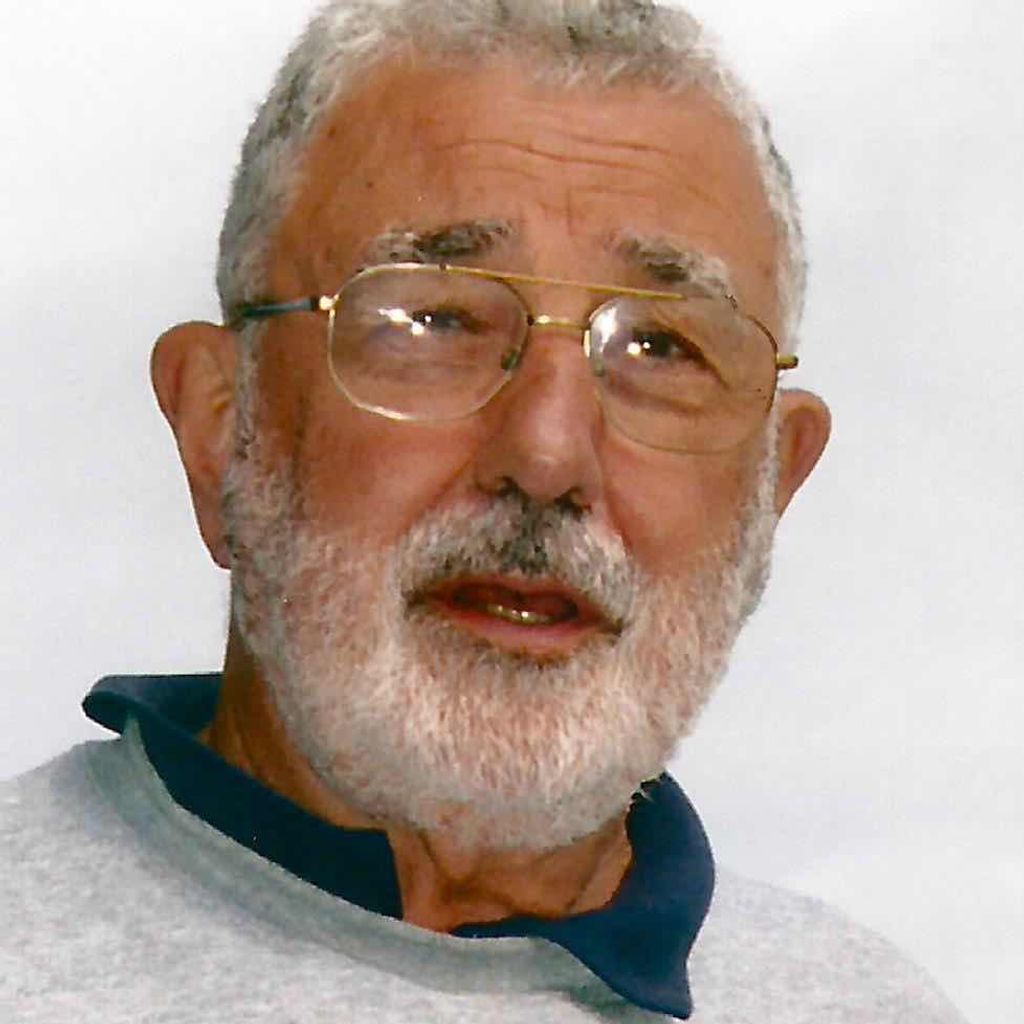
The charming, delightful, witty and tolerant Edmund Conti died on November 12th, aged 96.

R.S. (Sam) Gwynn, ‘Mr Heaney’

“This was Mr Heaney’s room. The peat’s
From off his boots. It got into the rug
And won’t be Hoovered out. Likewise the sheets
And pillow case.” Solemn, I nod and shrug,

Expecting little better, as I note
The sad brace of dried heads, the shards of flint,
The coprolites and drafts that Heaney wrote
Lying untidied here. “He liked his pint,

Did Mr Heaney, but you know the Irish.
That and a roasted spud. He didn’t pay
The last two weeks and more. You know the Irish.”
And so it is I lie where Heaney lay

And watch the twilight dripping with the murk
Lurking beyond short curtains. Left alone,
I ponder what she’d said: “He’d often work
My bit of bogland like it was his own–

He liked the muck and suck. But then one day
He got some kind of letter from the Swedes,
Got all excited and he went away.
Now the whole plot is given over to weeds.”

Such cause for wonderment: Did Heaney ask
No better than a spade or pen or hoe
To kill his time? Nothing to ease the task–
Girls, say? Or hurling pools? I just don’t know.

*****

R.S. (Sam) Gwynn writes: “It just came out of the similarity between the two names. With Heaney I always think of him out digging in a peat bog, etc.”

*****

The poem plays off Philip Larkin‘s description of himself moving into a boarding house, renting a room formerly lived in by ‘Mr Bleaney‘:

‘This was Mr Bleaney’s room. He stayed
The whole time he was at the Bodies, till
They moved him.’ Flowered curtains, thin and frayed,
Fall to within five inches of the sill,

Whose window shows a strip of building land,
Tussocky, littered. ‘Mr Bleaney took
My bit of garden properly in hand.’
(…)

(But if) at his age having no more to show
Than one hired box should make him pretty sure
He warranted no better, I don’t know.

What happened to Bleaney? He stayed there “till they moved him”. As for Heaney, he got that letter from the Swedes and went off to collect his Nobel Prize. – Editor

*****

R. S. (Sam) Gwynn was born in Leaksville (now Eden), North Carolina, in 1948. After attending Davidson College, he entered the graduate program at the University of Arkansas, where he earned his M. F. A. From 1976, he taught at Lamar University, where he was Poet-in-Residence and University Professor of English. He retired in 2016. His first two collections were chapbooks, Bearing & Distance (1977) and The Narcissiad (1980). These were followed by The Drive-In (1986) and No Word of Farewell: New and Selected Poems 1970-2000. His latest collection is Dogwatch (2014) from Measure Press (which includes this poem). His criticism appeared regularly in the Hudson Review and other publications, and he was editor of the Pocket Anthology Series from Pearson-Longman. He lives in Beaumont, Texas, with his wife, Donna. They have three sons and seven grandchildren.

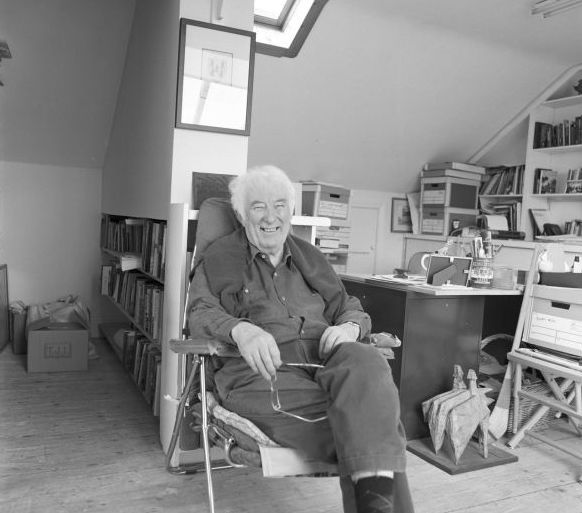
Photo with thanks to the Bobbie Hanvey Photographic Archive/Boston College.

Marcus Bales, ‘Suddenly’

Suddenly the kids, the car,
the house, the spouse, the local bar,
the work, have made you what you are.
What doesn’t chill you makes you fonder.

Should you stay or should you go?
The thrill you’re looking for, you know,
could be right here at home, although
what doesn’t thrill you makes you wander.

If, avoiding common truth,
you dye your hair and act uncouth,
will you find your misplaced youth –
really, will you if you’re blonder?

It doesn’t matter if you’re strong
or if you sing a pretty song,
something, and it won’t be long,
will come to kill you, here or yonder.

You’re human in the human fray,
and choose among the shades of grey.
No matter if you go or stay
what might fulfill you makes you ponder.

*****

Marcus Bales writes: “This is a little more than a decade old, back when I still had a full time job. There is something looming in a life about a full time job that’s hard to escape entirely even when you’re determined to try. Must have been a bad day on the sales floor.

“This is one of those poems where a rhythm enters my mind and won’t go away until I put words to it. Of course it already HAD words to it, but I couldn’t use those. So after one quatrain it became a challenge to see how many of that refrain rhythm it was possible to make sense with. That’s actually sort of freeing, because once that becomes the challenge, it opens the poem, for me anyway, to using the randomness of the rhyme words, as they arise, to drive each stanza’s, and thus the whole poem’s, sensibility. This is a good example of how the aleatory dice of rhyme can be used to open up opportunities to say things I wouldn’t have thought of to say at all without having to work toward the rhyme word. This can be very bad for a poem, of course — one of the main ways to judge poems in meter and rhyme is on how hard it is to tell whether the poet was using the rhyme words that way or not. The goal, of course, in almost all rhyme, is to delicately decorate the poem rather than for it to be clear that the poet was merely chasing a rhyme. And when there’s a rhyming refrain line the danger is extreme.

“I remember being pretty happy with it at the time. I do like the way something seems to loom over the narrator, pressing him onward through his meditation, and providing, I hope, the reason that meditation is needed.”

‘Suddenly’ was first published in The Rotary Dial, which is now offline… but this issue, the Best of 2015, is at https://midnightlanegalleryii.wordpress.com/wp-content/uploads/2014/10/7c8e9-december15.pdf

Not much is known about Marcus Bales, except he lives and works in Cleveland, Ohio, USA, and his work has not appeared in Poetry or The New Yorker. His latest book is 51 Poems; reviews and information at http://tinyurl.com/jo8ek3r

Photo: “Decisions decisions ..” by monkeywing is licensed under CC BY 2.0.
Lindsay McLeod, ‘Harvest’

There’s just so many nows in forever
if we’re apart or together as one,
we’d better cherish them all if we’re clever
make the most of our time in the sun,

‘coz it’s where we are led whether up or in bed
there’s one funeral we all must attend,
because somewhere ahead the sea kisses the sky
and the name of that place is the end.

*****

Lindsay McLeod writes: “‘Harvest’ was made as an end piece for the second book I wrote for my daughter.” It was originally published in Grand Little Things.

Lindsay McLeod currently lives by the sea on the Southern edge of the world, where he trips over the offing every morning. He has been published here and there in the past and won a few awards. He has started messing about with words again lately after a few necessary years away. You might expect him to know better by now, but oh no.

Photo: “Another Timor Sea sunset from Casuarina Beach, Darwin, NT, Australia” by Geoff Whalan is licensed under CC BY-NC-ND 2.0.

Semi-formal poem: Susan de Sola, ‘Bounty’

The fruit flies find our fruit, they slip
beneath the lid, a silver dome.
The dark fruit scent has drawn them in,
no other lures them out again.
They settle on apples, puckered figs,
they gorge in perpetuity,
may never fly back to their home,
(if they have ever had a home).
An allegory of choice? Well, yes–
in that we have no choice.
The fruit is fine, the day is long.
Let us feed, buzz, rejoice.

*****

Susan de Sola was a native New Yorker who earned a PhD in English Literature at Johns Hopkins, took a job at Amsterdam University… and stayed, married, raised five children. Published in the Hudson Review, PN Review, and The Dark Horse, she won the David Reid Poetry Translation Prize and the Frost Farm Prize. Her less serious work appeared in Snakeskin, Light, Lighten Up Online, and a couple of her poems were reprinted in Potcake Chapbooks. She was widely loved for her creativity, warmth, and sense of fun. She died from lymphoma in 2021, age 59.

‘Bounty’ is the final poem in her only published collection, Frozen Charlotte, published by Able Muse Press in 2019.

Photo: “Fruit flies from fig” by Alejandro Erickson is licensed under CC BY-NC-SA 2.0.

Tom Vaughan: ‘Is This It?’

Well if it is, and this is it
then what will be will be
and time will toil and time will tell
if there’s a guarantee

that at the least and at the last
the daily here and now
which now and here are thick as thieves
will be transformed, somehow

and either way, here’s my advice –
lie back and think of all
the ups which came between the downs
before your curtain call.

*****

Tom Vaughan writes: “There was no particular trigger for this poem, apart from my fitful attempts to be Stoical about the state – and weirdness – of the world. But just at the moment the anger occasioned by the former keeps breaking through.”

‘Is This It?’ was published in the current Lighten Up Online.

Tom Vaughan is not the real name of a poet whose previous publications include a novel and three poetry pamphlets (A Sampler, 2010, and Envoy, 2013, both published by HappenStance; and Just a Minute, 2024, from Cyberwit). His poems have been published in a range of poetry magazines, including several of the Potcake Chapbooks and frequently in Snakeskin and Lighten Up Online. He currently lives in Brittany.
https://tomvaughan.website

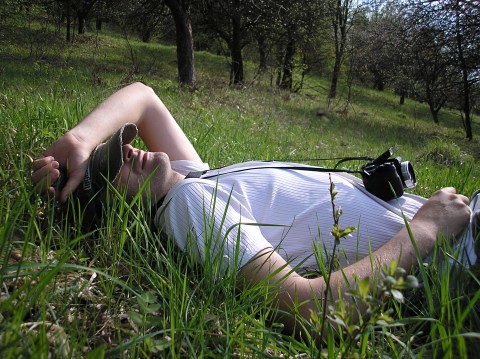
Photo: “man-relaxing-in-the-grass_8954-480×359” by Public Domain Photos is licensed under CC BY 2.0.

Using form: Rondeau: J.D. Smith, ‘Sans Issue’

What ends with me? A set of genes,
The notion that my slender means
Might turn into a son’s estate,
The hope that, at some distant date,
Beside my grave, my line convenes

To recollect my days’ routines,
My counsels, and the vanished scenes
Whose witnesses would recreate
What ends with me:

The consciousness that struts and preens
In holding that its passing means
An altering of our species’ fate,
My thought possessed of untold weight.
Yet, on that thought, the question leans–
What ends with me?

*****

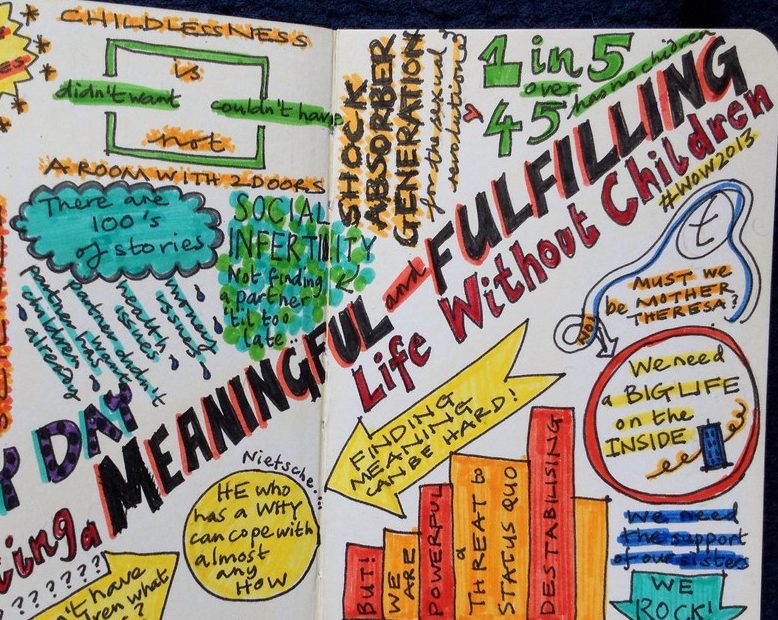
J.D. Smith writes: “After reaching a certain age and making certain commitments, I found myself coming to grips with never being a parent. As in other instances of following form, the repetitions of the rondeau gave me a way to enclose and develop my response to the situation.”

J.D. Smith has published six books of poetry, most recently the light verse collection Catalogs for Food Loversand he has received a Fellowship in Poetry from the United States National Endowment for the Arts. This poem is from The Killing Tree (Finishing Line Press, 2016). Smith’s first fiction collection, Transit, was published in December 2022. His other books include the essay collection Dowsing and Science, and his seventh collection, The Place That Is Coming to Us, will be published by Broadstone Books in 2025. Smith works in Washington, DC, where he lives with his wife Paula Van Lare and their rescue animals.
X: @Smitroverse

Photo: “Creating a meaningful and fulfilling life without children #sketchnotes #gatewaywomen #jodyday” by etcher67 is licensed under CC BY-NC-ND 2.0.

Morri Creech, ‘Mileage’

The car mechanic’s counting out his bills
behind the E-Z Mart at one a.m.;
he’ll toss rocks at beer bottles just for thrills
until his dealer comes, it’s fine with him.

He draws in a deep breath and sees the light
swerve from the highway, puzzling the back wall
he leans against just to keep out of sight.
A quarter bag and some fentanyl, that’s all.

His phone vibrates again though nothing’s wrong.
For two years he’s been living in a trailer
with a girl who works at Publix. They get along
even if sometimes she says he’s a failure—

what can he say to that? Sure. He lives cheap.
They’ll fight until she forces a decision,
then roll around on the couch. Once she’s asleep
he’ll take a dose and watch some television.

At night he dreams of cylinders and sprockets,
the trucks and cars too busted up to fix;
startled awake, eyes aching in their sockets,
he’ll watch the clock hands grope their way to six.

A car pulls up but he can see it’s not
his hookup. Just kids with nothing else to do
but drink a six-pack in the parking lot
before they head out to the lake to screw.

He had his share of mischief, too, Lord knows.
The girls don’t eye him in the check-out aisle
much anymore, the ones with painted toes.
A few years back, at least, they used to smile.

The boys can see the grease that stains his hands;
they all think, damn, who wants to work that hard?
He spends the day beneath their dads’ sedans
while they play tackle football in the yard.

Chasing a football blew out both his knees
and broke his wrist. That was three years ago.
Customers say, “go Stags,” and toss their keys,
then look at him real close as if they know.

A text says no one’s coming. The BP sign
flickers over the pumps, and though it’s half-
past two now, and he’s tired, he’s feeling fine
enough to think it’s all a bust, and laugh.

And, anyway, it’s good to be alone
with the gas fumes and blinking traffic light
and fifteen missed calls lighting up his phone.
Later, he thinks, once he and his girl fight,

and once she falls asleep on his left arm,
he’ll stare at the divots on the ceiling tile
and wait to hear the clock sound its alarm
while the night’s odometer counts one more mile.

*****

Morri Creech comments: “As Mark Strand once said, I write to find out what I have to say. I don’t start a poem with an idea; I start with a line, an image, a rhetorical stance. Then I write in search of context: how can I situate this in a situation, a narrative moment, an argument, a meditation? The language takes me wherever I end up. This poem was constructed like that. I started with a first line and then wrote toward trying to figure out the context of the line. In this case, it led me to a character sketch. It was fine to discover what this character was about; the decisions I made about his character and circumstances were largely directed by rhymes. They steered me in what I hope was the right direction.”

Morri Creech is the author of five collections of poetry, including the Sleep of Reason, a finalist for the Pulitzer Prize, Blue Rooms, and The Sentence (published by LSU Press, and which includes this poem). A recipient of NEA and Ruth Lilly Fellowships, as well as North Carolina and Louisiana Artists Grants, he teaches at Queens University of Charlotte.
www.morricreech.com

Photo: “Let’s Talk Tires” by gfpeck is licensed under CC BY-ND 2.0.

Semi-formal: RHL, ‘Terminal’

Christian culture’s crucifixation
nails us to our seats as, station by station,
we travel the trammelled line
until we find
that terminal
more primal.

The humanstrain’s end-of-line stop
is Ragnarok.
Everyone please disembark
into the dark–
no light, no map.
Mind the Ginnungagap.

*****

This is as close as I get to religion: existential uncertainty. I’m a Militant Agnostic: “I don’t know… and neither do you!” Yet this attitude is apparently compatible with religion, being not that different from Eliot’s ‘East Coker‘:
O dark dark dark. They all go into the dark,
The vacant interstellar spaces, the vacant into the vacant,
The captains, merchant bankers, eminent men of letters

(…)
I said to my soul, be still, and let the dark come upon you
Which shall be the darkness of God.

But Christianity? I think not. Altogether too unlikely, with so many impossibilities packed into such a small understanding of the cosmos. We don’t know where we are headed, not just as individuals with finite lives, but as a species that is simultaneously developing space travel and genetic modifications… the possibilities are endless and the future, dark as well as light, is unknowable.

The poem is semi-formal with its loose iambics and paired rhymes or slant rhymes, but no structure beyond its natural flow. It was originally published in the Experimental section of a 2019 issue of Better Than Starbucks, and republished as part of work being spotlighted in The HyperTexts in August 2024.

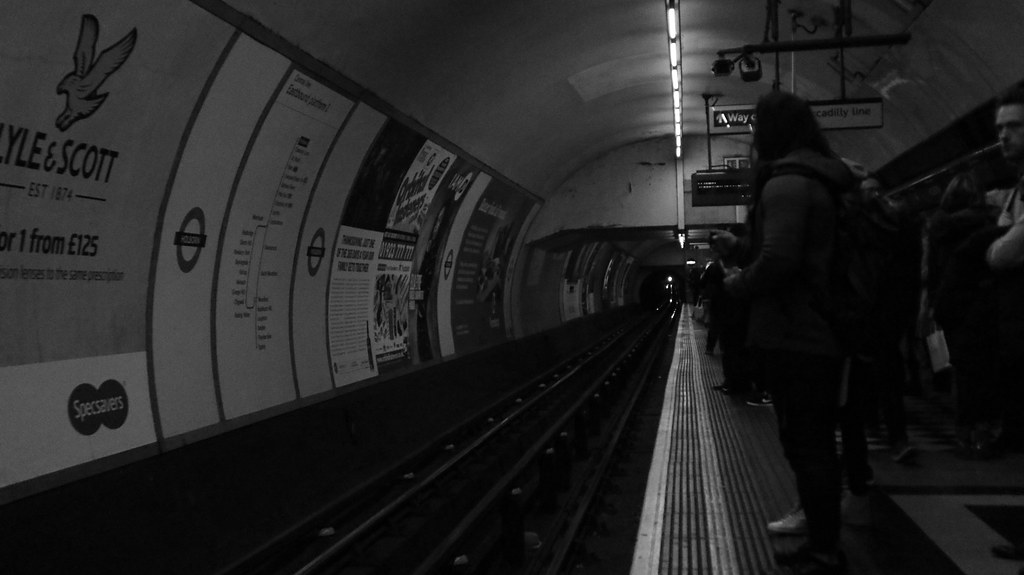
Photo: “London Holborn tube station in Black and White effect” by Patrick Cannon Tax Barrister is licensed under CC BY 2.0.

Sonnet: Melissa Balmain, ‘Memo to Self, in Bed’

Don’t think, while you are holding him, of deadlines,
of monster Visa bills you haven’t paid,
of NPR reports on gangs and breadlines
and kooks with nukes available for trade.

Don’t think of whom you owe a three-course dinner,
of editors you wish you had impressed,
of whether you should be two sizes thinner
and twice as nice to look at when undressed.

Above all, never think of how time’s racing
toward commonplaces you’re afraid to name–
white halls, bleak calls, the foregone mortal ending;

how you or he (which one?) will soon be facing
long nights where solitaire’s the only game.
Don’t think: just wink at him and keep pretending.

*****

From Walking in on People © Melissa Balmain, 2014. Used by permission of Able Muse Press.

Melissa Balmain writes: “Like many formalist poets, I miss the Nemerov Sonnet Award (for which this poem was a finalist). The Nemerov spurred many of us to write more sonnets, and gave us terrific ones to read when the winners and finalists appeared in The Formalist and, later, Measure. Other contests have emerged to fill the post-Nemerov void, including the wonderful Kim Bridgford Memorial Sonnet Contest, sponsored by Poetry by the Sea. Still, I’d love to see the Nemerov come back somehow–the more good sonnets, the merrier.”

Editor’s comment: In addition to the sonnet’s expected rhymes at the end of each line, Melissa Balmain has thrown in a bonus internal rhyme at the beginning of the last line of each quatrain and tercet. It is quietly done, but adds lightness to a poem that is both light and dark in subject matter.

Melissa Balmain’s third poetry collection, Satan Talks to His Therapist, is available from Paul Dry Books (and from all the usual retail empires). Balmain is the editor-in-chief of Light, America’s longest-running journal of light verse, and has been a member of the University of Rochester’s English Department since 2010.

Photo: “New Bedding!” by Andrew Love is licensed under CC BY-NC-SA 2.0.