Tag Archives: formal verse

Potcake Poet’s Choice: Marcus Bales, ‘Shore’

They grind across the continental shelf,
enormous in their long, well-muscled swells;
I know their sweaty smells of staling spray
and fishy sand; and oh, all by myself
I’ve heard the tide tell what it always tells:
some things wash up and others wash away.

They rise out there a long way from the beach,
and curl and pitch up face down on the sands
from roaming just too far to make it home,
and try to hold with fingers scrabbling, reach
for us, and fail and, failing, trail their hands
under water backwards in the foam.

Finally, though, the greyest weather clears:
small lapping waves replace exploding spume,
and one deep-breathing moment seems sublime;
sweet breezes sway embroidered window sheers
while pleasant sunlight fills the hospice room,
now empty, clean, and ready for the next time.

Marcus Bales writes: ‘The problem with me choosing or talking about one of my poems is that the impetus behind most of them is the same: a phrase or circumstance became a donnee because it resonated in some instant way, and I used it — and sometimes the actual donnee doesn’t survive the process of writing — to write something. It’s the resonance that interests me to turn the phrase over and look at it, clean it up, smear it with something, make it start, make it finish, bury it in the middle, whatever. The question that strikes me about a phrase with resonance is why does it resonate? The poem is the answer. In my view poetry is what a poet does to make a reader feel that resonance by putting it in a context that moves the reader to a feeling. I reject the notion that poetry is the poet expressing their feelings — at least, I don’t say poets cannot express their feelings, but that that expression must be in the service of making the reader feel the reader’s feelings in a directed way. Poetry is a method to make the reader resonate emotionally in response to the words.. If the best you can do is blurt out your pain or joy or whatever, then you’re doing it wrong. Yes, wrong. Write it in your diary, because poetry has never been about the poet. It’s always been about how the poet can make the reader feel in a directed way by using words, not a therapy-substitute for the poet. If you need therapy, get it, but don’t scatter the resulting words across ragged-margined pages and call it poetry.’

Not much is known about Marcus Bales except that he lives and works in Cleveland, Ohio, and that his work has not been published in Poetry or The New Yorker. However his “51 Poems” is available from Amazon.

Marcus Bales has appeared in several of the Potcake Chapbooks:

Tourists and Cannibals
Rogues and Roses
Careers and other Catastrophes
“Strip down,” she ordered
Wordplayful
Murder!
Houses and Homes Forever
Robots and Rockets

all available at https://sampsonlow.co/potcake-chapbooks/ for the price of a coffee.

Potcake Poet’s Choice: Amit Majmudar, ‘Eyespots’

Caterpillars build their bunkers out
of terror. Transformation hunts them, haunts them
as oak leaf peepholes open underfoot
to bare the air, the emptiness that wants them.
I have a measure of infinity
inside me. A is no and mit is measure
in an ancestral tongue that haunts me, hunts me.
I’m half in love with what I have to be.
The other half is looking for a razor
to make of me the Amit who was once me,

my yogi’s beard a clump of Spanish moss
limp at my feet, a piece of furry roadkill.
I’m no ascetic. Half in love with loss,
I’ll seek out beauty, or at least my ode will,
night-blooming jasmines dooming my samadhi,
scenting, resenting my hermetic dark
because they know a yogi, breathing in
his first girlfriend’s perfume, unarchives her body,
and drives her, after dusk, to the vanished park
where memory of sin cocoons the sin.

Caterpillars ravel bunkers into
bodybags—no way for them to know
the moment that they poke themselves a window,
the rebirth they were hiding from will show:
Two stained-glass windows mounted on my back,
two earshaped eyespot petals I can flex
and fold, a flailing that transforms to flight
while all the darkling jasmines that I lack,
past loves that called me onward to the next,
unpetal in the bodybag of night.

In love, or half in love, with mere aesthetics,
I’ve daydreamed Himalayan caves, a hive
that hums with “Aum” from ninety-nine ascetics,
their senses hibernating, half alive.
No one has ever scaled Kailash, the peak
where Shiva sits in bud, in shut-flytrap samadhi
with ashes smeared across his chest and arms.
But that’s just not the changelessness I seek.
I want my language, shapely as a body,
to weave and rive cocoons, enchantments, forms

with giant wings inside their ashgray berries.
I want my transience to live in speech,
if only as a resonance that carries,
like jasmine scent, beyond my voice’s reach.
I tell myself: Old soul, don’t be afraid
of changing. You are old enough to know,
whenever something changes, something dies,
but the dark you flowered in won’t let you fade.
A crack in this cocoon admits a glow.
The blue moon butterfly will wear your eyes.

Amit Majmudar writes: “This poem, ‘Eyespots’, is what I think of as a Keatsian ode, borrowing its stanzaic form and (I hope) something of its musicality. Yet the poem incorporates Hindu religious imagery throughout and sings of self-transformation in a way that isn’t to be found in Keats. This hybridization of Eastern and Western traditions in the poem feels idiosyncratic. There remain elements still opaque to me about it; so I never really delved into the metaphysical significance of the title’s false eyes, these seeming sense organs that are not actually sensing anything, but, given the focus on ascetic imagery, there seems to be something in that. Maybe in another essay? Or another poem….

I feel as though there are poems I have written that someone else could conceivably have written. But not this one; even ignoring that my name hides caterpillar-like inside the cocoon of the poem, I feel that the range of influences and ideas is simply too idiosyncratically “me” for this to have come from any other poet’s hand. Will everyone like it? Probably not, for precisely that reason. But I know that no one else could have produced this sequence of words, so I confess a certain fondness for it. It’s the one of my literary children who most resembles me. And it’s as good a way as any to get to know me as a writer.”

Amit Majmudar is a diagnostic nuclear radiologist who lives in Westerville, Ohio, with his wife and three children. The former first Poet Laureate of Ohio, he is the author of the poetry collections What He Did in Solitary and Dothead among other novels and poetry collections. Awarded the Donald Justice Prize and the Pushcart Prize, Majmudar’s work has appeared in The New York Times, The New Yorker, Best of the Best American Poetry, and the eleventh edition of The Norton Introduction to Literature. Two novels are forthcoming in India in 2022: an historical novel about the 1947 Partition entitled The Map and the Scissors, and a novel for young readers, Heroes the Color of Dust. Visit www.amitmajmudar.com for more details.

‘Eyespots’ was first published in Measure Review.

Sonnet: ‘The Fall of Rome’

Jesus, a preacher with fake miracles,
his “Sea” of Galilee just eight miles wide–
rebelling against Rome and crucified–
his failure clear (though words were lyrical)…
you’d think “Messiah” was satirical!
But epileptic Paul a chance descried
to shut out other gods and thoughts worldwide,
thus sealing up Rome’s vital spiracles.
So, building on apocalyptic fears,
the Jewish Jesus ends where Paul begins.
Scientists, artists, poets, engineers,
are suffocated as the new faith wins.
All progress is set back a thousand years.
The Roman Empire died for Jesus’ sins.

Belief is strange. Take Covid vaccination: two thirds of us believe it’s an effective way to save lives, one third of us believe it’s a dangerous and unscrupulous way to make money and control people. Virtually no one has actually done any research and analysis of the issue, we just listen to our preferred sources of information and the community we’re a part of.

Or take religion: for the most part, children raised in Christian families remain Christian believers all their lives, Muslims remain Muslim, Buddhists remain Buddhist, and so on. Which makes it all the more impressive when someone can radically change the belief structure that surrounds them. Kudos then to the epileptic Paul of Tarsus, who created a Jewish-Mithraist-polytheist mishmash that has lasted almost 2,000 years. Pity about the Roman Empire, though.

This happily Petrarchan sonnet (iambic pentameter, and rhyming ABBAABBA CDCDCD) was originally published in Rat’s Ass Review, where respectfulness and respectability are not required. Thanks, Roderick Bates!

“Darkness Falls in Rome” by Storm Crypt is licensed under CC BY-NC-ND 2.0

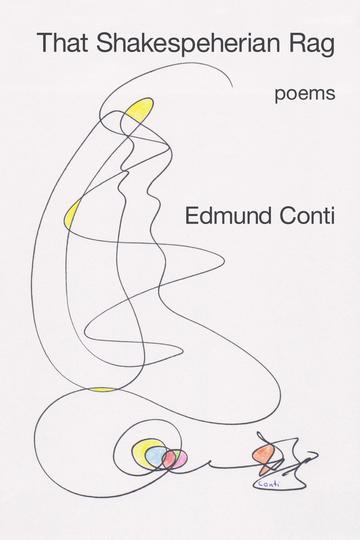
Review: ‘That Shakespeherian Rag’ by Edmund Conti

The problem of being
a 17-year
locust
is trying to stay
for 16 years
focused.

That poem is ‘Short Attention Span’ from Edmund Conti’s latest collection of verse. Originally the title was to be ‘O O O O’ in reference to T.S. Eliot’s lines from The Waste Land where the poet is being criticised by his wife:

“Are you alive, or not? Is there nothing in your head?”
But
O O O O that Shakespeherian rag—
It’s so elegant
So intelligent

It seems that the publishers sensibly preferred a title that would be more comprehensible, without the confusions of O and 0. So the next part of the quote was chosen–still idiosyncratic, but more useful. And, yes, Conti seems to have poetry singing rhythms in his head all the time, and he produces beautiful jazz-like drawings as in the book’s cover.

Both titles for the collection are pure Conti–he has a playful, Zen-like approach to life, highly literate, constantly referencing other writers (and other writers referencing other writers), expecting a level of knowledge and engagement from the reader, and often reducing his expositions to the shortest possible. So this latest volume is full of memories and meditations, jokes and puns, and threaded through with the words of others. Conti divides the book into 11 Shakespearean sections, starting with memories of childhood and youth, and then weaving through reading and writing, books and poetry, his neighbors and family (and their views of his verse), into a closer and closer look at mortality: the last four pieces having respectively four lines, two lines, one line, and nothing.

Conti writes both formal and free verse, depending what kind of playfulness he’s up to. When he parodies Emily Dickinson, of course it’s in her standard ‘The Yellow Rose of Texas’ meter and rhymes ABAB. But he’s a lot more free when he just wants some snide commens and a punchline. Here’s ‘Losing Battle’:

In a final desperate attempt
at survival, the sun sets
fire to the western sky.
Overblown, say my poet friends.
Cute, say my non-poet friends.
What does it mean? asks my neighbor.
How much will you get paid for it?
That’s from my wife.

My father’s an astronaut,
my son lies.

Engaging, amusing, thought-provoking, with many short passages that stay in the memory. A fun book for all poets. Just published this month by Kelsay Books.

Review: ‘Ruth Pitter, Selected Poems’

An excellent selection of some of the better-known and some of the previously uncollected poems of one of the 20th century’s least known but most accomplished poets. Ruth Pitter‘s first book of poems was published with the help of Hilaire Belloc in 1920; her work was admired and praised by Yeats, Larkin, Skelton and Gunn; she was the first woman to win the Queen’s Gold Medal for Poetry in 1955, and was awarded a CBE in 1979. She died in 1992.

My personal favourite in this large chapbook from HappenStance is “Smoky Kettle, Stinging Nettle”, for its magical incantation of life and afterlife, of love and loss, of the countryside and all things human:

Smoky kettle,
Stinging nettle,
Lily my darling,
Toad and starling,
Fox in wood,
Solitude,
O be there, be there again,
When my end I shall attain,
When the knot is all unravelled,
And the tangled path is travelled.

But the poem is not typical of her work, and was not previously collected in a book. More commonly her style is like the beginning of ‘Spectrum’:

A little window, eastward, low, obscure,
A flask of water on the vestry press,
A ray of sunshine through a fretted door,
And myself kneeling in live quietness:

Heaven’s brightness was then gathered in the glass,

Her usual style is quiet, understated, with simple metre and rhyme scheme. Often there is a religious element–she was a friend of, and was influenced by, C.S. Lewis–and even an element of Anglican hymns. But none of that was enough to stop the militantly atheist Philip Larkin from including four of her poems in The Oxford Book of Twentieth Century English Verse. And I found enough of interest in this 44-page chapbook to warrant ordering a copy of her ‘Collected Poems’, to explore further.

Short Poem: ‘Cultural Field Trip’

Properly stroppily,
Off to Thermopylae
Busloads of schoolchildren
Grudgingly go;
Hoovered, manoeuvred
Off into the Louvre’d
Be better for profs who are
Trudgingly slow.

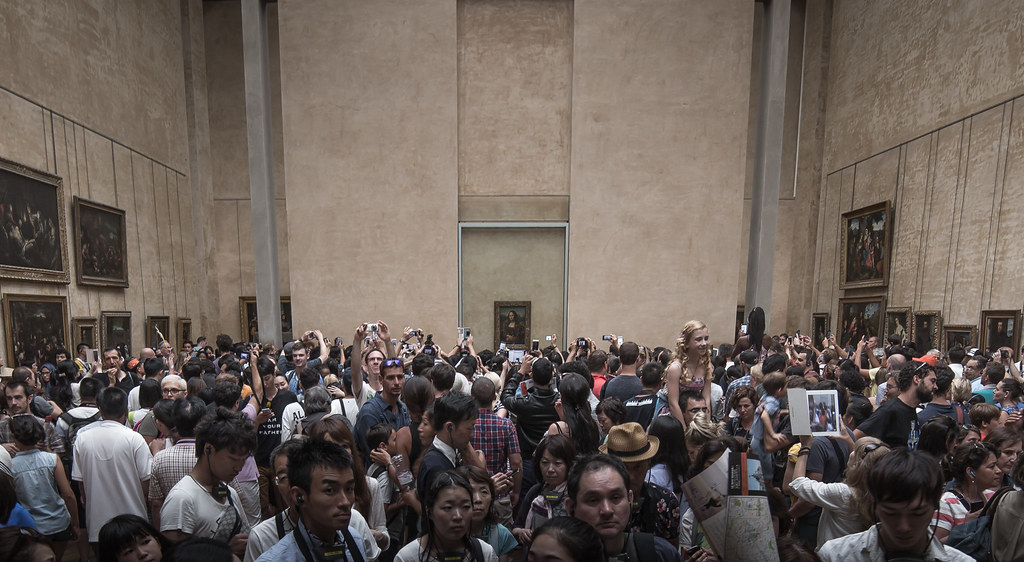
No, I agree, that’s not a true Double Dactyl because it doesn’t have a single-word double dactyl line. It’s just one of those poems I’ve written for no other purpose than to play with rhymes. The poem was published in this month’s Snakeskin, editor George Simmers privately commenting: “As an ex-teacher I empathise with the trudging profs.”

“Mona Lisa Madness” by Joe Parks is licensed under CC BY-NC 2.0

Short Poem: ‘Old Soldiers’

Sitting blowing bubbles
Each one a tiny world
Of monumental troubles
And how they all unfurled.

“The desert, Cairo, jaunty,
A blue room and whore –
And so I said to Monty –
And so we won the War!”

Bernard Law Montgomery, afterwards Viscount Montgomery of Alamein, was Britain’s star commander of the Second World War. “Unbeatable and unbearable” from North Africa to northwest Europe where he had control of all Allied land forces under Eisenhower, he was the figure that British veterans tended to suggest that they had had some useful contact with.

Always arrogant, opinionated and outspoken, he later opposed American tactics in the Vietnam War, as in the New York Times in 1968: “The United States has broken the second rule of war. That is: don’t go fighting with your land army on the mainland in Asia. Rule one is, don’t march on Moscow. I developed those two rules myself.” Familiar enough to fans of Risk and Civilization and The Princess Bride…

“Two Old Soldiers” by jf01350 is licensed under CC BY-NC-SA 2.0

Sonnet: ‘One True Religions’

No vision brings the whole world to its knees.
Jains, Hindus, Buddhists, Mithraists, Parsees,
Moses, Muhammad, Jesus or St. Paul,
One True Religions never conquer all.
Humans are simply too cantankerous
for any one belief to anchor us.

Success at once leads into sects and schisms:
the One Pure Ray of Light hits human prisms,
and egos, power grabs, love of dispute,
traditions, curiosity, all loot
the intellectual wealth of strong belief.
This year’s great guru’s merely last year’s thief.

Control’s maintained by sword and flame, not thought.
In failure, drink the Kool Aid or get shot.

Well, maybe 14 lines rhymed in pairs isn’t really a sonnet, even if it’s in iambic pentameter. But when you’ve got a structure that works for a poem, I don’t think it’s worth trying to hammer it into a different shape just to try to reach a “higher” standard. Anyway, sonnet or not this poem was published in Rat’s Ass Review – as you could guess from the journal’s name, editor Roderick Bates publishes whatever appeals to him, with no apologies for treading on other people’s sensibilities, religious, poetic or anything else. It’s a good place to submit a poem that other journals might be squeamish about, and a good place to read a wide range of outspoken poetry.

“Jonestown massacre” by johndavison883 is marked with CC PDM 1.0

Call for Submissions: Christmas etc holiday poems

It has been suggested that the Potcake Chapbooks really ought to include one for the Christmas season, as people already send out some of the chapbooks in place of greeting cards to friends and family. Well, it’s August – if I can find a wide enough assortment, perhaps we can get a chapbook out by the beginning of November… otherwise, we should be able to do it by next year.

What I’m looking for, of course, is a diversity of poems in a diversity of forms, but all with rhythm and rhyme. Not too long, because there will only be 13 pages of poetry – two to 20 lines preferred. With a mix of attitudes: sentimental, cynical, happy, rueful, whatever, but preferably elegant and witty. And not just Christmas, but all holidays of the season: Hanukkah, Divali, Kwanzaa, Festivus, New Year’s Eve, office parties, skating parties, special meals and drinks, customs and habits… (And of course I can only take 12-15 poems anyway.)

That’s a lot to ask for a little chapbook, we’ll have to see if it’s workable. If you have something you think I might like, on this or any other topic, preferably previously published, please send poems in the body of the email or as a single attachment to robinhelweglarsen@gmail.com. Contributors receive five copies.

Photo: “Christmas Cookies” by Kiss My Buttercream is licensed under CC BY-NC-SA 2.0

Resources: Goodreads

Goodreads’ stated mission is to help people find and share books they love, and to improve the process of reading and learning throughout the world. (That was crafted before they were bought by Amazon, so their mission may have a somewhat more mercenary aspect these days.) Founder Otis Chandler got the idea when looking at a friend’s bookshelf, and wishing there was a way to share discoveries and opinions of books online. Launched in January of 2007, by December it had 650,000 members–clearly it was on to something! And by the end of 2019 (i.e. pre-Covid) it had 90 million members, a number that can only have grown since then.

It’s a place where you can spend your time in a variety of ways: making shelves of the books you’ve read, sorting them by topic, giving them 1 to 5 stars, writing reviews of them… Developing a list of friends to follow or to share reviews with, joining a group with topics that you like, using the site to find books you are likely to enjoy… Setting a goal of how many books to read in the coming year, and having Goodreads track your progress, praising you or nagging you depending on whether you’re ahead of schedule or behind.

More completely, “Goodreads,” says Wikipedia, “is an American social cataloging website that allows individuals to search its database of books, annotations, quotes, and reviews. Users can sign up and register books to generate library catalogs and reading lists. They can also create their own groups of book suggestions, surveys, polls, blogs, and discussions.”

Because my main reading these days is formal poetry (of course–though leavened with Simenon, Le Guin and thick works of history) I have been looking to see what kind of poetry groups operate in Goodreads. I only found one of formal verse, with half a dozen members, and dormant for over a year. So I have started a new one called ‘Formal Verse – Mostly’. If you, reading this, are interested in reading, writing or discussing formal poetry, old or new, your own or that of others, then consider joining us.

But even if you don’t want to be that active, don’t want to join a group, Goodreads still offers a range of benefits for all readers. I’ve been reading more each year for the last few years, largely thanks to the Reading Challenge and being nagged when (as now) I’m behind schedule.

Photo: “My Books” by Jennerally is licensed under CC BY-NC-ND 2.0