Perhaps it’s true, as Twain implies, statistics are the greatest lies but point for point and size for size, I think they tie for major prize with poets’ modest little ‘i’s.
*****
Margaret Ann Griffiths, aka Maz, aka Grasshopper, was a British poet known almost exclusively for her online work. In his Preface and Personal Recollection, editor Alan Wickes speaks of her “belligerent modesty” and her lack of interest in the preservation of her verse. In 2008, after winning Eratosphere‘s annual Sonnet Bake-off with “Opening a Jar of Dead Sea Mud” and being praised by Richard Wilbur, she was a Guest Poet on the Academy of American Poets website, where she was hailed as “one of the up-and-coming poets of our time”.
Her poem ‘Lies’ speaks volumes (in a brief space) about the different types of modesty available to creative figures. Her reputation for wit, intelligence, astute criticism and kind-heartedness goes well with her wide-ranging subjects and diverse styles of verse. She was the preeminent English-language online poet of the early 21st century.
Her work was posthumously collected by fans and fellow poets in the 2011 ‘Grasshopper‘ from Arrowhead Press and Able Muse Press.
What a worthless thing is poetry, a product of hard labor I adore; a counter full of year-old toiletries will always fetch considerably more.
A merchant selling gift-wrapped bars of soap will come away with profit and some change; to sell a poem is no more than a hope washed clean of what a market can arrange.
Here! Have a few of mine, two for a quarter— a dime apiece—the bargain of the day… just name it! I’m here to take your order. Hard labor’s even hard to give away.
*****
Donald Wheelock writes: “I have spent most of my life as a composer of vocal, orchestral and chamber music. While remuneration for song cycles and string quartets is not unknown, the profits from commissions and other sources rarely exceed the expenses. I don’t have to tell the readers of formalverse that the same could be said for formal poetry. The conceit of this poem has been an assumption in my life for many years, and equivalent jokes among composers of “classical concert music” are not uncommon.
I have written formal poetry for almost as long as I have music, often to set to music. But it is relatively recently that I have submitted it to journals welcoming formal poetry. Snakeskin (where this poem was first published), Able Muse, Think, Blue Unicorn, Rue Scribe, Quadrant and many other journals have published my poems. My first full-length book, It’s Hard Enough to Fly, was published by Kelsay Books in 2022. My second book, With Nothing but a Nod, will appear in May of this year from David Robert Books.”
When I looked at her, and when her lips Pulled back to show her teeth, and when her voice Broke into laughter, I could only think Of moments that I’d pissed away, each choice I’d left to others, and the careless slips That landed me beside an empty drink. That afternoon, I could have sworn I saw A thinner, hopeful version of my face Staring from behind her retinas– Familiar, yes, the eyes, the skin, the jaw, But in that instant somehow out of place. It cast a knowing frown. The gravitas Was overbearing. Nonetheless, we filled The void with gossip, anecdotes and smut, Comparing chatty journals–note by note. Like poets, we dissembled in the rut That each of us was in, our chances killed By loss of nerve or failure to emote. But still, a sneer could not have hurt me more Than her clear laugh that sang of expectations So long forgotten from a distant day When youth still spread before me, and the poor And pitiful attempts at explanations Still lay in ambush, only years away.
*****
Quincy R. Lehr writes: “This poem was literally about running into a high school friend of mine by chance on the day I defended my doctoral dissertation (though that’s not in the poem). It’s funny how old I thought I was at twenty-nine.”
Born in Oklahoma, Quincy R. Lehr is the author of several books of poetry, and his poems and criticism appear widely in venues in North America, Europe, and Australia. His book-length poem ‘Heimat‘ was published in 2014. His most recent books are ‘The Dark Lord of the Tiki Bar‘ (2015) and ‘Near Hits and Lost Classics‘ (2021), a selection of early poems. He lives in Los Angeles. https://www.amazon.com/Quincy-R.-Lehr/e/B003VMY9AG
The Head was ambitious and nobody’s fool, A big man, efficient, and proud of his school.
At the start of the term, as he sorted his post, The item of mail that intrigued him the most
Was a piece puffing National Poetry Day, Including a list of the poets who’d stay
And workshop and somehow persuade the whole school That poets were ‘groovy’ and poems were ‘cool’.
‘Here’s status,’ the Head thought. ‘It’s not to be missed.’ The one problem, though, was the names on the list;
Though doubtless they wrote quite respectable stuff, Not one of them, frankly, was famous enough.
His school deserved more; his ambition took wing, And so he decided to do his own thing.
With his usual flair, and with chutzpah exquisite, He invited the whole English canon to visit.
Geoffrey Chaucer came first, on an equable horse, And Spenser, and Marlowe, and Shakespeare, of course
(Who was grabbed by the teachers of English, imploring ‘Do come and persuade the Year Nines you’re not boring.’)
Keats arrived coughing, Kipling marched vigorously; Matthew Arnold began to inspect the school rigorously –
Which delighted the Head, who with pride and elation Showed the bards of the ages today’s education.
Vaughan was ecstatic, though Clough was more sceptical. Ernest Dowson puked up in a litter receptacle.
Coleridge sneaked off to discover the rates Of an unshaven person outside the school gates;
Soon he’d sunk in a private and picturesque dream, While Auden was ogling the basketball team.
Plath lectured the girls: ‘Get ahead! Go insane!’ Algernon Swinburne cried: ‘Bring back the cane!’
Dylan Thomas soon found the head’s cupboard of booze, And Swift was disdainfully sniffing the loos.
And then the Head twigged, with a horrified jolt, That something had sparked a Romantic revolt.
Shelley’d gathered the students out in the main quad, And roused them to rise against school, Head, and God.
Byron soon joined him, and started to speak. (He showed his best profile, and spouted in Greek.)
The bards of the thirties were equally Red, And Milton explained how to chop off a head.
Decadents undermined all the foundations. Surrealists threw lobsters and rancid carnations.
Pre-Raphaelites trashed the technology room And the First World War poets trudged off to their doom.
Sidney with gallantry led a great charge in (Tennyson cheering them on from the margin).
The Deputy Head, who was rather a dope, Got precisely impaled on a couplet by Pope
(Who, while not so Romantic, was never the chap To run from a fight or keep out of a scrap).
Then the whole solid edifice started to shake As it was prophetically blasted by Blake.
Soon the School was destroyed. Eliot paced through the waste, And reflected with sorrow and learning and taste,
Which he fused in a poem, an excellent thing, Though rather obscure and a little right-wing.
He gave this to the Head, who just threw it aside As he knelt by the wreck of his school, and he cried
Salty tears that went fizz as they hit the school’s ashes. He said words that I’d better imply by mere dashes:
‘——– Poets! ——– Poetry – rhyme and free verse! Let them wilt in the face of a Headmaster’s curse!
‘Let poetry wither! How sweet it would be If all of the world were prosaic as me!’
*****
George Simmers writes: “Poets in Residence was written as a celebration of National Poetry Day many years ago. Several people had been mouthing blandly off about how lovely poetry was in contrast to that horrible pop music young people listen to. Schools were being encouraged to give children a lot of poetry because it was nice and beautiful, and would make them nice. ‘Do these people have no idea of how incendiary the English canon is?’ I wondered. I really enjoyed demolishing the school around the ears of the pompous and pretentious head. I was a teacher at the time.”
George Simmers used to be a teacher; now he spends much of his time researching literature written during and after the First World War. He has edited Snakeskin since 1995. It is probably the oldest-established poetry zine on the Internet. His work appears in several Potcake Chapbooks, and his recent diverse collection is ‘Old and Bookish’.
There’s shouting by the stove (it’s Plath & Hughes) as Wystan wanders off without his shoes and Whitman picks the Cheetos off his beard. The Larkin-Ginsberg chat is getting weird, for after countless hours they have found bizarre pornography is common ground. Old Emily is not As prim as billed— When Dylan finds her bra-hooks— She is thrilled. Poe strokes his bird; Pound yawps that it’s a pity Eliot can’t sleep without his kitty. Rimbaud’s on eBay searching for a zebra while sneering, “Oui, a cheemp can write vers libre!” The Doctor’s soggy chickens start to smell and Stevens has insurance he must sell. The readings are spectacular, I know, but is there any way to make them go?
*****
A.M. Juster writes: “This was first published in The Barefoot Muse. It looks like I wrote it in late 2008, it was a fairly prolific period for me and I was a little distracted because I was running the Social Security Administration. (Under his unpoetic name, Michael J. Astrue. – Editor). I don’t remember now the impetus for writing it, but I did enjoy taking these poetry idols off their pedestals and making them more human for a few laughs. This was about the time that I finished my translation of Horace’s Satires in something like 1850 heroic couplets, so I was much more comfortable with the form than I would have been five years before. I think the imitation of Emily Dickinson’s form is an amusing touch for the reader, although it is undetected when I read it because it remains in rhymed iambic pentameter.”
A.M. Juster’s poems and translations have appeared in Poetry, The Paris Review, The Hudson Review and other journals. His tenth book is Wonder and Wrath (Paul Dry Books 2020) and his next book will be a translation of Petrarch’s Canzoniere, which W.W. Norton will release in early 2024. He also overtweets about formal poetry @amjuster.
Bit by bit they deconstruct the thing: no frets, no pegs, no bridge, removing its harmonic parts until at last each string is slack, and lacking resonating bits. They put the rest, the body, neck, and head, aside as too much like a prop for those whose earnestness is all they need instead of craft and art to fake that they can sing. So there they are, on either stage or page: The foremost poets of the modern age, Who, writing their relineated prose, Will swagger as they grimace, strut, and pose Pretending they are better than they are While playing nothing but an air guitar.
*****
Marcus Bales writes: “Back in the day I spent more time than I should have arguing that freeverse was prose, and that freeversers are prose writers, not poets at all. Of course, when you strike at the core of a belief-system those who believe it feel you are attacking them personally, and respond with insults. They cannot address the reasoning of the arguments, so they resort to ad hominem. I was searching for a metaphor to substitute for argument, something that would reveal the fundamental paucity of the entire freeverser credo that prose is poetry if only they say it is. What I was looking for was something to demonstrate the posers as mere posers. What, besides writing prose and then arbitrarily or whimsically relineating it to resemble the ragged-right look of poetry on the page and calling it poetry, was an even more ridiculous example of that pose? Here it is.”
Not much is known about Marcus Bales except that he lives and works in Cleveland, Ohio, and that his work has not been published in Poetry or The New Yorker. However his ’51 Poems’ is available from Amazon. He has been published in several of the Potcake Chapbooks (‘Form in Formless Times’).
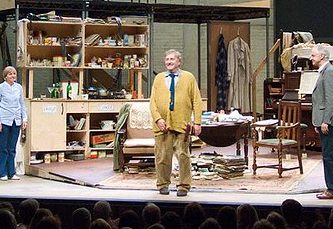
The poet drinks, he stinks, he pees in sinks. The audience, superior as shrinks, Appraise a life amusingly in tatters.
How they appreciate a play that flatters Their minds with chat about artistic matters! And how much more they savour nods and winks And saucy homosexual high-jinks!
They go home thinking: ‘Poets? Mad as hatters! They drink, you know! They stink! They pee in sinks!’
*****
George Simmers writes: “Alan Bennett’s 2009 play The Habit of Art deals with the later life of W.H. Auden, and deals frankly with Auden’s sexual and hygenic peculiarities, as well as giving a sense of the poet’s talent. Looking back on his poem, written soon after seeing a performance at the National Theatre, I was more annoyed by the sniggering audience of London sophisticates than by Bennett’s play, which has interesting things to say about the relationship between poetry and the fallible humans who create it.”
George Simmers used to be a teacher; now he spends much of his time researching literature written during and after the First World War. He has edited Snakeskin since 1995. It is probably the oldest-established poetry zine on the Internet. His work appears in several Potcake Chapbooks, and his recent diverse collection is ‘Old and Bookish’.
We are the natterers, We are the masters of arts polyglot; We are the patterners, We are the marks on the paths that you plot; We are the batterers, We are the iron-headed rams that you fear; We are the chatterers, We are the sons of the sins that you bear; We are the flatterers, Down on our knees to those who stand tall; We are the smatterers, Giving out dangerous knowledge and small; We are the shatterers, We are the haters of forces above; But, most, we are the clatterers, We are the hooves of the horses we love.
This was first published (I think) in Rubies in the Darkness (UK) and then in Metverse Muse (India). As for the word “clatter”, when I wrote the poem it only referred to sound, the verb “making a continuous rattling sound as of hard objects falling or striking each other.” The word is evolving though, as words do, with the meaning in football of a hard physical tackle that knocks your opponent over. I only meant the noise, of course…
T.S. Eliot, Virginia Woolf and the unfortunate Vivienne Eliot
“T. S. Eliot and Virginia Woolf were almost exact contemporaries, readers and critics of each others’ work, and friends for over twenty years. Their writings, though, are rarely paired.” So says the Amazon entry on Modernism, Memory, and Desire by Gabrielle Mcintire, which “proposes that some striking correspondences exist in Eliot and Woolf’s poetic, fictional, critical, and autobiographical texts, particularly in their recurring turn to the language of desire, sensuality, and the body to render memory’s processes.”
An article in the New Yorker from some years ago paints a different picture of Eliot: “he held all the English writers in contempt. It was a cool and disinterested contempt; it came from arrogance, not from pettiness or insecurity, and he gave just enough of a hint of it to make people nervous. The only contemporary writers he considered his peers were Pound and Lewis (though he knew their limitations extremely well). The only one he looked up to was Joyce.”
Virginia Woolf is only mentioned later in passing in the article, with a quote from her diary wishing “poor dear Tom had more spunk in him, less need to let drop by drop of his agonized perplexities fall ever so finely through pure cambric. One waits; one sympathizes, but it is dreary work.”
As for Eliot’s first wife, Vivienne, Virginia Woolf wrote in her diary: “Oh – Vivienne! Was there ever such a torture since life began! – to bear her on one’s shoulders, biting, wriggling, raving, scratching, unwholesome, powdered, insane, yet sane to the point of insanity, reading his letters, thrusting herself on us, coming in wavering trembling … This bag of ferrets is what Tom [Eliot] wears round his neck.”
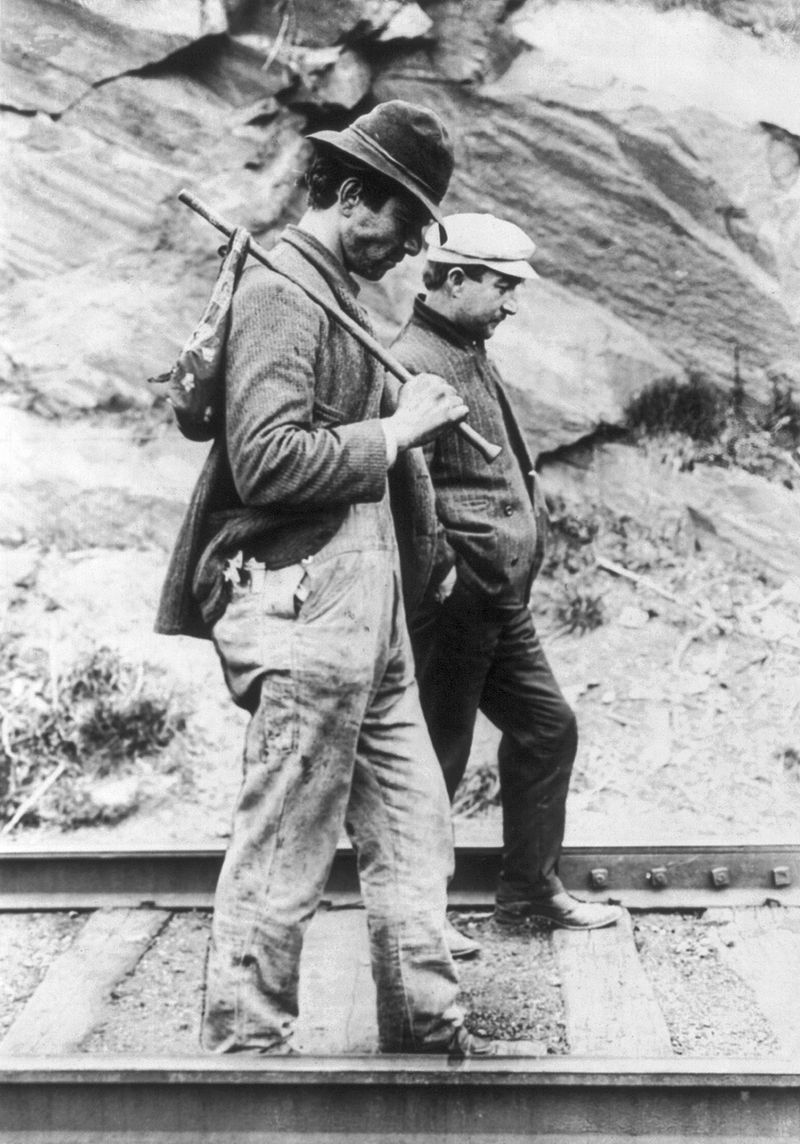
Hobos, US Library of Congress. Unknown date. Likely 1880s – 1930s
W.H. Davies was a poet whose best-known piece begins
What is this life if, full of care,
We have no time to stand and stare.
Born in Newport, Wales, in 1871, he was raised by his grandparents. As a boy he fought a lot, and at 13 was the leader of gang, was arrested for stealing handbags, and got twelve strokes of the birch. He read enthusiastically, disliked being apprenticed to a maker of picture frames, and at 21 took passage to America. His years of wandering provide a fascinating view of the US over 100 years ago, with chapters on jails, thieves, cattlemen, race issues in the Mississippi area, and so on. He worked his way back and forth over the Atlantic, lost a leg hopping a train in Canada and thereafter limited himself to England where he began writing his poetry and memoirs in doss houses in between bouts of tramping and begging. Eventually he was noticed, published for his poetry first and then for his autobiography–with a preface by George Bernard Shaw–and became famous.
His autobiography is frank, amusing, informative, insightful and naive all at the same time. A unique book, and a good accompaniment to his poetry (the link is to an 11-slide deck) which is also insightful and naive and oriented to observing life outside, whether in city or countryside. This is from “The Sleepers”:
As I walked down the waterside
This silent morning, wet and dark;
Before the cocks in farmyards crowed,
Before the dogs began to bark;
Before the hour of five was struck
By old Westminster’s mighty clock:
As I walked down the waterside
This morning, in the cold damp air,
I saw a hundred women and men
Huddled in rags and sleeping there:
These people have no work, thought I,
And long before their time they die.