Tag Archives: politicians

Odd poem: Xi Jinping, ‘In Memory of Jiao Yulu’

Ten thousand miles away your soul has flown;
the rivers, mountains and land yearn for your return.
The people mourn the loss of a caring official,
tears flooding under the empress trees you planted.
Having dedicated your life to the desert,
to the betterment of people’s lives, your legacy lives on
no matter how many years come and go.

The moon shining bright as always,
I think of you and your life’s work.
You toiled long and hard, claiming no credit.
Serving and benefiting the people:
such was your ambition and is also mine.
Many a trickle will add a touch of green to the desert
and create a wellspring of hope.”

*****

Xi Jinping, born in 1953, has been the general secretary of the Chinese Communist Party and chairman of the Central Military Commission, and thus the paramount leader of China, since 2012. Since 2013, Xi has also served as the president of China.

Jiao Yulu was a Chinese politician, highly respected for his hard work even as he was dying of liver cancer in his early 40s.

From the Chinese Embassy in the US:
Xi Jinping has always held Jiao Yulu in high esteem and regarded him as a role model. At the time of writing this poem, Xi was the Party Secretary of Fuzhou. One night in July 1990, he read an article entitled “People Yearn for the Return of Jiao Yulu.” The poem was inspired as literary thoughts surrounding the deceased upright man welled up in Xi’s heart. When he inspected Lankao in 2014, Xi recalled emotionally how he learned from the example of Jiao Yulu more than 40 years ago. “On February 7, 1966, the People’s Daily carried a long article by Comrade Mu Qing and others entitled ‘Jiao Yulu: A Model County Party Secretary.’ Back then, I was a grade one student in junior high school. The teacher of political education choked with sobs while reading the article to us. I was deeply moved when I heard Comrade Jiao Yulu kept on working even in the late stage of liver cancer, pressing a stick against his liver to relieve the pain. The pressure from the stick wore a hole into the right side of his rattan chair over time.”

Jiao Yulu is no stranger to the Chinese people. After being appointed Party Secretary of Lankao County, he mobilized the local residents in a great struggle to tackle water-logging, sandstorm, and alkaline soil. Leading by example, he was always at the frontline at the height of sandstorms and in torrential rainfalls to identify the wind corridor, forecast quicksand and gauge flood waters. Amid blinding blizzards, he visited poor families to deliver food and financial relief to their homes. He was devoted entirely to all the people of his county but himself. Despite severe illness, he carried on work till the last moment of his life, and is revered as the “model county Party secretary.”
Odd poem: Barack Obama, ‘Pop’

Sitting in his seat, a seat broad and broken
In, sprinkled with ashes,
Pop switches channels, takes another
Shot of Seagrams, neat, and asks
What to do with me, a green young man
Who fails to consider the
Flim and flam of the world, since
Things have been easy for me;
I stare hard at his face, a stare
That deflects off his brow;
I’m sure he’s unaware of his
Dark, watery eyes, that
Glance in different directions,
And his slow, unwelcome twitches,
Fail to pass.
I listen, nod,
Listen, open, till I cling to his pale,
Beige T-shirt, yelling,
Yelling in his ears, that hang
With heavy lobes, but he’s still telling
His joke, so I ask why
He’s so unhappy, to which he replies…
But I don’t care anymore, cause
He took too damn long, and from
Under my seat, I pull out the
Mirror I’ve been saving; I’m laughing,
Laughing loud, the blood rushing from his face
To mine, as he grows small,
A spot in my brain, something
That may be squeezed out, like a
Watermelon seed between
Two fingers.
Pop takes another shot, neat,
Points out the same amber
Stain on his shorts that I’ve got on mine, and
Makes me smell his smell, coming
From me; he switches channels, recites an old poem
He wrote before his mother died,
Stands, shouts, and asks
For a hug, as I shrink, my
Arms barely reaching around
His thick, oily neck, and his broad back; ‘cause
I see my face, framed within
Pop’s black-framed glasses
And know he’s laughing too.

*****

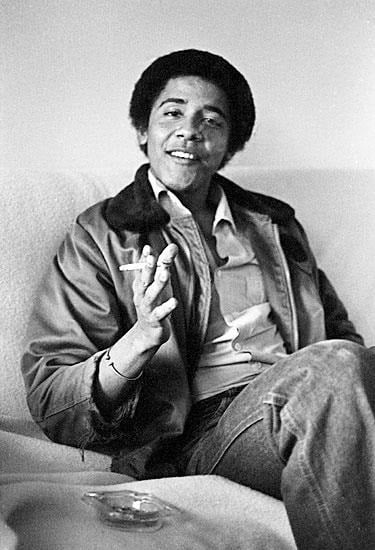
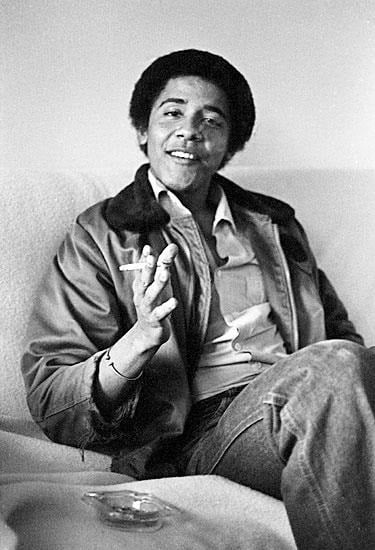
1981 poem by future President of the United States Barack Obama, published in the journal Feast.

Featuring it in 2007 (alongside another Obama poem, “Underground”), The New Yorker noted that it “appears to be a loving if slightly jaded portrait of Obama’s maternal grandfather, with whom he spent a large part of his childhood.”

Political poem: Matthew King, ‘Incendiary Song’

Baby you’re the Reichstag
I’m setting you on fire
You no longer represent me
I’m immediate desire
Our constitution is suspended
on a fence of barbed wire
Baby you’re the Reichstag
I’m setting you on fire

I’ve cancelled your election
I’ve exposed your fatal flaw
Trapped in your reflection
we argued to a draw
The people want perfection
they love to be in awe
Baby you’re the Reichstag
my will is the law

Our union needs annulment
our wedding was a sham
The preacher stole the word of God
now he’s on the lam
He said he’d bless the devil
he didn’t give a damn
Baby you’re the Reichstag
who do you think I am

Like lightning this befell me
not you but I self-crowned
No court can now compel me
my power is unbound
I dare you try to tell me
my methods are unsound
Baby you’re the Reichstag
I’ll burn you to the ground

I’m rounding up your lovers
each one of them a liar
They tell me they don’t know you
say it’s me they most admire
Now I alone can save them
or throw them on the pyre
Baby you’re the Reichstag
I’m setting you on fire

*****

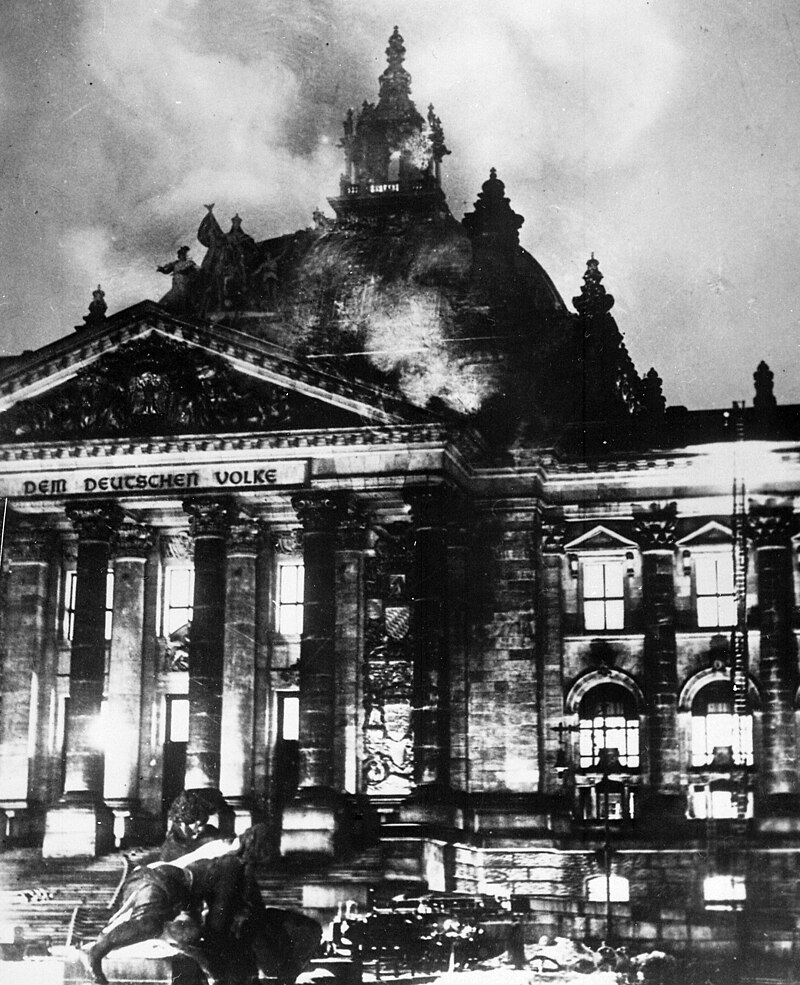
Matthew King writes: “Many, not on only one side of the political divide, have been watching for a “Reichstag Fire moment.” The thing about historical echoes is you’re never sure what you’re hearing is exactly what it sounds like, but with some things sounding like them at all is bad enough. A hat tip to Leonard Cohen, whose shade I seem to be channelling in this poem, and who would have turned 91 on Sept. 21. Leonard! thou shouldst be living at this hour; lucky for you you’re not, I guess.”

‘Incendiary Song’ was first published in New Verse News.

Matthew King used to teach philosophy at York University in Toronto; he now lives in what Al Purdy called “the country north of Belleville,” where he tries to grow things, counts birds, takes pictures of flowers with bugs on them, and walks a rope bridge between the neighboring mountaintops of philosophy and poetry. His photos and links to his poems can be found at birdsandbeesandblooms.com.

Photo: Reichstag Fire, 27 February 1933, public domain.

Odd, political poem: Emperor Qianlong, ‘My Feelings After the Ambassador of the Red-Haired English King, Macartney, Came to Pay Tribute and Give Offerings to Me’

Formerly Portugal presented tribute, now England is paying homage.
They have traveled further than Shu Hai and Heng-zhang;
My ancestors’ virtue must have reached their distant lands.
Though their tribute is nothing special, my heart approves sincerely.
Curios and their ingenious devices I do not prize.
Though what they bring is meager,
in my kindness to men from far away I make generous recompense –
Wanting to preserve my good health and power.”

*****

Original Poem:

《红毛英吉利国王差使臣马嘎尔尼奉表贡至,诗以志事》

  博都雅昔修职贡,英吉利今效荩诚。

  竖亥1横章输近步,祖功宗德逮远瀛。

  视如常却心嘉焉,不贵异听物翊2精。

  怀远薄来而厚往,衷深保泰以持盈。

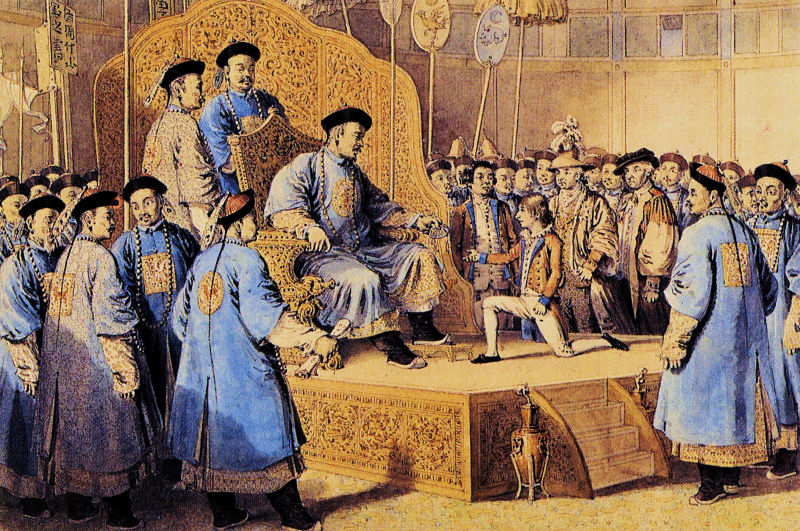
This poem was written by the Qianlong Emperor (25 September 1711 – 7 February 1799; also known by his temple name Emperor Gaozong of Qing, personal name Hongli) after his meeting with the British ambassador Lord Macartney at the Emperor’s grand tent in his Summer resort at Jehol (Chengde) on September 14th, 1793. The embassy was then sent back to Beijing, the Emperor followed and saw the previously prepared British gifts on September 30th. The gifts and embassy did not impress and so they were ordered home on the following day. The whole two-year expedition is detailed here.

Lord Macartney was not impressed either, and wrote: “The Empire of China is an old, crazy, first rate man-of-war, which a fortunate succession of able and vigilant officers have contrived to keep afloat for these 150 years past, and to overawe their neighbors merely by its bulk and appearance, but whenever an insufficient man happens to have the command upon deck, adieu to the discipline and safety of the ship. She may perhaps not sink outright; she may drift some time as a wreck, and will then be dashed to pieces on the shore; but she can never be rebuilt on the old bottom.”

Illustration: William Alexander’s drawing of the reception of the Macartney embassy to China. Young Thomas Staunton (kneeling not kowtowing) receives a gift from the Emperor. Image by William Alexander available under a Creative Commons License

Odd, political, semi-formal verse: Aung San Suu Kyi, ‘In The Quiet Land’

In the Quiet Land, no one can tell
if there’s someone who’s listening
for secrets they can sell.
The informers are paid in the blood of the land
and no one dares speak what the tyrants won’t stand.
In the quiet land of Burma,
no one laughs and no one thinks out loud.
In the quiet land of Burma,
you can hear it in the silence of the crowd

In the Quiet Land, no one can say
when the soldiers are coming
to carry them away.
The Chinese want a road; the French want the oil;
the Thais take the timber; and SLORC takes the spoils…

In the Quiet Land….
In the Quiet Land, no one can hear
what is silenced by murder
and covered up with fear.
But, despite what is forced, freedom’s a sound
that liars can’t fake and no shouting can drown.

Free bird toward to a free Burma

My home…
where I was born and raised
used to be warm and lovely
now filled with darkness and horror.

My family…
whom I had grown with
used to be cheerful and lively
now living with fear and terror.

My friends…
whom I shared my life with
used to be pure and merry
now living with wounded heart.

A free bird…
which is just freed
used to be caged
now flying with an olive branch
for the place it loves.

A free bird toward a Free Burma.

Why do I have to fight???

They killed my father a year ago,
And they burnt my hut after that
I asked the city men “why me?” they ignored
“I don’t know, mind your business,” the men said.
One day from elementary school I came home,
Saw my sister was lifeless, lying in blood.
I looked around to ask what happened, if somebody’d known,
Found no one but living room as a flood.
Running away by myself on the village road,
Not knowing where to go but heading for my teacher
Realizing she’s the only one who could help to clear my throat,
But this time she gave up, telling me strange things in fear.
Why, teacher, why.. why.. why?
I have no dad nor a sister left.
To teach me and to care for me you said, was that a lie?
This time with tearful eyes she, again, said…
“Be a grown one, young man,
Can’t you see we all are dying?
And stop this with your might as soon as you can,
For we all are suffering.”

*****

Aung San Suu Kyi is the daughter of Aung San, who negotiated Burma’s independence from the UK in 1947 (but was assassinated the same year). Aung San Suu Kyi was the leader of the National League for Democracy when it won 81% of parliamentary seats in the 1990 General Election, causing the ruling military junta to nullify the elections and put her under house arrest for most of the next 21 years.

She was awarded the Nobel Peace Prize in 1991; but claims she chose non-violence as an expedient political tactic, stating in 2007, “I do not hold to nonviolence for moral reasons, but for political and practical reasons.” Several of her international honours have been withdrawn in response to her perceived failings regarding ethnic minorities in Myanmar; she remains politically active and under attack in the courts.

I don’t know enough about her and her situation to have an opinion about her, other than “it’s complicated”.

Odd poem: Barack Obama, ‘Underground’

Under water grottos, caverns
Filled with apes
That eat figs.
Stepping on the figs
That the apes
Eat, they crunch.
The apes howl, bare
Their fangs, dance,
Tumble in the
Rushing water,
Musty, wet pelts
Glistening in the blue.

*****

A 1981 poem by future President of the United States Barack Obama, originally published in the journal Feast and featured in The New Yorker in 2007. You can forgive a 19- or 20-year-old for a lot of what they wrote… and after all, it’s better than anything we’ve seen from Donald Trump.

Marcus Bales, ‘A Rainy Day in Cleveland’

A rainy day in Cleveland. I almost said
“The skies are gray.” Of course the skies are gray,
It’s raining, so — what could they be instead?
I meant to mow the rest of the lawn today,
But it’s a day to watch the garden grow.
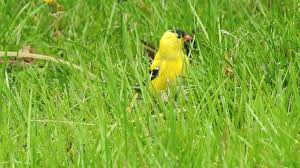
The finches, flashing in the too-long grass,
Are pecking dandelion seeds, and glow
Their special yellow through rain-dotted glass.
The internet is off. I sit and watch
The irises and roses in the rain,
And do not read about the ugly botch
The greedy criminals in charge sustain
So they can strut around, so white, so male,
And cheat and lie to keep themselves from jail.

*****

Marcus Bales writes: “The rap against democracy has until now always been that the public, once it realized they could simply vote themselves money and benefits, would bankrupt the state voting themselves benefits and money. For 250 years the US public managed not to do that, though the reactionaries always accused them of it. It turns out the real danger is that if you have enough money you can just buy the government and operate it as a racket to benefit yourself and your cronies, even when there are laws in place that you have to break in order to do so. The problem with democracy, it turns out, is not that people are irresponsible but that the wealthy are liars and thieves.”

Not much is known about Marcus Bales except that he lives and works in Cleveland, Ohio, and that his work has not been published in Poetry or The New Yorker. However his ’51 Poems’ is available from Amazon. He has been published in several of the Potcake Chapbooks – Form in Formless Times.

Photo: Danny redd Photography https://www.facebook.com/watch/?v=1605166609548538

Weekend read: Odd poem: Joseph Stalin, ‘The Outcast’

He knocked on strangers’ doors,
Going from house to house,
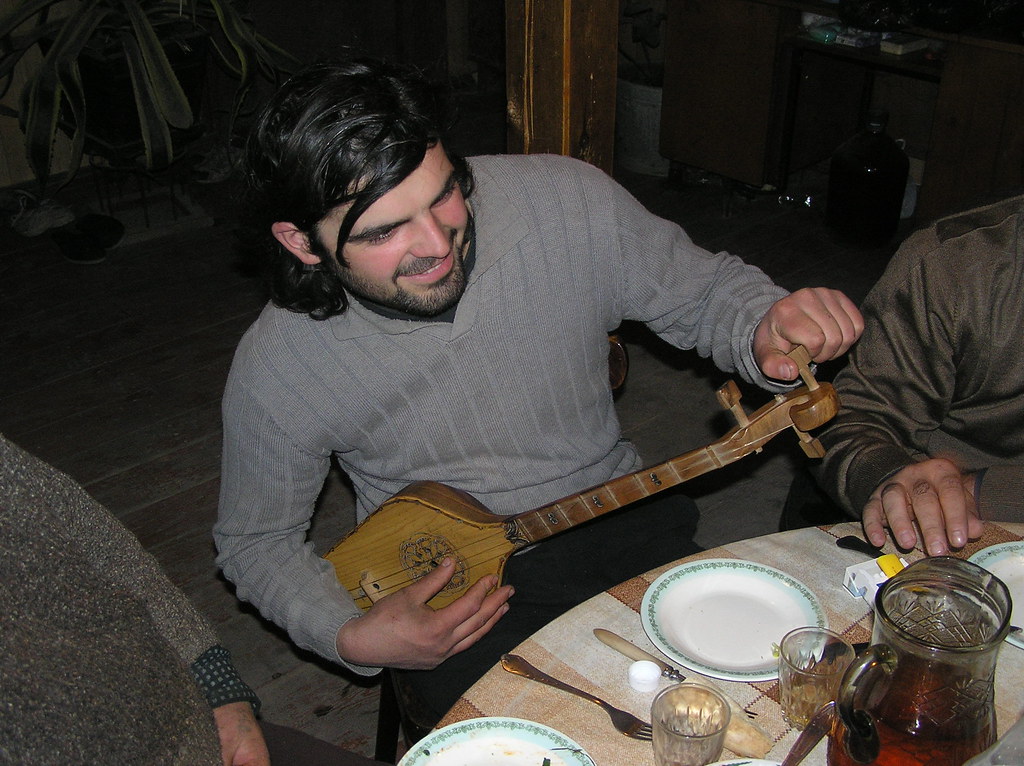
With an old oaken panduri
And that simple song of his.

But in his song, his song—
Pure as the sun’s own gleam—
Resounded a truth profound,
Resounded a lofty dream.

Hearts that had turned to stone
Were made to beat once more;
In many, he’d rouse a mind
That slumbered in deepest murk.

But instead of the laurels he’d earned,
The people of his land
Fed the outcast poison,
Placing a cup in his hand.

They told him: “Damned one, you must
Drink it, drain the cup dry…
Your song is foreign to us,
We prefer to live in a lie!”

*****

Ioseb Besarionis dze Jughashvili was a Georgian romantic poet who led a million-dollar heist that killed 40 people and funded the Bolshevik revolution. We know him as Joseph Stalin. His story is fascinating… and he is the model for the anti-hero Cassian Andor (Diego Luna) in the Star Wars spin-off TV series Andor.

The BBC has an excellent background article on him and the Andor connection: https://www.bbc.com/culture/article/20250417-how-a-young-joseph-stalin-inspired-star-wars-series-andor:
Yes, the troubled outlaw beloved by Star Wars fans everywhere is based in part on one of history’s most notorious mass murderers, as the series’ creator, Tony Gilroy, has acknowledged. “If you look at a picture of young Stalin, isn’t he glamorous,” Gilroy said in an interview in Rolling Stone in 2022. “He looks like Diego!”

The above poem and two others, all translated by David Shook, can be found here: https://molossusexperiment.tumblr.com/fall1/stalin. The link also contains Shook’s observations on Stalin’s qualities as a poet, and on his persecution of poets like Osip Mandelstam for the Stalin Epigram:
... the ten thick worms his fingers,
his words like measures of weight,

the huge laughing cockroaches on his top lip,
the glitter of his boot-rims.

Ringed with a scum of chicken-necked bosses
he toys with the tributes of half-men.
..

Not having found a title for Stalin’s poem, in this blog post I titled it ‘The Outcast’, though I considered ‘Panduri’.

Photo: “David and Panduri” by sarah&patrick is licensed under CC BY-NC-SA 2.0.

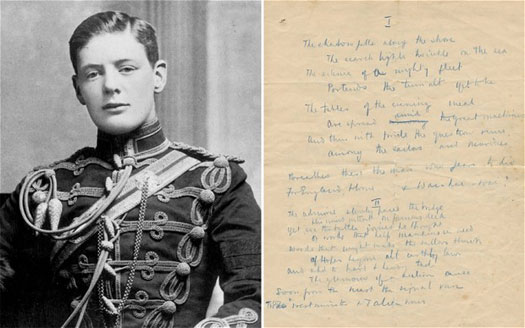
Weekend read: Odd poem: Winston Churchill, ‘Our Modern Watchwords’

I
The shadow falls along the shore
The search lights twinkle on the sea
The silence of a mighty fleet
Portends the tumult yet to be.
The tables of the evening meal
Are spread amid the great machines
And thus with pride the question runs
Among the sailors and marines
Breathes there the man who fears to die
For England, Home, & Wai-hai-wai.

II
The Admiral slowly paced the bridge
His mind intent on famous deed
Yet ere the battle joined he thought
Of words that help mankind in need
Words that might make sailors think
Of Hopes beyond all earthly laws
And add to hard and heavy toil
The glamour of a victorious cause.

*****

Around 115 years after it was written, the only known poem written by Winston Churchill as an adult was discovered by Roy Davids, a retired manuscript dealer from Great Haseley in Oxfordshire: ‘Our Modern Watchwords’, which was apparently inspired by Tennyson and Kipling.
Written between 1898 and 1900 when Churchill was a cornet (equivalent to today’s second lieutenant) in the 4th Hussars, the 10-verse poem is a tribute to the Empire. The author peppers the poem with the names of remote outposts defending Britain’s interests around the world, many of which he would have visited as a young officer and even fought at, including Weihaiwei in China, Karochaw in Japan and Sokoto in north-west Nigeria. Written in regular iambic tetrameter but with irregular rhymes, the poem exists in a tradition that stretches back to Homer’s Iliad: the soldier waiting impatiently for the battle to begin. As Churchill writes: ‘The silence of a mighty fleet / Portends the tumult yet to be.’
Davids, who says the poem “is by far the most exciting Churchill discovery I have seen”, admits it is merely “passable”.
Andrew Motion, the former Poet Laureate, goes further, calling it “heavy-footed”. “I didn’t know he wrote poems, though somehow I’m not surprised: oils, walls, why not poems as well?” said Motion. “This is pretty much what one would expect: reliable, heavy-footed rhythm; stirring, old-fashioned sentiments. Except for the lines ‘The tables of the evening meal/Are spread amid the great machines’, where the shadow of Auden passes over the page, and makes everything briefly more surprising.”
Despite its lack of literary virtues, however, the poem written in blue crayon on two sheets of 4th Hussars-headed notepaper was expected to raise between £12,000 to £15,000 when it went on sale in 2013. Its price reflected its rarity: the only other poem known to be penned by Churchill is the 12-verse ‘The Influenza’, which won a House Prize in a competition at Harrow school in 1890 when he was 15. However ‘Our Modern Watchwords’ failed to sell at the auction as bidding never reached the reserve price.
Churchill was well-known for his love of poetry. He won the Headmaster’s Prize at Harrow for reciting from memory Macaulay’s 589-line poem ‘Horatius at the Bridge‘.
Allan Packwood, director of the Churchill Archive Centre at Churchill College, Cambridge, said the wartime prime minister’s interest in poetry spanned the sophisticated to the more earthy: “In his speech accepting freedom of the city of Edinburgh in 1942, he quoted Robert Burns and ended by quoting the music hall entertainer Sir Harry Lauder, who was in the audience. This was no cheap politician’s trick, Churchill was an admirer of Lauder’s.”
By the way, Churchill was well-known for his oratory and repartee, but he wasn’t always the victor. My favourite story involves Richard Haldane in the 1920s. Churchill prodded Haldane’s ample belly and asked “What’s in there?” Haldane answered: “If it is a boy, I shall call him John. If it is a girl, I shall call her Mary. But if it is only wind, I shall call it Winston.”

Photos: https://winstonchurchill.org/publications/churchill-bulletin/bulletin-056-feb-2013/appreciation-the-young-churchill-poem-hints-at-the-rhetorical-greatness-to-come/

Weekend read: Odd poem: Benjamin Disraeli, ‘To A Beautiful Mute (The Eldest Child of Mr. Fairlie)’

Tell me the star from which she fell,
Oh! name the flower
From out whose wild and perfumed bell
At witching hour,
Sprang forth this fair and fairy maiden
Like a bee with honey laden.

They say that those sweet lips of thine
Breathe not to speak:
Thy very ears that seem so fine
No sound can seek,
And yet thy face beams with emotion,
Restless as the waves of the ocean.

‘Tis well. Thy face and form agree,
And both are fair.
I would not that this child should be
As others are:
I love to mark her indecision,
Smiling with seraphic vision

At our poor gifts of vulgar sense
That cannot stain
Nor mar her mystic innocence,
Nor cloud her brain
With all the dreams of worldly folly,
And its creature melancholy.

To thee I dedicate these lines,
Yet read them not.
Cursed be the art e’er refines
Thy natural lot:
Read the bright stars and read the flowers,
And hold converse with the bowers.

*****

This poem for a mute girl and another (‘To a Maiden Sleeping After her First Ball’) can be found in All Poetry; they each have an accurate but uninspiring AI-driven analysis after them; the subsequent comments are more engaging:
WolfSpirit – “keep writing, Benjamin. you may just be a known poet someday. 
Linda Marshall – “I know Disraeli as a novelist and (of course) as a politician.
This is the first poem of his I’ve ever read!
It has its moments and of course tastes were different in those days but there are rhythmical infelicities and some rhymes that verge on the comic.
I can see why he’s known for his prose rather than his poetry!”

Benjamin Disraeli was born into a Jewish family in 1804; his father quarrelled with the synagogue and renounced Judaism, and had all the children baptised into the Church of England when Disraeli was 12. After school, Disraeli was articled to a law firm at age 16, and his career went from there to stock market speculation, financial ruin, novel writing, and then politics. He was twice Prime Minister of the United Kindom, and was appointed Earl of Beaconsfield by Queen Victoria in 1876. He died in 1881, unmourned as a poet.

Photo: Earl of Beaconsfield, K.G. Photographed at Osborne by Command of H.M. The Queen, July 22, 1878. This file was derived from: Benjamin Disraeli CDV by Cornelius Jabez Hughes, 1878.jpg