Tag Archives: Robin Helweg-Larsen

Short poem: ‘Golden Childhood’

Golden girl on a sunset beach
With a dog and a horse,
Golden boy spears a silver shark
Under the sea;

Is such a dream forever in reach
Or forever false?
We stumble, emotional, through the warm dark
Back to the sea.

I wrote this in my 20s when I was saying goodbye to the Bahamas – my father had died, my mother had sold the house and moved back to Europe. For the next few decades I lived in Denmark, Canada, the US… but eventually came back to the sea.

The poem was originally published in Candelabrum. I always had difficulty with that seventh line. Originally it had “emotionally”, and I sort of justified it with the line itself being a stumble… but it’s a bad line, too many syllables, too many consonants. Sometimes when I submit a poem to a magazine, the editor points out a flaw, and more rarely, offers a useful alternative. Poems can always be tinkered with.

Photo cropped from “Girl riding a horse at sunset on Bali” by Jimmy McIntyre – Editor HDR One Magazine is licensed under CC BY-SA 2.0

Poem: ‘Here Come the Old Gods’

Here come the old gods,
laughing in their sleeves
At all the foolishness
humankind believes.
Vishnu and Odin say
Prayers are in vain.
Loki and Shiva say
All goes down the drain.
Jesus and Buddha say
All will rise again.
Dig into the molecule,
the atom you disclose–
Search into the atom and
its particles expose–
Then to string and quantum,
to things that no one knows,
But downward still and downward
the endless staircase goes.
What yet smaller pieces
make up the smallest part?
What is outside everything?
What’s before the start?
The answer’s in the searching
through human gods and sin,
The answer’s in the clicking
of the wheel’s endless spin,
The answer’s in the angels
dancing on a pin,
The answer is the journey
you begin, begin, begin.

This poem was published this month in Snakeskin. It is rhythmic without being precise in its metre: this, together with the rhymes, means it is easy to chant (if you like chanting poetry). Philosophically it is a good expression of my personal beliefs (or lack thereof). I’m a Militant Agnostic: “I don’t know, and neither do you.” Which creates a lot of space for us all to enjoy life.

Photo: “universe” by tolworthy is licensed under CC BY 2.0

Poem: ‘Nymph’

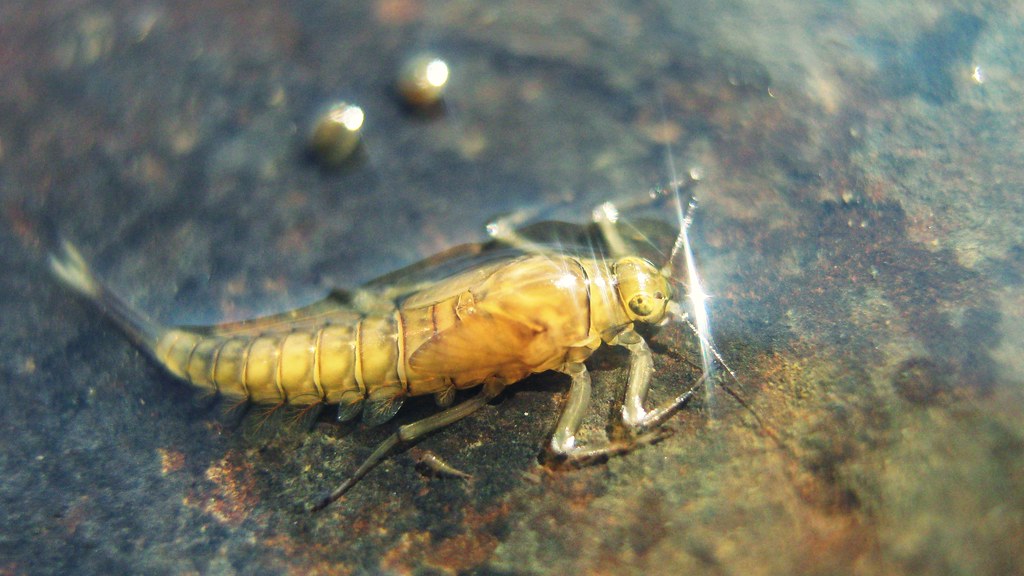
A mayfly nymph, in water for a year,
transforms into a beauty of the air
for just one day – one day to mate, breed, die.
The essence then’s the nymph, and not the fly
which we see only thronging in death throes,
death throes of riotous sex. Everyone knows,
though, that the fly’s the cycle’s pinnacle
to artists, if not to the clinical.
Though humans for long eons lived on land,
at Science’s Nietzschean precipice we stand,
transform to things that freely live in space,
or formless Cloud-based online lives embrace…
and may survive but briefly in that state,
but, dying, will seed new worlds as we mate.

Nature poem? Piece of science fiction? The observation of how nature works and a hypothetical extrapolation of human nature into the future are not really two different things – it’s all part of life, the universe and everything… though that future will be is anyone’s guess. The only thing for sure is that tomorrow is not going to be like today.

Is a 14-line poem in iambic pentameter a sonnet, if it just rhymes as couplets? I think not. This poem has a volta after the eighth line, but it still doesn’t feel like a sonnet to me. The feel comes from a couplet closing the poem out after a series of three quatrains, or from the shift from ABBAABBA to CDCDCD. That finalising shift, that sense of completion, is integral to the feel of the sonnet. This poem fails to meet that criterion.

‘Nymph’ was first published in the Orchards Poetry Journal, whose latest issue has just come out – free online, or available in print.

Photo: “mayfly” by ian boyd is licensed under CC BY-NC 2.0

Poem: ‘Ex-Rover’

I was a rover, footloose treasure-trover,
Bahamian, Brit, Dane, Aussie, Canadian,
Easily settling, never for very long,
Followed the sun and the moon with a song.

Now roving is over, Death’s raving and raging,
The threatening madman, waving a knife.
Even my babies have babies, are ageing –
Aren’t there any more decades left in my life?

I was a rover – no grass
Grew under my feet as I’d pass.
Now grass grows and I cut it.
And it grows, and I cut it.
I was wired, now I’m tired;
Fired up, now I’m mired.
And the grass grows again… I give up.

Let me sleep in the sun, and sleep slow.
Let me sleep deep.
When was that rover me?
Let the grass grow.
Let the moon be the stone over me.

This poem has just been published in The Orchards Poetry Journal, where it immediately follows the poem I posted here a couple of days ago, ‘Roughing It In Europe‘. It makes a nice, somewhat sardonic, pairing. Appropriately, this one was written several years after the more enthusiastic earlier one. (From the Orchards link above you can download the Journal as a pdf for free, or buy the very lovely finished product.)

‘Ex-Rover’ is one of those poems that stretches the meaning of the word “formal”. But it has enough rhythm and rhyme to make it relatively easy to learn word for word, and that is a lot of the point of poetry in any language. I feel barely any shame in putting it into the world in this ragged form. The ragged form suits the mood of the piece, after all.

“wanderer” by Cornelia Kopp is licensed under CC BY 2.0

Nonce Poem: “Roughing It In Europe”

One two three four
Is OK, but you need more:

Un deux trois quat’
If you want a welcome mat

En to tre fire
With the krone getting dearer,

Bir iki uç dirt
Selling off your jeans or shirt

Wahid zoozh teleta arba
In a cafe by the harbour

Üks kaks kolm neli
For some food to fill your belly;

Jeden dwa trzy cztery
Language may be shaky, very,

Uno dos tres cuatro
But they’ll love you if you’re up to

Eins zwei drei vier
Trying freely, laughing freer.

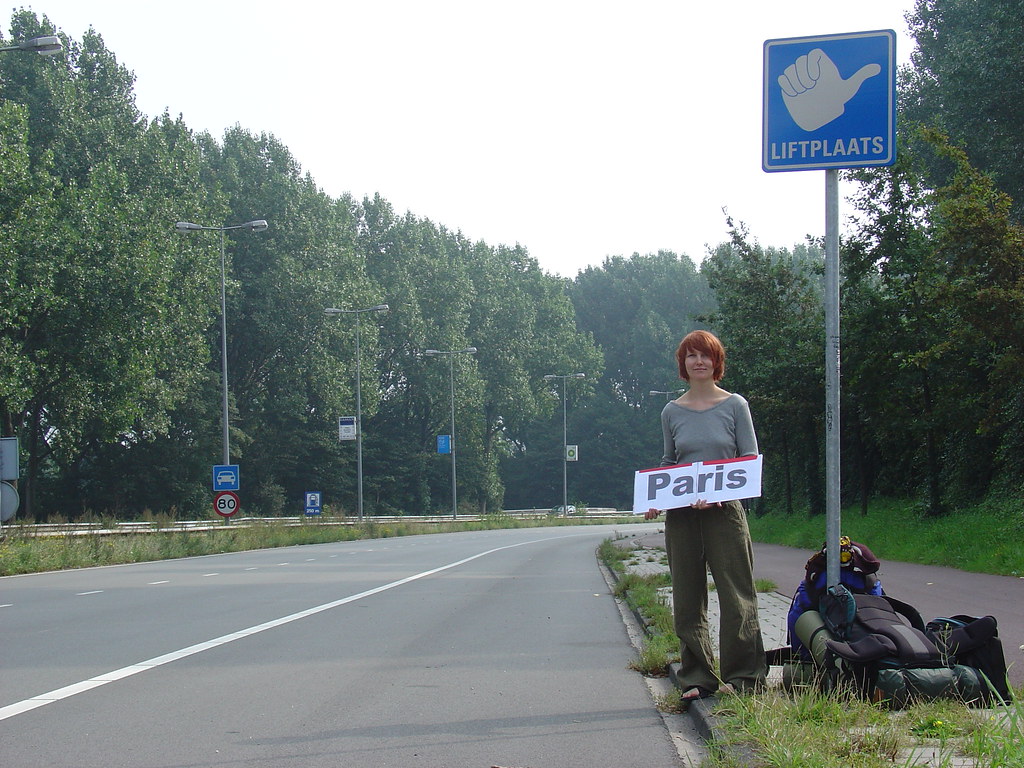
This poem, more fully titled “(On the value of learning languages, when) Roughing It In Europe”, was originally published in Unsplendid, actually a splendid magazine that unfortunately has been quiet for the past couple of years. Now the poem is just being reprinted in The Orchards Poetry Journal whose Summer edition is due out today. The poem dates back to my early hitchhiking days, when I was based in Copenhagen but wandering around Europe, North Africa and North America. My experience was that you could wander into any country without any plans, prior contacts or knowledge of the language, and survive so long as you quickly learned to say Yes, No, Please, Thank you, Hello, Goodbye and to count from one to ten – and so long as you smiled, and were comfortable being laughed at for all kinds of mistakes. Case in point: the word “zoozh” that I learned for “two” in Morocco won’t get you very far in most Arabic-speaking countries… So it goes.

Technically, this poem was written in a simple form, nine rhymed couplets, four feet to a line. The second line of each couplet has mostly trochaic feet (i.e. with two syllables, a stressed or accented one followed by an unstressed one). But the first line of each couplet is simply counting out 1-2-3-4 in different languages, and therefore the feet vary with the words of the language. But as we are used to counting to four in a steady rhythm, everything sounds rhythmic regardless of the number of syllables.

So this shows another type of “form”: each couplet is structured the same with the first line counting 1-2-3-4, always in a new language, and the second line having four feet and rhyming with its first line’s “four”. And therefore the poem has a “nonce” form – I created this form for this specific poem; it was created “for the nonce”. You’d be unlikely to find another poem structured quite like this.

Photo: “Hitchhiking in Amsterdam” by Teppo is licensed under CC BY-NC 2.0

Short Poem: ‘For Eliot’

I guess
Success
Not elation
Or creation
Alone may men not mock;

God bless
T.S.,
Spared the temptation
Of our generation —
Writing rhymes for rock.

First published in Metverse Muse in India. As you might guess, I wrote this before Andrew Lloyd Webber set that “Old Possum” T.S. Eliot‘s rhymes to music for the West End and Broadway hit Cats, disturbing everyone (except the Poetry Foundation)’s understanding of both Eliot and musicals.

Photo: “T.S. Eliot” by duncan is licensed under CC BY-NC 2.0

Short poem: ‘My Life Twists’

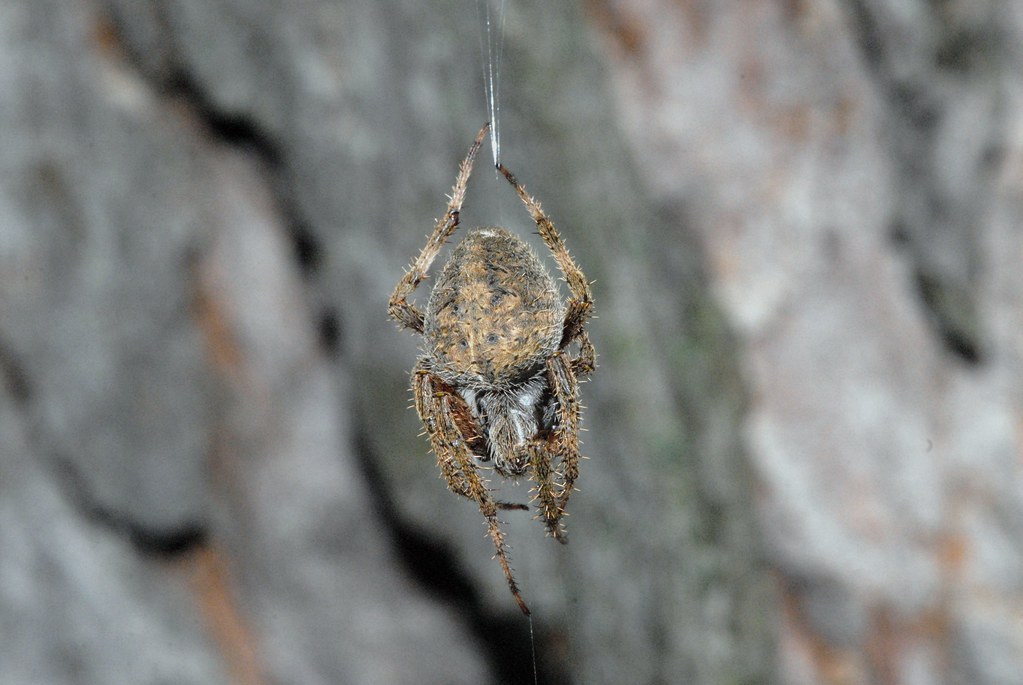
My life twists
Dangling in the mists
A spider in the earliest hint of dawn.
My mind roams
Lost in a thousand homes,
Amnesiac messenger still trying to warn.

Sometimes a poem is just a mood. This is one such. It was first published some years ago in the now defunct Candelabrum. And, yes, it rhymes better in English than in American…

“Unidentified Spider on a Thread DSC_0197” by NDomer73 is licensed under CC BY-NC-ND 2.0

Poem: ‘Dreams’

In the back alleys of our nightly dreams-–
Where cartoon murders repay debts of grudge,
And all’s not graspable nor as it seems,
And logic leers, then sneers and disappears,
And our warped lusts of power, sex and pain
Live stray cat lives, are killed, and live again
To yowl and fight, to scavenge, hunt, give birth-–
We overlay fresh civilized veneers
On age-old dynamos of massive girth.
So the thin skin of life upon the Earth
Cannot restrain the molten mass beneath
(Driving relentless change despite crust’s sheath),
Till, trampled and forgotten in the sludge,
Our empires are mere broken plastic toys.
Dreams run from us like cats from evil boys.

Dreams, the unconscious, one’s Muse… cats, ravens, the Earth… time and timelessness, change and continuty… so many of these ideas return again and again, always the same, always differently organised, a true kaleidoscope. And this isn’t a sonnet–too many lines, no pattern to the rhymes–even if it sort of feels like one; it’s more of a kaleidoscope itself.

This poem was first published in The Lyric. As far as I remember, its editor wanted the removal of the word “on” from the ninth line; they thought this improved the scansion, and the editor is always right so I allowed it. But I’ve put it back now, anyway.

“My cat running away from the camera #cat #iphone #cats” by gargudojr is licensed under CC BY-SA 2.0

Short Poem: ‘Chronosynclastic’

In the chronosynclastic infundibulum
That is God’s fantastic waiting room,
You’re always barely on the score,
One show away from being shown the door.

“God’s waiting room” normally applies to places considered to have a large population of retirees, like Eastbourne in the UK, or Victoria, BC, or the state of Florida. But we are all mortal, and all facing an end at an unknown time. So Kurt Vonnegut’s dark existential humour seems universally applicable. He created the term ‘chrono-synclastic infundibulum’ in ‘The Sirens of Titan’ as a label for a place, or a moment, where all the different kinds of truths fit together, and where there are many different ways to be absolutely right about everything.

Take the concept of ‘God’. Though we can all agree on the meaning and validity of “God’s waiting room”, we may disagree vehemently on the meaning and validity of the word “God”. Can there be a place in which all the understandings of that word are simultaneously correct? Perhaps. We are only tiny-brained creatures in an obscure solar system in an unimportant galaxy, and can hardly presume to know all the answers, any more than any of our stone age ancestors did when they thought they knew everything.

Anyway, my poem (first published in Lighten-Up Online) pays homage to the author of ‘The Sirens of Titan’, ‘Cat’s Cradle’, ‘Slaughterhouse Five’… I put Kurt Vonnegut right up there with Tolstoy in the ranking of People Who Should Have Won A Nobel Prize But Didn’t.

So it goes.

Photo: “The Chronosynclastic Infundibulum – Front Elevation” by Fulla T is licensed under CC BY-NC 2.0

Short Poem: ‘The Logophile Picks a Fight’

By the spots of shame with which your life is spattered,
Your position, sir, is grossly overmattered –
Overmattered, sir, or greatly undermined;
And I cannot help but find
That the lot of humankind
Would be bettered, not embittered, were you battered!

After having kicked around for years, this short piece–which has no purpose other than wordplay–finally got an explanatory title (instead of just the first few words) and was published in this month’s Lighten-Up Online in the section ‘Words, Words, Words’. Thanks, Jerome Betts!

Photo: “Picking a fight for net neutrality #ind12” by Kalexanderson is licensed under CC BY 2.0. Photo has been cropped.